Showing posts with label Newspapers. Show all posts

Wednesday, 25 March 2026

The Washington Post

 Bezos Begging

    At the end of February I cancelled my subscription to WaPo and Bezosbub probably didn't notice.  The remaining people who work at the Post did and for them I feel sorry. Here are the two latest offers I have received via email. For American readers, the CA$2 is about US$1.45.

Early Offer:


Later Offer:


A Solution: 
 
In a Post "Post Mortem" a former employee notes:
"When Jeff Bezos bought The Washington Post in 2013 and promised to find inventive ways to make journalism profitable in the digital age, he seemed like a godsend. He wasn’t...."
   The Post is again in the market for a new publisher, but saving this splendid national treasure requires more than that. The real need now is for a new owner, or a big endowment that would allow it to carry on as a nonprofit public service. Do we know anyone who could spare a billion or two to fund such a noble cause and assure his or her place in American history?"
  
   I do!
While Bezos has been boating, his ex-wife, MacKenzie Scott has been giving. She has been generous with gifts and grants to a variety of institutions, but has only given away $26 billion of her $40 billion fortune. Giving well could be the best revenge if she gave a portion of her wealth to support the paper Bezos abandoned. 
(The quote is from "Post Mortem" by Robert G. Kaiser, NYRB, March 26, 2026.)
(Analogy alert: One definition of "Beelzebub" - "a fallen angel in Milton's Paradise Lost ranking next to Satan".)

Saturday, 28 February 2026

The Washington Post

 Subscription Going Dark
   A few years ago, the Washington Post adopted the slogan "Democracy Dies in Darkness", implying that newspapers were needed to shine light on the things we should know about. I have lamented the loss of so many of them, but I am now cancelling my subscription to the Post. The latest round of staff cuts announced earlier this month, was the deciding factor for me, although many of the good writers and a cartoonist had already left.
   I grew up in Maryland, across the Bay from Washington and went to university just outside the D.C. border. The very thick WaPo picked up very late on a Saturday night could help one through the worst of hangovers and last all day Sunday.
   A few years ago, I started subscribing because of a very good deal and kept subscribing when it wasn't. Apart from the fact that it was an excellent paper, I still enjoyed reading the regional coverage that included the Delmarva Peninsula. Since I submitted my cancellation, I have been asked to reconsider. I decided not to take advantage of a really good deal - $20. Apparently I have two hours left and I don't think the price is going lower. I will miss reading it. I will even miss George Will. 


BEZOSBUB
  Although some were upset when Jeff Bezos bought the Post in 2013, he did have a lot of money and some good intentions. Lately, however, some decisions were made that were questionable and even a cartoon was cancelled. The paper is now not supposed to favour a presidential candidate and the columnists have been encouraged to endorse "personal liberties and free markets", not bad things to endorse, but it is bad to be told to do so.
  The Post is losing money, but money is not the issue for Bezos. As Ruth Marcus, who quit in March, notes: "
When Bezos purchased the Post, his net worth was about twenty-five billion; it is now an estimated two hundred fifty billion. Why not one per cent of that for the Post, enough to sustain the paper indefinitely? A pipe dream, I know, but this arrangement would make Bezos the savior of the Post, not the man who presided over its demise."

 
To put this in nautical terms,  "among the Amazon founder’s more expensive recreations, [ he has a]125.8-metre, three-masted sailing yacht, Koru. (No need to get into the details of Abeona, the seventy-five-million-dollar “shadow boat” that trails Koru and provides a helipad and adequate space for extra staff.)
   "Koru cost an estimated five hundred million dollars. This is double what Bezos paid for the Washington Post. Annual maintenance runs tens of millions of dollars. It is, to be sure, a very special boat. According to Architectural Digest, “Bezos’s superyacht has a classical style, with a navy-blue steel hull and a two-level white aluminum superstructure. The ship’s teak decks include spots for outdoor lounging as well as three Jacuzzis and a swimming pool. Robb Report notes that the hull features traditional portholes, while the upper deck windows are smaller than typical, which might help to foil paparazzi trying to capture guests inside.” If that information about the boat is not galling enough, there is more: the Journal published a story on Friday by Richard Rubin headlined “Trump’s New Tax Law Saved Amazon Billions.” But the Ukraine correspondent had to go."
   Bezos founded Amazon, by the way. Perhaps now he is simply more interested in films than journalism since he reportedly contributed $40 million for "Melania" and spent another $35 million to promote it. 
   Whereas the New York Times purchased a company to cover sports, WaPo just fired everyone. Some were at the Olympics when they learned. Ron Charles who sent a very interesting book newsletter every Friday, was laid off and quickly became "an unemployed journalist with a mortgage". You can now find him on Substack, along with many other fine writers. The entire book section was shut down. Even if you were not a subscriber, you may have read the WaPo reviews that were syndicated.
   Most papers do not review books anymore and the Associated Press stopped doing so last year. The New York Times "Book Review" "is the last discrete newspaper books section standing." 
   There still are magazines that publish book reviews, but "The books section of a newspaper plays an altogether different role. It does not cater to aficionados; it seeks new recruits. 
A newspaper is—or ought to be—the opposite of an algorithm, a bastion of enlightened generalism in an era of hyperspecialization and personalized marketing. It assumes that there is a range of subjects an educated reader ought to know about, whether she knows that she ought to know about them or not."
And Amazon is not the answer:
   "
On Amazon, the glorious inconvenience of browsing shelves or combing through piles has been eliminated. There is no occasion to pick up an unfamiliar book out of sheer curiosity. Every book that the site’s algorithm recommends is similar to one that you have purchased already. In this way, you encounter nothing but iterations of yourself forever. It is a world in which the customer is always right. But if you didn’t want to be proved wrong, if you didn’t want to be altered or antagonized in ways that you could never predict, why would you read at all?"
  To conclude with some CANCON, I will end with the word created by Cory Doctorow and say that this is just one more example of the enshittifcation of everything:
  "We’re all living through the enshittocene, a great enshittening, in which the services that matter to us, that we rely on, are turning into giant piles of shit."

Sources:
"The Death of Book World: What the Closing of the Washington Post’s Books Section Means for Readers," By Becca Rothfeld, The New Yorker, Feb. 10, 2026.
"How Jeff Bezos Brought Down the Washington Post: The Amazon founder bought the paper to save it. Instead, with a mass layoff, he’s forced it into severe decline," Ruth Marcus, The New Yorker, Feb. 4, 2026. (The nautical bit is also from The New Yorker, by David Remnick, Feb.8.)
More about "enshittification" can be learned in MM's, "On Bullshit."
Post Script: I just received another offer to re-subscribe.


Friday, 2 February 2024

Beyond the Palewall (9)

 
 This is another in a series about news items of which you should be aware. For those who prefer a table of contents: 1) The first story is about yet another Canadian apology and we may soon have offered one to every group that has been offended. I don't think the apologies are being done alphabetically, since the last one was to the Italians. For more about that, see my post "Apologizing Again", where you will learn there is even a book about such a subject: A Guilted Age: Apologies for the Past. If you feel traumatized by long ago events or feel guilty about something that happened in the last century, you should have a look. 2) This one is about children now allowed outside in Toronto. I have also dealt with this issue in an insightful piece about "Children and Risk." 3) This one will be useful since you probably don't have a local newspaper to read and 4) A very interesting piece about the shootings occurring outside of theatres in Canada where people supposedly don't have guns. Even more interesting are the comments posted by readers of the articles, who apparently are not thrilled with the current government or sold on the virtues or multiculturalism. 

1) Apology Parity


“B.C. To Apologize For Historical Treatment of Doukhobor Sect,” Mike Hager, Globe and Mail, Jan. 31, 2024.
Back in the middle of the last century about 200 children were seized “ from their parents in southeastern British Columbia and sent to the New Denver residential school by the province after their sect, known as the Sons of Freedom, refused to send them to public school. The tiny group had broken away from Canada’s Doukhobor population, a religious group that settled in the region and Saskatchewan after they were banished from Russia in the late 19th century for their pacifist views, rejection of the Orthodox Church and refusal to participate in the military.”
They will now be getting an apology:
“B.C. Attorney-General Niki Sharma’s office confirmed a public apology to the survivors, who may number about 75, and their families will be made Thursday in Castlegar. A corresponding proposal for financial reparations is expected by the descendants of the Sons of Freedom community.”
B.C. Ombudsperson, Jay Chalke, says the  "government’s apology needs to be “unconditional, clear and public.”
He said he has also communicated to the Attorney-General that the wider community needs to be compensated, as well as the individuals who were sent to the New Denver residential school and their progeny.
“Clearly there has been intergenerational trauma from the events that happened in the 1950s and I don’t think government should be seen to have the amount of compensation they pay reduced through their own delay,” he said in a phone interview.”

2) Children Allowed to Play Again: The Return of PLUCK
 [There will be no image of children playing since it might be too disturbing for some.]

                      Playing Even Sanctioned by The Toronto Star
   “'We Aren't Talking About Sending Them Into Busy Streets or Near Rough Water.' Canadian Paediatric Society Recommends Risky Play for Kids, Toronto Star, Jan. 25, 2024
"Unstructured outdoor play, in particular risky play, is essential for the physical, mental and social development of children, according to new recommendations from the Canadian Paediatric Society."

"We have to reframe how we view risk and understand that risk is a part of life and it's a part of our children's lives," said Dr. Suzanne Beno, a paediatric emergency medicine physician at SickKids, chair of the injury prevention committee of the
CPS, and author of the guidance document released Thursday.”

The new recommendations say children should be kept "as safe as necessary, not as safe as possible," and land on the heels of a tussle in Toronto over whether the city should be closing tobogganing hills that have served neighbourhoods for generations....
The city has closed 45 hills this year, due to concerns about hazards including trees, wading pools, stairs and benches. It maintains a list of toboggan runs it considers safe.
Risky play helps build physical and mental health and resilience among children and youth and can help prevent or manage conditions like obesity, anxiety and behavioural issues, according to the CPS."

                   Playing No Longer Condemned by the CBC
   The Canadian Broadcasting Corporation imprimatur guarantees that a reasonable bit of playing should be allowed while wearing helmets.
   "Pop the Bubble Wrap and let Kids Play Outdoors, Pediatricians Say:
Pediatricians Encourage Parents to Allow Children to Take Risks, Even if it Leads to Minor Cuts, Bruises," Amina Zafar · CBC News · Posted: Jan 25, 2024
"The group said opportunities for risky play fell over recent decades as unscheduled free play outside gave way to planned activities. Now, kids spend more time indoors, often on screens.
The 2022 Participaction report card gave Canadian children a grade of D overall for physical activity and a D– for active play.
"It's the move away from helicopter parenting, from over-parenting, over-scheduling and the recognition that it's probably healthy and good for kids to be kids and to be allowed to experience developmentally and age-appropriate challenges."


3) News Deserts - Oases Shrinking

   Weekly a writer for The Atlantic sends out a newsletter, “Up for Debate.” In a recent one he asked his readers to respond to this question: “What is the state of local journalism where you live, and how does it affect your community?” There were many replies, all lamenting the loss of local reporting. Here is one from close-by Pennsylvania and, with a change of newspaper names, it could probably have come from any province in Canada.

"There are four newspapers covering a county of about 150,000 people. On paper, we’re not a news desert by a long shot. But the reality is we’re a de facto news desert because our newspapers are zombies. Three of the four newspapers are owned by Gannett, which, according to the online staff directories of the Chambersburg Public Opinion, Greencastle Echo Pilot, and Waynesboro Record Herald, employs exactly two journalists across all three newsrooms, which sporadically cover local government. The Echo Pilot lists no staff at all. The fourth newspaper, the Mercersburg Journal, is print-only and owned by a local chain. It covers our borough council and other local events in our tiny town reasonably well, and local officials tend to be extremely aware that what they say and do could end up in the paper the following Wednesday. For me, that’s evidence that traditional dead-tree news remains essential, though I wonder how sustainable it is.”

  This is a very important subject. For more about it see:
For the United States:
Northwestern University: The State of Local News Project.

4) Shoot-Out at the Cineplex Corral


  "
Cineplex Pulls South Indian Film Following Drive-by Shootings at GTA Movie Theatres," Alex Nino Gheciu, The Canadian Press, Jan.30, 2024
TORONTO - Cineplex has cancelled screenings of a South Indian film following four drive-by shootings at theatres throughout the Greater Toronto Area the day it premiered.
       Coming Soon To A Cinema Near You
   "
Cineplex Pulls South Indian film Screenings After Incidents of Threats, Intimidation and Talk of Turf War," Joe Castaldo, Globe and Mail, Jan.31, 2024.
   "Movie exhibitors including Cineplex Inc. CGX-T -1.70% have pulled screenings of a South Indian-language film across Canada after individuals opened fire at four cinemas in the Greater Toronto Area last week, the latest incidents of intimidation related to Tamil, Telugu and Malayalam blockbusters.
   Videos obtained by The Globe and Mail show a person in a hoodie shooting a gun multiple times through the passenger window of a vehicle at the entrances of Cineplex locations in Scarborough and Vaughan. In a separate video, the driver of the vehicle fires at a Cineplex in Brampton. York Cinemas, a theatre in Richmond Hill, Ont., was also hit by gunfire. The shootings shattered glass and left bullet holes in windows. According to York Regional Police, the incidents occurred in the early morning hours, when the theatres were closed….
   Film distributors have contended that a turf war is being waged and that a group of individuals is trying to control the lucrative market for South Indian-language films in Canada, using vandalism and intimidation to pressure theatres and distributors to drop certain titles and ensure the films run in favoured cinemas.
   In recent years, Telugu and Malayalam movies have been affected, too. The Globe has found more than 20 incidents at Cineplex locations, independent theatres and other chains such as Landmark Cinemas across Southern Ontario, Ottawa, Montreal, Calgary, Edmonton and Surrey, B.C.
  In December, noxious substances were sprayed inside three GTA Cineplex theatres, forcing audience members to evacuate.
The illustration above is the poster for the currently contentious film, Malaikottai Vaaliban. As far as I can determine, it is not necessarily the film that is problematic, but rather the issue of who gets to decide which South Asian films should be shown. 

Tuesday, 16 January 2024

Reading Time (A Painful 5 MIN)


The Long and Short of It 

  I have noticed that articles available on the Internet are often accompanied by an estimate of the time it will take to read them. Why are they there? The producers must put them there for a reason. Is it because they know our time is valuable and that we want to be careful about how quickly we spend it? Or is it simply because from the link or the display we often cannot tell how long the article will be. In a print newspaper one can quickly see if the piece is a couple of paragraphs or a complete page.
   Such time notices can be useful. If we are in a hurry we only have a few minutes, but if we are looking for a diversion on a rainy day, the more minutes the better.


Words & Minutes
   Writing is generally measured by words and pages and how long it takes to produce them, not how long it takes to read them. We have all struggled to write that 5,000 word essay which we double spaced to make it look more substantial. The production of one for me, always took a long time and it likely took the professor longer to read than others, especially if it rambled like this one. Reading for grading surely takes longer than normal and a normal reading rate is assumed to be between 250-300 words per minute. The two essays above about Trump, which it takes about 20 minutes to read, probably total around 5,000 words. Too much time has been wasted on Trump.


Reading Time is Not New
   I thought that being told how long it was going to take you to read something was a new thing, like being warned about the content it contained. Such is not the case. A couple of months ago, I did a post about the Canadian version of Liberty, a popular magazine in both the U.S. and Canada (see, "Periodical Ramblings (14)." The American version informed readers of the time it would take to finish an article. This is from the Wikipedia entry for the magazine:

"A memorable feature was the "reading time," provided on the first page of each article so readers could know how long it should take to read an article, such as "No More Glitter: A Searching Tale of Hollywood and a Woman's Heart," Reading Time: 18 minutes, 45 seconds." This was calculated by a member of the editorial staff who would carefully time himself while reading an article at his usual pace; then he would take that time and double it."

From the entry you will learn that someone tested Liberty's calculations and noted that  "Liberty magazine existed in a world without television and the Internet. Time pressures on readers and potential readers change with the times."


"

                              Longform"
  Lately there are also often alerts to let us know if an article is going to be long, either to warn us or to let us know we about to get something special or a lengthy investigative piece. "Long Form" or "Longform" is the new long and it also appears as "Longread" or a "Big Read". The latter is produced by the Financial Times and the former is found in Wired on Sundays and it consists of "Our deepest dives and cutting edge features that will leave you smarter and sharper." The Guardian now has a new "Long Read magazine [which] brings together the very best longform journalism, with immersive stories on everything from world affairs to philosophy, from food to crime." GQ's Long Reads are where they put their "in-depth investigative features and profiles."
   Even our 'local' London Free Press is going long on occasion, although it is short of both local stories and local reporters:
   We have good news for you if you enjoy the pleasure of savouring a weekend newspaper.
I
t's called Long Story. It's a new section in your newspaper, designed to get lost in.
Every Saturday, we'll print in-depth stories you won't find anywhere else. Spread over four pages with great visuals and design, you'll want to settle in and stay awhile.This week's long read is about the Canadian battle to outlaw “normalizing” genital surgeries on babies and children born intersex, meaning with bodies that aren't clearly female or male."
(Joe Ruscitti, LFP, Nov. 11, 2023.)

Exactly how long, long is, is not clear. Let us say that something longform should be over 2000 words and take you over 8 minutes to read. The "culture wars" article above would qualify, but I admit that I skipped it.


Tracking What is Read
   In the old days a newspaper publisher didn't know if you actually read it, or just used it for wrapping fish. Now our screens typically tell us how many are reading the article along with us and how popular it is. At the end of the year, Maclean's  knew which of their longform stories were most read during the year. "The End of Homeownership" was number one and it was followed by a story about Fortnite, a video game, "They Lost Their Kids to Fortnite." Knowing such metrics is not necessarily a good thing, in that the most popular is likely not the most profound.


   The publications you subscribe to probably know your reading habits. The Washington Post provided me with the statistic above and others, such as, I had read over 565 different authors and about 79 countries and what the top five were. I learned that the columnist I read most was George Will. Don't tell my friends. I read him because of the way he writes, not the way he thinks.


Sources:
   If you really want to know about reading time try: "How Many Words Do We Read Per Minute? A Review and Meta-analysis of Reading Rate," Marc Brysbaert, Journal of Memory and Language, Vol.109, Dec. 2019.
"Based on the analysis of 190 studies (18,573 participants), we estimate that the average silent reading rate for adults in English is 238 words per minute (wpm) for non-fiction and 260 wpm for fiction. The difference can be predicted by taking into account the length of the words, with longer words in non-fiction than in fiction. The estimates are lower than the numbers often cited in scientific and popular writings. The reasons for the overestimates are reviewed. …". 
   Have a look at this tool: "The Read Time" . It is a "Words To Time Converter" which allows you to "Accurately Estimate Talk Time For Presentations, Speeches and Voice-Over Scripts".  According to it, you probably spent about 5 minutes reading this. 

The Bonus: 


This reminded me of "Speed Reading" and Evelyn Wood and "The Evelyn Wood Reading Dynamic Institute." Speed reading was almost a craze back in the early 1960's. Those who had not been diligent in their reading were attracted to classes which would teach you how to read thousands of words per minute and retain what was read. For more see: Evelyn Wood.

Sunday, 18 December 2022

Newsprint


From the Washington Post


   "Newsprint" is the name of a feature provided by the Washington Post. I received an email about it at the end of November and it is from that email that the graphic above was taken. Now at least I know how I spent some of my time in 2022.  
   Apparently I am both opinionated and stylish, since the opinion and style sections were the top two consulted by me. Sports took third place, which surprises me since I would have thought it would have ranked well below "Entertainment", which is often the section I click on first, because it includes the reviews and articles about "Books." 
   The folks at the Post then suggested that those readers with tastes similar to mine also enjoyed the "Tech Friend Newsletter" and they provided me with some other articles I may have missed. It was indicated to me that I am a loyal reader of the pieces produced by Timothy Bella, whose name I did not recognize, and it was suggested that I might also want to check out Kim Bellware, of whom who I was also unaware.  I gather I will receive more information about my reading habits as our relationship develops.
   A purpose of all this is, I suppose, to encourage our relationship, and the data collected will probably result in me receiving more notes from the WP indicating there are other articles I have missed that will appeal to a guy like me. Unlike the old paper on newsprint, the publishers of it now know what is being read and how long we spend on each article. Knowing such things allows the editors to see what is really popular and to point that out so that the article becomes even more popular and, on some newspaper sites, remains on the "front page" for days. The bad news is that more froth is likely to be produced and rise to the top, while well-written, heavier items related to obscure subjects will sink and eventually disappear. 


Good News From the Washington Post


   There used to be newspapers which were printed on paper and, on Sunday in the United States, were massive bundles, helpful for those who had hangovers. I had many of those while living in the Washington area in the 1960s and relied heavily on the WP. Unfortunately I once took the paper with me on a bus trip to fulfill a military obligation in Norfolk and was wearing 'whites', the bottom portion of which was blackened by the ink. 
   There even used to be thick printed sections which were essentially mini-magazines, one of which was known as "Book World", but when the advertising started to disappear, so did the book review tabloids. Long essays about books were lost, along with those who could make a living reviewing them. In 2009, the Washington Post stopped printing "Book World" because, “The advertising in Book World didn’t justify the amount of space that we dedicated each week to books coverage,” Marcus Brauchli, executive editor of The Post, said in a phone interview."
   Well, that is really bad news, but there is some good news to note since this fall it was announced that, 

"Starting this week, we begin something new and revive something beloved. I’m thrilled to say that "Book World" returns in print after a long hiatus. In 2009, the print edition closed, and books coverage appeared in separate sections, "Outlook" and "Style." We are now reuniting our books staff to produce enhanced online coverage all week and a print edition on Sundays." ("Reintroducing Book World: The Washington Post's Books Section Starts a New Chapter, in Print Every Sunday and With a Refurbished and Revitalized Presence Online," John Williams, WP, Sept. 21, 2022.)

Part of the "revitalization" consists of an email which subscribers will receive each week from Ron Charles, bearing the title - "The Washington Post Book Club." Many of the 1400+ articles I read would have been produced by him or fellow critic, Michael Dirda.

Bad News From the Washington Post


   More recently the news is again bleak, although one would think that Mr. Bezos, the owner of the WP, would have the resources to host a grand Christmas office party for the staff. If there is an office party, there will be fewer staff to attend it and the mood on the 25th will be grim since that is the last day the WP's "Sunday Magazine" will appear. For this bad news see: "The Washington Post Will End Its Sunday Magazine, Eliminate Positions," Sara Ellison, Nov. 30, 2022. 

"The Washington Post will stop publishing its stand-alone print magazine, one of the last of its kind in the country and which has been published under different names for more than six decades, the newspaper’s executive editor, Sally Buzbee, announced Wednesday.
The Sunday magazine has 10 staff members, who were told in a meeting that their positions have been eliminated, according to Shani George, The Post’s vice president for communications.
“We will end the print Sunday Magazine in its current form as we continue to undergo our global and digital transformation,” Buzbee said in a subsequent email to staff early Wednesday afternoon. She noted that “we will be shifting some of the most popular content, and adding more, in a revitalized Style section that will launch in the coming months.”
“We deeply appreciate the contributions this staff has made to our print readers over the years,” she wrote in conclusion.
The Post launched the magazine in its current form in 1986, though it had published a print Sunday magazine for the previous quarter century. The magazine is distributed with copies of the Sunday paper. Its last issue will publish on Dec. 25, Buzbee said.

  In this instance, popularity did not seem to matter since five of the forty most popular stories in the WP, are found in the magazine. Nor does the quality of the articles make a difference since the Pulitzer was won for some of them. There are now few such magazines left:

"Along with the Boston Globe and New York Times, The Post had been one of the few remaining newspapers to publish a weekly magazine. They were once popular features for major metropolitan dailies — “prime real estate for long-form newspaper features, especially as they were surrounded by gorgeous ads for expensive condos and watches,” said Bill Grueskin, a professor at Columbia Journalism School and a former editor for the Miami Herald and Wall Street Journal. “Those ads have largely disappeared from most newspapers, and so have the magazines.”
And although newspaper journalists once craved the opportunity to write at magazine length, “that’s less of a priority now, given the infinite space available online,” he said."

   About the situation at the Post there have been conflicting headlines, some positive and others negative. But, here is one of the latest ones and it is likely to best describe the mood of the employees: "Holiday Gloom at The Washington Post," Erik Wemple, Dec. 17. The "economic head winds" continue blowing across the news deserts and soon there will be few print newspapers left and likely no local ones at all. 

The Bonus: 
"The Washington Post recorded nearly 68 million unique visitors across its digital platforms in August 2022, up 7 percent month-on-month."

Wednesday, 8 June 2022

Match Making

Factlet (13)

   This is not about what you think, it is about matches. Back when many people smoked, matches were needed and the line uttered by Lauren Bacall to Humphrey in To Have and Have Not, "Anybody got a match?," was often heard.  One of my sisters had huge glass containers and vases full of colourful matchbook covers. Now you rarely seen them and only infrequently get asked, "Buddy, got a light?"


   I thought of those match-filled days of long ago when I ran across this paragraph which provides the Factlet(s):

"For this tree [Western White Pine], almost exclusively now [c1949], yields us our wooden matches. Formerly they were made from the Eastern White Pine, but as the first growth of that species approached exhaustion, the western species, its closest relative and similar to it in the physical and chemical properties of its wood, began (from about 1914 on) to bear the whole burden of matchwood production. This may not seem a great drain - a match so slight a thing - but remember that twelve thousand wooden matches are struck, by the American people, every second. That makes more than 103 million in twenty-four hours. To produce a year's supply of matches, three hundred thousand mature pines must yield up their lives. If grown to a pure strand, they would cover an area 2 miles wide and 10 miles long."


   I suppose that one could view all of this as "progress" since fewer trees are being cut down to provide matches.  On the other hand, less trees are being used to produce newsprint and that is not good. Trees grow back, but newspapers are unlikely to return, even in digital form.

Source:
   That paragraph will be found on p.38 of A Natural History of North American Trees, by Donald Culross Peattie. It's a much more interesting book than the title indicates. See my post about Peattie. 
   If you are interested in the disappearance of the ordinary objects we grew up with see: Going Going Gone: Vanishing Americana by Susan Jones & Marilyn Nissenson. Among the things that have gone: Bank Checks; Carbon Paper; DDT; Girdles; Men's Garters; Nuns; Slide Rules; Tonsillectomies and Typewriters and Wedding Night Virgins.
All of those topics are covered in the book and I have a copy if you want to borrow it.

Post Script: 
   If you are more interested in the subject of "Match Making," see my post - "Lonely in London."
Remember these?

Monday, 3 January 2022

Quote of the Week (1)

 It has been sad to see our local newspapers disappear. The loss is not ours alone. As Tom Zoellner points out in the quotation below this map, those who follow will know much less about us. 

News Deserts


“What were we doing with all those shorter items we slammed into the paper, however imperfectly, was logging a record of events into the permanent memory of the nation. Crack open any civic history at the bibliography, and odds are excellent that most of the details are sourced from the local paper. If we didn’t publish it, it might as well have never happened, so far as future consciousness is concerned. Now that a daily record of happenings is vanishing from America’s towns and cities, so with it will come amnesia. The stack of newspapers that mattered most, and which we spent no time thinking about, was delivered to the library archives. Future urban historians will come across an abundance of detail about virtually every town and city in the U.S. up until the first decade of the twenty-first century, when the record starts to trail off and the permanent record of what happened across America begins to disappear like brain cells under attack. How far this new Dark Age will last is, as yet, unknown. The COVID-19 lockdown and recession tore through an already feeble business, killing dozens of newspapers that had served their towns for more than a hundred years and leaving the civic lights dimmed, perhaps permanently.”

From: “Late City Final,” in The National Road, by Tom Zoellner, pp.133-134.


The answer here in London, for the London Free Press, is the Postmedia Network, and much of the content in it looks very much like that found in other Postmedia papers across the country.

The Bonus:
The maps above relate to the U.S., but the situation is similar in Canada. A good source for data is the Local News Research Project at Ryerson University's School of Journalism.


Wednesday, 10 February 2021

Druthers

 Newspapers


    So many newspapers have closed in recent years there is a Wikipedia entry for "The Decline of Newspapers." It is odd then, that I received another new one last week. You may recall my post about The Epoch Times back in January. This week our subject is Druthers which is pictured above. That is the third issue and 100,000 copies of it are being distributed across the country. The title, as the masthead indicates, means what it implies, as in "If I had my druthers, we all would know the truth," and apparently that is all that Druthers publishes.  You can decide for yourself at druthers.net where you can access and assess all the issues currently available. 
   Not only does Druthers give you the truth, it also points you to other places where more of it is found. On p. 5 of the issue above you will find "Websites of Interest" and the first one listed is "Vaccine Choice Canada" and the second is "The World Doctors Alliance." The first one cannot be said to be vaccine friendly and the second appeared in the headline: "World Doctors Alliance" Shares False and Misleading Claims About the Covid-19 Pandemic." Still, one wants to trust the publisher Shawn Jason Laponte, who says on the last page: "Please world, be kind to one another. We really are just one big earth family. Thank you. I love you. Keep on passing it on." He is publishing Druthers "Because Mainstream Media Sucks!" One London reader was impressed enough to offer to hand out copies at his place of work. Before you make such a decision do have a look at Druthers where you can also buy this T-shirt. 


Vaccines

   I thought most Canadians were worried about not getting the vaccine which, at this point, is a legitimate thing to be worried about. I forgot about the fact that vaccines cause autism and that many movie stars and wealthy and influential people like Robert F. Kennedy Jr. are ardent anti-vaxxers. But, if you are a vaccine fence sitter, where can you go for the real truth?


    The few employees still remaining at Statistics Canada have been looking into it. That chart is from, "Misinformation During the Covid-19 Pandemic," by Karine Garneau and Clemence Zossu and here is some prose to go with it and the news is not good:
During the pandemic, nine in ten Canadians (90%) used online sources to find information about COVID-19. The three main sources were online newspapers or news sites (63%), social media posts from news organizations or magazines (35%), and social media posts from other users or influencers (30%).
The survey found that many Canadians were not in a regular habit of checking the accuracy of information they found online, with only 21% reporting they always check the accuracy and 37% saying they often check. However roughly 36% of Canadians reported that they only sometimes (24%) or rarely (12%) checked the accuracy of COVID-19 information they found online, which facilitates the sharing of potentially misleading, false or inaccurate information.
The most common reason identified by the 1.5 million (6%) Canadians who never verified the accuracy of the information was that they trusted the source (53%). Of the other reasons, 22% reported that they did not think about checking the accuracy of the information, 20% did not care about checking, 11% said they did not know how to check and 10% did not have time to check. Men and women both reported similar proportions for the reasons they didn’t fact check the information found online.
  While the pandemic is serious, the infodemic is as well and is likely to last longer:
An infodemic is an overabundance of information, both online and offline. It includes deliberate attempts to disseminate wrong information to undermine the public health response and advance alternative agendas of groups or individuals. Mis- and disinformation can be harmful to people’s physical and mental health; increase stigmatization; threaten precious health gains; and lead to poor observance of public health measures, thus reducing their effectiveness and endangering countries’ ability to stop the pandemic.
   
Sources:
  An early report about Druthers is found here: "New Covid Conspiracy Newspaper With Extremist Ties Eyes Canada-Wide Distribution," by Rayne, Dec. 18, 2020 at Antihate.ca.
  For a recent article: "How This Man's Newspaper is Pushing Anti-Covid-Restrictions Rhetoric Across Canada," Alex McKeen, The Toronto Star, Feb.7, 2021.

The Bonus: 
  You have probably read about the new Novavax, vaccine that is going to be produced here in Canada (in a Montreal facility still under construction.) See: "Novavax's Vaccine Will Be Produced in Canada. What Do We Know About It?" Patricia Treble, Maclean's, Feb. 4, 2021.
Novavax was developed in Maryland. This from Reuters:
Chief Executive Stanley Erck and three of his top lieutenants have sold roughly $46 million of company stock since the start of last year, according to a Reuters review of securities filings, capitalizing on a near 3,000% rally in Novavax shares fueled by investors betting on the success of the shot under development. The lucrative liquidations, which have not previously been reported, underscore the transformation in Novavax’s fortunes during the global pandemic and the opportunity for its executives to lock in big profits from market optimism.
The Gaithersburg, Maryland-based company was worth only $250 million until about a year ago, when news of its experimental vaccine and its participation in Operation Warp Speed drove its valuation up to as much as $11 billion.

At least there is some good news to report. 


Sunday, 19 April 2020

Factlet (5)

The Opioid Epidemic


       A review of this book presents a few factlets worth noting:
“Eyre begins with the story of a single pharmacy in Kermit, W.Va., population 382. In just two years in the mid-aughts, the Sav-Rite distributed nearly nine million opioid pain pills to its customers. People drove hundreds of miles to get there, passing dozens of other pharmacies on the way. Lines were so long that the pharmacy’s owner sold popcorn and hot dogs to people in the drive-through lane.”
   "Eyre calls the addiction crisis “a man-made disaster fueled by corporate greed and corruption.” Cardinal [a drug distributor]“saturated the state with hydrocodone and oxycodone — a combined 240 million pills between 2007 and 2012. That amounted to 130 pain pills for every resident.” He writes: “The coal barons no longer ruled Appalachia. Now it was the painkiller profiteers.”

Deaths of Despair

   Right now we are preoccupied with the deaths and illnesses resulting from COVID-19, but the impact of despair should not be overlooked. It has been linked to the dramatic rise in drug overdoses, suicides and deaths caused by alcoholism. "In 2018, more than 158,000 Americans died from these causes, up from 65,000 in 1995, with increases that are similar for men and women." Among poor whites the historical patterns in longevity have been slowed or reversed. "From 2013 to 2017, life expectancy fell for white Americans, and from 2014 to 2017, it fell for all Americans, a setback that had not been seen since the influenza pandemic a century earlier." The current one won't help.

Deaths of Newspapers

   The author of Death in Mud Lick, won a Pulitzer Prize for the articles about the opioid epidemic in the Charleston Gazette. It was a family-owned newspaper for over 100 years and although it is not 'dead', it went bankrupt and was bought out and is now The Charleston Gazette-Mail. Supposedly, the unofficial motto of the paper is being kept - "sustained outrage over basic injustices" - and will still be an operating principle. We'll see.

Sources:
The review of Mud Lick is found in, "How Painkiller Pushers Took Over Coal Country, "by Dwight Garner, New York Times, April 6, 2020.
"Deaths of Despair" is a phrase coined by Anne Case and Angus Deacon back in 2015 and it is now in the title of their book: Deaths of Despair and the Future of Capitalism.
There has been so much written about Deaths of Despair and the Death of Newspapers, you don't need much assistance from me. They even have their own Wikipedia categories: See "Diseases of Despair" and "Decline of Newspapers".
For a good article about despair see: "There's Something Terribly Wrong: Americans Are Dying Young at Alarming Rates," Joel Achenbach, Washington Post, Nov. 26, 2019
For dying newspapers see: "A Hedge Fund's 'Mercenary' Strategy: Buy Newspapers, Slash Jobs, Sell the Buildings," Jonathan O'Connell and Emma Brown, Washington Post, Feb. 11, 2019.


The Canadian Angle:
   North of the border, people are also dying of despair and many of our local newspapers are deader than the parrot in the Monty Python sketch.
   The first instance I found of the phrase "Deaths of Despair" is in this headline which appeared on The Canadian Press website back in the summer of 2016: "Deaths of Despair: Overdoses, Drinking, Suicides Hit Whites," by Mike Stobbe on June 3. (As a very caustic aside, some people who are non-white, of indeterminate gender, or in the higher income levels, have suggested that the culling of a cohort of poor white males is not a bad thing!)
   The most recent issue of "Canada's National Magazine," Maclean's (May 2020) has a full page ad which begins with a question in very large type: "HAS THE PRESCRIPTION OPIOID CRISIS AFFECTED YOU OR SOMEONE YOU KNOW? And, locally, if you search for information about class actions and opioids in Canada, you will find Siskinds. The cover of that issue of Maclean's consists of the headline, in very large type, "HOW DOES THIS END?, which is referring to the CORONAVIRUS, but it could refer to the other crises as well.
   I do not recall when our local paper, the London Free Press, died. I do recall that the publisher of the Davidson Leader out in Saskatchewan had an essay contest, the prize of which was the Davidson Leader, and the entry fee was $1 (and that would be a Canadian $ which is now worth about 12 cents.)
   The "News Deserts" are not just in Saskatchewan. For more on that subject see: For the U.S., the University of North Carolina.  For Canada see: Ryerson University.
    The problem of the loss of local news was recognized in Canada a few years ago and a large sum was promised: See: "Ottawa Bolsters Struggling Media With $600M in Tax Measures," The Canadian Press, November 21, 2018. There may now be more immediate concerns.

Factlet? You were expecting Factoid? For the important distinction see Factlet (1) - What's a Gee-Gee? 

Bonus Material:
In one of the pieces there is quote about the dying papers: "There is a morbid joke in this business: Every time we print an obituary, we lose another subscriber."
Remember when a good local newspaper motto would have been: "The job of the newspaper is to comfort the afflicted and afflict the comfortable."
This appears under the masthead of the Washington Post: "Democracy Dies in Darkness."


Saturday, 21 March 2020

Eagle Update


From: The Chatham Daily News, Aug. 7, 1934.

   On Dec. 19, 2018 I did a post recounting an incident in which a child was attacked by an eagle - see: "Eagle Attacks Child." Attached to the post were about 100 examples of news reports about alleged eagle attacks involving children, ranging from around 1825 to 1990. (Those of you who are wondering why such a bizarre subject received such intense scrutiny will have to examine the post.)
   One of the most sensational (and unbelievable) accounts is a Canadian one from Chatham, Ontario which occurred in 1924. Supposedly, 14-year-old 97 pound Fred Cunningham was lifted by an eagle from a golf course, but was quickly dropped. The story was widely reported and can be found in both The New York Times and The Manchester Guardian. 
   I recently discovered a source where one will find digitized copies of Ontario newspapers, including some from the Chatham area. A search of these papers yielded the example above. Although I did not find any accounts from the year in which the event allegedly occurred, I did find the example from 1934 which seems to verify that there was an eagle attack, but not the fact that a large boy was lifted into the air. (Those of you who are wondering how much an eagle can actually lift can find out by looking at Appendix 2: "Eagle Lifting Capacities" in my original post.)

Sources: 
  In the eagle post referred to above, the Chatham incident from 1924 is found on p. 35. Appendix 2 is on p.44.
  The archive of digitized Ontario newspapers is provided by the Leddy Library at the University of Windsor. For a list of the newspaper titles and the years that have been digitized see the INK-ODW Newspaper Collection. 


Wednesday, 23 January 2019

Russell Baker (August 14, 1925 - Jan. 21, 2019)

   
Image result for russell baker

    You youngsters will find it hard to believe that in the last century there used to be many newspapers and it was usually fun reading them. Columnists could be both funny and harshly critical and one of them, Russell Baker, wrote a "casual column without anything urgent to tell humanity." It has just been reported that Mr. Baker died at the age of 93. You should read him and you still can. The university close by has several of his books and the London Public Library has a few, including So This is Depravity, a title which should attract you.

Sources: 

  When Mr. Baker turned 91 a few years back, I did a post about him and since it contains some of his writing you should read it: Russell Baker's Birthday.
  For obituaries see: 
"Russell Baker, Droll Columnist and Memoirist Who Twice Won Pulitzer, Dies at 93," Jon Thurber, Washington Post, Jan. 22, 2019
   The obituarist offers this sample from a column in which there was failure to pass legislation that would have put a warning label on cars:
“Put yourself in the Congressman’s shoes,” Mr. Baker wrote. “One of these days he is going to be put out of office. Defeated, old, tired, 120,000 miles on his smile and two pistons cracked in his best joke. They’re going to put him out on the used-Congressman lot. Does he want to have a sticker on him stating that he gets only eight miles on a gallon of bourbon? That his rip-roaring anti-Communist speech hasn’t had an overhaul since 1969? That his generator is so decomposed it hasn’t sparked a fresh thought in fifteen years?”

" Russell Baker, Pulitzer-Winning Times Columnist and Humorist, Dies at 93," Robert D. McFadden, New York Times, Jan. 22, 2019.
“What Baker does,” Ronald Steel wrote in Geo magazine in 1983, “is punch holes in vast bubbles of pretension, humanize the abstract and connect the present with what one predecessor, Walter Lippmann, once described as the ‘longer past and the larger future.’”
His last column, “A Few Words at the End,” on Christmas, “a day on which nobody reads a newspaper anyhow,” spoke of his love affair with newspapers."

 Back in the last century there were also many more reporters and, believe it or not, they had good and enjoyable jobs. Baker notes:
“Thanks to newspapers,” he wrote, “I have made a four-hour visit to Afghanistan, have seen the Taj Mahal by moonlight, breakfasted at dawn on lamb and couscous while sitting by the marble pool of a Moorish palace in Morocco and once picked up a persistent family of fleas in the Balkans.”

Sunday, 21 May 2017

A Portrait of a 50 Year Period

1882-1932

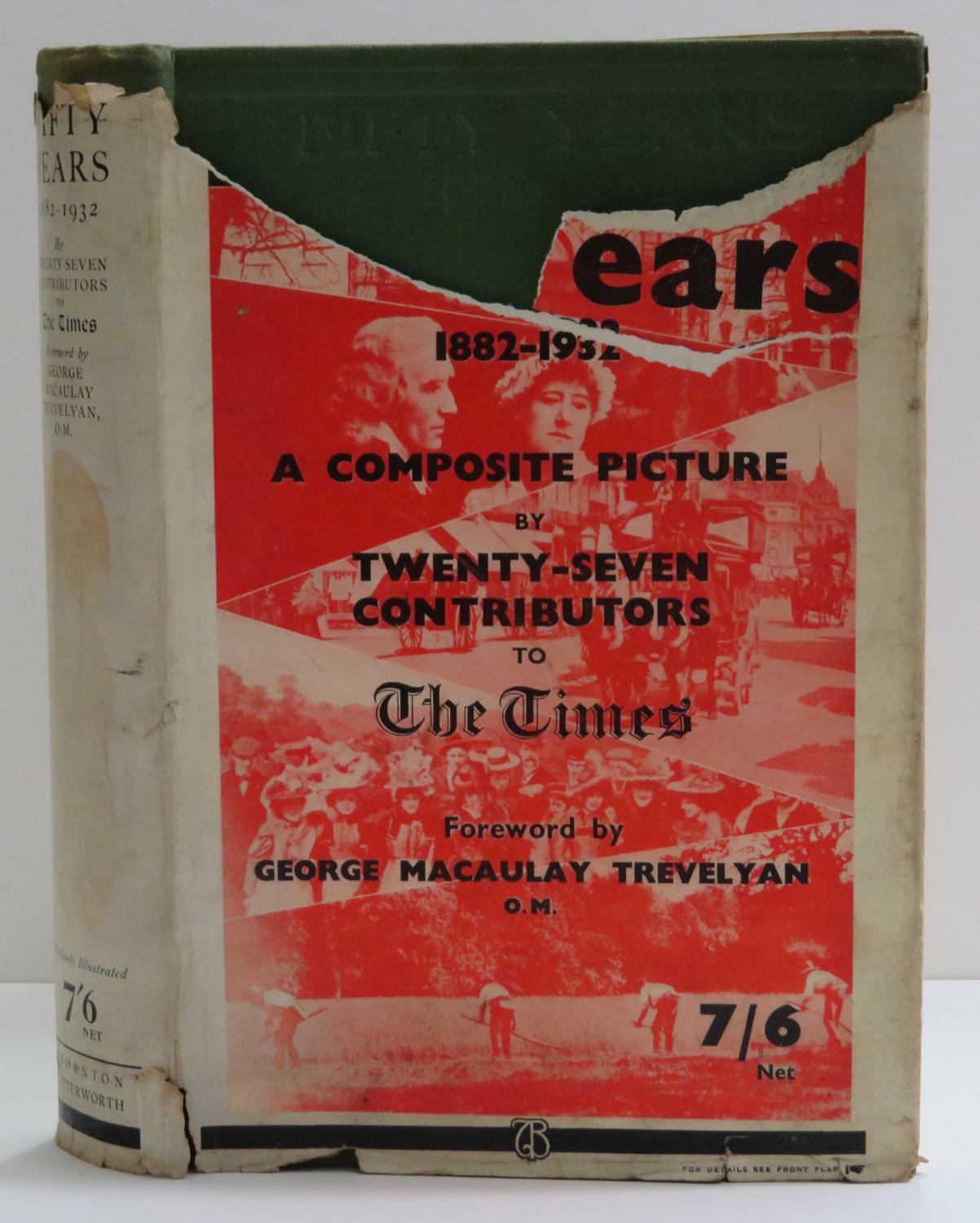
    A recent post in this blog concerned “Fourth Leaders” which were “ephemeral ruminations” published for a time in The Times. When I went searching for information about them I came across the following book:
Fifty Years: Memories and Contrasts. A Composite Picture of the Period 1882-1932, by Twenty-Seven Contributors to The Times, with a foreword by George Macaulay Trevelyan, O.M.
    Although the book contained no information at all about Fourth Leaders, I thought I would say something about it here because it is interesting and otherwise I will forget about it. It is also the case that this “Picture of the Period” has not attracted much attention. Those interested in the Victorian/Edwardian eras and those of you who are fans of Downton Abbey might find it worth a look.  If you need more incentive, consider this remark by Trevelyan from the introduction:

“In this volume we are reminded of a few of the things that our grandfathers had and that we have not and that no one will ever have again.” p.15.

A Series of Articles in The Times - 1932

    On Jan.7, 1932, The Times announced that articles covering the years 1882-1932 were forthcoming and the first one appears on Feb. 1: “Politics and the Statesman,” by The Earl of Middleton, K.P. Throughout the winter and spring twenty-six more pieces are to be found along with related photographs illustrating such subjects as: “Rural England in the Eighties”, “Changes in the World of Sport” and “Great Figures of Political Life”.  As well, one finds pictures of literary figures such as Tennyson, Browning, Hardy and R.L. Stevenson and of lesser known entertainers and performers such as Dame Nellie Melba (she of the toast) and G.H. Chirgwin, “The White-Eyed Kaffir.”

1882-1932?

    There is no clear rationale presented as to why those years were chosen or why the articles could not have been commissioned a year earlier or later. There are a few statements of purpose which are rather general in nature:

“...it is a series of articles designed as a critical retrospect over a period in which historical time seems to have travelled its swiftest pace.”

…”while there has never been a period of greater opportunity for contrast.”

“... a period of change to which history offers few parallels.”

Those who wrote the pieces were expected to have experienced and participated in the events of  the period and their observations were to be based on “direct personal reminiscence.”

Excerpts


What is A Weekend?
    Why Lady Violet, Dowager Countess of Grantham of Downton Abbey asked that question and was puzzled by the concept is partially explained by this passage:

The other great change in social habits is the present widespread exodus from London for a third of every week. Before motor-cars existed, to go more than ten miles out of London meant a troublesome business of catching trains. Accordingly the two nights’ country visit, called then a “Sunday Party,” was a rarity, and the majority of us were quite content to stay where we were.”

That excerpt is from the article “Society and the Season” by Mary, Countess of Lovelace which begins this way:
“For a picture of social life fifty years ago I can only draw upon a limited experience, first as a girl before 1880 and as a young married woman after that date. I can, in short, only give the youthful feminine point of view, It was a prosperous period, and for six months of “the Season,” which began in February and ended the last day of July, there was an incessant competition between entertainers small and great. Except for a few days at Easter, three or four balls were given every night except Saturdays, and on that day there was nearly always one of those large assemblies at one or other of the great family houses which embraced the whole of Society, old and young, rich and poor.”

Filthy Lucre

From the Chapter “Clubs and Club Life”, by Sir George Arthur BT.

“... at Arthur’s and Boodle’s there was a well-known rule that silver given in change had to be plunged in boiling water and swung round in a leather bag to ensure cleanliness.” p.35.

On the other hand, perhaps it was better not to use silver at all:

“The octogenarian, Lord Knightley, having won a rubber of whist, his opponent handed him eight half-crowns in payment of his debt. Lord Knightley rose, rang the bell, and pointing to the little heap of silver, said to the waiter: “Please bring me gold for that.” The silver -- such was the implication of gentle reproach -- could scarcely be considered as correct tender from one gentleman to another.” p.37

The Countryside

     Although Lord Ernle notes some of the positive developments in his essay on “The Countryside” it is generally a lament for what has been lost - …”life is made easier, it is also made harder to live.” p.194.

“The mellowness is vanishing from the external aspect of most rural districts. Raw and aggressive, new constructions fresh from the builder’s hand shout defiance at their weatherworn surroundings.” p.190.

“Yet no one who has not lived in a remote country district before the advent of mechanical aids to locomotion can realize its isolation. Even country houses, in spite of their command of horses and carriages, were narrowly limited in their social intercourse by time and distance. Their life was necessarily home-made. Neighbours from fifteen miles away came to stay the night, or to spend a long day -- long enough to rest the horses. Dinners or dances required so much correspondence and preparation that they became, as we might now think, ceremonious. Few opportunities for informal gatherings existed. In 1880 both afternoon tea and lawn tennis were very recent introductions. Bridge was still unknown. But today all the gadgets which quicken life and make manners more abrupt are in operation. Over the telephone parties of every sort can be improvised; unexpected guests can ‘blow in’, when resources can be quickly supplemented by ‘dialling’ appropriate tradesmen; B.B.C. supplies music or conversation for impromptu dances or meals, and in time will play the hands of bridge players.” 193

“Fifty years ago villages ten miles apart knew nothing of each other. The members of each community viewed “foreigners” with suspicion, and, as parish registers show, were often closely related to one another.” p.194.

“Another consequence of the same movement is the levelling down of village society. Carriers and shopmen cannot compete with motor-omnibuses or vans; the one puts down his horse and cart, the other puts up his shutters. An avalanche of Norwegian deals or ready-made doors and windows drives wheelwrights and carpenters from business and buries in the old saw-pit their folk knowledge of British timber. Blacksmiths and harness-makers lose their livelihood when petrol displaces horses. …. Villages gain many conveniences at the cost of much of their variety, individuality, and independence.” p.194.

Sport: A Definition

“But how is sport to be defined? Does it include games such as cricket, football, rowing, athletics, polo, and lawn tennis? Or should it be confined to hunting, shooting, fishing, stalking, coursing and other pastimes perhaps more strictly sporting? Sport would seem to imply the pursuit of some quarry, even if it were only rats, and if there is a spice of danger attending it, so much the better.” p.196 from the chapter “Sport of Many Kinds” by Lord Desborough, K.G.

It is followed by a chapter which, judging from the title, seems to be about more frivolous ‘sports’:  “Games With a Ball”, by Bernard Darwin.

The Book Published by The Times

    It did not take long for The Times to get the articles into book form. There are announcements almost daily during June of 1932 about the upcoming publication of the book and finally a long synopsis of this “composite portrait” of the age appears on June 16: “Book of the Day: 50 Years: A Picture of Loss and Gain.” Letters and reviews about the “anthology of reminiscences” quickly follow (for those really interested, synopses of reviews from other papers are provided by The Times - see the issues for July 5, July 8 and August 3, 1932.)

   I thought that newspaper book publishing was a more recent development, but that is clearly not the case. In fact, one letter-writer corrects Trevelyan who wrote in the introduction that “the articles form perhaps the longest series that ever appeared in The Times.” p.16. He notes that The Times had published fifty-four articles about a trip to the United States back in 1887-1888. He says “The collection was afterwards reprinted in two little grey yellow-edged volumes, long out of print.”

   I had a look and the book does exist and unlike the one discussed above, it is available in electronic format. Here is what you need to find it: A Visit to the States: A Reprint of Letters From the Special Correspondent of The Times, George Edward Wright, 1887. It looks to be quite interesting. (Since the book is out of copyright, one of the new ‘instant publishers’ will print one for you if you like. The e-version is available for free.)

A Canadian Version 1882-1932


    Somehow along the way I stumbled upon a Canadian book covering the same period and published in the same year, 1932:

Fifty Years Retrospect ; Canada, 1882-1932.

It is rather more limited in scope given that it is an anniversary publication of the Royal Society of Canada and Canada was, after all, but a colony.  I only mention it here to indicate the diligence of my research and because the book might provide potential topics for anyone on the tenure track in need of one. For example:

-There are around twenty-five essays in the book so your discipline is likely to be represented. Examples: “Trends in Fifty Years of Canadian Stratigraphy” or “Fifty Years of Canadian History.”
-Or you could attempt to determine if in fact the Royal Society of Canada succeeded in helping “to check the tendency of a pioneer community to put an overwhelming emphasis upon material things.”
-Or one could compare or contrast the subject of  “higher education” as presented in the two books discussed above. There are three chapters about the universities in The TImes compilation: “Oxford Men and Manners”, “New and Old at Cambridge”, and “The New Universities”. In the book about Canada you could start by considering the following:

Canadian Higher Education 

The universities had no contact with one another. Most of them had been conceived, born, and nourished for sectarian purposes, and all were very poor. Because they were poor they were ill-nurtured, and were as a rule at odds with one another. Professors were badly paid, libraries were meagre, laboratories were few and scantily equipped, museums hardly existed. The provincial treasurers, harassed by other demands for which they were afraid to tax their constituents, took advantage of the divided interests of the colleges to refuse aid impartially to all.
-Or, in relation to the last quotation, you could simply ask if much has changed.