Showing posts with label London Free Press. Show all posts

Sunday, 18 May 2025

Olde Posts Addenda (5)

  Since all of the news is "breaking" these days, here are some more stories which have broken and are related to older news items in MM.

War Is Also Bad For Animals
  Back in the spring of 2019 in MM I called to your attention the "Factlet" that in the fall of 1939 the pet-loving Brits chose to "put down" around 400,000 of them. The grim details are found in: Factlet (2) - The Brits and Their Pets.  Such an astonishing figure will need verification and it is found in a book mentioned in that post: 
The Great Cat and Dog Massacre: The Real Story of World War Two’s Unknown Tragedy by Hilda Kean.


   To the library of books about awful things that have happened to animals, another can be added: Humans and Other Animals in the Deadliest Conflict of the Modern Age, John M. Kinder. It is published by the University of Chicago Press where this description is found:
   A new and heartbreaking history of World War II as told through the shocking experiences of zoos across the globe. As Europe lurched into war in 1939, zookeepers started killing their animals. On September 1, as German forces invaded Poland, Warsaw began with its reptiles. Two days later, workers at the London Zoo launched a similar spree, dispatching six alligators, seven iguanas, sixteen southern anacondas, six Indian fruit bats, a fishing cat, a binturong, a Siberian tiger, five magpies, an Alexandrine parakeet, two bullfrogs, three lion cubs, a cheetah, four wolves, and a manatee over the next few months. Zoos worldwide did the same. The reasons were many, but the pattern was clear: The war that was about to kill so many people started by killing so many animals. Why? And how did zoos, nevertheless, not just survive the war but play a key role in how people did, too?"
The author of the book was asked five questions which are also available and answered in the related U of C blog.
  For a review of the book see: "
With World War II on the horizon, animal keepers in cities around the world had to face one question: What would happen to their charges?" By Sophy Roberts, Wall Street Journal, April 18, 2025.

War Is Certainly Bad For Humans

   Although the Vietnam war ended fifty years ago, even those of you born in this century will certainly have seen at least one of the two photos provided in: "Napalm Girl" and "Napalm Girl" (Again). "Napalm Girl" is still alive and is living in Ontario. The photos mentioned can be seen in the posts above and will not be shown again here. In the second post, it is noted that questions have been raised about the "authorship" of the "Napalm Girl" photo. Since it was written, the questions have been addressed and the 97 page report is linked in this article:
"The Associated Press Won’t Change ‘Napalm Girl’ Photo Credit: A documentary called “The Stringer” called into question whether Nick Ut actually took the famous photograph in Vietnam. The AP’s year-long probe couldn’t prove otherwise," Scott Nover & Jada Yuan, The Washington Post, May 6, 2025.

The End of the Crickets

Like Buddy Holly They Are No More
   De Bono, one of the last of the local reporters, has been dutiful in his reporting on the demise of Aspire, the London cricket factory. I also have been devoted to this subject and a future historian will find in this post all they need to know about the failed aspirations of this London enterprise. I will offer first, the latest and surely the last cricket story which is provided by Mr. De Bono. Then follow the MM posts which are largely based on his reporting. I did contribute a bit about Kricket Krap, a by-product the Aspire folks may have overlooked. And, if you are still not interested I should mention that the company was seen to be part of a conspiracy. 
   Mr. De Bono is a professional and his titles are clearer and first sentences better than mIne:
"Cricket Producer in Receivership: City Plant Still Going as Aspire, Reportedly $41.5M in Debt, Seeks Buyer or Financing," Norman De Bono, The London Free Press, May 14, 2025.
"By Jiminy, London's cricket dreams have run into a financial roadblock as menacing as, well, a massive can of Raid."
 
Now, here is one of my titles and you will likely spot the difference:
"ENTOMOPHAGY"
 
I will skip my first sentence and go to the second paragraph by the professional:
 "Norman De Bono (the reporter) revealed that, London will become home to the world’s largest indoor cricket farm with Aspire Food Group opening a 100,000-square-foot plant here that will act as a launch pad to bring bugs, as food, to the North American market....At the plant, crickets will be hatched and grown on-site and will become a tasteless, odourless protein powder that will be sold as a food additive, and will also be used to make protein bars.
That post is the one that mentions Kricket Krap which is sold by a company in Georgia so you shouldn't buy any right now.
  Here is the post which reveals that this cricket business is just part of a scheme by Davos-types who want to force us to eat insects in communist Canada.  Crickets and Conspiracies.

Trashy News
  That is a more attractive title than "News About Trash", about which I have provided many posts since there is plenty of trash. The new title about trash is all you need and I will spare you the details which are hardly needed: "On a Remote Australian Island, the Birds Are So Full of Plastic They Crunch: Seabirds Have Been Fishing Plastic From the Ocean and Feeding it to Their Chicks, Researchers Say. One Bird Was Found to Have Ingested 800 Pieces," Victoria Craw, The Washington Post, May 16, 2025.
For more proof that the plastic is piling up and that there is now something called "sea snot", see below:
Flotsam and Jetsam
More Flotsam
More Trash
Marine Mucilage in the Sea of Marmara 
Polluted RIvers

The Bonus:
 
I couldn't help but notice that one of the authors in the articles cited above provides an example of an inaptronym (Kinder in the article about killing) and another an aptronym (Craw in the last article about birds ingesting plastic.) About that subject see: Aptronyms
Amen
   

Sunday, 6 October 2024

London Lost A Fortune

The Curious Case of Peter Birtwistle
   I have a reference to this gentleman for reasons I don't recall. He was a successful jeweler in London, Ontario in the early part of the last century. When I went searching for information about him, I found some, but nothing from local sources or newspapers. My search was limited to electronic resources that are available from my chair. 
   Perhaps someone associated with The London & Middlesex Historical Society might try firing up a microform machine and having a look through the local papers. One of the references I provide below (from a Florida newspaper), cites a London Free Press article from 1920(1).  A cursory search has not yielded any historical articles about him.
 
Why should one bother with Mr. Birtwistle?
   One reason would be to try and figure out why this wealthy bachelor decided to leave all his money to Colne in Lancashire rather than London in Ontario.
  Here is what I have found from the sources provided below.
  Birtwistle emigrated (twice) from England. According to the brief history found on the Colne website, he partnered with a Joseph Pickles here in London. He became one of this city's most successful jewelers and was a well known diamond merchant. His business was at 113 Dundas Street, the ground floor of which was occupied by the Winslow Brothers shoe store. He later moved to 116 Dundas and lived above the shop(3d). If the current street numbers are similar, the location would be in the block where Kingsmill's used to be. 
Like most rich Canadians, he spent the winters in the south.
   What did the wealthy bachelor plan to do with his money when he died?
  There is one reference which indicates his niece was to be his beneficiary, but they quarrelled and she left for Australia (3d).
   The next suggestion is that the inheritor was to be the St. George's Society. It is found in the source mentioned just above, which also states that he was president of the London society from 1901 to 1907. Apparently he had a disagreement with the Society as well. When Birtwistle died in 1927, the Border Cities Star reported that: "According to the Trust and Guarantee Company, it had originally been Mr. Birtwistle's intention to leave this sum in trust for the benefit of the aged poor of London, Ontario, but certain disagreements which occurred later, notably what is known as the St. George's Society incident caused him to alter this determination(2).
   Although Birtwistle was a charitable chap, he must have been a bit touchy since there was also an incident with his next intended beneficiary, the city of London. In the 1935 Border Cities Star article it says that "the city of London was reported to be named the sole beneficiary in his will, but following disagreement with the city officials his home town was named to receive the estate."
   In 1941, when officials from his hometown of Colne showed up to attempt to get the money, the headline of a related article refers to the dispute with someone representing the city of London: "London Estate Is Sought Now For Colne, Eng.: Late Jeweler's Fortune Lost to Adopted City Because of Old Slight," Globe and Mail, Mar. 11, 1941.It begins with this sentence: "A real or fancied offense of certain citizens of London, Ont. in 1907, cost that city's aged and needy poor a sum of over $600,000 , which may now be turned over to a town in England..." It is further noted that, "The nature of the "offense" is not known. Some claim that it was a disagreement between a wealthy bachelor jeweller and city officials over city audits." 
   Colne was the heir chosen as you will see by looking at the related websites.           Apart from his alleged argument with the city, or the "incident" with the St. George's Society, perhaps he just wanted to leave the money to a place in his homeland, since an affection for it is suggested by his membership in the Society. It appears that the local branch still exists and if their records do as well, maybe more can be learned from them.
    Birtwistle had the money placed in trust for 21 years which explains the rationale for some of the articles provided which are listed in chronological order. There are four articles from 1935 because officials from Colne came asking that the money be released because of the depression. In 1941 they came again because the money was needed because of the damages caused by the war.
   The Supreme Court judgment from 1938 concerns the tax issues related to the Birtwistle Trust and a link to it is provided.
   It may be that an historian (or a historian, if you prefer American usage) has studied this issue and was overlooked by me. If not, and you decide to do a little investigating, make sure you search for "Birtwistle" since it can easily be replaced in searches by "Bir
DwHistle."


Current Colne Websites
The Peter Birtwistle Trust is a Registered Charity and Registered Social Housing Provider (RSH no 5086) based in Colne, Lancashire. 
Peter Birtwistle Retirement Housing Site.

Sources:

1. 1920 
"Lakeland Visitor Gives Old Folks of His Town a Tea Each Year," The Lakeland Evening Telegram, Feb. 23, 1920. Here is a screen shot and it indicates that the Free Press is the source.


2. 1927
"Million Left to Poor Folk: Former London Man Wills Estate to Native Town," Border Cities' Star, April 27, 1927. [ The Border Cities Star was a Windsor, Ontario newspaper. An apostrophe sometimes appears in the title - Cities' .]

3. 1935
a) “Colne Dignitaries Here Today Seeking Bequest For Town," Toronto Star, May 30, 1935.
b) “$1,000,000 Bequest For English Town: London, Ont. Jeweler Left Money To Accumulate Interest,” The Globe, May 31, 1935.
c) “Mayor of Colne in Canada,” The Manchester Guardian, June 1, 1935.
d) 
"Seek Estate of Londoner: Thousands Bequeathed to Lancashire Town by P. Birtwistle - Payment Deferred: Delegation Asks Money In Advance Because of Depression," Border Cities' Star, May 31, 1935.

4. 1938

5. 1941
“London Estate is Sought Now for Colne, Eng.: Late Jeweler’s Fortune Lost to Adopted City Because of Old Slight,” The Globe & Mail, Mar. 11, 1941

6. 2018
Millionaire's Legacy Lives on With 12 New Bungalows in Colne," Nic Marko, Lancashire Telegraph, March 18, 2018.
"Pendle Enterprise And Regeneration Ltd (PEARL) has completed the construction of the £1.4million housing development at Carry Lane for the Peter Birtwistle Trust.
The Trust was founded by Peter Birtwistle who emigrated from the UK to Canada but left his entire fortune to provide housing for people in his home town of Colne when he died in 1927."

Post Script
   
In Mulcahy's Miscellany I have provided a few historical posts about London, none of which would constitute much of a threat to the real historians of this city. Two of them relate to London during the period when Birtwistle resided here (at least during the summer.) This, slightly frivolous one, at least illustrates how one can find out about London by searching papers from places far away - those places where more resources from the past have been digitized - "Lonely in London c.1920." Another is about the KKK - "Verminous Missionaries."
   I mentioned Kingsmill's above and was pleased to see that the picture of the inside of that store, buried in one of my posts, still exists. If you click on the image in "Detour", you will see an example of the elegance that once existed on Dundas Street. 

Sunday, 11 August 2024

The London Free Press


The Good Old Days
   Seventy-five years ago that brief article was published in The Times (of London - the other one, June 14, 1949) when The London Free Press turned 100.  It is obviously a slow news day here and I just thought I would take the time to remind you that newspapers were once thicker and there were more of them.
    Although one can now find and read the older and much thicker newspapers that were published in the United States, and in B.C. and Alberta, that is not the case for most newspapers in Ontario unless you have access to some commercial database or travel to a library and attempt to read them on a microfilm machine. You can, however, view over a million photographs that were published in The London Free Press, by going up to the Western and consulting The London Free Press Collection of Photographic Negatives. 

   
One can, of course, search the U.S. newspapers for articles about London and many are found.
   

For example, The Nome Nugget noticed in 1946 that reporters here had their own plane.


London is also found in many advertisements, the loss of which is the reason why we now don't have many papers. Here is one from the New York Tribune, July 18, 1909


The Bonus:
   
I was able to find a partial copy of The London Free Press centennial edition in the County of Brant Public Library. Here is what the front page looks like and the readers back then still had 231 left to read. 


Tuesday, 16 January 2024

Reading Time (A Painful 5 MIN)


The Long and Short of It 

  I have noticed that articles available on the Internet are often accompanied by an estimate of the time it will take to read them. Why are they there? The producers must put them there for a reason. Is it because they know our time is valuable and that we want to be careful about how quickly we spend it? Or is it simply because from the link or the display we often cannot tell how long the article will be. In a print newspaper one can quickly see if the piece is a couple of paragraphs or a complete page.
   Such time notices can be useful. If we are in a hurry we only have a few minutes, but if we are looking for a diversion on a rainy day, the more minutes the better.


Words & Minutes
   Writing is generally measured by words and pages and how long it takes to produce them, not how long it takes to read them. We have all struggled to write that 5,000 word essay which we double spaced to make it look more substantial. The production of one for me, always took a long time and it likely took the professor longer to read than others, especially if it rambled like this one. Reading for grading surely takes longer than normal and a normal reading rate is assumed to be between 250-300 words per minute. The two essays above about Trump, which it takes about 20 minutes to read, probably total around 5,000 words. Too much time has been wasted on Trump.


Reading Time is Not New
   I thought that being told how long it was going to take you to read something was a new thing, like being warned about the content it contained. Such is not the case. A couple of months ago, I did a post about the Canadian version of Liberty, a popular magazine in both the U.S. and Canada (see, "Periodical Ramblings (14)." The American version informed readers of the time it would take to finish an article. This is from the Wikipedia entry for the magazine:

"A memorable feature was the "reading time," provided on the first page of each article so readers could know how long it should take to read an article, such as "No More Glitter: A Searching Tale of Hollywood and a Woman's Heart," Reading Time: 18 minutes, 45 seconds." This was calculated by a member of the editorial staff who would carefully time himself while reading an article at his usual pace; then he would take that time and double it."

From the entry you will learn that someone tested Liberty's calculations and noted that  "Liberty magazine existed in a world without television and the Internet. Time pressures on readers and potential readers change with the times."


"

                              Longform"
  Lately there are also often alerts to let us know if an article is going to be long, either to warn us or to let us know we about to get something special or a lengthy investigative piece. "Long Form" or "Longform" is the new long and it also appears as "Longread" or a "Big Read". The latter is produced by the Financial Times and the former is found in Wired on Sundays and it consists of "Our deepest dives and cutting edge features that will leave you smarter and sharper." The Guardian now has a new "Long Read magazine [which] brings together the very best longform journalism, with immersive stories on everything from world affairs to philosophy, from food to crime." GQ's Long Reads are where they put their "in-depth investigative features and profiles."
   Even our 'local' London Free Press is going long on occasion, although it is short of both local stories and local reporters:
   We have good news for you if you enjoy the pleasure of savouring a weekend newspaper.
I
t's called Long Story. It's a new section in your newspaper, designed to get lost in.
Every Saturday, we'll print in-depth stories you won't find anywhere else. Spread over four pages with great visuals and design, you'll want to settle in and stay awhile.This week's long read is about the Canadian battle to outlaw “normalizing” genital surgeries on babies and children born intersex, meaning with bodies that aren't clearly female or male."
(Joe Ruscitti, LFP, Nov. 11, 2023.)

Exactly how long, long is, is not clear. Let us say that something longform should be over 2000 words and take you over 8 minutes to read. The "culture wars" article above would qualify, but I admit that I skipped it.


Tracking What is Read
   In the old days a newspaper publisher didn't know if you actually read it, or just used it for wrapping fish. Now our screens typically tell us how many are reading the article along with us and how popular it is. At the end of the year, Maclean's  knew which of their longform stories were most read during the year. "The End of Homeownership" was number one and it was followed by a story about Fortnite, a video game, "They Lost Their Kids to Fortnite." Knowing such metrics is not necessarily a good thing, in that the most popular is likely not the most profound.


   The publications you subscribe to probably know your reading habits. The Washington Post provided me with the statistic above and others, such as, I had read over 565 different authors and about 79 countries and what the top five were. I learned that the columnist I read most was George Will. Don't tell my friends. I read him because of the way he writes, not the way he thinks.


Sources:
   If you really want to know about reading time try: "How Many Words Do We Read Per Minute? A Review and Meta-analysis of Reading Rate," Marc Brysbaert, Journal of Memory and Language, Vol.109, Dec. 2019.
"Based on the analysis of 190 studies (18,573 participants), we estimate that the average silent reading rate for adults in English is 238 words per minute (wpm) for non-fiction and 260 wpm for fiction. The difference can be predicted by taking into account the length of the words, with longer words in non-fiction than in fiction. The estimates are lower than the numbers often cited in scientific and popular writings. The reasons for the overestimates are reviewed. …". 
   Have a look at this tool: "The Read Time" . It is a "Words To Time Converter" which allows you to "Accurately Estimate Talk Time For Presentations, Speeches and Voice-Over Scripts".  According to it, you probably spent about 5 minutes reading this. 

The Bonus: 


This reminded me of "Speed Reading" and Evelyn Wood and "The Evelyn Wood Reading Dynamic Institute." Speed reading was almost a craze back in the early 1960's. Those who had not been diligent in their reading were attracted to classes which would teach you how to read thousands of words per minute and retain what was read. For more see: Evelyn Wood.

Sunday, 30 July 2023

One Hundred Years Ago

 1923


   Since my last few posts have been about the present, I will now look back through the London Free Press to a time that was clearly different.  The day landed upon happened to be May 24 and "Empire Day" is no more and mostly forgotten. This curriculum also appears a bit outmoded.


      We no longer have a 'local' newspaper and one reason for that is there not enough advertising to support one. Advertising was important back in 1923.


Here is a larger version which indicates that advertising was the "Aladdin" of the day in 1923, but replaced later on by genies such as Kijiji and Craigslist.


Sources
  One often needs a genie to find digitized editions of older newspapers and not many free digitized pages of the LFP exist as far as I know. I found a few on Canadiana. The reasons for this vary, but often it is the case that there are commercial ones. Before you pay money, however, or spend time (lots of it) sitting in the library at a microform reader, do check around to make sure your community paper is not available via the Internet. Genealogists have been more helpful than librarians in assisting those interested in finding local newspapers. Here is the place to start and if you scroll down you will find Canadian newspapers listed by province: "Newspaper Links," The Ancestor Hunt.com. And, as usual, Wikipedia is very useful: "List of Online Newspaper Archives." 
  Given that this post is a slight one, here are some other suggestions and remember that more papers are added daily. 
For the U.S. start with "Chronicling America: Historic American Newspapers." Canada is generally behind other countries in undertaking a national digital approach, but you can find provincial ones: Alberta and British Columbia. For a local Ontario effort see: "INK-ODW Newspaper Collection." 
  Google started to digitize newspapers (and every thing else), but was forced to stop.
The Bonus: 
   One fellow who has not stopped is located close by in Fulton, New York where among the over 50 million digitized pages you will find many from Canadian newspapers. Tom Tryniski is his name and he has done from his house what many librarians have not been able to do from their libraries. Don't be fooled by the look of the website because if you are searching for something or someone, you are likely to find them here: "Old Fulton New York Post Cards.

Sunday, 19 April 2020

Factlet (5)

The Opioid Epidemic


       A review of this book presents a few factlets worth noting:
“Eyre begins with the story of a single pharmacy in Kermit, W.Va., population 382. In just two years in the mid-aughts, the Sav-Rite distributed nearly nine million opioid pain pills to its customers. People drove hundreds of miles to get there, passing dozens of other pharmacies on the way. Lines were so long that the pharmacy’s owner sold popcorn and hot dogs to people in the drive-through lane.”
   "Eyre calls the addiction crisis “a man-made disaster fueled by corporate greed and corruption.” Cardinal [a drug distributor]“saturated the state with hydrocodone and oxycodone — a combined 240 million pills between 2007 and 2012. That amounted to 130 pain pills for every resident.” He writes: “The coal barons no longer ruled Appalachia. Now it was the painkiller profiteers.”

Deaths of Despair

   Right now we are preoccupied with the deaths and illnesses resulting from COVID-19, but the impact of despair should not be overlooked. It has been linked to the dramatic rise in drug overdoses, suicides and deaths caused by alcoholism. "In 2018, more than 158,000 Americans died from these causes, up from 65,000 in 1995, with increases that are similar for men and women." Among poor whites the historical patterns in longevity have been slowed or reversed. "From 2013 to 2017, life expectancy fell for white Americans, and from 2014 to 2017, it fell for all Americans, a setback that had not been seen since the influenza pandemic a century earlier." The current one won't help.

Deaths of Newspapers

   The author of Death in Mud Lick, won a Pulitzer Prize for the articles about the opioid epidemic in the Charleston Gazette. It was a family-owned newspaper for over 100 years and although it is not 'dead', it went bankrupt and was bought out and is now The Charleston Gazette-Mail. Supposedly, the unofficial motto of the paper is being kept - "sustained outrage over basic injustices" - and will still be an operating principle. We'll see.

Sources:
The review of Mud Lick is found in, "How Painkiller Pushers Took Over Coal Country, "by Dwight Garner, New York Times, April 6, 2020.
"Deaths of Despair" is a phrase coined by Anne Case and Angus Deacon back in 2015 and it is now in the title of their book: Deaths of Despair and the Future of Capitalism.
There has been so much written about Deaths of Despair and the Death of Newspapers, you don't need much assistance from me. They even have their own Wikipedia categories: See "Diseases of Despair" and "Decline of Newspapers".
For a good article about despair see: "There's Something Terribly Wrong: Americans Are Dying Young at Alarming Rates," Joel Achenbach, Washington Post, Nov. 26, 2019
For dying newspapers see: "A Hedge Fund's 'Mercenary' Strategy: Buy Newspapers, Slash Jobs, Sell the Buildings," Jonathan O'Connell and Emma Brown, Washington Post, Feb. 11, 2019.


The Canadian Angle:
   North of the border, people are also dying of despair and many of our local newspapers are deader than the parrot in the Monty Python sketch.
   The first instance I found of the phrase "Deaths of Despair" is in this headline which appeared on The Canadian Press website back in the summer of 2016: "Deaths of Despair: Overdoses, Drinking, Suicides Hit Whites," by Mike Stobbe on June 3. (As a very caustic aside, some people who are non-white, of indeterminate gender, or in the higher income levels, have suggested that the culling of a cohort of poor white males is not a bad thing!)
   The most recent issue of "Canada's National Magazine," Maclean's (May 2020) has a full page ad which begins with a question in very large type: "HAS THE PRESCRIPTION OPIOID CRISIS AFFECTED YOU OR SOMEONE YOU KNOW? And, locally, if you search for information about class actions and opioids in Canada, you will find Siskinds. The cover of that issue of Maclean's consists of the headline, in very large type, "HOW DOES THIS END?, which is referring to the CORONAVIRUS, but it could refer to the other crises as well.
   I do not recall when our local paper, the London Free Press, died. I do recall that the publisher of the Davidson Leader out in Saskatchewan had an essay contest, the prize of which was the Davidson Leader, and the entry fee was $1 (and that would be a Canadian $ which is now worth about 12 cents.)
   The "News Deserts" are not just in Saskatchewan. For more on that subject see: For the U.S., the University of North Carolina.  For Canada see: Ryerson University.
    The problem of the loss of local news was recognized in Canada a few years ago and a large sum was promised: See: "Ottawa Bolsters Struggling Media With $600M in Tax Measures," The Canadian Press, November 21, 2018. There may now be more immediate concerns.

Factlet? You were expecting Factoid? For the important distinction see Factlet (1) - What's a Gee-Gee? 

Bonus Material:
In one of the pieces there is quote about the dying papers: "There is a morbid joke in this business: Every time we print an obituary, we lose another subscriber."
Remember when a good local newspaper motto would have been: "The job of the newspaper is to comfort the afflicted and afflict the comfortable."
This appears under the masthead of the Washington Post: "Democracy Dies in Darkness."


Tuesday, 25 July 2017

HEADLINES


Extra Extra Read All About It

(Tabloid Trash Headlines  are not Considered Below, but I Couldn’t Resist This One)

    The other day there was a headline in the London Free Press that caught my attention, so today our subject is ‘Headlines’. That subject is further restricted to the type of headlines one sees in newspapers; the ones that are constructed to grab your attention and provide a hint about the topic being covered. Internet headline spam, the spawn of clickbait, is not considered.

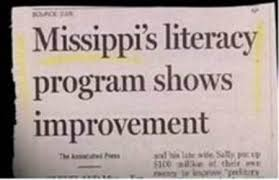
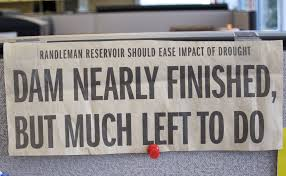
    The need for brevity, the lack of punctuation and the often odd arrangement of words can create confusing headlines, but also unintentional humour: “Criminally Insane Bill Passes”; “Sharks Stop Search for Span Collapse Victims”. The need to meet a deadline sometimes results in ones that are just incorrect: “Dewey Defeats Truman”. If you have your own deadline you can jump right to the lists of examples provided below.

     The headline in the London Free Press (on July 17) is: “13th Doctor Who is a Woman”. As one who is not paying much attention to popular culture, I assumed the article was about females who were having a hard time cracking the glass ceilings in medical clinics.

     The former editor-in-chief of the LFP, Paul Berton, who now has the same position at the Hamilton Spectator, wrote about headlines a while back after some readers complained about the use of a pun in a headline in that paper: “The Prince of Wails”. Here are some samples from his piece:
“Federal agents raid gun shop, find weapons”
“Marijuana issue sent to a joint committee”
“Homicide victims rarely talk to police”
“17 remain dead in morgue shooting spree”
“Bridges help people cross rivers”
“City unsure why the sewer smells”
“Meeting on open meetings is closed”
“Caskets found as workers demolish mausoleum”
“Meat head resigns”
“Man with 8 DUIs blames drinking problem”
“Parents keep kids home to protest school closure”
He concludes by reminding us that the headline writer has to generate very quickly a lot of short headlines to summarize long articles.

Columbia Journalism Review
    If you are looking for other sources, this publication is the place to begin. I used to grab copies of this magazine off the shelves and turn immediately to the inside of the back cover where one found the “Lower Case”. The entire page was full of reproduced headlines that were sent in by readers (they are all ‘real’ and were accompanied by the actual source - unlike the ‘fake’ ones I will provide below). One of my all-time favorites (which is now marginally politically correct): “Jesse Owens Dies; His Feats Live On”.

“Smoking warning labels will help save lives”
“Research finds club improves children”
“Dad says diplomat had passion for foreign affairs”
“Mother arrested after drowning”
“173 animals seized; 2 face cruelty charges”
“Chimpanzees get pregnant despite vasectomies”
“Shark bites land surfer in hospital”
“Plans made for east side crime wave”
“Army school suspends female head”
“Endangered fish holds up water plant”
“Middletown man hides crack in his buttocks”
“Man charged in electrocutions”
“Rangers' Hamilton to get shot for sore knee”
“Mrs. Ghandi stoned at rally in India”
“Nixon To Stand Pat On Watergate Tapes”
“Juvenile court to try shooting defendant”
“Shouting Match Ends Teacher's Hearing”
“Prostitutes appeal to Pope”
“High court OKs extra time for sex crimes”
“Stud tires out” (about banned studded tires)
“Experts suggest education standards might be to lofty”

Additional examples from the CJR are to be found in some sources provided below. The “Lower Case” no longer exists, but if you go to the digital Columbia Journalism Review you will still find examples under this heading: “Headlines Editors Probably Wish They Could Take Back”.

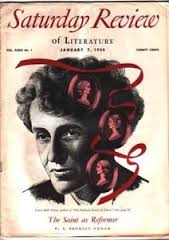
The Saturday Review of Literature
    
     This magazine is no longer published, but is still a good source for headline bloopers. Actually, bloopers were also reported from deeper within articles and readers often sent in pictures of signs and such things as examples from memos. One of the funny sign examples from back in 1969 has now become almost a sign cliché and was spotted at the neighborhood pub just last week: HAVE YOUR NEXT AFFAIR HERE. (One of my favorite business names was noticed on a hair salon somewhere in the interior of British Columbia; THE WACK AND YACK.

   Samples in The Saturday Review are found in two sections of the magazine: 1) In the column “Trade Winds” during the 1960s and 1970s (often written by  Bennett Cerf) and 2) in the section “Curmudgeon-at-Large” in the 1970s when Cleveland Amory was usually the curmudgeon.

  Examples of journalistic mistakes and oddities are often written about in other publications as well. Punch recorded this example from South Africa back in 1980: When a man saw someone dash into a sugar plantation carrying a pair of human feet and legs, he suspected that something sinister was  happening the Durban Criminal Sessions heard yesterday” The New Yorker sometimes sprinkles samples at the page bottom under headlines like “Block That Metaphor”.
         

The NEWSEUM
    More examples will be found at the Newseum, a museum in Washington where apparently media mistakes are sprawled like graffiti on the bathroom walls. You can also find there a book full of them: Correct Me If I'm Wrong: Press Bloopers as Seen in the Newseum. “The snippets featured in the collection include errant headlines -- "Asteroid Nearly Misses Earth" (The Washington Post, June 24, 2002) -- and questionable photo captions, messed-up weather maps, curious copy and even some regrettably incorrect corrections, such as this one from the Sept. 2, 1976, Evening Herald of Rock Hill, S.C.: "Chief Blue, the last full-blooded Catawba Indian Chief died in 1959. The Evening Herald incorrectly said Wednesday that he died three years ago due to a reporting error."


FAKE HEADLINES
  Given that the news from the lamestream media is said to be mostly fake, I might as well include some samples of completely made-up and untrue headlines. They are found in abundance at “America’s Finest News Source” - The Onion.
“Microsoft Patents Ones, Zeros”
“Clinton Deploys Vowels to Bosnia”
“Man With Heart Disease Eagerly Awaits Young Boy’s Death”
“NRA Shifts Focus From Guns to Penmanship”
“Desperate Vegetarians Declare Cows Plants”
“Black Box Reveals TWA Flight 800 Passengers Missed End of Dragonheart”
“Nation’s Educators Alarmed by Poorly Written Teen Suicide Notes”
“Massive Oil Spill Results in Improved Wildlife Viscosity”
“Tractor Pulls Now Number-One Use For U.S. Tractors”
“Viagra Giving Hope to Thousands of Struggling Stand-up Comedians”
“Colorado Judge Imposes Ban on Same-Sex Friendships”
“Who Will Kill the Roaches After the Apocalypse?”
“Great Books of Western Civilization Used to Accent Den”
“Taco Bell Launches New ‘Morning After’ Burrito”
“‘Midwest’ Discovered Between East, West Coasts”
“Islamic Fundamentalists Condemn Casual Day”
“New Remote Control Can be Operated By Remote”


P.S.
Some bonus headlines for those who read this far:
Here are two that are rather unclear: “Climber Who Cut Off Arm to Escape Speaking at MSU” AP August 29, 2011. (about the guy who cut off his arm to escape from a cave);
“Garbage Truck Lands on Saturn”, CBC May 28, 2012. (the Saturn was a car in Edmonton)
Others:
“For Towns Hold Elections”
Times-Record, Denton, Md. April 27, 2011.
“Pedestrian Deaths Largely Flat in U.S., Maryland”
Baltimore Sun, May 7, 2013
“Bishops Agree Sex Abuse Rules”
Sunday Business Post, Dublin, April 3, 2011
“Women’s Body Seeks Member”
Montreal Gazette, July 30, 1981
Church Member Donates Organ to St. Aloysius”
“6 Year Old Girl Just Found After 26 Years”
“Northfield Plans to Plan Strategic Plan”
“Amnesty Champions Tortured Girl”
“Defendant's Speech Ends in Long Sentence”

Sources:
“Writing headlines is an art ... ... Unfortunately, not everyone who writes them is a Rembrandt,” Paul Berton, The Hamilton Spectator, August 3, 2013.
He also covered the subject in: “We regret the error; Mistakes inevitably happen, but we do our best,” Paul Berton,  The Hamilton Spectator, May 14,  2011.
“Crash Blossoms,” by Ben Zimmer, NYT Magazine, Jan. 27, 2010.
(See also the website Crash Blossoms).
True journalists will appreciate: “Headlines: The Unappreciated Art,” by Lynn Ludlow,
In ETC: A Review of General Semantics, Vol. 45, No. 3 (Fall 1988), pp. 236-245
Books:

In addition to the book mentioned in the Newseum section above see the following:
For two collections of headlines from the Columbia Journalism Review see:
Red Tape Holds up New Bridge
Squad Helps Dog Bite Victim, and Other Flubs from the Nation's Press

Regret the Error: How Media Mistakes Pollute the Press and Imperil Free Speech, by Craig Silverman.
Double Bonus Source - A place where you can read lots of old magazines like The Saturday Review of Literature. http://www.unz.org/ (Don’t tell everyone).

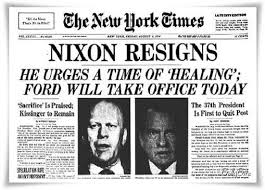
Many are hoping for a headline in the very near future that will look somewhat like this one: