Showing posts with label Maclean's. Show all posts

Sunday, 18 February 2024

BEYOND THE PALEWALL (10)


 1. Real Puzzling
   Many people up here are indoors working on jigsaw puzzles because that beats going outdoors or watching the news. A large 1000-piece puzzle, solidly coloured and with irregular edges, can keep you busy for quite a while. Looking for a bigger challenge, some senior folks in Utah, where they probably don't want to go outside either, ordered a 75 pounder consisting of 60,000 pieces. They went to work:

Over the next four months, about 50 seniors spent four hours a day piecing together 60 different 1,000-piece puzzle sections featuring a world map and 187 images of artwork by Dowdle of scenic landmarks such as the Colosseum in Rome, the Taj Mahal in India and U.S. national parks.
Last month, after the 60 puzzles were combined into one piece of art spread across 16 banquet tables, the senior center put its 8-by-29-foot creation on display for the public.

   Dowdle, the puzzle maker, operates "Dowdle Folk Art" which, conveniently enough is just down the road from the Springville Senior Center where the puzzle he made is on display. You can order "What A Wonderful World" - The World's Largest Puzzle" by clicking on this link. Before you do so, you should know that it is about 8' tall and 29' long and costs $1,027.00 in real dollars.
   All of this was learned from: "Utah Senior Center Tackles Loneliness With a 60,000-Piece Puzzle," Ruth Nielsen, Washington Post, Feb. 17, 2024. If you want to learn more, see the *
Largest Jigsaw Puzzles in the World," Nancy Levin, largest.org, Jan. 19, 2023. The smallest offered is the 33,600-piece, "Wild Life" which costs $600 also real dollars. 


2. Build A Border Wall - A Northern One!
 Former presidential candidate, Vivek Ramaswamy suggested one needed to be built because of the fentanyl problem, and Nikki Haley pointed out the problems presented by 500 people on the terrorist list who crossed over from Canada. More Republicans may be scrutinizing the Canadian/American border because of an article such as this one:
"Migrants Face Cold, Perilous Crossing From Canada to New York: Increasingly, Migrants From Latin America Are Risking Their Lives to Cross Illegally Into the United States Along the Northern Border," Luis Ferré-Sadurní, The New York Times, Feb. 11, 2024.

   As migrants continue to overwhelm the southern border in record numbers, a growing wave is trying an alternative route into the United States: across the less fortified, more expansive Canadian border….
More than 12,200 people were apprehended crossing illegally from Canada last year, a 241 percent jump from the 3,578 arrested the previous year. Most of them were Mexicans, who can fly to Canada without a visa and may prefer the northern border to avoid the cartels that exploit migrants in their country.

3. Dire Headline of the Decade - "Is the Media Prepared for an Extinction-Level Event?" 
 The subtitle of Clare Malone's Atlantic article (Feb.10) continued this way: Ads are scarce, search and social traffic is dying, and readers are burned out. The future will require fundamentally rethinking the press’s relationship to its audience. She reports on
 A report that tracked layoffs in the industry in 2023 recorded twenty-six hundred and eighty-one in broadcast, print, and digital news media. NBC News, Vox Media, Vice News, Business Insider, Spotify, theSkimm, FiveThirtyEight, The Athletic, and Condé Nast—the publisher of The New Yorker—all made significant layoffs. BuzzFeed News closed, as did Gawker. The Washington Post, which lost about a hundred million dollars last year, offered buyouts to two hundred and forty employees. In just the first month of 2024, Condé Nast laid off a significant number of Pitchfork’s staff and folded the outlet into GQ; the Los Angeles Times laid off at least a hundred and fifteen workers (their union called it “the big one”); Time cut fifteen per cent of its union-represented editorial staff; the Wall Street Journal slashed positions at its D.C. bureau; and Sports Illustrated, which had been weathering a scandal for publishing A.I.-generated stories, laid off much of its staff as well.
The Fahrenheit 451 of everything without the fires.


4. Rankled by Rankings (again):
   The rankings game is played by most universities which hide low numbers and seek the higher ones. Although most would like to opt out, it is difficult to do so and arguments about how the rankings are done and disagreements between those ranked continue.
   Among the recent rankings disputes, you may have missed this one. It does not involve U.S. News & World Report or Maclean's. It does involve the Chinese (again) and math, but in this case neither of those subjects is inscrutable.

  To Disraeli's, "lies, damned lies and statistics," math can be added. It may even be the case that you can have a highly ranked math department in a university where there is no department of mathematics. Here is all you need to know and you don't need to know any math to understand it: "Citation Cartels Help Some Mathematicians - and Their Universities - Climb the Rankings," Michele Catanzaro, Science, Jan.30, 2024.

Cliques of mathematicians at institutions in China, Saudi Arabia, and elsewhere have been artificially boosting their colleagues’ citation counts by churning out low-quality papers that repeatedly reference their work, according to an unpublished analysis seen by Science. As a result, their universities—some of which do not appear to have math departments—now produce a greater number of highly cited math papers each year than schools with a strong track record in the field, such as Stanford and Princeton universities.

   
The ranking wars will continue, however, and if you google any university, the rankings will appear since good ones can be found somewhere. Those pictured are currently displayed at the university close by. 

Tuesday, 16 January 2024

Reading Time (A Painful 5 MIN)


The Long and Short of It 

  I have noticed that articles available on the Internet are often accompanied by an estimate of the time it will take to read them. Why are they there? The producers must put them there for a reason. Is it because they know our time is valuable and that we want to be careful about how quickly we spend it? Or is it simply because from the link or the display we often cannot tell how long the article will be. In a print newspaper one can quickly see if the piece is a couple of paragraphs or a complete page.
   Such time notices can be useful. If we are in a hurry we only have a few minutes, but if we are looking for a diversion on a rainy day, the more minutes the better.


Words & Minutes
   Writing is generally measured by words and pages and how long it takes to produce them, not how long it takes to read them. We have all struggled to write that 5,000 word essay which we double spaced to make it look more substantial. The production of one for me, always took a long time and it likely took the professor longer to read than others, especially if it rambled like this one. Reading for grading surely takes longer than normal and a normal reading rate is assumed to be between 250-300 words per minute. The two essays above about Trump, which it takes about 20 minutes to read, probably total around 5,000 words. Too much time has been wasted on Trump.


Reading Time is Not New
   I thought that being told how long it was going to take you to read something was a new thing, like being warned about the content it contained. Such is not the case. A couple of months ago, I did a post about the Canadian version of Liberty, a popular magazine in both the U.S. and Canada (see, "Periodical Ramblings (14)." The American version informed readers of the time it would take to finish an article. This is from the Wikipedia entry for the magazine:

"A memorable feature was the "reading time," provided on the first page of each article so readers could know how long it should take to read an article, such as "No More Glitter: A Searching Tale of Hollywood and a Woman's Heart," Reading Time: 18 minutes, 45 seconds." This was calculated by a member of the editorial staff who would carefully time himself while reading an article at his usual pace; then he would take that time and double it."

From the entry you will learn that someone tested Liberty's calculations and noted that  "Liberty magazine existed in a world without television and the Internet. Time pressures on readers and potential readers change with the times."


"

                              Longform"
  Lately there are also often alerts to let us know if an article is going to be long, either to warn us or to let us know we about to get something special or a lengthy investigative piece. "Long Form" or "Longform" is the new long and it also appears as "Longread" or a "Big Read". The latter is produced by the Financial Times and the former is found in Wired on Sundays and it consists of "Our deepest dives and cutting edge features that will leave you smarter and sharper." The Guardian now has a new "Long Read magazine [which] brings together the very best longform journalism, with immersive stories on everything from world affairs to philosophy, from food to crime." GQ's Long Reads are where they put their "in-depth investigative features and profiles."
   Even our 'local' London Free Press is going long on occasion, although it is short of both local stories and local reporters:
   We have good news for you if you enjoy the pleasure of savouring a weekend newspaper.
I
t's called Long Story. It's a new section in your newspaper, designed to get lost in.
Every Saturday, we'll print in-depth stories you won't find anywhere else. Spread over four pages with great visuals and design, you'll want to settle in and stay awhile.This week's long read is about the Canadian battle to outlaw “normalizing” genital surgeries on babies and children born intersex, meaning with bodies that aren't clearly female or male."
(Joe Ruscitti, LFP, Nov. 11, 2023.)

Exactly how long, long is, is not clear. Let us say that something longform should be over 2000 words and take you over 8 minutes to read. The "culture wars" article above would qualify, but I admit that I skipped it.


Tracking What is Read
   In the old days a newspaper publisher didn't know if you actually read it, or just used it for wrapping fish. Now our screens typically tell us how many are reading the article along with us and how popular it is. At the end of the year, Maclean's  knew which of their longform stories were most read during the year. "The End of Homeownership" was number one and it was followed by a story about Fortnite, a video game, "They Lost Their Kids to Fortnite." Knowing such metrics is not necessarily a good thing, in that the most popular is likely not the most profound.


   The publications you subscribe to probably know your reading habits. The Washington Post provided me with the statistic above and others, such as, I had read over 565 different authors and about 79 countries and what the top five were. I learned that the columnist I read most was George Will. Don't tell my friends. I read him because of the way he writes, not the way he thinks.


Sources:
   If you really want to know about reading time try: "How Many Words Do We Read Per Minute? A Review and Meta-analysis of Reading Rate," Marc Brysbaert, Journal of Memory and Language, Vol.109, Dec. 2019.
"Based on the analysis of 190 studies (18,573 participants), we estimate that the average silent reading rate for adults in English is 238 words per minute (wpm) for non-fiction and 260 wpm for fiction. The difference can be predicted by taking into account the length of the words, with longer words in non-fiction than in fiction. The estimates are lower than the numbers often cited in scientific and popular writings. The reasons for the overestimates are reviewed. …". 
   Have a look at this tool: "The Read Time" . It is a "Words To Time Converter" which allows you to "Accurately Estimate Talk Time For Presentations, Speeches and Voice-Over Scripts".  According to it, you probably spent about 5 minutes reading this. 

The Bonus: 


This reminded me of "Speed Reading" and Evelyn Wood and "The Evelyn Wood Reading Dynamic Institute." Speed reading was almost a craze back in the early 1960's. Those who had not been diligent in their reading were attracted to classes which would teach you how to read thousands of words per minute and retain what was read. For more see: Evelyn Wood.

Friday, 30 October 2020

The Referendum

       
   Half of my readers have been complaining about the lack of content. The other two are disappointed in the content. To placate the former I will provide a quick post which consists largely of content provided by others, which should satisfy the latter since my thoughts and writing are kept to a minimum.

   If you are like most Canadians I know, you are consumed by the U.S. election which will take place next week. About it, I can think of nothing which has not been written. So, the focus here is on the 25th anniversary of a vote that took place in Quebec.

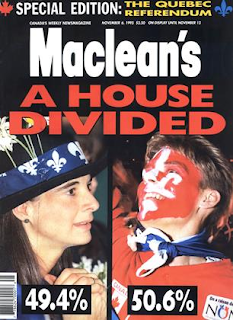
   It was a very important event and I was reminded of it by an email I received this morning from Maclean's. It is a very good magazine, by the way, and you should subscribe to it and pay more attention to Canadian affairs which, admittedly are not quite as, shall we say,  baroque as those south of our border. A portion of the email is appended:

ANNIVERSARY OF THE DAY: Twenty-five years ago today, Quebecers nearly voted to leave Canada. A stunning 93 per cent of eligible voters cast a ballot for either "Oui" or "Non," and the nays won the day with a margin of a little over 1 per cent. "So near and so far for sovereigntists, and so uncertain and unsatisfying a result for both sides," wrote Anthony Wilson-Smith in Maclean's.

   The email included a link to the article in Maclean's written at the time: "A House Divided: After A Narrow NO Win, Federalists Fear That the Real War is Only Starting," Anthony-Wilson Smith, November 6, 1995. Snippets from the article are provided below. Let us hope that the headlines from the election next week are not similar to the one noted above and the results more satisfying and certain.

It took 128 years to make Canada into the country that it is today—and 10 hours of voting and a margin of only 53,498 votes to almost break with that past and reshape both the map and the country’s future. No, 50.6 per cent, total votes: 2,361,526. Yes, 49.4 per cent, 2,308,028 votes. In however much time remains to Canada as a united country, those figures are likely to stay burned on the consciousness of federalists and Quebec sovereigntists alike. By that narrowest of margins, the dream of preserving one existing nation almost died on Monday night, and the dream of building a newer, smaller one within Quebec was thwarted—for now. “The people have spoken, and it is time to accept that verdict,” said a clearly relieved Prime Minister Jean Chrétien early Tuesday morning, when it finally became clear that the No side had won. But, said Quebec Premier Jacques Parizeau, in a defiant speech that was in sharp contrast to Chrétien’s attempt to make peace, “the battle for a country is not over. And it will not be until we have one.”


So near and so far for sovereigntists, and so uncertain and unsatisfying a result for both sides. The vote result means that Canada survives—by the barest of margins, and, perhaps, for the briefest of periods in its present form. The final result, which took close to four hours to record, showed the two sides divided by fewer than 54,000 votes out of a total of 4,669,554 cast, and the province riven by cleavages along linguistic, ethnic and regional lines. Montreal, the metropolis and economic motor of the province, voted massively No: the rest of Quebec, with the exception of the Ottawa Valley region, went strongly to the Yes side. Montrealers and ethnic and anglophone voters joined together to defeat Yes voters who were overwhelmingly francophone native-born Quebecers from other regions.

The Bonus:

   Paul Wells writes often and very well for Maclean's and you can read his posts without a subscription, but I won't provide the link since you should subscribe. He went to Western and I will have to ask some of my old friends in the Political Science Department if they have any good stories about him.

   I kept my subscription to Maclean's even after the humour column by Scott Feschuk was dropped. Fortunately you can read some of Feschuk's posts here. For those of you who insist on following the antics of President Trump, read what Feschuk had to say in this post back in 2017: "Scott Feschuk Unpacks Donald Trump's Totally Awesome Just-Trust-Me Tax Plan."

   Feschuk also went to Western and you can read more about him in this article by Brent Holmes, "Faces of the Gazette: Scott Feschuk,". One of his books, by the way, looks like required reading: The Future and Why We Should Avoid It.

  I wrote earlier about another Maclean's columnist, Allan Fotheringham and you can read it here: The Death of Dr. Foth.