Showing posts with label London Ontario. Show all posts

Sunday, 6 October 2024

London Lost A Fortune

The Curious Case of Peter Birtwistle
   I have a reference to this gentleman for reasons I don't recall. He was a successful jeweler in London, Ontario in the early part of the last century. When I went searching for information about him, I found some, but nothing from local sources or newspapers. My search was limited to electronic resources that are available from my chair. 
   Perhaps someone associated with The London & Middlesex Historical Society might try firing up a microform machine and having a look through the local papers. One of the references I provide below (from a Florida newspaper), cites a London Free Press article from 1920(1).  A cursory search has not yielded any historical articles about him.
 
Why should one bother with Mr. Birtwistle?
   One reason would be to try and figure out why this wealthy bachelor decided to leave all his money to Colne in Lancashire rather than London in Ontario.
  Here is what I have found from the sources provided below.
  Birtwistle emigrated (twice) from England. According to the brief history found on the Colne website, he partnered with a Joseph Pickles here in London. He became one of this city's most successful jewelers and was a well known diamond merchant. His business was at 113 Dundas Street, the ground floor of which was occupied by the Winslow Brothers shoe store. He later moved to 116 Dundas and lived above the shop(3d). If the current street numbers are similar, the location would be in the block where Kingsmill's used to be. 
Like most rich Canadians, he spent the winters in the south.
   What did the wealthy bachelor plan to do with his money when he died?
  There is one reference which indicates his niece was to be his beneficiary, but they quarrelled and she left for Australia (3d).
   The next suggestion is that the inheritor was to be the St. George's Society. It is found in the source mentioned just above, which also states that he was president of the London society from 1901 to 1907. Apparently he had a disagreement with the Society as well. When Birtwistle died in 1927, the Border Cities Star reported that: "According to the Trust and Guarantee Company, it had originally been Mr. Birtwistle's intention to leave this sum in trust for the benefit of the aged poor of London, Ontario, but certain disagreements which occurred later, notably what is known as the St. George's Society incident caused him to alter this determination(2).
   Although Birtwistle was a charitable chap, he must have been a bit touchy since there was also an incident with his next intended beneficiary, the city of London. In the 1935 Border Cities Star article it says that "the city of London was reported to be named the sole beneficiary in his will, but following disagreement with the city officials his home town was named to receive the estate."
   In 1941, when officials from his hometown of Colne showed up to attempt to get the money, the headline of a related article refers to the dispute with someone representing the city of London: "London Estate Is Sought Now For Colne, Eng.: Late Jeweler's Fortune Lost to Adopted City Because of Old Slight," Globe and Mail, Mar. 11, 1941.It begins with this sentence: "A real or fancied offense of certain citizens of London, Ont. in 1907, cost that city's aged and needy poor a sum of over $600,000 , which may now be turned over to a town in England..." It is further noted that, "The nature of the "offense" is not known. Some claim that it was a disagreement between a wealthy bachelor jeweller and city officials over city audits." 
   Colne was the heir chosen as you will see by looking at the related websites.           Apart from his alleged argument with the city, or the "incident" with the St. George's Society, perhaps he just wanted to leave the money to a place in his homeland, since an affection for it is suggested by his membership in the Society. It appears that the local branch still exists and if their records do as well, maybe more can be learned from them.
    Birtwistle had the money placed in trust for 21 years which explains the rationale for some of the articles provided which are listed in chronological order. There are four articles from 1935 because officials from Colne came asking that the money be released because of the depression. In 1941 they came again because the money was needed because of the damages caused by the war.
   The Supreme Court judgment from 1938 concerns the tax issues related to the Birtwistle Trust and a link to it is provided.
   It may be that an historian (or a historian, if you prefer American usage) has studied this issue and was overlooked by me. If not, and you decide to do a little investigating, make sure you search for "Birtwistle" since it can easily be replaced in searches by "Bir
DwHistle."


Current Colne Websites
The Peter Birtwistle Trust is a Registered Charity and Registered Social Housing Provider (RSH no 5086) based in Colne, Lancashire. 
Peter Birtwistle Retirement Housing Site.

Sources:

1. 1920 
"Lakeland Visitor Gives Old Folks of His Town a Tea Each Year," The Lakeland Evening Telegram, Feb. 23, 1920. Here is a screen shot and it indicates that the Free Press is the source.


2. 1927
"Million Left to Poor Folk: Former London Man Wills Estate to Native Town," Border Cities' Star, April 27, 1927. [ The Border Cities Star was a Windsor, Ontario newspaper. An apostrophe sometimes appears in the title - Cities' .]

3. 1935
a) “Colne Dignitaries Here Today Seeking Bequest For Town," Toronto Star, May 30, 1935.
b) “$1,000,000 Bequest For English Town: London, Ont. Jeweler Left Money To Accumulate Interest,” The Globe, May 31, 1935.
c) “Mayor of Colne in Canada,” The Manchester Guardian, June 1, 1935.
d) 
"Seek Estate of Londoner: Thousands Bequeathed to Lancashire Town by P. Birtwistle - Payment Deferred: Delegation Asks Money In Advance Because of Depression," Border Cities' Star, May 31, 1935.

4. 1938

5. 1941
“London Estate is Sought Now for Colne, Eng.: Late Jeweler’s Fortune Lost to Adopted City Because of Old Slight,” The Globe & Mail, Mar. 11, 1941

6. 2018
Millionaire's Legacy Lives on With 12 New Bungalows in Colne," Nic Marko, Lancashire Telegraph, March 18, 2018.
"Pendle Enterprise And Regeneration Ltd (PEARL) has completed the construction of the £1.4million housing development at Carry Lane for the Peter Birtwistle Trust.
The Trust was founded by Peter Birtwistle who emigrated from the UK to Canada but left his entire fortune to provide housing for people in his home town of Colne when he died in 1927."

Post Script
   
In Mulcahy's Miscellany I have provided a few historical posts about London, none of which would constitute much of a threat to the real historians of this city. Two of them relate to London during the period when Birtwistle resided here (at least during the summer.) This, slightly frivolous one, at least illustrates how one can find out about London by searching papers from places far away - those places where more resources from the past have been digitized - "Lonely in London c.1920." Another is about the KKK - "Verminous Missionaries."
   I mentioned Kingsmill's above and was pleased to see that the picture of the inside of that store, buried in one of my posts, still exists. If you click on the image in "Detour", you will see an example of the elegance that once existed on Dundas Street. 

Tuesday, 17 September 2024

Nature Writing (3)


The Wainwright Prize
   It is still much too nice outside to be blogging, so I will simply mention here some books which will be good to have once we have to retreat to the great indoors.
   Since Mulcahy's Miscellany has a small audience, I will cater in this case to the very small one that consists of the declining number of those in London,Ontario who maintain an affection for nature and Great Britain. The Wainwright Prize is a literary one, awarded for writing about nature and the outdoors in the now, not so United Kingdom. Here are some of the books.

Late Light, Michael Malay (the top prize.)
The Blue Machine: How the Ocean Works , Helen Czerski (a winner in the conservation category.)
Foxlight, Katya Balen, ( a novel for your grandchildren.)
And even some CANCON:
Fire Weather: The Making of a Beast, John Vaillant. 

Additional Reading For Nature Lovers:
   The number "3" in the title above indicates there are others and here they are:
"
Nature Writing (2) - British Version," discusses the Wainwright winners back in 2018.
"Nature Writing: Books That Have Won the John Burroughs Medal."
  Also back in 2018, this post provides the winners of an American Prize - "The John Burroughs Medal For Distinguished Nature Writing." 
For some other related books see, "Environmental Books" from the University of Washington Press.

More CANCON:
  The painting above is by Paul Peel and it depicts a natural setting in London, Ontario, known as "The Coves." It was displayed recently at a meeting of those who are trying to protect the area. For more see: "Friends of the Coves."

Wednesday, 8 February 2023

Crickets and Conspiracies


About the Conspiracy  

 I just uncovered a note to myself from back in the summer. In it, I had noticed a CBC article about a conspiracy involving the crickets now being raised in a factory here in good old London, Ontario. Apparently these little livestock are part of a "sinister totalitarian plot" promoted by a "cabal of shadowy elites" who "are trying to force us to eat insects. Seriously. 

   It is likely that you may have missed the article, so I will resurrect it here and present it as proof that conspiratorial thinking also occurs north of the border. As well, I will provide additional cricket information. The rationale for doing so is not obvious, so I will make it so. I have already written about our new cricket factory and about the consumption of them and other insects (see, Entomophagy.) If you combine the information already offered with what is about to be presented, you will have amassed a considerable amount of information about crickets. That will likely surprise you, but not nearly as much as I was surprised to learn that I am again writing about crickets. 

   What follows will not be so convoluted and will be presented like PowerPoint points, rather than in long, quirky sentences. Sources are provided, as usual, so you can go directly to more reliable and better written material. The short points follow this long introduction about the CBC piece.

The CBC Exposure

   The CBC title is a good one and should serve as a piquer (that is not a French word, but an invented one of mine. It should pique your interest.) "HOW A LONDON, ONT., CRICKET PLANT FOUND ITSELF AT THE HEART OF AN INTERNATIONAL CONSPIRACY THEORY, 7 DAYS AFTER THE FACTORY WAS BUILT, IT WAS FALSELY IMPLICATED IN A GLOBAL CONSPIRACY." by Colin Butler, CBC, Aug. 29, 2022. 

   It is quite long and well done. A timeline relating to the spread of the theory is offered as well as some comments by a professor here in London who teaches about conspiracies. A link is provided above, but here are some bits that may pique your interest. It's a conspiracy theory, so needless to say, the WEF, Jews and deniers of all sorts are involved. If they have their way, you will no longer be eating beef tenderloin.

   "The conspiracy theory has been circulating for months, amplified and published by hawkers of online misinformation in Canada and elsewhere in English and Chinese, often with the falsehood growing more sweeping or outrageous with each iteration. 

Those spreading the myth aren't just online bloggers and anonymous social media accounts. The falsehoods are also spread and tweaked by a number of political operators to suit their agenda, including the Alberta separatist movement and politicians like a sitting MP and a Conservative Party of Canada leadership hopeful. 
CBC News charted the history of how this conspiracy theory grew, from a single tweet by an Ontario construction company to being used as rhetoric in the Conservative Party of Canada leadership campaign. 

The timeline of the theory's growth
The entire thread begins simply enough with a tweet on June 10 from the Toronto-based construction company Ellis Don, announcing it had just completed work on the world's largest cricket production facility. 
The information was picked up a week later by Awakening Canada, a Facebook group that posts misinformation about the pandemic and conspiracy theories about the World Economic Forum.

The June 17 post was published shortly after midnight, asking: "Are you guys ready to eat some crickets welcome to communist Canada." It got 10 shares among the page's 4,600 followers. 

Eight hours later, the false information was repeated by Mike McMullen, a London, Ont., political candidate who ran for the People's Party of Canada in the last federal election, and a candidate for city councillor in this October's municipal elections...."

False info persists
Back on June 17, information about cricket consumption for humans continued to be shared on Facebook in Chinese on this page. According to Facebook's translation algorithm, followers are told the cricket factory is part of the "'Great Reset' agenda to stop the people from owning everything and implement the major food chain." 
On June 18, a similar post appears on Black Sheep Truth Media, a Facebook group that features numerous conspiracy theories with the caption: "The planned food shortages now offers a solution. Not to worry now, there will be plenty to eat folks."

The information has been reaching more people, with at least 292 shares and 164 comments among the page's 30,000 followers. It is also flagged as false information by Facebook after being singled out by independent fact checkers. 

Next, on June 22, the conspiracy is repeated by Tanner Hnidey, the vice-president of economics with the Alberta Prosperity Project (APP), a provincial separatist group. 

Hnidey posts a video to his personal Facebook titled "We're going to keep eating Alberta Beef!" 
"I do not intend to eat crickets or bugs for breakfast," Hnidey says in the video, falsely claiming the federal government is trying to replace beef with insect protein...."

On July 9, federal Conservative leadership hopeful Leslyn Lewis wrote a blog post with the heading, "Is animal meat being phased out?" that hints the cricket plant is part of a larger plan by the federal government to phase out meat.....

[The comment by the professor about all of this:]

"CBC News shared the timeline of the conspiracy theory's growth with Alison Meek, an associate professor of history at King's College at Western University in London, Ont., who studies conspiracy theories. 
She said the false information taps into a growing anti-government sentiment, playing on the fear and isolation many felt during the darkest days of the COVID-19 pandemic when authorities were imposing sweeping lockdowns and health restrictions that upended many people's daily routines. 
Meek said it's clear from the timeline that the false information was twisted and manipulated by each person who spread it, adding or taking away details in order to create propaganda to suit their own agenda."

--------------

   The timeline related to the cricket conspiracy has continued into this new year.  Here is the first paragraph from an article in the publication, American Thinker:

"Give up cheeseburgers, and eat bugs instead.  That's what the Davos elite want you to do, while they dine on $50 burritos and slabs of steak.  They would even have you feel good about being a meat- and diary-free insectivore.  To this end, they have carefully manufactured the cult of environmental alarmism, whose virtue-signaling adherents have been duped into thinking an ecological disaster is at hand." From, "Let Them Eat Bugs," Janet Levy, American Thinker, Jan. 23, 2023.


More Cricket Material

The Construction of the Cricket Factory
   EllisDon did construct the factory and the announcement is found here:

About Aspire - The Cricket Company
   The company website is useful and it announces that, A growing population and increasing demand for food and raw materials requires sustainable, scalable solutions that keep our world healthy.

Canadian Government Support For Aspire
   It is the case that the company received government funding in the summer of 2022. "Investment in State-of-the-art Facility For Aspire to Support Sustainable Food Production," Agriculture and Agri-Food Canada, June 27, 2022.
"The Canadian agriculture sector continues to develop innovative ways to meet the demand for more sustainably grown food. Today, Francis Drouin, Parliamentary Secretary to the Minister of Agriculture and Agri-Food, announced on behalf of the Honourable Marie-Claude Bibeau, an investment of up to $8.5 million for Aspire to support the building of a commercial facility to produce cricket protein.
Alternative sources of protein such as insects provide an opportunity for Canada's agriculture and agri-food sector to more sustainably meet global demand for food. Aspire's goal to tackle global food scarcity led to its focus on edible insect production, which can provide high volumes of nutritious food with a low environmental footprint.
With funding under the AgriInnovate Program, Aspire will use the latest smart technology to create the ideal growing conditions for crickets at its facility in London, Ontario. This investment will allow the company to monitor and grow billions of crickets at a time, producing a nutrient-rich protein for premium health food and pet markets. The technology will also significantly cut Aspire's cost of production, making its products more attractive for sale in domestic and international markets."

WEF Support For Insect Eating
   Early in 2022 the WEF did publish this report: "5 Reasons Why Eating Insects Could Reduce Climate Change," Feb. 9, 2022. The link is provided. It is noted that the report has been under attack: 
Help us prevent the spread of disinformation
This article has been intentionally misrepresented on sites that spread false information. Please read the piece for yourself before sharing or commenting.

The World Economic Forum is committed to publishing a wide array of opinions. Misrepresenting content diminishes open conversations.
Our consumption of animal protein is the source of greenhouses gas and climate change.
Insects are an overlooked source of protein and a way to battle climate change.
The consumption of insects can offset climate change in many ways.

Thinking About Entomophagy?
   See this video offered by the New York Times: "The Joy of Cooking (Insects)," Tala Schlossberg, et al, (no date) 
Mealworm soup. Chile-lime cricket tacos. Charred avocado tartare with ant larvae.
"In the West, edible insects have long been the domain of food adventurers, with few other takers — even as billions of people elsewhere on the planet count insects as a part of their traditional diets.
But as we explore in the Opinion Video above, a growing tribe of environmentalists, academics and entrepreneurs are arguing that edible insects must enjoy a wider acceptance to help create a more sustainable global food system and save the planet."

"Salted Ants. Ground Crickets. Why You Should Try Edible Insects," Carolyn Beans, Washington Post, Nov. 27, 2022. 
"Sanchez encourages people to eat insects, in part, to lighten environmental footprints. Farmed insects produce far less greenhouse gas and require much less land and water than conventional livestock. Insects also generate more biomass with less input. Crickets, for example, are 12 times more efficient than cows at converting feed into edible weight.
Already, 2 billion people eat insects, according to one estimate — primarily in parts of Africa, Latin America and Asia. The practice dates back millennia. “I always thought, even back in the ’90s, someday, maybe, [Americans] will do this,” Sanchez says."

Thinking About Getting Into the Cricket Business?
   Here is an abstract of a market research report indicating billions can be made. 
"Edible Insects Market by Product (Whole Insect, Insect Powder, Insect Meal, Insect Oil), Insect Type (Crickets, Black Soldier Fly, Mealworms), Application (Animal Feed, Protein Bars, Bakery, Confectionery, Beverages), and Geography—Forecast to 2030’, provides an in-depth analysis of the edible insects market in five major geographies and emphasizes on the current market trends, market sizes, market shares, recent developments, and forecasts for 2030. In terms of value, the Edible Insects Market is expected to reach $9.60 billion by 2030, at a CAGR of 28.3% during the forecast period 2022–2030. In terms of volume, the Edible Insects Market is expected to reach 3,139,035.10 tonnes by 2030, at a CAGR of 31.1% during the forecast period 2022–2030.
The 237 page report will cost you $4,175 (US).

The Bonus (finally)
  For another example of conspiratorial thinking in London, see my post about 9/11.
  You probably failed to notice that the name of a food writer above is "Carolyn Beans", an example of an aptronym.

CRICKET
  For those of you who thought all of this might be about the sport, see my "Sports News From Elsewhere." You will learn that real money can be made in cricket. 
  If, on the other hand, you don't know a "googly" from a "lolly" see: "15 Corker Cricket Terms, Deciphered", Angela Tung, mentalfloss.com, May 5, 2016.

Friday, 24 March 2017

Joy in Mudville

Golfing in London
    It was announced in the London Free Press today that the municipal golf courses will be opening on April 4. That is good news since the assumption is that spring is near, although most of us will likely watch more golf than play it until well after the magnolias have bloomed at the Masters. It is good news, as well, that the courses still exist since about a half-dozen years ago the city considered selling them. One of them, Thames Valley, is particularly pretty and as advertised, is actually in a valley along a river. Even the game of golf does not spoil a walk around it.


Thames Valley in the 1930s
    I mention all of this because I ran across an article from almost 80 years ago which indicates that the City Fathers (and they probably all were), were no wiser back then, although the need for cash for the city was probably greater given that this was the during the ‘Dirty Thirties’. Here is what a columnist had to say about the proposed sale:


Let’s hope that golfers in London, Ontario, will rally round to keep the civic fathers from doing any more than just considering the closing of that city’s famous municipal course at Thames Valley and selling the land. The 27 hole Thames layout is probably the finest municipal links in Canada, and no less an authority than Gene Sarazen a few years ago described it as one of the finest public courses in North America.
  Thames Valley’s case is the old story of a low-fee public club being the developing ground and feeder for private clubs. Business at Thames Valley has been slumping ever since the new Sunningdale course was opened, and, although the municipal course has never cost the ratepayers a cent in taxes, storm signals have been sent up by the Public Utilities Commission, which operates the links. Thousands of golfers throughout Ontario who have enjoyed the Thames test of golf, as well as its scenic beauty, will doubtless join the writer in hoping that this fine course can be saved.
(“Diggin' Divots At the 19th,” Roche, Bill. The Globe and Mail, Sept. 30, 1937, p.19.)


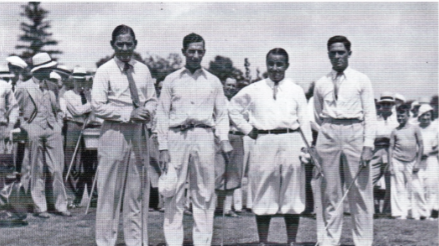
   I found the Sarazen description interesting and wondered why and when he might have visited Thames Valley. I learned that he was here in 1933 as the photograph below indicates and it was probably because he played in the Canadian Open that year, which was won by the Aussie in the photo - Joe Kirkwood. Apparently Sarazen won the match at Thames.
From left to right, Joe Kirkwood, Sandy Sommerville, Gene Sarazen and Jack Nash pose for a photo on the first tee Of Thames Valley prior to their opening day match. July 29, 1933.


    All of this information is provided by John Cowie and can be found in his book: From Rough to Fairway: The First 85 Years of the City of London Golf Courses. An excerpt of the book (along with the photo above) is found on this website: History of London and Area Golf Courses, with which Mr. Cowie is associated. [c 2024 - this link still works, but may be compromised. The information is still viewable, but use with caution since there appears to be an attempt to redirect to India.]


    Anyone interested in golf in this area should have a look at History of London and Area Golf Courses. [ see above.] It answered for me this question which I have often asked: “Wasn’t there a golf course on Gainsborough Road, on the north side before you get to Hyde Park?” The answer is “Yes”.


Additional sources:
    Information about the proposed sale of some or all of the courses back in 2011:
“City May Sell off One Golf Course ; London Assets: Revenues are Declining and a Report Says the Market is Overbuilt”, Patrick Maloney, The London Free Press, Sat. Jan. 15, 2011.Page: A3.
“Give Links Away, City Told ; Public Golf Courses: A Realtor Says Unloading Courses Would Be More Profitable For the City, But Others Say That’s Not the Answer to a Saturated Market,” Jennifer O’Brien, The London Free Press, Jan. 17, 2011, p.A1.
A response to the above: Letters to the Editor Column, The London Free Press
Sat Jan 22 2011 Page: E3. This good letter by Mr. Phil Gingrich offers strong reasons for keeping the municipal courses.


    The 1933 article by Mr. Roche was found in The Globe and Mail, as indicated. I am not sure what was written at that time in the London newspaper about the proposed sale since it is only available on microform.
    Mr. Roche, by the way, was born in Forest and worked for a time at the London Advertiser. He later joined the staff of The Globe and Mail and worked there until his retirement in 1958. He covered hockey as well as golf and wrote: The Hockey Book: The Great Hockey Stories of all Time, Told by the Men Who Knew the Game the Best. For an obituary see: “W.V. (Bill) Roche: Book Told Anecdotes About NHL Players, The Globe and Mail, June 26, 1962, p.30


    He is buried just up the river from Thames Valley in the Mt. Pleasant Cemetery.