Showing posts with label books. Show all posts

Tuesday, 21 April 2026

Blake Whiting - The Author - Does Not Exist

   I am still in the Comox Valley which is why I have not been doing much blogging. There are many better things to do, but it is cloudy this morning so I will produce something for those who are eagerly awaiting more prose from me, and for a few others who may be mildly curious about whether I still exist. I will finally get back to the subject of books.
   If the title has prompted you to search for "Blake Whiting", you will have found a baseball player and a lawyer and likely an obituary-or-two. You will not have found anything about the prolific author of the many books found on Amazon and elsewhere which appear under that name. Here are some samples from goodreads and more can be found on Amazon.

   I also have not been doing much reading while roaming around Vancouver Island, but I did notice an article and it is worth calling to your attention. If you are not interested in books, I will mention Artificial Intelligence (AI), which is the actual author of the books supposedly written by Blake Whiting. Who is behind Blake Whiting directing AI queries is not known at this point. Basically if one chooses a subject and a few books and articles related to it, AI can absorb the material and produce something which is not exactly plagiarism, nor is the resulting book actually  a 'new' one about the topic. It is best not to buy these books which are compiled from the work of real authors. Regard them as coal mine canaries since many more by other 'authors' will soon be available.

Source:
  "Who Is Blake Whiting?: 
The Most Astonishingly Productive Historian in Recent Times is Someone You’ll Never Meet," by Andrew Lawler, The American Scholar, April 16, 2026.
   "No living American historian is as prolific as Blake Whiting. In one week alone last fall, he published 13 books on a host of complex archaeological and historical subjects, ranging from the collapse of Near Eastern civilizations in 1177 BCE to the recent discovery of a huge Silk Road–era city in Central Asia.
   Amazon sells his hardbacks for $28.99, the paperbacks for $20.99, and the Kindle versions for a bargain $7.99. What you can’t buy from Amazon at any price, however, is Blake Whiting’s CV. Though the books claim to be copyrighted in his name, you won’t find an author picture or bio, nor will you find his website or Instagram. He does not belong to the faculty of any college or university, and he is unknown to those academics he cites in his books—which are not actually copyrighted.
   Whiting, as you have guessed, is neither historian nor human. His fake persona is harbinger of an alarming trend threatening disaster to academics and journalists alike.
   I know this all too well; I am a science and history author who has published extensively on many of the subjects covered in Whiting’s books. I have written magazine features that have been clearly reshuffled, reorganized, and supplemented with other freely available material to masquerade as the unique work of “Blake Whiting.” This is not plagiarism in the old-fashioned sense, in which a few sentences or paragraphs are lifted from a previously published work. This is word-laundering on a truly industrial scale, aided and abetted by one of the world’s largest corporations. Using AI tools and a pseudonym, unknown culprits are now profiting from my work and that of my colleagues."

Tuesday, 24 March 2026

Book Promotion

 Advertising and Books

   Promoting a book is harder than publishing, or even writing one. According to Publishers Weekly, about four million of them were produced in 2025, which means that being an author is somewhat easier than becoming an astronaut. The hard part is getting a reader to choose your book from a pile of 4,000,000 of them.

   I thought of this while reading the March 2026 issue of The Atlantic, which I am pleased to promote. The articles in this issue are first-rate. Even the advertisements are good and are our subject for today. Some of them were full page promotions for books. 

One of These Ads Is Not Like the Others

   You may have been watching Sesame Street, rather than reading a book, and remember the song containing the words above. Your task is to look at the four book ads below and identify which one is different.

1.

2.


3.   


4. 

And The Answer Is?
   
The most obvious answer is #3 since the ad is for six books rather than just one. The less obvious answer and the one I prefer is #4. 

   The book about Lincoln is published by W.W. Norton & Company. The Deserving is published by Bloomsbury. The six books in #3 are published by Princeton University Press.  It is usually the case that full page advertisements for books are paid for by publishing companies or university presses.

   The ad for Isabel, Anacaona & Columbus’s Demise: 1498–1502 Retold, by Andrew Rowen was likely paid for by Andrew Rowen. All Persons Press appears to be a publisher solely for Andrew Rowen publications. There is nothing wrong with this at all and I am glad to assist author Rowen by promoting the prequels to the work above: Encounters Unforeseen:1492 Retold and Columbus and Caonabó: 1493–1498 Retold.
   
One of the reasons self-promotion is resorted to is, as I mentioned when I wrote about the Washington Post, that there are now few book reviewers around to go through the four million produced. I found very few reviews for the books of Mr. Rowen and know about them only because I read the full page advertisement in The Atlantic. 
   
You now may be curious about the cost of a full page ad in a national magazine. That is difficult to determine and the rate provided for a person is likely less than the one quoted for a publisher. I will say, however, that the number is a big one.
   Mr. Rowen is apparently a Harvard Law graduate and a retiree from a New York city law firm. He seems to have had the means to spend a lot of time in the Caribbean doing research for his books and enough left over to promote them. He should not be blamed for that and I do hope he recovers his costs and carries on. 

Thursday, 22 January 2026

Anaïs Nin's Library

    I will do this quickly in order to push the unpleasant post below, farther down the page. This one will be the third in a row about a private library assembled by a woman; the last two belong to Geraldine Brooks and Louise Penny. Here is what Nin's library looks like.


  Given Nin's interests, one can say that this is a library for adults only. If now you are interested, then simply go to the Wikpedia entry for Anaïs Nin, where you will likely spend the rest of the day. There is little need for me to say much more since you will surely go deep into the erotic rabbit holes hinted at in the article provided. She had, for example, two husbands (at the same time), one in the east and another in the west, which she referred to as her "bicoastal trapeze."


This is the outside of the house in Los Angeles. It was designed by Eric Lloyd Wright, whose grandfather was Frank and the Wikipedia entries for both will provide you with more interesting content than I am offering. 


    Her full name is, by the way, Angela Anaïs Juana Antolina Rosa Edelmira Nin y Culmell and she was a flamenco dancer, who also practiced psychoanalysis and slept with her psychoanalyst, Otto Rank. 
    To provide a bit more content, which will push the unpleasant subject below out of sight, I will mention an earlier post about people with Very Long Names
    
I have also written often about Single-Author Journals and Nin has two devoted to her: Anaïs: An International Journal and A Café in Space: The Anaïs Nin Literary Journal.
    If you are new to the subject of erotica, see my: "Erotica: A Beginner's Guide."
    I have also done several posts about collections of books by men. See, for example, "Boys With Books."
Source: 
 "Anaïs Nin’s Los Angeles Hideaway Still Keeps Her Secrets: Shrouded by the pines of Silver Lake, the erotic writer’s minimalist, midcentury residence is a lasting monument to her life and legacy," Kurt Soller, The New York Times Style Magazine, March 21, 2022. 

Wednesday, 17 December 2025

Libraries and Christmas Shopping

   Doing this post will give me an excuse to avoid shopping. Reading it will have the added benefit of allowing you to avoid shopping. As a bonus, I will provide you with some gift suggestions, which could be useful if you ever get around to going out. 


Oxford Libraries
   I have documented the decline in the number of libraries on the campus close by, along with the reduction in the quality of collections held within them. While Oxford clearly had a head start when it comes to libraries, it is unfortunate that Western stopped paying much attention to them. At least we can still read about libraries. Here is a link to, Oxford Libraries Architecture. 
  To assist you in making the purchasing decision, see this review: "Timeless Temples of the Written Word: Oxford Might Best Be Described as a City of Books," William Aslet, The Critic, Sept.6, 2025.

   "The Bodleian is the most famous of Oxford’s libraries, but it is far from being the sole subject of this book. Indeed, the Bodleian is actually a collection of 26 different library spaces. Nor are these the only libraries available to scholars at Oxford. Every one of the University’s 39 constituent colleges has its own library, added to which is the Bodleian’s formidable and increasingly popular online offering, Digital Bodleian.
   It is a reflection of the astonishing diversity of Oxford’s libraries that the 46 examples (one at Oxford Brookes) described and illustrated in this book only constitute a fraction of the total number of library spaces that are today available to students and scholars."
   The book can be ordered online, but unfortunately it won't arrive before Christmas and costs over $100.


Biscuits and the Bodleian


Evidence of entrepreneurship is also found among the books at Oxford. The librarians partnered with Sky Wave Distilling, winner of the World's Best Gin, to host a special tour in "the stunning Divinity Schoolincluding a romp through the history of gin and tasting notes to match the gin you will be tasting." Unfortunately that tour is over, but one can still shop at Oxford. Although one can find items cheaper than the book, they also will not arrive before Christmas. Some more examples:


Digital Bodleian
   
The librarians at Oxford are not Luddites. If you cannot afford the book or even the biscuits, and don't want to go out shopping, you can spend this year and even the next one reading the books and manuscripts found by clicking on the link above. You will even find photographs. Here is one of Tom Stoppard, who recently passed.


The Bonus:
  Older and cheaper options will be found in these past posts:
"More Books For Christmas" 
"Books For Christmas"  (more links are found in this one.)

Sunday, 16 November 2025

Another Private Library

Again, this is a post about a personal collection of books, and again the collection is found in New York City. The last one mentioned, which is also located there, belongs to, "The Talented Mr. Towles,", but a more recent one is found in New Mexico - see, "Cormac McCarthy's Library". There are more.


Proving the Point

   This article is from The New York Times Magazine and you should have a look at it since I am focussing only on the books. Many other beautiful objects are described, but there over 4,500 books in the 1,100 square-foot apartment belonging to Peter-Ayers Tarantino.
A Home That Proves You Can Never Have Too Many Books,” Alexa Brazilian.(NYTM, Nov. 16, 2025.)
  The pictures tell the story about the books, but I will quote a few words about some of the many objects found among them.

  “Tarantino has been in his current apartment, which has become a kind of treasure map of his intense and far-flung enthusiasms, since 2018. In the small foyer, painted rain-cloud gray with cream-colored trim, his lizard skin Belgian loafers sit at the foot of a 1920s Japanese tansu chest; on top are twin Moorish wall busts bought in Catania, Italy; above looms a nickel-silver Spanish Colonial mirror. Behind the front door hangs an Ethiopian coming-of-age cape, a cowrie shell-embellished lion’s pelt…”

   “Then there are the books, which not even the wood-paneled living room’s floor-to-ceiling shelves can contain. Tall, neat piles are stacked everywhere: volumes on South American art, on the history of interior design, on British eccentrics, on American Jazz Age writers, on the Ballets Russes.”

   "Despite the apartment’s relatively small size, Tarantino has found a way to accommodate large collections. Above a series of framed Sumatran ceremonial sarongs in the narrow hallway to his bedroom hang more than 50 pieces of headgear — an English boater, a Portuguese fisherman’s hat, the cap of a Tyrolean soldier. Spotlights are positioned to illuminate each." 

   The pictures illustrate the books, but as I indicated, the words in the article describe much more: 
   "But arguably his most striking collection can be found in the small kitchen. Above taupe cabinets and across from an assemblage of framed maps of South America, each with its own picture light (he had 10 outlets wired inside the wall), Tarantino displays his 62 cream-colored ceramic English pudding molds from the 19th and 20th centuries."

The Bonus:
   
There are many comments about this article, most indicating how beautiful this apartment is. There were comments, however, about such practical concerns as dusting and disposing of the items when that time comes. But, one true bibliophile from Copenhagen had this to say:
"I don't know about the 'Peruvian ceramic bowls', but Keith Lowe's 'Naples 1944' is an excellent book about some sadly neglected and tragic events of WW2. Second photo, left side, second shelf from the top, eighth book from the top."

Sunday, 7 September 2025

Back To Books


   To push the post about movies down the page, here is one about books, a frequent subject. The picture below is from a two page advertisement in The New Yorker, Sept. 1&8, 2025. It is typical of many ads these days, in that, for me at least, it is not clear what is being sold. I suppose, however, that more fashionable readers will recognize, right away, that "BRUNELLO CUCINELLI" is not a bookseller, but a purveyor of very expensive apparel. To shop, click here. 


   According to the BC website, the marketing campaign behind the books and other of their ads is that: "The images and words that over the years have accompanied our company’s communication are inspired by our philosophy and the ethical values that are most important to us: the principles of Humanistic Capitalism and Human Sustainability, living in harmony with nature and all its creatures, the preservation and transmission of culture, the commitment to always respect human dignity." There is more. 
  You might think that is mere marketing hype, but Mr. Cucinelli, is actually a lover of books. This is what I found in: "A Day In the Life of Brunello Cucinelli," by Lauren McCarthy, in Harper's BAZAAR, Sept. 27, 2016:

"I like to sit on the couch, surrounded by all of my books. I have 5,000 books in my home, 1,000 of which I feel are close to my heart. They have always shown me the way. Books are my great passion; I could not live without them. If I were to pick a couple out of the 1,000, I would choose Meditations, by Marcus Aurelius. That really showed me the way ahead, as has Plato's Symposium, which is a dialogue on love that was written in the fourth century B.C. in Athens. When my older daughter got married, I gave her my 1,000 favorite books, and I've prepared the same thing for my younger daughter. And now I am preparing 1,000 books for my granddaughter."
  The image above also contains this caption: "Books showed me the way of life." Emperor Hadrian. It does not indicate, however, where such an array of books can be found. 

Saturday, 24 May 2025

Books To Keep Us Going


   Like most airline flights, spring has been delayed and, as I suggested in my last post, it is better to stay at home. If you are interested more in reading about an adventure than going on one (which is a much safer option), then read closely the excerpt below. Before doing so, if you are of the type easily injured by words, you should perhaps look away since it contains one that might hurt you. It is doubtful, by the way, that this man's boyhood dreams are being dreamt by children now. 

   "As I looked round the clearing at the ranks of squatting warriors and the small isolated group of my own men, I knew that this moonlight meeting in unknown Africa with a savage potentate who hated Europeans was the realization of boyhood dreams. I had come here in search of adventure: the mapping, the collecting of animals and birds were all incidental. The knowledge that somewhere in this neighbourhood three previous expeditions had been exterminated, that we were far beyond any hope of assistance, that even our whereabouts were unknown, I found wholly satisfying."  Wilfred Thesiger, The Life of My Choice, p.146.

   Those of you offended by the word "savage" should know that those so-labelled were much admired by Thesiger who chose to live among them, dress like them and suffer along with them. To those of you who can be labelled "anti-colonialists" and think this is yet another older book by a Brit who was somewhere he shouldn't have been, I will say simply that it is not incorrect to suggest that he also was an anti-colonialist.
  The Life of My Choice can be read for free on the Internet Archive or you can pay for it on Amazon. There are books by and about him found in the Western Libraries if you have access. There are even duplicates of some titles in the Western Libraries, which exist for reasons that will not be offered. This biography is recommended by most reviewers: Wilfred Thesiger: The Life of the Great Explorer, by Alexander Maitland. To determine if The Life of My Choice is your cup of tea, read this review from Publishers Weekly where a couple of other books by him are mentioned:
  "Perhaps the last of the great romantic gentleman-explorers, Thesiger, author of Arabian Sands and The Marsh Arabs, here looks back on an extraordinary life. He was born in Abyssinia (Ethiopia) to British diplomatic parents who were friends of Emperor Haile Selassie. Thesiger remembers Addis Ababa, the capital, as a village with grass huts, no roads and colorful ceremonies. He attended Eton and Oxford, then returned to Africa for the first of many journeys, exploring the Awash River (home to the dreaded Danakil, whose warriors killed randomly to prove their manhood and collected their victims' genitals for trophies). As a district officer in the Sudan Political Service, Thesiger had further opportunities to travel in desert lands and meet nomadic tribes. During World War II, he served with Orde Wingate's troops, liberating Abyssinia from the Italians; later, he fought behind the lines in the Western Desert. In addition to superb adventure, Thesiger gives a fine portrait of the waning days of the British Empire in the Sudan and of the last revolution in Ethiopia. Photos."


The Bonus:
   
For those who would rather look at photos than read see: 

Wilfred Thesiger: A Life in Pictures by Alexander Maitland. If you poke around even a little bit you will find enough good reading to keep you busy until the summer arrives, whenever that may be. 
   If you would rather watch than read or look, there are videos that captured Thesiger before he died in 2003. Here is one and others are found on YouTube. 
Wilfred Thesiger's Arabian Sands (in his own words with subtitles- 8 min.)

Thursday, 22 May 2025

A Branch Library For Good Books


Or, A Branch Library of Good Books

   The simple point, I will attempt to make, has been hinted at in both the title and sub-title of this post. I am suggesting that there should be, in a city of this size, one library built to acquire and keep good books. (The making of a simple point should not begin with a parenthetical remark, but for those of you who think the local university library might be the answer, let me know and I will provide another piece on that subject.)
   A silly subject, you are thinking because of the word "good", but I will avoid that issue by supplying this definition of that word from the OED.
  Good is the most general and most frequently used adjective of commendation in English, and one of the most common non-possessive adjectives in all periods from Old English to the present day. Almost all uses convey the sense of being of a high (or at least satisfactory) quality, useful for some purpose (specified, implied, or generally understood), and worthy of approval.
That's it. 
  Although it is likely that the London Public Libraries (LPL) buy the occasional good book and already contain a few, there are some problems that should be acknowledged. One of them is that budgets are limited and the librarians have to purchase books which patrons want and many of those are not good. Pick a very popular recent book and look it up in the LPL catalogue and you may see a message indicating that 50 copies are on order and 25 of them have already been requested. I will not attempt to pick on a title of a book that is not good, but I will suggest there are many of them and many copies of each of them have to be purchased. By the way, that such  books may be on the NYT  Best Sellers List" does not mean they are good. The list is compiled by the Times and the books are popular ones and those, particularly in the fiction category, are generally not considered good enough to show up in a review in the actual NYT. Literary snobbery is not the issue here. Just think of the number of copies of each book that the libraries have to buy from say, James Patterson, who produces many of them on a regular basis. Just think, as well, about the large number of books that now have to be purchased because of the identity of the author, not the quality of the book. Just think, as well, and again of the number of activities and things that librarians and libraries are supposed to do beyond buying and housing books and magazines.
   A new library could be built to house the good books that should be bought and kept. Or, perhaps a more popular option would be to build a new building to do all of the things that "libraries" were not established to do and the project could be given a more popular name as well. Now that I think about it there is already an empty library in London that has been vacant for years. 
   Another problem to address is the one related to the space required for storage since good books should be kept. Storage spaces are far less attractive today than "maker-spaces". To a degree, the space problems have been mitigated somewhat by current LPL policies which, I am fairly certain, cause a great deal of "shrinkage". Those policies will have to be re-examined. I think two things could be considered: 1) There should be penalties if one does not promptly return the good books and 2)
books should have to be signed out, especially good ones. (My concern about these issues was raised long ago in a very long post - "The Mystery of the Missing Books." 


Careful Curation

  The Acquisition of Older Books
   Maybe this portion will be of more interest. I was prompted to think about all of this because of the recent "war" that was declared on us by our southern neighbour. Many lamented over the loss of a friend and I thought of the book, Lament for a Nation: The Defeat of Canadian Nationalism. The LPL does not appear to have a copy, not even one of the 40th anniversary edition from which the following is taken and, I think you will agree, might be interesting to read or re-read under current conditions:

Canadians have relatively few binding national myths, but one of the most pervasive and enduring is the conviction that the country is doomed. In 1965 George Grant passionately defended Canadian identity by asking fundamental questions about the meaning and future of Canada's political existence. In Lament for a Nation he argued that Canada - immense and underpopulated, defined in part by the border, history, and culture it shares with the United States, and torn by conflicting loyalties to Britain, Quebec, and America - had ceased to exist as a sovereign state. Lament for a Nation became the seminal work in Canadian political thought and Grant became known as the father of Canadian nationalism. This edition includes a major introduction by Andrew Potter that explores Grant's arguments in the context of changes in ethnic diversity, free trade, globalization, post-modernism, and 9/11. Potter discusses the shifting uses of the terms "liberal" and "conservative" and closes with a look at the current state of Canadian nationalism.

The Purchase of New Ones
   The person employed to purchase new books has a difficult task, since there are many of them, produced from many different places and publishers and even by the authors themselves. Here are some suggestions from just one author, not named James Patterson. Although the author is a white male associated with the state of Texas, he was the Dean of Law at the University of Texas, which is in Austin and should not really be associated with the state of Texas. I knew nothing about the author, but stumbled upon these books, most of which are not even available at the local university. The librarian should have a good look at the reviews, but they certainly look like good books to purchase for our times. Pictures are provided since they are more appreciated these days than words. 


Post Script:
   While I am at it: Librarians are often criticized for the "progressive" books they are getting for libraries. Overlooked, however, are the "regressive" books they may not be considering. For an example of a book about Canada, published in Canada about Canadian history by credentialed Canadians see the example provided in the post linked below. There are no copies nearby in any libraries. (Now they I have looked this over, I see the books I have suggested may be considered "regressive" because they are about "Classical English" and good writing and proper speaking; rather "Tory" indeed.) Censorship By Other Means.


Saturday, 26 April 2025

Back When Books Mattered

    Premium subscribers to MM who expect at least one hundred posts per month are highly disappointed given that there have been only two for April. They reveal that the author has been on the road and in places that are warmer. It is hard to blog while driving and it is difficult to type while holding a Margarita in the glaring sunshine. 
   Now back in the north on cold day I will offer a post, but do not promise to provide ninety-seven more before Thursday. Those who want a refund can contact me through Rogers Communications where you may have to wait a while before getting through to an operator.
   The subject is books. Admittedly, interest in them has declined and that decline has been documented in MM which, you may have forgotten, trends toward the contrarian. Evidence that people once thought highly of books and even read them is proven below. The example also indicates that those who read were often clever writers. The person who placed this advertisement in The Times is clearly more upset about the loss of a book than the theft  of his sports car.


"Will the kind friend who removed a yellow Perry Coupé from the Winter Gardens, Bournemouth on Wednesday evening last, kindly return the copy of The Rough Road, found in the pocket, to the address on the flyleaf, Chelmsford, as it was borrowed?"
                                                                   The Times, 18, September 1919

   A Perry Coupé is pictured above. The Rough Road is likely the one written in 1918 by Willam J. Locke.

Post Script: 
   
While I attempt to produce more posts, those who are disgruntled and in immediate need of something to read will find a free copy of the book on Project Gutenberg. And if you want more to read right now, here is a summary: 
"The Rough Road" by William John Locke is a novel written in the early 20th century. The story revolves around the life of James Marmaduke Trevor, affectionately known as "Doggie," who is depicted as a rather sheltered and effeminate young man shaped by the overprotective upbringing of his mother. As world events unfold, including the backdrop of World War I, the narrative explores Doggie's transition from a life of delicate comforts to ...."
   You are more likely to be interested in the 
Coupé than the book and if that is the case see these two old posts on MM, while I attempt to manufacture more - if the weather remains cloudy and cool.
Cobble Beach Concours d’Elegance
Cobble Beach and Elegance

Monday, 3 February 2025

Book Trends

 Romantasy
   I don't have much to say about this, but it does indicate that people are reading books. It is also the case that you are likely to appreciate any diversion from the "breaking news."  


   Among my emails this morning was one from The Guardian which contained this news and that picture:
  "Who would have thought that of all the fiction genres available to readers, it would be “dragon smut” that could fly off shelves like nothing else? Last week, Rebecca Yarros’s novel Onyx Storm, the third instalment in her series about horny dragon riders, broke her own record for the fastest-selling science fiction and fantasy title in the UK since records began 25 years ago. 155,141 hardback copies – and thousands more ebooks – were sold in its first week on sale."    

  After reading that email and probably because of it, I then noticed this article, which, coming from a paper on this side of the pond, means that this is probably not fake news. Here it is: "
Rebecca Yarros’s ‘Onyx Storm’ Is the Fastest-Selling Adult Novel in 20 Years: The book, the third in a series, has sold 2.7 million copies in its first week, and provided yet another example of the romantasy genre’s staying power," Alexandra Alter, The New York Times, Jan. 30, 2025. Apparently, "Print sales alone well exceeded a million copies in the novel’s first week, making “Onyx Storm” the fastest-selling adult title since BookScan began tracking print sales around 20 years ago."
   Not only that, Ms. Yarrow was able to attract a crowd of around 1,700 to come and see her on a January night in St. Paul, Minnesota. I suppose this is sort-of breaking news which is also amazing news.


Here is a bit more to indicate that all of this is rather amazing, if not quite as amazing as Harry Potter:
   "Yarros currently holds the first three spots on The New York Times’s hardcover best-seller list, a rare feat for an adult fiction series. On Thursday, the series also occupied the first three spots on Amazon’s “most sold” fiction list.
   The success of “Onyx Storm” also shows that romantasy, which blends spicy sex scenes and romance tropes with supernatural elements, is not a fleeting trend. Last year, the genre accounted for some 30 million print sales, a rise of 50 percent over the previous year, according to Circana." (from the NYT article.)
The Bonus: 
   
The London Public Library System has 23 copies, but there are 172 people waiting to get one. 

Friday, 27 December 2024

Fast Shopping


I saw a reference earlier to "Slow Shopping" which encourages one to take time and buy less impulsively. It is very easy to shop quickly and I was reminded of that today. I read a book review this morning and when I looked for the book, the illustration above popped up. 
  If I ordered within a few minutes, the book would be delivered directly to my door in a couple of hours. In this case, the book is not available in the London area and even if it was, I could have it delivered at a cheaper cost, while avoiding slushy streets and road and mall rage. Given that I may make a resolution next week to buy fewer books in the new year, I did not act impulsively, but may act tomorrow and the book would probably be delivered on Sunday. It is difficult both to shop slowly and locally these days. 


Post Script:
  The book was this one. Ultimately I may have to buy it since it is unlikely to be picked up by the libraries because it runs counter to the current orthodoxy, and will likely not be in the few remaining bookstores.

Friday, 13 December 2024

More Books For Christmas

    Every few years I have suggested some books for your consideration as Christmas gifts. In 2017 I offered choices for those interested in history (see: "Christmas Shopping for Historians.") The list was more diverse in 2022 (see: "Christmas Book Shopping".) Last year ("Books for Christmas") contained some popular choices. There are other book lists from which to choose on MM and you may want to visit them since the older books might be in paperback and cheaper. 
  More recently, in two posts, I told you about books you could read because they were short. Here are a couple to read because you should. I should as well since the two listed I have not read, but will recommend anyway.
   If you are an admirer of Reagan who said, "I've always felt the nine most terrifying words in the English language are: I'm from the Government, and I'm here to help," then you should skip the first book. Reagan
 also thought that, "government is not the solution to our problems. Government is the problem," and the results of the last election indicate that many agree with him. So many, in fact, that perhaps the word "ungovern" should have been the word of the year, rather than "brain rot" which was. 


   The following information is from the Princeton University Press website, which should serve as a warning if you are one of those also suspicious of elites as well as the government. 

Ungoverning: The Attack on the Administrative State and the Politics of Chaos: How a concentrated attack on political institutions threatens to disable the essential workings of government, Nancy L. Rosenblum and Russell Muirhead.

   "In this unsettling book, Russell Muirhead and Nancy Rosenblum trace how ungoverning—the deliberate effort to dismantle the capacity of government to do its work—has become a malignant part of politics. Democracy depends on a government that can govern, and that requires what’s called administration. The administrative state is made up of the vast array of departments and agencies that conduct the essential business of government, from national defense and disaster response to implementing and enforcing public policies of every kind. Ungoverning chronicles the reactionary movement that demands dismantling the administrative state. The demand is not for goals that can be met with policies or programs. When this demand is frustrated, as it must be, the result is an invitation to violence.
   Muirhead and Rosenblum unpack the idea of ungoverning through many examples of the politics of destruction. They show how ungoverning disables capacities that took generations to build—including the administration of free and fair elections. They detail the challenges faced by officials who are entrusted with running the government and who now face threats and intimidation from those who would rather bring it crashing down—and replace the regular processes of governing with chaotic personal rule."

Some of the Blurbs
“Ungoverning is an essential book for our moment, starting with a title that deserves to become a touchstone in our political conversation. Brilliantly drawing together philosophical reflections on democracy’s obligations to its citizens with a lively practical sense of how government works, Muirhead and Rosenblum offer a passionate defense of the now contested work of making our society fairer, safer, and more responsive.”—E. J. Dionne Jr., author of Our Divided Political Heart: The Battle for the American Idea in an Age of Discontent.

"An illuminating — and alarming — book. . . . Muirhead and Rosenblum finished ‘Ungoverning’ before the 2024 election, but Trump’s ludicrous nominations — one already crashed in flames — serve as a sort of publicity campaign for the book’s thesis."—Ron Charles, Washington Post

“Ungoverning provides an unflinching and much-needed look at the threat posed by a new form of politics that actively seeks to undermine the core functions of government. Muirhead and Rosenblum deftly show how this alarming and uniquely nihilistic political philosophy helps define Trumpism and threatens democracy.”—Corey Brettschneider, author of The Presidents and the People: Five Leaders Who Threatened Democracy and the Citizens Who Fought to Defend It.


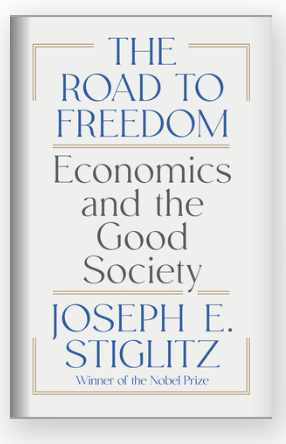
    Once again, if you are a libertarian-leaning, Reagan-lover, you will not like this choice either. The Road to Freedom will also not be liked by those who like,The Road to Serfdom.
   What follows is from the publisher:
   "We are a nation born from the conviction that people must be free. But since the middle of the last century, that idea has been co-opted. Forces on the political Right have justified exploitation by cloaking it in the rhetoric of freedom, leading to pharmaceutical companies freely overcharging for medication, a Big Tech free from oversight, politicians free to incite rebellion, corporations free to pollute, and more. How did we get here? Whose freedom are we—and should we—be thinking about?
   In The Road to Freedom, Nobel prize winner Joseph E. Stiglitz dissects America’s current economic system and the political ideology that created it, laying bare their twinned failure. “Free” and unfettered markets have only succeeded in delivering a series of crises: the financial crisis, the opioid crisis, and the crisis of inequality. While a small portion of the population has amassed considerable wealth, wages for most people have stagnated. Free and unfettered markets have exploited consumers, workers, and the environment alike. Such failures have fed populist movements that believe being free means abandoning any obligations citizens have to one another. As they grow in strength, these movements now pose a real threat to true economic and political freedom."

Blurb-like Comments
"Stiglitz is a rare combination of virtuoso economist, witty polemicist and public intellectual."
New Statesman
"Along with Krugman and Thomas Piketty, Stiglitz forms a triumvirate of leading economic critics of global capitalism, 21st-century-style."
Andrew Anthony, Guardian
"An insanely great economist."
Paul Krugman, The New York Times
"A towering genius of economics."
Independent
"A seer of almost Keynesian proportions"
Newsweek
The Road to Freedom ... seeks to reclaim the concept of freedom for liberals and progressives [and] calls for the creation of a “progressive capitalism'' that would look nothing like the neoliberal variant
John Cassidy, The New Yorker

Post Script:
   
If you think you might be inclined to be a "Stiglitzian" read the review of three of his books in, "Why the Rich Are So Much Richer,"by James Surowiecki, in the New York Review of Books, Sept. 24, 2015
   The Great Divide: Unequal Societies and What We Can Do About Them, by Joseph E. Stiglitz
Norton, 428 pp., $28.95
Rewriting the Rules of the American Economy: An Agenda for Growth and Shared Prosperity by Joseph E. Stiglitz
Creating a Learning Society: A New Approach to Growth, Development, and Social Progress by Joseph E. Stiglitz and Bruce C. Greenwald
Columbia University Press, 660 pp., $34.95; $24.95 (paper)
   "In the years since the financial crisis, Stiglitz has been among the loudest and most influential public intellectuals decrying the costs of inequality, and making the case for how we can use government policy to deal with it. In his 2012 book, The Price of Inequality, and in a series of articles and Op-Eds for Project Syndicate, Vanity Fair, and The New York Times, which have now been collected in The Great Divide, Stiglitz has made the case that the rise in inequality in the US, far from being the natural outcome of market forces, has been profoundly shaped by “our policies and our politics,” with disastrous effects on society and the economy as a whole. In a recent report for the Roosevelt Institute called Rewriting the Rules, Stiglitz has laid out a detailed list of reforms that he argues will make it possible to create “an economy that works for everyone.”....
   After all, the policies that Stiglitz is calling for are, in their essence, not much different from the policies that shaped the US in the postwar era: high marginal tax rates on the rich and meaningful investment in public infrastructure, education, and technology. Yet there’s a reason people have never stopped pushing for those policies: they worked. And as Stiglitz writes, “Just because you’ve heard it before doesn’t mean we shouldn’t try it again.”

Thursday, 24 October 2024

A $100,000 History Book !

The Cundill History Prize

On October 30 the author of an historical work that exhibits "scholarship, originality, literary quality and broad appeal," will receive $75,000 (US) as a result of winning an award established by F. Peter Cundill. His intention is to encourage "informed public debate through the wider dissemination of history writing to new audiences around the world."

The three finalists are listed along with sample reviews. The Cundill Prize Long List for 2024 is provided at the bottom.

Before the Movement: The Hidden History of Black Civil Rights by Dylan C. Penningroth (Liveright Publishing)
"Dylan Penningroth explodes conventional wisdom about African Americans and the law. He approaches his subject with the eye of a law professor, the tools of a social historian, and the sensibility of a skilled storyteller. The result is a remarkable book that stands civil rights history on its head and shows "how ordinary Black people used law in their everyday lives." The Register - Kentucky Historical Society, Vol. 122, No.1, 2024.
Judgement at Tokyo: World War II on Trial and the Making of Modern Asia by Gary J. Bass (Picador/Pan Macmillan)
"A detailed and sharply observed account of the 1946-1948 Tokyo trials – proceedings that were implicitly racist and hypocritical, and with a prosecution team that was led by a ‘blundering alcoholic’....Bass has written a massively long and detailed book, always lively and judgmental. He brings out not only the legal arguments, but the colour of the great tribunal itself: sharp sketches of the protagonists, of the stress on the multinational judges penned up month after month in the Imperial hotel, of Tojo Hideki among the seven shabby old men shuffling to the gallows in Sugamo prison." (Review by Neal Ascherson, The Guardian, Jan. 21, 2024.

Native Nations: A Millennium in North America by Kathleen DuVal (Penguin Random House)
" prodigiously researched and enlightening study from University of North Carolina historian DuVal (Independence Lost) recenters the past 1,000 years of Native North American history around the political power exercised by Indigenous governments...Tracing numerous Native governments across the ensuing centuries--including the 19th century's Cherokee republic and alliance of Great Plains nations--DuVal provides a profoundly empowered history of Native America. This keen reframing will appeal to fans of David Graeber and David Wengrow's The Dawn of Everything." Publisher's Weekly, Jan. 22, 2024.

Sources: See McGill's website for The Cundill History Prize.
  Back in 2017 on the 10th anniversary of The Cundill I posted this in MM -"Christmas Shopping for Historians." See also, "The Cundill History Prize" in 2019 and "F. Peter Cundill" in Oct. 2021.
The Bonus:
For prize winning historical works covering geographical areas from Asia to North and South America, see: American Historical Association Announces 2024 Prize Winners.
The Cundill History Prize 2024 (Long List)

Author

Title

Publisher / Imprint

Gary J. Bass

Judgement at Tokyo: World War II on Trial and the Making of Modern Asia

Pan Macmillan / Picador

Lauren Benton

They Called It Peace: Worlds of Imperial Violence

Princeton University Press

Joya Chatterji

Shadows at Noon: The South Asian Twentieth Century

Penguin Random House / TheBodley Head and Yale University Press

Kathleen DuVal

Native Nations: A Millennium in North America

Penguin Random House

Amitav Ghosh

Smoke and Ashes: Opium’s Hidden Histories

Hachette / John Murray

Catherine Hall

Lucky Valley: Edward Long and the History of Racial Capitalism

Cambridge University Press

Julian Jackson

France on Trial: The Case of Marshal Pétain

Belknap Press

Patrick Joyce

Remembering Peasants: A Personal History of a Vanished World

Simon & Schuster / Scribner

Ruby Lal

Vagabond Princess: The Great Adventures of Gulbadan

Yale University Press

Andrew C. McKevitt

Gun Country: Gun Capitalism, Culture, and Control in Cold War America

University of North Carolina Press

Dylan C. Penningroth

Before the Movement: The Hidden History of Black Civil Rights

WW Norton / Liveright

Stuart A. Reid

The Lumumba Plot: The Secret History of the CIA and a Cold War Assassination

Penguin Random House / Alfred A. Knopf

David Van Reybrouck

Revolusi: Indonesia and the Birth of the Modern World

Penguin Random House / The Bodley Head and WW Norton