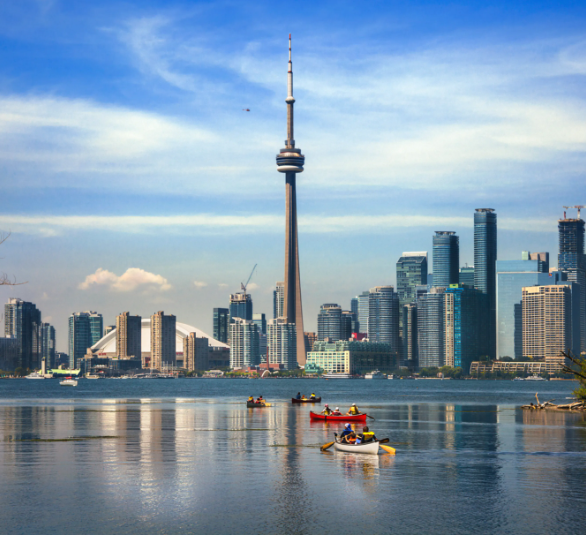
36 HOURS IN HOGTOWN
As the nickname chosen indicates, I have not been kind to Toronto, although I could have picked "Queen City" which, these days would be an even worse one. In MM I have twice referred to Toronto as a "carbuncle" and, as is usually the case, those references are based in ignorance, rather than on any actual knowledge of the subject. I have rarely gone to Toronto in recent years and on those occasions have found nothing to encourage me to revisit.
The fact that the esteemed New York Times had a travel writer visit leads me to believe that I may have missed something and been unfair. As one act of penance I will offer the observations of someone more knowledgeable and you can learn for yourself what Toronto has to offer. As another, I will provide earlier assessments of Toronto and then fully absolve myself by offering all of the other "36 HOURS..." pieces about CANADA that the New York Times has printed during this century.
It is also the case that I am feeling bad for Torontonians given the Maple Leaf loss last night.
We will begin with the recent Toronto article and then look at the older Toronto ones done in 2016 and 2005. The typical "36 Hours..." piece offers basic recommendations about such things as Key Stops, Attractions, Shopping, Eating and Staying. It is also typically the case that the choices are the ones that would be appreciated by a traveller whose expenses are covered by someone back in head office.
The recent Toronto article was done last month and from it, some information has been extracted. The citation is provided and you may be able to get beyond the paywall. That may be the case for all of the other articles as well. Here it is and the one place that might get me to visit is Issues: The Magazine Shop. If I do go, I might try to see the McMichael Canadian Art Collection, but I don't think it is right downtown.
“36 Hours; Toronto,” Ingrid K. Williams, New York Times, April 11, 2024
Recommendations
Key stops
Trillium Park, west of Toronto’s inner harbor, is relatively crowd-free despite having an outstanding view of the downtown skyline.
Sunny’s Chinese, a popular restaurant hidden inside a mini-mall in the Kensington Market neighborhood, serves fun plates like Hong Kong-style French toast with black-sesame jam.
The Museum of Contemporary Art Toronto is currently hosting “Greater Toronto Art 2024,” the second installment of its triennial.
Cry Baby Gallery is an art space with a cocktail bar hidden behind a curtain in the back.
Attractions
Massey Hall, a landmark theater, reopened in 2021 after a three-year renovation and modernization project.
Evergreen Brick Works is a cultural community center with a popular year-round farmers’ market.
The Gardiner Museum is dedicated to the artistry and craft of ceramics.
The Philosopher’s Walk winds through the leafy St. George campus of the University of Toronto.
The Bata Shoe Museum has an unexpectedly fascinating exhibit exploring the history of what we put on our feet.
The Beach (also called the Beaches), on the eastern edge of the city, is a neighborhood abutting Lake Ontario with sandy shorelines and a wood-plank boardwalk.
The McMichael Canadian Art Collection is a sprawling gallery surrounded by acres of pristine woodland.
Zaal Art Gallery has paintings, sculptures and fashion from contemporary Iranian artists.
Restaurants and bars
Patois is a festive restaurant serving Caribbean-Asian dishes like jerk chicken chow mein.
Bad Attitude Bread is a plant-based bakery with specialties like vegan Cheddar biscuits with Old Bay seasoning.
Milky’s, a cool cafe, brews up specialty drinks like a spiced maple syrup latte.
Taverne Bernhardt’s is a cozy neighborhood bistro featuring local produce and rotisserie-style chicken.
Bowie, a vibey bar beneath a laundromat, offers great people-watching behind an unmarked entrance.
Bathurst Local is a laid-back bar with a maze of private karaoke rooms.
White Lily Diner is an all-day restaurant serving comfort food, with produce supplied by its own Ontario farm.
Shopping
Easy Tiger Goods is a sunny boutique that sells cute made-in-Toronto ceramics.
Issues Magazine Shop stocks rare print titles.
Etc Home, a home décor shop, sells hand-crocheted coasters, embroidered tote bags and more.
Where to stay
A solid option downtown, the Ace Hotel opened in 2022 in a newly constructed building designed by the Toronto firm Shim-Sutcliffe Architects. Beyond the lobby framed by soaring concrete arches, the hotel features 123 cozy guest rooms as well as a restaurant and a rooftop lounge. Rooms start at around 499 Canadian dollars, or around $367.
In the trendy West Queen West area, the Drake Hotel is a longtime favorite for its cultural events, concerts and art-filled interiors. With the addition of a new five-story wing, which opened in 2021, the property now has 51 rooms in addition to a popular lounge, cafe and rooftop terrace. Rooms start at around 360 dollars.
On vibrant Dundas Street West in Little Portugal is the family-run Ode, which opened in 2021 with eight private guest rooms, each designed in collaboration with a different local artist. Rooms start at 260 dollars.
Look for a short-term rental in the Trinity-Bellwoods neighborhood, which is surrounded by great restaurants, shops, bars, bakeries, breweries and the popular Trinity Bellwoods Park.
Older 36 Hours in Toronto (2016, 2005)
"36 Hours: Toronto. In this famously diverse city you'll find an energetic food scene, vibrant street culture and cocktail wizardry," Egner, Jeremy. New York Times.13 Nov 2016: TR11.
With just under 2.8 million residents, Toronto is one of the biggest cities in North America, though it hardly feels like it. Even more so than New York, the famously diverse city is less a metropolis than a patchwork of distinct neighborhoods linked by a live-and-let-live-ethos and a vibrant street culture. Long recognized as one of the most livable...
"36 Hours Toronto," New York Times,17 June 2005: F4.
After 40 years of immigration from virtually every country, Toronto has realized its promise as a vibrant picture postcard of world culture. Cafes, clubs, restaurants, theaters, museums and galleries are everywhere, and instead of...
36 HOURS ELSEWHERE IN CANADA
I noticed above that I suggested that this list provides all of the Canadian-related ""36 Hours..." articles that the NYT has printed. There are about a dozen locations included, some of which were visited more than once and they range geographically from St. John's to Victoria, and chronologically from 2002 to the present. They were found by searching the databases provided by Proquest, which also offers the brief abstracts. I may have missed a few.
Those of you interested in seeing how the recommendations have changed over time may find that some of these older pieces are accessible without a NYT subscription.
Banff, Alberta (2002)
"JOURNEYS: 36 HOURS BANFF, ALBERTA"
Headlam, Bruce. New York Times, 29 Nov 2002: F3.
THERE are higher towns in the Canadian Rockies, but Banff in late fall is about as close to heaven as one can get. The breathtaking mountain scenery is highlighted by the dark boughs of evergreen trees, and the town's
Calgary, Alberta (2018)
"36 Hours CALGARY, ALBERTA: Visitors to this Canadian city will find a revived cultural scene, locally sourced menus and ice skating at Olympic Plaza," Glusac, Elaine. New York Times, 04 Feb 2018: TR10.
The construction cranes that pierce the downtown Calgary skyline and nearby neighborhoods suggest a boom on the Alberta prairie. In fact, in the past two years, sagging oil and gas prices have crimped Calgary's economy, which is now showing signs of recovery. Projects underway before the slowdown, including the music museum…
Montreal. (2015, 2010,2006, 2003)
"36 Hours MONTREAL: Whether you want to embrace the season on rinks, trails or runs, or simply head to the spa, this vibrant city has it all," Sherwood, Seth. New York Times, 22 Nov 2015: TR1.
Winter is right around the corner, and when the going gets cold--like zero-degrees-Fahrenheit cold--Montrealers get resourceful. Some dodge Canadian winter amid the heated vapors of the city's Nordic spas or the warming drinks of cozy bars. Others embrace it by skiing and skating in public parks, cheering the hometown...
"36 Hours: Montreal", Lee, Denny. New York Times,15 Aug 2010: TR10.
FRENCH or English? One of the beautiful things about Montreal is that you never know in what language you will be greeted. Which brings up a second tiling: Maybe it's the good food, the open skies or the free-spirited students who call this city their…
"36 HOURS Montreal", Chen, Aric. New York Times, 22 Oct 2006: D12.
MAKE no mistake: visiting Montreal is not like going to Paris. True, the brooding facades and crooked streets of Old Montreal feel distinctly European, and yes, the locals take their French seriously. But don't confuse this cosmopolitan Canadian port city for a fusty, Old World wannabe.
"36 Hours Montreal, New York Times , 13 June 2003: F5.
IF you crave a family trip featuring high culture and haute cuisine but don't want the hassle or the jet lag -- not to mention the air fares -- of Europe, Montreal has it all. Though it is predominantly a French-speaking city, Montreal is not just for Francophiles. It is a cosmopolitan melting pot with more than 100 different…
Mont-Tremblant (2005)
"JOURNEYS: 36 HOURS MONT-TREMBLANT, QUEBEC",Better, Nancy. New York Times, 18 Feb 2005: F3.
If you're dreaming of a weekend getaway to Courchevel or St. Moritz but can't stand the falling dollar--or the flights--consider an alternative: Mont-Tremblant, Quebec. Since 1995, the Intrawest skiing corporation has spent more than $400...
Niagara-on-the-Lake (2002)
"36 Hours Niagara-on-the-Lake," New York Times, 03 May 2002: F5.
THOUGH situated in Ontario only 20 minutes from the thunderous roar of Niagara Falls, it is impossible not to feel light years away from its touristy neighbor up river the moment you enter Niagara-on-the-Lake. Visitors
Ottawa, Ontario (2017, 2007, 2004)
"36 Hours OTTAWA: Ottawa gears up for its 150th birthday bash this year, with exhibits, galleries and a thriving food scene," Scalza, Remy. New York Times, 08 Jan 2017: TR11.
Canada's capital has no shortage of historical charms--from Gothic Parliament buildings to a Unesco World Heritage canal--but it has long been dogged by a reputation as a workaday government center. A weekend in the city, however, proves otherwise. With a thriving food scene, a multicultural and multilingual sensibility owing to its…
36 Hours: Ottawa Arnold, Katie. New York Times, 26 Aug 2007: D11.
OTTAWA has always had image problems. Back in 1867, when it beat out its rivals Toronto and Montreal in a bid to become Canada's national capital, the Governor General bemoaned Parliament's move to what seemed a frontier outpost on the Ottawa River as an "exile to wilder-...
"36 Hours Ottawa," New York Times, 02 Jan 2004: F3.
ARMS swinging rhythmically, briefcase In tow, a skater glides to work over the frozen surface of the 170-year-old canal that winds nearly five miles through the heart of the city. Parents push bundled-up babies across the ice in sleighs; and French- and English-speaking vendors sell hot chocolate at...
Prince Edward Island (2002)
"36 Hours Prince Edward Island," New York Times,16 Aug 2002: F4. FOR decades, tiny Prince Edward Island (population 138,000) has been a recreational haven for Canadians. But why should Canadians have all the fun? Prince Edward Island has all the charm of New England without...
Quebec City (2018, 2016, 2005)
"36 Hours: Even the tourist with little time can squeeze in some of this Quebec city's cosmopolitan pleasures," Glusac, Elaine. New York Times, 07 Oct 2018: TR9.
Its cobblestone streets and French architecture make Old Montreal, the original settlement on the St. Lawrence Seaway, compelling. But Montreal, now 376 years old, also has much to offer in its surrounding neighborhoods. From the new restaurants of Gay Village to the annually updated murals of the Plateau and the trendy shopping...
"36 Hours QUEBEC CITY: In Quebec’s capital, emerging neighborhoods reveal a mix of hip and historic that makes for a wide range of enticements," Williams, Ingrid K. New York Times, 17 Jan 2016: TR12. Quebec City has long drawn admirers to its historic district--the famed ramparts, quaint cobblestone lanes and handsome stone houses. Get swept up in this squint-and-you're-in-Europe charm, however, and you risk missing out on the Canadian city's most compelling attractions. Over the last few years, a gradual revival has spread…
"JOURNEYS: 36 HOURS QUEBEC CITY," New York Times, 28 Jan 2005: F5. QUEBEC can give provincialism a good name. Orphaned by mother France, dominated by Britain (after what Quebecois still call the Conquest) then for years by majority-Anglophone Canada, the people of…
St. John’s (2006)
"36 HOURS: NEWFOUNDLAND", St John's, JEFF SCHLEGEL, New York Times, 28 July 2006: F3. FOUNDED in the late 16th century, St. John's was already a settlement when New York City was a mere gleam in the eye of European colonizers. Cod was once king here, but now it's the offshore oil industry that is pumping cash and confidence into this quirky city of nearly 100,000 that sits at North America's easternmost...
Vancouver, B.C. (2017, 2010, 2007, 2003)
"36 Hours VANCOUVER, BRITISH COLUMBIA: With its urban forests, glassy downtown and lively food scene, this coastal Canadian city can be enthralling," MacNEILLE, SUZANNE. New York Times,17 Sep 2017: TR8.
It happens before you know it: Suddenly, you're smitten with Vancouver--its endless coastline, glassy downtown, the extravagant nature that surrounds and permeates it. A recent article in The Vancouver Sun featured a 600-year-old Douglas fir in Stanley Park. Vancouver is that kind of place--a place where a tree is a celebrity. It's also a…
"36 Hours: Vancouver, British Columbia," Lee, Denny. New York Times,14 Feb 2010: TR10.
NO wonder Vancouver is often heralded as one of the world's most livable cities. It is blessed with a snowcapped mountain backdrop and crystal blue harbors. It is also a gateway to the Inside Passage--the marvelous maze of glacier-carved...
"36 HOURS: VANCOUVER,"
Weingarten, Marc. New York Times,15 July 2007: D12. VANCOUVER, British Columbia, is two cities rolled into one. For outdoorsy types, this western Canadian city is a nature paradise, with miles of scenic hiking trails and bike paths that sweep along the Strait of Georgia, the pine treelined waterway that connects Vancouver with the Pacific Ocean.
"36 Hours Vancouver, British Columbia," New York Times, 08 Aug 2003: F4.
THE 2010 Winter Olympics, recently awarded to Vancouver, British Columbia, promise to bring a new level of attention to Canada's far-western gem. But this is a city at its best in Summer, when the weather is reliably decent and perfect at times. Vancouver is surrounded by water and mountains and is...
Victoria, B.C. (2018, 2004)
"36 Hours VICTORIA, BRITISH COLUMBIA: This jewel offers innovative restaurants, gorgeous parks and gardens, and museums that celebrate the areas many cultures," CARMICK, SUZANNE. New York Times, 22 Apr 2018: TR9.
This compact, eminently walkable city, set amid the breathtaking beauty and bounty of Vancouver Island, is lauded as one of the world's top small urban destinations. Beyond the picture-perfect downtown waterfront, British Columbia's capital is an exhilarating blend of cultures, from Canadian and First Nations to Chinese and European...
"36 Hours Victoria, British Columbia," New York Times, 11 June 2004: F4.
THOUGH elegant Victoria, at the southern tip of Vancouver Island, is the capital of British Columbia, it is actually closer to the United States than to the Canadian mainland. On a clear day the peaks of the Olympic Mountains in Washington seem tantalizingly close to visitors strolling along Dallas Road, a...
Whistler, British Columbia (2020, 2014, 2010, 2005)
"36 Hours: WHISTLER, BRITISH COLUMBIA; This resort has hints of a quaint mountain town. But the high-end indulgences and world-class skiing say otherwise," Scalza, Remy. New York Times, 02 Feb 2020: TR9.
Consistently ranked among the top ski resorts in North America, Whistler Black- comb is the opposite of a well-kept secret. Seventy-five miles north of Vancouver, in Canada's Coast Mountains, the resort -- technically two mountains, tethered by a two-mile-long, peak-to-peak gondola -- was the host of the 2010 Winter Olympics and…
"36 Hours: WHISTLER, BRITISH COLUMBIA With a boost from the 2010 Olympics, Whistler-Blackcomb has grown up, now drawing a vibrant, international crowd," Solomon, Christopher. New York Times, 14 Dec 2014: TR4.
With apologies to Aspen, Whistler-Black-comb in British Columbia really is North America's most cosmopolitan ski resort. Walk down the Village Stroll. Hear the voices heading toward the gondola: Chinese, Russian, Japanese. Lean in, though, and you'll also hear a Babel of young ski bums who give the place its real vibrancy:
"36 Hours Whistler, British Columbia," Solomon, Christopher. New York Times, 17 Jan 2010: TR12.
THERE are good reasons that much of the Winter Olympics is taking place in Whistler next month. Sure, North America's biggest ski resort looms overhead. But this steep mountain valley is home to something else that makes it particularly welcoming to…
"36 HOURS: WHISTLER, BRITISH COLUMBIA," Mackin, Bob. New York Times, 02 Dec 2005: F3.
MYRTLE and Alex Philip found their own pot of gold when they came from Maine and built the Rainbow Lodge by the shores of Alta Lake in 1914. There were several dozen year-round residents living on Alta, a fishing hole 75 miles north of Vancouver. The locals were intrigued by the sound made by the western...
The Bonus:
The image at the top was taken from an article that recommends two dozen things to do, some of which are not found in the NYT piece. See: "24 Best Things to Do in Toronto: Museums, Markets, Parks, and Much More," Sefanie Waldeck, Conde Nast Traveler, Sept. 29, 2023. My two visits in recent times were for musical events and we did find two places worth checking out, neither of which is mentioned. It is the case, however, that I don't think I would want to visit either one during a very busy time: "Little Canada" and "Ripley's Aquarium of Canada."
Post Script:
Another factor in Toronto's favour is that Richard Florida, who knows a thing or two about cities, has chosen to live there. It is also the case, however, that he does also have a place in Miami.