Showing posts with label Vancouver. Show all posts

Thursday, 23 July 2026

Henry Miller's Library


    A few months ago, Highway 1 along the California coast re-opened after landslides had made sections of it impassable. Right now, it is likely to be a road not taken by Canadians, given the political situation, but keep it in mind for a bucket list road trip. Admittedly, visiting a library along this route may be low on the list, but if there is fog, you may want to check out the Henry Miller Memorial Library which is mentioned in this article: “Tight Curves and Wide Horizons," Finn-Olaf Jones, New York Times,  April 28, 2026: 
 “Big Sur is a place of splendor, a savage beauty beyond words,” wrote Henry Miller, who lived here for nearly two decades. Farther up the highway, the Henry Miller Memorial Library echoes the lingering New Age energy that hums along this stretch of coast with poetry readings, tie-dyed patrons and pathways shaded by low, branch-woven canopies.

  At Henrymiller.org one finds this:

"The Henry Miller Memorial Library is dedicated to preserving and advancing the spirit of Henry Miller by fostering literature, art, music, and free expression.  Through public programs, education, and community engagement, the Library serves as a cultural gathering place that encourages open inquiry, creative exploration, and the preservation of Big Sur’s natural and cultural heritage." The website for the Henry Miller Memorial Library explains that it was established by Miller's friend: 
   "Created by Emil White, a longtime friend and confidant of Henry Miller. Miller dedicated “Big Sur and the Oranges of Hieronymus Bosch” to White, describing him as “One of the few friends who has never failed me.” While he is known primarily for his association with Miller, White was one of Big Sur’s most colorful characters, a brilliant painter, and a remarkable person in his own right. After Miller died in 1980, White decided to maintain his property as a memorial to his friend and as a gallery where local artists could show their work. In 1981, with the assistance of the Big Sur Land Trust (BSLT), he converted his home into the Library. Emil spent the rest of his life as director of the new institution, which evolved into a local center for the arts. At his death in 1989, White bequeathed the “Henry Miller Memorial Library, Founded by Emil White,” to the Big Sur Land Trust. “With this bequest,” White wrote in his Last Will and Testament, “I am encouraging support and maintenance of said Library, and to promote and enhance the scholarly research and worldwide enjoyment of Henry Miller’s literary and artistic works.” I have mentioned in MM that there are often journals devoted to authors and there is one for Miller - Nexus: The International Henry Miller Journal.

CANCON
  Of course, Miller's work was controversial in Canada as well, and not just because of the sex. The question, "Why Henry Miller's Work Was Banned?" was answered back in 2004 at York University, from which this is taken:
   "He had a forthrightness about life as he was experiencing it," said Susan Swan, a humanities professor in York University’s Faculty of Arts, as well as the author of The Wives of Bath, The Last of the Golden Girls and the upcoming What Casanova Told Me. "He didn't bow to any literary conventions of the time, that literature should be artful and describe sex elliptically. He wandered right in and said what he saw, and I think in that way he had a profound influence on other writers. It was a call to describe the world as it was rather than something that was more idealized." Even more subversive, said Swan, was Miller's dismissal of the puritan work ethic driving his fellow citizens back home – a notion that might shock contemporary society far more than Miller's shattering of sexual boundaries. "He was one of the first North American writers to tackle the subject of pleasure in our lives and critique the notion of life to be lived for the bottom line," she says. "He wanted to appreciate life as it was lived. He was kind of a hippie that way. That, too, is revolutionary and still rather suspect....If he was around today, he'd probably laugh at the way technology has made us work that much harder."


  He was even censored on the more liberal left coast of Canada. The image above is from: "This Week in History: 1961, RCMP Raid the Vancouver Public Library Over a Notorious Novel: Tropic of Cancer Was One of the Most Controversial Books of the 20th century," John Mackie, Vancouver Sun, Oct. 12, 2018.
   "October 13th, 1961, fell on a Friday. And it was definitely unlucky for Vancouver fans of writer Henry Miller.
“Royal Canadian Mounted Police swooped down on bookstores and the Vancouver Public Library Friday in a hunt for copies of author Henry Miller’s sex-in-Paris novel, Tropic of Cancer.
“They were armed with a little-used blanket warrant called a ‘writ of assistance’ which enables them to enter public buildings, commercial establishments and even private homes to search for the controversial novel.
“Two plainclothes officers seized one volume at Duthie Books and learned three other volumes were in circulation from the public library."
 "Tropic of Cancer was one of the most controversial books of the 20th century. It was published in Paris in 1934, in a limited run of 1,000 copies. But the “sex-packed confession of Bohemian life in Paris” quickly became notorious and was banned most everywhere, including in Canada and the States."

The Bonus: 
   
Miller had a relationship with Anaïs Nin. I wrote about her library which is in Los Angeles. See: "Anaïs Nin's Library".
This is from, "True Love: Anais Nin & Henry Miller":
  " Nin and Miller were both separately married when they met in 1931 but the attraction was so palpable they began an illicit affair, amongst a cavalcade of wife-swapping and threesomes of course.
  Nin and Miller’s literary friendship and stretching of sexual boundaries moved into an intense romance that lasted for decades, and she aborted his child 1934.  It is worth noting that Nin documented her life in her colossal collection of diaries, within which she offered inexhaustible exploration and insight into her relationships. They were both consistent, insistent lovers; he wrote sexually detailed passages, she was deemed one of the finest female erotica writers, undoubtedly both encouraged by their passionate addiction to one another. In France, the triangulated love affairs were as common as the flow of wine."

Thursday, 21 May 2026

Traffic Cameras

Photos Are Not On Ontario's Radar 

   I was in Vancouver last month and noticed an article that contained this map which showed some of the more "popular" cameras in that city.


   Here is the reference to the article which indicates that the introduction of traffic cameras is a positive thing to do if one is interested in promoting public safety.
   "These Metro Vancouver Intersections Caught the Most Speeders, Red Light Violators, Last Year," Nathan Griffiths, Vancouver Sun, April 23, 2026.
   "
More than 128,000 B.C. drivers were ticketed for speeding or running red lights last year under a traffic camera program that a local medical health officer says should be expanded because it saves lives.
   Research from Canada, the U.S., Australia and Europe all show that traffic camera programs reduce crashes that result in injuries and fatalities, according to Brandon Yau, a medical health officer at Vancouver Coastal Health.
   "They've been pretty well-studied internationally, and so the evidence is relatively conclusive," Yau said.
   He said programs, such as the installation of traffic cameras, that aim to reduce speeding and running red lights led to a roughly 40 per cent reduction in fatalities, and a 20 to 50 per cent reduction in injuries.
   "Most importantly, we have really good evidence that it impacts driver behaviour," he said. "If people know that there's a red light camera or a camera to watch their speeding, they're adjusting their behaviour...."
   Over the past three years, the impact of adding speed enforcement at 35 locations "led to a 52 per cent decrease in drivers exceeding the speed limit by more than 25 km/h," the ministry wrote.
   Red-light infractions decreased by 13 per cent and the number of repeat red-light offenders declined 29 per cent in the past five years, according to the ministry."

   
Apparently those living in B.C. do not object to this visual surveillance since a poll in 2024 found that  "seven-out-of-10 British Columbians supported automated speed cameras."
   Back in 2024, I noted that London added fifteen new red light cameras to its photo arsenal. If you want to know where they were placed, see "Candid Cameras."  Although it was argued that the cameras would likely be effective in reducing speeding and accidents, while generating revenue, it was also mentioned that over thirty years ago the Ontario Progressive Conservatives decided to stop using photo radar. 
   Premier Doug Ford is also opposed to the use of cameras and wants to protect taxpayers from this "cash grab". The Ontario government introduced legislation to ban the use of cameras by municipalities and Bill 56 ("Building a More Competitive Economy Act") was passed and the use of such cameras banned. The bill sped through the legislature, but I am not sure how Ontario voters felt about such a measure. (See: "Ford Government Passes Bill Banning Municipal Speed Cameras in Ontario," Joshua Freeman, CTV News, Oct. 30, 2025.)
   I do speed on occasion and could be caught on one of these cameras, but I think it reasonable to have them and install even more. The fine levied is sent to the owner of the car and demerit points are not added to a driving record. I could also blame my wife. The city gains some revenue and the driver learns a lesson.
   While I am at it, perhaps the sound of cars could be recorded as well as the speed. That is already happening in France and even in Edmonton where very noisy cars are fined. For more about lowering the level of "acoustic aggression" see "Advance Noise Alert" in this post on MM. 
The Bonus:
   While I am on the subject of motor vehicles and Premier Ford's many interesting initiatives, don't forget to renew your LICENSE PLATES. 

Wednesday, 9 July 2025

STRAVA Art

 Drawing While Exercising
   Strava is an app that combines the internet and satellites to track your routes while exercising. Although I had forgotten when I started using it, Strata just sent me an email congratulating me for being with them since July 2021. I am using the free version and it provides me with all the data I need and more. I am just an ordinary octogenarian who starts up Strata when I go for a bike ride and find it interesting that I have gone X miles averaging X mph and have done so X times. Others subscribe for even more features and share and socialize with Strava users around the world. Occasionally, I get an email from them reminding me to connect with one of my sons in Vancouver if I want to compete or boast about my activities. 
  Recently I read about a woman out in that area who creates art while riding. Apparently others have been as well and you likely have seen examples, so I will keep this short for the few other people who didn't know about it.
   

  That is an example of one of my recent simple routes. The next one is slightly more complicated. If you are creative, you likely recognize that you could choose a route that might result in a picture. I can't draw, so this could be an option for me if I wasn't so tired from exercising -- and if I was more creative. 


Ms Janine Strong, out on Vancouver Island, is more creative and here is one example.

 She has also "cycled out giant bananas and long-haired women in New York, Santas in Victoria, penguins in Campbell River, strawberries in San Francisco..."  More examples can be found on her website under "GPS ART."
  Since you probably were aware of this new artistic development I will supply a few sources which may yield something you didn't know. For example, it didn't take long for people to realize that naughty pictures could also be created if one could figure out an anatomical route.

Sources:
   For the article about Ms. Strong, whose website is recommended, see: "Road is a Canvas for two-wheeled artist; Vancouver Island Athlete Merges Creative Flair with Fitness, Drawing Large Scale Images with GPS," J.J. Adams, Vancouver Province, June 17, 2025.
   For the naughty bits, if you must: ‘The Giant Penis Took Shape Easily, as I Passed Through a Village called 'Three Cocks’: Meet the Artist Athletes Drawing with GPS: From the phallus on a Welsh hillside, to a huge portrait of Chappell Roan, these Strava runners, riders and skaters have been busy …" Chris Broughton, The Guardian, May 25, 2025.
  For an early piece: "Runners and Cyclists Use GPS Mapping to Make Art: 
Fitness apps and the power of live satellite tracking have allowed runners, cyclists and others to draw hearts, animals, birthday wishes — and even homages to Vermeer — across their local landscapes," Claire Fahy, NYT, Sept. 24, 2022.
  Strava appears to be doing okay, if you want to sign up: "
Popular Fitness App Strava Clinches Valuation of More Than $2 Billion:  Strava, whose valuation includes debt, says it acquired cycling app Breakaway," Ben Glickman, Wall Street Journal, May 22, 2025.

Monday, 25 November 2024

Back From British Columbia

Reporting In

   I noticed that I have not posted in over ten days so I figured I had better write something before an APB is issued. We were in Vancouver for two weeks visiting family and not much was else was done. That means I have little about which to write and right now I have to rake leaves. So here I will simply report on the weather which is always of interest. 


   On the few trips to various practices, this vehicle was noticed. There may soon be some in London since I have learned that Tesla is coming. On the other hand, maybe not, since I saw this headline: "Insurance Providers in Canada are Refusing to Cover Tesla Cybertrucks, Saying “We Don’t Cover Armored Vehicles.” By the way and to fill this space, I also read this headline which shows there is evidence of Musk in Northern Ontario as well: Ontario launches $100M partnership with Elon Musk’s Starlink."


   After previous trips I have had more to report, so here is some old material if you are interested in British Columbia. It is, by the way, still called that. 
"British Columbia or Sasquatchia? and "The Left Coast."
I noticed other exotic vehicles on our trip in 2018: "Cullinan."

   You have not learned much, but at least this post will push the picture of the scruffy new Vice President farther down the page.

Sunday, 5 May 2024

Visiting TORONTO


 36 HOURS IN HOGTOWN
   As the nickname chosen indicates, I have not been kind to Toronto, although I could have picked "Queen City" which, these days would be an even worse one. In MM I have twice referred to Toronto as a "carbuncle" and, as is usually the case, those references are based on ignorance, rather than on any actual knowledge of the subject. I have rarely gone to Toronto in recent years and on those occasions have found nothing to encourage me to revisit.
   The fact that the esteemed New York Times had a travel writer visit leads me to believe that I may have missed something and been unfair. As one act of penance I will offer the observations of someone more knowledgeable and you can learn for yourself what Toronto has to offer. As another, I will provide earlier assessments of Toronto and then fully absolve myself by offering all of the other "36 HOURS..." pieces about CANADA that the New York Times has printed during this century. 
  It is also the case that I am feeling bad for Torontonians given the Maple Leaf loss last night.
   We will begin with the recent Toronto article and then look at the older Toronto ones done in 2016 and 2005. The typical "36 Hours..." piece offers basic recommendations about such things as Key Stops, Attractions, Shopping, Eating and Staying. It is also typically the case that the choices are the ones that would be appreciated by a traveller whose expenses are covered by someone back in head office. 
   The recent Toronto article was done last month and from it, some information has been extracted. The citation is provided and you may be able to get beyond the paywall. That may be the case for all of the other articles as well. Here it is and the one place that might get me to visit is Issues: The Magazine Shop. If I do go, I might try to see the McMichael Canadian Art Collection, but I don't think it is right downtown. 

“36 Hours; Toronto,” Ingrid K. Williams, New York Times, April 11, 2024

Recommendations

Key stops

Trillium Park, west of Toronto’s inner harbor, is relatively crowd-free despite having an outstanding view of the downtown skyline.

Sunny’s Chinese, a popular restaurant hidden inside a mini-mall in the Kensington Market neighborhood, serves fun plates like Hong Kong-style French toast with black-sesame jam.

The Museum of Contemporary Art Toronto is currently hosting “Greater Toronto Art 2024,” the second installment of its triennial.

Cry Baby Gallery is an art space with a cocktail bar hidden behind a curtain in the back.

Attractions

Massey Hall, a landmark theater, reopened in 2021 after a three-year renovation and modernization project.

Evergreen Brick Works is a cultural community center with a popular year-round farmers’ market.

The Gardiner Museum is dedicated to the artistry and craft of ceramics.

The Philosopher’s Walk winds through the leafy St. George campus of the University of Toronto.

The Bata Shoe Museum has an unexpectedly fascinating exhibit exploring the history of what we put on our feet.

The Beach (also called the Beaches), on the eastern edge of the city, is a neighborhood abutting Lake Ontario with sandy shorelines and a wood-plank boardwalk.

The McMichael Canadian Art Collection is a sprawling gallery surrounded by acres of pristine woodland.

Zaal Art Gallery has paintings, sculptures and fashion from contemporary Iranian artists.

Restaurants and bars

Patois is a festive restaurant serving Caribbean-Asian dishes like jerk chicken chow mein.

Bad Attitude Bread is a plant-based bakery with specialties like vegan Cheddar biscuits with Old Bay seasoning.

Milky’s, a cool cafe, brews up specialty drinks like a spiced maple syrup latte.

Taverne Bernhardt’s is a cozy neighborhood bistro featuring local produce and rotisserie-style chicken.

Bowie, a vibey bar beneath a laundromat, offers great people-watching behind an unmarked entrance.

Bathurst Local is a laid-back bar with a maze of private karaoke rooms.

White Lily Diner is an all-day restaurant serving comfort food, with produce supplied by its own Ontario farm.

Shopping

Easy Tiger Goods is a sunny boutique that sells cute made-in-Toronto ceramics.

Issues Magazine Shop stocks rare print titles.

Etc Home, a home décor shop, sells hand-crocheted coasters, embroidered tote bags and more.

Where to stay

A solid option downtown, the Ace Hotel opened in 2022 in a newly constructed building designed by the Toronto firm Shim-Sutcliffe Architects. Beyond the lobby framed by soaring concrete arches, the hotel features 123 cozy guest rooms as well as a restaurant and a rooftop lounge. Rooms start at around 499 Canadian dollars, or around $367.

In the trendy West Queen West area, the Drake Hotel is a longtime favorite for its cultural events, concerts and art-filled interiors. With the addition of a new five-story wing, which opened in 2021, the property now has 51 rooms in addition to a popular lounge, cafe and rooftop terrace. Rooms start at around 360 dollars.

On vibrant Dundas Street West in Little Portugal is the family-run Ode, which opened in 2021 with eight private guest rooms, each designed in collaboration with a different local artist. Rooms start at 260 dollars.

Look for a short-term rental in the Trinity-Bellwoods neighborhood, which is surrounded by great restaurants, shops, bars, bakeries, breweries and the popular Trinity Bellwoods Park.

                           Older 36 Hours in Toronto (2016, 2005)

"36 Hours: Toronto. In this famously diverse city you'll find an energetic food scene, vibrant street culture and cocktail wizardry," Egner, Jeremy.  New York Times.13 Nov 2016: TR11.  
With just under 2.8 million residents, Toronto is one of the biggest cities in North America, though it hardly feels like it. Even more so than New York, the famously diverse city is less a metropolis than a patchwork of distinct neighborhoods linked by a live-and-let-live-ethos and a vibrant street culture. Long recognized as one of the most livable...
 
"36 Hours Toronto," New York Times,17 June 2005: F4.  
After 40 years of immigration from virtually every country, Toronto has realized its promise as a vibrant picture postcard of world culture. Cafes, clubs, restaurants, theaters, museums and galleries are everywhere, and instead of...

                                     36 HOURS ELSEWHERE IN CANADA

  I noticed above that I suggested that this list provides all of the Canadian-related ""36 Hours..." articles that the NYT has printed. There are about a dozen locations included, some of which were visited more than once and they range geographically from St. John's to Victoria, and chronologically from 2002 to the present. They were found by searching the databases provided by Proquest, which also offers the brief abstracts. I may have missed a few.
   Those of you interested in seeing how the recommendations have changed over time may find that some of these older pieces are accessible without a NYT subscription.

Banff, Alberta (2002)

"JOURNEYS: 36 HOURS BANFF, ALBERTA"
Headlam, Bruce.  New York Times, 29 Nov 2002: F3.  
THERE are higher towns in the Canadian Rockies, but Banff in late fall is about as close to heaven as one can get. The breathtaking mountain scenery is highlighted by the dark boughs of evergreen trees, and the town's

Calgary, Alberta  (2018)

"36 Hours CALGARY, ALBERTA: Visitors to this Canadian city will find a revived cultural scene, locally sourced menus and ice skating at Olympic Plaza," Glusac, Elaine.  New York Times, 04 Feb 2018: TR10. 
The construction cranes that pierce the downtown Calgary skyline and nearby neighborhoods suggest a boom on the Alberta prairie. In fact, in the past two years, sagging oil and gas prices have crimped Calgary's economy, which is now showing signs of recovery. Projects underway before the slowdown, including the music museum…

Montreal. (2015, 2010,2006, 2003)

"36 Hours MONTREAL: Whether you want to embrace the season on rinks, trails or runs, or simply head to the spa, this vibrant city has it all," Sherwood, Seth.  New York Times, 22 Nov 2015: TR1.  
Winter is right around the corner, and when the going gets cold--like zero-degrees-Fahrenheit cold--Montrealers get resourceful. Some dodge Canadian winter amid the heated vapors of the city's Nordic spas or the warming drinks of cozy bars. Others embrace it by skiing and skating in public parks, cheering the hometown...

"36 Hours: Montreal", Lee, Denny.  New York Times,15 Aug 2010: TR10.  
FRENCH or English? One of the beautiful things about Montreal is that you never know in what language you will be greeted. Which brings up a second tiling: Maybe it's the good food, the open skies or the free-spirited students who call this city their…

"36 HOURS Montreal", Chen, Aric.  New York Times, 22 Oct 2006: D12.  
MAKE no mistake: visiting Montreal is not like going to Paris. True, the brooding facades and crooked streets of Old Montreal feel distinctly European, and yes, the locals take their French seriously. But don't confuse this cosmopolitan Canadian port city for a fusty, Old World wannabe.

"36 Hours Montreal, New York Times , 13 June 2003: F5.  
IF you crave a family trip featuring high culture and haute cuisine but don't want the hassle or the jet lag -- not to mention the air fares -- of Europe, Montreal has it all. Though it is predominantly a French-speaking city, Montreal is not just for Francophiles. It is a cosmopolitan melting pot with more than 100 different…

Mont-Tremblant (2005)

"JOURNEYS: 36 HOURS MONT-TREMBLANT, QUEBEC",Better, Nancy.  New York Times, 18 Feb 2005: F3. 
If you're dreaming of a weekend getaway to Courchevel or St. Moritz but can't stand the falling dollar--or the flights--consider an alternative: Mont-Tremblant, Quebec. Since 1995, the Intrawest skiing corporation has spent more than $400...

Niagara-on-the-Lake (2002)

"36 Hours Niagara-on-the-Lake," New York Times, 03 May 2002: F5.  
THOUGH situated in Ontario only 20 minutes from the thunderous roar of Niagara Falls, it is impossible not to feel light years away from its touristy neighbor up river the moment you enter Niagara-on-the-Lake. Visitors

Ottawa, Ontario (2017, 2007, 2004) 

"36 Hours OTTAWA: Ottawa gears up for its 150th birthday bash this year, with exhibits, galleries and a thriving food scene," Scalza, Remy.  New York Times, 08 Jan 2017: TR11. 
Canada's capital has no shortage of historical charms--from Gothic Parliament buildings to a Unesco World Heritage canal--but it has long been dogged by a reputation as a workaday government center. A weekend in the city, however, proves otherwise. With a thriving food scene, a multicultural and multilingual sensibility owing to its…

36 Hours: Ottawa Arnold, Katie.  New York Times, 26 Aug 2007: D11.
OTTAWA has always had image problems. Back in 1867, when it beat out its rivals Toronto and Montreal in a bid to become Canada's national capital, the Governor General bemoaned Parliament's move to what seemed a frontier outpost on the Ottawa River as an "exile to wilder-...

"36 Hours Ottawa," New York Times, 02 Jan 2004: F3.  
ARMS swinging rhythmically, briefcase In tow, a skater glides to work over the frozen surface of the 170-year-old canal that winds nearly five miles through the heart of the city. Parents push bundled-up babies across the ice in sleighs; and French- and English-speaking vendors sell hot chocolate at...

Prince Edward Island (2002)

"36 Hours Prince Edward Island," New York Times,16 Aug 2002: F4.   FOR decades, tiny Prince Edward Island (population 138,000) has been a recreational haven for Canadians. But why should Canadians have all the fun? Prince Edward Island has all the charm of New England without...

Quebec City (2018, 2016, 2005)

"36 Hours: Even the tourist with little time can squeeze in some of this Quebec city's cosmopolitan pleasures," Glusac, Elaine.  New York Times, 07 Oct 2018: TR9.  
Its cobblestone streets and French architecture make Old Montreal, the original settlement on the St. Lawrence Seaway, compelling. But Montreal, now 376 years old, also has much to offer in its surrounding neighborhoods. From the new restaurants of Gay Village to the annually updated murals of the Plateau and the trendy shopping...

"36 Hours QUEBEC CITY: In Quebec’s capital, emerging neighborhoods reveal a mix of hip and historic that makes for a wide range of enticements," Williams, Ingrid K.  New York Times, 17 Jan 2016: TR12.  Quebec City has long drawn admirers to its historic district--the famed ramparts, quaint cobblestone lanes and handsome stone houses. Get swept up in this squint-and-you're-in-Europe charm, however, and you risk missing out on the Canadian city's most compelling attractions. Over the last few years, a gradual revival has spread…

"JOURNEYS: 36 HOURS QUEBEC CITY," New York Times, 28 Jan 2005: F5. QUEBEC can give provincialism a good name. Orphaned by mother France, dominated by Britain (after what Quebecois still call the Conquest) then for years by majority-Anglophone Canada, the people of…

St. John’s (2006)

"36 HOURS: NEWFOUNDLAND", St John's, JEFF SCHLEGEL, New York Times, 28 July 2006: F3.  FOUNDED in the late 16th century, St. John's was already a settlement when New York City was a mere gleam in the eye of European colonizers. Cod was once king here, but now it's the offshore oil industry that is pumping cash and confidence into this quirky city of nearly 100,000 that sits at North America's easternmost...

Vancouver, B.C. (2017, 2010, 2007, 2003)

"36 Hours VANCOUVER, BRITISH COLUMBIA: With its urban forests, glassy downtown and lively food scene, this coastal Canadian city can be enthralling," MacNEILLE, SUZANNE.  New York Times,17 Sep 2017: TR8.  
It happens before you know it: Suddenly, you're smitten with Vancouver--its endless coastline, glassy downtown, the extravagant nature that surrounds and permeates it. A recent article in The Vancouver Sun featured a 600-year-old Douglas fir in Stanley Park. Vancouver is that kind of place--a place where a tree is a celebrity. It's also a…

"36 Hours: Vancouver, British Columbia," Lee, Denny.  New York Times,14 Feb 2010: TR10.  
NO wonder Vancouver is often heralded as one of the world's most livable cities. It is blessed with a snowcapped mountain backdrop and crystal blue harbors. It is also a gateway to the Inside Passage--the marvelous maze of glacier-carved...

"36 HOURS: VANCOUVER,"
Weingarten, Marc.  New York Times,15 July 2007: D12.  VANCOUVER, British Columbia, is two cities rolled into one. For outdoorsy types, this western Canadian city is a nature paradise, with miles of scenic hiking trails and bike paths that sweep along the Strait of Georgia, the pine treelined waterway that connects Vancouver with the Pacific Ocean.

"36 Hours Vancouver, British Columbia," New York Times, 08 Aug 2003: F4. 
THE 2010 Winter Olympics, recently awarded to Vancouver, British Columbia, promise to bring a new level of attention to Canada's far-western gem. But this is a city at its best in Summer, when the weather is reliably decent and perfect at times. Vancouver is surrounded by water and mountains and is...

Victoria, B.C.  (2018, 2004)

"36 Hours VICTORIA, BRITISH COLUMBIA: This jewel offers innovative restaurants, gorgeous parks and gardens, and museums that celebrate the areas many cultures," CARMICK, SUZANNE.  New York Times,  22 Apr 2018: TR9.
This compact, eminently walkable city, set amid the breathtaking beauty and bounty of Vancouver Island, is lauded as one of the world's top small urban destinations. Beyond the picture-perfect downtown waterfront, British Columbia's capital is an exhilarating blend of cultures, from Canadian and First Nations to Chinese and European...

"36 Hours Victoria, British Columbia," New York Times, 11 June 2004: F4. 
THOUGH elegant Victoria, at the southern tip of Vancouver Island, is the capital of British Columbia, it is actually closer to the United States than to the Canadian mainland. On a clear day the peaks of the Olympic Mountains in Washington seem tantalizingly close to visitors strolling along Dallas Road, a...

Whistler, British Columbia (2020, 2014, 2010, 2005)

"36 Hours: WHISTLER, BRITISH COLUMBIA; This resort has hints of a quaint mountain town. But the high-end indulgences and world-class skiing say otherwise," Scalza, Remy.  New York Times, 02 Feb 2020: TR9. 
Consistently ranked among the top ski resorts in North America, Whistler Black- comb is the opposite of a well-kept secret. Seventy-five miles north of Vancouver, in Canada's Coast Mountains, the resort -- technically two mountains, tethered by a two-mile-long, peak-to-peak gondola -- was the host of the 2010 Winter Olympics and…

"36 Hours: WHISTLER, BRITISH COLUMBIA With a boost from the 2010 Olympics, Whistler-Blackcomb has grown up, now drawing a vibrant, international crowd," Solomon, Christopher.  New York Times, 14 Dec 2014: TR4. 
With apologies to Aspen, Whistler-Black-comb in British Columbia really is North America's most cosmopolitan ski resort. Walk down the Village Stroll. Hear the voices heading toward the gondola: Chinese, Russian, Japanese. Lean in, though, and you'll also hear a Babel of young ski bums who give the place its real vibrancy:

"36 Hours Whistler, British Columbia," Solomon, Christopher.  New York Times, 17 Jan 2010: TR12.  
 THERE are good reasons that much of the Winter Olympics is taking place in Whistler next month. Sure, North America's biggest ski resort looms overhead. But this steep mountain valley is home to something else that makes it particularly welcoming to…

"36 HOURS: WHISTLER, BRITISH COLUMBIA," Mackin, Bob.  New York Times, 02 Dec 2005: F3. 
MYRTLE and Alex Philip found their own pot of gold when they came from Maine and built the Rainbow Lodge by the shores of Alta Lake in 1914. There were several dozen year-round residents living on Alta, a fishing hole 75 miles north of Vancouver. The locals were intrigued by the sound made by the western...

The Bonus: 
   
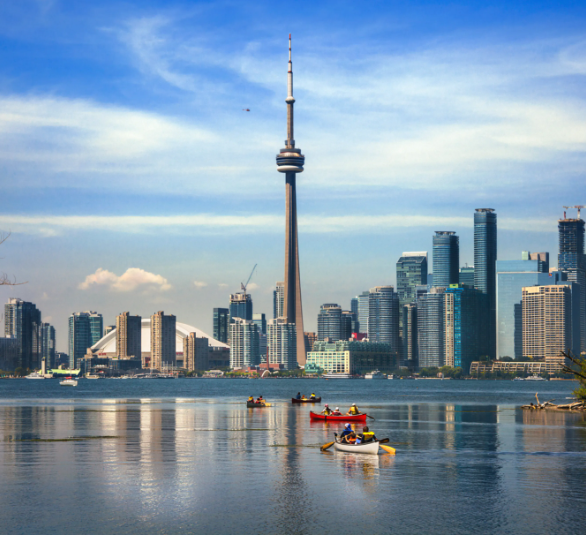
The image at the top was taken from an article that recommends two dozen things to do, some of which are not found in the NYT piece. See: "24 Best Things to Do in Toronto: Museums, Markets, Parks, and Much More," Sefanie Waldeck, Conde Nast Traveler, Sept. 29, 2023.  My two visits in recent times were for musical events and we did find two places worth checking out, neither of which is mentioned. It is the case, however, that I don't think I would want to visit either one during a very busy time: "Little Canada" and "Ripley's Aquarium of Canada." 

Post Script: 
 
Another factor in Toronto's favour is that Richard Florida, who knows a thing or two about cities, has chosen to live there. It is also the case, however, that he does also have a place in Miami. 

Sunday, 18 February 2024

More Very Expensive Used Books

    My efforts to convince people (especially those who work in libraries) that printed books are still worth some attention, were last displayed in the post about "Very Expensive Used Books." In it, a used copy of Gone With the Wind was reported to have been purchased for $25,000, not a bad price, given that literary critics didn't particularly like it, and now there are many critical of it for other reasons.
   The book above was just sold for $85,620, which is nothing to brag about since another first edition of the same book went for $471,000 in 2021. But, it is interesting that the one just sold was a used library book.


The Weeding of Books
  Librarians are discarding old books for many reasons. In the public libraries, one of them is to make room for the homeless, and in the university close by, it is to make space for students who, I gather, are not much interested in printed books. But, in both the public libraries and the university ones, care should be taken and weeding done with caution. Be more careful than even the gardener.
   The
inside of the $85,620 used library book is shown above and reveals that "it was borrowed 27 times between December 15, 1997 and October 12,1999 before it was withdrawn from service." I am not sure what happened after that, but I am pretty sure that the Edinburgh Public Library did not get any of the $85,620.


Sources:
   The Potter book was listed by AbeBooks as one of their "Most Expensive Sales 2023."
The book was sold by First and Fine in Shropshire and information related to its purchase is found here. 
  As the illustration above indicates again, printed books can be valuable even in the United States. It is one of many from Raptis Rare Books in Palm Beach, but I doubt that there have been many shoppers visit it from Mar-a-Lago, close by. 


CANCON:
 
As luck would have it, for those trying to make the case for printed books, this showed up on Feb. 17, 2024 in the Vancouver Sun. Dr. Vogrincic buys. "rare old medical books" and he bought this, "personal, annotated copy of Andreas Vesalius’s masterwork on anatomy de Humani Corporis Fabrica, printed in 1555." He paid less than $20,000 Canadian back in 2007. Once he realized the true value of the book, he lent it to the Thomas Fisher Rare Book Library for safe keeping. 
The book "was purchased by the University of Louvain in Belgium, which Vesalius had attended." It will probably be found in their library.

Sunday, 29 October 2023

B.C. Tidbits or Titbits: Take Your Pick


 This blog was abandoned over three weeks ago because I was in British Columbia for part of that time and have been experiencing trip-lag during the rest of it. Now the weather has turned and I am inside, without excuses, although I may have to come up with some if I can't increase my blogging output. 

  B.C. is a marvelous and scenic place and many interesting things happened there while I was in it, but not to me. Unless I include items relating to my children and grandchildren about whom you are not interested. Therefore, I will simply present past material about British Columbia, which is very interesting, but which you will likely not have read. In the academic world, where I was a minor citizen, presenting links to past work is known as "self-citation", and I am guilty of it here, but only for the legitimate reasons hinted at in this definition: "Self-citation occurs in an article when an author references another of their own publications. This can be a legitimate way to reference earlier findings; but self-citations can sometimes be unduly made in an attempt to inflate an individual's citation count."

 
The good news for an increasingly small number of us is that British Columbia is still called "British Columbia." I had suggested that it was likely (and likely still is) to be given a new shiny name or a duller, pre-colonial one. See: "British Columbia or Sasquatchia? There is more good news (for a few) in that, although the elementary school which the grandchildren attend was retrofitted to withstand the coming earthquake, the name was not changed and remains as, "David Livingstone Elementary School." The Vancouver School Board "Archives & Heritage Blog," indicates that it was named for that David Livingstone, but apparently no one has read it or thought much about the name of the school. If they do, there will be a call for a change since it is now known that Livingstone should never have been on the African continent and Stanley should never have bothered looking for him. As an aside, it should be noted that the folks in London are perhaps more progressive than those in Vancouver. The father of the children who go to David Livingston, attended "Ryerson Public School" in London, which has now the very imaginative moniker, "Old North Public School."

  My post about B.C. last year was titled, "The Left Coast", not for political reasons, but because residents there once drove on the left-hand side of the road as a result of the retrograde attitudes of the British colonialists. Another, "Notes From the Coast", describes the "atmospheric rivers', which were flowing again this year.

  The crows which darken the often dark sky over Vancouver were still able to fly against the flow of the atmospheric rivers. See, a "Murder of Crows."

   Although we did not go to the Van Dusen Botanical Gardens and the Yosef Wosk Library located there, you can learn more about the philanthropist, Mr.,Dr.,Dr.,Rabbi Wosk by reading "Unexpected Libraries" or the section about him in, "Olde Posts Addenda."

  We also did not make it up to UBC, but I am sure it is still the "University of Beautiful Cars," since we saw many on the streets close by. I did not notice any 
Cullinans, but I did see a few Rivians. Other evidence of opulence abounds even though one sees many people apparently without homes. Back in the early years of the last century one could get a piece of property in B.C. by subscribing to a magazine, see: "Property in British Columbia."

  We did see the sculptures of Parviz Tanavoli at the Vancouver Art Gallery, but, being white, were made to feel somewhat guilty by another exhibition, "Conceptions of White" which was designed to help "viewers grapple with contemporary configurations of White identity." Those who created the rather crude collage probably aren't aware of "A Black Sculpture" found in a back yard elsewhere in the city. It was based on an event that happened many years ago on the Eastern Shore of Maryland where I grew up and which I would have more reason to feel guilty about if I thought guilt was heritable and that I was accountable for the historical acts of others.

   This has been a useful exercise for me, if not an enjoyable reading experience for you. I often don't properly "tag" posts in MM and had difficulty finding some of these that relate to B.C. There may be more. For example, you will learn about the "British Columbia Food History Network" in my post about "Food History." and about the "Angling Books" found in the "Harry Hawthorn Foundation Collection" at UBC.

The Bonus:
   If you want more old news from British Columbia, be sure to visit "BC Historical Newspapers" where you will find hundreds of digitized newspapers dating from the mid-1850s. Unfortunately there will be fewer of them in the future. Both the Alaska Highway News and the Dawson Creek Mirror recently stopped publishing. See:"As B.C. Communities Lose TheIr Last Newspapers, Hope Emerges For Locally Owned Publications," Kate Partridge, CBC News, Oct. 18, 2023.

Thursday, 7 September 2023

OLDE POSTS ADDENDA

   Fall is in the air, but the weather has not been bad enough to force me back inside. It is for that reason that my few readers have returned day-after-day only to  see those same baby chicks staring from the top page of Mulcahy's Miscellany. I will now attempt to put them at the bottom of this post. All 45,000 of them are, by the way, still missing as far as I know.

  I do, of course, come in in the evening, but by then it is usually "5 o'clock Somewhere" and I typically spend more time drinking than writing, or thinking about things about which to write. Perhaps tonight we should all have another Margarita while thinking about Jimmy Buffett. 

  With worse weather perhaps my productivity will increase. For now I will simply offer some updates to old posts. Although I generally leave the "Breaking News" to the many who claim to be offering only news that is breaking, even some of my obscure topics sometimes surface, although not on the first page or screen. Five are presented below and if you combine them with the originals you will have amassed a fair amount of information which you can use to impress those who read only the breaking news. While you are digesting what follows, I will try to work on some new subjects for the dreary days ahead.


BUTTER


  It was late in August of last year that I wrote about BUTTER and told you about the sculptures that were still being carved from it at the Minnesota State Fair. You had already learned about butter sculptures (and palaces made from corn) in an earlier piece about the mysteriously named, “The  Land of Cockaigne.” I am pleased to report that things are still rocking at the Fair in St.Paul and that the likeness of a new “Princess Kay of the Milky Way” has been produced from a 90-pound block of Grade AA Butter at this “agriculture Disneyland.” If you read the article below, you will also learn about “Sweet Martha’s Cookie Jar,” where you can get a bucket full of them without depleting her inventory since she can make 44,000 cookies in 12 minutes.
“At Agriculture Disneyland, Butter Princesses Reign Supreme: Where Can You Find Dairy Royalty, Pork Chops on a Stick and Sen. Amy Klobuchar? The Minnesota State Fair,” Natalie. B. Compton, Washington Post, Sept. 2, 2023.
   P.S. Some Canadian content is also provided. In addition to pork chops on a stick you can also get “Pizza-on-a Stick” which is made by Tino Lettieri who was raised in Canada and played for the Montreal Castors, the Vancouver Whitecaps and the Hamilton Steelers. “"Pizza-on-a-Stick" is one of my dearest friends — he was in my wedding,” Rick Born said of Tino’s Pizza-on-a-Stick founder Tino Lettieri. “He’s actually in the Canadian Soccer Hall of Fame, and his son plays for the Minnesota Wild.” (I continue to be amazed about what can be learned from MM.)


FINE PRINTING: MR. TOROSIAN AND LUMIERE PRESS


  The relatively unknown Michael Torosian and his Lumiere Press are again profiled in an article in The Globe and Mail: “Printer Savant Pays Homage to Bygone Era of Publishing, Photography,” by Kate Taylor (July 19, 2023.) You can learn more about an earlier profile in the G&M by reading this post from MM in 2018. Mr. Torosian’s archive has been acquired by the Thomas Fisher Rare Book Library at the U. of T. and he has published this book: Lumiere Press: Printer Savant & Other Stories and you can place an order for it here. 
     In the new article, Mr. Torosian is asked questions and here is one, along with the answer: “You trained as a photographer at what is now Toronto Metropolitan University but had no credentials in publishing. How did you start?”
   When I came up in the seventies there were very few galleries, few museums showing photography. It was almost like an underground network where the language was passed on and studied through books rather than through exhibitions. Books were the medium of photography.
It was a matter of finding a way to do it that worked for me. Because the industrial method of trying to compete with big publishers is lunacy. I saw photographer after photographer attempt it and they would end up with a basement full of books they didn’t know what to do with." Lead type and the letterpress disappeared from commercial publishing in the late 1970s, but you don’t fetishize the old technology. You also use digital means to reproduce some photos. Why the letterpress?
It’s indisputable that the most beautiful way of getting words on paper is with lead type on a letterpress. The technology has been around for 500 years and nobody really figured out a way of making it better.
When I discovered it, it wasn’t totally antiquated yet, but it really wasn’t commercially viable for the big companies. Big printing plants, newspapers and book publishers were dumping all their equipment. What had been exorbitantly expensive equipment was being sold for just a bit over scrap value. So, I hit the sweet spot, the moment where I could scoop up all this stuff and set up my own shop."

YOSEF WOSK


     Another person about whom more should be known is Dr. Wosk who lives in Vancouver. I mentioned him when I stumbled into a library named for him at the VanDusen Botanical Gardens, (see: Unexpected Libraries.) Recently Dr. Wosk won the “Freedom of the City Award”, which is the highest award given by Vancouver and “only in exceptional cases to individuals of the highest merit.” (see: Yosef Wosk.)
    Just a  few excerpts from this article will prove that Dr. Wosk (also a rabbi) is worth your attention. 

“Yosef Wosk has a dream. The academic, philanthropist and scion of a famous Vancouver family envisions a conservatory in the back of his Shaughnessy heritage home that will house his extensive collection of art and books….
“I think of the house as an emanation of the spirit,” he says of the home, one of several heritage projects he’s undertaken over the years. He helped restore the B.C. Permanent Building, a temple bank from 1907, filled with stained glass, as well as the first highrises in the West End, the iconic four-building Beach Towers complex he co-owned for 40 years, built in the 60s by midcentury architect Charles Van Norman. He’s a curator, patron of the arts, author and poet. He’s also a major donor to heritage conservation, galleries and museums, and various charities. But lately he’s become more circumspect about the projects he’ll take on, and how he spends his time, which is growing more valuable….
His father, who died in 2002, was also a celebrated philanthropist whose namesake is the Morris J. Wosk Centre for Dialogue, to which he contributed $3-million. The Wosks left Odessa, Ukraine, in 1928 with next to nothing, and settled in a Jewish community at the time on Parker Street, on the city’s east side, peddling refurbished pots and pans….
He is devoting his time to several volumes of writing and his immense, eclectic art collection. So far in his prolific career, he’s obtained two PhDs, a Masters in theology from Harvard, the Order of Canada, the Order of B.C., the Freedom of the City of Vancouver, several honorary doctorates and accolades too numerous to count. At one point, he received the key to the city of Medford, Mass., for his contributions to that city. He put his work and accomplishments into a curriculum vitae, which is 767 pages long and still not comprehensive…”
These excerpts are from: “Yosef Wosk, Academic, Philanthropist and Art Collector, is Building a Gallery in His Own Backyard,” Kerry Gold, The Globe and Mail, Oct. 21, 2022. Ms Gold also wrote about Wosk more than a decade ago: "A Home With 'Character in Every Corner'," Kerry Gold, The Globe and Mail, April 22, 2010.

Crikey! WORMS AGAIN: But in Australia, Not Africa.


 Five years ago you were told about a gentleman who discovered a worm crossing his eyeball, and also that worms travelling in eye sockets had been spotted and written about by Mary Kingsley many years before in Travels in West Africa. See: "University of the Unusual (3); The Guinea Worm and Assorted Others.")

Here is a more recent headline about worms which have burrowed a little farther in: “She Was Depressed and Forgetful. It Was A Worm in Her Brain” Doctors in Australia Found a Three-inch Parasitic Worm in a Woman’s Brain During Surgery, After They Spent More Than a Year Trying to Find the Cause of Her Distress,” Amanda Holpuch, New York Times, Aug. 29, 2023. That’s the little fella, pictured above.
The explanation:  "An MRI showed that she had a brain lesion and, in June 2022, doctors performed a biopsy.
Inside the lesion, doctors found a “stringlike structure” and removed it. The structure was a red, live parasitic worm, about 3.15 inches long and .04 inches in diameter.
They determined that it was an Ophidascaris robertsi, a type of roundworm that is native to Australia and reproduces in a large snake, the carpet python, which takes its name from its intricate markings. The pythons shed the worm’s eggs in their feces. The eggs are then ingested by small mammals, and the worms can grow inside them….” 
The patient in this case resided near a lake area inhabited by carpet pythons. Despite no direct snake contact, she often collected native vegetation, warrigal greens (Tetragonia tetragonioides), from around the lake to use in cooking. We hypothesized that she inadvertently consumed O. robertsi eggs either directly from the vegetation or indirectly by contamination of her hands or kitchen equipment."

Jersey Girls STILL Don't Have to Pump Gas!

   Last year I pointed out that "Jersey Girls Don't Pump Gas!" and that is still the case. At that time, I also indicated that there was only one other state down in "The Land of the Free" where you were not free to fill up your own car. Oregon was that state, but now you are allowed to serve yourself, although many stations are still required to offer full service as well. So, this recent headline is now correct: "There's Only One State Left Where It's Illegal to Pump Your Own Gas," Nathaniel Meyersohn, CNN, August 9, 2023. That state is New Jersey. CNN also reported about the change in Oregon: "Oregon Drivers Are Now Allowed to Pump Their Own Fuel After the State Lifted a Ban Dating Back to 1951," Andy Rose, Aug. 6, 2023.
   If you are older you will remember that gas was always pumped for you and you were not allowed to do so yourself. If you are a youngster you will always have served yourself. This is one of the many benefits of progress. Those in New Jersey are not progressive in this respect since a poll recently revealed that most do not want stations to stop providing full service. I assume that if Canadians were polled on this issue, most would want to revert to the good old days and have an attendant serve them on the many cold and windy days, or the few truly hot ones.


I have run out of gas on this subject, but if you are now wondering why things changed, see my earlier post and these references:
NACS - "The History of Self-Fueling," Aug. 5, 2023
"First Gas Pump and Service Station," American Oil & Gas Historical Society.
"Gasoline Stations," Mulcahy's Miscellany," Nov. 19, 2017

The Bonus:
   There are a few full service stations in London. Here is Ron Kraft Auto Care, on Huron Street where you can go if you prefer to be served. What a concept.  You will also find:
-"Gas attendants who serve you at the pump – stay in your vehicle in rain, snow or heat
-Mobile payment machine brought to your car window
-Wheelchair accessibility to accommodate all of our customers
-Auto propane & BBQ tank refills."
"Why have the smell of gas on your hands when we can pump it for you?
At Ron Kraft Auto Care, if you don’t want to leave your vehicle, no matter the weather, our attendant is right there to pump your gas for you. Just pay with the mobile payment machine brought right to your car window."

Thursday, 27 October 2022

The Left Coast


    My recent trip to British Columbia began with my reading about the “Far Corner”, while on the plane. The “Far Corner” is that area of the continent encompassing Oregon, Washington and British Columbia and the full title of the book being read was (and still is): Far Corner: A Personal View of the Pacific Northwest Including Certain Places No Longer Easily Found. 

   The view offered is from the 1920s and from it one learns that British Columbians were driving on the left-hand side of the road during the early part of that decade. The following description of the protests over changing the rules of the road seems now to be rather quaint given the more noxious debates currently raging. 

“At that time the stranger discovered, before he got to his hotel, that Vancouver was no Yankee city. His taxi ran on the left. So did all other traffic, including the specially built streetcars. This was odd enough even in Canada, where otherwise, except for tiny Prince Edward Island off the East coast, traffic followed the right-hand custom common to the United States. 

    It was confusing at first, though one ceased to think of it; and it was fair notice to the outlander, either Canadian or American, that the Province of British Columbia proposed to live up to its name. This was a true British Commonwealth. But there had been a mounting opposition to the left-hand rule. This presently congealed into a strong parliamentary clique and, after a good deal of impassioned oratory, the provincial legislators passed an Act changing the rule of the road to right-hand. The time set for a change was January 1, 2019.

   I was still a resident of the province, and recall the uproar as the day drew near. The letter columns of the Vancouver Province, Sun, and World, and of the Victoria Colonist and other papers, were seething with bitter protests and denunciations concerning the un-British, even traitorous adoption of “Yankee notions.” Various societies, associations and clubs were galvanized into action, They held meetings. They passed and drew up resolutions damning the whole business as the work of Satan in league with Uncle Sam. Communications signed John Bull and The Englishman, both gentlemen obviously close to apoplexy, were given prominence. What was good enough in the time of Gladstone, it appeared; what was good enough for the Pitts, both Elder and Younger, and doubtless, too, good enough for Beowulf, was good enough for British Columbia in the twentieth century. It was freely prophesied that collisions and wrecks would strew the streets and highways with carnage compared with which the field at Balaclava was as nothing.

   The awesome day came and passed. The local press reported that not a single accident occurred that could have been charged to the change. Disappointed John Bull and True Englishman returned to their more usual subjects of letters to the editors, things like the first crocus in Kerrisdale, and the correct ingredients of proper chutney."

Sources: 
Far Corner...is by Stewart Holbrook and you will enjoy it. Here are two chapter headings which will likely entice you: "The Edens of Erewhon" and "The Dead Stacked Like Cordwood."
About the subject of "Left-Handed Driving" you are now curious. For B.C. see: "99 Years Ago, British Columbians Started Driving on the Right-hand Side of the Road," Bronwyn Smyth, Vancouver Is Awesome, Jan. 1, 2021. For a list of all countries where they still drive on the "wrong side" see this Wiki entry: "Left- and Right-Hand Traffic."

The Bonus:
Speaking of quaintness, attentive readers who made it to the last sentence will have noticed that letters were being written  to newspapers in British Columbia alerting readers to the blooming of the "first crocus in Kerrisdale." Readers of this blog will recall that letters were written in Great Britain reporting on the arrival in the spring of the first cuckoo. The Times even published a series of books with the titles, The First Cuckoo, etc. See: "Books of The Times."