Showing posts with label Henry Miller. Show all posts

Thursday, 23 July 2026

Henry Miller's Library


    A few months ago, Highway 1 along the California coast re-opened after landslides had made sections of it impassable. Right now, it is likely to be a road not taken by Canadians, given the political situation, but keep it in mind for a bucket list road trip. Admittedly, visiting a library along this route may be low on the list, but if there is fog, you may want to check out the Henry Miller Memorial Library which is mentioned in this article: “Tight Curves and Wide Horizons," Finn-Olaf Jones, New York Times,  April 28, 2026: 
 “Big Sur is a place of splendor, a savage beauty beyond words,” wrote Henry Miller, who lived here for nearly two decades. Farther up the highway, the Henry Miller Memorial Library echoes the lingering New Age energy that hums along this stretch of coast with poetry readings, tie-dyed patrons and pathways shaded by low, branch-woven canopies.

  At Henrymiller.org one finds this:

"The Henry Miller Memorial Library is dedicated to preserving and advancing the spirit of Henry Miller by fostering literature, art, music, and free expression.  Through public programs, education, and community engagement, the Library serves as a cultural gathering place that encourages open inquiry, creative exploration, and the preservation of Big Sur’s natural and cultural heritage." The website for the Henry Miller Memorial Library explains that it was established by Miller's friend: 
   "Created by Emil White, a longtime friend and confidant of Henry Miller. Miller dedicated “Big Sur and the Oranges of Hieronymus Bosch” to White, describing him as “One of the few friends who has never failed me.” While he is known primarily for his association with Miller, White was one of Big Sur’s most colorful characters, a brilliant painter, and a remarkable person in his own right. After Miller died in 1980, White decided to maintain his property as a memorial to his friend and as a gallery where local artists could show their work. In 1981, with the assistance of the Big Sur Land Trust (BSLT), he converted his home into the Library. Emil spent the rest of his life as director of the new institution, which evolved into a local center for the arts. At his death in 1989, White bequeathed the “Henry Miller Memorial Library, Founded by Emil White,” to the Big Sur Land Trust. “With this bequest,” White wrote in his Last Will and Testament, “I am encouraging support and maintenance of said Library, and to promote and enhance the scholarly research and worldwide enjoyment of Henry Miller’s literary and artistic works.” I have mentioned in MM that there are often journals devoted to authors and there is one for Miller - Nexus: The International Henry Miller Journal.

CANCON
  Of course, Miller's work was controversial in Canada as well, and not just because of the sex. The question, "Why Henry Miller's Work Was Banned?" was answered back in 2004 at York University, from which this is taken:
   "He had a forthrightness about life as he was experiencing it," said Susan Swan, a humanities professor in York University’s Faculty of Arts, as well as the author of The Wives of Bath, The Last of the Golden Girls and the upcoming What Casanova Told Me. "He didn't bow to any literary conventions of the time, that literature should be artful and describe sex elliptically. He wandered right in and said what he saw, and I think in that way he had a profound influence on other writers. It was a call to describe the world as it was rather than something that was more idealized." Even more subversive, said Swan, was Miller's dismissal of the puritan work ethic driving his fellow citizens back home – a notion that might shock contemporary society far more than Miller's shattering of sexual boundaries. "He was one of the first North American writers to tackle the subject of pleasure in our lives and critique the notion of life to be lived for the bottom line," she says. "He wanted to appreciate life as it was lived. He was kind of a hippie that way. That, too, is revolutionary and still rather suspect....If he was around today, he'd probably laugh at the way technology has made us work that much harder."


  He was even censored on the more liberal left coast of Canada. The image above is from: "This Week in History: 1961, RCMP Raid the Vancouver Public Library Over a Notorious Novel: Tropic of Cancer Was One of the Most Controversial Books of the 20th century," John Mackie, Vancouver Sun, Oct. 12, 2018.
   "October 13th, 1961, fell on a Friday. And it was definitely unlucky for Vancouver fans of writer Henry Miller.
“Royal Canadian Mounted Police swooped down on bookstores and the Vancouver Public Library Friday in a hunt for copies of author Henry Miller’s sex-in-Paris novel, Tropic of Cancer.
“They were armed with a little-used blanket warrant called a ‘writ of assistance’ which enables them to enter public buildings, commercial establishments and even private homes to search for the controversial novel.
“Two plainclothes officers seized one volume at Duthie Books and learned three other volumes were in circulation from the public library."
 "Tropic of Cancer was one of the most controversial books of the 20th century. It was published in Paris in 1934, in a limited run of 1,000 copies. But the “sex-packed confession of Bohemian life in Paris” quickly became notorious and was banned most everywhere, including in Canada and the States."

The Bonus: 
   
Miller had a relationship with Anaïs Nin. I wrote about her library which is in Los Angeles. See: "Anaïs Nin's Library".
This is from, "True Love: Anais Nin & Henry Miller":
  " Nin and Miller were both separately married when they met in 1931 but the attraction was so palpable they began an illicit affair, amongst a cavalcade of wife-swapping and threesomes of course.
  Nin and Miller’s literary friendship and stretching of sexual boundaries moved into an intense romance that lasted for decades, and she aborted his child 1934.  It is worth noting that Nin documented her life in her colossal collection of diaries, within which she offered inexhaustible exploration and insight into her relationships. They were both consistent, insistent lovers; he wrote sexually detailed passages, she was deemed one of the finest female erotica writers, undoubtedly both encouraged by their passionate addiction to one another. In France, the triangulated love affairs were as common as the flow of wine."

Monday, 18 May 2020

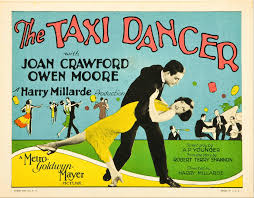
Taxi Dancer


   It is still raining and I happened to run across the term "Taxi Dancer" when reading about Henry Miller. He is the fellow who wrote those naughty books which you read when you were pretending to study for a geography exam (remember, Tropic of Cancer and Tropic of Capricorn.) He was also the kind of guy who would marry a "taxi dancer"; a girl he rented at a dance hall.

   Since I was unfamiliar with the term, I thought I would learn more about it for you and then tell you about it.  It is the case, yet again, that there is no need for me to do so since the Wikipedia entry is a very good one. So, I will pivot to a topic that is not unrelated and which is a more timely one than taxi dancers, who apparently went out of style a while back (I don't think the gentlemen hired to dance with women on cruise ships are given that name.)

Anti-Asian Racism
   
   We are still locked down because of the Great Flu, which according to a rapidly spreading number of people, is caused by the Chinese or other Asians. There has been a corresponding increase in anti-Asian sentiment, even in Canada where everyone is welcome. Anti-Asian sentiment is not new, however, and existed even back in the time of the taxi dancer. It was even expressed by some judges who were appointed before the current U.S. administration took over. Here is the story from the San Francisco Chronicle back in May of 1936:

May 17: A vehement condemnation of dance hall operators who make white girls dance with Filipinos was hurled from the bench yesterday by Municipal Judge Lazarus. He had just held Terry Santiago, 22, to answer a charge of assault with intent to murder. Brought to court by ambulance, Norma Kompisch, 22-year-old taxi dancer, had given from the stand the story of how she was pursued by Santiago, and how he had driven an 8-inch-blade butcher knife into her body 22 times, despite her cries for mercy. In his chambers, Norma had assured Judge Lazarus that she was like any girl whose family had been caught in the pinch of the Depression and that she had gone out to find a job. She became taxi dancer in a place that required her to dance with Filipinos. Said Judge Lazarus, who last month was mentioned in a national news weekly in consequence of having called Filipinos "savages": "I have become nationally known as commenting on conditions that bring about these instances. A small, little, insignificant judge in San Francisco would have to make a national feature to bring public attention to this very real evil. I once referred to Filipinos as savages. There was never a more typical case than this to justify my statement. The Filipinos are not at fault. They are vainly attempting to adjust themselves to civilization, but haven't the training or education. They are only one jump from the jungle. It is our fault for bringing them here. And what about dance hall operators that compel white girls to dance with Filipinos? Nearly all the robbery and shooting involving Filipinos is directly attributable to their association with white girls." Judge Lazarus ordered a transcript of testimony sent to Philippine Commissioner Parades in Washington, to whom he recently apologized for calling Filipinos savages.

   Although anti-Asian sentiment may be on the rise, I do think that our behavior has improved and the words like 'savages" and phrases like 'one jump from the jungle' would not be countenanced by even the current administration in Washington and certainly would be problematic if spoken before one of our Human Rights Tribunals.

Sources:
   A quick search will yield many examples of anti-Asian sentiment, here and elsewhere. 
    This headline is from Human Rights Watch, May 12, 2020: Covid-19 Fueling Anti-Asian Racism and Xenophobia Worldwide: National Action Plans Needed to Counter Intolerance." 
   Filipinos have been targeted so much there is a Wikipedia entry for "Anti-Filipino Sentiment."

The bonus:
   The Wikipedia entry for "Taxi Dancer" is so good it even has a section devoted to "Taxi Dancers in Popular Culture" which includes movies, songs, books, tv, etc. It does not yet include the new Canadian album, Taxi Dancers by the Tragically Hip's Gord Sinclair. Here is his explanation for the choice of the title:
Q. It's a lovely record. Before you go, can you tell me what Taxi Dancers means?

A. Yeah, it's a very old phrase. Back in the Dust Bowl days, these rural communities would have Saturday socials a couple times a year and invariably there were not enough dance partners for the guys that were working the farms. They would fill up taxi cabs from the nearest major centre and the young ladies would travel out. I always thought it was just this amazing metaphor for what we do in this country as performers. We wheel into town, dance around for a bit and then we move on to the next gig. We were throwing out album titles, sitting around my place — and I credit John-Angus [MacDonald] and his brother Colin — they just thought it was cool.
"Sinclair's Debut Solo Album, Taxi Dancers, Will Be Released on Friday," CBC Radio, Feb. 26, 2020.