Showing posts with label Libraries. Show all posts

Thursday, 22 January 2026

Anaïs Nin's Library

    I will do this quickly in order to push the unpleasant post below, farther down the page. This one will be the third in a row about a private library assembled by a woman; the last two belong to Geraldine Brooks and Louise Penny. Here is what Nin's library looks like.


  Given Nin's interests, one can say that this is a library for adults only. If now you are interested, then simply go to the Wikpedia entry for Anaïs Nin, where you will likely spend the rest of the day. There is little need for me to say much more since you will surely go deep into the erotic rabbit holes hinted at in the article provided. She had, for example, two husbands (at the same time), one in the east and another in the west, which she referred to as her "bicoastal trapeze."


This is the outside of the house in Los Angeles. It was designed by Eric Lloyd Wright, whose grandfather was Frank and the Wikipedia entries for both will provide you with more interesting content than I am offering. 


    Her full name is, by the way, Angela Anaïs Juana Antolina Rosa Edelmira Nin y Culmell and she was a flamenco dancer, who also practiced psychoanalysis and slept with her psychoanalyst, Otto Rank. 
    To provide a bit more content, which will push the unpleasant subject below out of sight, I will mention an earlier post about people with Very Long Names
    
I have also written often about Single-Author Journals and Nin has two devoted to her: Anaïs: An International Journal and A Café in Space: The Anaïs Nin Literary Journal.
    If you are new to the subject of erotica, see my: "Erotica: A Beginner's Guide."
    I have also done several posts about collections of books by men. See, for example, "Boys With Books."
Source: 
 "Anaïs Nin’s Los Angeles Hideaway Still Keeps Her Secrets: Shrouded by the pines of Silver Lake, the erotic writer’s minimalist, midcentury residence is a lasting monument to her life and legacy," Kurt Soller, The New York Times Style Magazine, March 21, 2022. 

Wednesday, 17 December 2025

Libraries and Christmas Shopping

   Doing this post will give me an excuse to avoid shopping. Reading it will have the added benefit of allowing you to avoid shopping. As a bonus, I will provide you with some gift suggestions, which could be useful if you ever get around to going out. 


Oxford Libraries
   I have documented the decline in the number of libraries on the campus close by, along with the reduction in the quality of collections held within them. While Oxford clearly had a head start when it comes to libraries, it is unfortunate that Western stopped paying much attention to them. At least we can still read about libraries. Here is a link to, Oxford Libraries Architecture. 
  To assist you in making the purchasing decision, see this review: "Timeless Temples of the Written Word: Oxford Might Best Be Described as a City of Books," William Aslet, The Critic, Sept.6, 2025.

   "The Bodleian is the most famous of Oxford’s libraries, but it is far from being the sole subject of this book. Indeed, the Bodleian is actually a collection of 26 different library spaces. Nor are these the only libraries available to scholars at Oxford. Every one of the University’s 39 constituent colleges has its own library, added to which is the Bodleian’s formidable and increasingly popular online offering, Digital Bodleian.
   It is a reflection of the astonishing diversity of Oxford’s libraries that the 46 examples (one at Oxford Brookes) described and illustrated in this book only constitute a fraction of the total number of library spaces that are today available to students and scholars."
   The book can be ordered online, but unfortunately it won't arrive before Christmas and costs over $100.


Biscuits and the Bodleian


Evidence of entrepreneurship is also found among the books at Oxford. The librarians partnered with Sky Wave Distilling, winner of the World's Best Gin, to host a special tour in "the stunning Divinity Schoolincluding a romp through the history of gin and tasting notes to match the gin you will be tasting." Unfortunately that tour is over, but one can still shop at Oxford. Although one can find items cheaper than the book, they also will not arrive before Christmas. Some more examples:


Digital Bodleian
   
The librarians at Oxford are not Luddites. If you cannot afford the book or even the biscuits, and don't want to go out shopping, you can spend this year and even the next one reading the books and manuscripts found by clicking on the link above. You will even find photographs. Here is one of Tom Stoppard, who recently passed.


The Bonus:
  Older and cheaper options will be found in these past posts:
"More Books For Christmas" 
"Books For Christmas"  (more links are found in this one.)

Sunday, 28 September 2025

Cormac McCarthy's Library


   I often write about libraries, and about a dozen posts relate to the libraries of individuals, not the institutional kind.  The last one, about Darwin's Library, contains links to some of the others. Scholars like to browse through them, looking for influences, while many of us are just curious about the books to be found on the shelves in private homes. 
   Little was known about Cormac McCarthy's library since he led a rather solitary life in a house near Santa Fe, New Mexico. Apart from writing he would hang out at the Santa Fe Institute which is a scientific research center. Perhaps that explains why his collection of over 20,000 books (with more in storage) covers many subjects. The group of scholars attempting to organize and catalog the collection have already discovered that,

 "discernible in his work but confirmed beyond doubt in his library, was that McCarthy was a genius-level intellectual polymath with an insatiable curiosity. His interests ranged from quantum physics, which he taught himself by reading 190 books on the notoriously challenging subject, to whale biology, violins, obscure corners of French history in the early Middle Ages, the highest levels of advanced mathematics and almost any other subject you can name."

   In my small collection, I do not have any books by McCarthy, although I did read The Road and saw the movie, No Country For Old Men. His library, however, contains books by a wide assortment of authors as this description indicates:

   "Giemza marveled at the heavy-duty philosophy books they were finding. “Seventy-five titles by or about Wittgenstein so far,” he said, referring to the Austrian philosopher of mathematics, logic, language and the mind. “And most of them are annotated, meaning Cormac read them closely. A lot of Hegel. That was his light evening reading, apparently.” 
   In the living room was a pool table piled with books and a leather couch facing two tall windows and three sets of nine-foot-tall wooden bookshelves designed by McCarthy that held approximately 1,000 books. Moving closer, I saw they were nearly all nonfiction hardbacks with no obvious system of organization.
   One shelf held volumes about Mesoamerican history and archaeology, along with Charles Darwin’s collected notebooks, Victor Klemperer’s three-volume diary of the Nazi years, books about organic chemistry and sports cars, and an obscure volume titled The Biology of the Naked Mole-Rat (Monographs in Behavior and Ecology). Another shelf held books about Grand Prix and Formula 1 racing, a great passion of McCarthy’s, and the collected writings of Charles S. Peirce, the American scientist, philosopher and logician, in six fat volumes of dense, difficult prose."


McCarthy wins a MacArthur
   McCarthy grew up in Knoxville in a relatively wealthy family, 'but Mr. McCarthy wrote for many years in relative obscurity and privation." In the early '80s, however, he did win a "Genius Grant" from the MacArthur Foundation, a fellowship that comes with a considerable amount of money. He was, of course, very successful in his later career, and at the end of it he sold his archives to Texas State University for $2 million. One reason he had so many books is that he did not use the Internet or a computer. His Olivetti sold for $254,500 at auction. 

The Bonus: 
   Apart from books, he also left behind a few automobiles. Here is a description from the article by Richard Grant, cited below:

   "I parked behind the house between a silver 1966 Buick Riviera rusting on deflated tires and a weathered red Lincoln Mark VIII. These were among the last survivors of McCarthy’s little-known vehicle collection. Dennis had sold 13 other cars, including two Allard racing cars from the early 1950s, a 1992 Lotus and a Ford GT40 racing car. McCarthy, who labored in obscurity and chronic poverty until he was 60, became a multi-millionaire later in life and freely indulged his desires and obsessions, with classic sports cars high on the list. Most of the money came from Hollywood, which turned three of his novels—All the Pretty Horses, No Country for Old Men and The Road—into star-studded movies."

Sources:
    The quote above and the picture of the typewriter are from this obituary: Cormac McCarthy, Novelist of a Darker America, Is Dead at 89: 
“All the Pretty Horses,” “The Road” and “No Country for Old Men” were among his acclaimed books that explore a bleak world of violence and outsiders," Dwight Garner, New York Times, June 13, 2023. For another obit: "Cormac McCarthy, Spare and Haunting Novelist, Dies at 89," Harrison Smith, Washington Post, June 13, 2023.
   The description of his library is from this very good article and the title indicates that examining private libraries can be revealing: "Two Years After Cormac McCarthy’s Death, Rare Access to His Personal Library Reveals the Man Behind the Myth," Richard Grant, Smithsonian Magazine, Sept./Oct. 2025. 
   For more about his library see: The Cormac McCarthy Library Project. There is a Cormac McCarthy Society and they produce one of those single-author journals which I have often discussed, The Cormac McCarthy Journal. See, for example,
"Periodical Ramblings (8)". 

Sunday, 7 September 2025

Back To Books


   To push the post about movies down the page, here is one about books, a frequent subject. The picture below is from a two page advertisement in The New Yorker, Sept. 1&8, 2025. It is typical of many ads these days, in that, for me at least, it is not clear what is being sold. I suppose, however, that more fashionable readers will recognize, right away, that "BRUNELLO CUCINELLI" is not a bookseller, but a purveyor of very expensive apparel. To shop, click here. 


   According to the BC website, the marketing campaign behind the books and other of their ads is that: "The images and words that over the years have accompanied our company’s communication are inspired by our philosophy and the ethical values that are most important to us: the principles of Humanistic Capitalism and Human Sustainability, living in harmony with nature and all its creatures, the preservation and transmission of culture, the commitment to always respect human dignity." There is more. 
  You might think that is mere marketing hype, but Mr. Cucinelli, is actually a lover of books. This is what I found in: "A Day In the Life of Brunello Cucinelli," by Lauren McCarthy, in Harper's BAZAAR, Sept. 27, 2016:

"I like to sit on the couch, surrounded by all of my books. I have 5,000 books in my home, 1,000 of which I feel are close to my heart. They have always shown me the way. Books are my great passion; I could not live without them. If I were to pick a couple out of the 1,000, I would choose Meditations, by Marcus Aurelius. That really showed me the way ahead, as has Plato's Symposium, which is a dialogue on love that was written in the fourth century B.C. in Athens. When my older daughter got married, I gave her my 1,000 favorite books, and I've prepared the same thing for my younger daughter. And now I am preparing 1,000 books for my granddaughter."
  The image above also contains this caption: "Books showed me the way of life." Emperor Hadrian. It does not indicate, however, where such an array of books can be found. 

Wednesday, 18 September 2024

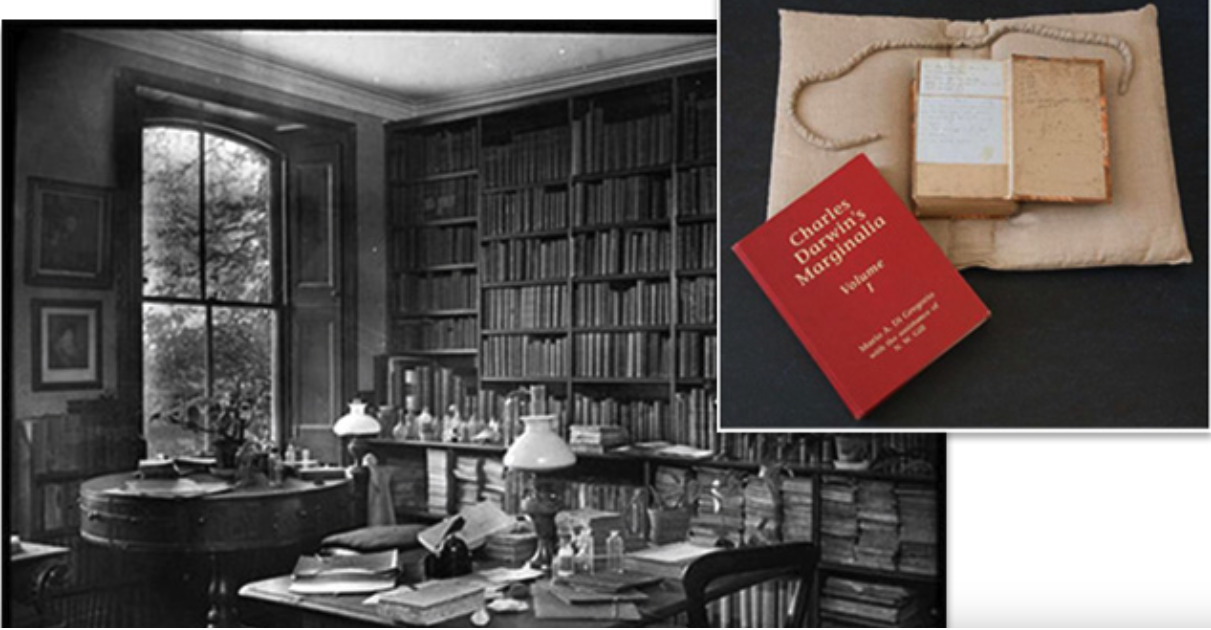
Darwin's Library


READ WHAT DARWIN READ
     I have presented other "private libraries", but this one is different, in that you can actually read the works in it, from the comfort of you own. Simply visit, Darwin Online. 
   The two libraries associated with Darwin, the one at Down House, his home in Downe, and the other at Cambridge, hold only a very small percentage of the books he read over his lifetime. In 1875, Darwin composed a "Catalogue of the Library of Charles Darwin", but many of the items listed on the 426 pages had been lost. Over 18 years, scholars have tracked down everything he read. "Darwin Online" now provides access to thousands of volumes and there are virtual links to over 9,000 of them. The leader of the project notes that:
“This unprecedentedly detailed view of Darwin’s complete library allows one to appreciate more than ever that he was not an isolated figure working alone but an expert of his time building on the sophisticated science and studies and other knowledge of thousands of people. Indeed, the size and range of works in the library makes manifest the extraordinary extent of Darwin’s research into the work of others.”
   This 'new' Darwin library contains novels and philosophical works as well as books in languages other than English. It even contains the works he had with him on the Beagle. See, "
Charles Darwin's Beagle Library."
   As an example of the exotica to be found, here is one from Audubon taken from the Edinburgh New Philosophical Journal. It relates to buzzards, but it is so interesting, I have included the link. 
Audubon, John James. 1826. "Account of the habits of the Turkey Buzzard (Vultura aura), particularly with the view of exploding the opinion generally entertained of its extraordinary power of smelling." Edinburgh New Philosophical Journal 2 (October-December): 172-184.

Sources: 
   Darwin Online is all that most of you will need and here is a press release about it from the National University of Singapore. 
   See also: "Researchers Reveal Lost Library of Charles Darwin For the First Time,"Ashley Strickland, CNN, Feb. 11, 2024 or "Contents of Charles Darwin's Entire Personal Library Revealed For First Time" by Mark Brown, The Guardian, Feb. 11, 2024.
   You can visit Darwin's home in Downe, Kent where there is soon to be a Halloween Celebration. 

Post Script: Private Libraries
  Since Mulcahy's Miscellany has no index, here are some of the other posts related to personal/private libraries, as opposed to, say libraries with people's names on them.
   You could start with "The Old Card Catalogue" which provides the catalogues of several private libraries.
Jefferson's Library
Mark Twain and Libraries
Oscar's Library
Library Furniture
(the library at Althorp in Northamptonshire.)

Wednesday, 17 July 2024

Women and Books


    I just completed yet another post about another guy with a library. Among the others you will find discussions of the books held by Stalin, Twain, Wilde, Gorey and Professor Macksey. There is even one titled, "Boys With Books" that deals with the book collecting of Colin Wilson and, Norman Mailer whose relationships with women were 'problematic', to say the least. 
  If there are any female readers of MM, they are likely to be shouting, genug shoyn, or, if not and they have happened upon it just now, "enough already." So, what about women and their libraries?
  As a male, under current rules, it is not appropriate for me to discuss a female subject, so I will keep this short and, let's face it, women are perfectly capable of finding on their own such stuff as is now presented.
  There is a Brooklyn bookseller run be women called Honey & Wax. If you go to their website today, they may be slow to respond since some are attending the annual Antiquarian Book Seminar in Minnesota. 
   Every year Honey & Wax sponsors a contest for young women book collectors. Size doesn't matter and,
 "The winning collection must have been started by the contestant, and all items in the collection must be owned by her. A collection may include books, manuscripts, and ephemera; it may be organized by theme, author, illustrator, publisher, printing technique, binding style, or another clearly articulated principle. The winning collection will be more than a reading list of favorite texts: it will be a chosen group of printed or manuscript objects, creatively assembled, that shine light on one another. Collections will not be judged on their size or their market value, but on their originality and their success in illuminating their chosen subjects." 
[I should mention that their definition of 'women' is an inclusive one and all of this is found on the H&W website."]
   The winners are interesting as the 2023 one indicates. It was Auroura Morgan's. “Hybrid Botanicals: A Modern Tattoo Artist’s Reference Collection.”
   I have probably appropriated enough, or even too much, but you may be wondering about the image at the top. It is an "American Woman's Questionnaire Scarf" and it is among the ephemera for sale at Honey & Wax. It could be yours for $85 (US).
Sources (and a tiny bit of CANCON):
  The Honey & Wax website is enough, but the attached article is interesting and it shows that one of the past winners of the H&W contest was a graduate student at the University of Toronto. It was for her collection of Yiddish children's books and she would surely know the meaning of genug shoyn. See: "Six Young Women With Prizewinning Book Collections," The Paris Review, Sept. 18, 2020.

Tuesday, 16 July 2024

Jefferson's Library

   To take us away from these troubled times I will again turn to the subject of libraries which used to exist and were tranquil places. Having spent some of our time recently on "Stalin's Library", here is some information about Jefferson's, which was much smaller.
   Jefferson's library in Charlottesville was bigger, however, than the congressional one in Washington, the 3000 volumes of which were used as kindling by the British during the War of 1812.
   Feeling bad about the British bibliocide, Jefferson sold his 6000+ volumes to the Library of Congress and some members objected since some of the books  were in French and others about unsuitable subjects.
   It is also the case that Jefferson needed the money, but you bibliophiles will be pleased to know that he then spent more of it to rebuild his library. His choices were eclectic and among his requests were, Charles Hutton’s “Mathematical Tables” and John William Norie’s “A Complete Set of Nautical Tables.” Note that the latter work could be useful during these troubled times. 
Sources
  For more reliable ones see: "Jefferson's Library" provided by the LC and this longer one: “UNQUESTIONABLY THE CHOICEST COLLECTION OF BOOKS IN THE U.S.”: THE 1815 SALE OF THOMAS JEFFERSON’S LIBRARY TO THE NATION," by Endrina Tay, Commonplace: The Journal of Early American Life, Sept, 2016.
Post Script:
   
I was able to visit Monticello, Jefferson's home, with a small group on a fine spring day. Apart from the home and its contents, the view and grounds are beautiful.
  The view explains 'Monticello', and like 'Montebello', the one near here and another one farther away in the Appalachians, both words are of Italian origin.

Tuesday, 30 April 2024

A Big Collection of Tiny Books

Very Little Books at Lilly Library

   I was tempted to call this "Tiny Tomes," but that would be an oxymoron. I learned recently that there are around 16,000 miniature books in this Library at Indiana University in Bloomington. As I have noted, I think of "Libraries As Cabinets of Curiosities" and like it when they contain such things as books. I am pleased that the Hoosiers are still bothering with them even if they are small ones. 
  I noticed this perhaps because I remembered I had written something about tiny books. It turns out that I did so, way back in 2019, but it took me a while to find it since the Dutch term for them - "Dwarsliggers" - is buried in a post with the title "Tsundoku." That I know such things amazes me, almost as much as I am amazed by the fact that I will soon forget again what those words mean.


   The books were collected by two women and you can learn more about them by reading, "Ladies of the Lilly: Collectors Elisabeth Ball and Ruth Adomeit." Learn even more by looking at this article by Indiana Public Media which includes a YouTube video (2 min.): "Lilly Library Home to 16,000 Miniature Books," by Grace Marocco, March 29, 2024. 

   If that is not enough to entice you to go to Indiana, remember that Indiana University is a major repository for material relating to "America's Most Loved Reporter", Ernie Pyle, about whom MM has additional information. If you need more encouragement and are more interested in buildings than books, visit Columbus, Indiana, "An Architectural Mecca.

A Very Big Library Donation at Davidson College
   I noticed this because a high school friend went to Davidson and I passed by there just recently. It is about thirty miles from Charlotte. I also noticed it because the total gift is $100 million and some of it will be used to keep and purchase actual books and periodicals. As I have complained, some libraries are getting rid of books to provide "Makerspaces" for students. I see that now that word is even found in Wikipedia - "Library Makerspace."   For more about Davidson see - "$25 Million Gift Names The George Lawrence Abernethy Library, Transforms Learning at Davidson College," Davidson College. 

A Small Bonus:
  Davidson is highly regarded. When my classmate enrolled in 1961, the school was all male and all white. Things have changed. You may know about it because Steph Curry attended and recently returned to get his degree.

Saturday, 30 December 2023

Book Weeding


    My plan, one of many for the new year, is to begin the discarding of things. I may start with clothes which are now too small, since my plan to grow smaller may not be implemented. Tchotchkes, trinkets and knick-knacks will be boxed and cleverly concealed so as to avoid embarrassment at the Goodwill drop off depot. At some point I will then take a look at the books. 
   This project is the difficult one. Should I start with novels I have not read or the non-fiction which it is my intention to read again? What about the impressive titles that visitors assume I have read? 
    After the long culling process ends, the even longer vetting one begins. Is anyone in London likely to be interested in all the books that Patrick Leigh Fermor wrote or all of those by Richard Russo? The collected works of Reynolds Price? Does anybody even read any books not written by James Patterson or Colleen Hoover? 
   Maybe I should buy a few of those decluttering books, or perhaps it makes more sense to just borrow The Gentle Art of Swedish Death Cleaning from the library. 
   There is some consolation in knowing that others have wrestled with the weeding process and that the questions which need to be asked (and answered) as one moves along the shelves can become quite involved. Here is a sample from a chap who had (and probably still has) a very interesting library indeed.

Marmaduke Pickthall?

   "I kneel on the floor of my book room with a large cardboard box at my side. Do I really need all those George Meredith novels? Edgar Saltus is harder, but will I miss those duplicates of Purple and Fine Women and The Pace That Kills with the variant dust-wrapper and the misprint on page 43? My shelf of the works of Philip Thicknesse, that querulous 18th-century gentleman, contains nearly all of his 24 books, and if I were forced to sell them I could never sacrifice The Valetudinarians Bath Guide, which contains valuable information on the exorcism of gallstones, and an account of Mrs Mary Toft of Godalming who claimed that she gave birth to 15 rabbits; an assertion Thicknesse plausibly supports. Whatever the demands for space in my book room, I cannot banish my Marmaduke Pickthall, or a single one of my 15 copies of the first edition of The Wooings of Jezebel Pettyfer, which Meredith praised with the mysterious disclaimer: ‘It ought never to have been written.’ Not seldom, when I surrender a book to a rascally dealer, I return to his shop and buy it back."

Unintended Consequences
    Once one starts pulling books from the shelves and reading the jackets of those pulled, one is reminded of other books by the author that one does not have and when reading a paragraph, such as the one above, one realizes that there are many other books that need to be looked at and perhaps purchased.

Edward Saltus - "Dean of Decadence"

    Who the hell is Edward Saltus? It seems he was an American who also wrote using the names "Myndart Verelst" and "Archibald Wilberforce" and translated works by Balzac. In addition to Purple and Fine Women, he also authored, The Pomps of Satan, The Imperial Orgy and Parnassians Personally Encountered and I doubt if they are contained in The Philosophical Writings of Edward Saltus: The Philosophy of Disenchantment & The Anatomy of Negation. I am also curious about The Facts in the Curious Case of Hugh Hyrtl Esq.
Thicknesse - "Libertine Turned Ornamental Hermit"

   One now has to have a look at The Valetudinarians Bath Guide and a purchase of it could be justified because the subtitle indicates it provides the Means of Obtaining Long Life and Health. I confess to obtaining one of Thicknesse's other works from the university library close by, simply because of its subtitle:  Memoirs and Anecdotes of Philip Thicknesse, Late Lieutenant-Governor of Land Guard Fort, and unfortunately Father to George Touchet, Baron Audley.
   Marmaduke Pickthall's first name turns out to be Muhammad and he was an Islamic scholar, but his novel Sir Limpidus about an eccentric and reclusive English aristocrat is probably worth a look. 


   And although the author of the paragraph above has 15 copies of The Wooings of Jezebel Pettyfer, I did find the one pictured, available for only 875 euros.
Source: 
   
The quoted paragraph was written by Barry Humphries, "Why Does No One Dress For Dinner at Claridge's Any More?", The Spectator, Dec. 17, 2022.
mea culpa
   I discovered too late that I have already told you about Marmaduke. Just a few months ago! Obviously this blogging is not improving my memory. Since the material mentioned before is found at the bottom of a long post, I will assume you didn't read it. If you did, and appreciate such odd information, you will likely have enjoyed it again and perhaps didn't remember it either. 

Saturday, 11 November 2023

BIRD ILLUSTRATORS


LOUIS AGASSIZ FUERTES

   I used to work in the Western Libraries back when there were more of them and the collections they held were impressive. As I have indicated in several posts, the area devoted to books and other resources has shrunk, while space for the students has grown. Many books are in storage, where they cannot be browsed and I think that is unfortunate. 
   It is the case, however, that the argument for keeping books and other scholarly resources has been lost. And, admittedly, the losing of that argument is not as unfortunate as one might think - unless you prefer printed books and journals.
   The material in storage is easily retrieved for you, if you know it is there. As well, much of it can be accessed electronically and from afar and at anytime. About the only rationale one can offer for keeping all those old books and journals around is an aesthetic one which does not hold much appeal for many. 
    That gets me to Fuertes, who produced books about birds and provided the illustrations for many others. Seeing such books and works like, The Double Elephant Folio: The Story of Audubon's Birds of America, is more appealing to me than viewing them electronically (that book is in storage.)
   A couple of years ago, I did a post about "Bird Art" and in it wrote about the works of John Gould and provided a list of his beautifully illustrated books that were held by the Western Libraries, but were in storage. There also are books by Fuertes in storage and I will provide just a couple of examples. If you want to see some of his images from afar you can visit the L.A. Fuertes Image Database at Cornell in Ithaca, where Fuertes was born. You will find 2500 and they are searchable by type (e.g. drawings, water colour, gouaches). You might argue that providing space for such things is no longer necessary, but I still disagree.
 

 Here are a few Fuerte's works in storage at the Western Libraries. He has been described as "the nation's most notable ornithological painter since Audubon."
A Natural History of American Birds of Eastern and Central America;
Birds of Massachusetts and Other New England States;
The Bird Life of Texas;
To a Young Bird Artist: Selected Letters From Louis Agassiz Fuertes to George Miksch Sutton.

The Bonus:
   I am pleased that, at least for now, there are other bird-related items to be found in storage. If you want to listen to them for example, here are a few recordings:
Voices of African Birds; Songs and Calls of 42 Species Found in Kenya, Uganda, Sudan, Tanganyika, Rhodesia, South Africa, the Congo, and Nigeria;
Mexican Bird Songs; The Voices of 74 of the Most Representative Birds of Mexico
   One can also hear the sounds made by other species:
The Songs of Insects; Calls of the Common Crickets, Grasshoppers, and Cicadas of the eastern United States;
Voices of the Night; The Calls of 34 Frogs and Toads of the United States and Canada.
   Apart from sound recordings there  are even some games to be found in storage. For example, Professor Noggin's Birds of North America Card Game is located there.


   It is likely that many of these items will ultimately end up in storage facility near Toronto for a variety of reasons, some of which are noted above. If items can be retrieved from storage, it doesn't matter much where the facility is located. 
   There is now another reason for withdrawing the books relating to birds, in that those books contain bird names which are no longer acceptable and were written by authors such as Audubon who have been 'cancelled'. This is yet another argument with which I do not agree and I would hope the dwindling collections in the Western Libraries are not further 'weeded' because they contain ideas and names now deemed unacceptable.

Post Script:
   Most of the books related to ornithology were held in the "sciences" library, which is now known as the "Allyn & Betty Taylor Library" (there also was once a separate "Engineering Library." and another one for Medicine.) There continues to be a reason for collecting ornithological research in that the campus now contains the Advanced Facility for Avian Research (see my post, "For The Birds." )
    Professor Noggin's card game would have been collected for aspiring teachers and housed in the Education Library, which also no longer exists and is now the "Wampum Learning Lodge." There is a sizeable collection of children's books in storage, many of them collected for fledgling librarians and held in the library of the Graduate School of Library Science, which also no longer exists (see my earlier posts, "Landmark Books" and "100 Years of Newbery Medals.")
   Perhaps at some point in the future someone writing a history of UWO and Western might be interested in knowing about the richness of the collections held in libraries that have since disappeared. 
    As for the "NAMES" problem, I touched upon it in a post, the title of which hints at my position on the subject - "No More Name Changing". The American Ornithological  Society does not agree. See the "English Bird Names Project" where you will learn that, among other things, "The AOS commits to changing all English-language names of birds within its geographic jurisdiction that are named directly after people (eponyms), along with other names deemed offensive and exclusionary, focusing first on those species that occur primarily within the U.S. or Canada."
   If you are just interested in birds, go back to Cornell and enjoy "All About Birds."
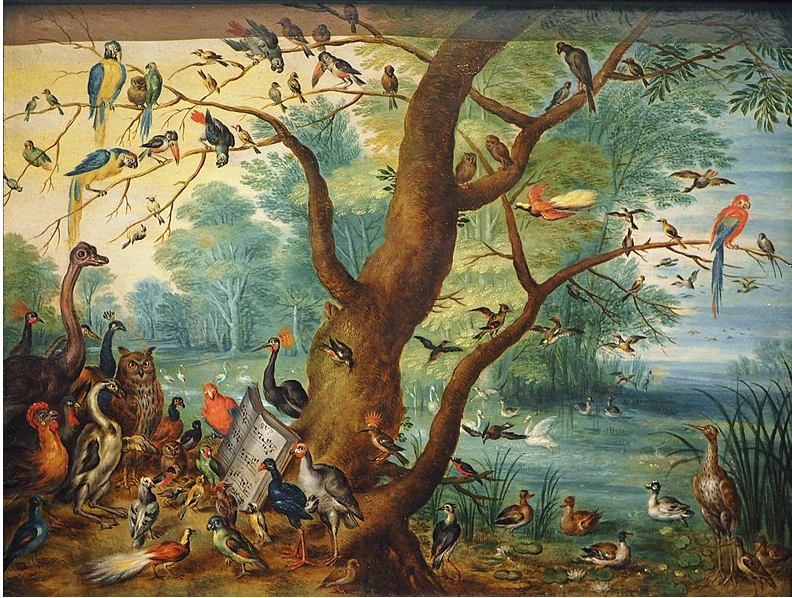
   If you are interested in eagles, such as the one above painted by Fuertes, see:
"Eagle Attacks Child", and "Eagle Update" or read about the Canadian "Eagle Man", Charles Broley. As well, the eagle and some insects are discussed more recently in, "Birds and Bugs.

The Bonus:
  Someone, who perhaps knew my position regarding the re-naming of everything, sent me this 'bird-day card', which, I admit, weakens it a bit.

Sunday, 30 April 2023

A Few Bits About Books

    My output has been sparse so I will attempt to come up with something quickly to boost my April production. It is also the case that the weather remains dreary and I am not that interested in hockey.

National Library Week

"National Library Week begins on Sunday, and the timing couldn’t be better. This annual celebration used to feel quaint; now it sounds like an existential rallying cry."(Ron Charles)  

   I noticed that it was a week to celebrate libraries in the U.S. In Canada the month of October is dedicated to them and there are library days, weeks and months throughout this country. As you will know, I am a fan of libraries and books and I suggest we should all be paying more attention to both of them.

Banned Books and Censorship
   One reason to do so is that libraries are under attack and librarians are being threatened. President Biden even mentioned the problem in his recent announcement about running again. Canadians should not be complacent as this headline indicates: "Libraries Are In the Political Crosshairs as They Fight Back Against U.S. Book Bans: Canadians Should Keep an Eye on Efforts to Remove Books From Libraries South of the Border," Nick Logan, CBC News, April 21, 2023. Another headline indicates the situation is the same in the U.K.: "Third of U.K. Librarians Asked to Censor or Remove Books, Research Reveals,"

  The libraries and books are victims of the collateral damage inflicted by the culture wars. There have always been people who wanted to restrict what others read, but generally the focus was on sex and ideology whereas now the concern is mostly  over books about gender and identity. Librarians, usually a liberal bunch, have been resisting, but one hopes they also protect the illiberal items on the shelves as well (even the Dr. Seuess books and the unedited Roald Dahl ones) and keep the other books which are now deemed noxious and continue ordering them.

  There is even a Banned Books Week, during which the American Library Association calls attention to the censorship pressures. The ALA's Office of Intellectual Freedom notes that censorship challenges are up nearly 40% over 2021.
"ALA documented 1,269 demands to censor library books and resources in 2022, the highest number of attempted book bans since ALA began compiling data about censorship in libraries more than 20 years ago. The unparalleled number of reported book challenges in 2022 nearly doubles the 729 book challenges reported in 2021. Of the record 2,571 unique titles targeted for censorship, the most challenged and reasons cited for censoring the books are listed below.


  The censorship efforts extend beyond libraries and into schools. The chart above comes from this study: "Banned in the USA: The Growing Movement to Censor Books in Schools."


Library Appreciation
   The importance of libraries to some patrons is noted by Ron Charles of the Washington Post, who wrote in this week's newsletter that a fundraiser has been established to dedicate a chair in the New York Public Library to Alfred Kazin who died 25 years ago. Kazin spent a lot of time in the room pictured above. 

"In his 1978 memoir “New York Jew,” Alfred Kazin recalled his early enthusiasm for the New York Public Library:
“Whenever I was free to read, the great Library seemed free to receive me,” he wrote. “There was something about the vibrating empty rooms early in the morning — light falling through the great tall windows, the sun burning the smooth tops of the golden tables as if they had been freshly painted — that made me restless with the need to grab up every book, press into every single mind right there on the open shelves.” 
The library was Kazin’s sanctuary and his laboratory. He started publishing book reviews when he was 19. Before he was 30, he’d written “On Native Grounds,” an instant classic of literary criticism."

  You may recall that another Jewish writer close by in New Jersey spent a lot of time in the Newark Public Library and donated his library to it and a space was dedicated for a room for Philip Roth (see: Actual Libraries.)


Books: Real or Fake?
   
That is Lord Black of Crossharbour who is once again a Canadian citizen and the picture was in Canadian papers today. It is here because he appears surrounded by books. Even if you do not like Conrad Black, you would likely agree that he has read a few and perhaps that may be one reason you do not like him. 

  Also in another article where books are featured in another paper, you will learn that some things are not always as they appear. The picture below is from: "Go Ahead, Judge This Book By Its Cover: Already the Norm For Film Sets and Commercial Spaces, Fake Books Are Becoming Common Fixtures in Homes, But if You See One, You Might Never Know," Anna Kodé, New York Times, April 28, 2023. About this phenomena I have already written. See, "Books By The Meter."


Real Books and Book Lovers

  As I have complained, university libraries are getting rid of books right and left and even those in the middle. Spaces are needed for lounging for the students and for the children of graduate students. Sometimes, however, some people have difficulty in throwing out the third copy of a book in their home library unless threatened by their partner who they accuse of being a philistine. The following passage is perfect for those who do not have fake books, but real ones and know how difficult it is to toss them:

"F. Scott Fitzgerald declared in an excellent late story that ‘the second half of life is a long process of getting rid of things’. It is certainly what I am striving to do. I have far too much stuff so I’ve decided a little culling is needed. Some weeding out imperative, deaccessions inevitable. I’ve started with books; I’ll end up with people and finish with me.
I kneel on the floor of my book room with a large cardboard box at my side. Do I really need all those George Meredith novels? Edgar Saltus is harder, but will I miss those duplicates of Purple and Fine Women and The Pace That Kills with the variant dust-wrapper and the misprint on page 43? My shelf of the works of Philip Thicknesse, that querulous 18th-century gentleman, contains nearly all of his 24 books, and if I were forced to sell them I could never sacrifice The Valetudinarians Bath Guide, which contains valuable information on the exorcism of gallstones, and an account of Mrs Mary Toft of Godalming who claimed that she gave birth to 15 rabbits; an assertion Thicknesse plausibly supports. Whatever the demands for space in my book room, I cannot banish my Marmaduke Pickthall, or a single one of my 15 copies of the first edition of The Wooing of Jezebel Pettyfer, which Meredith praised with the mysterious disclaimer: ‘It ought never to have been written.’ Not seldom, when I surrender a book to a rascally dealer, I return to his shop and buy it back."

(That bit is dedicated to my friend on Vancouver Island who has written some books and collected many more. It is from an article in The Spectator, Dec. 17, 2022 by Barry Humphries.)

Post Script:
   As I have noted too many times before, I think it is a mistake for university libraries to sacrifice the stacks for the students. The university libraries where I used to work are doing so. I do have to confess, however, that they had a copy of, Dr. Viper: The Querulous Life of Philip Thicknesse, In my defence, it is in storage, so as to make room for the students, or the toddlers of the graduate students, who will never be aware of its existence. I do also have to confess that although they did not have a copy of The Valetudinarians Bath Guide, it does appear in their catalogue and I (even you) can read it from the comfort of your couch (and right now!)

The Bonus:
   For the few remaining book lovers in London, I will save you time by telling you that I already have out of the library the copy of Dr. Viper. Those of you who are now looking for Purple and Fine Women are on your own, as are those of you who now are asking - "Who the hell is Edgar Saltus?" (But, I do have to be honest and make another confession - there are a couple of biographies of Saltus in the Western Libraries (in storage.) Let's hope they keep them there and do not send them to a storage bin near Toronto.)

Tuesday, 13 September 2022

Penguin Books

    I see now that it has been over a dozen days since I wrote anything and that means the weather has been good. My last post was about an old friend, Graham Murray, and at the end of it I mentioned that he used to order books for us from the U.K. Many of them were Penguins or Pelicans, but we were younger then and had no need for Puffins for the children yet to come.

   A good description of what resulted from such acquisitions is provided by Penelope Lively. Apart from offering a peek at her library, she also mentions the child-rearing advice offered by one author and laments the loss of many of her books.

"Perhaps my most treasured shelves are those with the old blue Pelicans, over fifty paperbacks, including some seminal titles: F.R. Leavis’s "The Great Tradition," Margaret Mead’s "Growing Up in New Guinea," Richard Hoggart’s "The Uses of Literacy," Richard Titmuss’s "The Gift Relationship." And John Bowlby’s "Child Care and the Growth of Love," which had us young mothers of the midcentury in a fever of guilt if we handed our young children over to someone else for longer than an hour or so lest we risked raising a social psychopath – even the father was considered an inadequate stand-in. Pelicans were the thinking person’s library – for 3 shillings and 6 pence you opened the mind a little further. And Penguin had of course their own flamboyant Dewey system – the splendid color-coding: orange for fiction, green for crime, dark blue for biography and cherry red for travel.
I don’t have enough old Penguins. The Pelicans have survived, but the rest have mostly disappeared – read until in bits, perhaps, of left on beaches or in trains or loaned and not returned. And long gone are the days when a paperback publisher could confidently market a product with no image at all on the cover – just the title and the author’s name, emphatically lettered. Beautiful."

   When I last saw Graham he still had many books spread throughout the house where they are cared for by his wife who, you will be glad to know, appreciates them as much as he did. 

Sources:
 
The quotation from Lively is found in: Dancing Fish and Amonites: A Memoir, pp.187-188.
   About Penguin Books you can easily find a lot. Up at Western Libraries there are these four books and more:
Baines, Phil. Penguin By Design: A Cover Story, 1935- 2005.
DBWSTK Z271.3.B65 B35 2005.
Greene, Evelyne. Penguin Books: The Pictorial Cover, 1960-1980
Storage: Z121.G726 1981
Morpurgo, J.E. Alan Lane: King Penguin - A Biography
Storage: Z325.L247M67 1979
Wooten, William & George Donaldson. Reading Penguin: A Critical Anthology
DBWSTK Z325.P42R433 2013.
Western Libraries even has a lot of Puffin Books which was the children's imprint of Penguin books. For the reason why Western University Libraries has so much "Kiddie Lit" see this post about Landmark Books.
Here is another description of the colours of the various genres:

Orange = General Fiction (F)
Green = Mystery and Crime (C)
Cerise = Travel and Adventure (T)
Dark Blue = Biography (B)
Grey = World Affairs (W)
Violet = Essays and Belles Lettres (E)
Red = Plays (P)
Yellow = Miscellaneous Penguins (M)

If you are really interested in Penguins, see: Penguin First Editions.

The Bonus: The "Penguincubator."

In 1937, "Allen Lane launched the "Penguincubator", a Penguin pocket book vending machine, which he installed in a busy street in London. By inserting 6 pence you choose and receive your book, or better, several books, as the small text under the photo indicates: "Some ingenious people noticed that a clever manipulation of the buttons of the machine made it possible to receive a pretty quantity of books beyond the 6 pence inserted. Lane hopes further testing will create a thug resistant machine".
From: "A Short History of Book Covers -3/4" Grapheine, July 12, 2017.

Wednesday, 23 March 2022

A Library is Lost at Leceister

    I have written about university libraries and noted that many are now getting rid of books and materials since they wish to be seen as much more than storage sites. Space is highly valued on most campuses and one can understand how various areas can be colonized by factions with more prestige and power - those in the administrative wing, for example.  Here is a case to consider. 


   Jillian Becker was born in South Africa and now, almost ninety years later, resides in California. During that period she wrote, Hitler's Children: The Story of the Baader-Meinhof Terrorist Gang and The PLO: The Rise and Fall of the Palestine Liberation Organization. She also was a co-founder of the Institute for the Study of Terrorism which became the home of the books, papers and research material which had accumulated over the years. In 1993, the archive was bought by the University of Leicester. More recently when someone inquired about the collection, it could not be found. 

   Ms. Becker raised this question in an essay to which I will provide a link: "How Did the University of Leicester Manage to "Lose" the Institute for the Study of Terrorism's Archive? Her remarks are reasonable as are the replies from Leicester, which basically indicate they don't know what in the hell happened to the material. 

   There is probably no mystery involved. Priorities may have changed or space was needed and a clerk was told to dispose of all those papers in the stacks on the third floor. But, Ms. Becker does raise an interesting point in her concluding paragraph which is bolded below:

The loss of an archive, whether by negligence or decision, is a calamity. To lose it by negligence is barbarously callous. To discard it deliberately is an act of intellectual vandalism, the equivalent of book-burning. If, in either case, a university is responsible, the disgrace must leave a permanent stain on its reputation.

   I would have assumed in the past that such things were lost simply because no one cared much about them. Now one wonders if sometimes people care too much and choose to get rid of items they find distasteful, or which could be 'hurtful' to those who might stumble upon them. Becker also wrote a book about Sylvia Plath. Had she donated Plath material, might it still be around?

Source:
   
The essay above is found on the website of  The Freedom Association which is a right-leaning, libertarian-type and Ms. Becker is a member. I don't think that matters in this case, but I thought I should mention it. 
The Bonus:
   
Some more cheap advice. If someone from an "Advancement Office" at a university takes your money in exchange for your name being affixed to something on campus, or if a librarian agrees to accept your books, papers or artworks, don't assume they will be there a decade from now.

Friday, 18 March 2022

Libraries As Cabinets of Curiosities


   I have not said much about libraries lately, largely because there has not been much to say, especially about the university variety. The one in which I used to work is being emptied of books to make room for students and for other activities. There are many places to see active students on campus, but for books you may be better off going to the bookstore. Years ago the main library used to be full of both books and things and I think it was a more interesting place to visit, even for the students. 

  I thought about this at year's end and you will easily see why, from reading the headline and the few paragraphs provided:

"A Cabinet of Wonders Opens Wide: A Coco Chanel Ballet Slipper, Beethoven's Hair, Andy Warhol's Painted Ticket: Treasures at the New York Public Library Showcases Delights From Its Collections," NYT, Dec. 28, 2021. If you are not enticed by those objects, there are more:

"The exhibition, supported by a $12 million gift from the philanthropist Leonard Polonsky, is the culmination of more than three years of shopping the library’s epic closets, which hold more than 45 million manuscripts, rare books, prints, photographs, audio and film clips and other artifacts. Covering 4,000 years of history, it mixes big-ticket items (a Gutenberg Bible, Shakespeare’s First Folio) and who-knew delights, like Andy Warhol’s painting of a Studio 54 ticket (inscribed “To Truman,” as in Capote).
Look through a display of the conductor Arturo Toscanini’s batons, suspended in space, and you catch a glimpse of a spotlighted case across the room holding “Political Prisoner,” a 1971 cedar sculpture by the African American artist Elizabeth Catlett. From the front, the figure — a woman with a Pan-African flag cut into her torso — looks exhilarated, regal. From behind, you see that her hands are chained.
The library, Kiely said, is really a “collections of collections,” whose own history is traced through the show. The core sections are heavy on treasures donated by the 19th-century philanthropist James Lenox, like an early 16th-century copper globe that includes one of the earliest cartographic representations of the Americas. (It’s also one of only two surviving Renaissance or medieval maps with the inscription “Here be dragons.”) 

UC DAVIS - Wine

  Some university libraries continue to collect and store and I was pleased that the Library at the University of California (Davis) is aspiring to be the "Greatest Wine Library in the World." The image above is from their "Amerine (Maynard) Wine Label Collection."

UC DAVIS - Food

  To choose the proper food to go with the wine there is now the "Chef Martin Yan Legacy Archive" at UC Davis. The archive "will include World-renowned celebrity chef Martin Yan’s collection of nearly 3,000 cookbooks, his first wok, thousands of photographs and other media." As well, there was a monetary donation to digitize and preserve the collection." Lest you think that UC Davis is only concerned with eating and drinking, you should know that it also has a well-ranked School of Veterinary Medicine. The daughter of a neighbour of ours went to the Equine Performance and Rehabilitation Center after graduating from Guelph. 

   If you are interested in research collections related to food and drink, revisit my long FOOD HISTORY post where you will find menus, recipes, cookbooks, etc. some of which are housed in Canadian university libraries (e.g. UBC and Guelph.) 


Some Canadian Content:

   The Ubyssey (the student newspaper at UBC) often runs stories about "Hidden Treasures" and the picture above is from one of them.  It is from the Chung Collection in one of the UBC Libraries: 

In the basement of the Irving K. Barber (IKB) Learning Centre, tucked in a corner behind multiple glass doors and a security desk, is a dim backroom that is curiously colder than the rest of the building. This is the Chung Collection, just one small portion of UBC’s vast Rare Books collection. With more than 25,000 items in this room alone, the Chung Collection fits more than a century of Canadian history into its tightly packed drawers and display cases.The walls of the Chung Collection gallery are lined with Canadian Pacific Rail advertisements ranging 1924 to the mid-1950s, most of which are the work of Saskatchewan-born Peter Ewert. Ewert’s stylized paintings of iconic Canadian sites, like this one of Lake Louise, gave tourists an idyllic image of the Canadian adventure they could embark one with CP rail. This 1942 ad for the Chateau Lake Louise depicts bathers lounging lakeside, in the shadow of the blue-tinted mountains.

Post Script: 
 
There may still be a few items of interest to be found in the few remaining libraries up at Western, most likely in the "Archives and Special Collections" in the D. B. Weldon Library. I recall there were displays, in massive cabinets,  of the large "Jeffrey Stamp Collection", which still may be there and I did do a post about the "Gregory Clark Piscatorial Collection" which is in the Archives. See: Angling Books. Otherwise, you will now see mostly students when you visit the libraries, or empty spaces during the summer months.

The Bonus: Libraries as Kindergartens

   The situation could be worse. In one of the libraries at the U of T, you might see mainly kids. Providing "childminding" and space for students are not bad things, but they can be provided by others. This is what is going on in Toronto according to College and Research Libraries News:

"Time of one’s own: Piloting free childminding at the University of Toronto Libraries,"Jesse Carliner, Kyla Everall
Abstract
In March 2018, the University of Toronto (UT) Libraries opened its first family study space, which was very well received. In the years since the family study space opened, there has been a growth in research about student parents and how academic libraries can best serve them.In response to an increased awareness about the student parent population and their needs, the libraries piloted programming for student parents during the 2019-20 academic year, including free childminding sessions. We will discuss how we developed and launched the service, areas for improvement, and other considerations for libraries planning a similar program. Although in-person programming is currently paused at UT due to the COVID-19 pandemic, we anticipate further growth in services for student parents once we can resume regular operations."