Sunday, 2 July 2023

The Culling of Things

   A couple of years ago, I called to your attention the fact that at the beginning of World War II, hundreds of thousands of household pets were euthanized in Britain (see in MM, "Brits and Their Pets", or, The Great Cat and Dog Massacre: The Real Story of World War Two's Unknown Tragedy, by Hilda Kean.) The reasons for such pet destruction varied, but you can be assured it was done more out of concern rather than cruelty. No one wants to see their pet cat bombed or their dog wandering about in the rubble of London, to be killed by the invading Huns. 

  Perhaps it was because I was aware of this episode, that I noticed an article about an earlier mass culling in Britain. Thousands of dogs and cats were ordered "to be immediately killed" by the Common Council of the City of London during the Great Plague of 1665 (there was no such order during the WW II episode. It was done voluntarily and often opposed by officials.) For more details see this article, where other historical culls are also mentioned: "The War on Dogs: The Dog Cull of 1760 Divided London: Were Dogs Man's Best Friend, Or Plague-RIdden Pests?" Stephanie Howard-Smith, History Today, June 6, 2023. 
   The article also points out something of which I was not aware, that during our own plague, "the UK government considered "that we might have to ask the public to exterminate all the cats in Britain." Apparently I just missed this news during covid, since it was easy to substantiate: "The U.K. Briefly Considered Killing All Pet Cats Early in the Pandemic," Armani Syed, Time, March 2, 2023.
   I do recall that there were cullings of animals that were not pets. Millions of minks in Denmark and thousands of hamsters in Hong Kong were disposed of out of fear that a virus mutation might spread to humans.
   My knowledge of zoonotic diseases is close to nil, but I am aware that diseases can be spread between species (in both directions) and that such episodes are being studied. 
   Culling is also worth our consideration. Current instances of it are easy to find. Buffalo are being culled in Yellowstone, deer in Tasmania and millions of chickens in France because of fear of avian influenza or for industrial farming reasons. There are too many deer in a graveyard near my house and there are far too many non-migratory geese leaving evidence of their existence throughout London. Culling is an option and the proceeds could benefit the homeless. (This recent headline is from Cleveland: "A Dozen Cuyahoga County Cities Now Use Sharpshooters to Reduce Their Deer Numbers.")
  The culling of deer in London, even if recommended and done by the Indigenous, would be difficult to implement politically. Generally attitudes toward animals are more humane, one would think, and some argue they even have rights. Peter Singer has just updated his book on "Animal Liberation" and the culling of things, even during a plague, may no longer be an easy remedy, especially if your pet is involved.

Canadian Content: 
   
A culling of stray dogs in St. John's in 1815 is reported. See, "The Newfoundland Dog." 

Pedagogical Notes


Cursive Returns To The Classroom

   Some of the knowledge imparted in Ontario schools is being questioned by some parents, but perhaps the re-introduction of handwriting will be accepted, unless, of course, it is promoted as "penmanship." The announcement in the news was made last month and portions of it are provided below where one will find some of the arguments made in support of the idea that the ability to write by hand is a useful skill for students to acquire.

   One assumes that one of the collateral benefits of learning handwriting is that one will be able to read it. Even if you are one of the ones who think that such a skill is no longer needed or relevant, you might agree that being able to read what has been written could be useful. I hadn't thought of that until I read this piece a while back:
"
Gen Z Never Learned to Read Cursive: How Will They Interpret the Past," by Drew Gilpin Faust in The Atlantic: 
  "It was a good book, the student told the 14 others in the undergraduate seminar I was teaching, and it included a number of excellent illustrations, such as photographs of relevant Civil War manuscripts. But, he continued, those weren’t very helpful to him, because of course he couldn’t read cursive.
Had I heard him correctly? Who else can’t read cursive? I asked the class. The answer: about two-thirds. And who can’t write it? Even more. What did they do about signatures? They had invented them by combining vestiges of whatever cursive instruction they may have had with creative squiggles and flourishes. Amused by my astonishment, the students offered reflections about the place—or absence—of handwriting in their lives. Instead of the Civil War past, we found ourselves exploring a different set of historical changes. In my ignorance, I became their pupil as well as a kind of historical artifact, a Rip van Winkle confronting a transformed world."
The 'signature' aspect is an interesting one. If, like me, you do little writing, then your signature may look as messy as mine. Under the best of conditions in calm circumstances the signature I produce doesn't look much different than the scrawl I leave by finger on the device of the deliveryman.

Falling Test Scores - Rising Grades?

   Given that I used the plural "Notes" I will offer another one about education. It is based on data from south-of-the-border, data that were found in a column written by someone we would call a "Tory", so you may want to skip to the cursive announcement below. Although it seems that most people agree that children lost a lot during the plague, one hopes the loss up here was not so profound and that such a loss would not be hidden under grades that had gone up. Here they are:

“California now leads the country in illiteracy. In fact, 23.1 percent of Californians over age 15 cannot read this sentence.”

"In math, 73% of 11th-graders earned A’s, B’s, and C’s. Tests scores showed only 19% met grade-level standards.
For eighth-graders, 79% earned A’s, B’s and C’s in math. Test scores showed 23% met grade-level standards.
In English, 85% of sixth-graders earned A’s, B’s and C’s, while 40% met grade-level standards.
For seventh-graders, 82% earned A’s, B’s and C’s in English. Test scores showed 43% met standards."

The Cursive Announcement:

Relegated in 2006 to an optional piece of learning in Ontario elementary schools, cursive writing is set to return as a mandatory part of the curriculum starting in September.
Education Minister Stephen Lecce said it is about more than just teaching students how to sign their own name.
“The research has been very clear that cursive writing is a critical life skill in helping young people to express more substantively, to think more critically, and ultimately, to express more authentically,” he said in an interview.
“That’s what we’re trying to do, to create a very talented generation of young people who have mastered the fundamental skills, like reading, writing, and math, that are the foundations of any successful productive life in the country....”
The curriculum reintroduces cursive writing as an expectation starting in Grade 3. That’s welcome news for language education experts.
“I think it is long overdue,” said Shelley Stagg Peterson, a curriculum, teaching and learning professor at the University of Toronto’s Ontario Institute for Studies in Education.
“Cursive should never have been taken out of the curriculum.”
There isn’t a lot of research specifically on cursive writing, Peterson said, but the work that has been done shows that it not only teaches students the skill of writing that script in and of itself, but it helps to reinforce overall literacy...."

[There is more.]

Sources:
  If you now feel the need to go shopping for a writing instrument, "Fahrney's Pens" is the place to visit, or a shop to which your email orders can be sent. You should know that some of the pens cost more than a laptop. "An Old Pen Shop Proves Mightier Than the Pandemic and the Death of Cursive," Tara Bahrampour, The Washington Post, March 14, 2023. 
  The troublesome data are found here and I doubt they are dubious, but the ideological bias of the columnist has been noted: "Why K-12 Education's Alarming Decline Could be a Dominant 2024 Issue," George F. Will, The Washington Post, June 28, 2023. 
  Although it is reckless to confound U.S. and Canadian educational issues, here is an education-related headline about Maryland that could soon be found in a newspaper in Ontario: "Hundreds of Md. Parents Protest Lessons They Say Offend Their Faiths: A Crowd of Mostly Muslim and Ethiopian Orthodox Parents, Wants the State's Largest School System to Exempt Their Kids From LGBTQ Content," Nicole Asbury and Katie Shepherd," The Washington Post, June 27, 2023. 
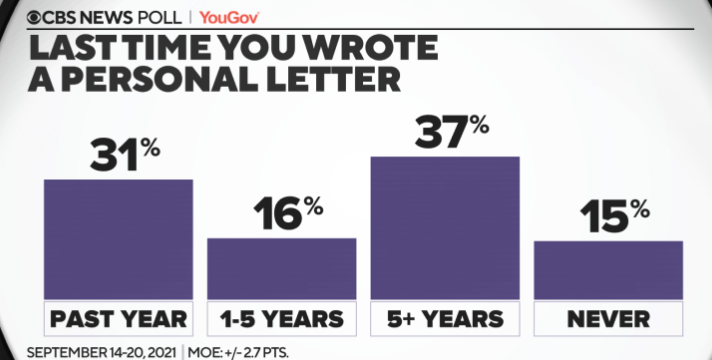
    The image below is from: "Most Americans Haven't Written a Personal Letter on Paper in Over Five Years," Fred Backus, CBS News, Oct. 11, 2o21. 


Post Script:
   When was the last time you wrote a letter by hand? Or when was the last time you wrote a thank you note, or even typed one? I was so shocked when I received a hand written thank you note a few years ago, I posted about it: "Gratitude: Say It In Writing." 

The Bonus: A Mild Defence of Teachers
 Omitted from the portion of the "Cursive Announcement" provided above are some remarks from teachers, who indicated concerns. For example:
"The four major teachers’ unions have slammed the timing of the new language curriculum, being made available for teachers to learn for September with less than two weeks before this school year ends.
The Elementary Teachers’ Federation of Ontario has said the changes are vast and is calling for a minimum two-year implementation period."
Needless to say, these comments elicited many responses, most of which could be subsumed under the category of "ridicule." "How much time do you need to learn to teach writing?" or "Use your PD Days to bone up," etc. are typical of the types of reactions (I made those up, but you can find real ones yourself.)
The defence: perhaps cursive is not that simple. See the Wikipedia entry. Here are a few sentences from it: 
"After the 1960s, a movement originally begun by Paul Standard in the 1930s to replace looped cursive with cursive italic penmanship resurfaced. It was motivated by the claim that cursive instruction was more difficult than it needed to be: that conventional (looped) cursive was unnecessary, and it was easier to write in cursive italic. Because of this, various new forms of cursive italic appeared, including Getty-Dubay Italic, and Barchowsky Fluent Handwriting. In the 21st century, some of the surviving cursive writing styles are Spencerian, Palmer Method, D'Nealian, and Zaner-Bloser script."

Saturday, 1 July 2023

Periodical Ramblings (13)

 National Geographic


  A "Happy July 1st" and a "Happy July 4th" to all of you. We should celebrate such occasions while we can since they soon may be cancelled and we soon may be gone. 
   It would be fitting if my first post in July was a celebratory one, but being contrarian I will instead chronicle another extinction, or near extinction. Although the National Geographic may be around for a bit longer, it is like Martha, the last passenger pigeon, likely to be soon extinct. 
   The last sightings are found in three recent articles which will be excerpted below since the passing of the National Geographic is worth noting. You will not be surprised that corporations played a role in this extinction and that the cast of characters includes Walt Disney and Rupert Murdoch. 

1. "National Geographic Lays Off Its Last Remaining Staff Writers: The magazine, which remains among the most read in the U.S., has struggled in the digital era to command the kind of resources that fueled the deep reporting it became known for," Paul Farhi, Washington Post, June 28, 2023.
"Like one of the endangered species whose impending extinction it has chronicled, National Geographic magazine has been on a relentlessly downward path, struggling for vibrancy in an increasingly unforgiving ecosystem.
On Wednesday, the Washington-based magazine that has surveyed science and the natural world for 135 years reached another difficult passage when it laid off all of its last remaining staff writers.
The cutback — the latest in a series under owner Walt Disney Co. — involves some 19 editorial staffers in all, who were notified in April that these terminations were coming. Article assignments will henceforth be contracted out to freelancers or pieced together by editors. The cuts also eliminated the magazine’s small audio department.
The layoffs were the second over the past nine months, and the fourth since a series of ownership changes began in 2015. In September, Disney removed six top editors in an extraordinary reorganization of the magazine’s editorial operations.
Departing staffers said Wednesday the magazine has curtailed photo contracts that enabled photographers to spend months in the field producing the publication’s iconic images.
In a further cost-cutting move, copies of the famous bright-yellow-bordered print publication will no longer be sold on newsstands in the United States starting next year, the company said in an internal announcement last month....
The magazine’s current trajectory has been years in the making, set in motion primarily by the epochal decline of print and ascent of digital news and information. In the light-speed world of digital media, National Geographic has remained an almost artisanal product — a monthly magazine whose photos, graphics and articles were sometimes the result of months of research and reporting.
At its peak in the late 1980s, National Geographic reached 12 million subscribers in the United States, and millions more overseas. Many of its devotees so savored its illumination of other worlds — space, the depths of the ocean, little-seen parts of the planet — that they stacked old issues into piles that cluttered attics and basements.
It remains among the most widely read magazines in America, at a time when magazines are no longer widely read. At the end of 2022, it had just under 1.8 million subscribers, according to the authoritative Alliance for Audited Media.
National Geographic was launched by Washington’s National Geographic Society, a foundation formed by 33 academics, scientists and would-be adventurers, including Alexander Graham Bell. The magazine was initially sold to the public as a perk for joining the society. It grew into a stand-alone publication slowly but steadily, reaching 1 million subscribers by the 1930s....
The magazine’s place of honor continued to dim through a series of corporate reshufflings that began in 2015 when the Society agreed to form a for-profit partnership with 21st Century Fox, which took majority control in exchange for $725 million. The partnership came under the Disney banner in 2019 as part of a massive $71 billion deal between Fox and Disney."

  Those of you who thought that the "television versions" were sometimes inferior to the print ones are correct:
"The magazine was eventually surpassed for profits and attention by the society’s video operations, including its flagship National Geographic cable channel and Nat Geo Wild, a channel focused on animals. While they produced documentaries equal in quality to the magazine’s rigorous reporting, the channels — managed by Rupert Murdoch’s 21st Century Fox — also aired pseudoscientific entertainment programming about UFOs and reality series like “Sharks vs. Tunas” at odds with the society’s original high-minded vision."
I do confess that both my wife and I enjoyed, "Restaurants at the End of the World," which were found in very remote areas. The program aired on the National Geographic channel. 
Comments:
  Many Post readers commented about the article. Here are a few samples:

The National Geographic went from a board of directors comprised of World renowned Scientists, Explorers, Educators, Photographers and Adventurers to a Corporate Board beholden only to the raw banality of bottom line Capitalism.

Thank you for this post. I will be cancelling my Nat Geo subscription. The writing has been declining (probably because they don’t have enough staff writers). Disney’s desire to create a low quality product as a profit engine is one I will not support with my money. I stand in solidarity with the writers. Disney won’t get another penny out of me.

When Rupert Murdoch bought it, I cancelled my subscription.

2. "National Geographic Lays Off More Writers: The company did not specify how many were shed and said that the magazine, known for its focus on discovery and exploration, would continue to be published on a monthly basis," Jesus Jimenez, New York Times, June 29, 2023.
"National Geographic, the science and nature magazine that for more than a century has sent its writers and photographers to explore and document some of the most remote corners of the Earth, shed more writers and other staff members this week in a round of layoffs that had been announced in April...."
The magazine is still well-read at a time when other magazines have lost subscribers or folded their print publications entirely. Through the end of last year, the magazine had more than 1.7 million subscribers, according to the Alliance for Audited Media, which audits publications."

3. "The Virtual End of National Geographic Magazine”, Jim Geraghty, National Review, June 29, 2023.
"On the menu today: This is going to sound like an extended version of an appeal to support our webathon, but the news that the illustrious magazine National Geographic has laid off all of its last remaining staff writers is a demonstration that we, as a society, have largely chosen to stop paying for news or entertainment, with far-reaching consequences for our lives. The belief that we’re entitled to high-quality information in almost every form — and will accept lower-quality stuff if it is free — is one big reason that the current state of American discourse looks and sounds like a WWE match among insane-asylum inmates held in a sewer.
What Happens When We Stop Paying for Quality?....
The rest of the article is worth reading and paying for. 


  Unlike passenger pigeons, old issues of the National Geographic can still be found. The October 1912 issue pictured above can be purchased at Attic Books here in London, Ontario for $25.00


 For now, at least, old issues can also be found for free in libraries. Western University has, for now, at least, many print volumes in storage and some on microfilm. 

Periodical Ramblings
  You have now been provided with a "Baker's Dozen" of posts about old magazines. The first is "Periodical Ramblings (The Series) and in it I mentioned that my sister had magazines stacked everywhere and many of them were National Geographics. As a subscriber her husband appreciated that that made him  a member of the National Geographic Society. The twelfth "Periodical Rambling" was about the Saturday Evening Post, which, you may be surprised to know, still exists. The one before that was about Look, which does not.

Friday, 16 June 2023

Genug Shoyn


Enough Already! 

    In clear violation of the statements I made in the "About This Blog" section of this blog, I was about to post about subjects relating to current affairs rather than obscure older ones. The current subjects you will be aware of and they mostly relate to those who feel they have been short-changed or feel left out, or who feel they are victims. Note the words 'feel' since most of these topics have to do with identity and feelings rather than ideology or thinking. When I recently had nerve enough to try and look at the news, these same subjects were to be seen across all channels, being discussed by the same people, when they weren't discussing Trump or Trudeau. As a verbal gesture of exasperation, I probably gasped out loud what I was thinking, which was "Enough Already." It is derived from the Yiddish expression above which, of course, make sense since the Jews have had many reasons to feel exasperated and and not a few of them were real victims.

  Given that you also have likely had enough of these subjects and that I implied I was not going to post about them, I will now do so and justify it by noting historical examples of such frustrations and by letting others finish most of this post. Also explained is how a barely unilingual person such as myself came to know the Yiddish words, 'genug shoyn'.

   They were found in a column by William Safire written almost thirty-five years ago when people had already had enough already. It was in a newspaper back when there were more of them and there was more in them. The column was about language and usually funny as well as scholarly. The question he addressed was whether there should be a comma in the phrase! Here is a portion of it and you will see that our Globe and Mail has a mention:

" 'What red-blooded American hasn't surveyed the muck and mire of our national politics,'' writes Mark Jurkowitz of The Boston Globe, ''and said, 'Enough, already'?''
   ''Time magazine reports that Clinton's woes have left U.S. foreign policy adrift,'' writes The Guardian of London, ''though Garrison Keillor says, 'Enough already!'
   ''Howard Fineman of Newsweek asks, ''Is there any way out of this mess?'' leading to an inch-high, 102-point, block-letter headline: ''enough already.''
   The stylistic issue raised is: Should there be a comma between the first and second words of this increasingly important phrase? The publication that pioneered in its popularization is The Toronto Globe and Mail; of the 19,000 entries in the Dow Jones database, the first 22 uses (from 1977 to 1983) were in that newspaper. According to Warren Clements, style editor, ''We abandoned the comma in 1979 because enough already was considered one of those expressions that is almost one word. It rips rollingly off the tongue; the comma would slow it down.'' Adds Michael Kesterton of that newspaper, ''I know it's a Yiddishism, but it just fits the Canadian soul -- you know, 'I've had it and I'm not gonna take it anymore.'"
   The origin is the Yiddish genug shoyn, literally ''enough already.'' It is part of an array of phrases using shoyn for emphasis, from the similar gut shoyn, ''All right already!'' in the sense of ''Stop bugging me,'' to shvayg shtil shoyn, ''Shut up already!'' one calibration more irritated than genug shoyn.
   ''This use of already began to appear early in the century,'' says Sol Steinmetz, the lexicographer who has taken the place of the late Leo Rosten as my primary Yiddish adviser, ''among immigrant Yiddish speakers living in New York who were just starting to talk English. By the 1930's it had become common usage among their children who no longer spoke Yiddish -- a development that enabled it to entrench itself in the American language...."
   We have seen how this Yiddishism has been thoroughly assimilated and is now an Americanism. Because other American English expressions have been adopted in many other languages -- O.K. and no problem are examples -- does this mean that this particular emphasis of exasperation is taking root elsewhere?
   Some evidence exists that it does. Here is a letter to The Washington Post from Robert Hill, an American working in a large Saudi hospital in Riyadh, Saudi Arabia: ''The overwhelming -- by 9 to 1 -- response to the Clinton affair varies among 'What is the very big deal?' to 'What about the problems in the rest of the world?' to 'Enough already!' ''

The Source: 
  "On Language; Enough Already! What Am I, Chopped Liver?", William Safire, The New York Times Magazine, Oct. 25, 1998.
   Attentive readers will have noticed Michael Kesterton's name in relation to The Globe and Mail. They will also have realized that I mentioned following in his foot steps in MM: "A Gathering of Kestertons."
   
The Post Script:
   It is difficult for me to leave current affairs without a couple of additional comments. The first one has to do with Fox News. A few folks up here have petitioned the CRTC to keep Fox out of Canada. I think that would be a mistake. Most Canadians I know dislike Trump (to put it mildly) and find it hard to believe that Americans don't. Well, many millions of them don't and a lot of those are in a state close to Ontario. It might be useful to see what these people are seeing and hearing in order to try and understand what they are thinking and feeling (that word again.) Fox has far more viewers than the other networks. The screenshot which follows is from Fox and the chyron reveals that Fox seems to favour the real president from whom the election was stolen.

This appeared on Fox News Tonight. I don't think those up here who are opposed to Fox News would be offended by this chyron since it probably doesn't qualify as "hate speech." It's just about two old, hetero white males, although admittedly the "real" president could be accused (and has been) of treating women badly. 

About another controversy, the SAUDI/PGA Bone Saw Tour, this cartoon illustrates all you need to know.
   

Monday, 12 June 2023

Dead Fish Headlines


More Signs of the Times

  You may have noticed many recent news stories with headlines such as the ones provided below. They all relate to dead fish in the Gulf of Mexico, the ones pictured above.

“Dead Fish Wash Ashore on Texas Gulf Coast: A Biblical Plague”
“Tens of Thousands of Dead Fish Wash Ashore on Gulf Coast Texas”
“Why Hundreds of Dead Fish Washed Ashore in Texas”
“Hundreds of Thousands of Dead Fish Are Washing Ashore”

  There are many others and I decided to troll and find more. A simple search yielded many from all around the globe. I will just provide the headlines because I am too lazy to type or paste the full source. Trust me, unfortunately they are all real and recent and there are many more than I have presented.

From elsewhere in North America:

“Dead Fish Washing Up on Shores of Lake Washington” (Washington state)
“Dead Fish and Other Aquatic Animals More Common in Summer Heat” (Michigan)
“Why Dead Fish are Washing Up on Michigan Shores" 
“Biologist Explains Uptick in Dead Fish Floating Along Riverfront” Paducah (Ohio River)
“Annual Spring Die-off of Lake Erie Fish Causing Concern”
“Dead Fish Spotted at Canyon Lake” South Dakota"
"Dead Fish Surface at Sunset Park Pond” Nevada
“Dead Fish in Grenadier Pond Being Investigated” (Toronto)
“Locals Still Concerned Over Dead Fish in RIver (Tenn.)
“Hundreds of Dead Fish Die From Spawning Stress in Iowa Lakes”

From the UK:

“Dead Fish Found Floating in Earlswood Lakes” 
“Ballinderry River: Fish Kill Investigated in County Tyrone”

From the Middle East and Africa:

“Authorities Probe Suspected Poisoning of Dead Fish in Sea of Galilee”
“Fish Deaths Near Rio Tinto Mine in Madagascar Dredge Up Community Differences”

From the Far East:

“Dead Fish Raise a Stink in Sursager Lake Once Again” (India)
“Thousands of Fish Dead in Dal Lake” Authorities See Thermal Stratification as Reason” (India)
“Almost 400 kg of Fish Found Floating Dead on Nam Ngao River” (Laos)
“35 Tons of Dead Fish Wash Up in China Lake”

Last, But Not Least - Australia:


“Dead Fish Found in the Darling River at Menindee”
“NSW Chief Scientist to Lead Inquiry Into Menindee Fish Kill”
“Millions of Dead Fish Wash Up Amid Heat Wave in Australia”
"Thousands of Fish Flushed Out of the RIver Murray"
“Tonnes of Dead Fish Pulled From Darling in River Cleanup”
“Thousands of Dead Fish Surface on Gold Coast”

I did not include magazines in my search, but here is one example that relates to the picture above" "Millions of Dead Fish Are Rotting in an Australian River," Margaret Osborne, Smithsonian Magazine, March 21, 2023. I also excluded stories about the fish killed in Ukraine - "“Footage Shows Dead Fish in Kakhovka Reservoir After Dam Flooding."

  The fish are disappearing fast along with farms in Ontario. At least we have our cricket factory. 

For more about our cricket factory see: "Entomophagy" and "Crickets and Conspiracies." 
For more about fish dying from industrial causes rather than unnatural ones see: "Holy Mackeral." 
For headlines that are less depressing see: "Headlines.


Self Defence For the Elderly


   An old friend came to visit recently. He has been a friend for a long time and he is in fact old, although not as old as I. He arrived with the help a cane or, what is known by the British as a "walking stick." Given that the cohort of the decrepit is increasing almost as rapidly as gangs of those who are younger and inclined to inflict violence, I thought it best to suggest some reading for us oldsters. Since we don't have much time, I will get right to the book.

  The title is: The "Walking Stick" Method of Self-Defence," by an "Officer of the Indian Police" (Herbert Gordon Lang). It is basically a manual for those of us who might need to bludgeon someone with our canes. There are headings in it like "Flicks" and "Flips" and "Active Stick Play." If you search for the title on AbeBooks, you will find many copies, some of which are very expensive. But, as a loyal reader of Mulcahy's Miscellany, I will provide you with a free copy. All 118 pages can be read by clicking on this link: The Walking Stick Method of Self-Defence. 
 
If you wish to know more about the art of stick fighting or canne de combat, see the entry for Pierre Vigny in Wikipedia. 
 
If you are shopping for such a device, there are options, but I suggest looking at this: "7 Best Tactical Self Defense Canes (Combat Canes)" by Robert Brannon in SurvivalMag, Jan. 6, 2023. The spelling of "defense" should indicate to you that this is a publication from the United States. I would suggest, however, that if you are hobbling into that country, you might find that you will need more than your stick.

Redbone at Massey Hall, 2007

The Bonus:
   
There is a good song about walking sticks. You will enjoy it and it will allow me to comply with the CRTC rules about Canadian content. The song is by Dickran Gobalian, who you may know as Leon Redbone. Listen here: "Walking Stick." Do skip the ad and wait for the lyrics: 

Without my walking stick, I'd go insane
I can't look my best I feel undressed without my cane.
Must have my walking stick 'cause it may rain
When it pours can't be outdoors without my cane....

Subtitles


  By 'subtitles' I mean the ones that appear at the bottom of a screen at the theatre or on your television. They are useful if the people on the screen are speaking a language you don't understand and the subtitles appear in a language you do, or if you cannot hear. The subtitles that appear after the title on a book constitute a different subject and it is a subject about which I have amassed a considerable amount of information. That will be presented to you if I ever stop being distracted by minor topics such as this one.

   I am now old and so are my ears. My ability to hear has diminished along with many others and I have come to rely on subtitles or "closed captioning" when watching television (chyrons are somewhat different in that they offer words at the bottom of the screen directing you to something else you should be watching or worrying about.) Apparently many people, even the younger versions, are reading subtitles while watching what is on the screen. That readership is increasing among viewers is not disputed and if you search for articles about subtitles you will find many. 

  My purpose here is to direct you to an article which offers some explanations for why the subtitles are on, even if the characters speaking are not Irish. If you are older and don't know how to turn them on, call your service provider. In advance, you should turn up the volume on the phone so you can hear the reasons why you are being put on hold and, as well,  listen to the music. 

  Here is the useful part and it represents only a portion of what the author has to say. You should read the entire piece which is by Devin Gordon and it came in a newsletter from the Atlantic magazine around June 6: "Why Is Everyone Watching TV With The Subtitles On?: It's Not Just You." 

The good news, according to Onnalee Blank, the four-time Emmy Award–winning sound mixer on Game of Thrones, is that it’s not your fault that you can’t hear well enough to follow this stuff. It’s not your TV’s fault either, or your speakers—your sound system might be lousy, but that’s not why you can’t hear the dialogue. “It has everything to do with the streaming services and how they’re choosing to air these shows,” Blank told me.

Specifically, it has everything to do with LKFS, which stands for “Loudness, K-weighted, relative to full scale” and which, for the sake of simplicity, is a unit for measuring loudness. Traditionally it’s been anchored to the dialogue. For years, going back to the golden age of broadcast television and into the pay-cable era, audio engineers had to deliver sound levels within an industry-standard LKFS, or their work would get kicked back to them. That all changed when streaming companies seized control of the industry, a period of time that rather neatly matches Game of Thrones’ run on HBO. According to Blank, Game of Thrones sounded fantastic for years, and she’s got the Emmys to prove it. Then, in 2018, just prior to the show’s final season, AT&T bought HBO’s parent company and overlaid its own uniform loudness spec, which was flatter and simpler to scale across a large library of content. But it was also, crucially, un-anchored to the dialogue.

“So instead of this algorithm analyzing the loudness of the dialogue coming out of people’s mouths,” Blank explained to me, “it analyzes the whole show as loudness. So if you have a loud music cue, that’s gonna be your loud point. And then, when the dialogue comes, you can’t hear it.” Blank remembers noticing the difference from the moment AT&T took the reins at Time Warner; overnight, she said, HBO’s sound went from best-in-class to worst. During the last season of Game of Thrones, she said, “we had to beg [AT&T] to keep our old spec every single time we delivered an episode.” (Because AT&T spun off HBO’s parent company in 2022, a spokesperson for AT&T said they weren’t able to comment on the matter.)

Netflix still uses a dialogue-anchor spec, she said, which is why shows on Netflix sound (to her) noticeably crisper and clearer: “If you watch a Netflix show now and then immediately you turn on an HBO show, you’re gonna have to raise your volume.” Amazon Prime Video’s spec, meanwhile, “is pretty gnarly.” But what really galls her about Amazon is its new “dialogue boost” function, which viewers can select to “increase the volume of dialogue relative to background music and effects.” In other words, she said, it purports to fix a problem of Amazon’s own creation. Instead, she suggested, “why don’t you just air it the way we mixed it?”

The appearance of the subtitles on your screen also varies widely by platform—the streamers control that dial too—and some of them put more effort into the task than others. But their default typefaces are all clunky and robotic and bear no connection to the content. If they can beam Severance into our homes and invent dialogue-boost features, surely they can figure out how to let us pick our own typeface, or shrink the font size, or move the words to a different spot on the screen. You know who’d really benefit from that? Deaf people! Non-English speakers. Anyone who finds that subtitles make them feel included in the culture, rather than shut out of it. And maybe the ubiquity of words at the bottom of the screen will inspire filmmakers and showrunners to craft their own subtitles as a viewing option—you can watch this Jordan Peele art-house horror series with Hulu’s charmless sans serif or with Peele’s signature typeset."


Sources: 
  As mentioned, there are many. The graphic above is from: "Survey: Why America is Obsessed With Subtitles," Matt Zajechowski, preply.com, 03/06/2023.

I see that I hinted about my larger project on print subtitles in a post about: "Titling." Perhaps I should see if I can find my notes.