Showing posts with label Muslim. Show all posts

Friday, 29 August 2025

Banning Burqas?


And Other Assorted Head Gear and Garments 
 
In some places people are compelled to wear certain things, while in others they are sometimes forced to remove them. The question in more "liberal", secular  countries is whether the banning of, say the burqa can be reasonably justified. Such issues are usually avoided because they are controversial and perhaps, more so, because they are complex - and they are. It is easy to say that a hijab doesn't hurt anyone, but to admit that a kirpan could. Masks may not be menacing when worn by Zorro or the Lone Ranger, but they can be threatening when worn by a man entering a bank or an ICE man in the U.S. Keffiyehs don't cover faces, but they are now prohibited in some instances. The debate over such issues is real in both France and Quebec. The debate everywhere is generally more about politics and religion than the philosophical problems.
   The question - "Should a Liberal State Ban the Burqa?" has been examined by Brandon Robshaw and he provides a fine example of how philosophy can be applied in such instances. I will simply introduce you to his work and provide some suggestions about how it can be found. 
   He has written a book and you can find it at Bloomsbury Publishing or on Amazon, where there is this description of: Should a Liberal State Ban the Burqa?
Reconciling Liberalism, Multiculturalism and European Politics:

   Debates about whether the Wahhabist practice of face-veiling for women should be banned in modern liberal states tend to generate more heat than light. This book brings clarity to what can be a confusing subject by disentangling the different strands of the problem and breaking through the accusations of misogyny and Islamophobia. 
   Explaining and expounding the ideas of giants of the liberal tradition including Locke, Mill, and Rawls as well as contemporary thinkers like Nussbaum, Kymlicka and Oshana, the book considers a variety of conceptions of liberalism and how they affect the response to the question. Directly addressing issues facing many of today's societies, it unpicks whether paternalism on grounds of welfare can be justified within liberalism, the value of personal autonomy and the problem of whether a socially influenced choice counts as a genuine preference. 
   Covering the role of multiculturalism, gender issues and feminism, this comprehensive philosophical study of a major political question gets to the heart of whether a ban could be justified in principle, and also questions whether any such ban could prove efficacious in achieving its end.

[as an editorial aside, close readers around London may recognize the name "Kymlicka", which in this case refers to a son of Kym, who was well-known on the Western campus.]

The TOC is helpful:

Table of Contents

1. Introduction
2. Reflections on the French ban
3. The liberal position on habitual public face-covering per se
4. What kind of liberalism?
5. Paternalism considered
6. Personal autonomy and the burqa
7. Adaptive preferences and the burqa
8. The burqa and multicultural theory
9. Gender and the burqa
10. The effect of the burqa on others: Offence
11. The effect of the burqa on others: Harm
12. Conclusion
Bibliography

Unfortunately, the price is $272.57

Another Approach
 
If you are not that interested in this subject, go to this article by Robshaw which reveals why he became interested in the subject and his rudimentary thoughts about it. The entire article is available for free at: Philosophy Now: A Magazine of Ideas (Issue 135 - "Should a Liberal State Ban the Burqa?".)
   Mr. Robshaw was so interested in the issue he decided to use it as a proposal for a PhD dissertation and that ultimately became the book and a review of it is found here: "Should a Liberal State Ban the Burqa?: Book Review," Andreas Matthias, Daily Philosophy: Making Sense of the World (nd)
"A very clear, instructive and carefully argued book that shows off applied philosophy at its best."

The Bonus: 
 
If you don't have $272, I will hint that the entire dissertation (296pp) is available for free. Here is the abstract:

  "This thesis concerns the problem of whether a liberal state should – for liberal reasons – ban the wearing of the burqa in public. The core of the problem is that liberalism appears to pull in two opposed directions on this question. On the one hand, liberals strongly support religious tolerance and the burqa is seen by many, including most of those who wear it, as a religious commitment; and even if it is not a religious commitment it may still be a personal choice, and liberals strongly support enabling personal choice. On the other hand, liberals are committed to supporting equal rights and freedoms for both sexes, and the gender asymmetry of the burqa (women wear it, men don’t) combined with the fact that habitually covering one’s face in public is liable to cause disadvantages in personal, social and professional life, look like good reasons for opposing it; moreover liberals value personal autonomy, which may be compromised if the burqa is worn in response to cultural pressure. The issue thus exposes a tension within liberalism. A central element of my approach is the disentangling of a number of connected but separate strands of the problem. Thus I consider: different conceptions of liberalism and how they affect the response to the question; whether paternalism on grounds of welfare can be justified withinliberalism and if so whether it would justify intervention in the specific case of the burqa; the value of personal autonomy within liberalism and whether a concern to safeguard or promote it couldjustify a burqa ban; the problem of adaptive preference and whether a socially influenced choice counts as a genuine preference; the role of multiculturalism in liberalism and to what extent it could justify exemptions; gender issues and feminism; the problem of coerced wearing of the burqa; and the problem of how likely it would be that a ban, even if justified in principle, would prove efficacious in achieving its end. 
[the additional bonus]
  The conclusion to the thesis is that banning the burqa in a liberal state is unlikely to be justified. It could not be justified in terms of the welfare or autonomy of the individual who voluntarily wears it. It could only be justified on the grounds of harm to others. It might, for example, theoretically be justified if coerced wearing of the burqa were widespread. This would be regrettable, however, as it would override the free choice of those who wore it voluntarily. Empirical evidence that such coercion was occurring would be necessary; and such a ban could only be justified if there were no other, equally efficacious and better targeted means of preventing coercion. My aim is to bring some clarity to this often heated and confused debate, and to supply clear principles on which to base any decision."

                                     [How unique and refreshing.]

Sunday, 2 July 2023

Pedagogical Notes


Cursive Returns To The Classroom

   Some of the knowledge imparted in Ontario schools is being questioned by some parents, but perhaps the re-introduction of handwriting will be accepted, unless, of course, it is promoted as "penmanship." The announcement in the news was made last month and portions of it are provided below where one will find some of the arguments made in support of the idea that the ability to write by hand is a useful skill for students to acquire.

   One assumes that one of the collateral benefits of learning handwriting is that one will be able to read it. Even if you are one of the ones who think that such a skill is no longer needed or relevant, you might agree that being able to read what has been written could be useful. I hadn't thought of that until I read this piece a while back:
"
Gen Z Never Learned to Read Cursive: How Will They Interpret the Past," by Drew Gilpin Faust in The Atlantic: 
  "It was a good book, the student told the 14 others in the undergraduate seminar I was teaching, and it included a number of excellent illustrations, such as photographs of relevant Civil War manuscripts. But, he continued, those weren’t very helpful to him, because of course he couldn’t read cursive.
Had I heard him correctly? Who else can’t read cursive? I asked the class. The answer: about two-thirds. And who can’t write it? Even more. What did they do about signatures? They had invented them by combining vestiges of whatever cursive instruction they may have had with creative squiggles and flourishes. Amused by my astonishment, the students offered reflections about the place—or absence—of handwriting in their lives. Instead of the Civil War past, we found ourselves exploring a different set of historical changes. In my ignorance, I became their pupil as well as a kind of historical artifact, a Rip van Winkle confronting a transformed world."
The 'signature' aspect is an interesting one. If, like me, you do little writing, then your signature may look as messy as mine. Under the best of conditions in calm circumstances the signature I produce doesn't look much different than the scrawl I leave by finger on the device of the deliveryman.

Falling Test Scores - Rising Grades?

   Given that I used the plural "Notes" I will offer another one about education. It is based on data from south-of-the-border, data that were found in a column written by someone we would call a "Tory", so you may want to skip to the cursive announcement below. Although it seems that most people agree that children lost a lot during the plague, one hopes the loss up here was not so profound and that such a loss would not be hidden under grades that had gone up. Here they are:

“California now leads the country in illiteracy. In fact, 23.1 percent of Californians over age 15 cannot read this sentence.”

"In math, 73% of 11th-graders earned A’s, B’s, and C’s. Tests scores showed only 19% met grade-level standards.
For eighth-graders, 79% earned A’s, B’s and C’s in math. Test scores showed 23% met grade-level standards.
In English, 85% of sixth-graders earned A’s, B’s and C’s, while 40% met grade-level standards.
For seventh-graders, 82% earned A’s, B’s and C’s in English. Test scores showed 43% met standards."

The Cursive Announcement:

Relegated in 2006 to an optional piece of learning in Ontario elementary schools, cursive writing is set to return as a mandatory part of the curriculum starting in September.
Education Minister Stephen Lecce said it is about more than just teaching students how to sign their own name.
“The research has been very clear that cursive writing is a critical life skill in helping young people to express more substantively, to think more critically, and ultimately, to express more authentically,” he said in an interview.
“That’s what we’re trying to do, to create a very talented generation of young people who have mastered the fundamental skills, like reading, writing, and math, that are the foundations of any successful productive life in the country....”
The curriculum reintroduces cursive writing as an expectation starting in Grade 3. That’s welcome news for language education experts.
“I think it is long overdue,” said Shelley Stagg Peterson, a curriculum, teaching and learning professor at the University of Toronto’s Ontario Institute for Studies in Education.
“Cursive should never have been taken out of the curriculum.”
There isn’t a lot of research specifically on cursive writing, Peterson said, but the work that has been done shows that it not only teaches students the skill of writing that script in and of itself, but it helps to reinforce overall literacy...."

[There is more.]

Sources:
  If you now feel the need to go shopping for a writing instrument, "Fahrney's Pens" is the place to visit, or a shop to which your email orders can be sent. You should know that some of the pens cost more than a laptop. "An Old Pen Shop Proves Mightier Than the Pandemic and the Death of Cursive," Tara Bahrampour, The Washington Post, March 14, 2023. 
  The troublesome data are found here and I doubt they are dubious, but the ideological bias of the columnist has been noted: "Why K-12 Education's Alarming Decline Could be a Dominant 2024 Issue," George F. Will, The Washington Post, June 28, 2023. 
  Although it is reckless to confound U.S. and Canadian educational issues, here is an education-related headline about Maryland that could soon be found in a newspaper in Ontario: "Hundreds of Md. Parents Protest Lessons They Say Offend Their Faiths: A Crowd of Mostly Muslim and Ethiopian Orthodox Parents, Wants the State's Largest School System to Exempt Their Kids From LGBTQ Content," Nicole Asbury and Katie Shepherd," The Washington Post, June 27, 2023. 
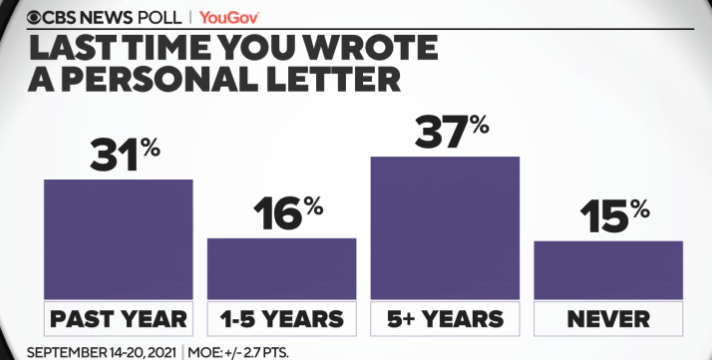
    The image below is from: "Most Americans Haven't Written a Personal Letter on Paper in Over Five Years," Fred Backus, CBS News, Oct. 11, 2o21. 


Post Script:
   When was the last time you wrote a letter by hand? Or when was the last time you wrote a thank you note, or even typed one? I was so shocked when I received a hand written thank you note a few years ago, I posted about it: "Gratitude: Say It In Writing." 

The Bonus: A Mild Defence of Teachers
 Omitted from the portion of the "Cursive Announcement" provided above are some remarks from teachers, who indicated concerns. For example:
"The four major teachers’ unions have slammed the timing of the new language curriculum, being made available for teachers to learn for September with less than two weeks before this school year ends.
The Elementary Teachers’ Federation of Ontario has said the changes are vast and is calling for a minimum two-year implementation period."
Needless to say, these comments elicited many responses, most of which could be subsumed under the category of "ridicule." "How much time do you need to learn to teach writing?" or "Use your PD Days to bone up," etc. are typical of the types of reactions (I made those up, but you can find real ones yourself.)
The defence: perhaps cursive is not that simple. See the Wikipedia entry. Here are a few sentences from it: 
"After the 1960s, a movement originally begun by Paul Standard in the 1930s to replace looped cursive with cursive italic penmanship resurfaced. It was motivated by the claim that cursive instruction was more difficult than it needed to be: that conventional (looped) cursive was unnecessary, and it was easier to write in cursive italic. Because of this, various new forms of cursive italic appeared, including Getty-Dubay Italic, and Barchowsky Fluent Handwriting. In the 21st century, some of the surviving cursive writing styles are Spencerian, Palmer Method, D'Nealian, and Zaner-Bloser script."