Showing posts with label periodicals. Show all posts

Sunday, 16 February 2025

The Journal of Schenkerian Studies

 Little Journal ----Large Issues

   I have devoted several posts to the subject of journals which are basically about one person. That person is usually an author, but in this case the periodical is about the Austrian music theorist Heinrich Schenker who was also an author. The number of subscribers to it is much smaller than the number of words in this post which I hope to keep very short.
   I should, because I know even less about classical music than I do about a very large number of other subjects about which I know little. Plus, I can't read music or German and the title of this journal scares me as much as the word "calculus." I understand enough, however, to know that even a little magazine can get into big trouble, if it is located on a campus and the subject of race arises.
   The Journal of Schenkerian Studies is published at the Center for Schenkerian Studies at the University of North Texas. The Center is headed by Professor Timothy Jackson, a tenured professor of music theory. 
    Across the country at Hunter College there is a Professor Ewell, also a music professor, but a Black one, a colour that should be mentioned in this case. In 2019, he travelled to Columbus and addressed the Society for Music Theory. The title of the talk was "Music Theory's White Racial Frame" and apparently one doesn't have to know much about music theory to understand the major points made, that Schenker was a racist, a fact ignored by the Schenkerians, and that, to put it bluntly, classical music was too white.  Apparently he received a standing ovation, which is a rather rare thing at an academic conference. 
   This news reached Texas and it is fair to say Professor Jackson did not agree. He then did what should be done when such academic arguments develop -- issue a call for papers to debate the issue. Articles discussing the Ewell arguments were returned and published in The Journal of Schenkerian Studies. Some agreed with Professor Ewell and some did not. Professor Jackson did not. Apart from the Black/white arguments, there were some into which anti-semitism was injected to further complicate the attempt at discourse.(Schenker, who was Jewish, died in 1935 and his wife died ten years later in Theresienstadt.)
   The news generated about this polemical essay in a very small academic periodical, was considerable. It came to the attention of the graduate students in Texas as did the word "race" and, probably without reading the papers, many decided that even a tenured professor should be fired it he was a racist. Others piled on and there was a demand that he be terminated.
   Naturally the news was a nuisance for those in the administrative  wing at North Texas and, not surprisingly, Professor Jackson was removed as editor and generally ostracized from departmental matters. 
   Once again, Professor Jackson did not agree, feeling perhaps that he had been treated shoddily, and sued the UNT regents and others who had defamed him and violated his right to speak freely. The regents appealed, but a Texas Court of Appeals ruled in favour of Professor Jackson and the litigation continues. 
   To keep this short, this episode can be characterized simply as another cannon shot at another canon that is a construct of a different group of DWEMS - DWEMusicians. It illustrates that even a little academic single author journal with limited circulation can have a big impact. 

Sources: 
   
For most, all of the information you will want can be found freely in the Wikipedia entries for Heinrich Schenker or the one for The Journal of Schenkerian Studies. To visit the scene of the crime, go to the UNT School of Music and the Division of Music History, Theory and Ethnomusicology where the Journal of Schenkerian Studies still exists, apparently in a suspended state.
   If you are willing to pay, start here: "
Obscure Musicology Journal Sparks Battles Over Race and Free Speech: A scholar’s address about racism and music theory was met with a vituperative, personal response by a small journal. It faced calls to cease publishing," Michael Powell, NYT, Feb. 14, 2021. 
"A periodical devoted to the study of a long-dead European music theorist is an unlikely suspect to spark an explosive battle over race and free speech."

The Bonus: 
Professor Ewell's views are expressed in his recently published book which is available up at Western in the Music Library. Here is a description:
On Music Theory: And Making Music More Welcoming For Everyone.
"Since its inception in the mid-twentieth century, American music theory has been framed and taught almost exclusively by white men. As a result, whiteness and maleness are woven into the fabric of the field, and BIPOC music theorists face enormous hurdles due to their racial identities. In On Music Theory, Philip Ewell brings together autobiography, music theory and history, and theory and history of race in the United States to offer a black perspective on the state of music theory and to confront the field's white supremacist roots. Over the course of the book, Ewell undertakes a textbook analysis to unpack the mythologies of whiteness and western-ness with respect to music theory, and gives, for the first time, his perspective on the controversy surrounding the publication of volume 12 of the Journal of Schenkerian Studies. He speaks directly about the antiblackness of music theory and the antisemitism of classical music writ large and concludes by offering suggestions about how we move forward. Taking an explicitly antiracist approach to music theory, with this book Ewell begins to create a space in which those who have been marginalized in music theory can thrive." -- Back cover.

Sunday, 17 December 2023

Beyond the Palewall (5)


[Beyond the palewall is the title of this series because beyond the paywall is taken. Information for which you are not willing to pay, along with information you may not wish to know, is presented in abbreviated form without charge. What has caught my eye may sometimes feel like a poke in yours and, in that sense, be beyond the pale. Items will appear weekly, or perhaps monthly, or maybe semi-annually, if I can get started and the weather is bleak.]


Something Else to Worry About

   One would think that it would be good news that fish are able to survive in Hamilton Harbour, but that is not the case. Very large goldfish have been spotted there and elsewhere in the Great Lakes (and elsewhere around the globe.) The point to be made in this post is simply that you should not take your goldfish out of the bowl and put it in the Thames.

   "Over the past several years, Ms. Boston and her colleagues have been tracking invasive goldfish in Hamilton Harbour, which is on the western tip of Lake Ontario, about 35 miles southwest of Toronto. The bay has been decimated by industrial and urban development as well as by invasive species — making it among the most environmentally degraded areas of the Great Lakes.
Their study, published last month in the Journal of Great Lakes Research, could help pinpoint goldfish populations for culling, said Ms. Boston, who is the lead author. “We found out where they are before they start spawning,” she said. “That’s a good opportunity to get rid of them.”
   The fast-growing female goldfish, Ms. Boston noted, can also reproduce several times in one season. “They have the resources,” she added, “and they can take advantage of them.”
   Goldfish were first spotted in Hamilton Harbour in the 1960s, but largely died off in the 1970s because of industrial contamination. In the early 2000s, their population appeared to recover. Goldfish can tolerate a wide range of water temperatures, reach sexual maturation quickly, and can eat nearly anything, including algae, aquatic plants, eggs and invertebrates, Ms. Boston said.
   Their football-shaped bodies can swell to a size that makes them too large a meal for predators — up to about 16 inches long. “A fish would have to have a really big mouth to eat it,” she said....
   Nicholas Mandrak, a professor of biological sciences at the University of Toronto Scarborough, said that while goldfish were introduced to North America in the late 1800s, the wild population had begun to “dramatically increase” in the past two decades. Their spawning explosion, he said, resulted partly from people in densely-populated areas releasing pets in urban ponds.
   Climate change may play a role, because of the goldfish’s capacity to adapt to warming and poorly oxygenated waters, he added.
   “There are literally millions of goldfish in the Great Lakes, if not tens of millions,” Dr. Mandrak said.

Sources:
 "Once They Were Pets. Now Giant Goldfish Are Menacing the Great Lakes.
Released into the Wild, the Humble Goldfish Can Grow to a Monstrous Size and Destroy Habitats for Native Species. Canadian Researchers are Tracking the Fish, so That They Might be Culled," Livia Albeck-Ripka, New York Times, Dec. 8, 2023.
  That the problem is a global one is clear from the picture, which portrays a goldfish caught in Europe. "Behold Carrot, The 67-pound Goldfish Caught in France," Jennifer Hassan, The Washington Post, Nov. 22, 2022.
 

Magazines Are Disappearing Along With Newspapers

   In Mulcahy's Miscellany there is a series titled "Periodical Ramblings" and the last post in it was about, Liberty magazine which stopped publishing in Canada long ago. The Last Post has now been sounded for Readers Digest Canada which has been around over 75 years. Although one commentator called it the "Barry Manilow of magazines," another noted: “It’s going to be missed by a lot of readers,” said Mark Pupo, who was editor-in-chief of Reader’s Digest Canada from 2019-2022. “It was a great space for Canadian storytelling. We’re losing a lot.” The following brief bits are from: "Reader's Digest Canada, Once A Household Staple, Will End its Run After 76 Years," Jana G. Pruden, Globe and Mail, Dec. 5, 2023.

   Employees were told Reader’s Digest Magazines Ltd. will continue to publish its five Canadian magazines until March 31, 2024, and that the websites will remain in operation “for a certain period” with “basic support” from employees in the United States.
   A spokesperson from American parent company Trusted Media Brands – identified in the presentation to staff as the person to handle all media inquiries – did not respond to multiple requests for comment.
It was an unceremonious announcement for a digest that has been a venerable part of the Canadian magazine market since it began publishing in the country in 1947. It was declared the most influential magazine in Canadian publishing history in 2008.
   As recently as April, a press release described Reader’s Digest as Canada’s most-read monthly magazine, boasting more than three million readers every month. Reader’s Digest Magazines Ltd. also publishes a French edition, Sélection, as well as Best Health Canada, Our Canada and More Our Canada....
   Founded in the U.S. in 1922, Reader’s Digest grew to be a dominant global brand with dozens of editions published all over the world in multiple languages, including braille, and sold in over 60 countries.
The magazine became known for its mix of upbeat and informative stories, health and wellness news and dramatic storytelling, often condensed and updated versions of other magazine pieces. Issues were also peppered with vocabulary quizzes, facts, jokes, comics, puzzles and lighthearted anecdotes in features such as Laughter, the Best Medicine, and Life’s Like That.

Post Script: 
   It is worth noting that the owner of the magazine is Trusted Media Brands. 
   Unfortunately, those of you who are saddened by this loss will no longer be able to reach for a Kleenex. See: "What Kleenex's Canadian Exit Reveals About Our  Grocery Sector's Lack of Competition," David Soberman, Globe and Mail, Sept. 11, 2023.


City Living
   I am not a big fan of big cities, nor do I put much faith in rankings. I did, however, call your attention to "The 100 Most Livable Cities in Canada", and particularly to the fact that London does not appear in that ranking. Another one has just been completed and London does not show up in it either. Ranked, this time, is the "Quality of Living", which must be related, one would think, to being "Livable." Given that I have provided you with the Globe and Mail and Economist rankings, I will now point you to the one by Mercer: "Quality of Living City Ranking 2023." You can go through the rankings by clicking on that link. If you don't want to take the time, I will suggest that you move to Vancouver if you wish to stay in this country or Vienna if you want to live abroad. 

Sources:
  "Vancouver Beats Out Toronto For Cities With the Best Quality of Living For Expats," The Toronto Star, Dec. 14, 2023
  Five Canadian cities made it on to the list ranking quality of life for newcomers and expatriates, but only one made it into the top ten.
   Vancouver - at eighth - beat out Toronto (17th), Ottawa (tied for 18th), Montreal (tied for 20th) and Calgary (tied for 23rd).

   "Move to One of These 10 Global Cities in 2024 If You Want to Work Somewhere    With a Great Quality of Life," Michael Grothaus, Fast Company, Dec. 15, 2023.
   "If you’ve ever wondered which of the world’s cities might be the best to live and work in, you’ll want to check out Mercer’s 2023 Quality of Living rankings, which look at the quality of life that workers and their families who work outside their home countries have.  
   This year, the consulting firm ranked more than 200 cities on five continents. The top city in the world, according to Mercer’s rankings, is Vienna, Austria. Mercer says the central European capital is “known for its rich history, stunning architecture, and vibrant cultural scene, Vienna offers its residents a high standard of living in various aspects.”
   The remainder of the top 10 list is dominated by European cities, which take seven of the 10 spots. Germany alone takes three of the top 10 spots with Frankfurt in 6th place, Munich in 7th, and Dusseldorf in 10th. The only North American city to make the top 10 list is Vancouver, Canada, which came in 8th place."

Tuesday, 7 November 2023

Periodical Ramblings (14)


Liberty Magazine - The Canadian One

   You will gather from the title that I have often written about periodicals and the rationale for doing so is stated in, "Periodical Ramblings (The Series)" which is found back in the summer of 2017. In the last few, I dealt with Look and Saturday Evening Post which, like Liberty, were popular magazines.

   I did not grow up in Canada, but if you did in the 1950s and '60s you probably read it or saw it displayed in the newsstands which used to exist. If you have any copies, you should hang onto them since they often fetch a fair price.


Images of the magazine are easy to locate, but the periodical is not. One reason for that is that "liberty" is a word attached to many things, including many different kinds of periodicals There was a very popular Liberty in the United States about which much is found, but that is not true for the Canadian version, although I will add that my searches for it have not been exhaustive. 


  Apart from having a popular name, the title varied and you will find a Canadian New Liberty Magazine and one with a subtitle: Liberty: Canada's Young Family Magazine.


  It was published in Montreal and likely existed over the years from 1932 to 1964 and was edited during the latter years by Frank Rasky who was a popular Canadian author. A paperback edition of the one pictured above is available on Amazon for around $200. 


   I don't think any copies of Liberty exist in libraries in London. For anyone studying Canadian popular history, it would be an interesting resource. Gale has digitized for researchers the entire collection of the Liberty Magazine published in the United States, ("Liberty Magazine Historical Archive, 1924-1950.") 

Saturday, 1 July 2023

Periodical Ramblings (13)

 National Geographic


  A "Happy July 1st" and a "Happy July 4th" to all of you. We should celebrate such occasions while we can since they soon may be cancelled and we soon may be gone. 
   It would be fitting if my first post in July was a celebratory one, but being contrarian I will instead chronicle another extinction, or near extinction. Although the National Geographic may be around for a bit longer, it is like Martha, the last passenger pigeon, likely to be soon extinct. 
   The last sightings are found in three recent articles which will be excerpted below since the passing of the National Geographic is worth noting. You will not be surprised that corporations played a role in this extinction and that the cast of characters includes Walt Disney and Rupert Murdoch. 

1. "National Geographic Lays Off Its Last Remaining Staff Writers: The magazine, which remains among the most read in the U.S., has struggled in the digital era to command the kind of resources that fueled the deep reporting it became known for," Paul Farhi, Washington Post, June 28, 2023.
"Like one of the endangered species whose impending extinction it has chronicled, National Geographic magazine has been on a relentlessly downward path, struggling for vibrancy in an increasingly unforgiving ecosystem.
On Wednesday, the Washington-based magazine that has surveyed science and the natural world for 135 years reached another difficult passage when it laid off all of its last remaining staff writers.
The cutback — the latest in a series under owner Walt Disney Co. — involves some 19 editorial staffers in all, who were notified in April that these terminations were coming. Article assignments will henceforth be contracted out to freelancers or pieced together by editors. The cuts also eliminated the magazine’s small audio department.
The layoffs were the second over the past nine months, and the fourth since a series of ownership changes began in 2015. In September, Disney removed six top editors in an extraordinary reorganization of the magazine’s editorial operations.
Departing staffers said Wednesday the magazine has curtailed photo contracts that enabled photographers to spend months in the field producing the publication’s iconic images.
In a further cost-cutting move, copies of the famous bright-yellow-bordered print publication will no longer be sold on newsstands in the United States starting next year, the company said in an internal announcement last month....
The magazine’s current trajectory has been years in the making, set in motion primarily by the epochal decline of print and ascent of digital news and information. In the light-speed world of digital media, National Geographic has remained an almost artisanal product — a monthly magazine whose photos, graphics and articles were sometimes the result of months of research and reporting.
At its peak in the late 1980s, National Geographic reached 12 million subscribers in the United States, and millions more overseas. Many of its devotees so savored its illumination of other worlds — space, the depths of the ocean, little-seen parts of the planet — that they stacked old issues into piles that cluttered attics and basements.
It remains among the most widely read magazines in America, at a time when magazines are no longer widely read. At the end of 2022, it had just under 1.8 million subscribers, according to the authoritative Alliance for Audited Media.
National Geographic was launched by Washington’s National Geographic Society, a foundation formed by 33 academics, scientists and would-be adventurers, including Alexander Graham Bell. The magazine was initially sold to the public as a perk for joining the society. It grew into a stand-alone publication slowly but steadily, reaching 1 million subscribers by the 1930s....
The magazine’s place of honor continued to dim through a series of corporate reshufflings that began in 2015 when the Society agreed to form a for-profit partnership with 21st Century Fox, which took majority control in exchange for $725 million. The partnership came under the Disney banner in 2019 as part of a massive $71 billion deal between Fox and Disney."

  Those of you who thought that the "television versions" were sometimes inferior to the print ones are correct:
"The magazine was eventually surpassed for profits and attention by the society’s video operations, including its flagship National Geographic cable channel and Nat Geo Wild, a channel focused on animals. While they produced documentaries equal in quality to the magazine’s rigorous reporting, the channels — managed by Rupert Murdoch’s 21st Century Fox — also aired pseudoscientific entertainment programming about UFOs and reality series like “Sharks vs. Tunas” at odds with the society’s original high-minded vision."
I do confess that both my wife and I enjoyed, "Restaurants at the End of the World," which were found in very remote areas. The program aired on the National Geographic channel. 
Comments:
  Many Post readers commented about the article. Here are a few samples:

The National Geographic went from a board of directors comprised of World renowned Scientists, Explorers, Educators, Photographers and Adventurers to a Corporate Board beholden only to the raw banality of bottom line Capitalism.

Thank you for this post. I will be cancelling my Nat Geo subscription. The writing has been declining (probably because they don’t have enough staff writers). Disney’s desire to create a low quality product as a profit engine is one I will not support with my money. I stand in solidarity with the writers. Disney won’t get another penny out of me.

When Rupert Murdoch bought it, I cancelled my subscription.

2. "National Geographic Lays Off More Writers: The company did not specify how many were shed and said that the magazine, known for its focus on discovery and exploration, would continue to be published on a monthly basis," Jesus Jimenez, New York Times, June 29, 2023.
"National Geographic, the science and nature magazine that for more than a century has sent its writers and photographers to explore and document some of the most remote corners of the Earth, shed more writers and other staff members this week in a round of layoffs that had been announced in April...."
The magazine is still well-read at a time when other magazines have lost subscribers or folded their print publications entirely. Through the end of last year, the magazine had more than 1.7 million subscribers, according to the Alliance for Audited Media, which audits publications."

3. "The Virtual End of National Geographic Magazine”, Jim Geraghty, National Review, June 29, 2023.
"On the menu today: This is going to sound like an extended version of an appeal to support our webathon, but the news that the illustrious magazine National Geographic has laid off all of its last remaining staff writers is a demonstration that we, as a society, have largely chosen to stop paying for news or entertainment, with far-reaching consequences for our lives. The belief that we’re entitled to high-quality information in almost every form — and will accept lower-quality stuff if it is free — is one big reason that the current state of American discourse looks and sounds like a WWE match among insane-asylum inmates held in a sewer.
What Happens When We Stop Paying for Quality?....
The rest of the article is worth reading and paying for. 


  Unlike passenger pigeons, old issues of the National Geographic can still be found. The October 1912 issue pictured above can be purchased at Attic Books here in London, Ontario for $25.00


 For now, at least, old issues can also be found for free in libraries. Western University has, for now, at least, many print volumes in storage and some on microfilm. 

Periodical Ramblings
  You have now been provided with a "Baker's Dozen" of posts about old magazines. The first is "Periodical Ramblings (The Series) and in it I mentioned that my sister had magazines stacked everywhere and many of them were National Geographics. As a subscriber her husband appreciated that that made him  a member of the National Geographic Society. The twelfth "Periodical Rambling" was about the Saturday Evening Post, which, you may be surprised to know, still exists. The one before that was about Look, which does not.

Monday, 20 February 2023

Ohio State University Press


    As the dreary weather continues, so does the search for good reading material. It is not usually found on the New York Times Best Seller List which, we have come to learn, does not contain books recommended by the NYT, but only those found in the various tabulations gathered by someone who works for the NYT. The best sellers are often not good, but they are popular, which also does not necessarily mean "good". As I type this on "Family Day", a holiday throughout much of Canada, it is interesting to note that Jennette McCurdy's, I'm Glad My Mom Died, is #4 on the "Non-Fiction" list. It may, or may not, be good, but apparently it is selling well. 

  About 12,000 books are published annually by University Presses, but they rarely appear on the lists in the NYT. An exception might have been, A River Runs Through It and Other Stories, which was published by the University of Chicago Press and was at least somewhat popular and made into a film directed by Robert Redford and starring Brad Pitt. Given that you may not come across many university press catalogues, or pay much attention to the book ads in some high brow magazines, there may be 12,000 new books of which you are unaware. 

  It is to make you aware of potential sources for good books that I have provided short profiles of university presses over the past couple of years. I began way out on the west coast with the University of Washington and lately have focused on ones near by, ranging from the University of Minnesota to those even closer to Ontario: Penn State, Wayne State, Michigan State and the University of Michigan. I must soon begin including Canadian ones. 

  Today, the choice is from Columbus, Ohio. I should have mentioned earlier, and have done so in earlier posts, that not all university press books are unreadable and full of the jargon we civilians associate with those who reside on campuses. While many current university press publications deal with things like intersectionality and hyphenated identities, the older entries in the catalogues can be of interest and many of them can be read and enjoyed by people like us. 

   At the website of The Ohio State University Press, you can quickly learn about their publishing priorities. When I have posted about the university presses close by, I have indicated that there is often a regional focus which encompasses our area, where books of "local" interest are found. See, for example, Penn State's "Keystone Books" and Wayne State's, "Great Lakes Book Series." Books with a midwestern focus produced at Ohio State are found under the "Trillium" imprint, a floral emblem Ontarians will recognize.

   If you are especially interested in nature and the birds and fishes found close by Ontario, be sure to check the works of Milton Trautman. Although he didn't make it beyond Grade 8, he is renowned as an ornithologist and ichthyologist and wrote many articles of interest about the Bass Islands a little bit south of Pelee Island. His very big book about The Birds of Buckeye Lake can be downloaded for free, but his Birds of Western Lake Erie could cost you almost $300. For a long and interesting article about Trautman see: "The Last Naturalist: A Zoologist Happiest in the Fields and Streams of Ohio, Wrote Major Works About the State's Birds and Fishes," Parker Bauer, The American Scholar, April 21, 2022. 

OSU PRESS


"The Trillium imprint publishes books about Ohio and the Midwest in an effort to help the citizens of the state learn more about the unique history, the diverse culture, and the natural environment of the state of Ohio. Books published under this imprint will also help to fund our scholarly publishing program, and will aid in lowering the cost of the student textbooks we publish." 


The entire book can be read by clicking on this link. 

A Few More Buckeye Books


The United States of Ohio covers little-known facts about Ohio, such as how the state was the birthplace of both the National Football League and Major League Baseball and how it was Ohioans who led efforts toward racial integration in both sports. Readers will learn what makes the state a manufacturing and agricultural powerhouse—with both the largest tire company, Akron’s Goodyear, and the largest consumer products company, Cincinnati’s Procter & Gamble, based there. The state grows, processes, and builds on a level that far outpaces the size of its population or expanse of its borders. And it is the birthplace of many prominent US figures—from Thomas Edison to John Glenn to Neil Armstrong. From sports to a century’s worth of entertainment superstars to aviation and space exploration, Ohio’s best have made for America’s greatest stories—all captured here in a look at the Buckeye State and its impact on the other forty-nine.


“An exceptionally thorough history of white supremacy focused on Ohio but relevant nationwide. By analyzing supremacist influences on American history, from conquests of Native Americans to today’s alt right, the authors have created an eye-opening resource. Its accessible style will engage a broad readership.”—Deborah Levine, editor of American Diversity Report


“Falconry in Hawking Women touches on so many topics: the strange intimacies of memory training that bonded a bird with its handler, gender hierarchies, and especially the entangled freedom and constraint of poetics. Petrosillo’s rich practical knowledge of the sport illuminates a key component of medieval literature.” —Karl Steel, author of How to Make a Human: Animals and Violence in the Middle Ages.

The Bonus:


   University presses also often publish journals and one produced by OSU is: Inks: The Journal of the Comic Studies Society. 


For an article of local interest in this journal see: "Comics and Public History: The True Story of the 1934 Chatham Coloured All-Stars, " Dale Jacobs and Heidi LM Jacobs, in Vol.4, No.1, Spring 2020, p.101.

Sunday, 13 November 2022

Celebrities!!!

Celebrity Cameos 


  It is snowing today and I am back at the blogworks. Thinking about a subject to approach I came up with CELEBRITIES because the citizenry seems to be obsessed with them and I need to divert some attention to this blog. I figure I can get some if I offer those who are star-obsessed a way to make a connection with their idols. 

  I vaguely recalled that there are now services that provide connections, such as, for example, getting Kyrie Irving or Kanye West to send you a tweet (unless you are Jewish.) Touching and personalized emails also will be sent if you know who to pay. 

 You can even get a personal video from the most aloof of celebrities, while your friends have to rely on those provided by the paparazzi. There are also ways to get them from the more elusive and rarer Canadian celebrities. For example, Mr. Roach above is a star in the show Trailer Park Boys and for $265 you will get a video directly from him. One from Wendel Clark is only $156 and these are Canadian dollars not the real ones. As the related website says, "Capture The Wow!"

Post Cards From Authors

   More suited for the readers of Mulcahy's Miscellany are the handwritten notes you will receive from the authors you cherish, once I show you where to look. I am not sure how many Canadian writers participate, but that is Claire Messud above. While perhaps not strictly Canadian, she spent time here and her mother is.
  Right now Claire will write to you for $75 (US), but there is a catch. Notes such as hers are part of an auction and her price may rise before the November 30, deadline. At this time, David Sedaris will write something funny for $400 while a more serious note will come from Donna Tart for $550.

  Now that I have warmed up, I will move to more serious subjects. Before I do, here is the information you need and I am sure there is more to be found.

Sources:
  For the crass, go directly to CAMEO - Celebrity Video Messages. 
  Those of you who are more refined should have a look at,  The Common's Author Postcard Auction. Do so soon. The site is worth visiting for the pictures of the authors. The funds raised are used to support the publishing efforts of writers from various backgrounds. The Common is located at Amherst College and The Common is also a literary periodical, the kind of "little magazine" I have often mentioned in my "Periodical Ramblings See, for example, The Sewanee Review. 

Friday, 21 January 2022

Periodical Ramblings (11)


A New Book About LOOK

  Although you would have to be over fifty to have read this magazine when it was still being published, you will probably have seen a copy and surely some of the photographs published within it. It was an important magazine in the United States and that is why Andrew Yarrow has written a book about it. Here is a description of the book:

"Andrew L. Yarrow tells the story of Look magazine, one of the greatest mass-circulation publications in American history, and the very different United States in which it existed. The all-but-forgotten magazine had an extraordinary influence on mid-twentieth-century America, not only by telling powerful, thoughtful stories and printing outstanding photographs but also by helping to create a national conversation around a common set of ideas and ideals. Yarrow describes how the magazine covered the United States and the world, telling stories of people and trends, injustices and triumphs, and included essays by prominent Americans such as Martin Luther King Jr. and Margaret Mead. It did not shy away from exposing the country’s problems, but it always believed that those problems could be solved. Look, which was published from 1937 to 1971 and had about 35 million readers at its peak, was an astute observer with a distinctive take on one of the greatest eras in U.S. history—from winning World War II and building immense, increasingly inclusive prosperity to celebrating grand achievements and advancing the rights of Black and female citizens. Because the magazine shaped Americans’ beliefs while guiding the country through a period of profound social and cultural change, this is also a story about how a long-gone form of journalism helped make America better and assured readers it could be better still."


The Photographs
   This new book, Look: How A Highly Influential Magazine Helped Define Mid-20th-Century America, contains some photographs and more can be found on the Internet, offered mostly by people trying to sell old issues of the magazine. The Library of Congress has over four million of them which were donated when the magazine folded. They remain, at this point, undigitized. The Museum of the City of New York has some relating to that city and a few of those can be viewed here and here. 

The Last of LOOK
   Look ceased publication in 1971 and, as Yarrow notes: 
"The end of Look (and Life a year later, on December 29, 1972) marked the end of the mass- circulation, general-interest magazine and the greatest days of photojournalism. News magazines like Time and Newsweek could still appeal to the nation's opinion leaders and much of middle America, but their content was more limited, and photos were mostly an afterthought."

Sources: 
   An e-version of the book is available in the Western Libraries for those fortunate enough to have access. Western also has this earlier book: The Forgotten Fifties: America's Decade From the Archives of Look Magazine, by James Conaway. 
  My last ramble was about the magazines held in The Steven Lamazow Collection of American Periodicals. 

The Bonus:
   
The director Stanley Kubrick was a photojournalist at Look. Western also has a book about that: 
Stanley Kubrick at Look Magazine: Authorship and Genre in Photojournalism.

Thursday, 4 March 2021

Periodical Ramblings (10)

 The Steven Lamazow Collection of American Periodicals


   Dr. Steven Lomazow is a neurologist in New Jersey. He has been collecting magazines for almost fifty years and has over 80,000 of them, many of which are very rare. One can only imagine what his waiting room is like. 
   It is fitting that the tenth post in the series, "Periodical Ramblings" is turned over to someone who is really interested in magazines. Many of those he has collected are now being exhibited in The Grolier Club in New York city. You can visit virtually here: Magazines and The American Experience: Highlights From the Collection of Steven Lomazow, M.D. You can spend the rest of the day rambling among periodicals that range in subject from the avant garde and archery, to wars and wrestling. 


    If you want to spend more time browsing, then visit his major website: The Great American Magazine: The Periodical Collection of Steven Lamazow, M.D. There you can search thousands of periodicals and view images, and find links to other periodical-related resources. It is also worth looking at his older blog site: Magazine History: A Collector's Blog Documenting and Illustrating the History, Importance and the Joy of Collecting Magazines, 2008-2013. 


The Bonus:
   If you are interested in books and libraries, you should visit The Grolier Club and do some browsing. There are many interesting books and resources to be found and among the other exhibitions, there is this one about medical history books related to plastic surgery: The History of Plastic Surgery: "Much More Than Skin Deep" from the Collection of Douglas M. Monasebian, M.D.
   Speaking of medical history, Dr. Lomazov has yet another blog relating to the health of FDR: see FDR's Deadly Secret. 


Sources:
"How Magazines Helped Shape American History: Explore 300 Years of the Periodicals in an Encyclopedic Exhibition Opening at the Grolier Club in New York City,” Nora McGreevy, Smithsonian Magazine, Feb. 23, 2021.
"For national audiences, Lomazow and librarian Julie Carlsen have curated an extensive online exhibition, chronicling the magazine experience against the backdrop of American history on subjects ranging from the birth of democracy, to emancipation and the Civil War, the mid-century information age and the battle for civil rights, as well as a host of niche publications on celebrity, humor, art and baseball."

"What Are Magazines Good For," Nathan Heller, New Yorker, Feb. 16, 2021.
"The Grolier is a club for bibliophiles, but magazine nuts are admitted if their obsession reaches sufficiently crazed levels. (The home Lomazow shares with his wife and collaborator in collection, Suze Bienaimee, teems intimidatingly, some might say alarmingly, with bound volumes.) Lomazow strode over to one of eleven glass cases displaying his magazines, moving like a man whose number has been called at a busy deli counter. In winnowing down his collection to about two hundred issues for display—the show, in the exhibition gallery of the Grolier’s clubhouse, is open to the public by appointment—he focussed on those of acute historical importance."

The Series:

Here are the ones that have been posted so far in "Periodical Ramblings."
Periodical Ramblings (1) (The Sewanee Review)
Periodical Ramblings (3) (The Village Voice)
Periodical Ramblings (4) (The Wilson Quarterly)
Periodical Ramblings (5) ( The Prairie Schooner)
Periodical Ramblings (8) (Journals Devoted to a Single Author)
Periodical Ramblings (9) ( Arizona Highways) 


Saturday, 23 June 2018

Periodical Ramblings (7)

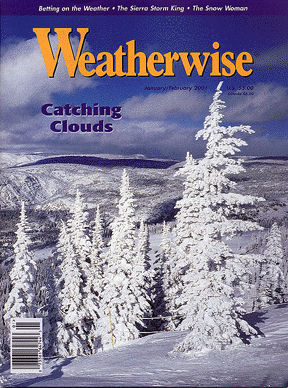
Weatherwise


I discovered this interesting magazine in the old periodical room in Weldon Library at Western University and was reminded of it because of two recent articles issuing from that university. Weatherwise covers the climate, weather and meteorology from a variety of different perspectives and the two pieces from Western News indicate that some scholars at Western are now studying those subjects. They are likely to find the periodical useful as will the many others who are increasingly interested in the climate and the way it has changed. 

      Professor MacEachern of the History Department was somehow able to get Environment Canada to send him a considerable amount of data AND somehow able to convince the folks in the Archives and Research Collections Centre to house the material which consists of two parts: “The first part comprises all existing meteorological observations generated at thousands of weather stations across Canada, from the predecessor agencies of Environment Canada, from 1840-1960….”The second part of the collection consists of 250 volumes of journals, observations, letter books, and correspondence related to Canadian meteorological and climatological history, and spanning the 1820s to the 1960s.” 

     Professor Melitta Adamson a “ Modern Languages and Literatures professor and food historian is among the first scholars in her field to document how climate change, with its critical impact on food production, shaped the Middle Ages (or Medieval Period) through famine, disease and war.” 

     Those interested in their work should see: 1) “Canada Researcher Unboxing Canada’s Climate History,” Adela Talbot, Western News, June 12, 2018 and 2) “Professor Tracks Medieval Winds of (Climate) Change, Aniruddho Chokroborty-Hoque, Western News, June 12, 2018.


The two covers above will indicate why, in the old days, Weatherwise was often seen on the re-shelving shelves and frequently used, even if only by the odd faculty member who had wandered in to avoid grading. Here is how the magazine describes itself: “Weatherwise features fascinating articles and spectacular color photographs that showcase the power, beauty, and excitement of weather. Weatherwise articles present the latest discoveries and hottest issues in meteorology and climatology and focus on the relation of weather to technology, history, culture, art, and society. In each issue, our expert columnists answer reader questions about the weather; discuss current events and people in the news; review new weather-related books and videos; test reader forecast skills with analysis of weather maps; and summarize recent weather events in the United States and Canada.” As they mention, Canadian weather information is often provided and here is a partial sample: “Hail and High Water,”, Malcolm Geast, Oct/.Nov.1996: “One of the worst flooding disasters in Canadian history devastated parts of Quebec in July, as eight inches of rain in less than 48 hours triggered flash flooding in the Seguenay (sic) River valley, killing ten people. The flood, coupled with several ferocious hailstorms in Winnipeg and Calgary, resulted in over half a billion dollars in damages and made for a memorable summer north of the border.”
And, way back in 1956 you will find “A Short History of the Meteorological Service of Canada,” Vol.9, 1956, No.2
Historians interested in the weather only as it affected an historical event will find examples such as these: On the Halifax explosion -” Retrospect: December 6, 1907: Halifax Explosion,” Sean Potter, Vol. 70, 2017, No.6 “U.S. Weather Synoptic Weather Map for 1300 GMT (9:00 a.m. AST) December 6, 1917. An area of high pressure helped create cool, clear conditions for Halifax, Nova Scotia, on the morning of an explosion that would prove to be the deadliest disaster in Canadian history. Meanwhile, a developing coastal low to the southwest would move up the Atlantic coast over the following 24 hours, bringing heavy snow and blizzard conditions to the area, hampering relief efforts.”
The military historians will enjoy: “The Weather of Independence: Burgoyne's Northern Campaign”, David M. Ludlum, Vol. 29, , 1976 No.5, and “Friend and Foe: Weather and the War of 1812,” Stephen Vermette, Vol. 65, 2012, No.1 I know you are interested in the weather and are now curious about this serial, but before you run up to the lovely campus you should know that the print Weatherwise was cancelled and most of the volumes are in storage. Over the years, hundreds of periodical subscriptions had to be cancelled at Western and that is the case at other universities as well. That bad news has to be followed quickly with the good news that the Western Libraries has been able to continue subscribing to the electronic version. It is available via three different vendors so, if you are associated with Western, you can read the periodical from afar and not have to visit the old periodical room. But, I need to quickly also add that you will not be able to access all the issues of Weatherwise electronically, including most of the articles mentioned above. The magazine began in 1948 and the Western Libraries have a healthy print run going back to 1950. But the oldest issues one can access electronically via the Western Libraries catalogue are from 1990. One can search the archives of Weatherwise from their site and get articles from before the 1990s either by subscribing to the publication or paying per article. One can also search the back issues from one of the vendors provided by Western (Taylor & Francis), but they also ask you to pay per article for the older ones. It is highly likely that the library could not afford to buy access to the complete electronic file - and keep in mind that the journal had already been purchased once.

(Tip: Search Weatherwise from their site or via Taylor & Francis in the Western Library catalogue and then ask for the journal to be retrieved from storage. Another tip is to ask a bona fide librarian.)

Sources:

The series "Periodical Ramblings" so far has considered: The Sewanee Review, Fortune, The Village Voice, Flair and the Wilson Quarterly. For its rationale see: Periodical Ramblings (The Series) Professor Adamson, mentioned above is also the author of Food in the Middle Ages : A Book of Essays. If you are interested in the history of food, see my recent post about sources for that subject: Food History. If you are really, really interested in that subject see my brief essay on "Clean Eating" (which, you should be warned, has a section on "placenta eating"). If you are more of a locavore see Local Food.

Finding books about the history of weather and its cultural impact can be tricky. Here are two that will illustrate how scholars are now looking at things with weather in mind.
For a look at the weather as experienced by Lewis and Clark see: Lewis & Clark: Weather and Climate Data from the Expedition Journals, edited by Vernon Preston. It is available as an ebook from the Western Libraries:
 "The Lewis and Clark Expedition of 1803-1806 systematically recorded weather and climate data during their 4,162-mile journey across largely uncharted territory. This data, organized by date and complemented by route descriptions and 50 color photos and historical maps, creates a fascinating look at the weather-related challenges that, at times, nearly derailed the Corps of Discovery from completing its mission and  returning safely. Lewis and Clark is both a compelling read for weather and history buffs and a key resource for scientists  researching climate history."

     For a literary example see: Weatherland: Writers and Artists under English Skies by Alexandra Harris.
"Writers and artists across the centuries, looking up at the same skies and walking in the same brisk air, have felt very different things and woven them into their novels, poems and paintings... 'Weatherland' is both a sweeping panorama of cultural climates on the move and a richly illustrated, intimate account - for although weather, like culture, is vast, it is experienced physically, emotionally and spiritually; as Harris cleverly reveals, it is at the very core of what it means to be English."
(also available at Western)