Showing posts with label Eating. Show all posts

Wednesday, 27 September 2023

Of Things Balzacian


He Loved Pears (Factlet 14)

   It is much easier to find interesting things to relate than to create something interesting to read. I have not, however, used this stall tactic for a while. It was back in the spring of 2022 when I provided you with a "Factlet" and gave you three at once. If you want to learn more about the woman who ran 167 miles in one day, or high real estate prices around Toronto, or the number of First Nation communities in Canada see, "A Few More Factlets." While you are reading that and what is to follow, I will try to  create something interesting.
   Why I stumbled upon this fascinating food-related information, I don't recall. But, at least I remembered where it was found. It is in the New York Review of Books in a review written by Edmund White of the book: Balzac's Omelette: A Delicious Tour of French Food and Culture with HonorĂ© de Balzac, by Anka Muhlstein, (Jan. 12, 2012.) Why I was reading such a review, I don't know, but was probably just stalling. 

    When Balzac worked, he didn't eat much:
"During his intense, prolonged bouts of composition all night long and well into the day he drank only water and coffee and ate nothing but fruit. Muhlstein adds:
Occasionally he took a boiled egg at about nine o’clock in the morning or sardines mashed with butter if he was hungry; then a chicken wing or a slice of roast lamb in the evening, and he ended his meal with a cup or two of excellent black coffee without sugar."

   But, when he was done writing he started eating:
"If Balzac was abstemious while writing, once he’d completed a book and the proofs were sent off to the printer, he sped to a restaurant, downed a hundred oysters as a starter, washing them down with four bottles of white wine, then ordered the rest of the meal: twelve salt meadow lamb cutlets with no sauce, a duckling with turnips, a brace of roast partridge, a Normandy sole, not to mention extravagances like dessert and special fruit such as Comice pears, which he ate by the dozen. Once sated, he usually sent the bill to his publishers."

  And here is the pear part:
"Parisians were obsessed with oysters; six million dozen were consumed a year. Pears had a special appeal for Balzac; he often kept bushels of them at home and could eat as many as forty or fifty in a day (one February he had 1,500 pears in his cellar). In any event, perfect fruits in a wide variety and even off-season were available only in Paris. As a young man Balzac was so poor and abstemious that he was very thin; only later did his binge eating result in his big stomach."

The Dying of the Rich or Famous
   Balzac may have died from the over consumption of caffeine. Most of you are morbidly curious, so I will remind you of an interesting book that deals with the diseases of those stationed above us, presidents, prime ministers, authors, actors, etc. It was written over 60 years ago, however, so you will learn from it, only information about the diseases of those long dead. If you are looking for a book project, an updating of the book mentioned below would be a worthy one. Although the Internet now makes it easy to learn how the famous have suffered or died, gathering such information in one place, along with the related medical information would be useful. For, as the author of this book says: “Interest and curiosity in the abnormalities of others is perhaps the most widespread human trait shared more or less equally by peoples everywhere, and of every time.” 
   
The book is: Disease and Destiny: A Bibliography of Medical References to the Famous. For much more information see: "Judson Bennett Gilbert (1898 -1950)."

  If you are interested in things culinary see, "Food History." If you want to know more about "clean" eating or the eating of placentas see, "Forbidden Food."

Saturday, 23 June 2018

Periodical Ramblings (7)

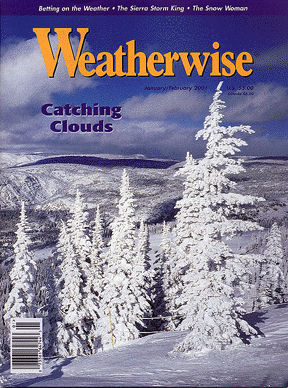
Weatherwise


I discovered this interesting magazine in the old periodical room in Weldon Library at Western University and was reminded of it because of two recent articles issuing from that university. Weatherwise covers the climate, weather and meteorology from a variety of different perspectives and the two pieces from Western News indicate that some scholars at Western are now studying those subjects. They are likely to find the periodical useful as will the many others who are increasingly interested in the climate and the way it has changed. 

      Professor MacEachern of the History Department was somehow able to get Environment Canada to send him a considerable amount of data AND somehow able to convince the folks in the Archives and Research Collections Centre to house the material which consists of two parts: “The first part comprises all existing meteorological observations generated at thousands of weather stations across Canada, from the predecessor agencies of Environment Canada, from 1840-1960….”The second part of the collection consists of 250 volumes of journals, observations, letter books, and correspondence related to Canadian meteorological and climatological history, and spanning the 1820s to the 1960s.” 

     Professor Melitta Adamson a “ Modern Languages and Literatures professor and food historian is among the first scholars in her field to document how climate change, with its critical impact on food production, shaped the Middle Ages (or Medieval Period) through famine, disease and war.” 

     Those interested in their work should see: 1) “Canada Researcher Unboxing Canada’s Climate History,” Adela Talbot, Western News, June 12, 2018 and 2) “Professor Tracks Medieval Winds of (Climate) Change, Aniruddho Chokroborty-Hoque, Western News, June 12, 2018.


The two covers above will indicate why, in the old days, Weatherwise was often seen on the re-shelving shelves and frequently used, even if only by the odd faculty member who had wandered in to avoid grading. Here is how the magazine describes itself: “Weatherwise features fascinating articles and spectacular color photographs that showcase the power, beauty, and excitement of weather. Weatherwise articles present the latest discoveries and hottest issues in meteorology and climatology and focus on the relation of weather to technology, history, culture, art, and society. In each issue, our expert columnists answer reader questions about the weather; discuss current events and people in the news; review new weather-related books and videos; test reader forecast skills with analysis of weather maps; and summarize recent weather events in the United States and Canada.” As they mention, Canadian weather information is often provided and here is a partial sample: “Hail and High Water,”, Malcolm Geast, Oct/.Nov.1996: “One of the worst flooding disasters in Canadian history devastated parts of Quebec in July, as eight inches of rain in less than 48 hours triggered flash flooding in the Seguenay (sic) River valley, killing ten people. The flood, coupled with several ferocious hailstorms in Winnipeg and Calgary, resulted in over half a billion dollars in damages and made for a memorable summer north of the border.”
And, way back in 1956 you will find “A Short History of the Meteorological Service of Canada,” Vol.9, 1956, No.2
Historians interested in the weather only as it affected an historical event will find examples such as these: On the Halifax explosion -” Retrospect: December 6, 1907: Halifax Explosion,” Sean Potter, Vol. 70, 2017, No.6 “U.S. Weather Synoptic Weather Map for 1300 GMT (9:00 a.m. AST) December 6, 1917. An area of high pressure helped create cool, clear conditions for Halifax, Nova Scotia, on the morning of an explosion that would prove to be the deadliest disaster in Canadian history. Meanwhile, a developing coastal low to the southwest would move up the Atlantic coast over the following 24 hours, bringing heavy snow and blizzard conditions to the area, hampering relief efforts.”
The military historians will enjoy: “The Weather of Independence: Burgoyne's Northern Campaign”, David M. Ludlum, Vol. 29, , 1976 No.5, and “Friend and Foe: Weather and the War of 1812,” Stephen Vermette, Vol. 65, 2012, No.1 I know you are interested in the weather and are now curious about this serial, but before you run up to the lovely campus you should know that the print Weatherwise was cancelled and most of the volumes are in storage. Over the years, hundreds of periodical subscriptions had to be cancelled at Western and that is the case at other universities as well. That bad news has to be followed quickly with the good news that the Western Libraries has been able to continue subscribing to the electronic version. It is available via three different vendors so, if you are associated with Western, you can read the periodical from afar and not have to visit the old periodical room. But, I need to quickly also add that you will not be able to access all the issues of Weatherwise electronically, including most of the articles mentioned above. The magazine began in 1948 and the Western Libraries have a healthy print run going back to 1950. But the oldest issues one can access electronically via the Western Libraries catalogue are from 1990. One can search the archives of Weatherwise from their site and get articles from before the 1990s either by subscribing to the publication or paying per article. One can also search the back issues from one of the vendors provided by Western (Taylor & Francis), but they also ask you to pay per article for the older ones. It is highly likely that the library could not afford to buy access to the complete electronic file - and keep in mind that the journal had already been purchased once.

(Tip: Search Weatherwise from their site or via Taylor & Francis in the Western Library catalogue and then ask for the journal to be retrieved from storage. Another tip is to ask a bona fide librarian.)

Sources:

The series "Periodical Ramblings" so far has considered: The Sewanee Review, Fortune, The Village Voice, Flair and the Wilson Quarterly. For its rationale see: Periodical Ramblings (The Series) Professor Adamson, mentioned above is also the author of Food in the Middle Ages : A Book of Essays. If you are interested in the history of food, see my recent post about sources for that subject: Food History. If you are really, really interested in that subject see my brief essay on "Clean Eating" (which, you should be warned, has a section on "placenta eating"). If you are more of a locavore see Local Food.

Finding books about the history of weather and its cultural impact can be tricky. Here are two that will illustrate how scholars are now looking at things with weather in mind.
For a look at the weather as experienced by Lewis and Clark see: Lewis & Clark: Weather and Climate Data from the Expedition Journals, edited by Vernon Preston. It is available as an ebook from the Western Libraries:
 "The Lewis and Clark Expedition of 1803-1806 systematically recorded weather and climate data during their 4,162-mile journey across largely uncharted territory. This data, organized by date and complemented by route descriptions and 50 color photos and historical maps, creates a fascinating look at the weather-related challenges that, at times, nearly derailed the Corps of Discovery from completing its mission and  returning safely. Lewis and Clark is both a compelling read for weather and history buffs and a key resource for scientists  researching climate history."

     For a literary example see: Weatherland: Writers and Artists under English Skies by Alexandra Harris.
"Writers and artists across the centuries, looking up at the same skies and walking in the same brisk air, have felt very different things and woven them into their novels, poems and paintings... 'Weatherland' is both a sweeping panorama of cultural climates on the move and a richly illustrated, intimate account - for although weather, like culture, is vast, it is experienced physically, emotionally and spiritually; as Harris cleverly reveals, it is at the very core of what it means to be English."
(also available at Western)