The Mystery of Avian Migration
It is now known that many birds, like most Canadians, travel great distances in search of comfortable climates. One can even ‘watch’ some of them do it. For example, here is what the cuckoo (‘Victor’, by name) is up to:
“Victor on his way back to Africa - 05 Jun 2017
Locations received from Victor's tag during the late afternoon on 4 June showed that he had left the UK and was in central France. Last spring he left the UK around 25 June, stopping briefly in northeastern France before moving to Central France. He is currently in an area of forest just south of Orleans and around 100km (65 miles) north of the area close to Chateauroux where he spent 10 days last spring.”
It was not that long ago that the most dedicated naturalist or bird enthusiast would have no idea where birds went, or if they even left. How would they know? I do not know where the birds around my feeder went last night or where they go during a short thunderstorm or a long winter. Brits thought the cuckoo was a British bird, but as you can see, he spends more time in the air and in Africa. Birds are difficult to track.
While some aspects of bird migration are still puzzling, an unusual event in 1822 helped solve the mystery behind the annual disappearance of storks.
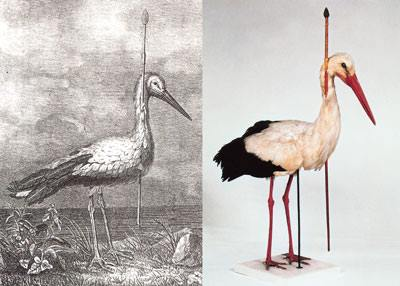
Arrow Storks
In that year in Northern Germany a stork was shot, obviously for the second time. When retrieved, it was found impaled with a long spear or arrow, clearly of African origin. That bird which had travelled from somewhere in Africa is now the stuffed “Arrow Stork” (Pfeilstorch) exhibited in the Zoological Collection at the University of Rostock. Although it is amazing that a stork wounded in such a manner could continue on its journey, there are around two dozen similar examples that have been recorded. Bird banding would later offer additional proof that birds often travel vast distances. Now even monarch butterflies are monitored.
“European” Storks
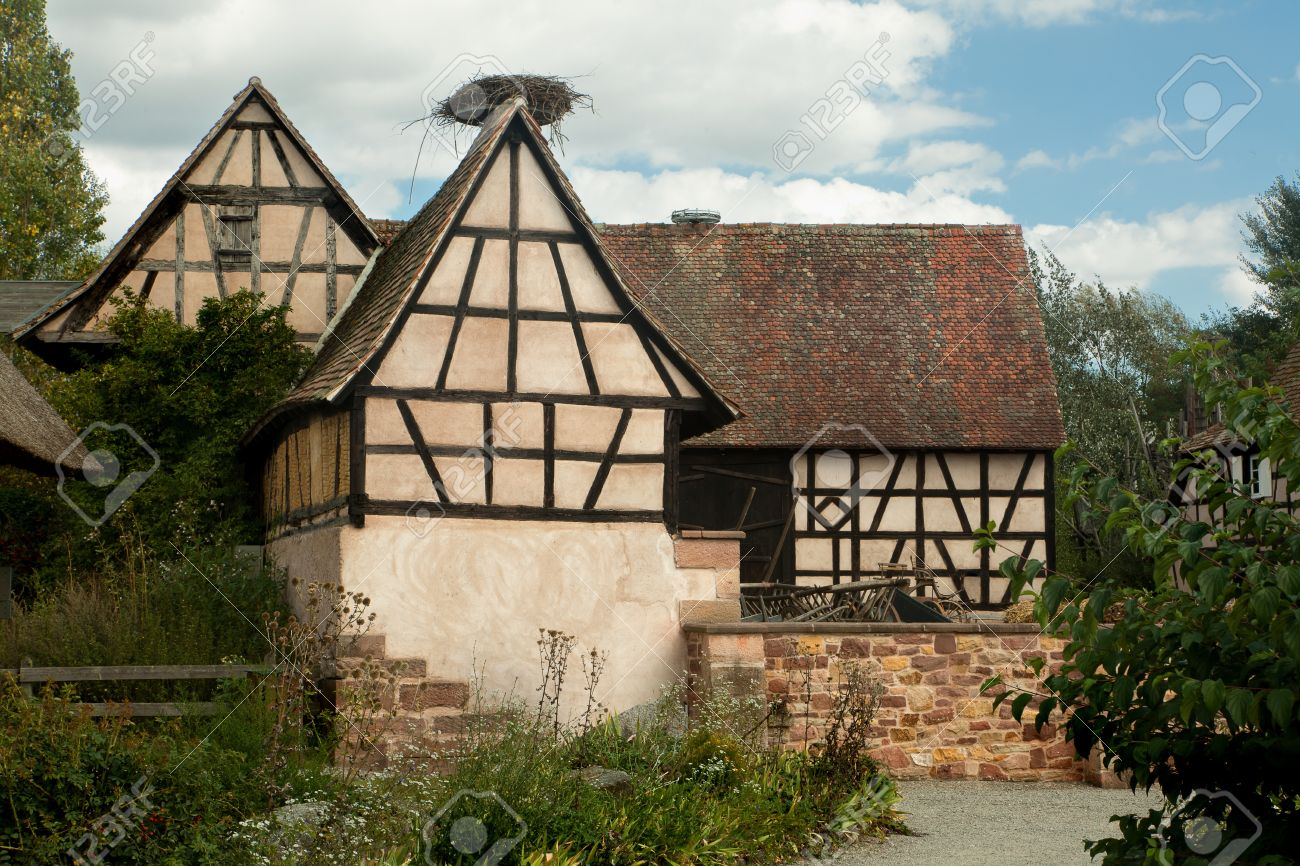
Storks are not common in North America and one only thinks about them in relation to the delivery of babies. I was surprised to find them so frequently mentioned in the books of Patrick Fermor, which have to do with his wanderings on foot through Europe in the 1930s. Nests seem to be in every village. Apart from the nests, he does offer a description of their migration and one is reminded of Audubon and passenger pigeons.
“Swifts were still skimming through the air and a heron flew across the river from wood to wood. A number of large and mysterious birds were floating high overhead and at first I thought they were herons too, but they carried their necks extended instead of coiled between their shoulders, and they were white. They were larger and more slender and less hurried than swans: the spread of wings scarcely moved as they revolved on the air-currents. There were about a dozen, snow-plumed except for black flight-feathers which ran along the inner edge of their wing like a senatorial swipe of mourning. They were storks!
When they circled lower, the long beaks and the legs that trailed in the slipstream showed red as ceiling wax. An old shepherd was leaning on the lamp close by and gazing up at them too. When some of the great birds drifted lower, the draught of their feathers brushed our upturned faces, and he said something in Magyar -- ‘Net, gobyuk’ and smiled. He hadn’t a tooth in his head. Two of the birds glided upstream. One dropped on a haystack and fluttered to regain its balance. The second landed underneath in the meadow -- becoming, as it folded its wings, a white bobbin with red lacquer stilts and bill -- and paced the water’s edge. The others, meanwhile, were alighting on the tiles of the two little bridgehead towns and advancing with ungainly steps along the roofs to inspect the dishevelled nests that cumbered many of the chimneys. Two of them were even attempting, in defiance of the bells which were tolling there, to land on one of the Cathedral belfries -- they remembered the harmless hazard from former incumbency. The bell-hampers were choked with tangles of last year’s twigs.
Touching my arm, the shepherd pointed downstream at something in the dark-shadowed east high above the river and just discernible across the failing sky. Ragged and flocculent, fading to grey, scattered with flecks of pink from the declining sun, varying in width as random fragments were dropping away and re-cohering and agitated with motion as though its whole length were turning on a single thread, a thick white line of crowding storks stretched from one side of the heavens to the other. Mounting Africa along the Nile, they had followed the coasts of Palestine and Asia Minor and entered Europe over the Bosphorous. Then, persevering along the Black Sea shore to the delta of the Danube, they had steered their flight along that shining highway until they had come to the great bend a few miles downstream. Defecting from the river, their journey was now following westerly as well as a northern bias; they were bound for Poland, perhaps, and shedding contingents as they went at hundreds of remembered haunts. We gazed at them in wonder. It was a long time before the rearguard of that great sky-procession had vanished north Before nightfall the whole armada would subside in a wood or settle all over some Slovakian hamlet -- astonishing the villagers and delighting them, for storks are birds of good omen -- like a giant snow storm; taking to the air again at first light. (Six months and hundreds of miles later, I halted on the slopes of the Great Balkan Range, and watched the same migration in reverse. They were making for the Black Sea, retracing their spring journey before wintering beyond the Sahara.)
From Chapter 11: “The Marshes of Hungary”, A Time of Gifts, pp.309-10.
Sources:
To see where Victor is now go to this BTO SITE.
https://www.bto.org/science/migration/tracking-studies
See the entry for Pfeilstorch in Wikipedia and the essay in that source on “Bird Ringing” is also good.
See also: “100 Wonders: The Arrow Stork” by Dylan Thuras, Atlas Obscura, Sept. 23, 2015.
And: “Flight Paths: On Nature,” Helen Macdonald, The New York Times, May 15, 2015
P.S.
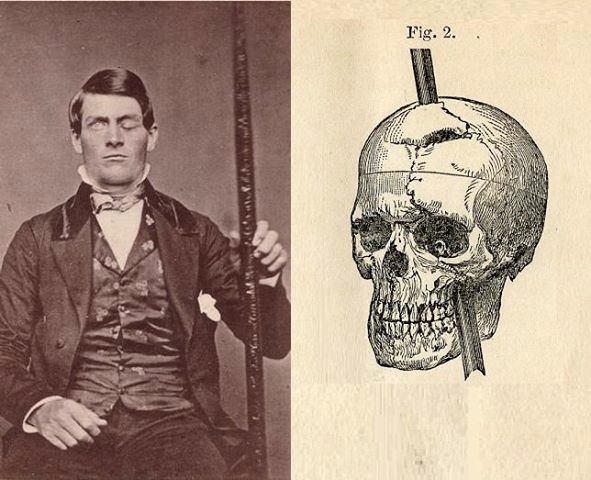
For another case where a great deal was learned from an impalement, read about Phineas Gage in a Wiki entry which is longer than a novella. Or: “Phineas Gage: Neuroscience’s Most Famous Patient,” Steve Twomey, Smithsonian Magazine, Jan. 2010