
Showing posts with label Fermor. Show all posts
Showing posts with label Fermor. Show all posts
Sunday, 20 July 2025
Along the Enchanted Way
An Enchanting Read


The Bonus:
On Raglan Road on an autumn day I met her first and knew

Tuesday, 28 May 2024
Italian Snakes

First, A Few Words About Patrick Fermor
I am a fan of the writer Patrick Leigh Fermor who died in 2011. I have most of what he has written and recently picked the book pictured from the shelf. It is an anthology and I thought I had read everything in it, but had not. It contains a piece about snakes.

Serpents of the Abruzzi
That is the title of the snake essay and it originally appeared in The Spectator, on June 5, 1953. During that year, Fermor was walking through Tuscany and Umbria when he came upon a religious festival honouring San Domenico who is credited with removing the snakes from the Abruzzo region. Large numbers of snakes are gathered and they are draped over the statue of San Domenico as it is paraded through the village of Cocullo.
Curious about whether the Rito dei Serpari or the "Rite of the Snake Charmers" written about by Fermor seventy years ago, still happens, I went searching and found that the snakes still slither around Cocullo on May 1. For more, and some very good pictures see this BBC piece, "Italy's Annual Snake Festival in the Village of Cocullo." After viewing them you may prefer Coachella or even Pamplona and the "Running of the Bulls."
Here are some of the snake bits from the Fermor piece:
LEAVING the gentle, Italian, primitive landscape of Umbria for the blank sierras of the Abruzzi was as complete a change as a journey to a different planet. Indeed, these wild grey peaks have an almost lunar remoteness, and the little village of Corullo, a grey honeycomb of houses at the end of a blind alley of the mountains a dozen miles from Ovid's birthplace at Sulmona, must usually seem a desolate habitation. The sun beats down from a blazing sky, but in the labyrinthine shadows of the lanes there is a chill bite in the air from the towering snows of the Gran Sasso.
But once a year, in the first week of May, this planetary silence is broken, and the village population, normally only a few hundred souls—shepherds and small cultivators to a man—swells to several thousands.. Pilgrims, last month, swarmed from all the neighbouring villages, and, as this is one of the few parts of Italy where regional costumes survive, the streets were a kaleidoscope of different colours and fashions, A bearded shepherd, playing an ear-splitting pibroch on a bagpipe made of .a patched inner tube, wore raw-hid/ mocassins, and his legs were cross-gartered, Iike those of a Saxon thane, with thick leather thongs. The religious occasion was also the pretext for a rustic fair, and the market was full of trussed poultry and squealing pigs. Pedlars carried trays of rosaries, medals, little tin motor-cars, celluloid thumbs-ups and dried acorn-cups. There were " lucky" hunch-backs, crippled beggars, hucksters with fortune- telling canaries and a wandering hypnotist. Less usual was the presence, wherever one turned, of snakes, slung over brown forearms or twisting like bracelets, lying in loose tangles among the funnel-topped bottles in the wine-shops, or held in clusters of four with their unwinking heads all gathered in the palm between the laden fingers of both hands, their long forked tongues sliding in and out of their jaws. Some were nearly two yards in length, and all of them looked alarmingly dangerous. Most of the serpari, or snake catchers, are under twenty. For weeks past they had been hunting them in the mountains, where they abound. Capturing them while they are still dazed with their winter-sleep, they disarm the poisonous ones by giving them the hem of a garment to bite, which, when snatched away, breaks off their teeth and drains their poison. Then, stored in jars or sewn into goatskins, they are put by until the great day conies round. There were now several hundred of them in the streets of Corullo—black, grey, greenish, speckled and striped, all hissing and knotting together and impotently darting and biting with their harmless jaws. The floor of the church—baroque, and surprisingly large— was deep in crumbs and bundles and debris, for hundreds of visiting peasants, finding the village overflowing, had slept there all night. Queues waited their turn at the confessional, and, under a pink and blue baldachin, relays of priests
administered the sacrament....
Then the devotees moved on to the effigy of St. Dominic himself, a lifesize, wooden figure in black Benedictine habit with a horseshoe in one hand and in the other a crosier. Embracing him with a hungry and possessive veneration, they rubbed little bundles of coloured wool— sovereign thenceforward, when applied to the spot, against toothache and snakebite and hydrophobia—down the grooves of his skirt, or lifted their children to kissing distance of the worn and numinous flanks. Silver ex-votos hung round his neck, and pink ribbons, on which were pinned sheaves of offered banknotes, fluttered from his shoulders. St. Dominic of Sora, or " the Abbot "—he has nothing to do with the great founder of the " Preachers' " Order—was a Benedictine of Umbrian origin, born in 951. He was eremetical and peripatetic by turns, and his countless miracles during his lifetime, and, the Abruzzesi relate, even since through the agency of his relic, were nearly all connected with the foiling of the bears and wolves, and, especially, of the snakes.
By the time High Mass began, there was no room to move in the crowded church. Yet a passage was cleared and two young women advanced with large baskets balancing unsupported on their heads, each of them containing great hoop- like loaves; both baskets were draped in pink and white silk and decked with carnations and wild cyclamen. The girls stood, like caryatids, on either side of the high altar until, at the end of the service, the image of the saint was hoisted shoulder-high and borne swaying into the sunlight before the church door. There, while the compact multitude clapped and cheered and the bells broke into a jubilant peal, the serpari clustered round the lowered float. Snakes began flying over the tonsured head like lassos. Parish elders arranged them feather-boa-like, about his shoulders, twisted them round his crosier and wound them over his arms and through the horseshoe and at random all over his body until the image and its pedestal were an all squirming tangle. Many fell off or wriggled free, and one over-active reptile was given a sharp crack over the head. It was raised shoulder high once more like a drowned figurehead salvaged from the Sargasso Sea. .A small pink banner, pinned all over with notes, and a large green one, were unwieldily hoisted. Village girls intoned a hymn in Abruzzi dialect in St. Dominic's honour; then the clergy, one of them bearing the cylinder with its swinging tooth, formed a procession
Then came the two girls with their peculiar baskets. A brass band struck up the triumphal march from Aida, and the saint, twisting and coiling with the activity of the bewildered snakes and bristling with hissing and tongue- darting heads, rocked insecurely forward and across the square. The innumerable peasants, the conjurors and pedlars and quacks, fell into step; the wine-shops emptied; pigs and poultry were abandoned in their pens, and the whole immense con- course, now itself forming a gigantic many-coloured serpent, wound slowly along the rising and falling streets. Every few steps the effigy came to a halt while fallen snakes were replaced or yet more banknotes, which floated down from the upper windows, were pinned to the fluttering ribbons. Boys on all sides brandished tangled armfuls of redundant snakes, and, looking up at the bright mid-day sky, I saw girls on the roof- tops waving the now familiar reptiles in either hand.
Sources:
"A Statue Draped With Snakes? In Italy, It Happens Every Year: Held in a Small Mountain Village, This Festival Has It All: Snakes, Charmers, Religion, Science. See For Yourself -- and Try Not to Squirm," Francesco Martinelli, New York Times, Sept. 29, 2023.
Fermor has many fans. Have a look at the Wikipedia biography first and if interested see this website devoted to him: "Patrick Leigh Fermor; He Drank From a Different Fountain." You could start with A Time of Gifts which is about an earlier walk across Europe just before the start of World War II.
Fermor has many fans. Have a look at the Wikipedia biography first and if interested see this website devoted to him: "Patrick Leigh Fermor; He Drank From a Different Fountain." You could start with A Time of Gifts which is about an earlier walk across Europe just before the start of World War II.
If you are close by and want to borrow any of his books, just let me know.
The Bonus:
For more about religion and snakes see, the "Snake Handlers."
Friday, 7 February 2020
Jails as Hostels
I read recently that on any given night, there are over 20,000 people spending it in the slammer in neighbouring New York state. That is a small fraction of the 2.1 million imprisoned in the United States, which is ranked at the top of the incarceration category, ahead of El Salvador and Turkmenistan. Apparently jails here are full as well and the local detention centre has had a problem with overcrowding.
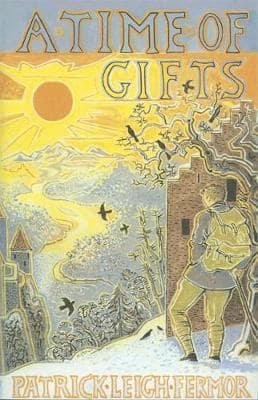 There was a time when jailers were looking for customers and offered cells to weary travellers. I have been re-reading A Time of Gifts which is an account of a walk across Europe in the early 1930s by the 18 year old Patrick Fermor. Not long into his journey on a winter night in Holland he found refuge in such an accommodation. Here is his account:
“I must have made a late start from Dordrecht: Sliedrecht, my next halting place, is only a few miles on, and Gorinchem, the next after that, is not much more. Some old walls stick in my memory, cobbled streets and a barbican and barges moored along the river, but clearest of all, the town lock-up. Somebody had told me that humble travellers in Holland could doss down in police stations, and it was true. A constable showed me to a cell without a word, and I slept, rugged up to the ears, on a wooden plank hinged to the wall and secured on two chains under a forest of raffish murals and graffiti. They even gave me a bowl of coffee and quarter of a loaf before I set off. Thank God I had put ‘student’ in my passport: it was an amulet and an Open Sesame. In European tradition, the word suggested a youthful, needy, and earnest figure, spurred along the highways of the West by a thirst for learning--thus, notwithstanding high spirits and a proneness to dog-Latin drinking songs, a fit candidate for succor.” A Time of Gifts, p. 25.
 That reminded me of another account of jails described as hostels for travellers, which provides an example found closer to home, if further back in time. In the late 1890s, a tramp and his companions jumped from a train in a small town in Michigan and one of them said they needed to locate the marshal.
“We had been here some fifteen minutes, when we saw the marshal coming down the road leading to the station, the bright star of his authority being seen distinctly on his breast. “Now,” said Brum, “let me be the spokesman, and I will arrange for a month’s comfort.” By this time the marshall stood before us. “Boys,” he began, “cold weather for traveling, eh?”....You would certainly be better off in jail. Sixty days in our jail, which is considered one of the best, if not the best, in Michigan, would do you know harm, I assure you.” “As for that,” said Brum, “we might take thirty days each, providing of course, that you make it worth while. What about tobacco and a drink or two of whisky?” “That’ll be all right,” said the marshal, “here’s half a dollar for a drink, and the sheriff will supply your tobacco.” “No, no,” objected Brun, “give us a dollar and three cakes of tobacco, and we will take thirty days, and remember, not a day over.” The marshall produced the three cakes of tobacco, seeming well prepared for these demands, and giving us a paper dollar, requested us to go to Donovan’s saloon, which we would find in the main street, where he would see us later in the day, “when of course,” he added winking you will be supposed to be just a bit merry?
“What is the meaning of this?” I asked Brum, as we went our way to Mr. Donovan’s saloon. “It simply means this,” he said, “that the marshall gets a dollar for each arrest he makes - in our case three dollars [another bum had joined them]; the judge receives three or four dollars for every conviction, and the sheriff of the day is paid a dollar a day for boarding each prisoner under his charge; we benefit by a good rest, warmth, good food and plenty of sleep, and the innocent citizens have to pay for it all.”
They showed up appearing to be suitably drunk and were arrested by the sheriff and, the next day, were sentenced to thirty days. The chapter in which this is found is suitably titled: "Chapter 8: A Prisoner His Own Judge." p.50
They travelled from Michigan into Ontario and apparently jailers here were welcoming as well. They did experience some difficulty on one occasion. “One night we arrived at a small town where a double hanging was to take place in the yard of the jail early in the next morning. A woman, it seems, had called on her lover to assist in the murder of her husband, which had been brutally done with an axe, for which crime both had been pronounced guilty and condemned to die. Thousands of people had flocked in from the neighbouring country, which in this province of Ontario was thickly settled, and a large number of plain clothes detectives had been dispatched from the cities, there being supposed that some attempt might be made at rescue, owing to one of the condemned being a woman.” p.135.
After some negotiating, they were given a cell. The Autobiography of a Super-Tramp.

If you think you would find such accommodations appealing, here is a list of jails in which you can stay. Be warned that most are swanky and pricey. You can begin in our nation’s capital and reserve a spot at the HI Ottawa Jail where you can “Hunker down among stone walls and iron doors, or even sleep in your own solitary confinement cell. You're free to leave when you want, and the Parliament Buildings, Byward Market and National Gallery of Canada are all within walking distance.” That is the entrance above.
For you more adventurous travellers here are 9 more:
There was a time when jailers were looking for customers and offered cells to weary travellers. I have been re-reading A Time of Gifts which is an account of a walk across Europe in the early 1930s by the 18 year old Patrick Fermor. Not long into his journey on a winter night in Holland he found refuge in such an accommodation. Here is his account:“I must have made a late start from Dordrecht: Sliedrecht, my next halting place, is only a few miles on, and Gorinchem, the next after that, is not much more. Some old walls stick in my memory, cobbled streets and a barbican and barges moored along the river, but clearest of all, the town lock-up. Somebody had told me that humble travellers in Holland could doss down in police stations, and it was true. A constable showed me to a cell without a word, and I slept, rugged up to the ears, on a wooden plank hinged to the wall and secured on two chains under a forest of raffish murals and graffiti. They even gave me a bowl of coffee and quarter of a loaf before I set off. Thank God I had put ‘student’ in my passport: it was an amulet and an Open Sesame. In European tradition, the word suggested a youthful, needy, and earnest figure, spurred along the highways of the West by a thirst for learning--thus, notwithstanding high spirits and a proneness to dog-Latin drinking songs, a fit candidate for succor.” A Time of Gifts, p. 25.
That reminded me of another account of jails described as hostels for travellers, which provides an example found closer to home, if further back in time. In the late 1890s, a tramp and his companions jumped from a train in a small town in Michigan and one of them said they needed to locate the marshal.“We had been here some fifteen minutes, when we saw the marshal coming down the road leading to the station, the bright star of his authority being seen distinctly on his breast. “Now,” said Brum, “let me be the spokesman, and I will arrange for a month’s comfort.” By this time the marshall stood before us. “Boys,” he began, “cold weather for traveling, eh?”....You would certainly be better off in jail. Sixty days in our jail, which is considered one of the best, if not the best, in Michigan, would do you know harm, I assure you.” “As for that,” said Brum, “we might take thirty days each, providing of course, that you make it worth while. What about tobacco and a drink or two of whisky?” “That’ll be all right,” said the marshal, “here’s half a dollar for a drink, and the sheriff will supply your tobacco.” “No, no,” objected Brun, “give us a dollar and three cakes of tobacco, and we will take thirty days, and remember, not a day over.” The marshall produced the three cakes of tobacco, seeming well prepared for these demands, and giving us a paper dollar, requested us to go to Donovan’s saloon, which we would find in the main street, where he would see us later in the day, “when of course,” he added winking you will be supposed to be just a bit merry?
“What is the meaning of this?” I asked Brum, as we went our way to Mr. Donovan’s saloon. “It simply means this,” he said, “that the marshall gets a dollar for each arrest he makes - in our case three dollars [another bum had joined them]; the judge receives three or four dollars for every conviction, and the sheriff of the day is paid a dollar a day for boarding each prisoner under his charge; we benefit by a good rest, warmth, good food and plenty of sleep, and the innocent citizens have to pay for it all.”
They showed up appearing to be suitably drunk and were arrested by the sheriff and, the next day, were sentenced to thirty days. The chapter in which this is found is suitably titled: "Chapter 8: A Prisoner His Own Judge." p.50
They travelled from Michigan into Ontario and apparently jailers here were welcoming as well. They did experience some difficulty on one occasion. “One night we arrived at a small town where a double hanging was to take place in the yard of the jail early in the next morning. A woman, it seems, had called on her lover to assist in the murder of her husband, which had been brutally done with an axe, for which crime both had been pronounced guilty and condemned to die. Thousands of people had flocked in from the neighbouring country, which in this province of Ontario was thickly settled, and a large number of plain clothes detectives had been dispatched from the cities, there being supposed that some attempt might be made at rescue, owing to one of the condemned being a woman.” p.135.
After some negotiating, they were given a cell. The Autobiography of a Super-Tramp.
If you think you would find such accommodations appealing, here is a list of jails in which you can stay. Be warned that most are swanky and pricey. You can begin in our nation’s capital and reserve a spot at the HI Ottawa Jail where you can “Hunker down among stone walls and iron doors, or even sleep in your own solitary confinement cell. You're free to leave when you want, and the Parliament Buildings, Byward Market and National Gallery of Canada are all within walking distance.” That is the entrance above.
For you more adventurous travellers here are 9 more:
1. Langholmen Hotell, Stockholm, Sweden
Located in Stockholm's Sodermalm neighbourhood, Långholmen Hotell is near a metro station and near the beach. Royal Swedish Opera and Vasa Museum are cultural highlights, and travellers looking to shop may want to visit Mall of Scandinavia and Sollentuna Centrum.
2. Het Arresthuis, the Netherlands
Situated in a former detention centre in the historic centre of Roermond, Het Arresthuis offers luxurious rooms with free WiFi and a flat-screen TV. Facilities include a sauna and a gym.
3. The Liberty, Boston, USA
Each of the 298 rooms and suites at The Liberty, a Luxury Collection Hotel, has been painstakingly renovated to maintain the historic nature of our landmark building. Inspired by the hotel’s location, Boston, Massachusetts’ former Charles Street Jail, our accommodations feature playful nods to the hotel’s infamous past. But don’t worry, these days, the doors lock from the inside only. But with rooms this luxurious, we can’t guarantee that you’ll ever want to leave.
4. Clink78, London
Clink78 is centrally located just 10 minutes' walk from King's Cross Tube Station and St Pancras International Station.
5. Alcatraz Hotel, Kaiserslautern, Gemany
This fascinating new hotel is a converted prison, offering both cell-style and conventional rooms. It is located near the Japanese Garden in the centre of Kaiserslautern, at the edge of the Pfälzer Wald forest.
6. Hotel Katajanokka, Helsinki, Finland
A unique hotel where chic design, uncompromised comfort and personal service meet in a historic former prison setting – a short walk from the city.
8. Malmaison Oxford, UK
Welcome to Malmaison Oxford, a boutique hotel in Oxford city centre with 95 richly appointed rooms and suites that are packed with some of the best creature comforts that come to mind. Housed in a former prison, the rooms in our Oxford hotel are rather more spacious than your average jail cell and come complete with luxurious beds, super-fast Wi-Fi and power showers.
9. Q Station in Sydney
Tread the path of Haunted Souls..
Sydney's Quarantine Station on North Head is one of Australia's most haunted sites!
As darkness descends over Q Station’s historic buildings, the burial ground and empty pathways… the time comes to encounter the ghosts of our site.
I did not put in links to the hotel sites, but they are easily found.
Sources:
Both A Time of Gifts and The Autobiography are highly recommended.
There are now many articles about over-incarceration, the one about the New Yorkers is from: "There's A Strong Case for Sticking With Bail Reform," Emily Bazelon and Insha Rahman, NYT, Jan. 24, 2020.
For prison data see: WPB: World Prison Brief.
For prison data see: WPB: World Prison Brief.
Post Script:
The Autobiography of a Super-Tramp is old enough to be freely electronically available. I suggest, however, that you get The Neversink Library edition pictured above since it has a good introduction by George Bernard Shaw who suggests: "All I have to say by way of recommendation of the book is that I have read it through from beginning to end, and would have read more of it had there been any more to read."
Apart from being talented, Davies was a tough old tramp. On a snowy night when attempting to catch a train to Pembroke, he missed the hand of his companion (probably because it belonged to "Three Fingered Jack) and fell under the train and lost his leg. He was found in the snow and taken to the station: A number of people were still there; so that when I was placed in the waiting room to bide the arrival of a doctor, I could see no other way of keeping a calm face before such a number of eyes than by taking out my pipe and smoking, an action which, I am told, caused much sensation in the local press."
Here is what GBS has to say about the event: "Were not the author an approved poet of remarkable sensibility and delicacy I should put down the extraordinary quietness of his narrative to a monstrous callousness. Even as it is, I ask myself with some indignation whether a man should lose a limb with no more to-do than a lobster loses a claw or a lizard his tail, as if he could grow a new one at his next halting place! If such a thing happened to me, I should begin the chapter describing it with "I now come to the event which altered the whole course of my life, and, blighted etc., etc.,"
The chapter which contains this episode bears the title " A Voice in the Dark", which is referring to the voice of the injured author and the fact that one man heard it and did not come to help. Davies does drop out of the "Gold Rush" and returns to England where he began to write about his experiences.
Sunday, 27 August 2017
THE JUKEBOX
One rarely sees such contraptions these days. For the youngsters I will provide a picture of one, along with the best description you will ever find. Although I recall well the one in our parent’s restaurant, I would never have thought of the glass panels as being full of orangeade or Chartreuse...

“The evening of our arrival ended in a bar on the waterfront, where, in a setting of vaults, chintz curtains and indirect lighting, a number of sailors were clustered in silent homage around a jukebox. It was the first time I had seen one of these wonderful machines. The barman called it a Wurlitzer Nickelodeum. It was a shrine of steel and bakelite and glass, six feet high, and a queue of sailors were waiting to insert their nickels. At the drop of a coin, an unerring steel hand inside the tabernacle grasped the chosen record from the shelf and placed it on a disc that rose like a magic carpet. A needle-bearing arm descended and unleashed a muted throbbing and the voice of a crooner. The air was filled with etherialized treacle. Glass panels were illuminated in shades of mauve and pink, and liquids that must have been orangeade and Chartreuse and Grenadine syrup bubbled and glowed softly through a maze of decorative glass-piping with the intention of attuning the listener’s bloodstream to the mood of the music. Sailor after sailor slipped their coins into this engine, their eyes becoming every second mistier with Sehnsucht and Heimweh. The Nickelodeum is in its infancy. When it is perfected it is to be armed with slowly turning rollers of satin and fur and plush for the palms of the hands, and a battery of little scent sprays, while, from a bakelite orifice, an inch of barley sugar or Turkish delight, antiseptically sheathed in cellophane, will emerge, in order that all five senses, and not only two, may be simultaneously gratified.”
Source:
This passage is found in Patrick Fermor’s The Traveller’s Tree: A Journey Through the Caribbean Islands. The journey was taken in the late 1940s and the waterfront bar is in St Thomas.
Post Script:
It looks like my Penguin paperback was picked up on an island - the Black Sheep book store on Salt Spring Island, BC. It is, by the way, a wonderful book.
Post Script:
It looks like my Penguin paperback was picked up on an island - the Black Sheep book store on Salt Spring Island, BC. It is, by the way, a wonderful book.
Tuesday, 13 June 2017
The University of the Unusual (2)
The Mystery of Avian Migration
It is now known that many birds, like most Canadians, travel great distances in search of comfortable climates. One can even ‘watch’ some of them do it. For example, here is what the cuckoo (‘Victor’, by name) is up to:
“Victor on his way back to Africa - 05 Jun 2017
Locations received from Victor's tag during the late afternoon on 4 June showed that he had left the UK and was in central France. Last spring he left the UK around 25 June, stopping briefly in northeastern France before moving to Central France. He is currently in an area of forest just south of Orleans and around 100km (65 miles) north of the area close to Chateauroux where he spent 10 days last spring.”
It was not that long ago that the most dedicated naturalist or bird enthusiast would have no idea where birds went, or if they even left. How would they know? I do not know where the birds around my feeder went last night or where they go during a short thunderstorm or a long winter. Brits thought the cuckoo was a British bird, but as you can see, he spends more time in the air and in Africa. Birds are difficult to track.
While some aspects of bird migration are still puzzling, an unusual event in 1822 helped solve the mystery behind the annual disappearance of storks.
Arrow Storks
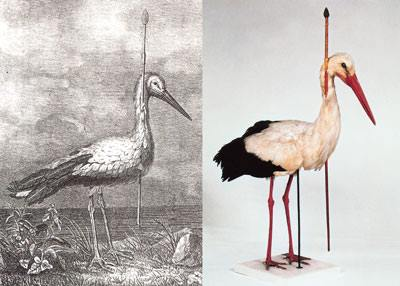

In that year in Northern Germany a stork was shot, obviously for the second time. When retrieved, it was found impaled with a long spear or arrow, clearly of African origin. That bird which had travelled from somewhere in Africa is now the stuffed “Arrow Stork” (Pfeilstorch) exhibited in the Zoological Collection at the University of Rostock. Although it is amazing that a stork wounded in such a manner could continue on its journey, there are around two dozen similar examples that have been recorded. Bird banding would later offer additional proof that birds often travel vast distances. Now even monarch butterflies are monitored.
“European” Storks
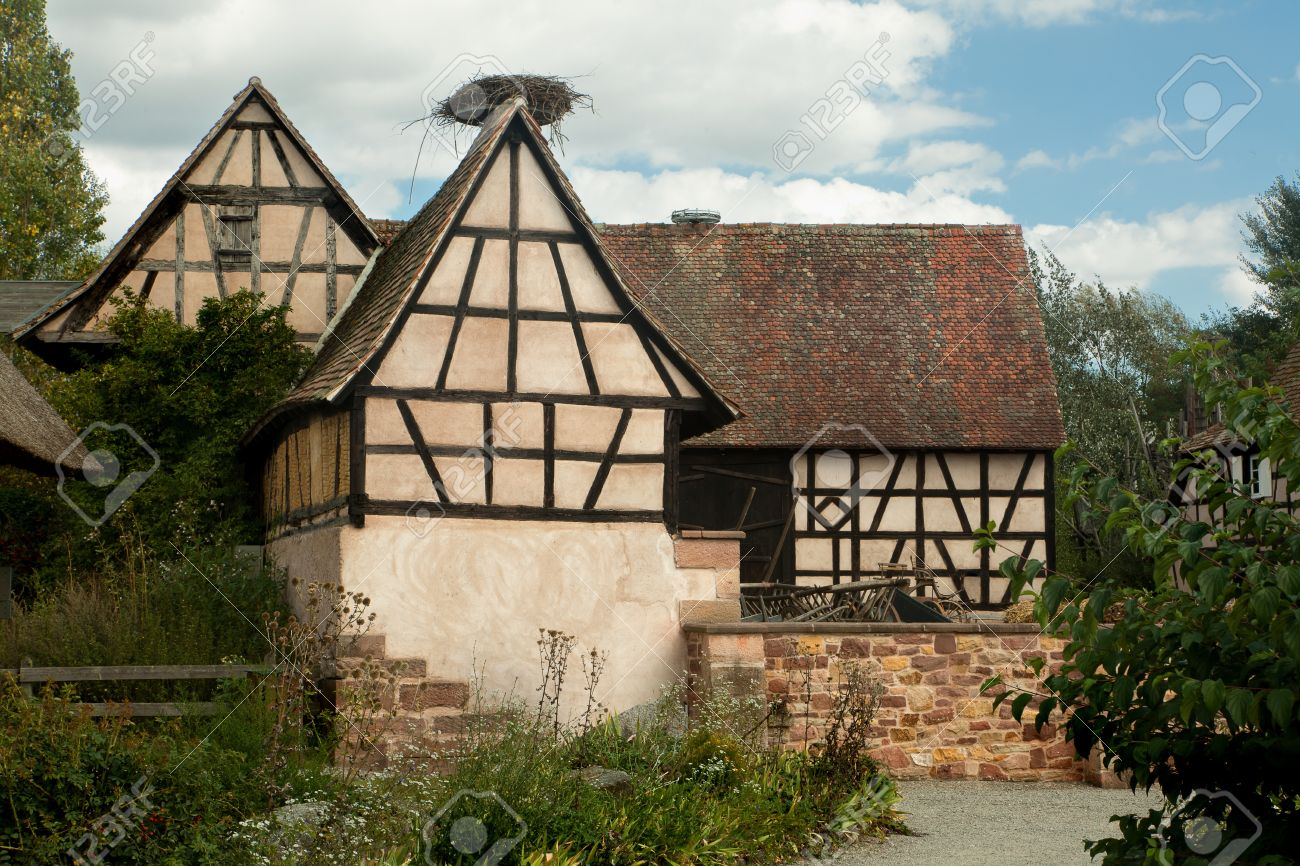
Storks are not common in North America and one only thinks about them in relation to the delivery of babies. I was surprised to find them so frequently mentioned in the books of Patrick Fermor, which have to do with his wanderings on foot through Europe in the 1930s. Nests seem to be in every village. Apart from the nests, he does offer a description of their migration and one is reminded of Audubon and passenger pigeons.
“Swifts were still skimming through the air and a heron flew across the river from wood to wood. A number of large and mysterious birds were floating high overhead and at first I thought they were herons too, but they carried their necks extended instead of coiled between their shoulders, and they were white. They were larger and more slender and less hurried than swans: the spread of wings scarcely moved as they revolved on the air-currents. There were about a dozen, snow-plumed except for black flight-feathers which ran along the inner edge of their wing like a senatorial swipe of mourning. They were storks!
When they circled lower, the long beaks and the legs that trailed in the slipstream showed red as ceiling wax. An old shepherd was leaning on the lamp close by and gazing up at them too. When some of the great birds drifted lower, the draught of their feathers brushed our upturned faces, and he said something in Magyar -- ‘Net, gobyuk’ and smiled. He hadn’t a tooth in his head. Two of the birds glided upstream. One dropped on a haystack and fluttered to regain its balance. The second landed underneath in the meadow -- becoming, as it folded its wings, a white bobbin with red lacquer stilts and bill -- and paced the water’s edge. The others, meanwhile, were alighting on the tiles of the two little bridgehead towns and advancing with ungainly steps along the roofs to inspect the dishevelled nests that cumbered many of the chimneys. Two of them were even attempting, in defiance of the bells which were tolling there, to land on one of the Cathedral belfries -- they remembered the harmless hazard from former incumbency. The bell-hampers were choked with tangles of last year’s twigs.
Touching my arm, the shepherd pointed downstream at something in the dark-shadowed east high above the river and just discernible across the failing sky. Ragged and flocculent, fading to grey, scattered with flecks of pink from the declining sun, varying in width as random fragments were dropping away and re-cohering and agitated with motion as though its whole length were turning on a single thread, a thick white line of crowding storks stretched from one side of the heavens to the other. Mounting Africa along the Nile, they had followed the coasts of Palestine and Asia Minor and entered Europe over the Bosphorous. Then, persevering along the Black Sea shore to the delta of the Danube, they had steered their flight along that shining highway until they had come to the great bend a few miles downstream. Defecting from the river, their journey was now following westerly as well as a northern bias; they were bound for Poland, perhaps, and shedding contingents as they went at hundreds of remembered haunts. We gazed at them in wonder. It was a long time before the rearguard of that great sky-procession had vanished north Before nightfall the whole armada would subside in a wood or settle all over some Slovakian hamlet -- astonishing the villagers and delighting them, for storks are birds of good omen -- like a giant snow storm; taking to the air again at first light. (Six months and hundreds of miles later, I halted on the slopes of the Great Balkan Range, and watched the same migration in reverse. They were making for the Black Sea, retracing their spring journey before wintering beyond the Sahara.)
From Chapter 11: “The Marshes of Hungary”, A Time of Gifts, pp.309-10.
From Chapter 11: “The Marshes of Hungary”, A Time of Gifts, pp.309-10.
Sources:
To see where Victor is now go to this BTO SITE.
https://www.bto.org/science/migration/tracking-studies
See the entry for Pfeilstorch in Wikipedia and the essay in that source on “Bird Ringing” is also good.
See also: “100 Wonders: The Arrow Stork” by Dylan Thuras, Atlas Obscura, Sept. 23, 2015.
And: “Flight Paths: On Nature,” Helen Macdonald, The New York Times, May 15, 2015
P.S.
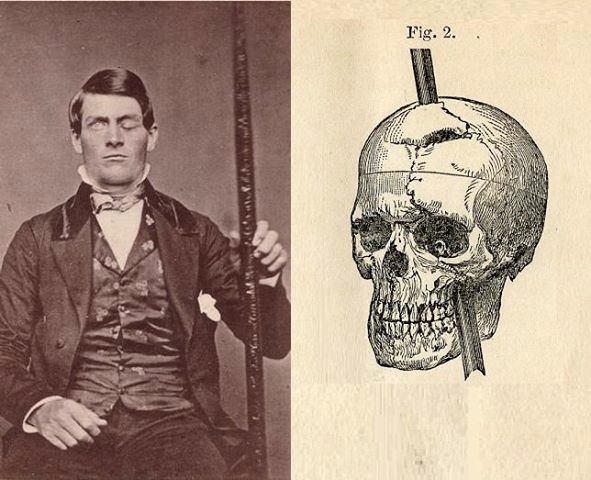
For another case where a great deal was learned from an impalement, read about Phineas Gage in a Wiki entry which is longer than a novella. Or: “Phineas Gage: Neuroscience’s Most Famous Patient,” Steve Twomey, Smithsonian Magazine, Jan. 2010
Subscribe to:
Posts (Atom)