First, A Few Words About Patrick Fermor
I am a fan of the writer Patrick Leigh Fermor who died in 2011. I have most of what he has written and recently picked the book pictured from the shelf. It is an anthology and I thought I had read everything in it, but had not. It contains a piece about snakes.

Serpents of the Abruzzi
That is the title of the snake essay and it originally appeared in The Spectator, on June 5, 1953. During that year, Fermor was walking through Tuscany and Umbria when he came upon a religious festival honouring San Domenico who is credited with removing the snakes from the Abruzzo region. Large numbers of snakes are gathered and they are draped over the statue of San Domenico as it is paraded through the village of Cocullo.
Curious about whether the Rito dei Serpari or the "Rite of the Snake Charmers" written about by Fermor seventy years ago, still happens, I went searching and found that the snakes still slither around Cocullo on May 1. For more, and some very good pictures see this BBC piece, "Italy's Annual Snake Festival in the Village of Cocullo." After viewing them you may prefer Coachella or even Pamplona and the "Running of the Bulls."
Here are some of the snake bits from the Fermor piece:
LEAVING the gentle, Italian, primitive landscape of Umbria for the blank sierras of the Abruzzi was as complete a change as a journey to a different planet. Indeed, these wild grey peaks have an almost lunar remoteness, and the little village of Corullo, a grey honeycomb of houses at the end of a blind alley of the mountains a dozen miles from Ovid's birthplace at Sulmona, must usually seem a desolate habitation. The sun beats down from a blazing sky, but in the labyrinthine shadows of the lanes there is a chill bite in the air from the towering snows of the Gran Sasso.
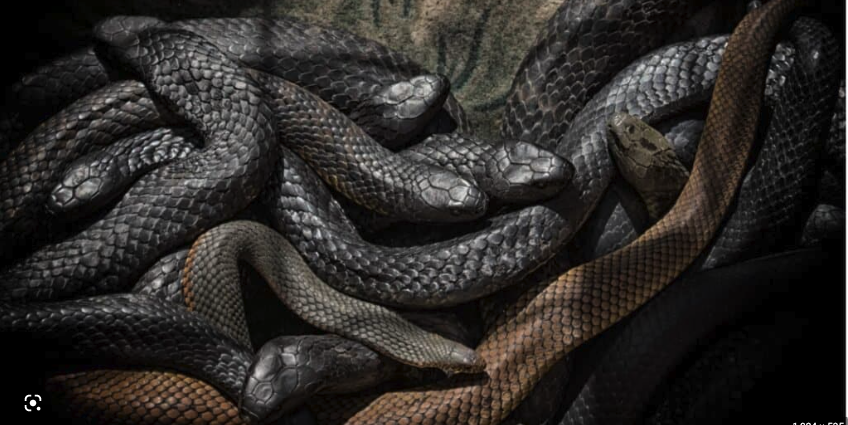
But once a year, in the first week of May, this planetary silence is broken, and the village population, normally only a few hundred souls—shepherds and small cultivators to a man—swells to several thousands.. Pilgrims, last month, swarmed from all the neighbouring villages, and, as this is one of the few parts of Italy where regional costumes survive, the streets were a kaleidoscope of different colours and fashions, A bearded shepherd, playing an ear-splitting pibroch on a bagpipe made of .a patched inner tube, wore raw-hid/ mocassins, and his legs were cross-gartered, Iike those of a Saxon thane, with thick leather thongs. The religious occasion was also the pretext for a rustic fair, and the market was full of trussed poultry and squealing pigs. Pedlars carried trays of rosaries, medals, little tin motor-cars, celluloid thumbs-ups and dried acorn-cups. There were " lucky" hunch-backs, crippled beggars, hucksters with fortune- telling canaries and a wandering hypnotist. Less usual was the presence, wherever one turned, of snakes, slung over brown forearms or twisting like bracelets, lying in loose tangles among the funnel-topped bottles in the wine-shops, or held in clusters of four with their unwinking heads all gathered in the palm between the laden fingers of both hands, their long forked tongues sliding in and out of their jaws. Some were nearly two yards in length, and all of them looked alarmingly dangerous. Most of the serpari, or snake catchers, are under twenty. For weeks past they had been hunting them in the mountains, where they abound. Capturing them while they are still dazed with their winter-sleep, they disarm the poisonous ones by giving them the hem of a garment to bite, which, when snatched away, breaks off their teeth and drains their poison. Then, stored in jars or sewn into goatskins, they are put by until the great day conies round. There were now several hundred of them in the streets of Corullo—black, grey, greenish, speckled and striped, all hissing and knotting together and impotently darting and biting with their harmless jaws. The floor of the church—baroque, and surprisingly large— was deep in crumbs and bundles and debris, for hundreds of visiting peasants, finding the village overflowing, had slept there all night. Queues waited their turn at the confessional, and, under a pink and blue baldachin, relays of priests
administered the sacrament....
Then the devotees moved on to the effigy of St. Dominic himself, a lifesize, wooden figure in black Benedictine habit with a horseshoe in one hand and in the other a crosier. Embracing him with a hungry and possessive veneration, they rubbed little bundles of coloured wool— sovereign thenceforward, when applied to the spot, against toothache and snakebite and hydrophobia—down the grooves of his skirt, or lifted their children to kissing distance of the worn and numinous flanks. Silver ex-votos hung round his neck, and pink ribbons, on which were pinned sheaves of offered banknotes, fluttered from his shoulders. St. Dominic of Sora, or " the Abbot "—he has nothing to do with the great founder of the " Preachers' " Order—was a Benedictine of Umbrian origin, born in 951. He was eremetical and peripatetic by turns, and his countless miracles during his lifetime, and, the Abruzzesi relate, even since through the agency of his relic, were nearly all connected with the foiling of the bears and wolves, and, especially, of the snakes.
By the time High Mass began, there was no room to move in the crowded church. Yet a passage was cleared and two young women advanced with large baskets balancing unsupported on their heads, each of them containing great hoop- like loaves; both baskets were draped in pink and white silk and decked with carnations and wild cyclamen. The girls stood, like caryatids, on either side of the high altar until, at the end of the service, the image of the saint was hoisted shoulder-high and borne swaying into the sunlight before the church door. There, while the compact multitude clapped and cheered and the bells broke into a jubilant peal, the serpari clustered round the lowered float. Snakes began flying over the tonsured head like lassos. Parish elders arranged them feather-boa-like, about his shoulders, twisted them round his crosier and wound them over his arms and through the horseshoe and at random all over his body until the image and its pedestal were an all squirming tangle. Many fell off or wriggled free, and one over-active reptile was given a sharp crack over the head. It was raised shoulder high once more like a drowned figurehead salvaged from the Sargasso Sea. .A small pink banner, pinned all over with notes, and a large green one, were unwieldily hoisted. Village girls intoned a hymn in Abruzzi dialect in St. Dominic's honour; then the clergy, one of them bearing the cylinder with its swinging tooth, formed a procession
Then came the two girls with their peculiar baskets. A brass band struck up the triumphal march from Aida, and the saint, twisting and coiling with the activity of the bewildered snakes and bristling with hissing and tongue- darting heads, rocked insecurely forward and across the square. The innumerable peasants, the conjurors and pedlars and quacks, fell into step; the wine-shops emptied; pigs and poultry were abandoned in their pens, and the whole immense con- course, now itself forming a gigantic many-coloured serpent, wound slowly along the rising and falling streets. Every few steps the effigy came to a halt while fallen snakes were replaced or yet more banknotes, which floated down from the upper windows, were pinned to the fluttering ribbons. Boys on all sides brandished tangled armfuls of redundant snakes, and, looking up at the bright mid-day sky, I saw girls on the roof- tops waving the now familiar reptiles in either hand.
Sources:
"A Statue Draped With Snakes? In Italy, It Happens Every Year: Held in a Small Mountain Village, This Festival Has It All: Snakes, Charmers, Religion, Science. See For Yourself -- and Try Not to Squirm," Francesco Martinelli, New York Times, Sept. 29, 2023.
Fermor has many fans. Have a look at the Wikipedia biography first and if interested see this website devoted to him: "Patrick Leigh Fermor; He Drank From a Different Fountain." You could start with A Time of Gifts which is about an earlier walk across Europe just before the start of World War II.
Fermor has many fans. Have a look at the Wikipedia biography first and if interested see this website devoted to him: "Patrick Leigh Fermor; He Drank From a Different Fountain." You could start with A Time of Gifts which is about an earlier walk across Europe just before the start of World War II.
If you are close by and want to borrow any of his books, just let me know.
The Bonus:
For more about religion and snakes see, the "Snake Handlers."