Showing posts with label publishing. Show all posts

Tuesday, 24 March 2026

Book Promotion

 Advertising and Books

   Promoting a book is harder than publishing, or even writing one. According to Publishers Weekly, about four million of them were produced in 2025, which means that being an author is somewhat easier than becoming an astronaut. The hard part is getting a reader to choose your book from a pile of 4,000,000 of them.

   I thought of this while reading the March 2026 issue of The Atlantic, which I am pleased to promote. The articles in this issue are first-rate. Even the advertisements are good and are our subject for today. Some of them were full page promotions for books. 

One of These Ads Is Not Like the Others

   You may have been watching Sesame Street, rather than reading a book, and remember the song containing the words above. Your task is to look at the four book ads below and identify which one is different.

1.

2.


3.   


4. 

And The Answer Is?
   
The most obvious answer is #3 since the ad is for six books rather than just one. The less obvious answer and the one I prefer is #4. 

   The book about Lincoln is published by W.W. Norton & Company. The Deserving is published by Bloomsbury. The six books in #3 are published by Princeton University Press.  It is usually the case that full page advertisements for books are paid for by publishing companies or university presses.

   The ad for Isabel, Anacaona & Columbus’s Demise: 1498–1502 Retold, by Andrew Rowen was likely paid for by Andrew Rowen. All Persons Press appears to be a publisher solely for Andrew Rowen publications. There is nothing wrong with this at all and I am glad to assist author Rowen by promoting the prequels to the work above: Encounters Unforeseen:1492 Retold and Columbus and Caonabó: 1493–1498 Retold.
   
One of the reasons self-promotion is resorted to is, as I mentioned when I wrote about the Washington Post, that there are now few book reviewers around to go through the four million produced. I found very few reviews for the books of Mr. Rowen and know about them only because I read the full page advertisement in The Atlantic. 
   
You now may be curious about the cost of a full page ad in a national magazine. That is difficult to determine and the rate provided for a person is likely less than the one quoted for a publisher. I will say, however, that the number is a big one.
   Mr. Rowen is apparently a Harvard Law graduate and a retiree from a New York city law firm. He seems to have had the means to spend a lot of time in the Caribbean doing research for his books and enough left over to promote them. He should not be blamed for that and I do hope he recovers his costs and carries on. 

Thursday, 11 July 2024

Armed Services Editions

 Books For The Troops


   During World War II, the Council on Books in Wartime in the U.S. established a non-profit program to get books into the hands and pockets of the troops scattered throughout the world. The books produced were very small paper ones, but they were complete not abridged. About 123 million copies of around 1300 titles were published and distributed.
   As the image indicates, the books could be classic or popular ones, fictional or non-fictional and serious or humorous. They were useful for bored soldiers in remote outposts, for sailors on long voyages and for both when convalescing in hospitals. They also promoted reading and ended up contributing to the paperback revolution for civilians.


   Much has been written about the ASE and the major sources for information are provided below for those interested in books and for those  interested in collecting them.

The Grolier Club Exhibition
  Titled, "The Best Read Army In the World" and curated by Molly Guptill Manning, this exhibition and the Wikipedia entry will be enough for many of you. For an article about it see: "A New Exhibition Tells the Story of the Armed Services Editions, Pocket-size Paperback Weapons in the Fight For Democracy," Jennifer Schuessler, New York Times, Oct. 6, 2023.

Related Books by Manning
   The Best-Read Army in the World, Molly Guptill Manning and Brian Anderson, The University of Chicago Press, 2020
"In late 1943, small packages bound in sturdy brown paper began to arrive at American military outposts, each containing a set of ingenious pocket-sized books called the Armed Services Editions. Titled the “Victory Book Campaign,” this initiative was led by librarians, who garnered the support of individuals, businesses, civic organizations, and Eleanor Roosevelt. For war-weary, homesick men, these books—fiction, biographies, classics, sports tales, history books, poetry, compilations of short stories, books of humor—represented the greatest gift the military could give them. This annotated catalogue includes posters, photographs, newspaper clippings, and other contemporary documents that provide valuable context for how the written word not only increased morale during wartime but ultimately transformed American education and changed the book industry forever."


   When Books Went To War: The Stories That Helped Us Win World War II. Molly Guptill Manning, HarperCollins, 2014
"When America entered World War II in 1941, [it] faced an enemy that had banned and burned over 100 million books and caused fearful citizens to hide or destroy many more. Outraged librarians launched a campaign to send free books to American troops and gathered 20 million hardcover donations. In 1943, the War Department and the publishing industry stepped in with an extraordinary program: 120 million small, lightweight paperbacks, for troops to carry in their pockets and their rucksacks, in every theater of war. Comprising 1,200 different titles of every imaginable type, these paperbacks were beloved by the troops and are still fondly remembered today. Soldiers read them while waiting to land at Normandy; in hellish trenches in the midst of battles in the Pacific; in field hospitals; and on long bombing flights. They wrote to the authors, many of whom responded to every letter. They helped rescue The Great Gatsby from obscurity. They made Betty Smith, author of A Tree Grows in Brooklyn, into a national icon. When Books Went to War is an inspiring story for history buffs and book lovers alike."--Publisher's website. Chronicles the joint effort of the U.S. government, the publishing industry, and the nation's librarians to boost troop morale during World War II by shipping more than one hundred million books to the front lines for soldiers to read during what little downtime they had.
  For a review see: "Marching Off to War, With Books," Janet Maslin, NYT, Dec. 24, 2014.
  
Manning has a new book out: The War of Words: How America's GI Journalists Battled Censorship and Propaganda to Help Win World War II, Blackstone, 2023.

Library Collections
  Small paperback books, such as the ASE ones would not have been routinely collected, but interest in having them developed later.

The Library of Congress has a full set, of course, and published this on the 40th anniversary of the ASE: Books in Action: The Armed Services Editions, by John Y. Cole, 1984. (This can be accessed online, but it may take a while to load.)

The Huntington Library
  "Fighting A War With Books," Natalie Russell, Verso: The Blog of the Huntington Library, May 22, 2019.

University of Alabama: The W.S. Hoole Special Collections Library
  The ASE collection here is almost complete and was lacking only five titles when this was written in 2015: “Armed Services Editions: A Quest For A Complete Collection,” Allyson Holliday, UofA Blog, Feb 16, 2015.

University of South Carolina - The Irvin Department of Rare Books & Special Collections Blog
"Books are Weapons in the War of Ideas..." Michael Weisenburg, Sept. 4, 2020
"The Irvin Department is pleased to announce that it has recently acquired the three final titles needed to complete its collection of the Armed Services Editions series of books. The books, Peter Field’s Fight for Powder Valley, William Colt MacDonald’s Master of the Mesa, and Clarence E. Mulford’s Hopalog Cassidy’s Protégé, are part of a series produced by the Council on Books in Wartime, from 1943 to 1947."

The University of Virginia
  "Books Enlist." This provides an exhibit of the ASE held in 1996.

Blogs
  This is worth a look: "Books For Victory: The Armed Services Editions of WWII," Andrew Brozyna, April 28, 2013.

Another Attempt In This Century - 2002
  See:" 
Literature Re-enlists In the Military; Pilot Project Is Sending Books to American Ships And Troops Abroad," by Mel Gussow, NYT, Nov. 7, 2002
   "During World War II soldiers carried Armed Services Editions of pocket-size books and read them avidly whenever they had time. These were literary classics, popular novels, plays and nonfiction issued free to troops around the world. The books, increasingly dog-eared, were a cultural oasis as well as entertainment. Some soldiers took them into battle. Copies were handed out as troops left England for the Normandy invasion....
   Andrew Carroll, an author and archivist, described the program as ''the biggest giveaway of books in our history'' with the possible exception of Gideon Bibles. It is, he said, ''a great forgotten story'' of World War II. After the war the editions were at least partly responsible for the proliferation of paperbacks in the United States.
   This month, in a pilot project created by Mr. Carroll, the Armed Services Editions are returning with 100,000 copies of new versions of four books being printed in the same wide, brightly colored ''cargo pocket'' format: Shakespeare's ''Henry V,'' ''The Art of War'' (Sun Tzu's classic 500 B.C. study of military strategies) and two recent best sellers, ''Medal of Honor: Profiles of America's Military Heroes From the Civil War to the Present'' by Allen Mikaelian, with commentary by Mike Wallace, and ''War Letters: Extraordinary Correspondence From American Wars,'' edited by Mr. Carroll....
   Clarence Strowbridge, president of Dover, which is publishing ''Henry V'' and ''The Art of War,'' said that the original editions ''inspired a whole generation of servicemen and women to become lifelong readers, and I have no doubt these books will do the same.'' After the war Dover became a leader in the paperback revolution....
   Mr. Carroll first became aware of the editions four or five years ago when he found a Steinbeck novel in an antiquarian bookstore in California. He soon began his own collection, which includes a rare copy of ''Superman,'' a novel, not a comic book.
Echoing his predecessors during World War II, Mr. Carroll said he wanted ''to promote the love of reading.'' He was adamant about using the original format as an act of nostalgia and ''a tip of the hat to this great project.'


CANCON
   Three books by Stephen Leacock are found listed by the ASE: 1) Laugh With Leacock #197; 2) Happy Stories Just to Laugh #344 and 3) My Remarkable Uncle: and Other Stories #976.


   One reason I became aware of the ASE is through the research I did for my book about Hulbert Footner who was born in Hamilton, Ontario. His book, The Murder That Had Everything was chosen for the ASE. I could find no pictures of the ASE version and that edition of the novel is  probably rare. One likely exists in the collection held in the Calvert County Historical Collection in Prince Frederick, Maryland. Here are two reviews of it:
The Murder That Had Everything
Here is a review from The Observer, by Maurice Richardson, Sept. 17, 1939.
“The Crime Ration”
The Murder That Has Everything has an extremely New York setting. Chief victim is a gigolo on the eve of his marriage to one of the richest and silliest girls in the world. Suspects include the husbands of several women who have been visiting him in his love nest. Lee Mappin and his beautiful secretaries do the detecting. The plot becomes trickier and muddier with every page; there is some interesting characterisation and strong satire at the expense of New York smarties and gossip writers. In fact it has everything to make you go on reading.

A Canadian review is found in the Vancouver Sun, Sept. 2, 1939.
“Mystery Fiction”
Park Avenue society, familiar to New York haunts and true-to-life habitues combine to make Hulbert Footner’s new mystery, The Murder That Has Everything (Musson), an A1 Thriller. Here’s the story of a cunning crime syndicate that plies among the daughters of millionaires. 

Friday, 7 June 2024

More Bad News For Books


COSTCO & Books
   I never really thought of Costco as a place to buy books, but I had also not considered buying gold or silver from a Costco store. I think I have seen books stacked on tables at the local one, but according to a recent article they may become a scarce commodity at Costco. A first reaction may be, "Who Cares?", but a more reasoned one might be, "Holy Cow!" Costco as a customer purchases thousands of books.
   Here is the article and while it refers to the United States, I would think the same decision would be made for the Canadian Costcos.
"Costco Plans to Stop Selling Books Year-Round: The Decision, Which Will Be Implemented in January 2025, Could Significantly Impact Publishers,Elizabeth A. Harris and Alexandra Alter, New York Times, June  5, 2024.

   Beginning in January 2025, the company will stop stocking books regularly, and will instead sell them only during the holiday shopping period, from September through December. During the rest of the year, some books may be sold at Costco stores from time to time, but not in a consistent manner, according to the executives, who spoke anonymously in order to discuss a confidential business matter that has not yet been publicly announced.
   
Costco’s shift away from books came largely because of the labor required to stock books, the executives said. Copies have to be laid out by hand, rather than just rolled out on a pallet as other products often are at Costco. The constant turnaround of books — new ones come out every Tuesday and the ones that have not sold need to be returned — also created more work....
   
The decision could be a significant setback for publishers at a moment when the industry is facing stagnant print sales and publishing houses are struggling to find ways to reach customers who have migrated online. 
   
While Costco isn’t as critical a retail outlet as bookstore chains like Barnes & Noble, it has provided a way for people who might not otherwise seek out books to see them and perhaps grab a new thriller or a cookbook while shopping for socks and paper towels. Shoppers could also browse books at Costco in a way that is difficult to do online.
   
Robert Gottlieb, a literary agent and chairman at Trident Media Group, said he’d spoken about the changes at Costco to a number of publishers who were alarmed by the potential blow to sales.
“Costco across the country was a big outlet for books,” he said. “There are now fewer and fewer places to buy books in a retail environment.”
   The change may also impact Costco customers, particularly those who live in areas without a bookstore. And because many books at Costco were impulse buys, some of those sales may not shift over to Amazon or Barnes & Noble. Instead, they might not happen at all.


Additional Bad Book News from Ukraine

All of the news from this area has been bad, but this may be overlooked, given the tremendous loss of lives.
   "
On May 23, Russian missiles struck the Factor Druk printing house in Kharkiv, Ukraine (story). Seven people were reportedly killed and more than 40 injured. In addition, some 50,000 books and 60 tons of paper were burned....
  Factor Druk was surely not a random target. Vladimir Putin has been determined to obliterate Ukrainian culture even before he began his barbaric invasion in early 2022. Unfortunately, this spring, Putin’s buddies in Congress were able to slow U.S. aid long enough to give Russia a major advantage.  Ukrainian President Volodymyr Zelensky issued a statement saying that the attack on the Factor Druk printing house “demonstrates that Russia is waging war against humanity and all aspects of normal life.”
[The source for this is Ron Charles, "Book Club" newsletter from the Washington Post, June, 7.]

CANCON
   If Costco needs to store their excess books in freezers, they should have good ones:
"NDP Leader Slams Liberals For Giving Nearly $26-Million to Costco, Loblaw in Recent Years," Canadian Press, Globe and Mail, May 9, 2024. 

"The money came from the Liberal government’s low-carbon economy fund, which is meant to support projects that will reduce greenhouse-gas emissions.
In 2019, the Liberals faced heat from Conservatives after the government announced it was giving up to $12 million to Loblaw for energy-efficient refrigerators and freezers at 370 of its stores. Newly released data from Environment and Climate Change Canada show Costco was also given more than $15 million for efforts to reduce emissions, including new fridges.
Loblaw was ultimately given more than $10 million.
The payments were made to the two grocery chains between 2019 and 2023."

Friday, 23 December 2022

The January 6th Report


   It may be January 6, 2023 before the Select Committee report is published in book form, so if you had planned to give one to a political junkie friend for Christmas, you better look for a bottle of scotch instead. It will take some time during this busy holiday season for the publishers to edit the 800+ page report and provide an introduction and some notes. The one being published by Random House will have an introduction by Adam Schiff (D-Calif), while the copy from the New Yorker will have a preface by David Remnick and an epilogue by Jamie Raskin (D-MD). If you want an unvarnished one, wait for the one being produced by Melville House. I am going to wait for a graphic one with Cassidy Hutchinson on the cover. 


   To console your political friend, send they a copy of the omnibus spending bill, the short title of which is the "Consolidated Appropriations Act, 2023". If you click on that link you can read all 4,155 pp., which is how many it took to show how $1.7 trillion will be spent. "Trillion" is a word we will seeing more of in 2023. 

Canadian Content
   
If you prefer a copy that is printed in our country, it is estimated one will be available in a few years. It has to be in two languages, after all, and that is true as well for the prefatory "Land Acknowledgement." Apparently the folks in Alberta are going to wait for one of the two versions being produced by Skyhorse Publishing - the one with the introduction by Darren Beattie who was a speechwriter for former President Trump and "who disputed his defeat in the 2020 election."

Source:
 
"The Most Sought After Manuscript in Publishing? The Jan. 6 Report," Alexander Alter and Elizabeth A. Harris, New York Times, Dec. 23. 2022.

Sunday, 21 May 2017

A Portrait of a 50 Year Period

1882-1932

    A recent post in this blog concerned “Fourth Leaders” which were “ephemeral ruminations” published for a time in The Times. When I went searching for information about them I came across the following book:
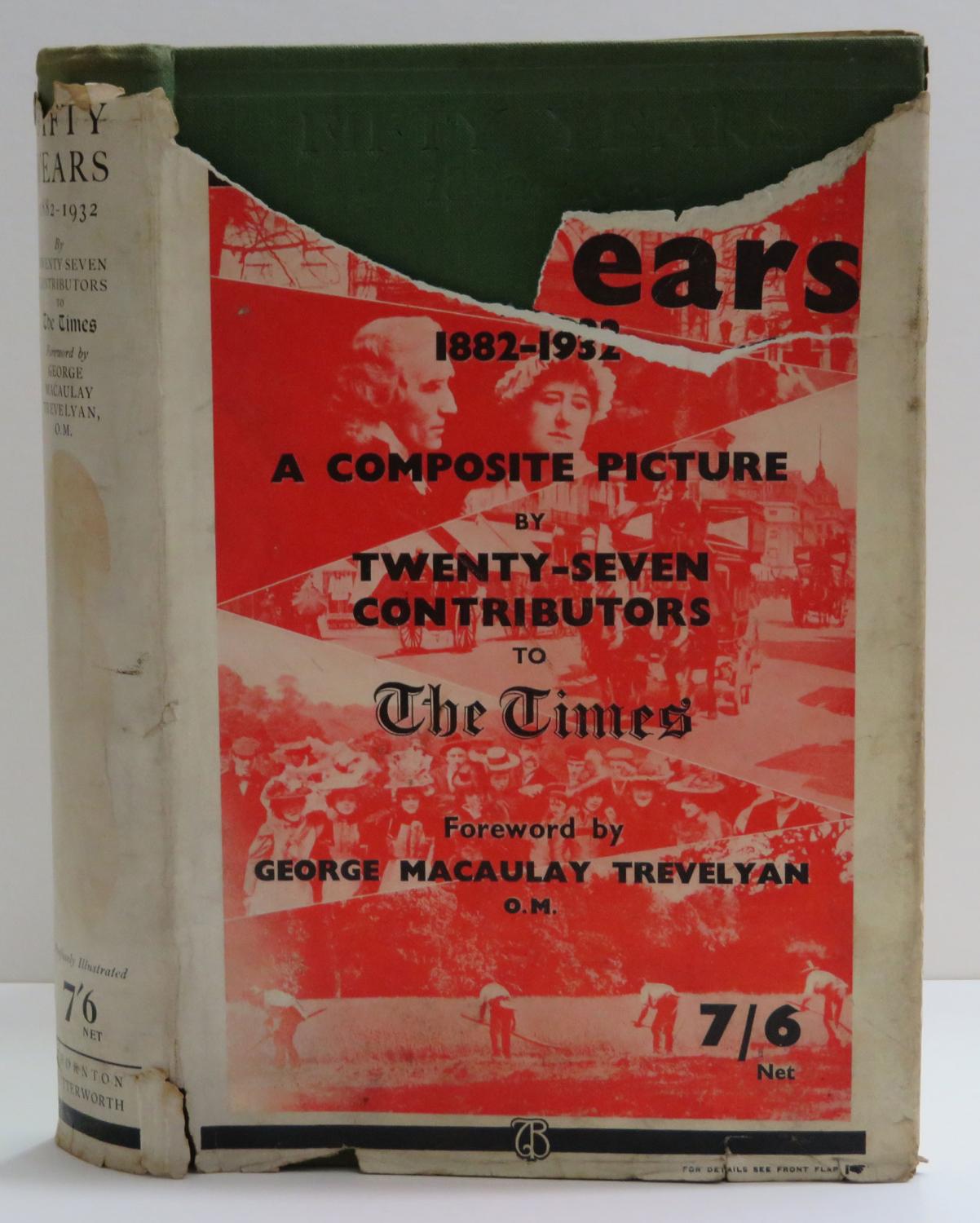
Fifty Years: Memories and Contrasts. A Composite Picture of the Period 1882-1932, by Twenty-Seven Contributors to The Times, with a foreword by George Macaulay Trevelyan, O.M.
    Although the book contained no information at all about Fourth Leaders, I thought I would say something about it here because it is interesting and otherwise I will forget about it. It is also the case that this “Picture of the Period” has not attracted much attention. Those interested in the Victorian/Edwardian eras and those of you who are fans of Downton Abbey might find it worth a look.  If you need more incentive, consider this remark by Trevelyan from the introduction:

“In this volume we are reminded of a few of the things that our grandfathers had and that we have not and that no one will ever have again.” p.15.

A Series of Articles in The Times - 1932

    On Jan.7, 1932, The Times announced that articles covering the years 1882-1932 were forthcoming and the first one appears on Feb. 1: “Politics and the Statesman,” by The Earl of Middleton, K.P. Throughout the winter and spring twenty-six more pieces are to be found along with related photographs illustrating such subjects as: “Rural England in the Eighties”, “Changes in the World of Sport” and “Great Figures of Political Life”.  As well, one finds pictures of literary figures such as Tennyson, Browning, Hardy and R.L. Stevenson and of lesser known entertainers and performers such as Dame Nellie Melba (she of the toast) and G.H. Chirgwin, “The White-Eyed Kaffir.”

1882-1932?

    There is no clear rationale presented as to why those years were chosen or why the articles could not have been commissioned a year earlier or later. There are a few statements of purpose which are rather general in nature:

“...it is a series of articles designed as a critical retrospect over a period in which historical time seems to have travelled its swiftest pace.”

…”while there has never been a period of greater opportunity for contrast.”

“... a period of change to which history offers few parallels.”

Those who wrote the pieces were expected to have experienced and participated in the events of  the period and their observations were to be based on “direct personal reminiscence.”

Excerpts


What is A Weekend?
    Why Lady Violet, Dowager Countess of Grantham of Downton Abbey asked that question and was puzzled by the concept is partially explained by this passage:

The other great change in social habits is the present widespread exodus from London for a third of every week. Before motor-cars existed, to go more than ten miles out of London meant a troublesome business of catching trains. Accordingly the two nights’ country visit, called then a “Sunday Party,” was a rarity, and the majority of us were quite content to stay where we were.”

That excerpt is from the article “Society and the Season” by Mary, Countess of Lovelace which begins this way:
“For a picture of social life fifty years ago I can only draw upon a limited experience, first as a girl before 1880 and as a young married woman after that date. I can, in short, only give the youthful feminine point of view, It was a prosperous period, and for six months of “the Season,” which began in February and ended the last day of July, there was an incessant competition between entertainers small and great. Except for a few days at Easter, three or four balls were given every night except Saturdays, and on that day there was nearly always one of those large assemblies at one or other of the great family houses which embraced the whole of Society, old and young, rich and poor.”

Filthy Lucre

From the Chapter “Clubs and Club Life”, by Sir George Arthur BT.

“... at Arthur’s and Boodle’s there was a well-known rule that silver given in change had to be plunged in boiling water and swung round in a leather bag to ensure cleanliness.” p.35.

On the other hand, perhaps it was better not to use silver at all:

“The octogenarian, Lord Knightley, having won a rubber of whist, his opponent handed him eight half-crowns in payment of his debt. Lord Knightley rose, rang the bell, and pointing to the little heap of silver, said to the waiter: “Please bring me gold for that.” The silver -- such was the implication of gentle reproach -- could scarcely be considered as correct tender from one gentleman to another.” p.37

The Countryside

     Although Lord Ernle notes some of the positive developments in his essay on “The Countryside” it is generally a lament for what has been lost - …”life is made easier, it is also made harder to live.” p.194.

“The mellowness is vanishing from the external aspect of most rural districts. Raw and aggressive, new constructions fresh from the builder’s hand shout defiance at their weatherworn surroundings.” p.190.

“Yet no one who has not lived in a remote country district before the advent of mechanical aids to locomotion can realize its isolation. Even country houses, in spite of their command of horses and carriages, were narrowly limited in their social intercourse by time and distance. Their life was necessarily home-made. Neighbours from fifteen miles away came to stay the night, or to spend a long day -- long enough to rest the horses. Dinners or dances required so much correspondence and preparation that they became, as we might now think, ceremonious. Few opportunities for informal gatherings existed. In 1880 both afternoon tea and lawn tennis were very recent introductions. Bridge was still unknown. But today all the gadgets which quicken life and make manners more abrupt are in operation. Over the telephone parties of every sort can be improvised; unexpected guests can ‘blow in’, when resources can be quickly supplemented by ‘dialling’ appropriate tradesmen; B.B.C. supplies music or conversation for impromptu dances or meals, and in time will play the hands of bridge players.” 193

“Fifty years ago villages ten miles apart knew nothing of each other. The members of each community viewed “foreigners” with suspicion, and, as parish registers show, were often closely related to one another.” p.194.

“Another consequence of the same movement is the levelling down of village society. Carriers and shopmen cannot compete with motor-omnibuses or vans; the one puts down his horse and cart, the other puts up his shutters. An avalanche of Norwegian deals or ready-made doors and windows drives wheelwrights and carpenters from business and buries in the old saw-pit their folk knowledge of British timber. Blacksmiths and harness-makers lose their livelihood when petrol displaces horses. …. Villages gain many conveniences at the cost of much of their variety, individuality, and independence.” p.194.

Sport: A Definition

“But how is sport to be defined? Does it include games such as cricket, football, rowing, athletics, polo, and lawn tennis? Or should it be confined to hunting, shooting, fishing, stalking, coursing and other pastimes perhaps more strictly sporting? Sport would seem to imply the pursuit of some quarry, even if it were only rats, and if there is a spice of danger attending it, so much the better.” p.196 from the chapter “Sport of Many Kinds” by Lord Desborough, K.G.

It is followed by a chapter which, judging from the title, seems to be about more frivolous ‘sports’:  “Games With a Ball”, by Bernard Darwin.

The Book Published by The Times

    It did not take long for The Times to get the articles into book form. There are announcements almost daily during June of 1932 about the upcoming publication of the book and finally a long synopsis of this “composite portrait” of the age appears on June 16: “Book of the Day: 50 Years: A Picture of Loss and Gain.” Letters and reviews about the “anthology of reminiscences” quickly follow (for those really interested, synopses of reviews from other papers are provided by The Times - see the issues for July 5, July 8 and August 3, 1932.)

   I thought that newspaper book publishing was a more recent development, but that is clearly not the case. In fact, one letter-writer corrects Trevelyan who wrote in the introduction that “the articles form perhaps the longest series that ever appeared in The Times.” p.16. He notes that The Times had published fifty-four articles about a trip to the United States back in 1887-1888. He says “The collection was afterwards reprinted in two little grey yellow-edged volumes, long out of print.”

   I had a look and the book does exist and unlike the one discussed above, it is available in electronic format. Here is what you need to find it: A Visit to the States: A Reprint of Letters From the Special Correspondent of The Times, George Edward Wright, 1887. It looks to be quite interesting. (Since the book is out of copyright, one of the new ‘instant publishers’ will print one for you if you like. The e-version is available for free.)

A Canadian Version 1882-1932


    Somehow along the way I stumbled upon a Canadian book covering the same period and published in the same year, 1932:

Fifty Years Retrospect ; Canada, 1882-1932.

It is rather more limited in scope given that it is an anniversary publication of the Royal Society of Canada and Canada was, after all, but a colony.  I only mention it here to indicate the diligence of my research and because the book might provide potential topics for anyone on the tenure track in need of one. For example:

-There are around twenty-five essays in the book so your discipline is likely to be represented. Examples: “Trends in Fifty Years of Canadian Stratigraphy” or “Fifty Years of Canadian History.”
-Or you could attempt to determine if in fact the Royal Society of Canada succeeded in helping “to check the tendency of a pioneer community to put an overwhelming emphasis upon material things.”
-Or one could compare or contrast the subject of  “higher education” as presented in the two books discussed above. There are three chapters about the universities in The TImes compilation: “Oxford Men and Manners”, “New and Old at Cambridge”, and “The New Universities”. In the book about Canada you could start by considering the following:

Canadian Higher Education 

The universities had no contact with one another. Most of them had been conceived, born, and nourished for sectarian purposes, and all were very poor. Because they were poor they were ill-nurtured, and were as a rule at odds with one another. Professors were badly paid, libraries were meagre, laboratories were few and scantily equipped, museums hardly existed. The provincial treasurers, harassed by other demands for which they were afraid to tax their constituents, took advantage of the divided interests of the colleges to refuse aid impartially to all.
-Or, in relation to the last quotation, you could simply ask if much has changed.