Showing posts sorted by relevance for query roth. Sort by date Show all posts

Friday, 10 November 2017

ACTUAL LIBRARIES


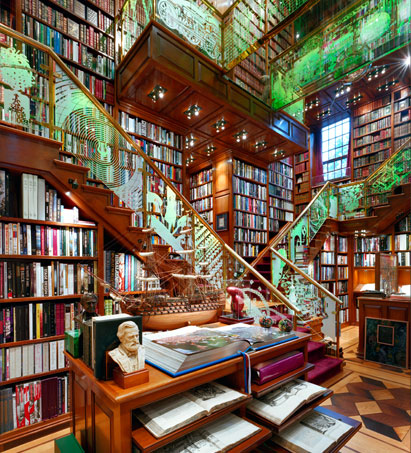
    As an old guy I am rather old-fashioned about libraries. Old, actual ones full of wood and paper rather than the new virtual ones full of computers and comradery. Although there is nothing wrong with comradery it is likely that the warmer, actual libraries were more conducive to contemplation if not outright creativity. I liked libraries when I studied in them and even as places in which I worked. I expressed my concern about the disappearance of actual libraries back in “University Libraries: A Last Stroll for a Lost Cause”. My affection for, and fond memories of libraries is noticeable in the ongoing series “Periodical Ramblings.”


Virtual Ones


    I realize, however, that it is very difficult to convince administrators (and even many faculty members) at universities to devote money to an actual library they will not visit and increasingly need not to. Particularly since the students will prefer the virtual kind. The space above was “inspired by student requests” and one of them remarks that “I usually come here because it’s a lot more focused,” he said. “It’s just rows and rows of cubicles, and people only come here to study.” It was once the home of a good science library full of books and journals.


    I suppose that if space and money were unlimited even the philistines on a campus would not object to having a beautiful building full of books, manuscripts and mahogany. At some ivy-covered colleges they do still exist.

And, as you will learn below, in some instances adventurous libraries have acquired and restored and even resurrected the libraries of others. Perhaps a few such places will live on as repositories for manuscripts and as museums for memories.


The Newark Public Library


    It will seem odd to begin in New Jersey, but just about a year ago it was announced that Philip Roth would donate his library to the Newark Public Library. As a child he often visited the various branches and as a college student he spent a lot of time in the main one. In this instance, the contents and books will be supplied by Roth and stored as they were in his Connecticut home, but the space will be remodelled as shown. Here are some details:


“Mr. Roth has designated the library, which he has called his home away from home, as the repository for his own book collection, a bequest that will be announced here on Thursday evening at the inaugural Philip Roth Lecture, to be delivered by Zadie Smith.”
“The series is a sort of thank-you on the part of the library’s trustees, who see the gift of his books as a fortunate, transforming windfall and intend to house it in a special room designed by the architect Henry Myerberg. “It really sparked a renaissance here at the library,” Rosemary Steinbaum, a trustee, said recently, explaining that the board planned to start a capital campaign not just to pay for the Roth room but also to refurbish the whole place. “We think the Newark Public Library can now become an important literary destination for students and scholars and even for tourists.”


“Mr. Roth’s library, some 4,000 volumes, is now stored mostly at his house in northwest Connecticut, where it has more or less taken over the premises. A room at the back of the house has been given over to nonfiction. It has library shelves, library lighting — everything except a librarian, Mr. Roth said recently on the phone from his New York apartment. Fiction starts in the living room, takes up all the walls in a front study, and has also colonized a guest bedroom upstairs. Copies of Mr. Roth’s own books and their many translations are stuffed in closets and piled in the attic. The books that were helpful to Mr. Roth in his research for his novel “The Plot Against America” are all grouped together, as are those he consulted for “Operation Shylock.”


“The books will be shelved in Newark exactly as they are in Connecticut — not a window into Mr. Roth’s mind exactly, but physical evidence of the eclectic writers who helped shape it: Salinger, Bellow, Malamud, Kafka, Bruno Schulz. Many of the volumes are heavily underlined and annotated. “It’s like he’s having a dialogue with them,” Ms. Steinbaum said.”


“I’m 83, and I don’t have any heirs,” Mr. Roth said, explaining why he decided to give the library away. “If I had children it might be a different story. It’s not a huge library, but it’s special to me, and I wanted it preserved as it was, if only for historical interest: What was an American writer reading in the second half of the 20th century.”


“Mr. Roth said that he liked the design the moment he saw it, and added: “I’m glad that my books are all going to be together. I don’t know why. I’m not going to be together, but let them be together.”


THE HARRY RANSOM CENTER


    This library/archive and museum is located in Austin at the University of Texas. You have probably read about it since it is well-funded, aggressive at acquiring archival material  and frequently in the news. Over the years they have resurrected and restored at least two working libraries.


    THE FLEUR COWLES’ LONDON STUDY


     Fleur Fenton Cowles was an author, journalist and the founder of Flair magazine. In 2011 the Ransom Center acquired her papers and set-up her study. You can learn more by consulting their blog Cultural Compass and the entry on “Fleur Cowles’ Pieces of Flair”


   ERLE STANLEY GARDNER’S STUDY
Temecula Valley Museum


    One does not have to be among the high of brow to gain a room of one’s own at a prestigious university. Given the Texas setting it is fitting that this collection also includes a lot of weaponry. Here is the link to the Erle Stanley Gardner Study at the Harry Ransom Center, The University of Texas at Austin. From this link you can explore an interactive panorama of a replica of mystery writer Erle Stanley Gardner's study at his ranch home in Temecula, California, displaying original memorabilia and artifacts from his career.


Other Actual Spaces


   Rooms other than libraries and studies have been acquired as artifacts. A few years ago I went to some meetings at Babson College and was shown some valuable space that was occupied by Sir Isaac Newton’s parlour!


  The Sir Isaac Newton Room


The Sir Isaac Newton Room, purchased for Babson College by Roger Babson's wife Grace in 1937, was installed in the former Sir Isaac Newton Library (now called Tomasso Hall) on the Babson campus in 1939. It consists of the original pine-paneled walls and carved mantel from the foreparlor of Isaac Newton's house on St. Martin's Street, Leicester Square, London, where he lived from 1710-1725.
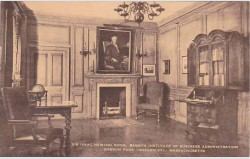

The Grace K. Babson Collection of Newtonia includes a library of more than 1,000 volumes of English and foreign language editions of Newton’s works (many of which are autographed and annotated in Newton’s hand), manuscripts, engravings, artifacts, and other Newton memorabilia, including a death mask that originally belonged to Thomas Jefferson. The collection was acquired through the efforts of Grace Knight Babson, first wife of Roger Babson, and is the largest source of Newton materials in the United States. The original 1950 printed catalog is available as a PDF.


   One can even find a kitchen at the Smithsonian.


    Julia Child’s Kitchen.
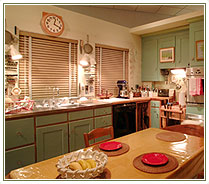
“Bon Appetit! Julia Child's Kitchen at the Smithsonian is located in the West End Gallery on the first floor of the Smithsonian's National Museum of American History. It features the 14' x 20' kitchen from Julia Child's Massachusetts home exactly as it appeared in November 2001, when she donated it to the National Museum of American History. While it is not possible for visitors to walk through the kitchen, there are three viewports set into the actual doorways that led to other areas of the house. Visitors can view all corners of Julia's kitchen.”

    Perhaps in the future there will be at least one actual library even if it is only an exhibit.

Monday, 17 February 2025

Two Lists of Single Author Journals

They Are Difficult to Find

I have rambled on about single author periodicals in many posts and this will be the fourth in a row about that subject. It will be the last one. My few readers will be relieved, but should any accidental visitor stumble upon them, I am sure they will be useful. I say "sure" because finding them is difficult.
To demonstrate the difficulty in finding single author journals as a category (i.e. all of them) I will present first, the result I found after conducting another search for them. Given that the words "author(s)" and "journal(s)" yield a large number of unrelated "hits" one might find the following single author journals listed in Wikipedia, under: "List of Academic Journals About Specific Authors." I will say right away that not all such journals are "academic" and, to indicate that the list is hundreds of titles short of being complete, I provide a list of single author journals published currently by just one university press. It is still the case that the best reference source is an old one and it remains the starting point for any future researcher: Author Newsletters and Journals : An International Annotated Bibliography of Serial Publications Concerned With the Life and Works of Individual Authors, by Margaret C. Patterson.
Before the lists, here are some brief remarks which, along with my other posts, may be useful for anyone who chooses to work on this subject or look for these periodicals.
-That there is an academic industry devoted to single intellectuals/authors should not be surprising. There are also many periodicals devoted to popular authors.
- There are entire courses dedicated to one author and there are conferences held on their behalf, but some writers are seen to merit more attention and given it in serial publications.
- Retiring academics are sometimes honoured by a Festschrift so single author journals can be regarded as simply continually published Festschriften. - Not all single author journals are about single authors. Some include others who are in some way closely related. - One is likely find them mentioned only in bibliographies or when a new one comes along and an advertisement is produced in a publication such as the TLS. I spotted one a while back about The Journal of the Sylvia Townsend Warner Society and I learned recently that the Arnold Bennett Society publishes a 40+ page newsletter three times a year. They often appear on lists when they die.
- The market for such serials is small and even university libraries will usually have only those devoted to major figures (Shakespeare) or those demanded by a zealous faculty member.
- And again to demonstrate how hard they are to locate, there is no way to find out how many of these journals your favourite university library has.
The Internet is likely to result in a decline in the number of single author journals in printed form. There is, however, unlikely to be a decrease in the number of individuals who remain dedicated to their own favourite author.

         LIST OF ACADEMIC JOURNALS ABOUT SPECIFIC AUTHORS
   This list is found in Wikipedia along with this brief statement: "
The following is a list of notable academic journals and magazines that are devoted to the study of specific authors and philosophers. Some of the journals are not currently active."
   Links are provided in some cases and some go to an entry for the journal in Wikipedia. There are more than 66 since some authors rate more than one journal, e.g., Dickens(3) Hegel(3), Shakespeare(3). The subjects range from, fiction, politics (Lincoln), and religion to philosophy and the geographic coverage is broad, e.g. C.L.R. James (Trinidad). Women are included: Cather, Dickinson, Rand, and some journals are about more than one author, e..g the Brontes and The Inklings. The Acorn, is listed next to Gandhi and King "since it explores philosophical issues related to non-violence in theory and practice, with a focus on the work of M. K. Gandhi and Martin Luther King, Jr." Fitzgerald and Hemingway also share a journal. 
Although these people have their own journal, I am willing to bet there are names you will not recognize. That the list is only a partial one is illustrated by the next list which is from just one press.

  1. Hannah Arendt. Arendt Studies

  2. Aristotle. Proceedings of the Aristotelian Society

  3. Augustine of Hippo. Augustinian Studies; Augustinianum

  4. Jane Austen. Persuasions; Jane Austen Annual

  5. Samuel Beckett. Journal of Beckett Studies; Samuel Beckett Today

  6. George Berkeley. Berkeley Studies

  7. Brontë family. Brontë Studies

  8. Willa Cather. Willa Cather Newsletter & Review

  9. Gilbert Keith Chesterton. The Chesterton Review

  10. Joseph Conrad. The Conradian

  11. Gilles Deleuze. Deleuze and Guattari Studies

  12. Jacques Derrida. Derrida Today

  13. Charles Dickens. Dickens Quarterly; Dickens Studies Annual; The Dickensian

  14. James Dickey. James Dickey Review

  15. Emily Dickinson. The Emily Dickinson Journal

  16. Arthur Conan Doyle. The Baker Street Journal

  17. T. S. Eliot. T. S. Eliot Studies Annual

  18. Philip José Farmer. Farmerphile: The Magazine of Philip José Farmer

  19. William Faulkner. The Faulkner Journal

  20. F. Scott Fitzgerald. The F. Scott Fitzgerald Review; Fitzgerald/Hemingway Annual

  21. Theodor Fontane. Fontane Blätter

  22. Mohandas Karamchand Gandhi. The Acorn

  23. Robert Graves. Gravesiana

  24. Graham Greene.Graham Greene Studies

  25. Félix Guattari. Deleuze and Guattari Studies

  26. H. Rider Haggard. Haggard Journal

  27. Georg Wilhelm Friedrich Hegel. Hegel Bulletin; Hegel-Jahrbuch; The Owl of Minerva

  28. Martin Heidegger. Heidegger Studies

  29. Ernest Hemingway. Hemingway Review; Fitzgerald/Hemingway Annual

  30. David Hume. Hume Studies

  31. Edmund Husserl. Husserl Studies

  32. The Inklings. Journal of Inklings Studies; VII: Journal of the Marion E. Wade Center; Mythlore [not about an individual, but an Oxford discussion group.]

  33. C. L. R. James. The CLR James Journal

  34. Henry James. The Henry James Review

  35. Ben Jonson Ben. Jonson Journal

  36. James Joyce. James Joyce Quarterly

  37. Franz Kafka. Journal of the Kafka Society of America

  38. Immanuel Kant. Kant Yearbook; Kant-Studien; Kantian Review

  39. Søren Kierkegaard. Kierkegaard Studies Yearbook; Kierkegaard Studies Monograph Series

  40. D. H. Lawrence. D. H. Lawrence Review

  41. Martin Luther King Jr. The Acorn

  42. Gottfried Wilhelm Leibniz. The Leibniz Review; Studia Leibnitiana

  43. Emmanuel Levinas. Levinas Studies

  44. C. S. Lewis. Sehnsucht: The C. S. Lewis Journal; VII: Journal of the Marion E. Wade Center.

  45. Abraham Lincoln. The Journal of the Abraham Lincoln Association

  46. Bernard Lonergan. The Lonergan Review

  47. Pierre Loti. Bulletin de l'Association internationale des amis de Pierre Loti

  48. Thomas Mann. Thomas Mann Jahrbuch (in German)

  49. Cormac McCarthy. The Cormac McCarthy Journal

  50. Herman Melville. Leviathan

  51. Maurice Merleau-Ponty. Chiasmi International

  52. Vladimir Nabokov. Nabokov Studies

  53. Friedrich Nietzsche. New Nietzsche Studies; The Journal of Nietzsche Studies

  54. Paul the Apostle. Pauline Studies; Journal for the Study of Paul and His Letters

  55. Edgar Allan Poe. Poe Studies: History, Theory, Interpretation

  56. Marcel Proust. Marcel Proust Bulletin

  57. Ayn Rand. The Journal of Ayn Rand Studies

  58. Philip Roth. Philip Roth Studies

  59. Jean-Paul Sartre. Sartre Studies International

  60. William Shakespeare. Shakespeare Bulletin; Shakespeare Quarterly; The Shakespeare Yearbook

  61. George Bernard Shaw. SHAW: The Annual of Bernard Shaw Studies

  62. Wallace Stevens. The Wallace Stevens Journal

  63. J. R. R. Tolkien. Tolkien Studies; Journal of Tolkien Research; Mallorn; VII: Journal of the Marion E. Wade Center; Quettar

  64. Giambattista Vico. New Vico Studies

  65. Virginia Woolf. Virginia Woolf Bulletin

66. Slavoj Žižek. International Journal of Žižek Studies

LIST OF SINGLE AUTHOR JOURNALS FROM PENN STATE UNIVERSITY PRESS This list was constructed from the journals listed at PSU Press in 2025. There is no category for these single author journals. I simply took the ones I identified on the list of PSU journals. Other journals in this category would be found at other university press websites. For example, the University of Chicago Press publishes, Spencer Studies and The Wordsworth Circle.
  1. The Arthur Miller Journal
  2. Bishop–Lowell Studies
  3. The Chaucer Review: A Journal of Medieval Studies and Literary Criticism
  4. The Cormac McCarthy Journal
  5. Dickens Studies Annual: Essays on Victorian Fiction
  6. The Edgar Allan Poe Review
  7. Edith Wharton Review
  8. The Eugene O'Neill Review
  9. The F. Scott Fitzgerald Review
  10. George Eliot—George Henry Lewes Studies
  11. The Harold Pinter Review: Essays on Contemporary Drama
  12. The Langston Hughes Review
  13. The Mark Twain Annual
  14. Milton Studies
  15. Nathaniel Hawthorne Review
  16. SHAW: The Journal of Bernard Shaw Studies
  17. Steinbeck Review
  18. The Scriblerian and the Kit-Cats [about more than one author.]
  19. Thornton Wilder Journal
  20. Wesley and Methodist Studies
  21. William Carlos Williams Review     
   If you are interested in the class of single author journals, Patterson's
Author Newsletters and Journals : An International Annotated Bibliography of Serial Publications Concerned With the Life and Works of Individual Authors, is still the place to begin. If you want to take on a large research project to update that work, you will have a lot of work to do. Some of the other related posts in MM will be useful and since this is my last mention of this subject, here is one short piece I was unable to examine: "One Man's Meat: Societies and Journals Devoted to a Single Author," William White, American Book Collector, 1957, 8(3), p.22. 
  To use a word that may be found in one of Zane Grey's books, or journals about him, I will now say adios to this subject. 

Sunday, 30 April 2023

A Few Bits About Books

    My output has been sparse so I will attempt to come up with something quickly to boost my April production. It is also the case that the weather remains dreary and I am not that interested in hockey.

National Library Week

"National Library Week begins on Sunday, and the timing couldn’t be better. This annual celebration used to feel quaint; now it sounds like an existential rallying cry."(Ron Charles)  

   I noticed that it was a week to celebrate libraries in the U.S. In Canada the month of October is dedicated to them and there are library days, weeks and months throughout this country. As you will know, I am a fan of libraries and books and I suggest we should all be paying more attention to both of them.

Banned Books and Censorship
   One reason to do so is that libraries are under attack and librarians are being threatened. President Biden even mentioned the problem in his recent announcement about running again. Canadians should not be complacent as this headline indicates: "Libraries Are In the Political Crosshairs as They Fight Back Against U.S. Book Bans: Canadians Should Keep an Eye on Efforts to Remove Books From Libraries South of the Border," Nick Logan, CBC News, April 21, 2023. Another headline indicates the situation is the same in the U.K.: "Third of U.K. Librarians Asked to Censor or Remove Books, Research Reveals,"

  The libraries and books are victims of the collateral damage inflicted by the culture wars. There have always been people who wanted to restrict what others read, but generally the focus was on sex and ideology whereas now the concern is mostly  over books about gender and identity. Librarians, usually a liberal bunch, have been resisting, but one hopes they also protect the illiberal items on the shelves as well (even the Dr. Seuess books and the unedited Roald Dahl ones) and keep the other books which are now deemed noxious and continue ordering them.

  There is even a Banned Books Week, during which the American Library Association calls attention to the censorship pressures. The ALA's Office of Intellectual Freedom notes that censorship challenges are up nearly 40% over 2021.
"ALA documented 1,269 demands to censor library books and resources in 2022, the highest number of attempted book bans since ALA began compiling data about censorship in libraries more than 20 years ago. The unparalleled number of reported book challenges in 2022 nearly doubles the 729 book challenges reported in 2021. Of the record 2,571 unique titles targeted for censorship, the most challenged and reasons cited for censoring the books are listed below." 


  The censorship efforts extend beyond libraries and into schools. The chart above comes from this study: "Banned in the USA: The Growing Movement to Censor Books in Schools."


Library Appreciation
   The importance of libraries to some patrons is noted by Ron Charles of the Washington Post, who wrote in this week's newsletter that a fundraiser has been established to dedicate a chair in the New York Public Library to Alfred Kazin who died 25 years ago. Kazin spent a lot of time in the room pictured above. 

"In his 1978 memoir “New York Jew,” Alfred Kazin recalled his early enthusiasm for the New York Public Library:
“Whenever I was free to read, the great Library seemed free to receive me,” he wrote. “There was something about the vibrating empty rooms early in the morning — light falling through the great tall windows, the sun burning the smooth tops of the golden tables as if they had been freshly painted — that made me restless with the need to grab up every book, press into every single mind right there on the open shelves.” 
The library was Kazin’s sanctuary and his laboratory. He started publishing book reviews when he was 19. Before he was 30, he’d written “On Native Grounds,” an instant classic of literary criticism."

  You may recall that another Jewish writer close by in New Jersey spent a lot of time in the Newark Public Library and donated his library to it and a space was dedicated for a room for Philip Roth (see: Actual Libraries.)


Books: Real or Fake?
   
That is Lord Black of Crossharbour who is once again a Canadian citizen and the picture was in Canadian papers today. It is here because he appears surrounded by books. Even if you do not like Conrad Black, you would likely agree that he has read a few and perhaps that may be one reason you do not like him. 

  Also in another article where books are featured in another paper, you will learn that some things are not always as they appear. The picture below is from: "Go Ahead, Judge This Book By Its Cover: Already the Norm For Film Sets and Commercial Spaces, Fake Books Are Becoming Common Fixtures in Homes, But if You See One, You Might Never Know," Anna Kodé, New York Times, April 28, 2023. About this phenomena I have already written. See, "Books By The Meter."


Real Books and Book Lovers

  As I have complained, university libraries are getting rid of books right and left and even those in the middle. Spaces are needed for lounging for the students and for the children of graduate students. Sometimes, however, some people have difficulty in throwing out the third copy of a book in their home library unless threatened by their partner who they accuse of being a philistine. The following passage is perfect for those who do not have fake books, but real ones and know how difficult it is to toss them:

"F. Scott Fitzgerald declared in an excellent late story that ‘the second half of life is a long process of getting rid of things’. It is certainly what I am striving to do. I have far too much stuff so I’ve decided a little culling is needed. Some weeding out imperative, deaccessions inevitable. I’ve started with books; I’ll end up with people and finish with me.
I kneel on the floor of my book room with a large cardboard box at my side. Do I really need all those George Meredith novels? Edgar Saltus is harder, but will I miss those duplicates of Purple and Fine Women and The Pace That Kills with the variant dust-wrapper and the misprint on page 43? My shelf of the works of Philip Thicknesse, that querulous 18th-century gentleman, contains nearly all of his 24 books, and if I were forced to sell them I could never sacrifice The Valetudinarians Bath Guide, which contains valuable information on the exorcism of gallstones, and an account of Mrs Mary Toft of Godalming who claimed that she gave birth to 15 rabbits; an assertion Thicknesse plausibly supports. Whatever the demands for space in my book room, I cannot banish my Marmaduke Pickthall, or a single one of my 15 copies of the first edition of The Wooing of Jezebel Pettyfer, which Meredith praised with the mysterious disclaimer: ‘It ought never to have been written.’ Not seldom, when I surrender a book to a rascally dealer, I return to his shop and buy it back."

(That bit is dedicated to my friend on Vancouver Island who has written some books and collected many more. It is from an article in The Spectator, Dec. 17, 2022 by Barry Humphries.)

Post Script:
   As I have noted too many times before, I think it is a mistake for university libraries to sacrifice the stacks for the students. The university libraries where I used to work are doing so. I do have to confess, however, that they had a copy of, Dr. Viper: The Querulous Life of Philip Thicknesse, In my defence, it is in storage, so as to make room for the students, or the toddlers of the graduate students, who will never be aware of its existence. I do also have to confess that although they did not have a copy of The Valetudinarians Bath Guide, it does appear in their catalogue and I (even you) can read it from the comfort of your couch (and right now!)

The Bonus:
   For the few remaining book lovers in London, I will save you time by telling you that I already have out of the library the copy of Dr. Viper. Those of you who are now looking for Purple and Fine Women are on your own, as are those of you who now are asking - "Who the hell is Edgar Saltus?" (But, I do have to be honest and make another confession - there are a couple of biographies of Saltus in the Western Libraries (in storage.) Let's hope they keep them there and do not send them to a storage bin near Toronto.)