Sunday, 22 September 2019

Ernie Pyle

Image result for "ernie pyle"

War Correspondent

     Although there are newspapermen with richer sounding names (Westbrook Pegler, Heywood Broun, Quentin Reynolds) the skinny Hoosier, Ernie Pyle, was the most celebrated and popular correspondent during the 30s and 40s in the U.S.  Even before he started covering the war, his columns were widely syndicated.
     It is because of the the 75th D-Day anniversary back in early June that he is being considered here. Since that time I have read much of what he wrote. There is no need for me to attempt to write an essay about him; the Wikipedia article is first-rate. I simply want to encourage you to learn more about Pyle and read some of his columns. I will provide some below which you can either read or listen to. 
    The piece that led me to Pyle is this one: "The Man Who Told America the Truth About D-Day, By David Chrisinger," New York Times, June 5, 2019. He writes: "It wasn’t until Pyle’s first dispatch was published that many Americans started to get a sense of the vast scale and devastating costs of the D-Day invasion, chronicled for them by a reporter who had already won their trust and affection." He also notes that Pyle underwent "a sort of journalistic conversion", after which his columns became "more stark and honest." 
    He had already volunteered to cover the bombing in England and it is clear from his letters and his columns that he had seen enough. Still, he later chose to cover the war in the Pacific. He was killed on the island of Ie Shima by a Japanese machine-gunner in April, 1945.
     To learn more about Pyle, start with the website at Indiana University. From there you can read or listen to some of his WARTIME COLUMNS.  For a famous one that appeared on the front pages of many papers see: "The Death of Captain Waskow", Jan. 10, 1944. Indiana University is also the repository for Pyle's letters and columns - Archives Online at Indiana University. See also the website of the Indiana Historical Society. 
    Pyle was adopted by Albuquerque where he had a home which he was rarely in. See: "America's Most Loved Reporter: Ernie Pyle".

Roving Reporter
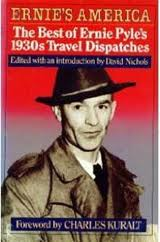
     If you would rather not read about war, have a look at the columns he wrote about various towns, villages, and people scattered throughout the U.S. and Canada. For over five years in the 1930s he and his wife travelled back and forth and up and down the continent writing six columns a week. They are typically about unimportant things, people and events and they are always enjoyable and usually funny. If you remember and liked Charles Kuralt, you will not regret picking up a copy of Home Country. A new edition was published as: Ernie's America: The Best of Ernie Pyle's 1930s Travel Dispatches. 
     They visited some places in Canada and you can find the related columns by using the index in Home Country. There is an amusing one about Dr. Mahlon Locke from Williamsburg, Ontario (here is a link to the Williamsburg plaque about Locke). Although I was not able to see a copy of Ernie's America..., apparently Canadian material was not included. ( I learned that from a good review of the book by Ken Cuthbertson, "Nomad in a Dead End,"  in the Kingston Whig-Standard, Dec. 30, 1989.)

Some additional sources: 
   For biographical material see the biography by his editor, Lee Miller,  The Story of Ernie Pyle. For reasons I don't recall I have a copy of An Ernie Pyle Album by Miller which contains all of the photos he couldn't put in his biography. 


    Pyle's war reporting is collected in: Brave Men; Here Is Your War and Last Chapter.  They are also conveniently collected in this book which contains a good biographical sketch: Ernie's War: The Best of Ernie Pyle's World War II Dispatches, David Nichols. 
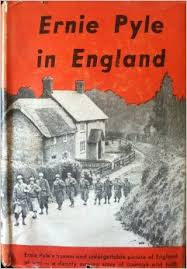
   If you are interested in The Blitz, Ernie Pyle In England is very good. And if you are really interested read also the book by his fellow American, Quentin Reynolds - London Diary. 
And for a movie see:

"The Story of G.I. Joe (United Artists) is
an attempt to picture the infantryman's
war as the late Ernie Pyle saw it. Pyle
himself (played in the film by Burgess
Meredith) and nine fellow correspondents
supervised and vouched for the movie's
hard-bitten authenticity. The result is far
& away the least glamorous war picture
ever made. It is a movie without a single
false note. It is not "entertainment" in the
usual sense, but General Eisenhower called
it "the greatest war picture I've ever seen." 
TIME Magazine. 6/18/1945, Vol. 45 Issue 25, p64. 

Professor Macksey's Library


library_1

    In July of this year there were many obituaries for Professor Richard A. Macksey who taught for over six decades at Johns Hopkins University. Apparently he was a legendary and inspirational teacher. Clearly he was a great collector of books. His library of approximately 70,000 of them is pictured above.


Richard Macksey


Sources:
"Richard Macksey, Johns Hopkins Professor With Capacious Mind and Library, Dies at 87, " Matt Schudel, Washington Post, July 26, 2019.
"Dr. Macksey (pronounced “Maxie”) was a wide-ranging scholar and polymath whose expertise extended from ancient and modern literature — in at least six languages — to medical history, biophysics, critical theory and film. He had joint appointments in Johns Hopkins’s School of Arts and Sciences and the medical school, where he helped design a curriculum that included writing and the humanities."
"He also was a founder of what is now the Maryland Film Festival in Baltimore and volunteered to work in the night shift at a free book exchange. He seemed to subsist on three hours of sleep and pipe tobacco."
"Dr. Richard A. Macksey, A Legendary Johns Hopkins University Professor, Polymath and Noted Bibliophile, Dies," Frederick N. Rasmussen, Baltimore Sun, July 25, 2019.
"At home, the center of Dr. Macksey’s life was his library, which came about after he and his wife decided to convert the garage of their 1921 Guilford home into a library measuring 16 feet by 28 feet, and whose walls contained shelves that rose 15 feet to the ceiling. In spite of the massive size of the room, which had a Palladian window and a heat pump to protect the books from humid Baltimore summer, his library of an estimated 70,000 books spilled onto tables and rose in piles from the floor, making it the largest private library in the state."
"Richard Macksey, 'A One-of-a-Kind Intellectual Giant' Dies," Rachel Wallace, HUB, July 23, 2019.
"When Hopkins Alums Think of the Humanities, They Think of Richard Macksey," HUB, July 23, 2019.  This is a profile of Professor Macksey that appeared originally in the Johns Hopkins Gazette on June 21, 1999.  The picture of Macksey is from this article.
"Farewell Richard Macksey, Legendary Polymath and 'The Jewel in the Hopkins Crown,(1931-2019)" Cynthia Haven. From "The Book Haven", her blog at Stanford.

[Once again, no links are provided because of the likely instability of many of them and because some sources may be behind a firewall. If you google, them you can verify the sources.]

Post Script:
This bad news for Hopkins is offset to a great degree by this good news:
"Bloomberg Gives $1.8 BILLION to Johns Hopkins for Student Aid," Anemona Hartocollis, New York Times, Nov. 18, 2019

Saturday, 21 September 2019

Wayne State University Press

Regionalism and University Presses

     It can be difficult to find interesting books. The various "Best Sellers Lists" are generally not too useful and you may balk at the suggestions made by the heavily pierced bookstore clerk, or not find anything enticing among "Heather's Picks" (for American readers, our Heather is the boss of Indigo Books, the equivalent of  your Barnes and Noble).
    If you are interested in the general area in which we live I will make the surprising suggestion that you look at some of the books published by the Wayne State University Press.  I said "surprising" because many civilians think that scholarly books written by academics are likely to be unreadable. That may be the case for most subjects about which they write, but sometimes an attempt is made to publish books that will have some appeal for the tax-paying citizens.
    I made a similar suggestion a while back when I posted about the Penn State University Press. They publish a local series called Keystone Books and the geographical range of some of them extends across the lake and the subjects covered are often of interest to Canadians.
    Wayne State University Press produces books about many subjects. The focus here is on the Great Lakes Book Series. If you travel to Detroit or enjoy books about cars, sports and the history of our area have a look at their publications.
     A list of some of the titles from the WSU Press available in London is provided below. As well, they publish some works in Canadian Studies and a few titles are mentioned at the bottom of this list.

 Great Lakes Book Series (click on this link for a full list of the titles in this series.)
Editor: Thomas Klug, Wayne State University
"The Great Lakes Books Series specializes in books of regional interest and importance to Michigan and the entire Great Lakes region. Inaugurated in 1986 to honor Michigan's 1987 sesquicentennial, the series currently includes titles on Michigan and regional history, the Upper Peninsula, military history, the Great Lakes and maritime history, Detroit history and culture, automotive history, art and architecture, literature, sports, ecology and the environment, and books for young readers."


     Listed below are about 40 titles from the Great Lakes Series that are available in the Western Libraries. There are around 1000 titles listed in the Western catalogue from the WSU Press. The London Public Libraries also have some. In both cases, the books can be located by doing a key word search by publisher.

The Ambassador Bridge : a monument to progress 
Arsenal of democracy : the American automobile industry in World War II 
Throughout World War II, Detroit's automobile manufacturers accounted for one-fifth of the dollar value of the nation's total war production, and this amazing output from "the arsenal of democracy" directly contributed to the allied victory.
Beyond the Model T : the other ventures of Henry Ford 


The French Canadians of Michigan : their contribution to the development of the Saginaw Valley and the Keweenaw Peninsula, 1840-1914 
Charting the inland seas : a history of the U.S. Lake Survey 
Deep woods frontier : a history of logging in northern Michigan 
Narrating the history of Michigan's forest industry, Karamanski provides a dynamic study of an important part of the Upper Peninsula's economy.


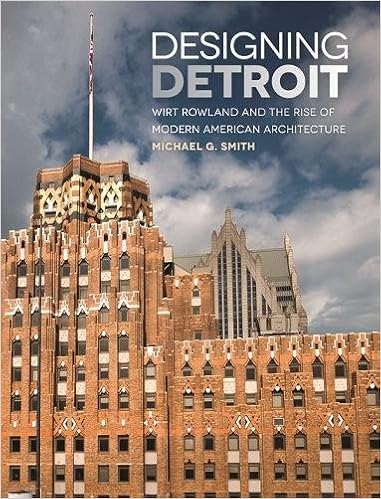
Designing Detroit : Wirt Rowland and the rise of modern American  architecture 
Shines a light on Detroit architect Wirt Rowland who, until now, has largely slipped into obscurity.
Detroit : city of race and class violence 
Beginning with the legacy of the Ku Klux Klan and the industrial tyranny of the early twentieth century, Detroit: City of Race and Class Violence charts Detroit's bitter history through the birth of industrial unionism, war time, the 1967 riots, and their effect on the city today.
Detroit images : photographs of the renaissance city 

The Detroit Tigers : a pictorial celebration of the greatest players and moments in Tigers history Discovering stained glass in Detroit 
"Expanding the frontiers of civil rights" : Michigan, 1948-1968 
A fluid frontier : slavery, resistance, and the Underground Railroad in the Detroit River borderland 
New research on the long, shared struggle for freedom by people of African descent in the Detroit River borderland from a uniquely bi-national perspective.
Frontier metropolis : picturing early Detroit, 1701-1838 
Great Lakes journey : a new look at America's freshwater coast 
Henry's lieutenants 
In the shadow of Detroit : Gordon M. McGregor, Ford of Canada, and Motoropolis 
Part biography and part corporate history, In the Shadow of Detroit investigates the life and career of Gordon M. McGregor, who founded and led Ford of Canada during the first two decades of the twentieth century.

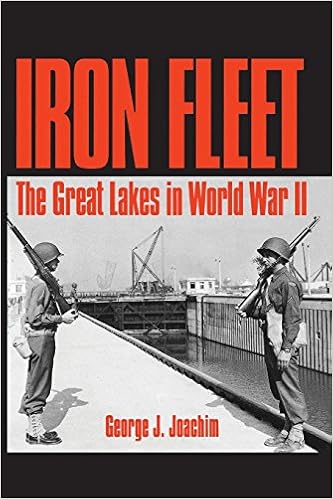
Iron fleet : the Great Lakes in World War II 
John E. Fetzer and the quest for the new age, 
John Jacob Astor : business and finance in the early republic 
Biography of John Jacob Astor's life and his career as a merchant, fur trader, and land speculator as vehicles for examining several important themes and issues in American economic and urban development between 1790 and 1860.
Lake Erie and Lake St. Clair handbook 
Let the drum beat : a history of the Detroit Light Guard / 
Life on the Great Lakes : a wheelsman's story
The Making of Michigan, 1820-1860 : a pioneer anthology
Mapping Detroit : land, community, and shaping a city
Illustrates and analyzes Detroit’s dramatic physical transformation in a balanced mix of text and maps.
Maxwell Motor and the making of Chrysler Corporation
A detailed history of Maxwell Motor Company, a medium-sized Detroit automaker that became the foundation of the Chrysler Corporation.

Michigan remembered: photographs from the Farm Security Administration and the Office of War Information, 1936-1943
A newscast for the masses : the history of Detroit television News
"Old Slow Town" : Detroit during the Civil War 
Details Detroit's tumultuous social, political, and military history during the Civil War.
A place for summer : a narrative history of Tiger Stadium
Riding the roller coaster : a history of the Chrysler Corporation
Roads to prosperity : economic development lessons from midsize  Canadian cities
Explores popular economic development strategies in midsize Canadian urban areas.
Roy D. Chapin : the man behind the Hudson Motor Car Company /


Rumrunning and the roaring twenties : prohibition on theMichigan-Ontario Waterway 
Songquest the journals of Great Lakes folklorist Ivan H. Walton
The field notes of a pioneering folklorist who collected the songs, stories, and cultural history of Great Lakes sailors in the 1930s.
Steamboats & sailors of the Great Lakes 
Steamboats and Sailors of the Great Lakes traces the evolution of the Great Lakes shipping industry over the last three centuries.
Storied independent automakers : Nash, Hudson, and American Motors
Survival and regeneration : Detroit's American Indian community
These men have seen hard service : the First Michigan  Sharpshooters in the Civil War /
Turkey Stearnes and the Detroit Stars : the Negro leagues in Detroit, 1919-1933


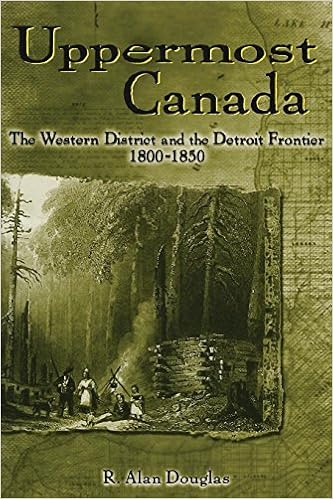
Uppermost Canada : the Western District and the Detroit frontier, 1800-1850 
Examines the historical, cultural, and social history of the Canadian portion of the Detroit River community in the first half of the nineteenth century.
Windjammers : songs of the Great Lakes sailors
Wonderful power : the story of ancient copper working in the Lake Superior Basin 

    The Wayne State University Press also publishes books relating to Canadian Studies. Here are two examples:


Power Play:Professional Hockey and the Politics of Urban Development
Big money and municipal politics collide in the story of Edmonton’s Rogers Place hockey arena.


Reflections on Malcolm Forsyth
A captivating and approachable portrait of the life and work of a Canadian musical legend.


Saturday, 14 September 2019

Campus Corner

     Image result for "western university"
     Here are a couple of university-related items I will attempt to post quickly before the sun shines.

1. Retirement Communities on College Campuses

     You are correct, I have mentioned this subject before, but will do so again because there is a good article about one of the latest examples which will soon be found on the campus of Purchase College (SUNY). Why colleges would be interested in old codgers and why retirees would be interested in roosting on a campus are questions answered in the article and in my earlier posts. Among them:

"Purchase is one of a growing number of colleges sponsoring retirement communities on campus or thinking about it. It is a marketer’s dream, monetizing spare land, while milking the baby boom generation’s affluence by appealing to their obsession with staying forever young."

"The schools say their motive is more educational and social — encouraging intergenerational mixing — than financial. But the communities promise a new revenue stream for institutions that are coping with reduced state operating support and declining college enrollment in many parts of the country. They are bringing a new generation (or old generation) to campus to fill classes, eat in dining halls, attend student performances and become mentors."

     Among the other schools mentioned are Arizona State and Lasell University near Boston.  If you look at my old post you will see examples ranging from Cornell and Dartmouth to the University of Florida and the University of Michigan. Additional articles and Canadian sources are also provided. In short, if this subject is of interest see:

Sources:
"At Colleges, What's Old Is New: Retirees Living on Campus," Anemona Hartocollis, New York Times, Sept. 10, 2019.
To learn more about the Purchase College example see "Broadview - Senior Living at Purchase College.

2. Not A Touching Moment at Western

     You may recall that I posted about HEADLINES and how they can be misconstrued if not clearly written. The one that follows is fairly clear, but some readers could understand it to mean that London police were summoned because finally something less than crass happened on campus: "London Police Investigate Touching Incident."London Free Press, Sept. 8, 2019.

3. University Rankings

     The latest Times Higher Education rankings were released and there were many headlines such as this one in the Canadian papers: "Top Canadian Universities Rise in Global Rankings," The Globe and Mail, Sept. 11, 2019. There were many additional headlines issuing from those campuses that did well. Unfortunately Western did not. 
     Credit should be given to Western, however, since it was noted in a campus publication that the university had dropped out of the Top 200. Usually in such cases, universities only note the good news.
See: "THE [Times Higher Education] Reveals World University Rankings," Jason Winders. Western News, Sept. 13, 2019.

Post Script:
     There has been a lot of news from Hong Kong lately, but I have not seen any mention of the Ivey Business School Asia, which is located there. The times appear to be a bit rough for universities offering graduate business programs and surely the disruption there cannot be good for the School. I have seen no mention of it on the Ivey or Western websites. Years ago the local paper would have picked up on such a story, but, like most communities, we no longer have one. 

Saturday, 7 September 2019

Birds & Eggs

The Feather Thief

     
     I do not often offer reviews of books I am reading, but I will do so in the case of The Feather Thief: Beauty, Obsession and the Natural History Heist of the Century, which I thoroughly enjoyed.  I read it so quickly I am sure to forget what it was about even faster than usual, unless I attempt a brief summary for you. You also will enjoy it even though it is about the following things: fly-tying; the feathers of birds and a flautist (what the Brits call a player of the flute) who may or may not have Asperger’s. Hardly compelling ingredients, you’re thinking.

      At an early age Edwin Rist became obsessed with tying flies like the one pictured above which requires “the crest feathers of the Golden Pheasant from the mountain forests of China, black and fiery orange breast feathers from the Red-Ruffed Fruitcrow of South America, ribbon-like filaments of Ostrich herl feathers from South Africa, and tiny turquoise plumes from the Blue Chatterer of the lowlands of Central America". As an aside, such flies are rarely used for fishing, but they are highly valued piscatorial objets d'art that attract collectors.

      Such feathers are as rare as the birds from which they are plucked and it is illegal to trade in them. Fortunately Rist the flautist found himself at the Royal Academy of Music in London which is not too far from the Natural History Museum in Tring. It is full of feathers and Rist broke into it and “ stuffed into his suitcase 39 resplendent quetzals, 47 Indian crows, 98 blue chatterers, 37 king birds-of-paradise, 17 flame bowerbirds and so on.”

     Kirk Wallace Johnson the author becomes obsessed with Trist and the fly-tyers and with finding out what happens to the criminal and what became of the proceeds of the crime. It is a very interesting story and along the way one learns about Alfred Russel Wallace (the collector of the feathers held at Tring), Lionel Walter Rothschild (the original owner of Tring), exotic birds and the use of feathers in Victorian fashions. 

 For those of you who rely on opening sentences to choose a book, here they are:

“Alfred Russel Wallace stood on the quarterdeck of a burning ship, seven hundred  miles off the coast of Bermuda, the planks heating beneath his feet, yellow smoke curling up through the cracks. Sweat and sea spray clung to him as the balsam and rubber boiled and hissed below deck. He sensed the flames would soon burst through. The crew of the Helen raced frantically around him, heaving belongings and supplies into the two small lifeboats that were being lowered down the ship’s flank.”


Post Script:
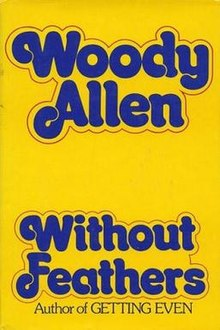
     One of the funniest books I have ever read has the word 'Feathers' in the title. Consisting of several short pieces, my favourite is The Whore of Mensa. It is about intellectual call girls, the kind a man wants if he is more interested in the mind than the body and where in the whore house one finds "pale, nervous girls with black-rimmed glasses and blunt-cut hair [lolling] around on sofas, riffling Penguin Classics provocatively." Among the services rendered in such an establishment: "For a hundred, a girl would lend you her Bartók records, have dinner, and then let you watch while she had an anxiety attack. For one-fifty, you could listen to FM radio with twins. For three bills, you got the works: A thin Jewish brunette would pretend to pick you up at the Museum of Modern Art, let you read her master’s, get you involved in a screaming quarrel at Elaine’s over Freud’s conception of women, and then fake a suicide of your choosing—the perfect evening, for some guys. Nice racket. Great town, New York."
    You can read these short stories in the book below. Most of them appeared in The New Yorker and you can find "The Whore of Mensa" in the Dec. 16, 1974 issue (it is readable via the Internet, but I won't put the link in out of fear it will soon rot).


What About the EGGS?
     I mentioned that word in the title and will offer a few articles about some oologists who are even more obsessive than the feather collectors. Stealing and collecting birds’ eggs is big business. Start with the fascinating story in The New Yorker:
“Operation Easter: The Hunt for Illegal Egg Collectors", Julian Rubinstein, July 15, 2013.
See also:
"Inside the Bizarre, Secretive World of Obsessive Egg Thieves: Audubon talks with filmmaker Tim Wheeler, whose documentary exposes the underworld of Britain’s illegal egg collectors. Audubon, By Emma Bryce, January 06, 2016.
"Journalist Joshua Hammer recounts the story of egg thief Jeffrey Lendrum and his latest jail sentence," CBC Radio · Posted: Jan 23, 2019

See the entry in Wikipedia for The Jourdain Society, and the one for Colin Watson.


Thursday, 15 August 2019

More Aids for Autodidacts

     At the beginning of this year I offered some useful suggestions for those who wished to improve the mind rather than the body. Short cuts to intellectual success were provided in the form of book series such as 30 Second Books and Very Short Introductions (see Intellectual Resolutions - 2019). 
     We are now more than halfway through the year and it is likely that my diligent readers have quickly burned through these very slim volumes. As a reward, I will now point you to some books that will let you know what really matters, and to some others that provide a little history. In keeping with the bespoke nature of this blog, the recommendations are loftier than the Whatever for Dummies...type books and appear under the imprimatur of a University Press - in this case, Yale.
     Although you sluggards should not be rewarded, I will remind you of a post that provides an excuse for those who buy books and do not read them, and a suggestion for the one book you should purchase: How To Talk About Books You Haven't Read. (see: TSUNDOKU)


Why X Matters

"Yale University Press presents the Why X Matters series, in which passionate authors present concise arguments for the continuing relevance of important people or ideas.The Why X Matters series aims to champion the cause of important disciplines and influential thinkers that are perhaps under-represented in modern discourse."


The Titles 


Why Architecture Matters Why Acting Matters Why Arendt Matters Why Baseball Matters

Why the Constitution Matters
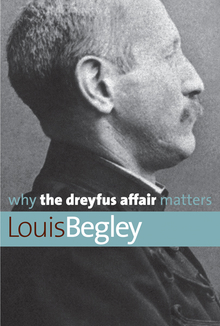
Why the Dreyfus Affair Matters
Why Niebuhr Matters
Why Poetry Matters
Why Preservation Matters
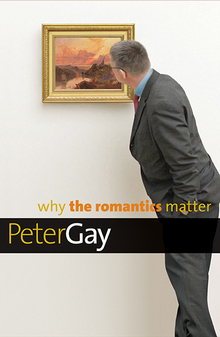
Why the Romantics Matter
Why Translation Matters
Why Trilling Matters


Little Histories

"The Little Histories are vivid storybook introductions for the young and old alike. Inspiring and entertaining, each short book lays out our greatest subjects in deceptively simple, engaging tones. With charming and personal insights each expert gently takes the reader from ancient times to the present through bite size chapters, ideal as bedtime reading or on the journey to work."

The Titles 

A Little History of Economics
A Little History of the World
A Little History of Religion
A Little History of Philosophy
A Little History of the United States
A Little History of Literature
A Little History of Science

Sources: 
   The "X Series" is easily found on the Yale University Press site along with additional information about each title. A rationale for the series is offered in the blog post of the London branch of YUP: "Introducing Yale's Why X Matters Series."
   The "Little Histories" are found here: littlehistory.org.
   In some cases, podcasts and video interviews are available. 
Post Script:
   If you feel a little embarrassed about telling people you are reading A Little History of the World, mention that it was written by E. H. Gombrich and memorize the German title: Eine kurze Weltgeschichte für junge Leser. By the way, it was written in 1935.
     

Monday, 12 August 2019

American Sportsman's Library

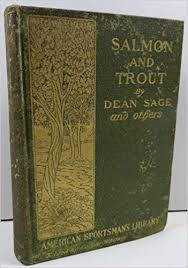
     I came across this series when I went looking for Upland Game Birds, which is the actual subject of this post. Given that I often provide information about books published in a series, I offer below a list of the titles in the American Sportsman's Library. If you are at all interested in nature, sports and literature about the outdoors, you will enjoy learning about such subjects as they were covered early in the last century. One of the books is authored by a U.S. President (he wrote it while in office) and the book under consideration was written by Edwyn Sandys from Ontario.

Upland Game Birds

If you are a hunter or a nature lover you will enjoy this book and if you are ornithologically inclined you will find it useful. One reason I am bothering to post about it is because it seems to me that more people should know about it. It covers most of the continent and the birds considered range from turkeys and ptarmigans to quail and whooping cranes. The other is that more should be known about the author.  If you go looking for “Edwyn Sandys” you will find a lot about a Bishop or the founder of Virginia, but not much about the one who was born in Chatham, Ontario. If you are a student of Canadian history Sandys is worth investigating. If you are more interested in environmental history you should have a look at Upland Game Birds. Although it  ranges widely geographically, there are often specific references to this area. Here are a few snippets: p.160. On the mating of Prairie-Hens "When I first heard this booming, it sorely puzzled me. It was in western Ontario, on what is known as Raleigh plains - an extensive tract of low, marshy land, lying for miles along the south bank of the Thames River….Spring shooting of geese, duck, and snipe was then both legal and amazingly good, guns were comparatively few, and the plains formed something very like an earthly Eden for those sufficiently game to face astounding mud and ice-cold water.”
p.249. On the Wild Turkey
"That such a bird, in the opinion of many the finest game-bird in the world, has been almost exterminated in miles of forested country where it might have been preserved, is a blot upon the sportsmanship of older states. Thirty years ago [c1870] one could drive in almost any direction through the woods of western Ontario and reasonably expect to see either the birds themselves or their tracks crossing the snowy roads. Twenty years ago the range had narrowed to the big woods of the western tongue of Ontario. Ten years ago, the last stronghold had dwindled to the wildest parts of about three counties. Today there is perhaps a single narrow strip where one might strike a trail and possibly catch a glimpse of a fleeing survivor of the old-time hosts.”
[ Things have improved. Now wild turkeys are seen routinely even here in the city].

The Titles in the American Sportsman’s Library

Listed below are the books in the series. The six titles that are bolded are found in the catalogue of the Western Libraries.


Anderson, E.L. and P. Collier, Riding & Driving: Hints on the History, Housing, Harnessing and Handling of the Horse. [One copy on microfiche as part of the Kentucky Culture Series.] Brownell, L.W., Photography for the Sportsman Naturalist (1904) [An electronic copy as part of Nineteenth Century Collections Online] Busby, Hamilton, The Trotting and Pacing Horse in America (1904) Crowther, Samuel and A. Ruhl, Rowing and Track Athletics (1904)
Graham, Joseph A., The Sporting Dog (1904)
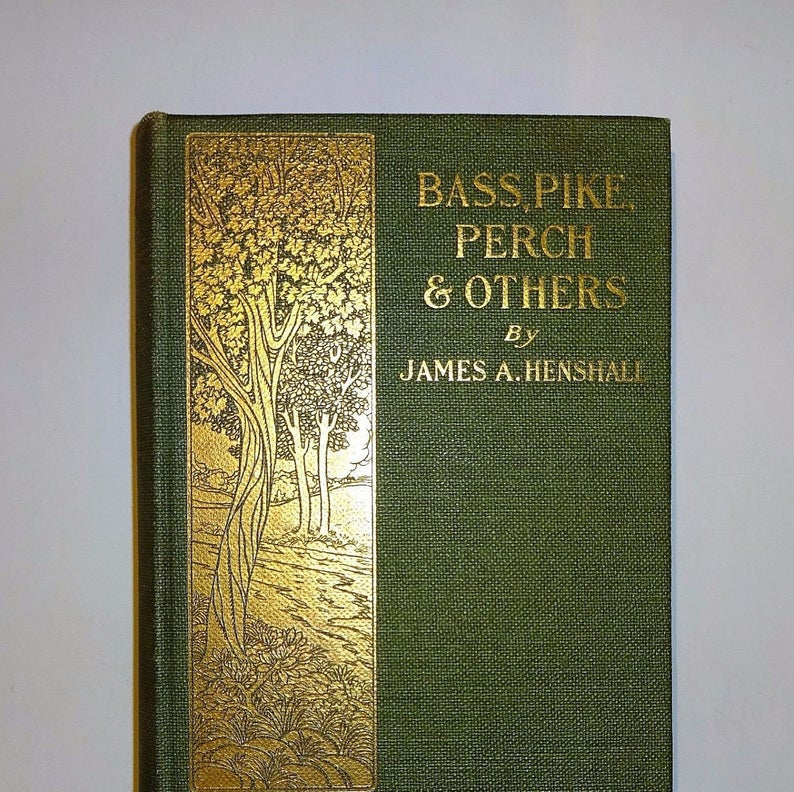
Henshall, James A., Bass, Pike, Perch and other Game Fishes of America (1903)
[Copy in storage]
Holder, Charles F., The Big Game Fishes of the United States (1903)
Money, A.W. et al., Guns, Ammunition and Tackle (1904)
Paret, J.P. and W. H. Maddren, Lawn Tennis: Its Past, Present and Future, by J. Parmly Paret; to which is Added a Chapter on Lacrosse by William Harvey Maddren (1904)
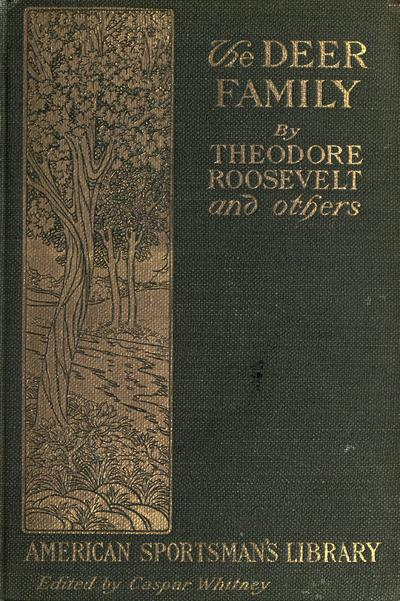
Roosevelt, Theodore et al., The Deer Family (1902)
[copy in storage]
Sage, Dean et al., Salmon and Trout (1902)
[One copy in storage and one in ARCC]
Sandys, Edwyn and T.S. Van Dyke, Upland Game Birds (1902)
[One copy in storage]
Sanford, L. C. et al., The Waterfowl Family (1903)
Stephens, William P., American Yachting (1904)
Trevathan, Charles E., The American Thoroughbred (1905)
Whitney, Caspar et al., Musk Ox, Bison, Sheep, and Goat (1904)
Sources:
There is a Wikipedia entry for The American Sportsman's Library.
 Here are two reviews of Upland Game Birds: 
    "Because most remarkable changes are making in the life habits of many game birds in their native haunts, the second volume in the American Sportsman’s Library, a work entitled Upland Game Birds, is certain to prove of interest to those observers of nature who do not shoot as well as to gunners.….It is loaded to the muzzle with good stories, all founded (more or less) on facts." John R. Spears, "A Work on Upland Shooting", New York Times, June 28, 1902.

"Upland Game Birds cannot fail to interest alike the sportsman, the ornithologist and the general reader. Mr. Edwyn Sandys, who is the author of about seven eights of the volume, is a keen field observer and a pleasing writer, whose experience covers the whole field of his subject, including the natural history as well as the sportsman's side, with both of which he is in fullest sympathy."The Auk, Volume 19, Issue 3, 1 July 1902, Page 306.

There is not much information about Edwyn Sandys. At some point he moved from Ontario and became a writer. Many of his articles are found in Outing magazine, with which he was associated. There are brief mentions of him in Mount’s, When Canadian Literature Moved to New York. His date of birth was found in an entry for his sister, Grace Denison, who was a writer and on the staff of Saturday Night. See: Canada’s Early Women Writers. 

An obituary for Edwyn Sandys is found in the New York Times on Oct. 27, 1906 (under ‘Edwin’).


Post Script: 
I was pleased to find some of these books in the libraries at Western University and hope they are not discarded. The copy that was retrieved for me from the storage facility was given as a gift in 1907 to someone in Chicago. It ended up at Western in 1922. (It should be noted that titles such as these are often worth a lot of money, depending upon the edition or condition of the items. I spotted one set of the Sportsman’s Library for $5,000 (US).)
I would have preferred to see the Western Libraries full of books rather than students. I have to admit, however, that all of the Sportsman’s titles are available via the Internet since they are out of copyright. Sandy’s Sporting Sketches is available and you can read his children’s book, Trapper Jim. You can also read all of his articles in Outing magazine. There are a few Internet options, such as HathiTrust, but for nature and outdoor books see the very good Biodiversity Heritage Library.