Showing posts with label abandoned projects. Show all posts

Friday, 21 February 2025

GAME BOOKS


   This post provides another example of an abandoned project, the purpose of which is forgotten. It is again a sign that I am getting rid of some old notes. It may have been the case that I thought that game books, such as the one pictured above, could yield some interesting information and, at least I can prove that is the case.
   The information may be hard to digest if you are an animal lover or vegetarian. And no larger lessons are learned from it, since these are just my notes from which no conclusions are reached about the large scale slaughters described. If you don't wish to read about the killing of game, read Singer's Animal Liberation instead.
   The OED defines "game book" as "A book or ledger in which details are kept of the game killed in the course of a shoot, or of all the game killed on a particular estate." In 1908, Lord Alanbrooke notes, "I have just been adding up my game book, and find that my totals for the larger game work out most satisfactorily for my first year in India."  If you have read much history about the upper classes you will have run across such books and realize that hunting was both a sport and pastime which also provided a considerable amount of food.
   Such books are typically classified under a broad heading and are not easily identified. This one was found in storage in the collection of the Western Libraries and is likely to be shipped off soon for storage elsewhere. Here are some passages from Leaves From A Game Book, followed by some other notes.
   The first interesting item is from the forward where one learns that, “This book was written in various prison-camps in Germany." It is well-written as you will see and you will also learn a bit about the appeal of hunting, and that fish can be found in trees.

   “Little mention will be found in this book of large-scale shoots, or of notable bags obtained. For though most of us can and do recall such occasions with pleasure, they must almost invariably rank second in our memories. The first places are filled with those treasured days when we went forth alone, or but with one or two friends, to the achievement of a small triumph, or the gaining of experience by defeat. No true hunter of game really minds  disproportionate rewards for his labours, or even total failure; the actual killing of the quarry represents so small a part of his enjoyment.” (pp.6-7)
   “The majority of us, whatever our detractors may assert to the contrary, have no desire to take life simply for the pleasure of seeing blood. If we had, our natural propensities would surely lead us to find our enjoyment in the nearest slaughterhouse. What we want is to match our wits, our quickness of hand and eye, our powers of patience, or concentration, or pure physical courage, against those of a wild creature. And that we should have to kill our prey in order to complete the victory may be regrettable; nevertheless it is a deep-rooted and an essentially natural instinct in man. But the true hunter desires no easy conquest. Rather will he prize difficulties, prefer that the odds may be in favour of the quarry and that the duel should be played out in exactly those surroundings which constitute the natural home of the hunted — and the erstwhile home of the hunter also.” (p28)
   “I got no other chance at pig during that drive, though even I could scarcely have failed to kill a mouse deer which stood in the open, at point-blank range, for several seconds. But to destroy so fairy-like a creature, looking no bigger than an English hare, with a weapons not unsuitable for disabling a light tank seemed altogether too grotesque a piece of savagery. So, after peering at me in a doubtful and short sighted manner with its large soft eyes, the mouse deer skipped safely away among the trees; leaving for me an enduring memory of the slender grace of delicate legs, of the tiny polished feet and shining coat of brown-and-white satin.” (p.21)
Malaya
   “Of the hot two hour journey up the river my recollections are a little confused. I remember the Dutchman distributed bottled beer from the ice-chest and corkscrew cheroots from one of his packages; that we sat drinking and smoking, as the green steaming banks slid smoothly by…. But one most vivid recollection of the journey I can must describe in full. I am not likely ever to forget it., for it was of the nature of a Solemn Warning. Seating facing the bows, I was idly scanning the twisted masses of the mangroves when, amid a tangle of roots, branches and leaves some three feet above the mud, I encountered the stonily disapproving stare of a fish….I closed my eyes. This, then, was what happened to immoderate drinkers in the tropics. I remembered with shame that I had been wont to consider as diverting tales of men who saw pink elephants, or snakes wearing hats – or fish in trees….But when I looked again the thing was still there; a veritable slate-grey, blunt-nosed fish, eight inches long and perched comfortably in the crook of a branch. And, as we drew abreast of it the creature shuffled hastily down from its eyre, propelled itself with seal-like flippers over the mud, and vanished into the water. “They are funny little fishes those belukang,” said the Dutchman placidly. “Always they sit out on the mud and sometimes, as now in a tree. Very amusing. You will have some schnapps in your beer—yes?” (p.150)

  Game books will be found in the collections of other good university libraries. In the "Hawthorn Fly Fishing & Angling Collection" at UBC, you will find Alan Roderick Haig-Brown's, My Game Book and you can look through the 293 pages.
  Such books often have been digitized and are located in the Internet Archive and in collections like the one at the Biodiversity Heritage Library, where this book is found: Leaves From a Game Book, by Augustus Grimble.
   The figures relating to the number of birds and animals killed are often astonishingly large. Here is a sample from the Grimble book noted above.


Data such as these are used by historians as is seen here:
  "
Head keepers, who were responsible for coordinating the driving of the birds, utilized a small army of beaters to sweep in wide areas on the days before the main shoot to concentrate birds on the beats that were to be shot. The record bag of 1,671 partridges, regarded as the best sporting bird, was achieved in 1905 on Lord Leicester’s Holkham beat in Norfolk. A close second was the total achieved in 1906 on the Duke of Portland’s estate of 1,504 killed on the Blue Barn beat, while 1,461 birds were shot in a single day on Lord Ashburton’s celebrated shooting estate near Alresford in Hampshire in1897. Not far behind was the Prince of Wales’s Sandringham estate, where in 1905 1,342 birds were secured. 
  Shooting parties achieved considerably larger bags of pheasants, as it was easier to amass them and drive them in military style to the waiting guns. The all-time record for a single day’s shooting is credited to a party of seven guns, which included King George V and the Prince of Wales, on an estate at Beaconsfield in 1913, when 3,937 pheasants, three partridges, four rabbits, and one “various” were shot. Warter Priory achieved a memorable day in 1909 with 3,824 pheasants. A party of eight guns, including King Edward VII, achieved an outstanding bag in 1903, killing 3,948 pheasants in two days, while in 1906 another party, which also included the king, shot 4,310 pheasants in three days. As historian J. G. Ruffer has poignantly noted, “The big shoots were a curious phenomenon which dominated winter months of English society for about 
forty years.”
(From, "British Game Shooting in Transition, 1900-1945," John Martin, Agricultural History, Vol.85, 2011-04,p.204.)
  If you are now interested in such books, you can find some on Amazon and this one at Quiller Publishing:


  About the killing of things there are also many books produced about and by  hunters and those from the lower orders. From the state where I grew up, there is this one for example: Forty-Four Years of the Life of a Hunter; Being Reminiscences of Meshach Browning, a Maryland Hunter; Roughly Written Down by Himself. There is even a marker about him, unless it has been torn down or removed by those who think we should no longer see such things: "A Maryland Historical Marker states Browning was Garrett County's most famous hunter, killing 2,000 deer and 500 bears during this 40-year period. This marker lies within eyesight of Browning's grave at St. Dominic's Catholic Cemetery in Hoye, Maryland."
  If you are also interested in purchasing a "long gun" for yourself, you won't find any any longer than this one, a "punt gun" typical of the ones used by market hunters.
 

Sources:
 
If you are interested in cooking game, see this Exhibit at the University of the Fraser Valley. For many more recipes see, Food History. 

Wednesday, 23 March 2022

James Oliver Curwood

    James Oliver Curwood was a very popular Michigan author who wrote a large number of outdoor adventure novels about "God's Country", which was basically Canada. He was for the coureurs de bois, what Zane Grey was for the cowboys. In the early part of the 20th century, the image that many people worldwide had of Canada, was the one painted in prose by Curwood. This is all summed up in the very long title of a Maclean's profile of Curwood in 1954:  

                  "The Man Who Invented God's Country: Being a True Account
                   of How James Oliver Curwood Gave the World, in 27 Spine-
                   Tingling Novels Devoured by Kings, Presidents and
                   Commoners, The Electrifying But Slightly Inaccurate Idea
                   that CANADA Was and Always Will Be a Heroic Land 
                  Peopled by Stalwart Mounties, Noble Indians,
                  Lonely Loons and Virtuous Maidens!"
 
                 
by Stephen J. Gamester, Our Intrepid Reporter, 
                  Whose Amazing Correspondence, Begins Overleaf,
                   Maclean's, Feb. 22, 1964.

The Curwood Festival

   I am telling you all of this because Curwood will be honoured again in Owosso, Michigan, which is due west of here, on the weekend of June 2.  He is honoured annually unless germs interfere. To avoid dying, you have been masked up and indoors and are probably dying to get out and go somewhere. I will be your trip advisor on this one and recommend that you enjoy the parades, tours, old homes, and particularly Curwood's castle on the banks of the Shiawassee River. I will provide the pertinent links below and by clicking on the first one, you will learn all you need to know.

The Curwood Collector

   Once again, you are amazed that I know such things and wonder why. This is the case, I admit, of another abandoned project. It relates, oddly enough, to my "Periodical Ramblings" and to those periodicals that are dedicated to one, specific individual. Curwood is such an individual and The Curwood Collector was dedicated just to writing by and about him. When I saw the title, I wondered who this Curwood was and looked him up. He turned out to be almost a neighbour. 
   This all was learned about forty years ago and the reason I am only telling you now is that I just discovered the notes of a trip taken to the Curwood Festival back on a fine summer day in 1981. Apparently I enjoyed it, but I will provide below a reference to an account by a writer more accomplished than I. He enjoyed the Festival in 1992. Before you pack your bags, do note that these endorsements are from the last century, not this one. Things may have changed, but those Pure Michigan ads are always enticing.

Curwood Actually Went to Canada

    He knew about what he wrote about and often spent months alone (or with his attractive wife) in campsites or cabins they constructed. Part of the time, he was even on the Canadian government payroll as a promoter of God's Country. Here are some photos:


The author and his first wife on their honeymoon in Ontario, 1909

  Such endeavours were successful, which is how he was able to construct the castle in Owosso.


The Curwood Festival:
    To learn more about the man and the events, see these links.
The Owosso Historical Commission
This site tells the whole story and has great photos in the section about Curwood Castle.
Historic Views of Owosso and Corrunna, Michigan
See this sub-section which contains a short profile, pictures of the castle being constructed, lists of his books and movies and his grave in the Oak Hill Cemetery. 
The Curwood Festival 
This is the official site with a countdown clock telling you how many days before the festival begins. It does not offer much else right now, but more will be added.

Sources:
   For the account of the Festival see: "Why, O Why, O Why O, Do They Ever Leave Owosso?" Thomas Mallon, The American Spectator, June 1992. 
   For a more recent one: Claire Moore, “Author-adventurer’s Castle in Unlikely Place: Owosso,” Spartan News Room, Dec. 11, 2020 - a description of JOC and the town by a reporter who lives there.
More information about his books is provided below.

The Bonus:
   
Curwood died in 1927 at a young age. Some think it was from the bite of a spider. Here is what one biography notes. He was returning from Florida during the spring: 
“The route home from by way of Washington was fortunate for Jim. Wearing waders, he’d been hunting water moccasins near Englewood and a snake - or something - had bitten him on the upper thigh. It had been a pricking sensation, like that of a needle, and he’d not thought much about it then, but now it was giving him trouble and he stopped by to see a doctor.” [he stayed five days for treatment - this was early in 1927 - he died in the fall.]
From: Eldridge, Judith A. James Oliver Curwood: God's Country and the Man. Bowling Green, OH: Bowling Green State University Popular Press, 1993.


Post Script:
   I never did do anything with old Curwood. I did, however, publish an article about journals like The Curwood Collector and have written about them in MM: "Single Author Journals" Periodical Ramblings (8)
   If you think you would like to give him a shot, all my materials relating to Curwood, the Festival and Owosso are available until Friday which is garbage day here in London and I do need to get rid of some of this detritus. If any of you get an Owosso postcard from me, now you will know why since I still have a few from that trip in 1981.
  As for those other "Abandoned Projects" I mentioned, one was about Charcoal Fueled Automobiles, a minor endeavour, and the other, A Dance to the Music of Time, which simply involved reading rather than writing.


Selected Curwood Books


A full list of his books is found in the Wikipedia entry for James Oliver Curwood. Most of them are now available to read for free. A convenient way to access them

is from the bottom of the Wikipedia entry, under "External Links."

Provided below are those found in the Western Libraries at Western University. Also

provided are some sample reviews from the New York Times.


The Alaskan : A Novel of the North

The Ancient Highway : A Novel of High Hearts and Open Roads

Back to God's Country, and Other Stories

Baree, Son of Kazan.

The Black Hunter; A Novel of Old Quebec.

The Country Beyond : A Romance of the Wilderness

NYT, Aug 6, 1922 "The popularity of James Oliver Curwood is so positive, his novels have such a surprisingly wide sale, that it is of interest to note the ingredients of his most recent book". The sales are surprising for the reviewer because he thinks the ingredients are banal.

The Courage of Captain Plum.

NYT, Nov. 7, 1908

Favourable review. The subject is a breakaway colony of Mormons on Beaver Island in Lake Michigan. "Mr. Curwood is to be congratulated upon having utilized an insignificant crumb of national history for the making of a well-constructed and interesting tale."

The Courage of Marge O'Doone.

NYT, Feb. 24, 1918.

Curwood's picture is provided and he is described as a born narrator and story teller.

The Crippled lady of Peribonka

The Flaming forest : A Novel of the Canadian Northwest

Flower of the North : A Modern Romance

NYT, Mar. 31, 1912.

The title is "A Good Adventure Tale", although the reviewer does complain of some

stale devices.

A Gentleman of Courage

The Gold Hunters

God's Country and the Woman.

NYT, Jan. 17, 1915.

A sole survivor of an expedition discovers a beautiful woman in the far north. Although barely credible, the plot is ingenuous according to the reviewer.

God's Country; The Trail to Happiness

NYT, April 3, 1921.

"It you are a lover of nature, you will enjoy this book..."

The Great Lakes, the Vessels That Plough Them : Their Owners, Their Sailors,

and Their Cargoes; Together With a Brief History of our Inland Seas NYT. June 19, 1909.

The reviewer is very enthusiastic. Although a work of nonfiction, it reads like a novel.

This book is now very expensive on the used book market.

The Grizzly King, A Romance of the Wild. NYT, Sept. 17, 1916. About hunters in the Rockies who learn to care about animals rather than hunt them.

The Honor of the Big Snows

The Hunted Woman

Nomads of the North; A Story of Romance and Adventure Under the Open Stars.

NYT, April 27, 1191.

The adventures is about animals and the reviewer finds it entertaining.

The Plains of Abraham

The River's End; A New Story of God's Country.

NYT, Oct. 12, 1919.

The reviewer thinks this one may have been written in haste and for the movies,

but finds it interesting, if overly sentimental. Good descriptions of the Saskatchewan River.

Steele of the Royal Mounted : A Story of the Great Canadian Northwest

The Valley of Silent Men

NYT, Nov. 7, 1920.

A postive review of "a corking good adventure story." The Wolf Hunters : A Tale of Adventure in the Wilderness

NYT, Dec. 19, 1908. Notes that it is full of adventure and shows real knowledge of the north.

Tuesday, 29 December 2020

Charcoal Fueled Automobiles


   This is Abandoned Project #737 and it does actually have to do with cars that use charcoal as fuel. I am really abandoning the subject in 2020 since it is highly unlikely that I will take it up in 2021, given where it resides in the queue of things which remain unfinished. You are likely to be interested in such an unusual topic and eager to learn more, but you are probably fatigued more than usual at this covid year end. So, I will make it easy for you.

   There is no specific Wikipedia entry, but there is a good article that will provide you with all you need, or probably want to know. It is found, appropriately enough, in Low-Tech Magazine - "Wood Gas Vehicles: Firewood in the Fuel Tank." One reason I am now abandoning what I thought was an unheard of subject is because quite a few people know about it. I am assuming that you are not among them.

   Although the link provided above has been around for many years, it may not be around in the years to come - it is, after all, found in a publication that is 'Low-Tech'. Where would that leave readers of this blog who happen to stumble over this post a few years from now? It is out of concern for them that I offer more. You are free to go. 

   They would likely want to know how I came upon such a subject. I found it mentioned in what is regarded as one of the greatest travel accounts of the last century: The Road to Oxiana, by Robert Byron (no relation.) If you weren't particularly interested in the workings of internal combustion engines, you now are likely to be more intrigued. I recently discovered some old notes of mine and it is them that I am about to abandon and toss out, to make room for more projects to be abandoned in my few remaining years.

   The first mention is found in the introduction: “From Beriut [sic] they were supposed to be conveyed to Persia by some young British friends making a publicity expedition in two Rolls-Royces burning charcoal instead of gasoline. When to no one’s great surprise these failed to appear, Byron and Sykes proceeded by themselves.... There is not really much information about the charcoal burners in the Road to Oxiana and that is what led me to start poking around.

   I do not recall what surprised me most, that,  a) cars could run on charcoal or b) anyone would trust a British-made vehicle for such a long journey. Perhaps they were better in the 1930s. The trip, by the way was not a short one - it was 6,000 miles, the approximate distance from England to Oxiana, which was a vague region somewhere in northern Afghanistan. The Rolls were of the 'Silver Ghost' type and one was driven by Colonel Noel, accompanied by Mrs. Noel. They were also described as 'open tourers' and here is the proposed route: 
"The route taken will be to Brindisi and thence by boat to Haifa. From there the cars will go to Damascus, Baghdad, and on to Teheran [sic]. If permission can be obtained Colonel Noel will go through Afghanistan.
   
You will agree that it was surely an exciting adventure, the purpose of which was described in The Times on Oct. 19, 1933:
Colonel Noel stated that the objects of his 6,000 mile journey were to revive the charcoal industry in India and to keep in this country money now spent on imported petrol. Charcoal was able to do the work of petrol and it was cheaper. Twelve pounds of charcoal were equal in power to about one gallon of petrol.

   Future readers may be more interested than you in alternatives for petrol, since interest is inversely related to the availability of it. Right now there is a glut. While I have indicated that you can find plenty of pieces about charcoal burning cars, future readers will likely appreciate the kind of bespoke references I will offer below, which illustrate that interest was high when gasoline was scarce and that the charcoal powered vehicles were found around the globe. I will begin with Canada.

Sources;

Canada
   
In 1943 one finds an article indicating that a Forestry Department boat was propelled by sawdust in Parry Sound and others indicating that newspaper publishers with plants in Canada were using charcoal to power engines at pulp mills. See: "Sawdust Drives Launch Nearly As Well as Gas," Globe & Mail, July 19, 1943. For a government study see: "Wood and Charcoal as Motor Fuel," Dept. of Mines and Resources, 1936. The pamphlet begins by indicating that there has been little interest in charcoal as a fuel in the U.S. and Canada because there was lots of gas and it was cheap. In B.C. various types of trees were analyzed with regards to their suitability as sources for charcoal and it was suggested that it could be used for fuel to run stationary engines in isolated areas in the far north.,

   The first reference I found was from 1902 in a New York Times article on Nov. 16 under "Automobile Topics of Interest."

    There are many articles from France including this one about Imbert, an early inventor: "USES CHARCOAL GAS TO DRIVE AUTOMOBILE: Alsatian Inventor Puts a Furnace on the Car and Uses the Ordinary Engine," NYT, Feb. 1, 1924 and "Big French Motor Magnate Talks on Gas," Drew Pearson, Boston Daily Globe, Dec. 14, 1924.

   "Gasoline Powered Cars May Become Oddity in Germany," The Hartford Courant, May 29, 1936.
    "25,000 French Cars, Trucks, Now Run on Charcoal," Chicago Tribune, April 3, 1941.
    "Most of Europe's Autos Driven by Ersatz Fuel," Christian Science Monitor, June 12, 1941. (The same newspaper later published a 'how-to' article: "Did You Even Wonder How an Automobile Can Run on Charcoal?", Oct. 6, 1941

   There was also interest in Italy:
"Gas-Driven Motor-Cars Fuel Derived From Charcoal," (News) FROM OUR OWN CORRESPONDENT. The Times Wednesday, Nov 22, 1933; pg. 13; Issue 46608; col B
This is a report from Rome about a gasogene machine running on charcoal  derived from wood and fuel from “vegetable refuse or other normal waste materials.” It provides details about the cost, showing how much cheaper these fuels are.

"Charcoal Fuel For Cars Result Of Italian Experiment, 3,750 Miles For £3 (News) "FROM OUR ROME CORRESPONDENT. The Times Saturday, Sep 21, 1935; pg. 9; Issue 47175; col E
This is a good lengthy piece talking about how the Italians are trying to make themselves self-sufficient and to balance trade. An ‘open sports car’ was driven over 3000 miles around Europe and a breakdown is given of the costs – which were much less than for petrol. This is so successful that public transport is increasingly using charcoal and “that all vehicles used for passenger transport must be adapted for the consumption of charcoal fuel by December 31, 1937.”

   This from New Zealand: "Best Woods Are Sought to Make Car Charcoal", The Hartford Courant, Nov. 17, 1940. The same paper has an article about Japan: "Jap Cars to Burn More Charcoal, Less Gasoline." July 7, 1940.  In Australia it was announced that a charcoal powered car had made the 7000 mile trip from Perth to Sydney with the fuel costing $3.20 per 1000 miles. The Hartford Courant, Aug.12, 1942.

   In 1944, students at Lehigh University built one: "Ration Free Automobile Uses Charcoal as Fuel," Christian Science Monitor, April 5, 1944.

Post Script:
 
Sadly, such sources led me to Project #738, which I will also now abandon to clear the decks for 2021. It was about - LOONEY GAS - an interesting subject I will leave it up to you to investigate. It is not, by the way, about gas that costs a loonie a litre, but rather about leaded gas that often caused people to go 'looney.' I should have covered it in my post about the history of Gasoline Stations. 

   Alas, as well, I am abandoning the subject of "bubble cars" which were the many tiny cars built in Europe because of fuel shortages during the war. A few year back, a collection of microcars were auctioned for over $8 million in an auction run by RM Auctions located close by in Chatham. Their story almost became another project. They have since partnered with Sotheby's to become RM Sotheby's.  See also: "Tiny Bubbles, Causing a Buzz," Robbie Brown, NYT, Feb. 22, 2013.


Tuesday, 15 September 2020

A Dance to the Music of Time

 A Pandemic Project For You


     Over the years before I retired, I would occasionally run across references to a series of novels by Anthony Powell which were produced over a long period of time. The title of the series is attractive, as it should be since it is taken from a painting with that name by Nicolas Poussin. I thought if the author could expend all that labour over a number of years to write the novels, I could at least exert a little in reading them. 

   I just ran across the few notes I made when I undertook the project. I was not up to the task, which is often the case, and abandoned the project, which I usually do.  I did read the first three, but I am sure you can do better.  I also am sure you will enjoy them since they are highly ranked by people far more discerning than I.


12 Novels to Get You Through Covid-19

   I do remember that the first problem I encountered was rounding up the titles which were not catalogued as a series in the library I used.  You may be able to find them packaged together as in the set pictured above, or you can shop title-by-title from the list provided below.


   You should know that there are around 400 named characters and one of them has one of the worst names I have ever encountered - Widmerpool. If you get bogged down, you can also read the guide written by one of his biographers, Hilary Spurling: Invitation to Dance - A Handbook to Anthony Powell's A Dance to the Music of Time. If the pandemic continues, or you need more help, you can read yet another guide - An Index to A Dance to the Music of Time, by B.J. Moule.  (It might be better before you begin all this reading to have a look at the Wikipedia entry for A Dance to the Music of Time.)

The Titles: 

A Question of Upbringing:Heinemann, 1951
A Buyer's Market; Heinemann, 1952
The Acceptance World; Heinemann, 1955
At Lady Molly's; Heinemann, 1957
Casanova's Chinese Restaurant; Heinemann, 1960
The Kindly Ones; Heinemann, 1962
The Valley of Bones; Heinemann, 1964
The Soldier's Art; Heinemann, 1966
The Military Philosophers; Heinemann, 1968
Books Do Furnish a Room; Heinemann, 1971
Temporary Kings; Heinemann, 1973
Hearing Secret Harmonies; Heinemann, 1975

The Bonus
   This should keep your book club going for months and you can further impress the members by letting them know that the author's last name is pronounced as "Pole". 
For that tidbit see: "Preposterously British: The Life of Anthony Powell," Christopher Taylor, Harper's Magazine, Nov. 2018.

Wednesday, 18 December 2019

Mussels and Other Molluscs

[One in a River Series which discusses rivers as they were, not as they now are.]

   One of the advantages of personal blogging is that one doesn't have to spend any time creating a captivating title to satisfy the people in the marketing department. The subject of mussels (and pearls if you are already bored) concerns us today because I just read this article: "Freshwater Mussels are Dying at an Alarming Rate, and Scientists Want to Know Why," Travis Loller, USA Today, Dec. 17, 2019. The report focuses on the Clinch River in Tennessee, but the problem is a global one. “Over the past century, mussel populations everywhere have declined steeply due to pollution, habitat loss and climate change, yet the current decline looks to be something different. Richard and a team of scientists suspect an infectious disease.”

   A few years ago I looked into this subject because of something else I read and I compiled some information about it. Of course, I never did anything with the material which gathered dust while nestled in a cloud somewhere. It was still there so I will provide some of it here because I will never get around to writing about it. The basic points I would have made are that our rivers used to be clean and full of fish and molluscs. Towns along them thrived by harvesting mussels and making buttons and there were even pearl divers.
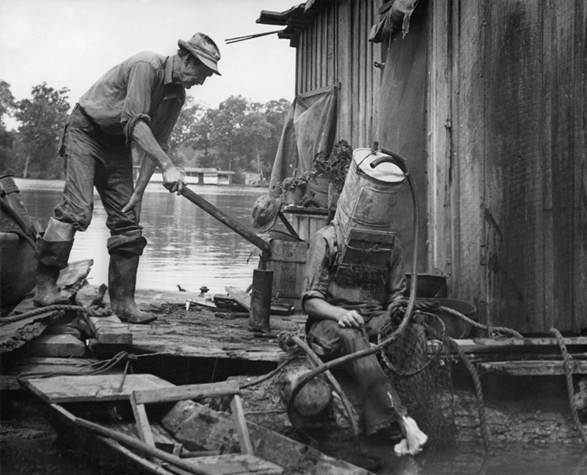

Caption:PEARL STRIVERS
A car's old gas tank and some garden hose compose a homemade helmet for this Mississippi River pearl diver. Notes with the photo claim the apparatus enabled the man to "go down 70 feet, and remain down one and a half hours." He would have needed that much time to find anything. When this photo was taken in 1938, the Mississippi's population of pearly mussels had already been largely depleted for use by button factories. For them, the mussels' shells proved more valuable than the gem sometimes inside. One bivalve could yield 24 buttons punched from its halves—and some six billion buttons were produced in the U.S. in 1916 alone. Though most pearl-button factories did not survive the 1940s rage for plastic buttons (not to mention zippers), the end of the harvests did not bring the Mississippi's mussels numbers back. Dozens of its species are now classified as endangered or threatened. Some might say they're as rare as pearls.— Margaret G. Zackowitz

   We are now far more likely to associate rivers with sewage than with sustenance. That was not the case in 1911 when this book was written: Highways and Byways of the Great Lakes, by Clifton Johnson. It was the book that led me to do a little research from which you will now benefit. The passage the follows relates to the Rock River around Dixon, Illinois. It is the river, by the way, that provided employment for Ronald Reagan as a lifeguard back when one could actually swim in them. Here is Johnson's description of clamming and 'pearlin'.

“But far more important commercially than the fish are the clams that inhabit the river. The clamming season, which lasts from April 1st to October 1st, had recently closed and every little while I observed a great heap of shells on the bank. I learned something of the industry at the hotel in the town where I stopped that night. "If a man wants to go clamming," said the landlord, "he fixes up a lot of four-pronged wire hooks, fastens 'em with short strings to sticks about a dozen feet long — perhaps as many as two hundred hooks to each stick. He goes out in a little flat-bottomed boat, drags down stream, and pulls up his stick and puts it on a rack at the side of the boat. Then he takes off the clams that have clinched onto the hooks and throws 'em into the boat. On the shore he has a tank under which he builds a fire and heats water to put the clams into and make 'em open. As he takes the clams out he feels for pearls, throws the shells in a heap, and saves the clams to give to farmers to feed their hogs. I tell the farmers who use that sort of feed to fat their hogs that I don't want to buy no pork off 'em, but probably it's all right. They feed the hogs corn before they market 'em. 

"The clam-opening job is rather odorous, and pearlin' don't attract very high grade labor. The pearl gatherers are mostly kind of shiftless — too lazy to do anything else, and they only work when they feel like it; but pearl hunting is profitable. A man can get shells enough in a day to net him four dollars, and there's the chance to make a big thing in pearls besides. One fellow in this town got a pearl that sold for eighteen hundred dollars. I've seen 'em clear as glass, and so round that when you put 'em down you could hardly keep 'em from rollin'. One was found, in another part of the state, this year, that was pink in tint and weighed fifty grains and sold for five thousand dollars. I wouldn't give five dollars for all there are in this river for my own use." When I was a boy I used to go pearlin' in a New England river near my home, and I had a whole teacup full of pearls at one time. I took 'em to a jeweler's store, and he said they wasn't any good. I couldn't get a nickel for 'em." 

(pp.288-289).

   Among the many sources (some of which will be provided below) here are some Canadian examples:
“The lumbermen, while sailing down the Canadian rivers on their rafts, collect Unios [a genus of freshwater mussels] for food, by fastening bushes to the rear of the raft, so that when they pass through the mussel shoals, where the rivers are shallow, the bushes touch, the Unios close on the leaves and thin branches, holding to them securely and at intervals the bushes are taken out and the Unios removed. Many brooks and rivers, among them the Olentangy, at Delaware, Ohio, and a number of streams near Columbus, have been completely raked and scraped, often in a reckless manner, and consequently with little result. The general method of collecting shells was for a number of boys and men to wade into the mill-race or into the river to their necks, feeling for the sharp ends of the Unio, which always project. When one was discovered in this manner, the finder would either dive after it or lift it with his feet. It was the custom at that time to open the shells in the water, and once during the process a pearl the size of a pigeon's egg is said to have been dropped into the water and never recovered.”p. 230.

   This happened along the Humber around Toronto as my annotation to this article will show:
"Attention to Toothsome Clam may Become National Sport." The Globe, Sep 20, 1923, 
This one is Canadian and relates to the Old Mill on the Humber. A caterer from Rochester introduced Canadians to the ‘clam-bake’. “It was claimed that this affair was the first “official” clam-bake ever held in Canada, and those concerned, without exception, did the repast justice worthy of the occasion.” It was obviously quite the affair, held in the late afternoon with dancing and a live orchestra.  Clams were served along with with salmon, chicken, lobster and corn on the cob. There is no mention of whether the clams came from the Humber or were brought from NY.  “It was unanimously agreed when the remains were cleared away that, if the custom has only been introduced into Canada, it deserves immediate adoption, eternal preservation, and inclusion in the category of national sports.”

Sources:

   I should be Christmas shopping so I will stop here and provide you with the sources. Towns along major rivers often offer resources- see especially Muscatine ("The Pearl of the Mississippi"), Dubuque and Prairie du Chien. Although I don't usually provide links, I will do so here since they seem to have existed for a while and I will also provide additional information to help you find them. Some article references are also included. 
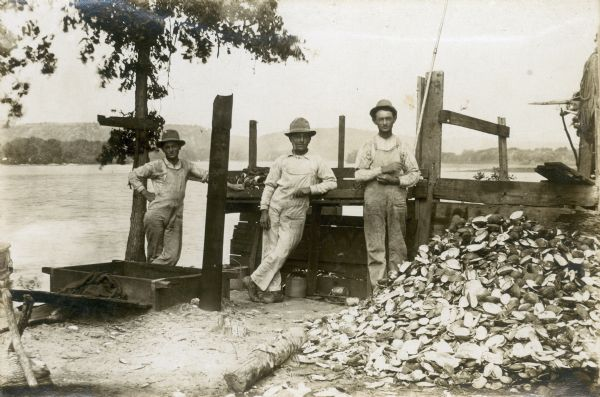
 

Harvesting the River (Illinois)
Under harvesting, follow the link to the "History of the Pearl Button Business in Meredosia, IL.
Great River - (The Mississippi River)
See especially, "The Clam Lady of America's Rivers: Marian Havlik," which should be here:
http://www.greatriver.com/clam.htm
"Back in the late 1960s Mrs Havlik was attempting to help her daughter with a science project and soon discovered how little (or difficult to find) was information about fresh water mussels. She goes on to become an authority on the subject and works to conserve what remains. The “Clam Lady” can be classified as a Malacalogist. She founded Malacological Consultants, in 1977 and a company with that name is found in La Crosse, WI"- I did not check to see if she is still associated with the company.
This should work for information about Muscatine:http://www.greatriver.com/pearls.htm
"Pearl Clamming and Pearl Button Clamming on the upper Mississippi River", Kari Pearls
For Dubuque: Encyclopedia of Dubuque.
Wisconsin: A Brief History of the Clamming and Pearling Industry in Prairie Du Chien, Eric F. Temte
And even in South Dakota - a very good article: "Clams Once Thrived in the Clean, Steady Waters of the James River," John Andrews, South Dakota Magazine, May/June, 2009.

Selected Newspaper Articles About Clamming - c1900-1980.
(from oldest to latest with some annotations)

"Big Pearl in a Clam Shell," Chicago Daily Tribune. Sep 18, 1900,
This is an example of how lucrative clamming could be . This report is from Winona, Minn and it is reported that a large pearl of “exceptional lustre” was estimated to be worth between $1500 and $2000. The pearl was supposedly the largest seen “in this part of the river”

"American Pearl Fishing." Los Angeles Times, Oct 15, 1900,
A basic description of the pearl fishery on the Mississippi.

"Our Finest Pearl." Los Angeles Times, Jun 28, 1901,
Good piece about a $50,000 pearl. The subtitle is: “Jewel Discovered in a Mississippi River Clam by a Poor Clam Digger Valued at $50,000”. The clam was caught in May 21 in Prairie du Chien and sold to a dealer for $17,500. It was re-sold and is now being offered for the amount above. A description is offered in the final paragraph: “Connoisseurs who have examined the pearl since it was brought to Chicago pronounce it the  most wonderful ever found in America. They also say it is equaled by few in the world. Its weight is 103 grains,while the average pearl weighs from 2 to 5 grains. It is almost a perfect pear shape, measuring over three-quarters of an inch in length and five-eighths of an inch. It is of a pink hue and exceedingly lustrous.”
[Like the other LAT stories this is a reprint - in this case from The Chicago Tribune.]

"Gems in River Clams." The Washington Post, Sep 25, 1904,
This is a very long piece with three pictures  - from the Mississippi in Iowa - 1) Clamtown, Prairie du Chien 2) Clamming Village at York’s Landing and 3) Clamming Scene near McGregor. The article concludes with a discussion of pearl-diving in the Far East and the development of ‘artificial’ pearls by the Chinese. The opening provides a good description of the process and how pearls develop.
"Woman and Boy Drowned Hunting for Pearls in River." Chicago Daily Tribune, Aug 11, 1910,
This event occurred on the Fox River near Wedron, Ill. A woman and her 6 year old grandson stepped in an 18 foot hole.
“Wading around in the river, the woman and boy were picking up clams and putting them into a bag which Mrs. Carter carried. Twice they had filled the bag and the same number of times had gone to the bank and opened them in search of pearls. Each time they were unsuccessful and the last time they walked down stream stepping into an eighteen foot hole”

"How Clams are Planted." Los Angeles Times, Jul 18, 1913,
This is a lengthy piece which provides background for the article immediately above. Because the beds were being over-clammed the federal government undertook artificial propagation by injecting baby clams into fish. This article describes the process thoroughly and is pretty good.

"Farming Clams in Kansas." Los Angeles Times, Nov 6, 1913.
This is taken from  The New York Telegram and the subtitle is “Tons of the Bivalves Gathered in the Rivers for the Pearl in Their Shells to be used as Buttons” Pearl hunting and clam gathering has become a “regular business”. “On a single farm, that of C.M Gregory, which is traversed by the Cottonwood River, no less than 100 tons of clams, it is estimated, have been taken from the riverbed during the last few weeks.” They are shipped in freight cars and each carload will bring $300 to $500 depending upon the quality.
“This is the first time in years that the Cottonwood River had been low enough to enable shell hunters to successfully explore its largest clam beds, which at some points are said to lie so thickly as to cover the river- bed.”

"Pearls in River Clams." The Atlanta Constitution, Nov 9, 1913,
This is reprinted from Leslie’s and discusses briefly the thriving clam industry around Peoria, Ill.

"Fortunes in Clam Shells." Boston Daily Globe, Jul 26, 1914.
The rest of the title is “Mississippi Yields Them by Thousands of Tons for the Maker of Buttons and Ornaments”.
“An industry which now assumes large proportions, and around which clings a peculiar flavor of romance, has developed on the Mississippi River, where hundreds of men are employed in gathering mussel shells in commercial quantities.” That is the opening paragraph and the concluding one: “The supply for a constantly increasing market is almost inexhaustible, the work is easy.

"Rise in Clam Shells." The Washington Post, Nov 12, 1916.
"Mississippi River Clam Diggers." Los Angeles Times , Aug 13, 1922,
This is a short piece indicating that clam digging was resuming after a 5 year moratorium. It mentions that there were factories in La Grange and Canton and that excessive clamming had depleted the beds. Apparently it takes 5 years for clams to mature.

"Scarcity of River Pearls, Clam Beds Worked Out." Boston Daily Globe, May 26, 1925,
This article is about the depletion of clams along the Upper Mississippi and in the Sugar and Rock Rivers and the inland streams of Wisconsin.

"Chasing the Elusive Clam New Way to Pay Way through College." Boston Daily Globe, Aug 15, 1926.
This is an account of three young women in Mass who are clamming on the North River. It does not say exactly what the clams are for but, “The clams meet a ready market and the three girls often total seven bushells in a day’s work.”

"Makes River Clams Grow Fine Pearls." Daily Boston Globe, May 20, 1928.
"Clam Digger Swims to Evade Policemen." Daily Boston Globe, Apr 23, 1930,
Apparently digging was not allowed because of pollution in the Saugus River in
Massachusetts.

Berlin .H.W. "Specimens of Hiawassee River Warty Clams Desired." The Atlanta Constitution, Sep 14, 1930.
Mass."Parker River Clam Diggers to Receive $4 a Barrel." Daily Boston Globe, Aug 2, 1940.
"U. S. Gives Up some Sanctuary Areas, Holds Clam Flats." Daily Boston Globe, Sep 17, 1946, 1946.
Special to The Christian Science Monitor. "Pennsylvania Spurs River Conservation." The Christian Science Monitor, Nov 10, 1948,
This is about the Schuylkill  [sic] which was heavily polluted by coal mining.

“Fall River Recalls Clambake 'Boom'." The Christian Science Monitor , Aug 18, 1956,
“...not only is there  profit in gathering the shells, but occasionally pearls ranging in value from $5 to $20 are found in the mussels. In the last three seasons more than 10,000 tons of shelves have been taken”
"Man, Dig those 16 $100 Clams in that Crazy Niantic River." The Hartford Courant, Jul 29, 1956.
"Ruling Held Up on River Clamming." The Washington Post, Times Herald , Sep 19, 1964.
"Clamming Permits on Sale for River." The Hartford Courant, May 1, 1969.
“Niantic River Clamming Rules Set by Shell Fish Commission." The Hartford Courant, May 2, 1970.
"Harmful Chinese Clam Discovered in River." The Hartford Courant, Apr 4, 1973,
This is another reason why clams declined - in this case the invasive Chinese clam.

"Tiny Clam A Threat to River." New York Times, Mar 1, 1973,
David Bird, Special to The New York Times. "Return of Clams and Even Oysters is also Envisioned." New York Times, Apr 28, 1973,
This is about the Hudson and more about shad which have also largely disappeared.

"River Closed to Clammers." The Hartford Courant , Jul 18, 1976.
"Clamming Closed in Niantic River." The Hartford Courant , Apr 22, 1979.

Post Script:
Apparently one fellow is still in the business:
"How to Dive for Pearls," By Malia Wollan July 23, 2019. NYT
“Run your hands back and forth through the sediment at the bottom of the river,” says Chuck Work, who has spent much of the last 25 years underwater, crawling the muddy bed of the Tennessee River, feeling for mussels with his hands.
When he started diving in the mid-1990s, the booming cultured-pearl industry in Japan meant thousands of boats jockeyed for territory on the river (about 80 percent of the mussel shells exported from the United States come from Tennessee). Back then, you needed a companion onboard to ward off shell thieves. Today only about 20 divers remain. A few years back, he found a pearl almost the size of a quarter, but he had a hard time selling it and now wears it around his neck. “I sure wish people would start wearing more pearls again,” he says."

The clams are now gone, the pearls are cultured, the buttons plastic and the rivers polluted.