Showing posts with label PGA. Show all posts

Tuesday, 19 September 2023

Fishing For Money


The White Marlin Open

   This is not a fish story. "The White Marlin Open" which has been open and ongoing for 50 years, really is the "World's Largest & Richest Billfish Tournament." The port from which the contestants venture forth is Ocean City, Maryland. When we visited back in early April, there were many signs promoting the tournament which has now been completed. I thought I would take a look and see what happened. While I am looking and you are waiting, you can read or re-read my earlier account about visiting Ocean City in "Blogging While Travelling." 
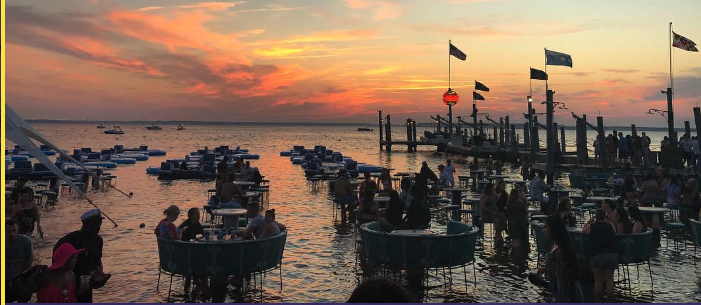


  In that post, I did not focus on the rowdier aspects of the resort since we deliberately went before Memorial Day to enjoy the unoccupied ocean beach. From then until Labour Day, the place is a festive one and I suppose the reporting during that period would be more exciting, but I can assure you that this account about the fishing tournament is likely to be more rewarding than you might think. If you would like a sample of the more raucous side, simply visit the website of SEACRETS. It is a mini-Jamaica on the bay side where there are 15+bars and a distillery. Palm trees are trucked in every spring, but if you don't want to drink under them or in one of the many bars, you can drink right in the Isle of Wright Bay. 

   Rather than focus on the summer-long, "Spring Break" atmosphere and those people who spend a great deal of money drinking, I will now report on the fisherpeople who win large sums of money fishing (and likely drink some while doing so.) Here are some of the results which were taken from the WMO site or other sources. The prize amounts will seem confusing since someone in fourth may have won more than someone in second. That has to do with things like the type of contestant and the fish. The WMO rule book is 12 pp. of small type and that does not include the IFGA rules. As well, there is an additional information sheet where you can find out if it is legal to use a "FLIPPY FLOPPY" or a "STINKY TINKY." And, if you win a large amount, you may be asked to take a polygraph test. 


Blue Marlin
John Ols of Laytonsville, Md., was this year's big money winner, reeling in a 640.5-pound blue marlin aboard the Floor Reel out of Ocean City to take home $6,200,000.

Tuna
First place: Brian Stewart of Shady Side, Md., reeled in a 265-pound tuna aboard the Reel Tight out of Ocean City to take home $1M.
Second place: Chris Mentlik of Street, Md., reeled in a 221.5-pound tuna aboard the Fishlik out of Chincoteage to take home $360,000.
Third place: John Zimmerman of Boynton Beach, Fla., reeled in a 221.5-pound tuna aboard the Game Over out of Ocean City to take home $160,000.
Fourth place: Rusty Shriver of Leonardtown, Md., reeled in a 215-pound tuna aboard the Ro Sham Bo out of Ocean City to take home $1,700,000.


Wahoo
First place: John Harris of Boyertown, Pa., reeled in a 57-pound wahoo aboard the "Shooting Star" out of Indian River to take home $2,000.
Second place: Chad Jackson of Fory Myers, Fla., reeled in a 55-pound wahoo aboard the Captain Deadley out of Ocean City to take home $28,000.
Third place: Matthew Gessler, 15, of Chadds Ford, Pa., reeled in a 46-pound wahoo aboard the Boy's Toy out of Indian River to take home $26,000.


Dolphin
First place: Andrew Spangenberger of New Freedom, Pa., reeled in a 50.5-pound dolphin aboard the Roncito out of Ocean City to take home $25,000.
Second place: Timothy Goodman of Palm Beach, Fla., reeled in a 32-pound dolphin aboard the Aquila out of Beach Haven, N.J., to take home $78,000.
Third place: Will Mcateer of Kent Island, Md., reeled in a 31-pound dolphin aboard the Maverick out of Ocean City to take home $27,000.


White Marlin
  Ironically enough, there were no White Marlin caught at this year's White Marlin Tournament. But, the total payout was around $10.5 MILLION. 

The Bonus:


   Michael Jordan often competes in this tournament and did so again this year. Just about all you need to know is found in this title: "Michael Jordan Took His $8 Million Fishing Boat, Catch 23, to the White Marlin Open Competition: The 84-Foot-Long Vessel, Wrapped in Elephant Print, Costs a Whopping $1 Million Annually to Operate," Neha Tandon Sharma, Luxurylaunches.com, Aug. 14, 2023.
   I followed him farther north to the "Midatlantic Fishing Tournament" and learned this: "In total, the tournament paid out $5.79 million to 35 boat crews. Jordan's boat Catch 23, by the way, took home $462,318 for a 75-pound white marlin, good for third in that category."
The person who chose the name for Jordan's boat also deserves some credit.

Sources:
To prove that this is not just a fish story, here are some sources. 
   The website of "The White Marlin Open" contains all the rules and regulations and you will also find some archival issues of the White Marlin Open magazine. The recent issue has this article: "How OC Became the White Marlin Capital of the World." For another history of the event see: "The White Marlin Open: A History Lesson," Jan Fogt, Marlin Magazine, March 6, 2015.
  For coverage of this year's WMO see: "White Marlin Open 2023 Final Leaderboard: A $6.2M Blue Marlin is Big Winner," Keith Demko, Delmarva Now, August 12, 2023.
   The "Midatlantic Tournament" numbers were found in: "Sports Outdoors: Pipe Dreamer Wins $1.18M in MidAtlantic With Blue Marlin Catch," Dan Radel, Asbury Park Press, August 30, 2023.

  The more sensitive readers of MM may be disappointed that I did not mention the more serious subjects related to fishing, namely overfishing and endangered species. The issue of "conservation" is raised on both the website of the WMO and in the article about the history of the event. Many of the fish caught are released, although admittedly the process is not painless.  In short, industrial fishing is more problematic than sports fishing and those engaged in the sport are often ardent protectors of the things they wish to fish or hunt. Sushi eaters should be reluctant to throw stones, and appreciate the irony.

Some Perspective: 
   Perspective is somewhat difficult to apply when you compare fishing to putting or angling to golfing, but in the most recent PGA Fortinet Championship which was held on a golf course, Sahith Theegala won and received $1.512 million. If you weren't reading carefully the bit above, you may not have noticed that the winner of the WMO received $6,200,000 and another guy got $1,700,00 for catching a tuna.

Wednesday, 30 September 2020

Rod Spittle

   Mackenzie Hughes is a Canadian golfer who, last week, finished in third place in a golf tournament in the Dominican Republic. Apart from getting a tan, he received $276,000. At the richer Travelers Championship, back at the end of June, he tied for third and won $436,000. On the first of March he finished second at the Honda Classic and the number on the check was $763,000. Playing golf as a professional was not always so financially rewarding.

  Rod Spittle was born in St. Catherines in 1955 and, like Hughes, headed south to Ohio to play golf and get a college education. He went to Ohio State, while Hughes attended Kent State. The economic prospects for professional golfers were not so bright back then and Spittle decided to go into the insurance business which was likely to be more lucrative and, some would say, more exciting.  In an interview back in 1977 he indicated he was spending time in the pro shop and supplementing his income by making wooden drivers like the one illustrated above (a link to the video is provided below.)

Apart from a fine collegiate career, Spittle won the Canadian Amateur Championship in 1977 and 1978. If you recognize him, however, it is likely because you have seen him on the Champions Tour, which is the professional tour for older players. It was only after a long career in insurance that he attempted to become a professional golfer. In 2010 he won the AT&T Championship in San Antonio and has made over $4 million. He retired from golf in 2018. Apparently he is a fine fellow and you can learn more about him below.

Television Archives

I stumbled upon Mr. Spittle when I discovered that some television news footage from a neighbouring state is now available over the Internet. Those who would rather watch events from the past than read about them, will be pleased to know that more archived video material is now being made available. In this case, the Buffalo Broadcasters Association is providing content as part of the New York Heritage Digital Collections.

The Channel F Sports Director interviewed Spittle back in 1977 when he was the Canadian Amateur Champion. You can see the entire interview by clicking on the link provided. There is a short opening glitch, but stick with it and listen to the southern-sounding Spittle talk about his career and the club he has made. It looks better than the one pictured above. (the video is only 2 minutes) WIVB-TV Featured Segment - Rod Spittle-1977.

The Bonus - Local News Coverage


   Those who would like to view local television news coverage will be pleased to know that the archives of the London TV Station CFPL are available at Archives Ontario. Footage is provided for the years from 1953 to 1968. Here is the link to the Ontario Archives. 
   I used the CFPL footage in a post I did about Western students winning a bed-pushing contest in the early 1960s -see, The Important Subject of Bed-Pushing.  Lately, however, I have had problems opening the videos. I hope you have better luck. A few of the CFPL broadcasts are available on YouTube. 

Sources:
   There is a Wikipedia entry for Rod Spittle and a profile on the PGA Tour Champions website. He is also in the Canadian and Ontario Halls of Fame. 
For a good profile see:
"Rod Spittle Returns to Hamilton For Historic Career Milestone," Brent Long, Golf Canada. 

My only other post about golf is about golfing in London in the 1930s - see Joy in Mudville. 

Monday, 3 August 2020

Slavery

  It is still raining and I will move from the safe subject of cycling to the much more controversial one of slavery. This post, should not be controversial, however, since I will state clearly that, I am against it. 

   There have been many articles about slavery recently, generally in relation to statues. I will not talk about statue removal, yet again, but I will point you to two articles which suggest that the number of problematic statues is likely much larger than you would think and not all of them are carved in white marble. The point is, that not all slavers were white Americans or Englishmen. 

   The first article is a syndicated one by Gwynne Dyer which appeared in many papers on July 30, 2020. Here is how it begins and in it he is attempting to make the point that slavery was not restricted to the American south:

“Assessing the people of America’s past by today’s standards would compel us to cast the majority of our heroes as villains.”

That might seem to be the line taken by Sen. Tom Cotton of Arkansas last week in his opinion piece for the New York Times. It caused great outrage, the opinion editor had to resign, and Cotton was roundly abused for “defending slavery.....”

The point is that I [Dyer] changed one word in that quote, and it wasn’t Cotton who said it. It was Nigerian journalist and novelist Adaobi Tricia Nwaubani, and what she actually said, in an opinion piece for the BBC, was this: “Assessing the people of Africa’s past by today’s standards would compel us to cast the majority of our heroes as villains.”

"She was talking specifically about her great-grandfather, Nwaubani Ogogo Oriaku, who was a widely respected trader in tobacco, palm oil, and slaves in southeastern Nigeria in the early 20th century. The Atlantic slave trade had been banned by the European empires a century before, but slavery was still a flourishing domestic business in Nigeria and many other African countries.

Her great-grandfather became famous by defying the British colonial authorities, who were trying to stamp out slavery in Nigeria. They had confiscated some of his slaves, and he marched right up and demanded them back, waving a trading licence that dated back to the previous century.

The British were taken aback, apologized and returned his slaves. Indeed, they were so impressed by his boldness and self-confidence that they subsequently appointed him paramount chief of his region. So he became a local hero in his own day, and is still a hero to the Nwaubani family.

Slavery was normal in most pre-modern societies, including almost all the kingdoms and ethnic groups of sub-Saharan Africa. Africans had sold slaves north to various Islamic empires in the Middle East for centuries before Europeans showed up on the coast in ships. They were just another set of customers buying in the same market.
Most enslaved Africans didn’t travel more than a few hundred kilometres from home. It is estimated that in the 18th century one-third of the people in what is now Senegal were slaves who belonged to other Senegalese. But the ones who were sold to foreigners probably suffered more.

Historians believe around one-fifth of the 10 million Africans transported to the Americas over more than three centuries died on board ship. The fatalities among the estimated 17 million African slaves sold to Arab traders and forced to walk across the Sahara or carried around the India Ocean in ships during 10 centuries were probably just as high. What awaited the survivors when they arrived was pretty appalling, too."

   The second article was reprinted recently in The New York Review of Books. It had originally appeared in TNYRB in 1994 and was written as a letter rebutting the notion that large numbers of Jews were involved in the slave trade. The point again, is that many different peoples and religions participated in slavery, even some ex-slaves.

   The participants in the Atlantic slave system included Arabs, Berbers, scores of African ethnic groups, Italians, Portuguese, Spaniards, Dutch, Jews, Germans, Swedes, French, English, Danes, white Americans, Native Americans, and even thousands of New World blacks who had been emancipated or were descended from freed slaves but who then became slaveholding farmers or planters themselves. Responsibility, in short, radiated outward to peoples of every sort who had access to the immense profits generated from the world’s first system of multinational production for a mass market.

“In the American South, in 1830, there were only 120 Jews among the 45,000 slaveholders owning twenty or more slaves and only twenty Jews among the 12,000 slaveholders owning fifty or more slaves.” David Brion Davis noted in 1994, on the question of Jewish involvement in the slave trade. “No one should defend the small number of Jews who bought and sold slaves,” he writes. “No one should defend the infinitely larger number of Catholics and Protestants who built the Atlantic slave system, or defend the Muslims who initiated the process of shipping black African slaves to distant markets, or defend the Africans who captured and enslaved perhaps twenty million other Africans in order to sell them to European traders for valuable and empowering goods. But while posterity has the right and even duty to judge the past, we must emphatically renounce the dangerous though often seductive belief in a collective guilt that descends through time to every present and future generation.”
(David Brion Davis, "The Slave Trade and the Jews," NYRB, Dec. 22, 1994)

The Bonus:

Peonage on the PGA Tour


   It is still raining and I will likely watch some golf.  Whenever I do, I am often irritated when I see the golfer holding his club out behind him, without looking behind him, fully expecting the caddy to be there to grab and clean it. When I went looking for a picture to illustrate all of this, I didn't find one, but I did find the one above that leads us back to the subject of slavery.
   The kind of behaviour that irritates me also upset the caddy of a famous golfer.  The caddy, who is white, said that the famous golfer, who is black, treated him like a "slave." Given that the caddy was white and had been made very wealthy by his black  'master', he was subjected to considerable criticism.
  Here is how the word was used by Steve Williams (the caddy) in his biography -Out of the Rough. 
"One thing that really pissed me off," he writes, "was how he would flippantly toss a club in the general direction of the bag, expecting me to go over and pick it up. I felt uneasy about bending down to pick up his discarded club - it was like I was his slave."

If you don't believe me see, for example: "Caddie Steve Williams Defends Using 'Slave' to Describe Working for Tiger," The Hamilton Spectator, Nov. 11, 2015. Also: "Caddie's Slave Comment Provokes Widespread Ridicule," Dominion Post, Nov. 5, 2015.

P.S. I suppose this last part could provoke some ridicule and controversy given that discussing slavery in relation to the PGA, which is the whitest sport on the planet, does not seem appropriate.