Showing posts with label Gen Y. Show all posts

Tuesday, 9 November 2021

Spontaneous Generations


Spontaneous Generation (singular)
"The theory of spontaneous generation states that life arose from nonliving matter. ... Louis Pasteur is credited with conclusively disproving the theory of spontaneous generation with his famous swan-neck flask experiment. He subsequently proposed that “life only comes from life.”
What was spontaneous generation and why was it wrong? It was once believed that life could come from nonliving things, such as mice from corn, flies from bovine manure, maggots from rotting meat, and fish from the mud of previously dry lakes. Spontaneous generation is the incorrect hypothesis that nonliving things are capable of producing life."

   Having disproved the notion that nonliving things were sometimes generated spontaneously, we now appear to be on the cusp of discovering that a generation cannot be conceived and developed on a whim. The notion that if you are a member of Generation Y (a Millennial), or are a Gen Xer, you are of a certain type, is now being questioned. 

   About four years ago, I indicated that I was a contrarian about cohorts such as those and will have little more to say about them. My original post is here and the title indicates how I felt about the subject: Millennial Nonsense: Generalizations About Generations. The only reason I raise the subject again, is because a few more articles have surfaced recently and they suggest not much is being gained by talking about Generation Whatever.  Here are some samples:

Sources: 
"It’s Time to Stop Talking About “Generations”: From Boomers to Zoomers, the Concept Gets Social History all Wrong," By Louis Menand, The New Yorker, Oct. 18, 2021.

‘Gen Z’ Only Exists in Your Head:  The dividing Lines Between Generations Are a Figment of our Collective Imagination," Joe Pinsker, Atlantic, Oct.14, 2021.
"You know there’s drama in research circles—or at least what qualifies as drama in research circles—when someone writes an open letter.
Earlier this year, that someone was Philip Cohen, a sociologist at the University of Maryland at College Park. His request: that Pew Research Center, the nonpartisan “fact tank,” “do the right thing” and stop using generational labels such as Gen Z and Baby Boomers in its reports. Some 170 social-science researchers signed on to Cohen’s letter, which argued that these labels were arbitrary and counterproductive...."
Generational labels capture some of the basic fact that people who are born in different eras lead meaningfully different lives. But these labels are clumsy and imprecise—and getting more so all the time. They flatten out the experiences of tens of millions of very different people, remove nuance from conversations, and imply commonality where there may be none. The social scientists are right: Generational labels are stupid.

"Answers to 10 Questions About Generations and Generational Differences in the Workplace," Cort W Rudolph, PhD, Rachel S Rauvola, PhD, David P Costanza, PhD, Hannes Zacher, PhD. Public Policy & Aging Report, Volume 30, Issue 3, 2020, Pages 82–88, https://doi.org/10.1093/ppar/praa010
Conclusion:
Our goal with this work was to present answers to 10 common questions about generations and generational differences as they are assumed to operate in the workplace. Mannheim’s (1927/1952) original conceptualization of “the problem of generations” deals with questions about the mechanisms of social change. Given the answers to the preceding 10 questions, we would argue that there is a need to recast the problem of generations into more modern terms. The contemporary problem with generations lies in their ubiquity as an explanation for social phenomena. There is no credible evidence to suggest that generations exist, or that they manifest to influence behavior in any systematic way. Further, there is no value whatsoever in formulating organizational, economic, or labor policies based on these unsupported social constructions.

There you have it. Now that I am no longer a contrarian on this issue, I may have to reassess my position. 

Sunday, 26 February 2017

Millennial Nonsense

Generalizations about Generations


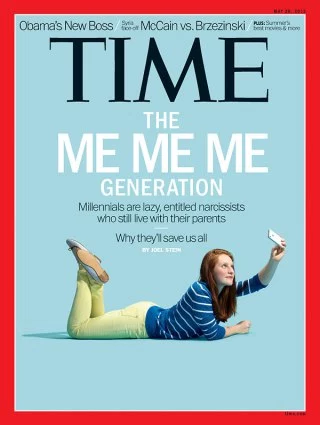
From: “Millennials: The Me Me Me Generation”
Joel Stein, Time, May 20, 2013.

    It is absolutely the case that the words ‘absolutely’ and ‘millennials’ appear rather too often these days, but for now we will only discuss the latter word. While I am not ready this morning to go so far as to look again at any sociological texts, I am willing to be contrarian about cohorts, particularly generational ones such as Gen X and Gen Y (the Millennials). I reluctantly concede that Lost and Beat Generations may have had some sort of ethereal existence, but I am less convinced that there was a “Greatest” one, or that subsuming millions of people born between c1980 and c1995, in many different parts of the world, under the label “Millennial Generation” helps us understand much at all.

  As evidence of overuse, I introduce a few recent article and book titles from the zillions available:

Articles:
“Millennials are the most narcissistic generation ever”
“The Terrible Truth About Hating Millennials That No One Wants To Admit”
“Millennials Are Not Being Rewarded for Job Loyalty”
“U.K. Millennials Are Badly Paid for Staying With Their Jobs”
“Millennials: A Generation in Financial Chaos”
“Why Millennials are better with their money than their parents”
“New Study Shows How Wealthy Millennials Are”
“Millennials, we didn’t eat your lunch, we were in the kitchen making it for you”
“Millennials ruining parents’ retirement”
“Millennials may never get out their parents' homes”
“Millennials will never get to live alone”
Why Millennials Are Lonely
Millennials are killing department stores
How Millennials Are Driving Changes For Retail Stores

Books:
The Millennial Mindset : Unraveling Fact From Fiction
Fast Future : How the Millennial Generation is Shaping Our World
The M-factor : How the Millennial Generation is Rocking the Workplace
Millennials Go to College : Strategies for a New Generation on Campus : Recruiting and Admissions, Campus life, and the Classroom
Millennials Rising : The Next Great Generation
The Millennials on Film and Television : Essays on the Politics of Popular Culture

Condemnation of GenYphobia and the Elimination of Millennials

    That subheading looks rather contradictory so I will be clearer here and say that it is the word ‘Millennials’ that needs to be eliminated not all the people born during that ‘generation’. (Although I guess it would now be possible in the U.S. to, at least,  round up all of them along with the immigrants and deport them).
    My proposal is more modest. In the Canadian House of Commons there has been concern expressed that some Canadians are making some negative generalizations about our fellow Muslim citizens and that such tendencies should be discouraged. To the motion to condemn such “Islamophobia” I suggest that the private member consider adding a Condemnation of GenYphobia along with the recommendation that the plural form of the word ‘Millennial’ be expunged from both official languages.
    In support of my suggestion read “Against Generations” by Rebecca Onions from which this quotation is taken:
But in real life, I find generational arguments infuriating. Overly schematised and ridiculously reductive, generation theory is a simplistic way of thinking about the relationship between individuals, society, and history. It encourages us to focus on vague ‘generational personalities’, rather than looking at the confusing diversity of social life.” (From the digital magazine, Aeon, n.d.).

 Also consider this remark by William Blake:  “To Generalize is to be an Idiot. To Particularize is the Alone Distinction of Merit.” (as cited by Cass Sunstein in “Why Free Markets Make Fools of Us,” in the NYRB, Oct. 22, 2015).