Showing posts with label Chicago. Show all posts

Tuesday, 30 July 2024

Regional Murder Series

    I have offered a number of posts about books published in a series and you will find ones relating to, Roads, Trails, Rivers, Lakes, Highways and even Customs and Folkways.  "Murder" seems like an odd choice as a subject for an entire series, but between 1944 and 1948 Duell, Sloan & Pearce published nine volumes relating to homicides which were committed in cities scattered throughout the United States.
   The books listed below are all works of nonfiction and the over sixty murder cases contained within them were typically written by reporters and journalists. They will be of interest to murder mystery fans and other readers who prefer "true crime." They are listed in alphabetical order by the city in which the murders took place.
   One of the murderers profiled below was a doctor who had a practice in London on Dundas Street and killed a woman there.


1.
Boston Murders
   
  This was the ninth (the last one published.) 
Contents, p. [5] ; Maria met a gentleman: The Bickford case, 1845, by Marjorie Carleton.--Twelve parts of a lady: The Chester S. Jordan case, 1908, by Paul Whelton.--He fought to kill: The Kid Carter case, 1913, by W.G. Schofield.--A man of too much distinction: The Harry Manster case, 1918, by Timothy Fuller.--The haunted man: The Kearney case, 1924, by Lawrence Dame.--The Brown Derby murder: The Corey-Price case, 1925, by J.A. Kelley.--Who killed Fastasia?: The Joseph Fantasia case, 1927, by John N. Makris.--A calandar of Boston murder trials; A Calendar of Boston Murder Trials, p. 209-220; Bibliography, p. 221-223]


2. Charleston Murders


3. Chicago Murders
   
Readers of MM know that I always try to include some CANCON (Canadian content) and this volume has some LONCON (London content). The first story, "The Chicago Career of Dr. Cream" is about Thomas Neill Cream who murdered a woman here in London (click on the link provided at his name.)

4. Cleveland Murders
 
For a brief review of the Cleveland Murders and the Charleston Murders see below.


5. Denver Murders

6. Detroit Murders


7. Los Angeles Murders
   
One of the authors in this book is Erle Stanley Gardner. "The Rattlesnake Murder" can be read about in this gruesome Wikipedia entry: "Rattlesnake James."


8. New York Murders
   
This is the first volume published in the series. 


9. San Francisco Murders
   For a review of San Francisco Murders and Los Angeles Murders see: "Western Mayhem, Plain and Fancy," Russel Crouse, NYT, Aug. 3, 1947.

Many reviews of the books in the series can be found in newspapers and magazines, but academic ones are rare. Here is one for two volumes in the series that is found in: The Journal of Criminal Law and Criminology, Vol. 39, No.2, July/August, 1948.


Other sources:
  See this Wikipedia entry for: "Bloodhound Mysteries." The best source is Carol Fitzgerald's, Series Americana: Post Depression-Era Regional Literature, 1938-1980: A Descriptive Bibliography: Including Biographies of the Authors, Illustrators, and Editors.

All of the books can be found on AbeBooks and Amazon. For those who live in London and have access to the Western Libraries, some may be borrowed. Although the Western Libraries do not have any of them, seven of the nine volumes are available at other Ontario university libraries:
Boston Murders  (McMaster, Queen’s, York)
Cleveland Murders (Queen’s)
Denver Murders  (McMaster, Queen’s)
Detroit Murders  (McMaster, Queen’s, Guelph, York)
Los Angeles Murders (Queen’s)
New York Murders (Queen’s)
San Francisco Murders (Queen’s, York)

Monday, 18 May 2020

Great Lakes Pollution

Downstream News

   Great Lakes - Wikipedia 

   It is raining here on "Victoria Day" and I gather this storm came to us by way of Chicago where "two days of rain overwhelmed Chicago’s underground labyrinth of sewers Friday, forcing a noxious mix of sewage and stormwater into local waterways and Lake Michigan. At 2:30 a.m., the Metropolitan Water Reclamation District opened a sluice gate separating the lake from the North Shore Channel in Wilmette, allowing millions of gallons of human and industrial waste to flow with runoff into the water supply for 7 million people in Chicago and the suburbs." The Chicago River and its sewage used to flow east into Lake Michigan, but it was reversed over a century ago so the sludge would head west and then south. With the overflow, the stuff just flowed everywhere and some will find its way toward us.

   That recent story reminded me of one from earlier this year when it was announced that London is also contributing to the rising lake levels. In January 68 million litres of sewage was sent into the Thames after we had considerable rainfall. While no one will be heading to the beach today, it is worth noting that we get our water from both Lake Huron and Lake Erie.

Bonus Information


   Heading to the beach is problematic these days and not just in the Great Lakes area. Here is a headline from across the Atlantic Ocean: Apparently a "Massive Sea Foam Wave Kills Five Experienced Surfers Who Went Out During a Storm in the Netherlands. It was reported that "five surfers who knew the sea like the back of their hand, died after a huge layer of foam in the water hampered efforts to rescue them. While some sea foam develops naturally, the addition of sewage to the water is reported to not help.

Sources: 
   The Chicago story is found in The Chicago Tribune on May 16, 2020.
   For London see: "January's Record Rain Exposes London's Dirty Sewage Secret," by Megan Stacey in the LFP on Jan.20, 2020.
“It’s the dirty secret of a lot of the cities on the Great Lakes,” said Mark Mattson, head of Waterkeeper, a Canadian charity advocating for clean water....
“A major city like London discharging raw sewage into the Thames River . . . that’s a terrible thing. We live in the freshwater capital of the world. We’re blessed to have it. The idea that we’re polluting it to the degree we do is really unacceptable,” he said.
   For the story from Europe: "Five Surfers Die in the Netherlands After Huge Layer of Sea Foam Hampers Rescue,"By Lianne Kolirin, CNN
The group ran into difficulties at the northern harbor head of the Scheveningen district of The Hague in the Netherlands on Monday evening.
A statement issued online by the rescue service said its efforts were "complicated by the man-sized foam layer at sea and on the beach," while "strong winds and high waves also made it very difficult to provide relief from the harbor pier."
Police, firefighters, the coastguard, units from KNRM and other emergency workers were all involved in the rescue operation, in which a helicopter was used to try to blow away the foam and improve visibility.
   The picture above is from:  The BBC
    Sea foam is a growing global mess: "How Frothy Waves of Sea Foam Coated the Coast of Chennai: Don't Play in the Bubbles." Atlas Obscura, Jessica Leigh Hester, Dec. 5, 2019.

Monday, 1 July 2019

'American Rivers' Day

Canadian Rivers Day

    For most of this century there has been a "Canadian Rivers Day" held on the 2nd Sunday of June. I don't think there is an official "American Rivers Day", but I will inaugurate one here since I intend to discuss a few 'local' rivers, some of which are located in the United States. It was my intention to have 'rivers' be a frequent topic in this blog, but I have failed to deliver, just as I have been unable to offer much about anything over the past few weeks.  Here, quickly, I will attempt to catch up by providing mercifully short entries (for a change).

The Cuyahoga River

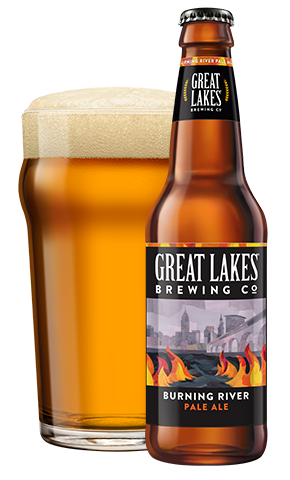
If you look closely at the label above you will see that it is branded as the Burning River Pale Ale which is, it seems to me, an odd choice for the marketing people to make. It was 50 years ago that the Cuyahoga caught fire and for that reason there have been many anniversary articles about the event. 1959 was the year of the last fire on the Cuyahoga so the news is generally good. The marketing people who are attempting to sell Cleveland now have a much easier job.
Sources:
"A Gleaming Cuyahoga River Helps Tourists Flow to Cleveland," Scott Suttell, Cleveland.com June 7, 2019. "Jim Ridge, the founder of Share the River, a nonprofit group that heightens awareness about the Cleveland waterfront, said the Cuyahoga River has achieved something that few could have imagined decades ago. It's a destination. Seeing recreational aspects on the body of water that ignited the environmental movement is a game-changer for locals, but also for folks well beyond our ZIP code who are going, 'Wait, that's not the Cuyahoga River I had in mind,' " he said.

"From 5 Rowers to 1,500, How the Cleveland Rowing Foundation Shares the Cuyahoga River with the City," Laura Johnston, cleveland.com ,June 11, 2019.

"Rough (but clean) Water Ahead: Cuyahoga Falls Embraces Cuyahoga River's Return to Nature," Grant Segall, The Plain Dealer, June 12, 2019.
"Just upstream, high schoolers are sitting along a boardwalk, sketching the scenic river.
Fifty years ago on June 22, Cleveland’s stretch of a gunky, stinky Cuyahoga had its best-known fire, spurring the Clean Water Act and a half-century of cleanup. Now a resurging river and its corridor teem with fish, turtles, herons, paddlers, hikers, diners and more."
"A Cleveland River Once Oozed and Burned. It’s Now a Hot Spot." By Erik Piepenburg June 7, 2019, New York Times.
"Then there's this striking example of how a river that once was so toxic that it bubbled and oozed like a caldron is producing edible marine life: the Ohio E. P. A. announced in March that fish from the Cuyahoga River, including catfish and common carp, are safe to eat."

The Thames River


The riparian situation here in London is rather murkier, both above and below the forks of the Thames. The failure of a dam downriver has reduced the more robust activities of rowing and boating, although the fishing may have improved. The promotion of a waterfront promenade is rather difficult given that it will overlook not much more than a muddy stream because of the dam upriver. In terms of the health of the river it can be said that: "While combined efforts in the watershed have been great over the past two decades, the outcome has shown only small environmental improvement."
Sources:
You locals will not need any. For the quote above see the report card offered by The Upper Thames River Conservation Society,

The Chicago River

 
The recent reviews about the Chicago River are somewhat mixed. Reports from upstream are better, which is usually the case. The river is green in the above picture because it was taken around Saint Patrick's Day when the water is dyed that colour. The good news here is that everyone everywhere agrees that that holiday is one that should be celebrated.
Sources:
"In Chicago, A River Revitalized — But Not for Everyone," Kari Lydersen June 22, 2019, Washington Post.
"The river’s water is cleaner than it has been in decades. New amenities, including four new boat houses, riverside restaurants and the Riverwalk, a pedestrian promenade downtown, line its banks. Revitalizing the river was a major priority of Mayor Rahm Emanuel (D), who left office May 20. The spot in the river where the rowers launch could be seen as the dividing point between the two sides of the Chicago River system. Just upstream is a lush park with a Chinese pagoda, and beyond that, the skyscrapers of downtown. Downstream, the river becomes increasingly industrial and filled with detritus...[it gets worse].

The Buffalo River


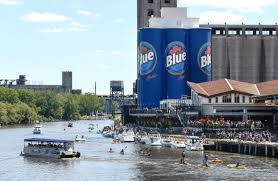
The situation in Buffalo is so good along the rivers that some Canadian beer marketing folks obviously thought old industrial silos were perfect platforms for their brand. The city promoters say that Buffalo should be your "Port of Call" and that Canalside is a good place to kayak and party. They can also say "Sail Into Summer" and "Make a Splash in Buffalo" because there is another river - the Niagara River - and Lake Erie is close by as is the Canal. The water resources so important for trade and industrialization are being revitalized for recreational purposes.
Sources:
See: The Buffalo Touring Guide.

Fishing (!/?)

We were in Buffalo in early May, allured by the arts not the water. It was still a little chilly for waterfront wandering, but I did notice in the Buffalo paper an entire page devoted to fishing and the major headline was: "WNY[Western New York] Fisheries Show Off for National Media" and apart from two pictures of huge fish (a lake trout and a king salmon) there were remarks such as these: "Outdoor media from around the country arrive every spring to take advantage of the world class bass and walleye fishing on Lake Erie. The Niagara River spring trout fishery is outstanding too...." "Being from Michigan, I was a little slow to discover the world class trout and salmon fishery Lake Ontario offers...." "Lake Erie's Eastern Basin is well known as a walleye destination...." Year end and year out, spring offers some of the best multi-species fishing in the Lower 48 in and around the Niagara River." Buffalo News, May 9, 2019.
I was surprised by the extent of the fish coverage and the apparent success of the fisherpeople. I live on a river between Lake Erie and Lake Huron and don't read much about fishing and I don't think one reads much about the subject in the Toronto press. A quick search of Toronto-area papers didn't catch much. A short one for the Cleveland area landed:"If You Aren’t Catching Walleye on Lake Erie, You Aren’t Trying:" June 14 Fishing Report, Cleveland.com May 14 and "Anglers Eager for 2019 Lake Erie Fishing Season: Ohio Anglers, Get Ready for Another Phenomenal Lake Erie Fishing Year." Laura Johnston, Jan. 25, 2019.
   My impression about the fish coverage may be incorrect, but, if not, among the questions that could be asked are these two: Is the fishing better below the invisible border line in the lakes or are the Americans just better at fishing (or marketing)?

Post Script:
   Near the end of the 19th century the flow of the Chicago River was reversed and no longer emptied into Lake Michigan which provides Chicagoans with their drinking water. The sewage is now sent south. 
  Not all the news is good. The Maumee River which empties into Lake Erie at Toledo is a major reason for the algae bloom the develops in that lake. The Cleveland slogan "A Green City on a Blue Lake" may soon need a slight change.
  Bonus tourist tip. If you are going to Buffalo I recommend that you stay in the insane asylum, now known as The Richardson Hotel (formerly The Henry.) From there you can walk to the Albright-Knox Art Gallery and the Burchfield Penney Art Center.