Tuesday, 25 July 2023

Simple Solutions

   I have been busy for a bit and the weather is nice, but it is time to post something. I will again rely on the creativity of others, which you readers will find reassuring since I, myself, so far have demonstrated little of it. Here I will present two solutions to the problem that arises, when people who are more sensitive than I, come across something horrible or frightening when they are reading or watching in the privacy of their home or out walking in the public square. 


Caveat Lector

    I will keep this simple because it is and because I have touched upon it before in, for example, the appropriately titled, "WARNING."  This simple headline summarizes it all: "Only Trigger Warning Needed: Caveat Lector," and it is at the top of an an article in the National Post (June 29, 2023.) The solution occurred to the author, William Watson, who thought of it after watching Casablanca. In it Ilsa refers to the black piano player as the "boy." Since Ilsa (or Ingrid) were likely not racists and since the film otherwise embraces and exhibits values the sensitive will appreciate (anti-fascism, for example), does the movie really need to be banned or severely edited? Mr. Watson, thinks not, and notes that "the harm done by giving offence to some readers or viewers is outweighed by the benefit from the work itself."

  I agree and implied as much when I discussed in "WARNING"  the new propriety pronouncements being produced on Turner Classic Movies.  Mr. Watson suggests that Caveat Lector is better than "Contains Explicit Language" because generally we like language to be clear. I argued that "Viewer Discretion Advised" be placed before all films since now something in them will be offensive to someone. To be safe and to ensure the sensitive are not harmed perhaps all films and books be labeled with all of the warnings: Caveat Emptor, Caveat Lector, Caveat Auditor, Contains Explicit Language and Viewer (Reader) Discretion Advised. And, rather then ban or bowdlerize all older books and films or have librarians affix the above labels, a general public pronouncement, like the one found on beaches, should be widely promulgated indicating that all books or films produced before 2000 are to be approached cautiously: Danger: No Censors On Duty.

                                                     "Retain and Explain"

BEFORE


AFTER
   

   The solution to the problem of what to do with statues in squares or names on buildings which are problematic for those more sensitive than I, is encapsulated in the phrase, "Retain and Explain", which does have a nice ring to it. Rather than eliminate or subtract items and names from the landscape, we should add to them other objects or explanations which provide the historic context, as well as the present one which calls for the change. I will explain that the photos above portray the current view of many who believe that one should "Abolish and Remove." That is the statue of Edward Colston being dumped in the river in Bristol.

  "Retain and Explain" is an English suggestion, but I learned about it in an American article. I will provide the citation here since it helps explain things and because one reader told me they never look at the sources I usually dutifully apply at the bottom: "A Philosopher and a Slaver, But No Longer a Name on a Library: No One Disputes That George Berkeley Was Among Ireland's Greatest Thinkers, But He Was An Unapologetic Slaver. Now Trinity College Dublin Is Taking His Names Off One Of Its Buildings," Ed O'Loughlin, New York Times, May 8, 2023. Although his name is being removed from the library, "students will still encounter Berkeley in the form of a 19th century stained-glass window commemorating his life in the college chapel. The school decided to keep the window in place, but add information about the controversy -- adopting a so-called retain and explain approach." 

   "Retain and Explain" does sound nice, but it is not so simple. An explanatory plaque adjacent to a very large colonizer on a huge horse, would probably not be sufficient and the arguments over the statues would be endless. as would the debates about who should do the arguing. There would be other things to consider, but this day is a nice one and I will leave you to do the considering and will supply the sources to assist, although I know no one will read them. Do have a look at The Bonus, however, since it lists naming problems on the horizon. 

Sources: 
  This quotation -- "We believe that the right approach to statues, however contentious, is to retain and explain their presence" -- is found here: "Listing Controversy II: Staues, Contested Heritage And the Policy of "Retain and Explain", in Law & Place.
"Monumental Error: The Plan to 'Retain and Explain' Statues," Alexander Pelling-Bruce, The Spectator, April 10, 2021.
"The Times View on the Fate of Controversial Statues: Retain and Explain," The Times, Jan. 18, 2021.
"Retain and Explain is a Woke Trap To Rewrite History," Zareer Masani, The Sunday Telegraph, June 20, 2021. Here is his conclusion: 
"What such examples show is the near-impossibility of explaining in short captions what are often complex and contested reputations. Public spaces belong to the public, the vast majority of whom have little appetite for seeing monuments defaced by sanctimonious disclaimers. While most of us would back the policy to retain, must we really suffer it being accompanied by simplistic health warnings similar to those on cigarette packs? By all means let's also explain, but ensure those who do the explaining have the necessary expertise."

The Bonus:
   In the American article that started all of this it is noted that Berkeley came to America and that the University of California, Berkeley is named for him, but that the University is not changing the name. Yet.
  I have produced several posts about names, naming and statues and you likely will have read none of them and I won't bother pointing them out. A related one that you surely did not read was my year-end rant a few years ago. In it, you will note my prescience, in that I predicted that the names of some universities will be problematic for the sensitive ones (remember Ryerson?) Here is that small portion from a post that was too long:

The larger issue relates to the complete university not just the structures on the campus. What if the name applied to the entire university is tainted? I feel that it is my duty to alert you to some possible problems. In short, you would short the following colleges and universities if they were stocks or securities. The alphabetical list by institution includes the name of the person along with the alleged ‘crime’. 

Alcorn State (James L. He was a Confederate. Alcorn is largely black!)
Austin Peay  (Austin Peay. Like Jefferson, fathered a black child.)
Clemson ( Thomas Green. Married Calhoun’s daughter - see Yale above.)
Drake (Francis Marion. Killed a few Pawnees.)
Duke ( James Buchanan. Tobacco.)
Furman (Richard. The slave thing.)
George Mason (George Mason. The slave thing. See my related post - ASSOL)
Hofstra (William S. Lumber business - open to the charge of despoliation.)
Lamar ( Mirabeau Buonaparte. Slave trader AND Cherokee/Comanche killer.)
Marshall (John. His papers are online at the UVA. Find the problem yourself.)
Rice (William Marsh. Guy was a capitalist and died a rather messy death.)
Stanford (Leland Jr. The son of a robber baron.)
Tulane (Paul. Confederate donor.)
Vanderbilt (Cornelius. Rich - “unmannered brute.”)
Yale (Elihu. Corruption charges. Elis may become as rare as Jeffs.)

    Many colleges in the U.S. were founded by religious leaders and those named for such figures may be assumed to be safe from onomastic scrutiny (Wesleyan, for example) or maybe not (Oral Roberts). Otherwise if you are sending your sons or daughters off to college and you want them to have a ‘safe space’ , then perhaps you should consider a plainly-named land-grant university like the University of Iowa where the students are also likely to be less flighty. 

    As far as Canada goes, less work is required if you are trying to choose or avoid a university because of its name. Select one with a geographically-based name like ‘Toronto’, or  ‘Western’ which could exist anywhere and is surely not offensive. You could simply avoid any college that is named for a person unless she is Emily Carr. In the east, for example, I would not choose Dalhousie without thoroughly vetting the Earl. In the far west the choice is easy.  Go to UBC. It is clear that you should avoid Simon Fraser which will likely be attacked in the near future for reasons that are obvious. 

The source for the above, where there is even more, is my cleverly disguised post: "This Is NOT About Mariah Carey."

Monday, 17 July 2023

Footner Down Under


   This will be the third post in a row relating to the author, Hulbert Footner. I quietly introduced him when I told you about “Where I Went on My Spring Vacation." I went to Maryland and part of the reason for doing so was to visit Footner’s granddaughter and the Calvert County Historical Society where a room is dedicated to him. More recently, you learned that he became engaged to the daughter of the Canadian journalist, “Kit" Coleman, whose visage is now found on some Canadian coins.  And you just found out that jousting is the official state sport in Maryland and read Footner’s account of a tournament held in the 1940s in southern Maryland.

    This is likely Footner’s Last Post in this blog, so before leaving him I should explain why he has shown up in MM. Before that is done, you would probably like to be reminded of who he is and for that I will just direct you to the Wikipedia entry. That was the only source about him that I could find. After reading his non-fiction works, I couldn’t understand why more was not known about him. Additional catalysts were the facts that he was born close by in Hamilton and died in Maryland, the state in which I was born, and where they had declared March 14 as “Hulbert Footner Day.”

   Considerable research was done. I have often undertaken massive amounts of research related to a wide variety of subjects, as well as a number of people, and the paucity of finished output is truly astonishing. In this case, I thought the references gathered should not be wasted. The Footner family would find them useful, plus he is worthy of examination as a novelist and historian. They ended up in book form and to prove that this post is not a plug for that publication, I am only including the title here in the concluding sentence of this paragraph and will not note that it can be easily and cheaply purchased in print, or as an e-book from Amazon: Hulbert Footner: Author of Adventure Novels, Detective Novels and Historical Nonfiction: A Bibliographic Account of His Life and Work.

                              Additional Evidence From The Antipodes


   For that book, I searched throughout North America and the United Kingdom for references to Hulbert Footner  and for indications that he was, in fact, a popular author. There was little to be found about him, but there was considerable proof that he was relatively well-known. More data to support that were not needed and to plough through even more references would have been a chore for even the most dedicated Footner fan. But, there are now a few who are interested in Footner who are reading this blog and that is the reason he has shown up. They will be pleased to know that his stories, books and movies were popular with the Aussies and I now know that he was even liked by the Kiwis.

Even if you are not interested in Footner, but are in Australia, then you should visit TROVE, an immense digital treasure. You can search thousands of newspapers and sort the results in a variety of ways. (They have also figured out a way to placate ‘sensitive’ readers who might stumble across a one hundred year old word that is now offensive.) I found Footner information in it a few years ago, but did not include the Australian material in the book. The references to Footner  found in Trove have increased as new publications and years are added.  Apart from the ads for his books there are often reviews of them and apparently the Aussies frequently found them to be ‘rattling good.’ Here, for example, are some sentences from a review of The Fugitive Sleuth which appeared in The World’s News (Sydney) on Saturday, May 3, 1919:
The Fugitive Sleuth is a rattling good detective story, breathless, pauseless, full of life and go. In Hulbert Footner the public has found the adventure story writer par excellence. The instant success of his brilliant romance, The Sealed Valley, will always ensure a wide welcome for a new book by the same masterly hand.”


You can now also do the same for publications in New Zealand in “Papers Past.” They are both free! Footner samples from both are provided below. 


When I searched for “Hulbert Footner” on TROVE a few years ago there were over 500 “hits.” Now there are 887. The results can be restricted in a variety of ways: you can look in particular papers or cities and separate the ads from the articles. Here are some of my notes from the earlier searches: [NB - note that these are from old 'notes'. They should be checked on TROVE and verified.]

"The Shanty Sled is described in similar fashion as “a rattling fine yarn of the frozen north.” Readers in Brisbane are told that Footner “is endowed with a sense of humour and the dramatic ease of a born story teller.” (The Queenslander, Saturday, Nov.14, 1925).


Advertisements and reviews for his films are also found. For example: Even in Tasmania - a review of “Ramshackle House,” The Mercury, (Hobart), Thursday, Dec. 20, 1925. As well in the West (Perth), The Mirror, Saturday, Jan. 9, 1926: “Similes fail in finding a fitting word for Betty Compson, star of The Ramshackle House, the picturisation of the Hulbert Footner novel of the same name now screening at the Palladium.” The earliest mention of Hulbert Footner found was in an ad for The Sealed Valley in 1915 (The Advertiser, (Adelaide), August 28, 1915. The latest is a mention of his name in a review in 1951.”

   I recently did a bit of searching again and here are some examples. One learns that the University of Sydney Library has a copy of De dubbelganger, which is apparently a Dutch version of Two on the Trail. The earliest mention of Footner is now found in 1908 when it is reported that an article of his is appearing in Century Magazine. In 1943, The Northern Advertiser (Western Australia) excerpted a piece from his New York: City of Cities: “One of the World’s Great Avenues” [Park], Feb. 27.


This is the title of an article in The World News Sydney, Sep. 6, 1919 “Have You Read?” Thieves' Wit (Hulbert Footner). "Those who read and enjoyed, as each reader surely did, this author's "Fugitive Sleuth" will welcome this latest story from his pen. It is a new type of detective story, and quite a good one at that. It is fashioned on new and fascinating lines, and it is quite difficult to forecast the end until the author chooses to take the reader into his confidence.” “Backwoods Breezes” The Herald (Melbourne, Vic.) May 23, 1917 “Canadian novels never lack In vigor and freshness of scene. The Fur Bringers, by Hulbert Footner, is conspicuous in that respect. The breezes of the pine forests blow through it, and make up a peculiar attraction for readers who nave tired of the old haunts and devices of the story tellers….Mr Footner has made a study of his subject, he is full of the spirit of the region, knows its moods and intrigues, and has fashioned a romance at once rugged and beautiful.” "The Folded Paper Mystery" , Sunday Times, Perth, Sep.28, 1930 “A good story can always be expected from Hulbert Footner. And "The Folded Paper Mystery" is one of his best productions.” Even Footner's book about his house in Maryland gets reviewed: The Australasian, (Melbourne), July 13, 1940

"Charles Gift " “Many readers will like to think of "CHARLES' GIFT," by HULBERT FOOTNER (Faber and Faber), as a delightful writer's gift to a reading public. The world is so unsteady, the present so uncertain, and the future to many unthinkable. In these days it is often hard to feel relaxed even when reading, but '•Charles* Gift" is a joy to read. Its tempo is one of leisure and of peace; one is lulled by the soothing prose. “

From New Zealand

A search in 2023 for "Hulbert Footner" in the newspapers digitized on Papers Past yields 950 "hits." The first (oldest) is his story "Melodrama in Fulton Street," in the Lyttleton Times, April 4, 1908. Soon after, "The Simple Adventures of 2112," appears in the Dunstan Times, Sept. 6, 1909. Reviews of Footner's works are easily found. For example: There is a short review of "The Nation's Missing Guest" in the New Zealand Herald, May 27, 1939, under the title, "Sultan Disappears", where it is described as "a diverting story." In the same newspaper on Sept. 22, 1934, Dangerous Cargo is reviewed. See: "Two Mystery Novels." "Always to be relied upon for an exciting and entertaining story, Hulbert Footner has thrills a plenty in his latest mystery novel, "Dangerous Cargo," a Crime Club book. Advertisements can be searched separately and many are found for the film, "Ramshackle House (e.g. Evening Post (Wellington), Sept. 14, 1926. Twenty years later Footner's book, Unneutral Murder is advertised by Hyndman's bookstore in the Otago Daily Times, Nov. 21, 1946.

There are many more for Footner aficionados to use and study. Although the global popularity of his writings may not be a proxy for the quality of them, one can still surely argue that Hulbert Footner deserves more attention and I am glad to see that he is getting some from the Calvert County Historical Society.

Tuesday, 11 July 2023

Surely You Joust

   You will likely be surprised to learn that jousting is Maryland's official state sport and has been since the early 1960s. There were jousting tournaments long before and they still exist in the form of "Ring Tournaments." Instead of tilting toward another knight coming from the other direction, one attempts to put the lance through a suspended ring while galloping at a high speed. Valour may have been sacrificed for safety reasons, but fine equestrian skills are still required and chivalrous behaviour expected.
   This form of mediaeval activity still exists in the mid-Atlantic states and farther south and during this time of "culture wars" some may characterize such activities negatively, as most activities are, since something about them will be upsetting to someone. Instead of tilting at ring tournaments I will present here a description of one from the last century when Maryland planters appreciated the "good things of life -- wines, handsome furniture and plate, fine clothes and blooded horses." Pomp and pageantry are displayed and one can simply regard it as a prom in a pasture which people of all ages could dress up for and enjoy.


                                    Ring Tournaments

   This description of a ring tournament held in Maryland in the early 1940s is found in Hulbert Footner's, Maryland Main and the Eastern Shore. It appears in the chapter, "Calvert", which is the county in which he lived and, as the last sentence indicates, loved. One reviewer notes that it is a book "with a quite particular charm" and another that it is "a handsome tribute to one of our most civilized states..." Footner had, a few years before, published the book, Charles' Gift" which was about his Calvert county house, and a couple of years later he finished Rivers of the Eastern Shore: Seventeen Maryland Rivers. They were well received, as well, and a new edition of the latter one has just been released by Schiffer Publishing. Perhaps someone should do the same with Maryland Main...
[caveat lector. If you are the type of reader who gets upset by the racial terminology used in the past, you should skip this part, since the one minor occurrence may be a major one for you.]

"The most picturesque fiestas in Maryland are the tournaments. Formerly held in all parts of the state, they are now pretty well restricted to Southern Maryland, though I hear occasionally of one in Harford and there have been sporadic attempts to revive the custom on the Eastern Shore. When a smart society is in the ascendant, tournaments are quickly abandoned; it is only in the unfashionable parts that they flourish. I have asked many of the old men how they started and the answer is always the same; they didn’t start, they have come down uninterruptedly from medieval times. I am inclined to suspect that this is a myth; nevertheless, the rite is an ancient and gallant one. 
   Each little community holds its tournaments once a year, generally  in the month of August. The proceeds are devoted to the local church.  A flat pasture field is chosen and measured off and three wooden arches erected in line. From the middle of each arch depends an iron rod with a claw in the end which holds an iron ring  of the sort you snatch at from the hobby-horse of a merry-go-round.  Meanwhile every boy has been practising assiduously on his own farm. Nowadays they don’t tilt at each other but at the rings. The boy who spears the most rings on the point of his lance is privileged to crown the Queen of Love and Beauty; the runners-up crown her Maids of Honor. 
  The tournament I saw at Mutual last week differed little from the first one I saw more than thirty years ago. True, the slick automobiles, all so much alike, were a poor substitute for the quaint family chariots, some of which dated from the Civil War. They have all disappeared; they ought to have been preserved in Museums.  The Marshal  and the Herald, fearful of appearing ridiculous, no longer stick the wife's willow plume in their old felt hats, or hang the parlor lambrequin over a shoulder. On the other hand, the riders are beginning to dress up again. They wear striped silk jockey caps and gay scarfs across their breasts; most of them have achieved riding breeches and boots. It is remarkable how many of these plain farmers boys still contrive to keep a good riding horse.
  Mutual is not even a village, but only a scattered community. Their tournament is always the best because they put their hearts in it. The people of Prince Frederick are becoming too worldly wise. How the women of Mutual work to prepare and serve the supper! And what a supper! Country-cured ham, fried chicken, deviled crabs, and fixings. They have adopted the cafeteria style of serving which I deplore, because it deprives you of the opportunity to exchange a bit of persiflage with the charming waitresses, but of course, it is a great saving of labor. Tom Mackall runs the soft-drink stand both afternoon and evening, the hottest and most thankless job of all; Dr. Everard Brisco manages the whole show and is everywhere at once.
The scene on the field is an animated one. The long straight course is roped off and the automobiles are lined up two or three deep. The modern steel body permits those in the rear to sit on top of their cars. On a very small scale, it is like the famous painting of “Derby Day.” Midway a little judges stand has been built with a few dignitaries down in front and a band of five or six pieces behind. Up at the start the horses are held by colored boys while the knights await their turn. Up at this end, the real sports are always to be found kneeling in a row with bills between their fingers watching the track and offering odds in low voices, for fear the parson might overhear. The Marshall and the Herald patrol the course on horseback. Of late years it has been customary to furnish the Herald with two of the prettiest girls as pages, an innovation I endorse.
  To equalize their chances, the contestants  are divided into novices, amateurs, and professionals. There are crowns for novices and amateurs and usually cash prizes for the professionals.  Each knight adopts a pseudonym for the riding, the name of his home place, such as Knight of Preston, Knight of Parrot's Cage; Knight of Tulip Hill; or  a fanciful appellation, as Knight of Nowhere, Knight of Last Night, Knight of Failure. In choosing such names the lads, without knowing it, are upholding a  tradition of their earliest forbears, who were fond of calling their plantations "Dear-Bought," “Happy-be-Lucky,” “Penny Come Quick” and so on. 
The band plays a few bars and the Herald bawls out his first command: “Knight of Rousby Hall, on deck!” Somebody lately pointed out the absurdity of this order, so now he has changed it to: “Knight of Rousby Hall, get ready!” The next order follows shortly: “Knight of Rousby Hall, prepare to charge!” Then: “Charge, Sir Knight!” and he comes thundering down the track. He leans far over his horse’s neck with his eye trained along the lance and the true knight’s expression of derring-do. If he takes the rings the band blares a few more triumphant notes; Marshall, Herald, and pages gallop to meet him and escort him back to the judge’s stand. If he misses, there is silence, and he generally makes a detour back of the spectators to the starting point.
So it goes throughout the long, sunny afternoon. The star riders of other years bring their wives and babies to the field; each year there is a new crop of skinny youngsters to take their places. Each knight takes three tilts at the rings. At the end there are always ties to be ridden off, and this furnishes the most excitement. I have seen it take an hour to settle a tie between two tight-lipped boys. They put up smaller rings and when that fails, rings only a half-inch in diameter. This provides a marvelous exhibition of skill. 
When the riding is over, there is a free-for-all back to the Mutual Hall for supper. It used to be served out-of-doors, but the meal was so often interrupted by a thunderstorm that now the tables are set in the hall. But you can still carry your food outside if you like it that way. Following this delectable meal, after an interval to give the girls time to change their dresses, comes the ball. The tables have been whisked out; the brass band transforms itself into an orchestra. Calvert County is famous for its pretty girls, and each year, I swear, they grow prettier. 
There is a deal of oratory spilled on these occasions. Political aspirants are always to be had; one is invited to address the assembled knights in the afternoon, another (of the opposite party) to open the ball. The speeches bear a strong family resemblance with frequent reference to “our brave knights and fair ladies; the ancient chivalry of Maryland” and so on. It is a pretty sight to see the successful knights and their crowned ladies lined up in front of the platform. The crowns are fillets of wax orange blossoms, becoming to every feminine head. Everybody heaves a sigh of relief when the orator finishes his peroration. The first dance, “the royal set,” is reserved to the knights and ladies.
“Tou’nament Day” provides Calvert County with its grand opportunity of the year to get together. All the sons and daughters who have gone out into the world try to get home for that day. In the afternoon there is continual visiting from car to car; in the evening the older ladies sit around the stifling hall, fanning themselves, and of course, you must speak to them all. It is wonderful for anybody like me, brought up in an unfeeling city, to have a community where I belong.”

[pp.284-287. The above was all typed by me. Anyone using it should check the original.]


Sources: 
Here is the website of the Maryland Jousting Tournament Association
See this good article in Atlas Obscura
It appears as though you can see real jousting at the Maryland Renaissance Festival
Canadian Content:
  Canadians will want to know that LACROSSE is the official team sport of Maryland. 

Wednesday, 5 July 2023

Kathleen "Kit" Coleman


    If you do not know much about this famous Canadian journalist, you soon will. This year the Canadian Mint honoured "Kit" Coleman by producing coins celebrating the 125th anniversary of her "becoming North America's first accredited woman war correspondent." If you know of a young woman who is interested in journalism, "Kit" would be a good role model.
   In the first part of this post, I will present the numismatic announcements along with some of the biographical information provided in them. 
In the second I will offer some information about her daughter and the apparently very brief relationship she had with the author Hulbert Footner. 

The Coins and the Announcements


   The silver coin shows her holding an open notebook and pen. "Within that silhouette are various elements that represent her life and career (from top to bottom): The Mail and Empire building in Toronto, Ont.; SS Circassian, the passenger ship that brought the Irish-born writer to Canada in 1884; a partial map of the Atlantic Ocean, to represent Coleman’s travels and dispatches; a view of Coleman writing at her desk; and a vintage typewriter that symbolizes her legacy and impact on Canadian journalism." 
   The gold one shows her "penning her weekly column. The map in the background traces the trailblazing reporter’s incredible journey—from her birthplace in Ireland to her life and career in Canada, and her travels as North America’s first accredited woman war correspondent."

   
   Early in 2023 one finds this news release about the newly minted coins:
"Royal Canadian Mint Introduces Transitional Effigy on 2023 Proof Silver Dollar Celebrating Pioneering Woman Journalist Kathleen "Kit" Coleman," PR Newswire, Jan. 10, 2023.
OTTAWA, ON, Jan. 10, 2023 /PRNewswire/ - The Royal Canadian Mint has dedicated its 2023 Proof Silver Dollar to celebrating the inspiring life of Canada's first woman journalist, Kathleen "Kit" Coleman. Born in County Galway, Ireland and emigrating to Canada in 1884, Kit Coleman first joined the Toronto Daily Mail as a Women' Editor and later became North America's first accredited woman war correspondent, gaining international fame for her coverage of the aftermath of the Spanish-American War. She also helped establish the Canadian Women's Press Club, and served as its first President. Her fascinating journey is told through the artistry of Pandora Young, who used Kit's silhouette as the canvas upon which the main chapters of her life are richly illustrated on the reverse of the coin.
Pandora Young has fashioned another portrait of the pioneering journalist on the 2023 $100 Pure Gold Coin. The reverse features Kit Coleman writing at her desk. Behind her is a map showing North America and Europe, with dotted lines retracing her epic travels across both continents.

   Soon after, the Canadian Mint offered this information:
"“Fine Silver Proof Dollar– Kathleen “Kit” Coleman: Pioneer Journalist,”
SILVER 2023 MINTAGE 35,000
"Pencil to Paper to Metal: The Journey of Journalism Pioneer Kit Coleman is Honoured on the 2023 Proof Dollar."
"Who was “Kit”? That’s what readers of the Toronto Daily Mail (later The Mail and Empire) were asking, as they pored over the writings of Kathleen Blake Coleman. An intrepid reporter with a lively journalistic voice, “Kit” Coleman rose above the fray in the male-dominated newspaper industry, tackling a wide range of issues as well as the topics typically covered in women’s columns. She made history 125 years ago by becoming North America’s first accredited woman war correspondent. Coleman also helped establish the Canadian Women’s Press Club in 1904 and served as its first president, and later became Canada’s first syndicated woman columnist.
In a time when women journalists were limited to writing about the female perspective and women’s issues, Kathleen Blake Coleman paved the way for better representation in newsrooms and a more equal standing for Canadian women in other aspects of life."

    On January 12, the Mint published a blog post with this title: “Kathleen “Kit” Coleman: How Canada’s Early Presswoman Led the Way for Journalists Today."
The link has been provided and I hope it lasts. You should have a look at it. The picture at the very top was taken from the blog post where much more information  about Coleman is found. As, well there is a link to a video by Dr. Barbara Freeman, the author of Kit's Kingdom: The Journalism of Kathleen Blake Coleman. The link to the video is also available here: https://youtu.be/euH7MiSU2I0. As Dr. Freeman indicates, "Kit" was a fascinating woman and you will enjoy the video.

                                  Hulbert Footner


  It is more likely that you knew about “Kit” than Hulbert Footner. He was born in Hamilton (where “Kit” lived as the wife of Dr. Theobald Coleman), but left at a very young age for the United States. He was a successful writer and is best known for his detective stories 
  He returned briefly to Canada and had some adventures in, and wrote about, the Northwest. That is where I discovered him and after reading New Rivers of the North, I went searching for more information.  There wasn’t much, except for the Wikipedia entry for Hulbert Footner which was constructed mostly by his son, Geoffrey.
  I ended up with a considerable amount of information about Footner and decided to present it in a book.  Unfortunately Footner’s son died before I could give it to him, but I have since met his granddaughter, Karen, and some “Footner Fans.” In Calvert County, Maryland the Historical Society has created a  room dedicated to Hulbert Footner where one can find Footner’s books and assorted memorabilia. I had the pleasure of meeting Karen and some of the “Footner Fans” at the CCHS, which is where the picture above comes from. 
   During my search for information about Footner, I ran across a piece that reported that “Kit” Coleman’s daughter Patsy had become engaged to Hulbert Footner. A later article indicated they were married. The former is probably true, while the latter is surely not. The relationship is not mentioned in Dr. Freeman’s book, or elsewhere. There was no awareness on the Footner side that Hulbert possibly had such a tryst, somewhere and  at some time, in Canada. (He was, by the way, known as "Bill" among friends and it is somewhat easier to believe that a "Bill", rather than a "Hulbert" would have had such a fling.)

  I am pleased that the commemorative coins honouring "Kit" Coleman were produced by the Canadian Mint. At least now the Footner family and his fans will know that I was not exaggerating when I told them that "Kit" was famous in Canada and that Footner had proposed to Patsy, her daughter. 

   Those of you who now wish to know more about Footner should look at the website of the Calvert County Historical Society (or visit the actual site at Linden.) On the website, you will find the "Hulbert Footner Sideshow", from which the picture above was borrowed. Created by Diane Harrison, it is also available via YouTube. 
  
   If you are interested only in the relationship between Patsy Coleman and Bill Footner, all that is known about it is found below. It comes from the book I published and before you rush to purchase it, you should know that this is the only, mildly prurient part within it. Here is the excerpt, from which you will learn about Footner's travels in Canada early in the last century and more about "Kit" and her daughter.

                                              The Coleman “Affair"

   "After exploring the “New Rivers” Footner and his travelling companion, Auville Eager, returned to the Edmonton area. During the fall of 1911 there are a few accounts of their activities found in Canadian papers and in one of them they were seen at a concert in Edmonton. It is likely that Footner was promoting Two On The Trail, which was based on his journey in 1906 and giving talks about  the one just completed in 1911.

That trip "to the Land of the Silences, our great Lone Land to the North -- so much of which is as yet unexploited by railway or tourist….” was the subject of a piece by Kit Coleman, who wrote those words. They are found in “Kit’s Column,” in the section “Woman & Her Interests'' in the Brandon Daily Sun on Saturday, Nov. 18, 1911, p.5. She clearly enjoyed the account of the trip presented by Footner and the “quaintness and humor with which it was told.” It is unclear where Coleman met Footner and heard the story. Her column was widely syndicated and she travelled a lot, but they may have met in Hamilton, where he was born and where she lived. 

   Where Footner may have met Kit’s daughter is also unclear and it is she who is the subject of what I have labelled, “The Coleman Affair.” It is based on an announcement that was made in the following spring, on May 25, 1912: “Dr. and Mrs. Theo. Coleman (Kit) of Hamilton, Ont. announce the engagement of their daughter, Miss Patricia to Hulbert Footner of New York.” Their daughter “Patsy”  is marrying a “clever young fiancé, who is by the way, a successful author and well-known newspaper man…” Over a dozen years later in an article about expatriate authors one learns that “He [Footner] married Miss Coleman, daughter of “Kit,” whom, everyone knows, was one of the first and ablest writers in Canada.”

  Those are the only two references to the relationship between Hulbert Footner and Patsy Coleman that even the most diligent researcher will find.Their engagement was announced, their marriage never was. I think the “affair” likely ended fairly quickly, perhaps after Footner returned to the United States. I think the author who assumed they were married, is incorrect. I have found no mention of Patsy Coleman in any other material about Footner, nor have I encountered any suggestion that Footner became engaged to a Canadian woman, or any other woman, prior to his marriage to Gladys Marsh in 1916.

Kit Coleman was a well-known Canadian journalist. She was “the first syndicated newspaper columnist in Canada,” the first President of the Canadian Women’s Press Club,” “Canada’s first advice-to-the-lovelorn columnist,” and the “world’s first accredited woman war correspondent,” who reported on the Spanish-American War. That information is from Ted Ferguson’s, Kit Coleman: Queen of Hearts, an early biography which has more information about her career than her family and very little about Kathleen “Patsy” Coleman. As one reviewer noted: ”If there is anything disappointing about Kit Coleman, Queen of Hearts, it is only that it contains so little biographical detail about its subject.” The same can be said for Barbara M. Freeman’s, Kit’s Kingdom: The Journalism of Kathleen Blake Coleman and many other more recent accounts that focus on her as a journalist and not a mother.

   About Kit Coleman, a lot is known. Those who wish to learn more and attempt to find information about Footner’s fiancé can start with the Wikipedia entry for Kit Coleman or see Freeman’s profile of, “Ferguson, Catherine, Kit Coleman,” in  the Dictionary of Canadian Biography. See also this work, where a profile of Bob Edwards can also be found: Patrick Watson, ed. “Kit Coleman: Kit of the Mail,” Pt. Nine, p. 191 in The Canadians: Biographies of a Nation, Vol. II. There are many more sources which have been checked. An obituary is found in The Globe and Mail, on May 17, 1915 - “Kit Has Passed Away; Famous Woman Writer: Notable Pioneer in Journalism, Ill Only Two Days.”

   About Kathleen “Patsy Coleman” not much is known. Kit indicated, in one of her columns, that Patsy was born on Oct. 4,1887 and she was often referred to in the articles written by Kit and sometimes travelled with her. A picture of her as a young child is found in the Freeman biography where it is mentioned that she attended Quaker College in Pickering, Ontario. There is little information about her as a young woman and Freeman notes that “Patsy” was, as an adult, quite reticent about the family's private life, even with her own children.” The engagement to Footner is not discussed in any of the sources consulted and the obituary for Kit in 1915 indicates that Patsy was married and now Mrs. John Gartshore."

The section above is found on pp.36-38 of the print edition of: Hulbert Footner: Author of Adventure Novels, Detective Novels and Historical Nonfiction: A Bibliographic Account of His Life and Work. 

Sunday, 2 July 2023

The Culling of Things

   A couple of years ago, I called to your attention the fact that at the beginning of World War II, hundreds of thousands of household pets were euthanized in Britain (see in MM, "Brits and Their Pets", or, The Great Cat and Dog Massacre: The Real Story of World War Two's Unknown Tragedy, by Hilda Kean.) The reasons for such pet destruction varied, but you can be assured it was done more out of concern rather than cruelty. No one wants to see their pet cat bombed or their dog wandering about in the rubble of London, to be killed by the invading Huns. 

  Perhaps it was because I was aware of this episode, that I noticed an article about an earlier mass culling in Britain. Thousands of dogs and cats were ordered "to be immediately killed" by the Common Council of the City of London during the Great Plague of 1665 (there was no such order during the WW II episode. It was done voluntarily and often opposed by officials.) For more details see this article, where other historical culls are also mentioned: "The War on Dogs: The Dog Cull of 1760 Divided London: Were Dogs Man's Best Friend, Or Plague-RIdden Pests?" Stephanie Howard-Smith, History Today, June 6, 2023. 
   The article also points out something of which I was not aware, that during our own plague, "the UK government considered "that we might have to ask the public to exterminate all the cats in Britain." Apparently I just missed this news during covid, since it was easy to substantiate: "The U.K. Briefly Considered Killing All Pet Cats Early in the Pandemic," Armani Syed, Time, March 2, 2023.
   I do recall that there were cullings of animals that were not pets. Millions of minks in Denmark and thousands of hamsters in Hong Kong were disposed of out of fear that a virus mutation might spread to humans.
   My knowledge of zoonotic diseases is close to nil, but I am aware that diseases can be spread between species (in both directions) and that such episodes are being studied. 
   Culling is also worth our consideration. Current instances of it are easy to find. Buffalo are being culled in Yellowstone, deer in Tasmania and millions of chickens in France because of fear of avian influenza or for industrial farming reasons. There are too many deer in a graveyard near my house and there are far too many non-migratory geese leaving evidence of their existence throughout London. Culling is an option and the proceeds could benefit the homeless. (This recent headline is from Cleveland: "A Dozen Cuyahoga County Cities Now Use Sharpshooters to Reduce Their Deer Numbers.")
  The culling of deer in London, even if recommended and done by the Indigenous, would be difficult to implement politically. Generally attitudes toward animals are more humane, one would think, and some argue they even have rights. Peter Singer has just updated his book on "Animal Liberation" and the culling of things, even during a plague, may no longer be an easy remedy, especially if your pet is involved.

Canadian Content: 
   
A culling of stray dogs in St. John's in 1815 is reported. See, "The Newfoundland Dog." 

Pedagogical Notes


Cursive Returns To The Classroom

   Some of the knowledge imparted in Ontario schools is being questioned by some parents, but perhaps the re-introduction of handwriting will be accepted, unless, of course, it is promoted as "penmanship." The announcement in the news was made last month and portions of it are provided below where one will find some of the arguments made in support of the idea that the ability to write by hand is a useful skill for students to acquire.

   One assumes that one of the collateral benefits of learning handwriting is that one will be able to read it. Even if you are one of the ones who think that such a skill is no longer needed or relevant, you might agree that being able to read what has been written could be useful. I hadn't thought of that until I read this piece a while back:
"
Gen Z Never Learned to Read Cursive: How Will They Interpret the Past," by Drew Gilpin Faust in The Atlantic: 
  "It was a good book, the student told the 14 others in the undergraduate seminar I was teaching, and it included a number of excellent illustrations, such as photographs of relevant Civil War manuscripts. But, he continued, those weren’t very helpful to him, because of course he couldn’t read cursive.
Had I heard him correctly? Who else can’t read cursive? I asked the class. The answer: about two-thirds. And who can’t write it? Even more. What did they do about signatures? They had invented them by combining vestiges of whatever cursive instruction they may have had with creative squiggles and flourishes. Amused by my astonishment, the students offered reflections about the place—or absence—of handwriting in their lives. Instead of the Civil War past, we found ourselves exploring a different set of historical changes. In my ignorance, I became their pupil as well as a kind of historical artifact, a Rip van Winkle confronting a transformed world."
The 'signature' aspect is an interesting one. If, like me, you do little writing, then your signature may look as messy as mine. Under the best of conditions in calm circumstances the signature I produce doesn't look much different than the scrawl I leave by finger on the device of the deliveryman.

Falling Test Scores - Rising Grades?

   Given that I used the plural "Notes" I will offer another one about education. It is based on data from south-of-the-border, data that were found in a column written by someone we would call a "Tory", so you may want to skip to the cursive announcement below. Although it seems that most people agree that children lost a lot during the plague, one hopes the loss up here was not so profound and that such a loss would not be hidden under grades that had gone up. Here they are:

“California now leads the country in illiteracy. In fact, 23.1 percent of Californians over age 15 cannot read this sentence.”

"In math, 73% of 11th-graders earned A’s, B’s, and C’s. Tests scores showed only 19% met grade-level standards.
For eighth-graders, 79% earned A’s, B’s and C’s in math. Test scores showed 23% met grade-level standards.
In English, 85% of sixth-graders earned A’s, B’s and C’s, while 40% met grade-level standards.
For seventh-graders, 82% earned A’s, B’s and C’s in English. Test scores showed 43% met standards."

The Cursive Announcement:

Relegated in 2006 to an optional piece of learning in Ontario elementary schools, cursive writing is set to return as a mandatory part of the curriculum starting in September.
Education Minister Stephen Lecce said it is about more than just teaching students how to sign their own name.
“The research has been very clear that cursive writing is a critical life skill in helping young people to express more substantively, to think more critically, and ultimately, to express more authentically,” he said in an interview.
“That’s what we’re trying to do, to create a very talented generation of young people who have mastered the fundamental skills, like reading, writing, and math, that are the foundations of any successful productive life in the country....”
The curriculum reintroduces cursive writing as an expectation starting in Grade 3. That’s welcome news for language education experts.
“I think it is long overdue,” said Shelley Stagg Peterson, a curriculum, teaching and learning professor at the University of Toronto’s Ontario Institute for Studies in Education.
“Cursive should never have been taken out of the curriculum.”
There isn’t a lot of research specifically on cursive writing, Peterson said, but the work that has been done shows that it not only teaches students the skill of writing that script in and of itself, but it helps to reinforce overall literacy...."

[There is more.]

Sources:
  If you now feel the need to go shopping for a writing instrument, "Fahrney's Pens" is the place to visit, or a shop to which your email orders can be sent. You should know that some of the pens cost more than a laptop. "An Old Pen Shop Proves Mightier Than the Pandemic and the Death of Cursive," Tara Bahrampour, The Washington Post, March 14, 2023. 
  The troublesome data are found here and I doubt they are dubious, but the ideological bias of the columnist has been noted: "Why K-12 Education's Alarming Decline Could be a Dominant 2024 Issue," George F. Will, The Washington Post, June 28, 2023. 
  Although it is reckless to confound U.S. and Canadian educational issues, here is an education-related headline about Maryland that could soon be found in a newspaper in Ontario: "Hundreds of Md. Parents Protest Lessons They Say Offend Their Faiths: A Crowd of Mostly Muslim and Ethiopian Orthodox Parents, Wants the State's Largest School System to Exempt Their Kids From LGBTQ Content," Nicole Asbury and Katie Shepherd," The Washington Post, June 27, 2023. 
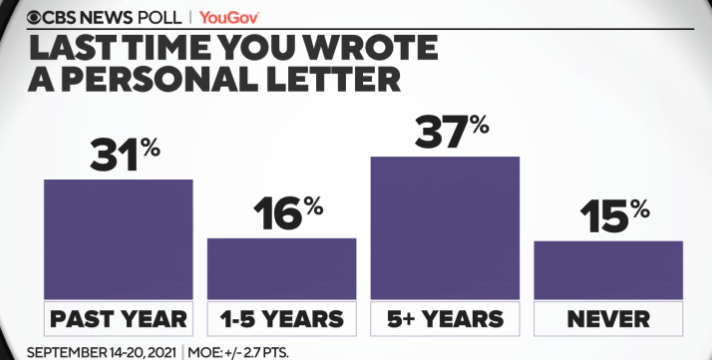
    The image below is from: "Most Americans Haven't Written a Personal Letter on Paper in Over Five Years," Fred Backus, CBS News, Oct. 11, 2o21. 


Post Script:
   When was the last time you wrote a letter by hand? Or when was the last time you wrote a thank you note, or even typed one? I was so shocked when I received a hand written thank you note a few years ago, I posted about it: "Gratitude: Say It In Writing." 

The Bonus: A Mild Defence of Teachers
 Omitted from the portion of the "Cursive Announcement" provided above are some remarks from teachers, who indicated concerns. For example:
"The four major teachers’ unions have slammed the timing of the new language curriculum, being made available for teachers to learn for September with less than two weeks before this school year ends.
The Elementary Teachers’ Federation of Ontario has said the changes are vast and is calling for a minimum two-year implementation period."
Needless to say, these comments elicited many responses, most of which could be subsumed under the category of "ridicule." "How much time do you need to learn to teach writing?" or "Use your PD Days to bone up," etc. are typical of the types of reactions (I made those up, but you can find real ones yourself.)
The defence: perhaps cursive is not that simple. See the Wikipedia entry. Here are a few sentences from it: 
"After the 1960s, a movement originally begun by Paul Standard in the 1930s to replace looped cursive with cursive italic penmanship resurfaced. It was motivated by the claim that cursive instruction was more difficult than it needed to be: that conventional (looped) cursive was unnecessary, and it was easier to write in cursive italic. Because of this, various new forms of cursive italic appeared, including Getty-Dubay Italic, and Barchowsky Fluent Handwriting. In the 21st century, some of the surviving cursive writing styles are Spencerian, Palmer Method, D'Nealian, and Zaner-Bloser script."

Saturday, 1 July 2023

Periodical Ramblings (13)

 National Geographic


  A "Happy July 1st" and a "Happy July 4th" to all of you. We should celebrate such occasions while we can since they soon may be cancelled and we soon may be gone. 
   It would be fitting if my first post in July was a celebratory one, but being contrarian I will instead chronicle another extinction, or near extinction. Although the National Geographic may be around for a bit longer, it is like Martha, the last passenger pigeon, likely to be soon extinct. 
   The last sightings are found in three recent articles which will be excerpted below since the passing of the National Geographic is worth noting. You will not be surprised that corporations played a role in this extinction and that the cast of characters includes Walt Disney and Rupert Murdoch. 

1. "National Geographic Lays Off Its Last Remaining Staff WritersThe magazine, which remains among the most read in the U.S., has struggled in the digital era to command the kind of resources that fueled the deep reporting it became known for," Paul Farhi, Washington Post, June 28, 2023.
"Like one of the endangered species whose impending extinction it has chronicled, National Geographic magazine has been on a relentlessly downward path, struggling for vibrancy in an increasingly unforgiving ecosystem.
On Wednesday, the Washington-based magazine that has surveyed science and the natural world for 135 years reached another difficult passage when it laid off all of its last remaining staff writers.
The cutback — the latest in a series under owner Walt Disney Co. — involves some 19 editorial staffers in all, who were notified in April that these terminations were coming. Article assignments will henceforth be contracted out to freelancers or pieced together by editors. The cuts also eliminated the magazine’s small audio department.
The layoffs were the second over the past nine months, and the fourth since a series of ownership changes began in 2015. In September, Disney removed six top editors in an extraordinary reorganization of the magazine’s editorial operations.
Departing staffers said Wednesday the magazine has curtailed photo contracts that enabled photographers to spend months in the field producing the publication’s iconic images.
In a further cost-cutting move, copies of the famous bright-yellow-bordered print publication will no longer be sold on newsstands in the United States starting next year, the company said in an internal announcement last month....
The magazine’s current trajectory has been years in the making, set in motion primarily by the epochal decline of print and ascent of digital news and information. In the light-speed world of digital media, National Geographic has remained an almost artisanal product — a monthly magazine whose photos, graphics and articles were sometimes the result of months of research and reporting.
At its peak in the late 1980s, National Geographic reached 12 million subscribers in the United States, and millions more overseas. Many of its devotees so savored its illumination of other worlds — space, the depths of the ocean, little-seen parts of the planet — that they stacked old issues into piles that cluttered attics and basements.
It remains among the most widely read magazines in America, at a time when magazines are no longer widely read. At the end of 2022, it had just under 1.8 million subscribers, according to the authoritative Alliance for Audited Media.
National Geographic was launched by Washington’s National Geographic Society, a foundation formed by 33 academics, scientists and would-be adventurers, including Alexander Graham Bell. The magazine was initially sold to the public as a perk for joining the society. It grew into a stand-alone publication slowly but steadily, reaching 1 million subscribers by the 1930s....
The magazine’s place of honor continued to dim through a series of corporate reshufflings that began in 2015 when the Society agreed to form a for-profit partnership with 21st Century Fox, which took majority control in exchange for $725 million. The partnership came under the Disney banner in 2019 as part of a massive $71 billion deal between Fox and Disney."

  Those of you who thought that the "television versions" were sometimes inferior to the print ones are correct:
"The magazine was eventually surpassed for profits and attention by the society’s video operations, including its flagship National Geographic cable channel and Nat Geo Wild, a channel focused on animals. While they produced documentaries equal in quality to the magazine’s rigorous reporting, the channels — managed by Rupert Murdoch’s 21st Century Fox — also aired pseudoscientific entertainment programming about UFOs and reality series like “Sharks vs. Tunas” at odds with the society’s original high-minded vision."
I do confess that both my wife and I enjoyed, "Restaurants at the End of the World," which were found in very remote areas. The program aired on the National Geographic channel. 
Comments:
  Many Post readers commented about the article. Here are a few samples:

The National Geographic went from a board of directors comprised of World renowned Scientists, Explorers, Educators, Photographers and Adventurers to a Corporate Board beholden only to the raw banality of bottom line Capitalism.

Thank you for this post. I will be cancelling my Nat Geo subscription. The writing has been declining (probably because they don’t have enough staff writers). Disney’s desire to create a low quality product as a profit engine is one I will not support with my money. I stand in solidarity with the writers. Disney won’t get another penny out of me.

When Rupert Murdoch bought it, I cancelled my subscription.

2. "National Geographic Lays Off More Writers: The company did not specify how many were shed and said that the magazine, known for its focus on discovery and exploration, would continue to be published on a monthly basis," Jesus Jimenez, New York Times, June 29, 2023.
"National Geographic, the science and nature magazine that for more than a century has sent its writers and photographers to explore and document some of the most remote corners of the Earth, shed more writers and other staff members this week in a round of layoffs that had been announced in April...."
The magazine is still well-read at a time when other magazines have lost subscribers or folded their print publications entirely. Through the end of last year, the magazine had more than 1.7 million subscribers, according to the Alliance for Audited Media, which audits publications."

3. "The Virtual End of National Geographic Magazine”, Jim Geraghty, National Review, June 29, 2023.
"On the menu today: This is going to sound like an extended version of an appeal to support our webathon, but the news that the illustrious magazine National Geographic has laid off all of its last remaining staff writers is a demonstration that we, as a society, have largely chosen to stop paying for news or entertainment, with far-reaching consequences for our lives. The belief that we’re entitled to high-quality information in almost every form — and will accept lower-quality stuff if it is free — is one big reason that the current state of American discourse looks and sounds like a WWE match among insane-asylum inmates held in a sewer.
What Happens When We Stop Paying for Quality?....
The rest of the article is worth reading and paying for. 


  Unlike passenger pigeons, old issues of the National Geographic can still be found. The October 1912 issue pictured above can be purchased at Attic Books here in London, Ontario for $25.00


 For now, at least, old issues can also be found for free in libraries. Western University has, for now, at least, many print volumes in storage and some on microfilm. 

Periodical Ramblings
  You have now been provided with a "Baker's Dozen" of posts about old magazines. The first is "Periodical Ramblings (The Series) and in it I mentioned that my sister had magazines stacked everywhere and many of them were National Geographics. As a subscriber her husband appreciated that that made him  a member of the National Geographic Society. The twelfth "Periodical Rambling" was about the Saturday Evening Post, which, you may be surprised to know, still exists. The one before that was about Look, which does not.