Showing posts with label eagles. Show all posts

Saturday, 11 November 2023

BIRD ILLUSTRATORS


LOUIS AGASSIZ FUERTES

   I used to work in the Western Libraries back when there were more of them and the collections they held were impressive. As I have indicated in several posts, the area devoted to books and other resources has shrunk, while space for the students has grown. Many books are in storage, where they cannot be browsed and I think that is unfortunate. 
   It is the case, however, that the argument for keeping books and other scholarly resources has been lost. And, admittedly, the losing of that argument is not as unfortunate as one might think - unless you prefer printed books and journals.
   The material in storage is easily retrieved for you, if you know it is there. As well, much of it can be accessed electronically and from afar and at anytime. About the only rationale one can offer for keeping all those old books and journals around is an aesthetic one which does not hold much appeal for many. 
    That gets me to Fuertes, who produced books about birds and provided the illustrations for many others. Seeing such books and works like, The Double Elephant Folio: The Story of Audubon's Birds of America, is more appealing to me than viewing them electronically (that book is in storage.)
   A couple of years ago, I did a post about "Bird Art" and in it wrote about the works of John Gould and provided a list of his beautifully illustrated books that were held by the Western Libraries, but were in storage. There also are books by Fuertes in storage and I will provide just a couple of examples. If you want to see some of his images from afar you can visit the L.A. Fuertes Image Database at Cornell in Ithaca, where Fuertes was born. You will find 2500 and they are searchable by type (e.g. drawings, water colour, gouaches). You might argue that providing space for such things is no longer necessary, but I still disagree.
 

 Here are a few Fuerte's works in storage at the Western Libraries. He has been described as "the nation's most notable ornithological painter since Audubon."
A Natural History of American Birds of Eastern and Central America;
Birds of Massachusetts and Other New England States;
The Bird Life of Texas;
To a Young Bird Artist: Selected Letters From Louis Agassiz Fuertes to George Miksch Sutton.

The Bonus:
   I am pleased that, at least for now, there are other bird-related items to be found in storage. If you want to listen to them for example, here are a few recordings:
Voices of African Birds; Songs and Calls of 42 Species Found in Kenya, Uganda, Sudan, Tanganyika, Rhodesia, South Africa, the Congo, and Nigeria;
Mexican Bird Songs; The Voices of 74 of the Most Representative Birds of Mexico
   One can also hear the sounds made by other species:
The Songs of Insects; Calls of the Common Crickets, Grasshoppers, and Cicadas of the eastern United States;
Voices of the Night; The Calls of 34 Frogs and Toads of the United States and Canada.
   Apart from sound recordings there  are even some games to be found in storage. For example, Professor Noggin's Birds of North America Card Game is located there.


   It is likely that many of these items will ultimately end up in storage facility near Toronto for a variety of reasons, some of which are noted above. If items can be retrieved from storage, it doesn't matter much where the facility is located. 
   There is now another reason for withdrawing the books relating to birds, in that those books contain bird names which are no longer acceptable and were written by authors such as Audubon who have been 'cancelled'. This is yet another argument with which I do not agree and I would hope the dwindling collections in the Western Libraries are not further 'weeded' because they contain ideas and names now deemed unacceptable.

Post Script:
   Most of the books related to ornithology were held in the "sciences" library, which is now known as the "Allyn & Betty Taylor Library" (there also was once a separate "Engineering Library." and another one for Medicine.) There continues to be a reason for collecting ornithological research in that the campus now contains the Advanced Facility for Avian Research (see my post, "For The Birds." )
    Professor Noggin's card game would have been collected for aspiring teachers and housed in the Education Library, which also no longer exists and is now the "Wampum Learning Lodge." There is a sizeable collection of children's books in storage, many of them collected for fledgling librarians and held in the library of the Graduate School of Library Science, which also no longer exists (see my earlier posts, "Landmark Books" and "100 Years of Newbery Medals.")
   Perhaps at some point in the future someone writing a history of UWO and Western might be interested in knowing about the richness of the collections held in libraries that have since disappeared. 
    As for the "NAMES" problem, I touched upon it in a post, the title of which hints at my position on the subject - "No More Name Changing". The American Ornithological  Society does not agree. See the "English Bird Names Project" where you will learn that, among other things, "The AOS commits to changing all English-language names of birds within its geographic jurisdiction that are named directly after people (eponyms), along with other names deemed offensive and exclusionary, focusing first on those species that occur primarily within the U.S. or Canada."
   If you are just interested in birds, go back to Cornell and enjoy "All About Birds."
   If you are interested in eagles, such as the one above painted by Fuertes, see:
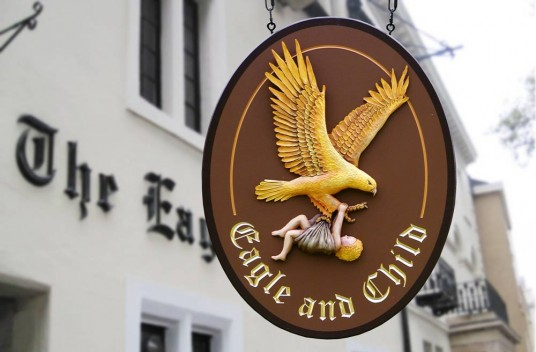
"Eagle Attacks Child", and "Eagle Update" or read about the Canadian "Eagle Man", Charles Broley. As well, the eagle and some insects are discussed more recently in, "Birds and Bugs.

The Bonus:
  Someone, who perhaps knew my position regarding the re-naming of everything, sent me this 'bird-day card', which, I admit, weakens it a bit.

Saturday, 12 March 2022

Birds and Bugs

First, The Bird

 Two new books have been published and they relate to subjects covered in Mulcahy’s Miscellany. Considering the posts and the books together may be useful for both the readers of the books and of this blog. 


The Bald Eagle
   This book just came out and I have not read it. I have read two reviews of it, however, and both indicate that Davis deals with a question which is typically put this way: Could eagles snatch children and carry them away? That question is the first issue raised in the review found in The Atlantic, March 2022.  The author of the book does not think it possible.

"Jack E. Davis wants it very clearly understood that a bald eagle cannot, in fact, pluck an infant girl from her carriage, carry her clenched between its talons to its nest, and feed her to its eaglets. Okay?
If Davis’s plea seems especially plaintive, that’s because it contradicts centuries of personal testimony and expert accounts. Alexander Wilson, in his foundational American Ornithology (1808–14), described a bald eagle dragging a baby along the ground and flying off with a fragment of her frock. The naturalist Thomas Nuttall wrote in 1832 of “credibly related” accounts of balds abducting infants, and the 1844 edition of McGuffey’s Reader, a primer in most American grade schools, told the story of an eagle that deposited a girl in its aerie on top of a rock ledge, amid the blood-spattered bones of previous victims. As recently as 1930, an ornithologist with the Geological Survey refused to rule out baby snatchings in congressional testimony. Davis’s defense rests on the finding that a bald eagle’s maximum cargo capacity is five pounds. Although he acknowledges that eagles do fly off with chickens, the five-pound limit puts most newborns out of range. Still, in fairness to Wilson, Nuttall, and McGuffey, it should be noted that the average female birth weight in the 19th century was barely over six pounds."

   Dr. Davis has both a Pulitzer and a Ph.D and hardly needs my assistance. I am sure he is a very good and diligent researcher, but I doubt if his references include Mulcahy's Miscellany.  That is not his fault, but if google had located my post relating to the subject, it could have saved him a lot of time. Apart from my blog being un-promoted and unknown, there is the fact that searching for the two words with such ubiquity - 'eagles' and 'children' - yields results numbering in the many millions. The eagle is both a bird and a symbol and there are thousands of teams, streets and products containing the word. It is likely that the 'eagle' in Mulcahy's Miscellany was overlooked.

    "Eagle Attacks Child" is the post that examines the question raised above. Apart from the basic post, there is appended to it, an over 50 page pdf which includes annotated accounts of over 100 reports covering the period from 1825 to 1990. Appended to those reports are three appendices: Appendix 1: Eagle Sizes;  Appendix 2: Eagle Lifting Capacities (including a sub-section on "Owl Lifting Capacities;" and  Appendix 3: Other Victims of Eagle Attacks (which includes such victims as deer, dogs and even a kangaroo.)
I conclude that it is unlikely that children were carried away, but that it is highly likely some were attacked.  The link to the post is provided above and at the bottom of it you will find a link to Avian Abductions. 

   My interest in eagles has passed, but I am interested in how my references compare to his. If you read the book, please let me know. 

Sources: 
   In addition to the review in The Atlantic, here is one from the Wall Street Journal, Feb. 19, 2022, with the portion relating to 'eagle snatching', and to the Montreal incident which was what led me to do the research about the subject:

"One of the enduring myths around the bald eagle is the notion that it routinely snatches defenseless animals -- and not only lambs, pigs or calves. From time immemorial there have been stories about eagles carrying off human babies. An early silent movie, "Rescued From an Eagle's Nest" (1908), feeds this ancient fear, depicting a bald eagle, flapping its wire-controlled wings, as it steals an infant and hoists it into the sky. The heroic father in the film (played by D.W. Griffith, who would go on to fame as director of the racist epic "Birth of a Nation") eventually bludgeons the prop eagle to death, throwing it off a cliff before joyfully reuniting with his child.
More than 100 years later, a 2012 video created by animation students in Canada showed much the same scene. That video was quickly exposed as a hoax, but not before it garnered two million hits on YouTube in its first 24 hours. Mr. Davis is unable to find any variation on this myth that stands up to examination. The problem is that the real bird maxes out at about 14 pounds (for a very large female, which, on average, is 20% larger than a male) and can't lift more than half its weight. An eagle's bread and butter is fish, although there are stories of eagles carrying off small cats." [article author, Bill Heavey.]

The Bonus:
   In 2020 I did an Eagle Update which involved an account in Chatham, Ontario where it had been reported that an eagle lifted a teenage boy from a golf course. Have a look and then also read about Canada's very own Eagle Man - Charles Broley. 

Now, the Bugs


   Having just answered the eagle question we will now turn to a question relating to insects: "When Did You Last Clean Bug Splatter Off Your Windshield?" That is the title of a review of a new book which answers it: The Insect Crisis: The Fall of the Tiny Empires That Run the World, by Oliver Milman (the review by Thor Hanson is found in the NYT, March 5, 2022.)
   Mulcahy's Miscellany has already dealt with this subject so I will say little more about it.  For another book and more references relating to the "insectageddon" see in MM: Insect Elegy, 2017 and Insect Apocalypse, 2018. For newcomers to this issue, I will provide some information about this new book.

"Anyone with a car has gathered data on insect declines. Entomologists call it “the windshield effect,” a relatable metric neatly summed up by a question: When was the last time you had to clean bug splatter from your windshield? This ritual was once an inevitable coda to any long drive. Now, we’re far more likely to watch those same landscapes pass by through unblemished glass, mile after empty mile....
Those concerns lie at the heart of the environmental journalist Oliver Milman’s gripping, sobering and important new book. He, too, delves beyond the headlines, refreshingly willing to embrace the complexity of the issue....
Blame for the crisis falls on broad biodiversity threats like habitat loss and climate change, as well as insect-specific challenges from light pollution and the rampant use of pesticides. But Milman draws particular attention to the way industrial agriculture has transformed once-varied rural landscapes into vast monocultures. Devoid of hedgerows or even many weeds, modern single-crop farms simply lack the diverse plant life necessary to support an insect community."

The Bonus:
   While revisiting this subject, I learned that there is yet another book about the loss of insects. It is: Silent Earth: Averting the Insect Apocalypse, Dave Goulson. 


A terrific book…A thoughtful explanation of how the dramatic decline of insect species and numbers poses a dire threat to all life on earth.” (Booklist, Starred Review)
In the tradition of Rachel Carson’s groundbreaking environmental classic Silent Spring, an award-winning entomologist and conservationist explains the importance of insects to our survival, and offers a clarion call to avoid a looming ecological disaster of our own making.

More self-promotion. See my related post about crickets and London - Entomophagy. 

Post Script:
   I am sure that if you attempt a search for information about 'neonicotinoids', you will first get 'hits' about 'neocolonialism.' Perhaps we should shift some of our concern to the future rather than the past. 

Saturday, 21 March 2020

Eagle Update


From: The Chatham Daily News, Aug. 7, 1934.

   On Dec. 19, 2018 I did a post recounting an incident in which a child was attacked by an eagle - see: "Eagle Attacks Child." Attached to the post were about 100 examples of news reports about alleged eagle attacks involving children, ranging from around 1825 to 1990. (Those of you who are wondering why such a bizarre subject received such intense scrutiny will have to examine the post.)
   One of the most sensational (and unbelievable) accounts is a Canadian one from Chatham, Ontario which occurred in 1924. Supposedly, 14-year-old 97 pound Fred Cunningham was lifted by an eagle from a golf course, but was quickly dropped. The story was widely reported and can be found in both The New York Times and The Manchester Guardian. 
   I recently discovered a source where one will find digitized copies of Ontario newspapers, including some from the Chatham area. A search of these papers yielded the example above. Although I did not find any accounts from the year in which the event allegedly occurred, I did find the example from 1934 which seems to verify that there was an eagle attack, but not the fact that a large boy was lifted into the air. (Those of you who are wondering how much an eagle can actually lift can find out by looking at Appendix 2: "Eagle Lifting Capacities" in my original post.)

Sources: 
  In the eagle post referred to above, the Chatham incident from 1924 is found on p. 35. Appendix 2 is on p.44.
  The archive of digitized Ontario newspapers is provided by the Leddy Library at the University of Windsor. For a list of the newspaper titles and the years that have been digitized see the INK-ODW Newspaper Collection. 


Wednesday, 19 December 2018

"Eagle Attacks Child"


Six years ago that was typical of the many headlines that appeared in newspapers throughout the world. A child was attacked by an eagle in a Montreal park and video proof was offered. The proof was soon found to be false and there was one less thing to worry about.
Given that many parents these days are highly attuned to the many, many dangers children face, they may have worried a little less about the eagle threat, but were probably kept awake wondering if such an event could happen.
I wasn't worried, but I did wonder. The event in this case was clearly fabricated, but I did recall reading about such attacks. I went looking for accounts of eagle attacks and found many of them over a period of 150+ years.
Recently the great eagle event of 2012 was referred to and I was reminded of all the hard work I did on behalf of worried parents everywhere. I was moved to assemble it all here and will attempt to embed the 50 page pdf in this post. If I fail, email me and I will send it to you.
Here are some samples to entice you. Although many of the reports I provide are from the United States, I can let my loyal Canadian readers know that I did find some that were close to Montreal. In 1881 a child was attacked near Gananoque and received minor injuries. The next year, a child was more seriously injured near Belleville. Things did not work out so well for the child in this account from 1895 and you can learn more of the gruesome details in the attached (I hope) report:
     “A few mornings since the wife of Jean Baptiste Romilly, a farmer in St. Vincent de Paul, a village about ten miles from Montreal, was feeding her fowls, while her child, aged about two years, was playing around, when suddenly a large bald-headed eagle swooped down and bore the little one off in its talons. The child screamed and extended its arms to its mother, who was beside herself with mental agony, but was powerless to render assistance...."   I can see that these snippets do nothing to ease the anxiety of anxious parents. I can assure you, however, that all the news is not bad and that the entire report will make you feel better.
For details see: Avian Abductions.
(or email me)

Thursday, 15 March 2018

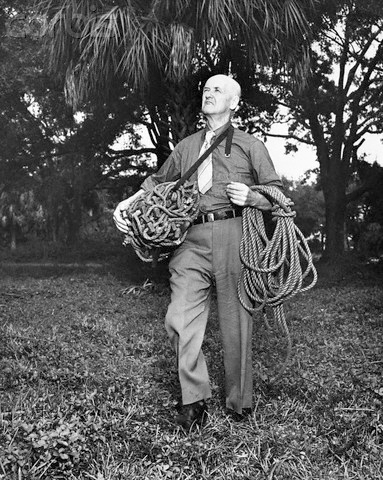
Eagle Man


Charles Lavelle Broley (Dec. 7, 1879 - May 4, 1959)


    A short while back, I became aware of Edwin Way Teale who, among many other things, wrote four books about travelling across the U.S. following the seasons. I started reading the first one - North With the Spring - and was not far into the 17,000 mile trip when I took this detour.

   Teale (and his wife) were hardly into their trip (c.1950), journeying around Lake Okeechobee in Florida, when he mentioned that he was going to join up with a Canadian for an eagle adventure. The Canadian is Charles Broley and naturally I wanted to find out who he was. In terms of google 'hits' there is not much about him and there is no Wikipedia entry. There should be.

   He was originally from Gorrie, Ontario which is near Goderich and he was definitely not your ordinary snowbird. If you are interested in eagles or ornithology, you will be interested in what follows and may not be aware that this "bald-headed eagle-bander" knew more about eagles than just about anyone. He made people aware of migratory patterns and he knew of the potential negative effects of DDT early-on and was cited by Rachel Carson.

     He was also fearless. If you are not fascinated by birds, you still may be interested in finding out more about a late-bloomer who started climbing very tall trees at a very late age.

     I have detoured long enough so this short introduction will have to do. If I have not convinced you that Broley is an interesting subject, then simply read the brief biography I have linked below. If that changes your mind you will find that I have dutifully typed-out the relevant section from Teale's book. I have also provided a bibliography, which I have partially annotated and from which you will learn a great deal.


A Short Broley Biography


Lower Beverley Lake Association
“Charles Broley/Eagle Platform
Jan. 6, 2012.

Lower Beverley Lake is near Delta, Ontario which is approximately 60 km from Kingston.
This is where the Broley snowbirds migrated from in the winter and returned to in the summer.
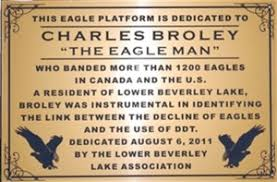
A good short biography of Broley is provided when an eagle platform was dedicated to him in 2011. Click on the link above to read it.

Broley as Described by Teale 

Among other things you will learn how Broley got to the top of this tree!


North With the Spring: A Naturalist’s Record of a 17,000 Mile Journey With the North American Spring, Edwin Way Teale. Dodd, Mead & Company, 1957

Chapter Six: “Eagle Tree” pp.39-54.
[The action takes place near Lake Okeechobee and the 'prairie' is the Kissimmee Prairie, c.1950]

     “At breakfast Dick Pough told us that in a couple of days Charles L. Broley was driving over from Tampa to band eagles on the prairie. Broley, a retired Canadian banker who took up the risky hobby of eagle banding when nearing sixty, is an almost legendary figure in modern ornithology. At sixty-seven he was then nearing his thousandth eagle. We decided to wait and join the expedition. (pp.39-40).

     “Outside the Southland Hotel, the next morning, we met the Broleys. They had driven over from Tampa the evening before. Both the eagle bander and his writer-wife were people we liked at once. Five feet, nine and a half inches tall, 150 pounds in weight, with a sense of humor as keen as his blue eyes, with his hair cropped so short that he has been referred to as the “bald-headed eagle bander,” this retired banker was one of the most remarkable men we met on our travels. Although he was nearing seventy, he was ascending cypress trees 150 feet high and climbing trunks so rickety that they swayed with his weight and went down in the next heavy storm.” (p.47)

     “Broley spread out coils or rope, three rope ladders, lead sinkers, stout fishline, a broom handle with a teaspoon taped to one end, a slingshot, a pair of rubber-soled shoes, and other odds and ends….”
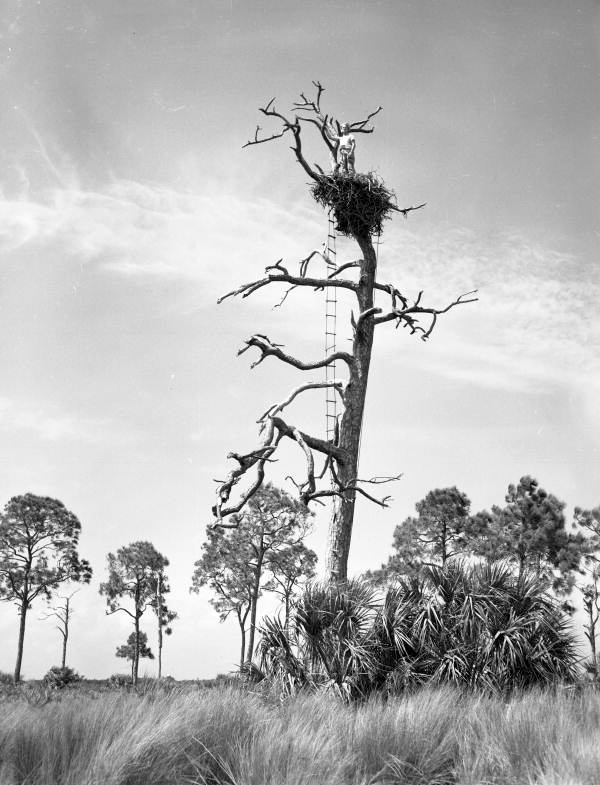
     “Under the eagle tree our eyes ran upward along more than half a hundred feet of trunk to an immense nest of sticks massed against the sky. Bald eagles keep adding sticks to their nests year after year. Sometimes the weight of the accumulated material will exceed a ton. Broley’s largest nest, perhaps the largest in America, is lodged in the top of a Florida pine near St. Petersburg. His measurements show it is 20 feet deep and 91/2 feet wide. Among the sticks of another nest he once found about three-quarters of the handle of a heavy ash oar….”
     “He never knows, in ascending a tree, what will lie at the top of his climb. Moreover, each tree presents a fresh set of problems. The dead pine under which we stood rose for more than twenty feet before the first stub of a limb jutted out. One cypress Broley climbed had its first limb seventy feet from the ground. And, in Canada, he once reached a nest at the top of an 80-foot basswood tree which had lost all its lower limbs. In this case he threw a weighted fishline directly over the nest itself, by means of his slingshot, and with this pulled up his rope ladders. For less lofty throws he use the broom handle with the teaspoon at the end. We watched him place a lead sinker, attached to a stout fishline, in the spoon and flip it over the stub of a limb with a deft sweep of the wooden handle that was a tribute to his years as a lacrosse player. To the fishline he attached a rope, pulling it over the limb and attaching it, in turn, to a 40-foot length of rope ladder with wooden steps. When this was fastened securely in place and he had changed into rubber-soled sneakers he was ready to climb….”
     “Standing on the first limb, Broley threw a sinker and fishline over the highest limb and repeated the process of pulling up rope and ladder. This enabled him to reach the edge of the nest. Now came the ticklish job of getting over the side. The last few feet are the most important of his climb….”
     “The same tree is used by the same eagles season after season. The highest next Broley has visited is 125 feet above the ground in the top of a giant cypress….”
     “As Broley pulled himself up and onto the nest above us -- first his head and shoulders disappearing, then his legs projecting out into space and shortening until they were gone -- patches of loose bark sloughed away from the upper trunk and fell to the ground. For ten minutes he was hidden behind the wall of sticks. But we could visualize events on the nest high overhead. Before making the ascent he had demonstrated the steps required in banding an eagle….”
     “When his legs appeared over the edge of the mass of sticks and he came down the tree, loosening ropes and letting down ladders in his wake, he had banded his 932nd eagle. Since then he has passed the 1,200 mark. He has banded more eagles -- a dozen times more -- than all other birdmen put together.” (pp.48-53)


A Broley Bibliography


For more photographs of Broley see The Florida Photographic Collection
which is part of the Florida Memory Project and where you will find much else to see.

Anon. “Eagles to be Like Dodos in a Hundred Years, Conservationist Says,” Daytona Beach Morning Journal, July 5, 1954.
Broley is quoted and notes that development and land clearing are problems: “I can’t see anything else than a gradual decrease in population.” He had also issued an earlier warning. See:“Timber Cutting in Florida Threatens the Life of Eagles,” Sarasota Herald-Tribune, Dec. 27, 1946.

Anon. “Dunnellon Garden Club Hears Russell Mason,” Ocala Star-Banner, Jan 23, 1963.
Mason was the executive director of the Florida Audubon Society. After providing background about the AS “...he showed colored films of wading and song birds of Florida. Of special interest was the film of the bald eagle in his natural habitat, filmed by the late Charles Broley, a Canadian, whose pictures and writing sparked the effort for the preservation of this bird.” See the obituary by Mason that is provided below.

Beans, Bruce E. Eagle's Plume: The Struggle to Preserve the Life and Haunts of America's Bald Eagle, Scribner, 1996.
Broley gets a thorough treatment - see especially Chapter 5: "In at the Death", pp.72-84.

Bergstrom, E. Alexander,  (Reviewed Work:) Eagle Man by Myrtle, Jeanne Broley
In Bird-Banding, Vol. 25, No. 2 (Apr., 1954), p. 82
Eagle Man: Charles L. Broley's Field Adventures With American Eagles was written by Broley’s wife Myrtle. This short review of it is available via JSTOR. Those interested in banding should see other issues of Bird-Banding where Brody is often mentioned in relation to the subject. For example in this article one will find a list of eight banded eagles which had been found after banding by Broley. Most of them had been shot! See: May Thacher Cooke, Bird-Banding, Vol. 21, No. 1 (Jan., 1950), pp. 11-17.

Bodsworth, F., “How to Catch an Eagle,” Maclean’s, Vol. 65, No.3, Feb.1,1952.
“Broley has taught U.S. scientists more about their national bird than any man alive.”
“Retired, he has earned a spot in a couple of U.S. biographies as the world’s leading authority on eagles, has been elected one of the few Canadian fellow members of the traditionally hard-to-crash American Ornithologists’ Union, and is in such a demand as a lecturer that if he wished he could earn more than he ever did in a bank office. He’s also, without doubt, the most actively retired businessman on the continent.” p.23.
“Roger Tory Peterson, a leading U.S. ornithologist said: “To Broley goes the distinction of adding more to the knowledge of our national bird than any man living.” p.33.
[Peterson also wrote about Broley in his book All Things Reconsidered... see the Peterson entry below.]

Broley, Charles L. “Migration and Nesting of Florida Bald Eagles,”The Wilson Bulletin,Vol. 59, No. 1 (Mar., 1947), pp. 3-20
This article by Broley from The Wilson Bulletin is available via SORA, the Searchable Ornithological Archive, and JSTOR. This is the first paragraph:
“Previous to January 1939 few Bald Eagles (Haliaeetus l.Leucocephalus)
had been banded in Florida. The Florida Bald Eagle was considered non-migratory and was regularly recorded as a permanent resident of the State. In 1938, Richard H. Pough, of the National Audubon Society, suggested that I band a few eagles as an experiment, and during the eight years, 1939 to April 1946, I banded 814 Bald Eagles along the Gulf Coast of Florida-practically all in January and February, a few in March. Meanwhile, I kept a year-by-year record of most of the nests in the banding area, which extended from Hernando
County south to Lee County.”

Broley, Charles L. "Plight of the Florida Bald Eagle," Audubon, Jan.-Feb., 1950,p. 45.

Broley, Charles L. "Plight of the Florida Bald Eagle Worsens," Audubon,  Mar.-April, 1951. p.72

Broley, C.L., “The Eagle and Me,” Canadian Banker, Vol.60, No. 1, Winter, 1953. pp.99-106.
This article has as a subtitle: "A Retired Banker's Hobby". He describes how he got started and provides a thorough description of how he climbs trees and devised his climbing gear.
"At the age of 73, I find that I can climb perhaps more easily than I did 13 years ago. I enjoy a difficult tree more than an easy one, and I hope to carry on for a few years more." p.106.

Broley, M.J., Eagle Man: Charles L. Broley's Field Adventures With American Eagles.
The author of this book is Myrtle Jeanne, Broley's wife. There is an introduction by Teale.

Cook, Hugh A.,  “Charles Broley: An Extraordinary Naturalist” , CM: A Reviewing Journal of Canadian Materials for Young People, Vol.14, No.4, July 1986. (CM was also known as Canadian Material and was published from 1971 to 1994 by the Canadian Library Association.)
This review of Gerrad’s book about Broley is presented here in its entirety:
     “Jon Gerrard, a medical doctor in Manitoba, developed an interest in bald eagles. As a result of this interest, he became interested in the life of Charles Broley and had the opportunity to meet Jeanne, Charles's daughter, and visit the site of the family cottage at Delta, Ontario. This, along with the writings he had perused of Charles Broley's pioneer work in bird watching and the banding of bald eagles, lead Gerrard to write a paper for a conference on bald eagles that was being held in Winnipeg.
     Unfortunately, there are several gaps in the life of Charles Broley that Gerrard could only surmise about, and these he has acknowledged. Charles Broley was raised in Elora, Ontario. He became a banker, moved to Delta, where he met and married his first wife, Ruby, and built the family cottage on an island. Unfortunately, he lost Ruby to tuberculosis. He moved to Manitoba, where he met his second wife, Myrtle. At this time in his life he became an avid bird watcher, as did Myrtle. He became highly respected for his knowledge of birds and upon his retirement, at the age of sixty, began climbing one hundred foot high trees to band eagles. After several years of banding, Charles began to notice a decline in successful nestings of the eagles and was responsible for raising enough concern that political action brought about a ban on DDT.
     Shortly after Myrtle's death Charles died trying to extinguish a grass fire that burnt his cottage. By his personal efforts Charles had greatly encouraged an interest in bird sanctuaries and bird conservation in general. Avid hunters became avid bird watchers and photographers. This is a story that needed telling and it would be a worthwhile addition to the bird section of all libraries.”

Curtin, Dave, “The Eagle Has Landed: National Symbol Flies in the Face of Near-imminent Species Extinction,” Colorado Springs Gazette Telegraph, Jan. 8, 1995.
    “Retired banker and amateur biologist Charles Broley theorized in 1958 that fish eaten by eagles were contaminated by the pesticide DDT, according to Greg Breining in the 1994 book "Return of the Eagle" (Falcon Press).” [This book is not available locally. A copy is searchable via the Internet and it is clear that Broley is discussed in the book which has its full title: Return of the Eagle: How America Saved Its National Symbol.]

Evanoff, Vlad, “Seen Any Pink Geese Lately?”, The American Mercury, May 1959, pp. 46-49
This is an article about how scientists are marking birds and animals so that they can obtain information about their movements and habits. Broley is mentioned in this context on p.47.

Gerrard, Jon. Charles Broley: An Extraordinary Naturalist 1983
    This short biography was published by White Horse Plains Publisher in 1983. See the review above in the entry for Cook.

Haddock, Dudley, “Eagle Scout:The Little-known Story of our National Bird: The Eagle,"
Collier's Weekly, May 9, 1942, pp. 14-15.
This article has a few good photographs.
“Because he tackles buzz saws with his bare hands as a hobby, Charles L. Broley, a 63-year-old retired Canadian banker, has supplied Uncle Sam with more information about his trade mark during the last four years than had been learned since its adoption by the Continental Congress in 1782. In lieu of golf and fishing he bands bald eagles during his winter visits to Florida.
     Until Broley became interested, in 1938, only 58 of the birds had been banded in North America. Knowledge of its habits was limited. It was believed, for one thing, the Florida species was non-migratory. Now it is known to be a long-distance traveler, for two with Broley bands have been found in Canada, one on Prince Edward Island, 1,650 miles north of the nest it left only three weeks previously….”
     Until recently much of the life story of the species was a closed book. Observation of the nests and banding of the eaglets is so strenuous and hazardous few attempt it. One must be an engineer, acrobat and strong man to do so, for these nests are in the tops of the tallest pines and cypresses. Open a great umbrella, turn it upside down and attempt to climb into it from the tip, without wings, and it may be realized what one is up against in gaining the top of a nest, even after the tree has been scaled….”
     Broley became addicted to his hobby by request. Prior to his retirement in 1938 after twenty years as manager of the Winnipeg branch of the Bank of Montreal, he had attained recognition as one of the continent's foremost authorities on ducks, geese and swans.
Upon learning he intended to spend that winter in Florida, officials of the National Audubon Society and the Fish and Wildlife Service of the Department of the Interior requested that he band a few bald eagles. That was the beginning. His work from the outset proved to be of such scientific value Washington since has annually requested the Canadian government, which restricts the movement of its nationals during wartime, to permit him to return and continue it.”

Hickey, Joseph J. A Guide to Bird Watching, 1943.
See the section “Florida Odyssey” on pp.143-145.

Mager, D. “Charles Broley in Florida,” in J.M Gerrard and T.M Ingram, The Bald Eagle in Canada, 1985. This book was not available to me.

MacMaster, A. “Charles Broley in Manitoba,”  in J.M Gerrard and T.M Ingram, The Bald Eagle in Canada, 1985.

Mason, C.R., Obit. The Auk, Vol.77, No. 3, July 1960, p.378.
The Auk is available on SORA, the Searchable Ornithological Archive, and via JSTOR. Presented below is Mr. Mason’s obituary for Broley:
  “Charles L. Broley  of Delta, Ontario, an Elective Member of the American Ornithologists' Union, and a member since 1926, died suddenly in the early summer of 1959 as a result of fighting a brush fire near his home. He had shortly before returned from Tampa, Florida, where he had continued his long fight for protection and restoration of the Bald Eagle. He had just agreed to serve on the Wildlife Committee of the Florida Audubon Society, with special emphasis on his favorite bird. His presentation of the plight of America's National Bird at the Annual Meeting of the Society in March 1958 had inspired its officers to initiate a program of census and research leading to greater knowledge of the needs for survival of the Bald Eagle in Florida.
     Mr. Broley was a banker by profession but retired at 58 to spend most of the following two decades in studying, banding, photographing, and lecturing about the Bald Eagle. He became adept in the use of rope ladders in climbing eagle trees and developed a national and international reputation as an authority on the species. Mrs. Broley, who preceded her husband in death by a year, wrote the "Eagle Man," which described his experiences with this great bird during his retirement years. The Broleys' daughter has deposited her father's records and eagle films with the Laboratory of Ornithology at Cornell University so that they may have further use. Many of us here in Florida, and throughout the country, considered Charlie Broley a fine personal friend, and the warmth of his association will be greatly missed as will his work in ornithology and conservation.”
C. Russell Mason,  Altamonte Springs, Florida.

McNicholl, Martin K., “Charles Lavelle Broley,” The Canadian Encyclopedia.
This is the complete entry:
    “Charles Lavelle Broley, banker, ornithologist (born at Gorrie, Ontario,  7 Dec 1879; d at Delta, Ont 4 May 1959). A banker in Winnipeg, he was also active in ornithology and conservation. In 1939 he "retired" to winters in Florida and summers in Ontario.
In Florida he began a raptor-banding study, in his first 8 years banding 814 bald eagles and ultimately banding more than 1200. Recoveries showed that eagles dispersed northwards after nesting prior to southern migration; Broley's was the first study to demonstrate this phenomenon with large numbers. Declining hatching success during his study resulted in one of the first alerts to science of the dangers of insecticides.
Broley was honoured for his work by a life membership in the Natural History Society of Manitoba. He also encouraged the early career of wildlife artist Terence Shortt. Broley was to assume membership in a special conservation committee on bald eagles when he died fighting a brushfire.”

Peterson, R.T., “Eagle Man,” Audubon, 50, 1948.
Apparently Broley is mentioned in this article.

Peterson, Roger Tory, All Things Reconsidered: My Birding Adventures
See the chapter: “Broley, The Eagle Man,” p.124. There is a good picture of Broley on p.130.

Redford, Polly, “Counting Our Eagles, The Atlantic Monthly, July 1965, pp. 64-68
Apparently Broley is mentioned in this article.

Sterling, Keir Brooks, et al.  Biographical Dictionary of American and Canadian Naturalists and Environmentalists. Greenwood Press, 1997
A short, but useful biographical sketch of Broley is provided along with a bibliography (see “Broley, Charles Lavelle, on pp.116-117.)
 [Broley’s] “ investigations were among the first to implicate DDT in raptor declines and thus pesticides as environmental threats.”
“Rachel Carson’s Silent Spring effectively used Broley’s data in combination with others to sound this warning.”

Tao, Dominick, Soaring Spiritual Bond: The Image and Aura of the Eagle Have a Clutch on Countless Lives,” St.Petersburg Times, June 6, 2010.
     “Back in the days when most of Central Florida was pine scrub and farmland, Charles Broley ventured where only eagles dare.Throughout the 1940s, the former bank manager climbed into hundreds of eagle nests across the state, often more than 100 feet up, placing numbered bands on more than 1,000 chicks so their movement patterns could be tracked.
His obsession is legend among present-day Florida eagle stewards, like Barb Walker, the coordinator for Pinellas County's Audubon Society Eagle Watch program.
She feels it's her job to carry on the torch of eagle conservation pioneered by Broley 60 years ago. "I think it's important to our children. The past with eagles is important, even before they were delisted (from the endangered species list)," Walker said.

Teale, Edwin Way, “Bird of Freedom,” The Atlantic Monthly, November 1957, pp. 133-140
Apparently Broley is mentioned in this article.

Wellington County Museum and Archives
This is from the website of the Wellington County Museum and Archives
http://wcma.pastperfectonline.com/
A1997.132 - Eagle Man, by Myrtle Jeanne Broley, 1952.
Eagle Man, by Myrtle Jeanne Broley, 1952; hardcover, 210 pages. Story of the Elora banker-naturalist Charles L. Broley's field adventures with American Eagles; written by his wife, Myrtle Jeanne Broley. Inside front cover, signed "Myrtle Jeanne Broley / Charles Broley". Includes newspaper clippings from Toronto Daily Star, July 28, 1954; Kitchener-Waterloo Record, May 5, 1959 [obituary Charles Broley].

White, E.B. “Talk of the Town,” New Yorker, April 24, 1954.
Broley is mentioned and a couple of months later one finds him profiled by Geoffrey T. Hellman in “Eagle Bander, New Yorker, June 19, 1954.
The leading eagle bander of the world” is described as  “a wiry, sun-burned, single-chinned, bright-blue-eyed man who looks ageless…” Broley says that a few weeks before had just had a very rough eagle outing in Maryland. He is 74 at this time.

Winnipeg Free Press.
     A large number of references to Broley are found in the archive of the Winnipeg Free Press, but one has to pay to access them. According to Sterling’s sketch in the Biographical Dictionary.... noted above, Broley often contributed to A.G. Lawrence’s bird column, "Chickadee Notes," which was published in that paper.

Wood, Madelyn, “Our Bird of Freedom,” Coronet Magazine, July 1954, pp. 81-84
Apparently Broley is mentioned in this article.

[I was not able to see the two biographical works about Broley and didn't have time to track down some of the unannotated references. This is a 'detour' after all.]