Showing posts with label Tom Wolfe. Show all posts

Monday, 28 November 2022

"Screwed the Pooch"


Headline of the Month

   Although I could not find a good Canadian image to illustrate our topic for today, the one above should suffice and, as well, indicate that variants of the phrase are widely used. It is an odd bit of slang, but it is found in this CBC headline on Nov. 22, 2022: 
" 'Your Guy Really Screwed the Pooch,' texts Kenney, Upset With Feds Over Coutts Blockade." The term is not really explained in the article, but it is clear that many people "screwed up" when the Emergency Act was invoked.

   Apparently pooch screwing is synonymous with blundering or making an egregious mistake, but the discriminating readers of Mulcahy's Miscellany will only be satisfied if a bit of philology is applied. Here is that bit.

   Readers of this blog likely first encountered the phrase when reading The RIght Stuff by Tom Wolfe. The rest of you probably heard it uttered in the film with that name back in the last century. More recently in this one, you may have been surprised when a CBS News correspondent  used the phrase on "Face the Nation" when discussing the Obama administration and the war in Syria. If one is travelling to outer space or navigating through the political milieu, there are lots of opportunities to "screw the pooch" and apply acronyms like SNAFU or FUBAR. 

"F****** the Dog"

  It is likely that "screwing the pooch" is a euphemism for the more vulgar "F****** the dog," which like SNAFU and FUBAR, originated in the military. The latter phrase has a different meaning and I thought of it when I first encountered a new one - "Quiet Quitting." It is likely most of us were aware of "QQ", before it was a thing, and had a colleague or two who were slacking off, being lazy, dogging it, or as we would say after work and a few drinks, "Jim was "f****** the dog" again today." 

Sources:
   The use of the less vulgar variant of the phrase is described in this article: "Review - The Week - The Word on the Street - The Pedigree of the Naughty Pooch," Ben Zimmer, Wall Street Journal, Jan. 4, 2014. Mr. Zimmer discusses the topic in more detail in a publication which allowed him to mention the more vulgar phrase: "A Reporter Said 'Screw the Pooch' on Face the Nation: Where Does That Phrase Come From?", Slate, Jan. 14, 2014. 
   Everything you need to know about the F-Word is found in the plainly titled book, The F-Word by the lexicographer Jesse Sheidlower. It is published by the Oxford University Press and a copy used to be found in the London Public Library. I suppose that someone f***** off with it. For more F information see: "Swearing & Slurring." 

The Bonus:
  In the longer article by Mr. Zimmer, this is noted: 
 "It’s not impossible, after all, for various military personnel to have independently transformed “fuck the dog” into “screw the pooch” on separate occasions. After my Wall Street Journal column was published, former Navy Lieutenant Commander Arthur P. Menard wrote in to say that he recalled “screw the pooch” being used to describe fatal crashes in 1959, when he was a midshipman aboard the aircraft carrier USS Oriskany, and again in 1960 in flight school in Pensacola. He described it as “black humor in the Naval air arm for a very unfunny incident.”
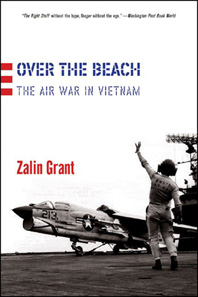
  If the USS Oriskany rings a bell that may be because I mentioned it in my post about Senator John McCain where a review of the book, Over the Beach: The Air War in Vietnam is presented. It's easy to screw the pooch on an aircraft carrier. 

Sunday, 26 August 2018

Senator John McCain


Image result for mccain navy
   
     It would be difficult to find anyone, other than the current President of the United States, who did not think that Senator John McCain was an honourable man who dedicated his life to serving his country. From one of the obituaries I read today, I have extracted a small portion which relates to his military career and an unfortunate event he experienced prior to the very unfortunate one he lived as a prisoner of war for over five years.

     “Sen. McCain requested and got orders to do a Vietnam combat tour, joining a squadron on the supercarrier Forrestal in the Tonkin Gulf. On July 29, 1967, having flown five uneventful bombing runs over North Vietnam, he was preparing for takeoff when a missile accidentally fired from a nearby fighter struck the fuel tank of his A-4 Skyhawk, Sen. McCain wrote in his memoir. It set off explosions and a fire that killed 134 crewmen, destroyed more than 20 planes and disabled the ship so severely that it took two years to repair.
     His own injuries being relatively — and miraculously — minor, Sen. McCain, then a lieutenant commander, volunteered for dangerous duty on the undermanned carrier Oriskany. He joined a squadron nicknamed the Saints that was known for its daring; that year, one-third of its pilots would be killed or captured.

(“John McCain, ‘Maverick’ of the Senate and Former POW, Dies at 81," By Karen Tumulty, Washington Post, August 26, 2018.)

     The name “Oriskany” reminded me of a review I wrote over 30 years ago of a book about that carrier and the experience of those who served on it. The review is presented below and the book will be of interest to those who want to learn more about the pilots, like McCain, who fought in the air war in Vietnam. The review is found in the Canadian Review of American Studies, Vol. 18, No.4, Winter, 1987. p.562.


Zalin Grant. Over the Beach: The Air War in Vietnam. W.W. Norton & Company, 1986.


     The author of Over the Beach served in Vietnam and then reported from there as a journalist for Time and The New Republic. While working on a story in 1966, Mr. Grant met the members of Squadron 162 who flew off the carrier Oriskany. Intrigued by the exploits of the Naval aviators, the author kept in touch and, in 1971, located the surviving members and interviewed a number of them. The time was not right and readers were not ready, however, at least in his judgement, for the type of story that Mr. Grant wanted to tell, so the project was delayed until 1984, when the author again traced down the pilots and further recorded their experiences. So the book that has resulted is based on research, some of which was conducted twenty years ago, on the recorded reminiscences of the participants and on an analysis of some of the scholarship that was produced in the intervening years. It is partly an oral history, partly an exercise in the “New Journalism,” and it is totally satisfying.

     Over the Beach recounts the history of one squadron of Naval pilots who flew F-8 Crusaders off the deck of the Oriskany as she cruised in an area known as “Yankee Station” in the Gulf of Tonkin during the period 1966 to 1972. Personal experiences are emphasized, and the reader learns a great deal about how the aviators were trained, how they viewed combat, how they lived within the confined space of “officer’s country” and how they behaved while on liberty or when captured by the enemy. Scattered throughout the book are the words of wives and, in particular, the moving recollections of the wife of one pilot who was shot down and killed. Those who approach this book expecting prose overwhelmed by military acronyms and the jargon typically uttered by men who say “Negative” when they mean ”No” will be pleasantly surprised by the eloquence of the testimony.

     Although the author’s primary purpose was to tell the personal stories of pilots and “to write about them in human terms,” he does not ignore the larger political and military issues. The basic goal of the air war was to stop the flow of men and supplies into South Vietnam. However, it was not quite this simple. The strategies that were designed by military officers and politicians to accomplish this goal often differed from each other. Grant does a good job of discussing how the political restrictions that were imposed affected the course of air operations and the lives of the pilots who actually had to fly missions at particular times against particular targets, both of which were chosen by politicians thousands of miles away.

     One is impressed when reading the book by the complexity of air operations and the courage it takes to perform them. It is not easy to coordinate the activities of several floating cities and it takes considerable skill to drive a huge piece of machinery off the deck of an aircraft carrier. It also takes considerable nerve to fly from a carrier and return to it at night through the rain, clouds and mist of a monsoon and land on a very small deck pitching and rolling in a heavy sea. And it takes still more courage and skill when one misses and misses again, to fly back into the night and find a tanker and refuel so one can once more try to land. The number of deaths recorded in this book from accidents alone is staggering and one does not have to be an actuary to realize that Naval aviators were involved in a very risky profession.

     About ten years ago, Tom Wolfe also wrote about Naval carrier pilots in an interesting essay titled,  “The Truest Sport: Jousting With Sam and Charlie,” which was reprinted in Mauve Gloves & Madmen, Clutter & Vine and in The Purple Decades. It was his goal, he wrote elsewhere, “to give the full objective description, plus something for which readers had always to go novels and short stories; namely, the subjective or emotional life of characters.” The author of Over the Beach would, I think, agree with this statement. In any case, he has written a book about those who possess “the right stuff” and anyone interested in contemporary American Studies is certain to enjoy it. Jerry Mulcahy
Canadian Review of American Studies, January 1987, 18(4), p.562

Post Script
McCain is not mentioned in Over the Beach, but the author,  Zalin Grant, does offer a good account of McCain's naval experiences here: http://www.pythiapress.com/wartales/McCain-Shootdown.htm

McCain's father and grandfather were admirals and he requested a tour in Vietnam.  I did not and then refused to serve there. It should not seem odd, however, that I can admire the man and do. As far as I am concerned, candidate Trump's remark about McCain should have ended his run for office and I remain surprised that so many Republican patriots were silent (and still are).

In the review, Tom Wolfe is quoted and he is now also gone.  Among other things he should be remembered for giving us 'radical chic",  long before 'virtue signalling' became fashionable.