Showing posts with label New Orleans. Show all posts

Thursday, 28 September 2023

Water Woes


   Although I would prefer to avoid the awful things now occurring, a recent article compels me to issue this alert: "Our drinking water may soon disappear!"

   I read the article which is the first one listed above and both the graphic and the article are from the New York Times. It was written by a team and the data supporting it were substantial. The other articles pictured above constitute a series and there may be more. If you can access them, do so. "America Is Using Up Its Groundwater Like There's No Tomorrow," is in the Aug. 28 issue. The "Big Farms" one is from Sept.3, the "Colorado City" one from Sept.5 and the "Monster Fracks" from Sept.25.

   I will offer my simple summary of the core article by suggesting that we are all living in Arizona now and that assertion is based on a lot of data. Here are some extracts from the article:

   "Many of the aquifers that supply 90 percent of the nation’s water systems, and which have transformed vast stretches of America into some of the world’s most bountiful farmland, are being severely depleted. These declines are threatening irreversible harm to the American economy and society as a whole. 

   The New York Times conducted a months-long examination of groundwater depletion, interviewing more than 100 experts, traveling the country and creating a comprehensive database using millions of readings from monitoring sites. The investigation reveals how America’s life-giving resource is being exhausted in much of the country, and in many cases it won’t come back. Huge industrial farms and sprawling cities are draining aquifers that could take centuries or millenniums to replenish themselves if they recover at all.

There is no way to get that back,” Don Cline, the associate director for water resources at the United States Geological Survey, said of disappearing groundwater. “There’s almost no way to convey how important it is.”

   This analysis is based on tens of thousands of groundwater monitoring wells that dot the nation. The Times collected data for these wells, which are widely scattered and often poorly tracked, from dozens of federal, state and local jurisdictions....

   One of the biggest obstacles is that the depletion of this unseen yet essential natural resource is barely regulated. The federal government plays almost no role, and individual states have implemented a dizzying array of often weak rules....

   The federal government sets rules on groundwater, but not its overuse or depletion, although experts say Congress has the constitutional authority to do so. Overall, federal responsibility for water is scattered among a half-dozen different agencies....

   America’s approach to regulating water is “a total mess,” said Upmanu Lall, director of the Columbia Water Center at Columbia University.

   “From an objective standpoint, this is a crisis,” said Warigia Bowman, a law professor and water expert at the University of Tulsa. “There will be parts of the U.S. that run out of drinking water.”

   In the very near future, thirsty people will be found throughout the country. Minnesota, the "Land of 10,000 Lakes" is not excluded, nor is Maryland, the state in which I grew up. Charles County, "which contains fast-growing suburbs of Washington, has used most of its groundwater for homes and agriculture. And, it isn't coming back anytime soon."

Canadian Content

   Canada is not mentioned, but it is not difficult to find articles that indicate concerns about this commodity in our country. Tofino, one of the wettest places I have been, has nearly a dry reservoir and has issued water restrictions and this headline indicates lack of water is a problem elsewhere: "Gulf Islands Water Woes an Ominous Omen For the Rest of B.C." Also in that province, there are major issues between the U.S. and Canada involving the Columbia River and the water in it and it is not too difficult to imagine that there will soon be increased demands in the U.S. from some of the Great Lakes, one of which supplies water to London. Let's hope that Line 5 does not burst under the Straits of Mackinac.

Post Script:
 
The water-related news continues to be bad, which is one reason I decided to bring up an issue we would rather not think about. When you do think about it, you realize that it is rather amazing that we plop down housing developments and assume that water will magically come up to supply the residents. Among the news stories one learns that the folks living in New Orleans soon may run out of drinking water, although they generally have to worry about having too much water, and salt water intrusion is a problem in many coastal areas. (see, for example, "A Saltwater Wedge Climbing the Mississippi River Threatens Drinking Water: New Orleans Mayor Latoya Cantrell Signed an Emergency Declaration Friday as Saltwater Threatens the City," Brady Dennis, Washington Post, Sept. 22, 2023.)


Even the Panama Canal is 'Thirsty.'
   The picture above shows ships waiting to enter the Panama Canal. Who knew that it takes 50 million gallons of fresh water from the Gatun Lake to move one ship through the canal and that daily the Panama Canal uses three times as much water as all of New York city? If you are still waiting for that fridge to come from the Far East, it may be delayed because of a lack of water. (The NASA photograph is found in this article where you can learn more about another cause for supply chain interruptions: "Panama Canal Traffic Backup.")
   

Friday, 31 December 2021

American Customs Series

    Again, I am discussing a book series, this one about "American Customs." Considered are the customs and folkways of folks living in various regions of the United States. There are three books about the northeast (Cape Cod, Maine and New England), one for the mid-Atlantic area (Pennsylvania), one for the south (New Orleans) and two for the west (California and the Old Wild West.) The seven books were published by Vanguard Press during the years from 1946 to 1949. 

   These are unprofessional social histories, which means you are likely to enjoy them and find a good recipe-or-two, as well as some tales and yarns. The tables of contents of a few of the volumes are presented, as well as a some brief summaries. They are all still protected by copyright, which means that you cannot read complete digital copies of them. All are found on AbeBooks and some are inexpensive. 

It's An Old New England Custom


A listing and exploration of many customs associated with New England. Pie for breakfast, bundling, high excellence in epitaphs, phantom ships, haunted houses-these and many more are explored as to their sources and identification with the locale. A humorous and unusual historical curiosity of a regional nature, amusing prints, gay verses, bits of odd information, curious episodes- a characteristic Mitchell item. In format it has a slightly juvenile flavor which may limit the market. (Kirkus)

It's An Old California Custom


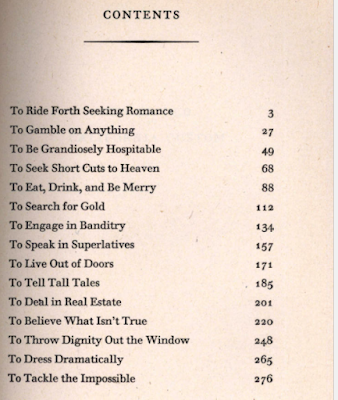
Informal chronicling of California's personality in terms of traits, inherited, adopted and native. Stories of old romances, gambling heritages, the large scale hospitality, the types of messiahs and cults, the pleasures of food and drink, the spirit of fiesta, are combined with material on gold hunting, bandits, hoaxes, real estate, the tendency for self deception, the playtimes of various clubs and groups, the exhibitionism, and the originality in solving problems of public works and civic questions. This traces, from the old land grants and the old families, the roots of California's individuality, independence and pride, and is a pleasant review, in conversational style, of the state's story....One of the numerous California books gauged to the interest generated by the centennial. Of regional appeal largely. (Kirkus)

It's An Old Pennsylvania Custom


There  are  two kinds  of historical writing: one is conceived  and  executed with fine attention  to  accuracy  of  facts  and  validity  of interpretation;  the other  is  conceived  and  executed  with  less  attention  both  to  the  facts  and their  interpretation.  The  former  is designed  to  satisfy  the  demands  of  the specialist, or at least  of the serious student; the other  is designed  to  satisfy the  nonspecialist,  or  the  "general"  reader.  Both  kinds  can  and  should  be attractively  presented, but the latter, having  for its primary  purpose popu-lar  appeal, emphasizes style  even  at  the  expense  of  content.It9s An  Old Pennsylvania Custom is clearly of the second kind. It  is indeed a fine example. It  was written  by Mr. Mitchell  in  an interesting style, is excellently  designed  by  Stefan  Salter,  and  was  well  manufactured  by  H.Wolff. It  presents  a wealth  of  historical  facts,  both  conventional  and  un-usual, relating  to Pennsylvania. At  the same time, it  arrives at  interpretations  of the  facts,  both  in general  and  in particular,  which  clearly  mark  it as  of the  second  kind  of historical  writing. 
(Pennsylvania Magazine of History and Biography)

It's An Old New Orleans Custom


Companion volume to It's An Old New England Custom and It's An Old Pennsylvania Custom, this somehow manages not to overlap to any considerable degree the other books on New Orleans which have been published in the year past. This is full of human interest bits, anecdotes, slices of history and biography. There's a brief survey of New Orleans history as the changes of flag went on. There's a section on the music  from street cries to the classics. The most interesting chapter, perhaps, is the one on commerce as it is pursued by the citizens, who prefer to cultivate the art of leisure. Some rather ironic comments on the beauty and the frailty of New Orleans women; some entertaining sidelights on gambling from cards to lotteries; the river front and its melodramatic contribution to the city's checkered career; weather, fire and water- and the parts they play; basis for the repute for wickedness --offset by equal repute for hospitality, and a genius for elegant living -- these represent some of the many facets that contribute to the unique flavor of this enchanting city. The section on food has some toothsome recipes; (yes, I copied three for future reference). (Kirkus)

It's An Old Wild West Custom


This book captures the colorful spirit of the American West in its history and quirks. Included are songs and stories, charts of brands used to mark cattle, and sketches of the boom and bust of the Old West. In one chapter, the author informs us that the Westerner left his names casually and naturally on the land and on each other, without ostentation. This led to names like Jerked Beef Butte or Rattlesnake Basin in Arizona, or nicknames for fellow cowboys like Crooked-Nose Pete and Three-Fingered Smith. 
Duncan Emrich was a professor and collector of American folklore, once a ranch hand and historian in the military. The American Art & Portrait Gallery copy of this book is signed by the author, and inscribed under his portrait as "old bag eyes, the Monday morning folklorist."   


It's An Old State of Maine Custom


Without the particular charm of the last in this series, It's An Old New England Custom, this still holds an interest for natives of or visitors to this region. In this miscellany of historical facts and special features, customs, legends, superstitions, you will pick up a good deal of information about the timber country and the logging and shipbuilding it produced; its other industries- quarrying and fishing; the scenic attractions of its gardens, old houses, islands, flowers, birds; the pleasures of the palate- lobsters, seafood, blueberry pies (with recipes); and the character of its native humor... A predictable, regional market for this. (Kirkus)

It's An Old Cape Cod Custom


From the New York Times, June 19, 1949, where the complete review will be found.

For a discussion of this series see: Series Americana: Post Depression-Era Regional Literature, 1938-1980: A Descriptive Bibliography: Including Biographies of the Authors, Illustrators, and Editors 1st Edition, by Carol Fitzgerald.

The Bonus:
  In its early days, Vanguard Press published radical books and during the later ones, such authors as Saul Bellow and Marshall McLuhan. It was bought by Random House in the 1980s.