Saturday, 19 May 2018

The Wide World of Sports

The Rainbow Man


     I receive thousands of  compliments daily about the eclectic nature of this blog, but lately complaints have poured in from readers who have noted my lack of coverage of SPORTS.  One perceptive critic opined that, apart from my fleeting reference to ‘Tex Cobb’, there has been nothing much about the sweaty subjects, even though I have sometimes mentioned the perhaps less worthy one of religion (he (she) then went on to criticize me for being uniformly negative about whatever cult I was discussing).  This post allows me to combine scripture and sports which should be almost as good, rankings-wise, as mentioning Lincoln and dogs (or cats).

     The fact that the title refers to an ABC television program about sports which ended before this century began, should indicate to you that I have not been keeping up. My interest in watching sports, waned even more quickly than my ability to participate in them. Once the players started moving around, and then the teams (not usually in the same direction), to play in stadiums with confusing corporate names which were full of fans who  responded only to signs saying, “Make Some Noise”, the free t-shirts and the thumping of organ music, I became much less enthusiastic. With ‘amateur’ sports, my interest was sustained a little longer, but then the players began leaving after one year of university, the bowls and college playing fields became corporate brands, teams from Utah moved to the Atlantic Coast Conference  and finally, ‘Whoa, Nellie’, Keith Jackson died.


Rollen Stewart


    Admittedly,  it is odd that rather than considering truly interesting old-timey sports subjects or personalities ( the Millrose Games, the Wanamaker Mile, the Penn Relays, Evel Knievel, Gorgeous George, Yogi Berra), I ended up choosing Stewart who, you have guessed, is the “Rainbow Man.”

    Surely you remember him and JOHN 3:16, which was Rollen’s way of letting you know that: “For God so loved the world, that he gave his only begotten Son, that whosoever believeth in him should not perish, but have everlasting life.” The Gospel would be displayed by him behind the goal post at a Jet’s game on Sunday, and then again on Monday in Seattle. It truly was miraculous.

The Pathetic Proselytizer


    Now that I have reminded you of this “Jesus Freak” and you know his name, my job is done since you can easily learn more about him. I will even help by providing sources below. I will just say that the story does not end well. In 1992, he held a hostage in a California motel, for reasons that are confusing to me and probably were for him - it had something to do with “rapture”. He remains in prison.

Sources:
     The usual ones can be consulted; there are Wikipedia entries for “Rainbow Man” and Rollen Stewart.
    More devoted fans should see this very good video (10 minutes): “A Colorful Testimony” by Caleb Crouch, Aug. 30, 2006.
    For a good piece last year see: “The Unbelievable Life of the 'John 3:16' Sports Guy,
by Jake Rossen, MentalFloss.com,  August 18, 2017
    There are two stories by Cecil Adams on Straightdope.com (“Fighting Ignorance Since 1973”): 1) This question is answered back in 1987 - “What’s with those “John 3:16” signs that people hold up at football games?” 2) Ten years later there is a follow-up and this one answers the question -  “Is the guy who held up those “John 3:16” signs at sports events in jail for life?”

Post Script:
    The usual bonus stuff:
   As I write this, there is a Royal Wedding happening and Rollen showed up at an earlier one involving Princess Diana and Prince Charles.
   I do still watch one sport - golf - and have seen 3:16 signs. At the 1990 Masters, the Rainbow Man set off a remote-controlled air horn as Jack Nicklaus was swinging.
  If you wish to see scripture at your sporting events, you can likely see 3:16 displayed over in Binghamton, where Tim Tebow is playing Double-A ball with the Rumble Ponies. Clearly all his prayers have not been answered.


 Some Canadian content: Apparently Bill King, a Canadian, is supported by an evangelical organization to attend sporting events and display John 3:16


Now you know.

P.S.
I remain confused about sporting events. Although all the ice has melted, two of the teams still playing for the Stanley Cup are located in Tampa Bay and Las Vegas.


Periodical Ramblings (6)

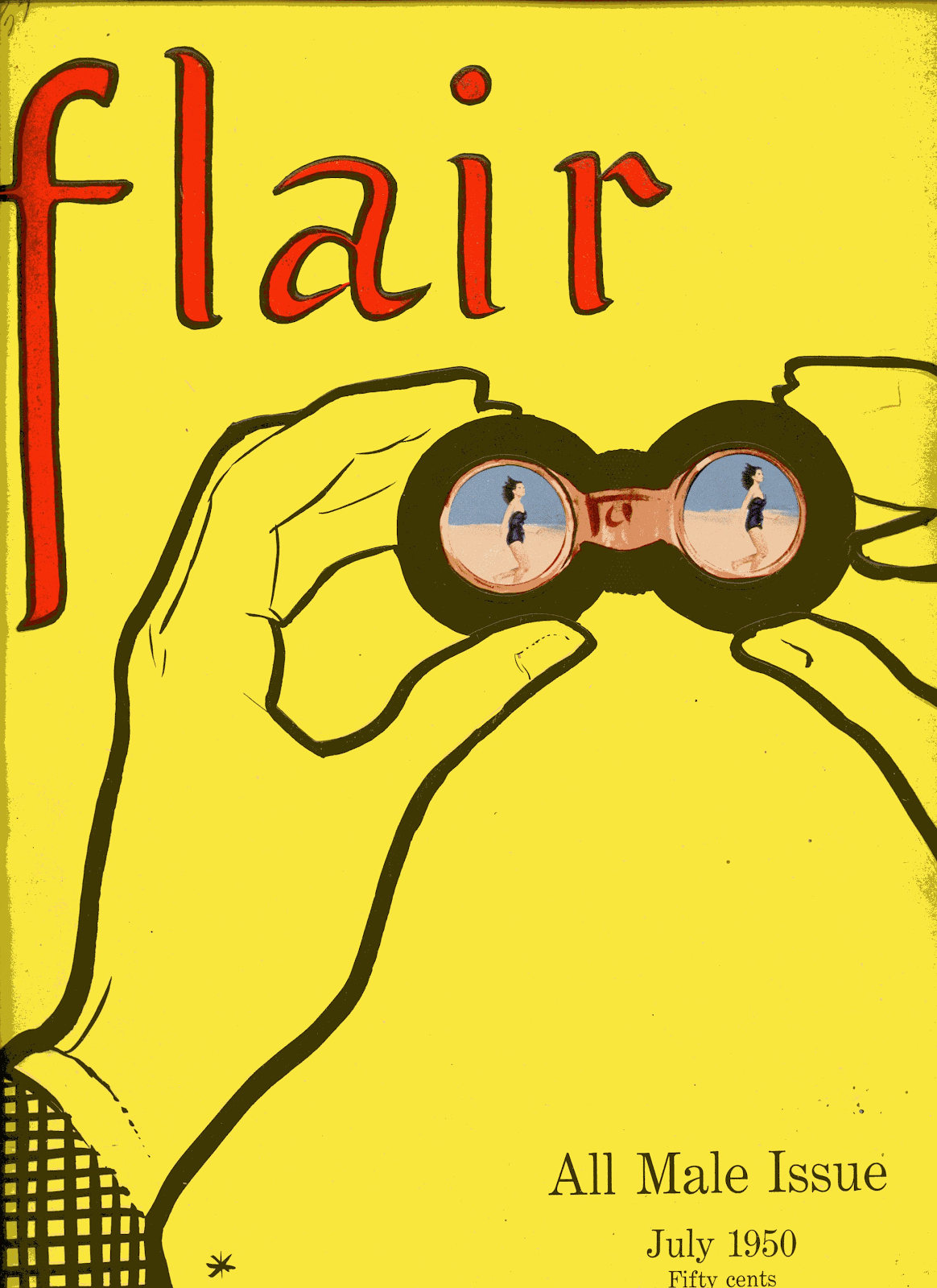
Flair


It was not my intention in this series about serials to include within it, Flair, a magazine that only existed for 12 issues during 1950/51. I learned about it when I learned about Fleur Cowles, about whom I posted some information a while back. She produced the magazine for those we now refer to as ‘One Percenters’, and she was one herself. It was a costly production and after losing around $200,000 per issue, the publication ceased. A very short-lived fashion magazine seems hardly worth considering, but I will make a short case for doing so here.

   If you picture a very good book for children - the kind which has holes in the pages for peek-a-boo, and things which you pull and tug - and then populate it with people like the Duke and Duchess of York, Julien Freud and Hemingway rather than Piggly-Wiggly, you can begin to imagine what a copy of Flair looked like. Apart from the special paper, inserts and beautiful illustrations, there were often postcards and self-contained booklets. One issue even had scented pages.

   Flair was such an unusual and sumptuous periodical, you can even purchase it today - as a massive coffee-table book. When I was looking for information about the magazine, I discovered that the university nearby had a copy, although they would not have had a subscription to such a magazine back in 1950. The Best of Flair that I examined was published by Rizzoli in 2014 and an earlier edition was produced by HarperCollins in 1996. You can easily purchase a copy. Before you order, look at the Rizzoli video provided below.

   Another reason I decided to devote some time to Flair has to do with the fact that the copy I examined is dedicated to an unknown American soldier. Here is the explanation offered by Ms Cowles in the introduction:

“Many years ago, I received an anonymous letter which reads as follows”:
Dear Fleur Cowles,
    I have just been drafted to be sent to Vietnam. I don’t believe in war. I don’t believe in this one.  I shall probably be killed and if not, I shall probably just stand up and let it happen.
   I have nothing in this world worth leaving to anyone but my twelve issues of your magazine, FLAIR. They are on their way to you.

“The following pages have all been reproduced from the gift of this unknown American soldier -- to whom I now dedicate this book.”

Sources:
  To see what I have attempted to describe, view this short video: The Best of Flair: The Magazine That Became an Art Form".
  For more covers such as the one above: “5 Covers of Flair: The Most Beautiful Magazine You’ve Never Heard Of,” Alex Beggs, Vanity Fair, Sept. 2014.
  “Fleur’s Flair,” Dan Piepenbring,  Paris Review, Jan. 20, 2015.

  
 Fleur Cowles died in 2009. “Fleur Cowles, 101, Is Dead: Friend of the Elite and the Editor of a Magazine For Them,” Enid Nemy, The New York Times, June 8, 2009.
She was quite interesting; have a quick look at her Wikipedia entry.

Here are some examples of the content found in The Best of Flair:
There is a section called “It’s About Time” which was a regular feature that allowed writers to complain. There are contributions from Margaret Mead, Simone De Beauvoir and Barbara Ward.
Michener has a travel piece on Hawaii and in the literature section you will find: Mary Hemingway, “Life with Papa”; Tallulah Bankhead, “On Satchmo” and
Tennessee Williams , “The Resemblance Between a Violin Case and a Coffin.”
There is a piece by Gypsy Rose Lee talking about her carnival experiences and Jean Cocteau writes, “ A Letter to Americans.”
The last section - “Smile and Farewell” contains cartoons about the hole in the cover that was a characteristic of Flair and which was referred to as the ‘cover cut-out.’

Sunday, 13 May 2018

ENVIRONMENTAL BOOKS


UNIVERSITY PRESSES & BOOK SERIES

Over the last few years I have been jotting down notes about university presses and keeping track of interesting books published in series. In this post I will combine those two subjects and introduce you to a university press that publishes a very useful series of books related to the environment.

Since book stores generally stock only popular titles that will be sure to sell and since it is those titles that get reviewed in the dwindling number of newspapers that offer reviews, it is often difficult to discover books that are different. One can easily find and order books online, but you have to know what you want. If you are interested in environmental matters you are likely to find some interesting books in the lists below.

University of Washington Press

The University of Washington Press has been around for over 100 years and they note that, "As a nonprofit publisher, our mission is to develop and produce books based on value and impact rather than solely on commercial success." They offer series ranging from "Classics of Chinese Thought" to "Feminist Technosciences, but here we will focus on their Environmental Series.

Weyerhaeuser Environmental Books!!


The exclamation marks register the surprise in seeing 'Weyerhaeuser' and 'Environmental' together, but Weyerhaeuser has been a very generous sponsor of this series since 1991. "The concept was to publish a series of scholarly books, focused on environmental themes and written for nonacademic audiences. Because of the unusual generosity of the Weyerhaeuser gift, the series would support its books and authors as few university presses are able to do, providing special funds for illustrations, subventions to help cover permissions fees, spectacular cover designs, and enhanced marketing."

    There was some concern as to whether such a partnership would allow for complete editorial independence and the concern was addressed: 

"The press intended this to be one of its premier series. There was, however, a question that many of my colleagues asked me: would a series carrying the name of one of the world’s largest timber and forest products companies be able to publish works of environmental scholarship no
matter what their politics, even if some were critical of the timber industry? Would authors even be willing to let their books be published by such a series? I had colleagues who were convinced that this would be an insurmountable problem, so I quizzed Don Ellegood about it at some length.
He assured me—indeed, wrote into my contract—that I would have complete editorial control over the books I recruited. As long as they met the press’s standards for scholarship, their interpretive point of view would have no bearing on whether they would be accepted for publication in the series."

     The series WEYERHAEUSER ENVIRONMENTAL BOOKS consists of three sub-series: 1) Weyerhaeuser Environmental Books; 2) Weyerhaeuser Environmental Classics and 3) Cycle of Fire. For a additional information about each of the books and the authors see this beautifully illustrated document - Weyerhaeuser Environmental Books: A Celebration - which is available on the University of Washington Press website.

     All of the titles are listed below. For readers in the London area who have access to the Western Libraries, the titles found in one of those libraries are noted in bold, followed by [WL]. If those initials include a number, it indicates that more than one copy is available.

1. Weyerhaeuser Environmental Books "explore human relationships with natural environments in all their variety and complexity. They seek to cast new light on the ways that natural systems affect human communities, the ways that people affect the environments of which they are a part, and the ways that different cultural conceptions of nature profoundly shape our sense of the world around us."

A Storied Wilderness: Rewilding the Apostle Islands

Behind the Curve: Science and the Politics of Global Warming
Bringing Whales Ashore: Oceans and the Environment of Early Modern Japan
Car Country: An Environmental History [WL2]
Cultivating Nature: The Conservation of a Valencian Working Landscape [WL]
Defending Giants: The Redwood Wars and the Transformation of American [WL2]
Drawing Lines in the Forest: Creating Wilderness Areas in the Pacific Northwest [WL2]
Dreaming of Sheep in Navajo Country[WL]
Driven Wild: How the Fight against Automobiles Launched the Modern Wilderness Movement [WL2]
Environmental Politics
Faith in Nature: Environmentalism as Religious Quest [WL2]
Forest Dreams, Forest Nightmares: The Paradox of Old Growth in the Inland West [WL2]
George Perkins Marsh: Prophet of Conservation [WL]
How to Read the American West: A Field Guide
Iceland Imagined: Nature, Culture, and Storytelling in the North Atlantic [WL]
Irrigated Eden: The Making of an Agricultural Landscape in the American West [WL]
Landscapes of Conflict: The Oregon Story, 1940-2000
Landscapes of Promise: The Oregon Story, 1800-1940
Loving Nature, Fearing the State: Environmentalism and Anti-government Politics before Reagan [WL2]
Making Mountains: New York City and the Catskills
Making Salmon: An Environmental History of the Northwest Fisheries Crisis [WL4]
Native Seattle: Histories from the Crossing-Over Place, [WL]
Nature Next Door: Cities and Trees in the American Northeast [WL]
On the Road Again: Montana's Changing Landscape
Pests in the City: Flies, Bedbugs, Cockroaches, and Rats [WL]
Plowed Under: Agriculture and Environment in the Palouse
Public Power, Private Dams: The Hells Canyon High Dam Controversy
Pumpkin: The Curious History of an American Icon [WL]
Quagmire: Nation-Building and Nature in the Mekong Delta [WL]
Seeking Refuge: Birds and Landscapes of the Pacific Flyway [WL]
Seismic City: An Environmental History of San Francisco's 1906 Earthquake
Shaping the Shoreline: Fisheries and Tourism on the Monterey Coast
Smell Detectives: An Olfactory History of Nineteenth-Century Urban America
Tangled Roots: The Appalachian Trail and American Environmental Politics [WL]
The City Is More Than Human: An Animal History of Seattle
The Country in the City: The Greening of the San Francisco Bay Area
The Dawn of Conservation Diplomacy: U.S.-Canadian Wildlife Protection Treaties in the Progressive Era [WL3]
The Fishermen's Frontier: People and Salmon in Southeast Alaska [WL]
The Lost Wolves of Japan
The Natural History of Puget Sound Country [WL]
The Nature of Gold: An Environmental History of the Klondike Gold Rush [WL2]
The Organic Profit: Rodale and the Making of Marketplace Environmentalism
The Promise of Wilderness: American Environmental Politics since 1964 [WL2]
The Republic of Nature: An Environmental History of the United States [WL2]
The Rhine: An Eco-Biography, 1815-2000 [WL]
Toxic Archipelago: A History of Industrial Disease in Japan
Vacationland: Tourism and Environment in the Colorado High Country [WL]
Whales and Nations: Environmental Diplomacy on the High Seas
Where Land and Water Meet: A Western Landscape Transformed
Wilderburbs: Communities on Nature's Edge [WL]
Wilderness Forever: Howard Zahniser and the Path to the Wilderness Act
Windshield Wilderness: Cars, Roads, and Nature in Washington's National Parks [WL]

2. Weyerhaeuser Environmental Classics "are reprinted editions of key works that explore human relationships with natural environments in all their variety and complexity. Drawn from many different disciplines, they examine how natural systems affect human communities, how people affect the environments of which they are a part, and how different cultural conceptions of nature powerfully shape our sense of the world around us. These are books about the environment that have stood the test of time, and that continue to offer profound insights about the human place in nature."

A Symbol of Wilderness: Echo Park and the American Conservation Movement
Conservation in the Progressive Era: Classic Texts
DDT, Silent Spring, and the Rise of Environmentalism [WL]
Environmental Justice in Postwar America: A Documentary Reader
Making Climate Change History: Documents from Global Warming's Past [WL]
Man and Nature: Or, Physical Geography as Modified by Human Action [WL]
Mountain Gloom and Mountain Glory: The Development of the Aesthetics
of the Infinite [WL2]
Nuclear Reactions: Documenting American Encounters with Nuclear Energy
Reel Nature: America's Romance with Wildlife on Film [WL2]
The Environmental Moment: 1968-1972 [WL2]
The Great Columbia Plain: A Historical Geography, 1805-1910 [WL2]
The Wilderness Writings of Howard Zahniser
Tutira: The Story of a New Zealand Sheep Station [WL]

3. Cycle of Fire "is a suite of books that collectively narrate the story of how fire and humanity have interacted to shape the Earth."
All of these books are by the same author: Stephen J. Pyne
World Fire: The Culture of Fire on Earth [WL2]
Vestal Fire: An Environmental History, Told through Fire, of Europe and
Europe's Encounter with the World [WL]
Fire in America: A Cultural History of Wildland and Rural Fire [WL]
Burning Bush: A Fire History of Australia [WL]
The Ice: A Journey to Antarctica [WL]
Awful Splendour: A Fire History of Canada [WL3]



Sunday, 29 April 2018

FOOD HISTORY

     Recently I rounded-up some resources related to SOUND for anyone who wants to listen to the Internet. Here I have gathered together major sources for those interested in cooking or eating and for those who wish to know more about the history of food. I will assure you that the links provided below are worthy of a better introduction than the one provided here. In short, if you are looking for an old recipe, or are curious about whoever thought of the Turducken, you can begin your search here. I admit that, apart from offering this as a public service, this is all somewhat self-serving. If my wife, who is a very good cook, discovers this post I will surely benefit.

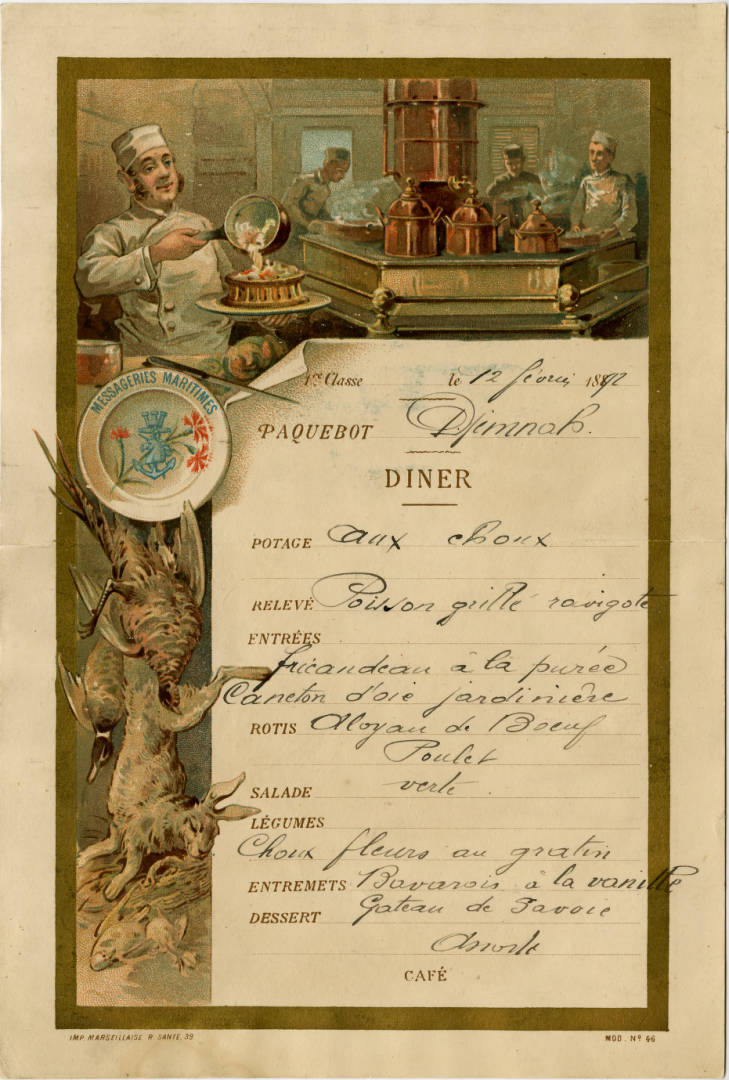
   We might as well begin with menus. Some specifically Canadian resources are offered near the bottom.

Menus


Culinary Institute of America 

“About this collection:
This selection of menus from The Culinary Institute of America Menu Collection features historical menus that are relevant to the Hudson Valley region, including menus from CIA restaurants, from restaurants and hotels in New York State and New York City, and from the Smiley Family Menu Collection. View all digitized menus from the CIA Menu Collection .”

Menus- The Art of Dining. The University of Nevada -Las Vegas
“Menus provide a wealth of information beyond their purely aesthetic value and are a particularly rich resource for aspects of cultural and social history. They give us information on the most popular cuisine of a time period and region and are evidence of changing culinary tastes.”
This site is very visually appealing. You can also find 17 Canadian menus.


What’s On the Menu? -New York Public Library
“We’re transcribing our historical restaurant menus, dish by dish, so that they can be searched by what people were eating back in the day.”


Database of Menus - Los Angeles Public Library

A database of menus from Los Angeles, other cities, steamships, airlines and banquets. Images of the actual menus are being added. The address and telephone number of the restaurant is given, plus the menu date, cuisine type, meal, and price range.


Omnibus Sites

Food Timeline [link]
Although no longer updated, this timeline is well-designed and comprehensive. Click on 1830 and find out how to make Worcestershire Sauce, or 1894 to learn about Eggs Benedict.
“The Food Timeline was created and maintained solely by Lynne Olver (1958-2015), a reference librarian with a passion for food history. About it she originally said " Information is checked against standard reference tools for accuracy. All sources are cited for research purposes. As with most historical topics, there are some conflicting stories in the field of food history. “

"A Food History Story and Recipe Every Weekday of the Year"

What’s Cooking America?
https://whatscookingamerica.net/History/HistoryIndex.htm
A site by Linda Stradley that is wide-ranging and covers the history of beverages as well as food - everything from “Chitlins’ to Crepes Suzette.

HISTORICAL COOKBOOKS

Keep in mind that you are being served only an appetizer. For more resources search library catalogues using such subject headings as Food-History, Cooking-History, Gastronomy and various subheadings. At the university close-by (Western) you can find this bibliography: English Cookery Books to the Year 1850, by A.W. Oxford and even a work done by a former faculty member: The Culinary Recipes of Medieval England : An Epitome of Recipes from Extant Medieval English Culinary Manuscripts, by Constance Hieatt. As well, links to old, out-of-print cookbooks are often provided and one can even print a copy. See, for example, by Hannah Glasse,  The Art of Cookery Made Plain and Easy:To Which are Added, One Hundred and Fifty New Receipts, a Copious Index, and a Modern Bill of Fare, for each Month, in the Manner the Dishes are Placed Upon the Table. (c.1783).
There are also related periodicals. For example, see Food & History which contains useful articles such as this one: “Printed Cookbooks: Food History, Book History, and Literature,” by Henry Notaker, Vol. 10, No.2, 2012.


If you are interested in the food history of the United Kingdom, you will find plenty of options. See, for example, these two: History of Food and Drink in the Institute of Historical Research Library and the Guildhall Library “Wine and Food” collection. ]

Cookbook History
     For an understanding of how some culinary collections are created see this very interesting article about an octogenarian librarian who has spent most of her life preparing a database of cookbooks: “The Archive of Eating....”, Bee Wilson, New York Times, Oct, 29, 2015.


19th and 20th Century Cookbooks from LeMoyne
     This excellent website if from the Noreen Reale Falcone Library at LeMoyne College in Syracuse, N.Y. Provided are links to hundreds of historical cookbooks from a variety of places with directions for preparing all kinds of food.

Feeding America: The Historic American Cookbook Project - Michigan State
“The Feeding America project has created an online collection of some of the most important and influential American cookbooks from the late 18th to early 20th century. The digital archive includes page images of 76 cookbooks from the MSU Library's collection as well as searchable full-text transcriptions. This site also features a glossary of cookery terms and multidimensional images of antique cooking implements from the collections of the MSU Museum.”

Home Economics - Cornell University Library
“HEARTH is a core electronic collection of books and journals in Home Economics and related disciplines. Titles published between 1850 and 1950 were selected and ranked by teams of scholars for their great historical importance. The first phase of this project focused on books published between 1850 and 1925 and a small number of journals. Future phases of the project will include books published between 1926 and 1950, as well as additional journals. The full text of these materials, as well as bibliographies and essays on the wide array of subjects relating to Home Economics, are all freely accessible on this site. This is the first time a collection of this scale and scope has been made available.
   This part relates to Food & Nutrition.
   This section covers Food, Wine & Culinary History.

Manuscripts & Menus - University of Iowa
Guide to the Szathmary Culinary Manuscripts


“Summary: Among the more than 20,000 items in Chef Szathmary's culinary arts collection are just over 100 German, Czech, Irish, English and American manuscript recipe books. There is also a group of manuscripts related to food from the Chicago writer Nelson Algren.”
See also the Szathmary Recipe Pamphlet Digital Collection.
“The University’s collection includes more than 4,000 promotional recipe pamphlets, published mainly by food and appliance manufacturers and trade associations (the majority are listed in this index).  Dating from the late 19th century to the present, this advertising ephemera reflects the evolution of the modern American diet.”

Virginia Tech
Food & Drink History Resources @Virginia Tech (and Beyond): Digital Collections & Exhibits
As the title suggests, this guide links you to some of the websites presented here as well as many others.

Major Library Collections

Books About Food History - Library of Congress
“This guide, a revision of Library of Congress Science Tracer Bullet 04-1, focuses on works on food history. The intent is to assist researchers in identifying resources and trends in food history studies, through a broad sampling of writings and bibliographies. Rather than being a comprehensive listing, the titles listed here are intended to give an idea of the breadth of information available, with the focus being on works published in English, during the 19th, 20th and 21st centuries, and mainly in the United States, though other time periods and areas have occasionally been included. Not intended to be a comprehensive bibliography, this guide is designed--as the name of the series implies--to put the reader “on target.”


New York Public Library
Culinary History - New York Public Library
“The field of food and cookery has always held a strong interest for The New York Public Library. The retrospective collection on gastronomy and the history of foods is unusually extensive, and the cookbook collection alone numbers well over 16,000 volumes. From the beginning, the Library has sought out culinary materials from all regions of the country, and from all parts of the world, in all the languages in which it collects. Some highlights of the collections are described in an article in Biblion, The New York Public Library's journal, in the issue of Fall 1993 (vol. 2, no. 1).”

Canadian Culinary Sites

Culinary Historians of Canada
 Apart from the section “Canadian Cookbooks Online” be sure to look at “Further Resources” where the major Canadian sources relating to food are listed. For example, one finds a list of historic kitchens found in Canadian museums.

British Columbia Food History Network
“Our intent is to share research into the history of food in British Columbia. Our inquiries are wide-ranging and include such topics as early food production, food products, and food practices as well as the social, economic, political and cultural significance of foods produced and consumed in British Columbia.”
Apart from cookbooks it contains essays relating to food history and book reviews.

Canadian Library-Related Collections: Guelph University
Guelph hosts a major culinary collection.Unfortunately you will have visit Guelph to access the material. “Throughout its history, the University of Guelph has been at the forefront of foodways education and research. Guelph's Culinary Collections feature an impressive variety of books as well as manuscript and archival resources. With more than 17,000 published volumes, some of which date back to the 17th century, it ranks as one of the largest collections of cookbooks in North America. Two collections are especially large and contain a variety of important historical works: the Una Abrahamson Collection and the Canadian Cookbook Collection. They contain publications from many countries and highlight the development of cookery not only in Canada, but also in other parts of the world|

Canadian Cookbooks


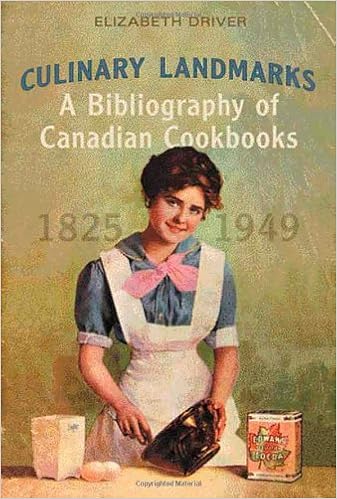
Culinary Landmarks: A Bibliography of Canadian Cookbooks, 1825-1949, Elizabeth Driver

Culinary Landmarks is a definitive history and bibliography of Canadian cookbooks from the beginning, when La cuisinière bourgeoise was published in Quebec City in 1825, to the mid-twentieth century. Over the course of more than ten years Elizabeth Driver researched every cookbook published within the borders of present-day Canada, whether a locally authored text or a Canadian edition of a foreign work. Every type of recipe collection is included, from trade publishers' bestsellers and advertising cookbooks, to home economics textbooks and fund-raisers from church women's groups.The entries for over 2,200 individual titles are arranged chronologically by their province or territory of publication, revealing cooking and dining customs in each part of the country over 125 years.


Recently McGill-Queen's University Press re-issued a new edition of a Canadian classic for the modern cook:


“What did you eat for dinner today? Did you make your own cheese? Butcher your own pig? Collect your own eggs? Drink your own home-brewed beer? Shanty bread leavened with hops-yeast, venison and wild rice stew, gingerbread cake with maple sauce, and dandelion coffee - this was an ordinary backwoods meal in Victorian-era Canada. Originally published in 1855, Catharine Parr Traill’s classic The Female Emigrant’s Guide, with its admirable recipes, candid advice, and astute observations about local food sourcing, offers an intimate glimpse into the daily domestic and seasonal routines of settler life.
This toolkit for historical cookery, redesigned and annotated in an edition for use in contemporary kitchens, provides readers with the resources to actively use and experiment with recipes from the original Guide. Containing modernized recipes, a measurement conversion chart, and an extensive glossary, this volume also includes discussions of cooking conventions, terms, techniques, and ingredients that contextualize the social attitudes, expectations, and challenges of Traill’s world and the emigrant experience.”

   See also this new book from the University of Manitoba Press:
Snacks: A Canadian Food History, by Janis Thiessen.


A Few Special Topics

BBQ
An Updated and Tasty Reference Guide from the Library of Congress: “American Barbecue: History and Geography”

Local Cook Books - Lackawanna Valley
Funded by a grant from the Willary Foundation, this is a collection of historic cookbooks produced by churches and communities organization often containing rare and ethnic recipes.

Local Cook Books - Indiana
Service Through Sponge Cake
“The digital collection of cookbooks is a collaborative effort between the University Library and the Indianapolis Public Library and will focus on Indiana cookbooks dating from the turn-of-the-century, with a special emphasis on fundraising cookbooks published by churches, synagogues and other community organizations. The University Library has created the community cookbook collection using unique materials from the Indianapolis Public Library's collection of historic Indiana cookbooks. The online collection includes digital images of each cookbook in its entirety, plus in-depth descriptions of each item. The collection is fully text searchable and broadly available on the Web.”

Presidential Food
This guide includes: Books on Presidential Food, Individual Presidents, Related Titles, For Younger Readers, Representative Articles and additional Selected Online Resources.

The History of Food and Dining at Harvard
Apart from menus, there is even a section on Food Fights.

Literary Feasts


From The American Scholar - "The 11 Best Literary Feasts: Our Favorite Fictional Culinary Scenes," June 17, 2017.

Thursday, 26 April 2018

JASPER CROPSEY

Pictures From an Institution
     Winter remains and I am still inside doing some reading and very little posting. I will attempt here to parlay a current event into a post.
   
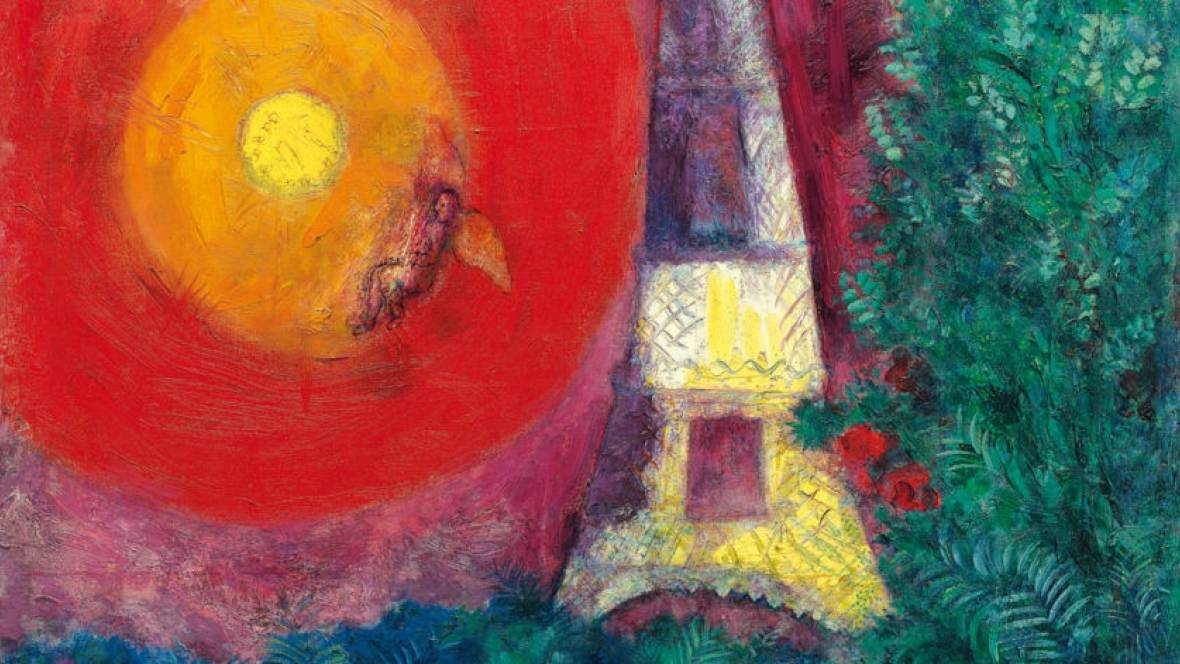
     Of late, Chagall has been much in the Canadian news and that got me thinking about Cropsey. Unfortunately that is the way I think. The connection, except for the fact that the two gentlemen are artists, is not apparent, but in this quick (I hope) exercise, I will try to make one.

     I am not sure how scholars of art would characterize Chagall, but I will just call him ‘Modern”, whereas Cropsey is known as a member of the Hudson River School. Rivers and woods and romanticized landscapes are often the subjects of those in this School and, being unsophisticated about such matters, I like them much more than the abstract offerings  and the modern art found in most galleries. The works of the Chagall and Cropsey are quite different, but the admirers of each are willing to pay large sums to obtain one of their paintings. The connection I made between the two relates to the problems that can arise when one attempts to sell one of their paintings.

The Chagall Conundrum


     Since you probably know about this current episode and since this post is mainly about an older one involving Cropsey, I will provide the basics here and some sources below.
     The National Gallery came up with the idea of selling a Chagall in order to raise enough funds to purchase a David. The Chagall painting,  La Tour Eiffel, is pictured below here:


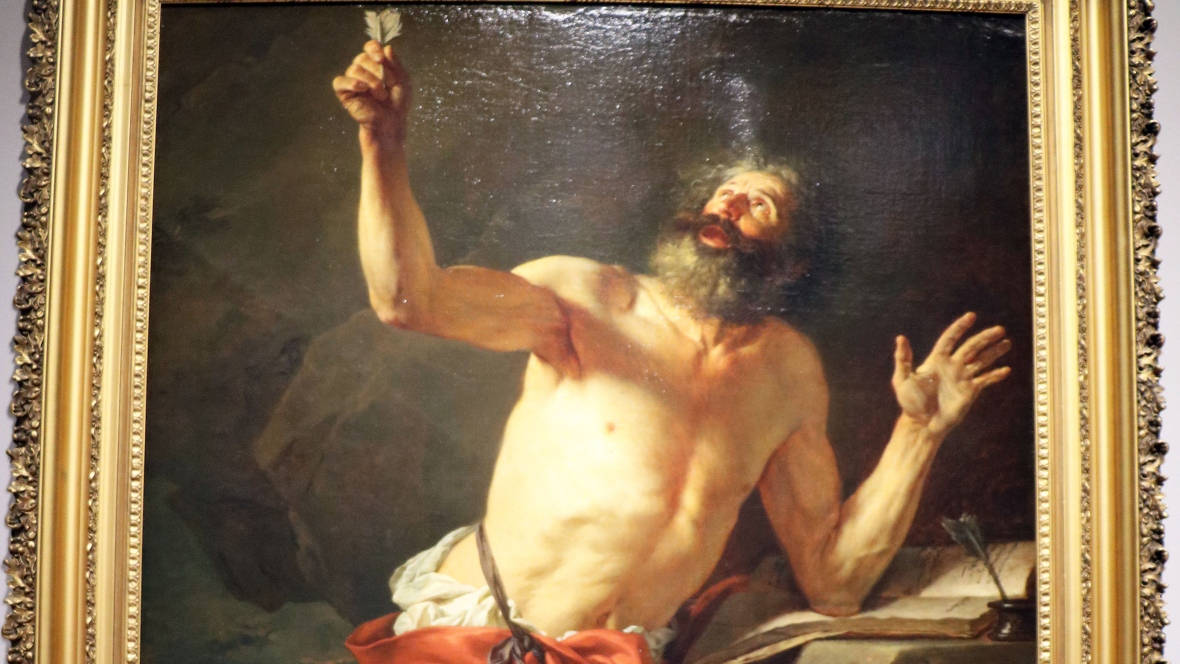
     The painting by Jacques-Louis David is owned by the Notre‑Dame‑de‑Québec Parish Corporation, a Catholic group, and they needed to sell the painting to upgrade the plumbing in some of their churches. Both paintings are worth millions. The David is here and, ironically enough, it appears to depict the dismay and alarm experienced by those involved:

Saint Jerome, also known as Saint Jerome Hears the Trumpet of the Last Judgment, by French artist Jacques‑Louis David, can currently be seen in Montreal's Museum of Fine Arts. (Elysha Enos/CBC)

      Apart from aesthetics - politics, religion, identity politics, and federal/provincial affairs are involved, hence the conundrum. (Since the Supreme Court has just ruled that beer could not be carried between provinces, one expected that the transfer of valuable art work might be problematic). The Quebec Culture Minister has declared Saint Jerome a ‘heritage’ work and it will not be leaving the province, so the problem has been solved.

The Cropsey Controversy


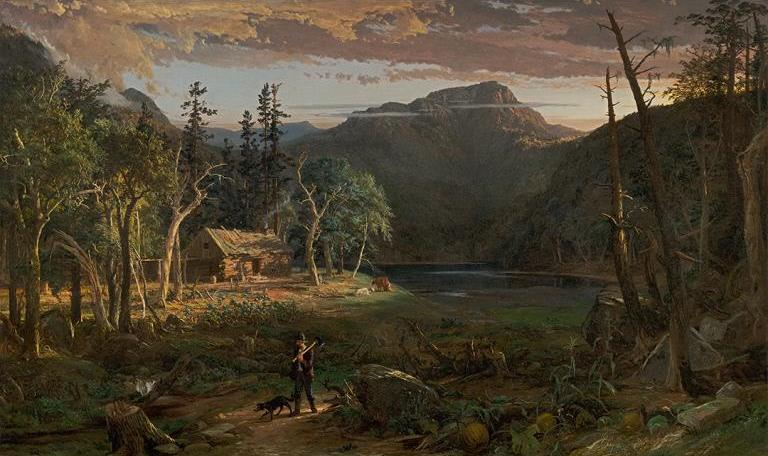
     I have vague (very vague) memories of this incident which occurred almost forty years ago at the University of Western Ontario. It is, by the way, a fine university, but like the other Canadian ones back in those days, it relied upon government funding of which there was never enough. Simply put, when the University had the opportunity to sell Cropsey’s Backwoods of America, it took it. Those who valued the painting as a work of art, lost to those who thought it was more valuable as a commodity. More details are provided in this account by Poole:

“While there was always a certain tension between the McIntosh Gallery administration and the department of visual arts, this developed, in the winter of 1980, into open warfare over the proposed sale of a painting, Backwoods of America by Jasper Cropsey, a nineteenth century American artist. W. H. Abbott, the art collector who had been a representative of the Western Art League to the Western Fair Association for many years early in the century, had given the Cropsey painting to the university in 1931. The fuss began when it was suggested that since the university was not building a collection of nineteenth century American paintings, perhaps the work should be sold. About this time, however, a professor in the visual arts department was writing an important paper on the Cropsey painting in question. He and his colleagues were adamant in their opposition to any thought of selling the work. Their position was that until the paper was published, it was vital that the work remain on campus. The university administration was faced with a rapidly escalating art market and was advised by the auction house of Sotheby Parke Bernet in New York that the painting was a valuable work, and that now was the time to sell it. Opposition to the sale was so strong throughout the university community, however, that the administration delayed any action. The following year, when the art market moved even higher, the Board of Governors decided that Backwoods of America must be sold. In the spring of 1981, the painting went up for auction in New York*, and, as a result, the university received $665,000 - probably the largest amount of money ever paid for a work of art from a London collection. While the faculty of visual arts still believed the sale to be ill-advised, the McIntosh Gallery now received the annual interest from the capital realized by the sale, and because those funds came ultimately from a gift to the university, the government agencies for the arts were willing to give the McIntosh matching grants each year. The sale thus guaranteed comfortable budgets for all future acquisition committees.”
The Art of London, 1830-1980, Nancy Geddes Poole, 1984. Pp.178-179.

     The professor to whom she refers is the author of a thorough analysis of the painting which is found in this article where more details about Cropsey in relation to the campus are also provided.
“Here Today and Gone Tomorrow: Jasper F. Cropsey's 'The Backwoods of America',”Bernard  Bonario, RACAR: revue d'art canadienne / Canadian Art Review, Vol. 9, No. 1/2 (1982), pp. 9-20
“The University of Western Ontario acquired The Backwoods of America in January, 1933. It was the gift of a local philanthropist, W.H. Abbott, among whose interests was the organization of art exhibits at the city’s annual Western Fair.” [p.9]
“Almost ironically, The Backwoods of America is the most significant painting to have passed through Abbott's modest art collection, remaining on public display for several decades and hanging in the University's Lawson Library until about 1970, when it was transferred to its location in the collections of the University's newly reorganized Mcintosh Art Gallery. [p.10]
4. University of Western Ontario, McIntosh Art Gallery, inv. 221
“I studied the painting in storage under unfavourable conditions. Since the completion of my manuscript in March 1979, the University has deaccessioned The Backwoods of America. Sold Sotheby Parke Bernet, Inc., New York, sale 4583M (23 April 1981), lot 18. [footnote 4, p.10]
   
     This episode proves, if nothing else, that Sayre’s Law does not alway apply since the stakes were pretty high. ("Academic politics is the most vicious and bitter form of politics, because the stakes are so low.")

Backwoods of America

Provenance:
(W. B. Huggins & Co., Glasgow, Scotland), by 1859; purchased by Private Collection, Glasgow, Scotland, March 10, 1859; (Williams & Sutch, London, England), 1932; to (Leslie W. Lewis, London, England), 1932; purchased by William H. Abbot, London, Ontario, Canada, 1932; given to University of Western Ontario, London, Ontario, Canada, January 1933; to (Sotheby's, New York, NY), April 23, 1981, lot 18; purchased by Richard and Jane Manoogian Foundation, Taylor, MI, 1981; purchased by Crystal Bridges Museum of American Art, Bentonville, AR, 2006


 Label Text:When Cropsey painted The Backwoods of America, land across the country was being developed at an unprecedented pace. This idealized pioneer landscape depicts a remote homestead nestled along the shore of a wilderness lake. As the sun breaks over the mountains, a pioneer family begins its day. A woman stands in the doorway of a log cabin, her young children playing nearby, while her husband heads into the woods, shouldering a long-handled broadax and accompanied by a dog. A garden that includes the distinctly American pumpkin grows in roughly cleared patches along the forest's edge. As if forecasting the imminent end of frontier life, the artist signed his name on a rock resembling a tipped-over gravestone that soon will be covered by the cultivated pumpkin vines.

Sources:

      For the current Chagall issue see:
“Quebec Will Grant French Painting Heritage Status, Bringing Saga to an End:
Sale of 'Saint Jerome Hears the Trumpet of the Last Judgment,' Painting From 1779, led to Tensions,” CBC News · Posted: Apr 24, 2018.
“National Gallery’s Sale of Marc Chagall Work Linked to Tug of War Over Jacques-Louis David Painting,” Robert Everett- Green, Globe and Mail, April 12, 2018.

     For the Cropsey issue at Western, there is little additional information that is easily available. I am sure the student newspaper and some UWO publications would have covered the controversy. Unfortunately the back issues are only available via film or fiche if you wish to fiddle with them.

Post Script:

The usual bonus information for premium subscribers.

Pictures From an Institution
    The irrelevant title of this post refers to a campus novel by Randall Jarrell, should you want to read more about academic life.

The Case at Fisk University
    A couple of years ago this institution had a similar issue:
“When Fisk University, the historically black school in Nashville, tried to sell two paintings several years ago from its storied Alfred Stieglitz art collection, a firestorm erupted. The proposed sale violated conditions of the gift of the collection from Stieglitz’s widow, Georgia O’Keeffe, according to her foundation….
But what was not revealed at the time, and has only recently come to light, is that before the agreement was completed — and with the debate over the future of Fisk itself swirling around her — Hazel O’Leary, then the university’s president, on behalf of the school quietly sold off two other paintings owned by Fisk….
Fisk’s under-the-radar sale of the Stettheimer highlights the minefield institutions must navigate when they use proceeds from art, whether to pay expenses or, in recent years, to try to finance costly expansions. At the same time, the sale reveals what can happen when an artist — even one as critically revered as Stettheimer — fails to secure her legacy.”
“A Prized Stettheimer Painting, Sold Under the Radar by a University,” Susan Mulcahy [no relation], New York Times, July 26, 2016.

Those of you who shop at Wal-Mart will be glad to know your money is well-spent since the painting from Fisk, and the Cropsey from Western both were bought by Alice Walton and can be found at Crystal Bridges. You may recall that I visited this wonderful museum in Arkansas and wrote about it in the post Amazing Accomplishments

Association of Academic Museums and Galleries
     This association set-up a task force to deal with the issue and you can learn more about it here where I provide the opening paragraphs:
Task Force for the Protection of University Collections
“National economic crises create tensions at all levels of society. In the United States, cultural institutions of all sizes have been particularly vulnerable in times of economic recession, particularly those institutions that are part of larger umbrella organizations such as cities, colleges, or universities.

“University collections, particularly art collections, are increasingly being viewed as disposable and coveted assets by parent organizations desperate to shore up faltering endowment funds or to fill budget gaps caused by reduced funding from states. Even those university museums that have worked hard to ensure that their parent college or university views them as an essential part of the academic enterprise may face threats when severe economic crises hit.”

No Deaccession at Dubuque
     When recently offered $6 million for a Grant Wood, the Dubuque Public Library rejected the offer. See: “Dubuque Library Refuses $6M Offer to Buy Grant Wood Painting

Colby College Doesn’t Have to Worry About This Issue
    “ Benefactors Give Colby College Art Museum a Gift Worth $100 MillionAgain
The Donation by Peter and Paula Lunder Will Launch the Lunder Institute for American Art and Elevate the College as a Global Research Center on American Art,” Amy Calder, Morning Sentinel, Feb. 2, 2017 (Portland Press Herald).
WATERVILLE — The Colby College Museum of Art has received a gift of more than $100 million from longtime supporters Peter and Paula Lunder that college officials say will help cement the region’s reputation as a world-class arts destination.
The donation, the Lunders’ second gift of more than $100 million, includes about 1,500 works of art and will launch the Lunder Institute for American Art, whose focus will be the practice, study and exhibition of American art. As part of the institute, scholars, artists and curators will work with students from all disciplines.
Colby officials say the gift, which was announced Thursday night at a meeting of Colby trustees in Boston, helps establish Colby as the only liberal arts college with a top museum and a global research center dedicated to American art.

Picture Problems at York University
     Sometimes (especially these days) a university can get in trouble for displaying rather than deaccessing a piece of art. This happened at York when Mr. Bronfman, a major benefactor, objected to the painting below.
“York University's ‘Inclusion’ Committee Stacked With Anti-Israel Faculty, Jewish group Charges: The University Promised a ‘Committee on Inclusion’ in the Wake of Prominent Donor Paul Bronfman’s Objections to a pro-Palestinian Painting on Campus,” National Post, Tristin Hopper, April 6, 2016.