Showing posts with label toponymy. Show all posts

Monday, 22 June 2026

Kitty Coleman

 Kitty Coleman Provincial Park


     Recently we spent some time in the Comox Valley area on Vancouver Island. While there, we visited both the Kitty Coleman Provincial Park and the Kitty Coleman Woodland Gardens. Although personal names appearing in place names is common in B.C. (e.g.,Vancouver), Kitty Coleman caught my eye.

      A few years ago I wrote a book and in it “Kit" Coleman is mentioned. “Kit” is the diminutive associated with Kathleen Blake Coleman who was a famous Canadian journalist and war correspondent. She is the “Kit” I found during my research and I didn’t recall her ever being referred to as “Kitty”.  Could the Kitty Coleman for whom the park is named, be simply a West Coast, laid-back reference to Kathleen “Kit" Coleman?


Kit Coleman


   The short answer is “No”.  The famous “Kit Coleman” I wrote about showed up recently on a commemorative Silver Dollar issued by the Royal Canadian Mint. (For more about that Kit Coleman and the coin see, Kathleen "Kit" Coleman.)
   
Although I am reluctant to use the following word in relation to an Indigenous woman, the infamous “Kitty" Coleman shows up in the database of BC Geographical Names where this is found:
   “Kitty Coleman was an Indian woman who, 40 or 50 years ago, left her tribe to marry a white man. He was later jailed, and she lived alone on this beach selling fish and berries. The beach became known locally as Kitty Coleman's Beach, hence the park name….There are frequent references to Kitty Coleman in court documents through the 1890's and into the early 1900's; she ran a brothel (location not specified), and was frequently cited for unseemly behavior or jailed on prostitution charges. In later years, she lived near Cape Mudge.”

   
  I confess to being curious about “Kitty” and did a cursory search. The following article was found and it is very interesting. Since it involves Indigenous matters and “colonial” ones, which are contentious these days, I will offer no comments, other than to say that the infamous Kitty and the famous Kit both deserve more attention and research.


       THE GAZETTE, MONTREAL. TUESDAY. MAY 8, 1906, p.7

“SLAVERY AMONG INDIANS”
A Bad State of Affairs Reported in
British. Columbia.

Ottawa, May 7.--  (Special) According to a return secured by Mr. Borden, there seems to have been ample grounds for the statements which appeared In the British Columbia papers a few months ago, that Indian children were being sold into slavery in that province. The matter first came to the attention of the department through a letter from the Rev, J. B. Kindle, of Cape Mudge, B.C., who wrote to Mr. Vowell, Indian superintendent at Victoria, transmitting the complaint of an Indian named Billy Seawhit and his wife Sarah.These Indians said that Mr. South, agent of the Children's Aid Society of Vancouver, had visited the Indian village at Cape Mudge, and had taken from the Seawhits their little girl, who was known as Edith Grant. From reports it appears that she was three parts white and one part Indian. Mr. Debeck, agent for the Indian Department at Cape Mudge, when, asked for particulars of the affair, reported that the child was in the hand of a vicious Indian woman named Kitty Coleman, and that, by order of two magistrates, the child was handed over to Mr. South, to be cared for by the society
at Vancouver. Mr.Debeck says that Mr. South, is a most humane man, and
took this action after full enquiry upon the spot Then, curiously enough,
Debeck recommends the Seawhits to consult a Vancouver lawyer, with a view to compelling the Vancouver society to deliver the child up to the parents. Transmitting Mr. Debeck's report, Mr. Vowell declares that from every possible moral standpoint Mr.South took the proper course under the circumstances. He comments upon the inconsistent position of Mr. Debeck in recommending to the parents to resort to law. They did secure a hearing before two Judges to Vancouver, and after full enquiry the child was ordered to be retained by the Vancouver society. Mr. Vowell proceeds to say that girls with white skins, thick brown hair braided down their backs, and big, innocent, childish eyes, are being sold today, and have been sold for years in British Columbia to the highest bidders. He points out that many of the girls are sent into the logging camps for immoral purposes, and urges that this practice should not be allowed to continue longer. He thinks that the administration of justice department in British Columbia should take hold of the matter. 
   Agent Debeck makes a special report to the department from Alert Bay, dated October 23rd last. He says almost every Indian in that agency who Is in the potlatch is a slave dealer; fathers sell their daughters, brothers sell their sisters or cousins, and he knew of one instance where a son offered his old mother for sale as a slave. He mentions one case where a boy was taken out of the Indian school, and a young girl of 12 or  13 from the girls' school was sold to him. They lived together for a while, and then the authorities compelled both to go back to sohool again. Mr.Debeck recommends a remedy for the existing evils, first of all, the putting down of the potlach, which is really at the bottom of all the evils complained of. He says It should be done with a firm hand, not in a slipshod manner in which Justice has been administered among the Indians in the past. Secondly, he suggests a rigid enforcement of the law, especially as regards the sale of intoxicants to Indians which  is at present, he says, a disgrace to any civilised country. Third, he suggests patting a stop to the custom of buying and selling women, and,  if possible, the compelling  of the Indians to marry their women legally, and lastly, if possible, to keep out the grafters. These different communications evidently stirred up the Indian Department, as a circular letter was sent to all inspectors and agents in the western provinces, asking for information on the subject of the intermarriage between whites and Indians, a number of alliances of a temporary character, the age at which Indian children should be allowed to marry, and the extent of the custom of selling young girls into slavery.
   Again Agent Debeck is to the fore with some pretty frank advice. He says: "You may legislate for these Indians until doomsday, and they will never do any good until this curse of their whole lives, the potlatch, is completely wiped out.” Further he says "People come here in the  garb of missionaries, start a store, commence trading with the Indians, making what they can out of them, ride roughshod over the Indian Act and are then upheld by the Indian Department.  As far as the Criminal Code goes. It Is about the same. All manner of crimes ore committed among these Indians, even to murder, and it is seldom that any of them are brought to justice."

[The source is provided and should be checked. This version is a result of my cutting and pasting and may contain errors. The bolded print is not in the original and was applied by me to call attention to the 'sensational' parts.]

Place Names:
   I suppose one could ask if a place should be named for someone who exhibited "unseemly behavior", ran a brothel and is described as "vicious'. I am not one who would ask such a question and am against the scrubbing of names from maps. For a good book relating to questionable toponyms see, From Squaw Tit to Whorehouse Meadow: How Maps Name, Claim, and Inflame by Mark Monmonier. For a fascinating book about names on the land, read Names on the Land by George R. Stewart.
  For a discussion of those books in MM see "Names on the Land" and the post about the author, George R. Stewart. 
 
For more about name changing (and name calling) in B.C., where there are some who want to sanitize the landscape and remove names that often reveal interesting stories see, "British Columbia or Saquatchia?". 
  For my typical contrarian view about name changing, see "No More Name Changing".
  The geographical puritans are also worried about names in the Southern Hemisphere. See, for example, "The Meaning of Magellan."

Monday, 31 October 2022

Lovely Names for Lost Landscapes


   I just did another post about the elimination of old geographic names and I will not bore you again with that subject. Instead, I will suggest that we should also be concerned about the creation of new toponymic terms. Particularly as they are applied to recently constructed housing developments.

   You may have noticed when travelling around the perimeter of London, that the natural landscape is rapidly being altered and replaced by rows of very large homes on very small lots. While they may not look attractive, they are attractively described and if you are lured by the name, you are likely to be disappointed. 

   There appear to be no truth in advertising regulations about names which are deceptive, so I will offer a few suggestions here. If the name sounds old and has the word "Mews" in it, it is brand new. Often the description is about things which don't exist on the sites, or conveys notions about what the place is not. "Rolling Meadows" is likely to be flat and not green. If trees are mentioned there will be none and do be especially wary of those that offer groves of chestnuts. Avoid descriptive phrasing that uses "At", as in "The Sanctuary at Sydenham Canyons" or "The Preserves at Port Stanley." An "Andover Trails" will have few and none that are not concrete and if the brochure uses the word "Trace" for "Trails", surely there will be no place to hike. 

Fancy Names for Bland Developments is Not a New Development

   In the early part of the last century one finds examples of entrepreneurial developers who were guilty of real estate hyperbole and in this quote you will learn that I am not the first to make fun of it.

"I had not been long in the Northwest before I discovered it to have elegancies. It first astonished and then mildly amused me to run across, among the stumps still standing on logged-off land, a hunt club, complete with red coats, masters of the hounds, and considerable view halloo….
The Northwest was spotted here and there with elegancies other than hunt clubs. I suppose all new countries go through like labors. Kensington Manors were appearing suddenly where one might yet hear the melancholy cadences of the owl. Out of the newly drained swamps, as one watched, sprang Mayfairs, Windermeres, Highland Moors. A small convivial party of newspaper reporters once devoted an entire evening to conjuring up the most preposterous names possible for one of these raw new subdivisions. We finally settled on Buckinghamshire Mews."

The Source: 
   
Far Corner: A Personal View of the Pacific Northwest Including Certain Places No Longer Found, Stewart Holbook.

The Bonus:
 
What the hell is a "view halloo"? ---"
a shout given by a hunter on seeing a fox break cover."

Saturday, 29 October 2022

British Columbia or Sasquatchia?


Should The Name Be Changed? 

   
   At some point in the near future, the name of the province of British Columbia may be changed. Although right now a majority of the people who reside there do not want to change the name, those in the vocal minority are likely to make the call to do so and it will be done. 
   There are two major problems with the name: 1) the word "British" and 2) the word "Columbia".  They are both now noxious. 
    Don't worry. If the name changes and you miss the news, you will still be able to find the province. For example, if you google the "Queen Charlotte Islands" you will now automatically learn from the Wikipedia entry that this group of islands is known as "Haida Gwaii." I suppose future google searches will also find Galiano Island and Mount Garibaldi under their new names. And, for that matter, Prince Edward Island. 
   I was recently in British Columbia which is why I am bringing up again, the subject of "names." I wrote "again" because I think it is mostly mistaken to yield ground to the totalitarians of toponymy who would like to vacuum clean the map, and have said so. In short, remember the children's rhyme, "Sticks and stones.." For arguably more mature reasons see, Names on the Land, No More Name Changing or First They Came For the Names. For even more about both names and words now problematic see, This is NOT About Mariah Carey, where statues are also touched upon (the puzzling title is explained by the fact that it was conjured up on a new year's eve. I would change the title, but am not unhappy with the content. You will find in it, for example, a consideration of university names which are, or will be, under the microscopes yielded by the new linguistic puritans. Remember "Ryerson University?")
   More than enough said. You can decide for yourself and probably already have. Below are seven sources relating to the name "British Columbia." The last one is my favourite. Citations are provided in case the links rot. 

Sources:
“Renaming Places: How Canada is Reexamining the Map: The History Behind the Dundas Name Change and How Canadians are Reckoning With Place Name Changes Across the Country — From Streets to Provinces,” Robert Jago, Canadian Geographic, July 21, 2021. This is an interesting piece and in it one learns that in 1858, there was consideration given to the idea that an “Indian name should be sought out and adopted in a translated shape.” Columbus is thoroughly denigrated and the author asserts that: "The name British Columbia is unquestionably offensive in this or any era. The name was never meant as anything but a placeholder, disliked at its own inception; it became the name of the colony, and then the province, because time and distance prevented the founders from finding their preferred choice — an Indigenous name.”

“Should British Columbia Change Its Name? As We Reckon With History, Some Say It's Time,” CBC NEWS, AUG. 2, 2021
“There's been a national reckoning on place names and the people they're named after — and some say that conversation should include looking at the name of British Columbia, which is derived, in part, from Christopher Columbus.”

“Majority of British Columbians In New Survey Say No Way to B.C. Name Change
CBC News · Posted: Aug 31, 2021
Most B.C. residents don't want the name of their home province to be changed to reflect the area's Indigenous heritage, according to a survey created by Research Co. 

“A New Name For British Columbia? Here Are a Few Ideas,” Vancouver is Awesome, Jack Knox, Jan, 28, 2018. 
“First, let’s get real: Nobody is going to change the name of British Columbia. Good idea or bad, it isn’t going to happen. It’s an intriguing proposal to debate, though, as proven by the response to last Sunday’s column.”
It’s an intriguing proposal to debate, though, as proven by the response to last Sunday’s column. After we asked readers to submit alternative names, more than 300 poured in. Some were serious, some frivolous, some thoughtful, some racist, some anatomically challenging.
All were in response to an idea first advanced a decade ago by Victoria’s Ben Pires, who argues the province’s current name is neither historically accurate (direct British rule didn’t last that long) nor inclusive. Thinking about that perspective was the real point of the exercise.

“Rename British Columbia: The Province’s Name is the Shameful Holdover of a Colonial Past," Stephen Collis,  The Walrus, June 16, 2020.

“It Is Time to Rename British Columbia: Changing British Columbia’s Name is an Idea That Has Been Percolating for a While. A Notion That is not as Far Fetched as it Sounds or Without Precedent,” Jennifer Cole, Toronto Star, June 29, 2021.

“No, Don’t Change British Columbia’s Name,” Mark Milke, The ORCA, May 24, 2021.
This is a good article to read if you don’t think the name should be changed. The basic argument is presented briefly below, after which the author discusses slavery on the West Coast, that is, the practice of slavery in Indigenous societies.
“To wit, if the argument for changing British Columbia’s name rests on the notion of past colonial imperfection, that misses the big picture as well: Everyone’s ancestors fail by modern standards. And others, even out-of-step on some matters, had redeeming qualities on others.
But when ideologues look back, they see only extremes in black-and-white, and never the full spectrum of colour. They engage in cartoonish history.”

The Bonus: 
Forget about the politics and have fun. Read this fascinating book:

For more about the author, George R. Stewart, see: "George R. Stewart (1895 - 1980).

Sunday, 19 December 2021

First They Came For The Names

   My stance on the subject of name changing has been made clear - I am against it and have posted about it. The only reason I am bringing it up again is because the situation is about to get worse. The reasons why are provided at the bottom, as are links to my related remarks on this subject - if you wish to see how wrong-headed one can be. I turn now, however, to the subject of the next purge - OFFENSIVE ADVERTISEMENTS.


Next It Will Be The Advertisements

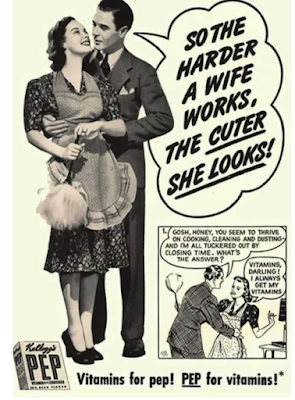
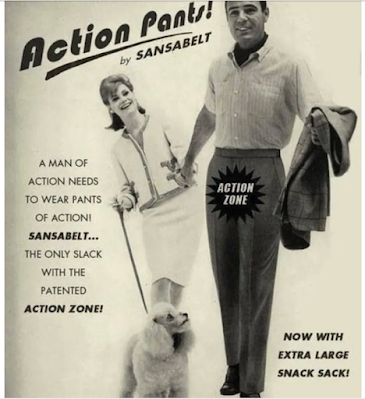
  I am not a fan of advertisements and 'tape' just about every TV program to avoid them. I stopped watching the U.S. evening news, mostly because of them. We also don't need to be encouraged to buy more things and I would be pleased if the one pictured above was never to be seen again. These are current ads, however, and about purging them I am ambivalent.  The ones I am concerned about, are the older ones, particularly those in print, which some fragile person might stumble upon, in what used to be the safe spaces provided by libraries. 

   It did not take me long to find ones that are no longer appropriate and it will not take long for the posses of the politically correct to ask that they be removed, or that huge WARNING signs be placed in periodical rooms. Here are a few and they don't even include the really offensive ones that do not have the right mixture of races, genders, etc. You read it here first and in a few months my minuscule audience will be praising me for my prescience in predicting the next purge. 


   That should be enough. It is perhaps a good thing that General Motors stopped making the Pontiac, because they would have had to change the name in any case.

Sources: 
  The reason I am focusing on this again is because the U.S. Department of the Interior, just issued this press release: Secretary Haaland Takes Action to Remove Derogatory Names From Federal Lands. Surely a giant eraser soon will be rubbing across the more northerly part of the continent. 
   For earlier pronouncements: Names on the Land. And, No More Name Changing. 

The Bonus:
  If you haven't done your Christmas shopping, you can buy this book AND it will convince you that toponymy should not be tampered with: Names on the Land: A Historical Account of Place-Naming in the United States, George R. Stewart.

  Those of you who are familiar with FIRST THEY CAME FOR.... will be aware of the totalitarian trends from earlier times. If you are not see here.