Showing posts with label George R. Stewart. Show all posts

Wednesday, 15 November 2023

The Meaning of Magellan


What's Next: The Ceremonial Lynching of Linnaeus?

   The new old name on the long list of those to be erased is 'Magellan.'  Back in early October, his name showed up in many of those anniversary, "What happened on this date in history," articles with a text like this:
"1520: Ferdinand Magellan, Portuguese navigator, and his expedition team are blown by storms into a strait that separates South America from Tierra del Fuego and other islands south of the continent and that also connects the southern Atlantic and Pacific oceans. The strait now bears his name."
This month he is under attack and there are those who think that both the strait and the clouds in the sky which are also named after him, should be re-labelled. I am not sure what they think about all the other things named "Magellan" and if they are going to have to pull their investments from the Fidelity Magellan Fund.
   Once again, I will tack differently on this issue and continue the battle against the bowdlerizers, who everywhere seem to be in the ascendancy. I will add quickly, however, that Magellan was not a nice fellow, a fact that has been known for a few hundred years. Over those years, somehow most people were able to admire the man for his nautical achievements, be critical of his bad behaviour and not be traumatized by seeing his name on a globe. What name is next, or for that matter what word? Suppose one of the new linguistic puritans learns from the OED that their favourite and very useful word was coined by a colonizer, do we all have to lose it?
   Readers of MM will know my general position on the re-naming issues which I will attempt to briefly offer below, but I will say simply here that I don't think we should throw caution to the wind when it comes to the radical alteration of our vocabularies. 
 

The Throw Magellan Overboard Camp

   I will not attempt to interpret the arguments offered by those who want to see the word 'Magellan' disappear, but instead point you toward their arguments and the sources in which they are found. 
   Suprising to me is the fact the "Magellan Issue"  has been brought forward by those on the STEM side of campus. Perhaps they fear the citizens on the other side of the quad. Here you will find an entire essay on the subject: "The Magellanic Clouds Must Be Renamed, Astronomers Say: A Coalition of Over 50 Astronomers Is Calling to Rename the Large and Small Magellanic Clouds," Monisha Ravisetti, Space.com, Nov.3, 2023. Two major points seem to be that: 1) the author indicates that she is a "Filipino-American, and Magellan is an infamous figure in Filipino history, so this has always been at the back of my mind." , and 2) "The primary issue is that the clouds aren't his discovery." The Indigenous observers saw them first. 
   There will surely be more reactions, but here are a couple available now: "Violent Colonialist' Magellan is Unfit to Keep His Place in the Night Sky, Say Astronomers: Indigenous Peoples Already Had Their Own Names for the Galaxies Named After the 16th- Century Portuguese Explorer," The Guardian, Nov.12, 2023 and "Astronomers Request Retitling of Galaxies Named After 'Violent Colonialist' Explorer Magellan: Large and Small Magellanic Clouds Claimed to Have Been Discovered by Portuguese and His Crew in the 16th Century," Genevieve Holl-Allen, The Telegraph, Nov. 12. 2023. 

The Heretical Minority View (Mine)
   I will simply point you to two of my posts relating to this issue (there are more) and then offer my last defence. See, "Names on the Land", but avoid it if you are going to be injured by names like, "Squaw Tit" or "Whorehouse Meadow." The best writing in it is not mine and is taken from a book you should read before you make up your own mind on the matter - Names on the Land. In it, George R. Stewart writes that,

 The land has been named, and the names are rooted deep. Lake Mead may fill with silt, and Lake Michigan again spill south to the Gulf -- but the names may still remain. Let the conqueror come, or the revolution rage; many of our names have survived both already, and may again. Though the books should be burned and the people themselves be cut off, still from the names -- as from arrowheads and potsherds -- the patient scholar may piece together some record of what we were. 

  Another pertinent post is (spoiler alert), "No More Name Changing" and in it you will learn about "Awful Anna" the hummingbird that the American Ornithological Society is going to kill. If you think all those old bird names need to go, you have an ally in Margaret Renkl, who wrote this article yesterday: "North American Birds Will No Longer Be Named For Racists - or Anybody Else," New York Times, Nov. 13, 2023. That this hummingbird was named for someone's wife does not keep me awake at night and it is likely that the new one will not sound much better.

  If it is decided that one solution for improving names is applying ones that are more descriptive, it will work very well for most birds, unless they are homely, in which case, care must be taken. Sacrificing colourful or contentious names on the landscape or in the heavens will result in areas that are linguistically blighted and devoid of historical references.

  Enough energy has been expended on this issue, if not much thought given. My side in this debate is expressed in the first lines in the poem, "American Names" by Stephen Vincent Benét who expresses sentiments similar to those of George R. Stewart quoted and bolded above. Given the current zeitgeist, this debate is likely to continue, but I think I will no longer be a participant. 

                                              American Names

I have fallen in love with American names,
The sharp names that never get fat,
The snakeskin-titles of mining-claims,
The plumed war-bonnet of Medicine Hat,
Tucson and Deadwood and Lost Mule Flat.
......
I shall not rest quiet in Montparnasse.
I shall not lie easy at Winchelsea.
You may bury my body in Sussex grass,
You may bury my tongue at Champmédy.
I shall not be there. I shall rise and pass.
Bury my heart at Wounded Knee.

    I included the last lines as well and you will recognize among them, the final one which has been bolded. The questions now being considered by those of you concerned about such things are: Should the writings of Stephen Vincent Benét be delisted from curricula because of his reactionary liking of established names? Should the non-Indigenous Dee Brown be cancelled because of his appropriation of such a subject for his book with that title? And should Buffy Sainte-Marie be further vilified for borrowing the phrase from either Brown or Benét, a dead old white male American poet? I suggest that the excessive focus on identity is about as useful for the geographers as it is for the political theorists. Genug Shoyn. 

Sunday, 27 November 2022

Old Beatrice & Uncle Tom


   It has been two weeks since I last posted and it is raining so I will attempt one now. It will be based, I think, on stories I just read in the Sunday papers. You will be relived to know that they are not "news" stories, since most such stories are rather bad these days.

  I will begin with the benign one about Beatrice. The picture above is from the North Sea off the coast of Scotland where the oil rigs, like the one on the right, are being replaced by the wind turbines on the left. There will be over 80 of them and the 50 square miles will be known as "The Beatrice Offshore Wind Farm." Her name was also on the old oil rigs. 

  You will not be surprised that I noticed the name "Beatrice", since I have written often about such names, mostly because they are being replaced. You will also know that I am not generally in favour of such replacements since the history behind them is often more interesting and illustrative than the monikers manufactured by the new toponymic totalitarians among us. 

  Although HRH Prince Charles of Wales reigned over the official opening of the "farm" in the Moray Firth, Scotland, old Beatrice is not British.  She was the wife of old T. Boone Pickens, who has his name all over the campus at Oklahoma State University. Old T. Boone was very rich and his story is more interesting than this post (see below for sources.)


  At this time I don't think anyone is suggesting that Beatrice be removed, but remember that the hummingbird "Anna" is being attacked for being named after the wife of a French naturalist. "Uncle Tom", as in "Uncle Tom's Cabin,"  is causing problems, even in Germany where "Onkel Toms Hütte" is the name of a subway station in Berlin. Blacks would be very much offended by being referred to as an "Uncle Tom" and the one pictured above objects to the station name as do many others. She is not alone and the naming authorities will probably have to re-name a Bauhaus housing development and the street, Onkel-Tom-Strasse. Just as I did not say much about T. Boone, I will say little more about the Uncle Tom controversy in Germany, since it is the type of  "news" story, of which there are already too many. If you can't figure it out, sources are provided, along with some other interesting bits.

Sources:
   
For information about Beatrice see: "Giant Wind Farms Arise Off Scotland, Easing the Pain of Oil’s Decline," Stanley Reed, New York Times, Nov. 27, 2022.
   For Boone Pickens see the very interesting Wikipedia entry. The money he has given to OSU could save Laurentian U. and revitalize the entire industry of higher education in all of Canada. If you are a golf fan you will finally understand why so many of the foreign (and domestic) top PGA tour professionals ended up in Stillwater rather than, say in San Diego. 

  Information about the "Onkel Toms Hütte" controversy is found in this article, from which the illustration above was poached: "A Berlin Subway Stop is Called ‘Uncle Tom’s Cabin.’ Some Black Germans Want Change," Meena Venkataramanan, The Washington Post, Nov. 27, 2022.

The Bonus:
   
There is no doubt that you are still looking for something better to read on this dreary Sunday. Here is a suggestion, which allows me to plug some of my old posts. When discussing the various naming controversies, I have usually mentioned George R. Stewart. His name and book were mentioned in this article which also contains many other good book suggestions: "BY THE BOOK: Douglas Brinkley Would Like to Invite Thoreau to Dinner," New York Times, Nov. 27, 2022. Here is his answer to this question:
"What's the last great book you read?"
"During the pandemic I was transfixed by George R. Stewart’s “Earth Abides,” perhaps the most frightening doomsday thriller of all time. Most of American civilization collapses because of a strange disease, but a Berkeley ecologist is one of the rare survivors of the epidemic. Stewart wrote the book about 75 years ago, but his description of empty cities and the power of nature unleashed seem very contemporary in a world of Covid and climate change. It holds up well, and Kim Stanley Robinson wrote a fine introduction for the 2020 edition."
For more about Stewart and some of his other books see: 
George R. Stewart (1895 - 1980)
 My last post about geographic name changing is:  "British Columbia or Sasquatchia?" There are many more which surprises me. 


Saturday, 7 August 2021

No More Name Changing


 Sticks & Stones

"Sticks and Stones" is an English-language children's rhyme. The rhyme is used as a defense against name-calling and verbal bullying, intended to increase resiliency, avoid physical retaliation and to remain calm and good-living."
   "Sticks and Stones" - Wikipedia
"A common childhood chant meaning hurtful words cannot cause any physical pain and thus will be ignored or disregarded."

   My suggestion for solving the problem of problematic names is that we simply relearn the rhyme mentioned above, rather than relearn all names. And, it is far easier than eliminating all eponyms. I stated my position on the matter of names in this post - Names on the Land - and it has not changed, nor am I now embarrassed about what I wrote, or how it is written. Even if I was someone defined by an acronym such as, BIPOC, I don't think I would be traumatized by seeing the signs for Dundas Street or Plantation Lane.


Birds & Bees

   Those of you who have somehow been able to avoid the debates over toponyms will surely be surprised that the arguments now extend to the naming of birds and even insects (there are other "nyms" by the way. For example, it is proposed by some that the name of "British Columbia" should be changed and I think that BC is an example of a choronym. Other choronyms will need to be examined for excision, as will astionyms such as "Vancouver." Those of you who want to be among the first to display your self-righteousness over an old name newly discovered, as well as those of you who are beginning to worry about the amount renaming to be done, can start here.") I have already done more work than I planned, so here are the basics about the Birds and the Bees.


Awful Anna
 
   
You will find all you need to know at the link above (Bird Names for Birds.) It contains a spreadsheet of: 1) bird names, 2) who the bird was named for and 3) who it was named by. Biographical profiles are provided and here is why Anna's Hummingbird is up for elimination:

"Anna’s Hummingbird was named by René Primevère Lesson, a French naturalist in the early 19th century.  This bird was named to honor Anne d’Essling, wife of François Victor Masséna, Second Duke of Rivoli, who also has a hummingbird named for him by Lesson.
I am personally very fond of this bird species.  This is a bird that used to visit my feeders almost every day all year long in Phoenix, AZ.  I feel very attached to these chunky little hummingbirds, their beauty, their feisty behavior, and their spectacular courtship dives.
My problem with naming this wonderful bird for Anne d’Essling is that she really has nothing to do with this bird other than her husband’s ornithological interests.  Anne probably never saw a live hummingbird and it is unknown if she was even interested in them.  Surely she appreciated their beauty, but that is not known for certain."

Audubon, by the way, was an awful fellow. 


   For bugs, see the link above . I will just say here that the entomologists have moved into the field of etymology. Among the derogatory names the Task Force is currently examining is Gypsy Moth which is offensive to some Romani people. The Crazy Ant is also under the etymological microscope. 

   Rather than worrying about the elimination of the names of some insects, we should be more worried about the extinction of them. For that see: Insect Elegy. 

Post Script:
   To complicate matters I will introduce you to Stigler's Law of Eponymy which "holds that scientific laws and discoveries are never given the names of their actual discoverers.” It is a good reminder of just how collaborative and complex the processes of scientific discovery really are - the point here isn't so much that the wrong person gets credit as it is that the very idea that a single individual can get credit for a discovery is, well...a bit ridiculous."
   The same could be said about naming generally which was usually "collaborative and complex." Names were applied to the land by people who were often scoundrels, to honour people who were even worse and sometimes to satirize them. Some were attached in seriousness, others as a joke and not a few were chosen by those who may have been inebriated.  If the names are eliminated so is the history. Read Names on the Land before you discard Dundas. 

Sources: 
   "This Moth’s Name Is a Slur. Scientists Won’t Use It Anymore:The Entomological Society of America Will No Longer Refer to Common Species of Insects as “Gypsy Moths” and “Gypsy Ants,” Because Their Names are Derogatory to the Romani People." Sabrina Imbler, The New York Times, July 9, 2021.
   "Scientists are Renaming the ‘Gypsy Moth’ as Part of Broader Push to Root Out Offensive Monikers," Caroline Anders,  Washington Post, July 11, 2021.
   For Stigler's Law see the very good: "Stigler's Law: Why Nothing in Science is Ever Named After Its Actual Discover," Alasdair Wilkins, Gizmodo. 7/13/11
[It's hard not to think of Sayre's Law in this context: "In any dispute the intensity of feeling is inversely proportional to the value of the issues at stake."]

The Bonus:
   Country renaming has been continual over the centuries and some of the name changes are both reasonable and understandable. I was reminded of that fact by this recent headline and it is unlikely that you will recognize the name of the country: "Africa's Last Absolute Monarchy Convulsed by Mass Protests," John Eligon, NYT, July 2, 2021. The country is Eswatini, which was formerly known as "Swaziland." Other changes are noted in the article:

Nyasaland became Malawi on achieving independence in 1964. Months later, Northern Rhodesia achieved nationhood as the new republic of Zambia. In 1966, Bechuanaland was reborn as Botswana, and Basutoland changed its name to Lesotho. Rhodesia, following a 14-year period of white-minority rule that was not internationally recognized, became the new nation of Zimbabwe in 1980.
But several former British colonies in Africa — like Uganda, Kenya and Gambia — did not change their names upon gaining independence.


The Bonus Question: 
   Of all the country names on the planet, which one is in most need of reconsideration?
The United States.
Think about it. 
As soon, however, as the emergency of the war [ the American Revolutionary War] had grown less, the inadequacy of the name became apparent. United States of America was greatly lacking in that it applied no good adjective or term for the inhabitants of the country. It was unwieldy, inexact, and unoriginal. Although it rolled well from the tongue of an orator, not even the sincerest patriot could manage it in a poem or song."
Names on the Land, p.171.

Sunday, 20 December 2020

George R. Stewart (1895 - 1980)

Pandemic Reading Project


   It is highly likely that you are bored and have run out of reading material. My purpose here is to introduce you to one author who will provide all the books you need, whether you are a fan of fiction or non-fiction. As well, a large number of subjects are covered.
   You will be surprised to learn that the producer of all these books, on different topics and in different genres, was a professor of English. Don't let that discourage you. He was an interesting fellow and the English Department at Berkeley was clearly different back in his day. You can easily learn more about him in the sources I will offer.  For now, here are some of the subjects he wrote about and there will surely be one-or-two that will interest you. We will begin with the fiction.

The Pandemic

   Although you may be trying to avoid reading about the current Covid crisis, you can't. Nor can your friends and relatives and we are all reading and talking about the same things, which at this moment are vaccines. Introduce some variety into the conversation, by speculating about what would happen if the virus resulted in the loss of most of mankind (or theykind or whatever.) In the novel Earth Abides, a young man returns from the wilderness only to find that most of the population has disappeared - because of a virus. It is a well-crafted tale. The earth abides, the animals do well, but the humans do not.

The Weather

   Always a very popular subject and now we are experiencing it in extreme forms. The National Weather Service ran out of the usual names for storms this year and had to take some from the Greek alphabet. Although the Atlantic tropical storms have only been given names since 1953, Stewart named storms in his novel, Storm which was a Book of the Month Club selection back in 1941. 
   The weather was also partially responsible for the destruction of almost 10 million U.S. acres by fires. Stewart's novel Fire, "is the blazing story of Spitcat, a forest fire, and of the eleven days during which it was born, almost died, and raged across a green and gracious Sierra forest to leave only black desolation and a terrible silence. It is the story of a flaming disaster that took only a few days to happen, but would need a hundred years to mend. It is also the intensely human story of the men and women who risked their lives and pitted their strength and strategy against this red terror of the forest."

Now For Some Non-Fiction

   Not all of Stewart's work is going to be covered, but if you are growing impatient and want to read a book about possible cannibalism among pioneers in the Sierra Nevada mountains, read Ordeal by Hunger (or just read the almost book length account about the Donner Party in Wikipedia.)

Travel

   You are not supposed to be travelling, but you can read about doing so. I covered books about trails and wandering around and included Stewart's The California Trail, He also wrote about Route 40 and the roads heading north to Alaska and south to Costa Rica. He travelled a lot to gather research about the names of places. That is Stewart pictured above with his wife.

Names

   The problems we are having now with many names was covered in my post - Names on the Land, which is also the title of one of Stewart's books. There are others by him about other names. The New York Review of Books re-publishes 'classics' and Names on the Land is one of them. It is fascinating and I have a copy if you want to borrow it. 

University Politics

   You probably aren't eager to tackle this topic which has been much in the news. Stewart did write about the subject and Year of the Oath has some relevance. When university professors were forced to sign an oath indicating they were not members of the Communist Party, Stewart objected and noted that "Men and Women of Spirit object to having a knife put at their throats." It takes a spirited individual these days to stand up to those now wielding the knives.
   

Sources: 

   This is now far too long.  To quickly see if Stewart is likely to interest you read the Wikipedia entry for him. This source is not being updated, but it is very good: George R. Stewart. This one is continually updated and very good. Earth Abides (there is also a Wikipedia entry for this book.)
   
   There is a copy of Earth Abides in the London Public Library System and at Western. Other books by Stewart available in the Western Libraries are listed below.

Books by George R. Stewart

   The books in red are available in the libraries of Western University for those who live in the London area and have access to the collections (Search done in December 2020).

Novels:
      
East of the Giants, Holt, 1938.
Doctor's Oral, Random House, 1939.
Storm (Book of the Month Club selection), Random House, 1941.
Fire, Random House, 1948.
Earth Abides, Random House, 1949, 3rd edition, Hermes, 1974.
Sheep Rock, Random House, 1951.
The Years of the City, Houghton, 1955.

Nonfiction:

Bret Harte,
Houghton, 1931, reprinted, AMS Press, 1977.
Ordeal by Hunger, Holt, 1936, reprinted, Houghton, 1960, with a supplement and three accounts by survivors, 1992.
Names on the Land, Random House, 1944.
Man: An Autobiography, Random House, 1945.
The Year of the Oath, Doubleday, 1950 , reprinted, Da Capo Press, 1971.
U.S. 40 , Houghton, 1953, reprinted, Greenwood Press, 1973.
American Ways of Life, Doubleday, 1954, reprinted, Russell, 1971.
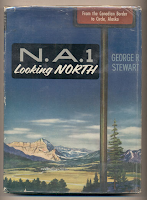
N.A. 1 , Houghton, 1957.
Pickett's Charge, Houghton, 1960.
The California Trail, McGraw, 1963.
Committee of Vigilance: Revolution in San Francisco, Houghton, 1964.
Good Lives, Houghton, 1967.
Not So Rich as You Think, Houghton, 1968.
American Place-Names, Oxford University Press, 1970.
Names on the Globe, Oxford University Press, 1975.
American Given Names: Their Origin and History in the Context of the English Language, Oxford University Press, 1979.
Also author of Technique of English Verse, 1930, Bibliography of the Writings of Bret Harte, 1933, and John Phoenix Esquire, 1937. Juveniles: To California by Covered Wagon, Random House, 1954.


The picture at the top is from the Berkeley Historical Plaque Project.  For a recent article about Earth Abides see this article in the Berkeley alumni magazine: "A Killer-Type Virus Ends the World! Revisiting Earth Abides, the Novel That Inspired Stephen King and Jimi Hendrix," by Pat Joseph, Summer 2020. 

Post Script: Western University has also started a digital plaque project. See: Western University Names. 

Tuesday, 22 September 2020

Names on the Land


   There are more examples this week of linguistic puritans roaming the countryside looking for names to be erased and eliminated from the geographic vocabulary. I don't think they should be. Rather than treat established place names as bits of graffiti that should be painted over, perhaps they should be looked at as we do pictographs and petroglyphs and regarded as something from which we can learn.

 Let Them Be

   The current problem is named 'Squaw's Tit' which is pictured above and located near Canmore, Alberta. Even though the word 'squaw' is an indigenous one, it is now regarded as a racist term and when situated next to 'tit' it is doubly offensive because it is clearly misogynistic as well. It will surely be changed. The half as offensive 'Squaw Valley' in California is going soon and clearly we are more 'woke' than the Americans.  Shame on you if you ever skied there.

   I am not a racist or misogynist, but I am also not a toponymist so I am unlikely to be able to convince you that we should not so quickly erase what has been labelled over a long period of time and for many different reasons. Before you join the protests of the puritans, or sign the petition to have the name of your street changed, pause and read these two books.

   The first one is Names on the Land, by George R. Stewart, who also wrote, Names on the Globe and American Place-Names, as well as other books and novels. From him you will learn to appreciate names, no matter how crude or offensive. Consider this:

   The land has been named, and the names are rooted deep. Lake Mead may fill with silt, and Lake Michigan again spill south to the Gulf -- but the names may still remain. Let the conqueror come, or the revolution rage; many of our names have survived both already, and may again. Though the books should be burned and the people themselves be cut off, still from the names -- as from arrowheads and potsherds -- the patient scholar may piece together some record of what we were. 

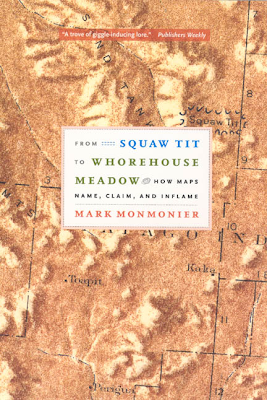
   The second book is, From Squaw Tit To Whorehouse Meadow: How Maps Name, Claim, and Inflame by Mark Monmonier. So far, this book has not been burned, nor has the author been forced to erase the title (he almost called it, Fighting Words). Although this book is about applied toponymy and is by an academic, it is written in prose the rest of us can understand.  Here is what the publisher's blurb indicates. The publisher is the University of Chicago Press:

“Brassiere Hills, Alaska. Mollys Nipple, Utah. Outhouse Draw, Nevada. In the early twentieth century, it was common for towns and geographical features to have salacious, bawdy, and even derogatory names. In the age before political correctness, mapmakers readily accepted any local preference for place names, prizing accurate representation over standards of decorum. Thus, summits such as Squaw Tit—which towered above valleys in Arizona, New Mexico, Nevada, and California—found their way into the cartographic annals. Later, when sanctions prohibited local use of racially, ethnically, and scatalogically offensive toponyms, town names like Jap Valley, California, were erased from the national and cultural map forever. 

From Squaw Tit to Whorehouse Meadow probes this little-known chapter in American cartographic history by considering the intersecting efforts to computerize mapmaking, standardize geographic names, and respond to public concern over ethnically offensive appellations. Interweaving cartographic history with tales of politics and power, celebrated geographer Mark Monmonier locates his story within the past and present struggles of mapmakers to create an orderly process for naming that avoids confusion, preserves history, and serves different political aims. Anchored by a diverse selection of naming controversies—in the United States, Canada, Cyprus, Israel, Palestine, and Antarctica; on the ocean floor and the surface of the moon; and in other parts of our solar system—From Squaw Tit to Whorehouse Meadow richly reveals the map’s role as a mediated portrait of the cultural landscape.”

  See especially Chapters 3, "Purging Pejoratives," and 4, "Body Parts and Risqué Toponyms." It is an enjoyable book.

Bonus Material: (from the book):
   Some officials chose the toponym "Naughty Girl Meadow", for an area in Oregon, but the locals protested and it was changed back to "Whorehouse Meadow", "officially recognizing the historical and cultural significance of the established local name for the area."
   Even original, indigenous names are not safe: "Another Indian name to bite the dust is Paska Township (in Ontario)—although paska means “shallow” in Cree, the province changed the name after a local Finnish family objected that a word with a similar sound means “shit” in Finnish."
   When the word "gay" began to mean something other than "happy", the locals in Gayside, Newfoundland decided they were more comfortable with Baytona. 

Post Script: 
    For now, Dildo is still in Newfoundland and Swastika is still here in Ontario. 

Sources:
   "Lawyers Hope to Erase Racist and Misogynistic Nickname of Mountain Landmark: Momentum is Building to Properly Name the Landmark, Which Can be Seen From Canmore, Colette Derworiz · The Canadian Press · Posted: Sep 06, 2020.
   For the Squaw Valley name change see this FAQ:
After extensive research into the etymology and history of the term “squaw,” both generally and specifically with respect to Squaw Valley, outreach to Native American groups, including the local Washoe Tribe, and outreach to the local and extended community, company leadership has decided it is time to drop the derogatory and offensive term “squaw” from the destination’s name.
Work to determine a new name will begin immediately and will culminate with an announcement of a new name in early 2021. Implementation of the name change will occur after the winter season concludes in 2021.

To learn more about Professor Monmonier, who is worth learning about see:
His website:
The official faculty link at Syracuse.
To order your copy of From Squaw Tit... and for more of his books, including, Bushmanders and Bullwinkles, see the University of Chicago Press website.