Sunday, 10 March 2019

Verminous Missionaries

Related image

KKK - The Ku Klux Klan in Kanada


     Having just mentioned a current event, I will now return to my consideration of older ones, and of other assorted odd subjects. In 1923 in London some "Verminous Missionaries" visited and Mayor Wenige did not welcome them. Here is what he had to say:

" Mr. Wenige, the Mayor of London (Ontario) issues a public statement in which he says: 
London needs no Ku Klux Klan or other order that seeks to gain unjust ends by a cowardly praise of masks and mystery. Gentlemen of foreign extraction in this municipality who may be planning a local organization would first do better to give the matter serious thought. Canadians will not tolerate men with bloody hands walking in their midst. Justice in this Dominion is swift and sure. As mayor of London I will use all the power of my office to rid the city of verminous missionaries of an order that seeks to terrify citizens who may differ from these so-called Knights of the Ku Klux Klan in race, religion, or ability to succeed. London, like the rest of the British Empire, has been safe from democracy for a long time. But London is not going to be safe for Ku Klux Klan or any other hooded order. And any non-Canadian who may seek to establish it here will be deported as an undesirable alien, so far as it lies in the hands of the mayor of this city to bring it about."

        The message the Klan brought back then was:


"Here you have problems that must be faced and solved by direct action. And we are coming to Canada because we believe that this whole continent must be welded into the greatest empire in history, pledged to enforcing the white man's law and the white man's ideals on the rest of the world and the preservation of peace. Our idea is a sort of confederacy at present. That would not necessarily mean your separation from the British Empire, but a more definite alliance between the two great English-speaking countries of this continent. We have a definite program in view that would be of greatest benefit to all."

     Apart from a belated nod to "Black History Month", this brief post should serve to remind those who were shocked a few months ago to see the PEGIDA people protesting outside of City Hall, that racial problems are not new, even in London, Ontario.


Sources: 
"Canadian Mayor and the Ku Klux Klan," The Times (London), Mar. 17, 1923.
"Canada and the Serpent, Globe & Mail, Mr, 15, 1923.
"Facing the Challenge; As Racism Once Again Rears its Ugly Head, all Londoners Must find the Courage to Step up and Resist Hatred and Bigotry," Larry Cornies, London Free Press, August. 19, 2017.


   For a very good account of KKK activities in London see: "The Ku Klux  Klan in London, Ontario," John Lisowski, The London and Middlesex Historian, Vol. 24, 2015. In it, you will learn of a Dr. Bratton from South Carolina who was kidnapped on Wellington Street and returned to South Carolina where he had been implicated in the lynching of a black man.
   There has just been a new book published that involves the Klan and Confederates in London. See: London Ontario's Unrepentant Confederates, the Ku Klux Klan and a RENDITION on WELLINGTON STREET, by Ron W. Shaw. Mr. Shaw apparently lives next door in Perth County and information about the book can be found here

Post Script:
   Perhaps the quickest way to be reminded of much more recent Klan activities (and even cross-burnings) in this area is to see the Wikipedia entry for Martin Weiche. Anyone who visited the old cinemas on Dundas Street will likely remember Mr. Weiche, who was often in front of them handing out pamphlets. Mr. Lisowski discusses Weiche in the article mentioned above. 

It is easy to prove that racial problems have been persistent. It is more difficult to determine if they are getting worse. One thing has changed and that is the religious component. In the past, the Klan was concerned about the Catholics. Now such people are more worried about the Muslims.

Homeopathy


Image result for homeopathy historical

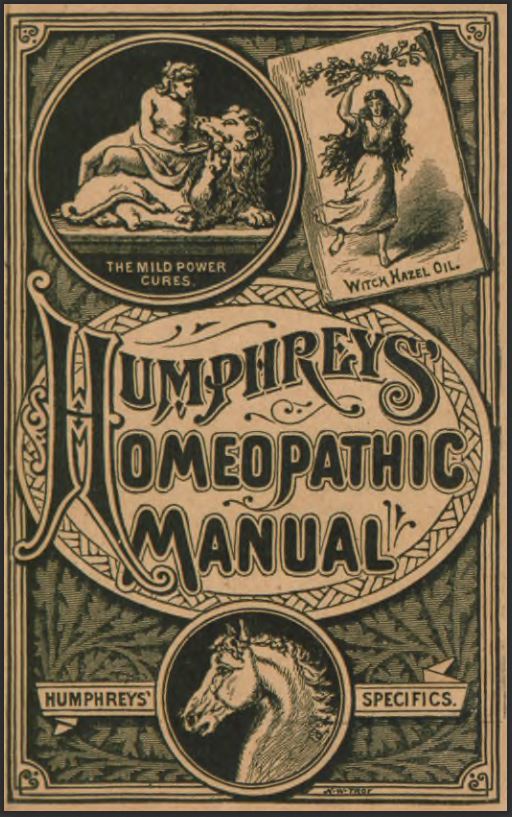
   Although it is generally the purpose of this blog to consider remote events, so we don't have to worry or think about current ones, I do think it is my duty to call to your attention a recent headline. It hints at good news which is rare. It is:

CANADIAN GOVERNMENT WILL STOP PAYING FOR HOMEOPATHS TO GO TO HONDURAS

   Now, apart from noticing the alliterative attractiveness of the title, I can't say much since I did not read anything below it, out of fear that I would notice all the other bad news. I am just pleased to learn that no more of the tax dollars we are about to pay will by going to fund this dubious project.

   I knew we were having difficulties with Huawei, but I admit that I was not aware that there were problems with Honduras. If we really want to do the Hondurans harm, our money would be better spent if we sent the anti-vaxxers (and their children) rather than homeopaths.
Source: 
"Canadian Government will Stop Paying for Homeopaths to go to Honduras: CBC Stories Raised Concerns About Unproven Claims and Potential Harms" The Canadian Press · Posted: Mar 06, 2019

Sunday, 3 March 2019

Spring Break Consolations


   Perhaps you are unable or unwilling to join the migrating tourists and need some new excuses to replace the ones you have already used, namely: airport hassles; airline hassles;TSA hassles; border hassles; intestinal issues; the low loonie; the high risks; yellow vests; green algae blooms and nasty political problems (e.g. if you were planning  to visit Abuja, Caracas, or especially Washington, for which, if the U.S. State Department was still in operation, there would likely be a Travel Advisory.)

   If those reasons are not enough to lower the peer pressure you know you will feel when the tanned people return, or if your spouse is not content with being couch-bound during this gloomy and cold period, remind him or her, or ze or zir, or whomever, of the exoticism of the things that can be found locally and of the foreign objects in your very own neighbourhood (or county if you feel adventurous), and also read them this:

“Martin Martin, the traveller and writer who in the 1690s set sail to explore the Scottish coastline, knew that one does not need to displace oneself vastly in space in order to find difference. “It is a piece of weakness and folly merely to value things because of their distance from the place in which we were born,’ he wrote in 1697, ‘thus men have travelled far enough in the search of foreign plants and animals, and yet continue strangers to those produced in their own natural climate.” So did Roger Deakin: “Why would anyone want to go live abroad when they can live in several countries at once just by being in England?’ [Canada]. Likewise, Henry David Thoreau: An absolutely new prospect is a great happiness, and I can still get this any afternoon. Two or three hours walking will carry me to as strange a country as I expect ever to see. A single farmhouse which I had not seen before is sometimes as good as the dominions of the King of Dahomey.’


Source:
The Old Ways: A Journey on Foot, Robert Macfarlane, Penguin Books, pp.78-79 & p.381.

Monday, 25 February 2019

Mark Twain and Libraries


     I wrote recently about useless knowledge and will here offer more of it. In the post about fellowships I indicated that I was pleased that some scholars were still able to make a living by studying subjects which seem likely to yield little that is not perceived by most to be without worth. Unlike the Wall Street “quants”, however, who invent useless financial tools which yield high returns for themselves at great costs to others, the “harmless drudges” are mostly just that. Here is another literary toiler who has worked hard for many years on the subject of Mark Twain's books. A consideration of his work and of Twain allows us to continue to avoid more pressing political and environmental concerns.

      As Twain said, “the secret of getting ahead is getting started”, so now that that first paragraph is out of the way I can quickly move on to him and the subject of libraries. I can’t say that I thought of Twain as being ‘bookish’, and associated him more with steamboating and adventures along the Mississippi and elsewhere, mainly outside. I was wrong since there is a new book about Twain’s books and, apart from having had a sizeable library, Twain's name is now associated with other libraries, one of which was relatively close by.

    Mark Twain’s Literary Resources: A Reconstruction of His Library and Reading is the title of a new book by Dr. Alan Gribben. It comes after an earlier book on the subject (Mark Twain’s Library, 1980), which came after a 2,000+ page dissertation on the subject, and all of this will be followed by two more volumes about Twain’s library. Such an interest is not unusual; just think of Twain’s library as his hard drive. From it one can learn what he was reading and how certain books may have influenced his thinking. Since Twain was a great producer of marginalia one can learn about his reactions, particularly his dislikes, which he relegated to his “Library of Literary Hogwash”. And Gribben is not the only one scrutinizing what Twain studied. Two other scholars worked together (on a fellowship, I might add) to go through all the French marginalia in the works that Twain used to write Personal Recollections of Joan of Arc.

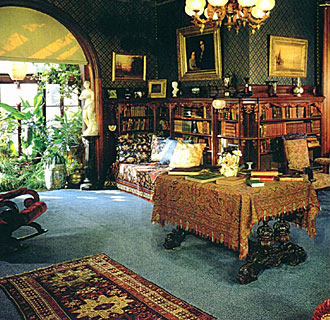
Mark Twain's Personal Library


  Unfortunately the books in Twain’s library were sold at auctions many years ago. Apart from studying Twain’s books, Professor Gribben has spent over 40 years travelling across the continent just to locate and identify them. Once again, he is not alone; an antiquarian book dealer in Austin, Texas has amassed the largest private collection of Twain material and he is the one you should contact if you are looking for a first edition of Pudd’nhead Wilson. You can visit the room that would have held many of them in the Mark Twain House & Museum in Hartford, CT.

Mark Twain Libraries

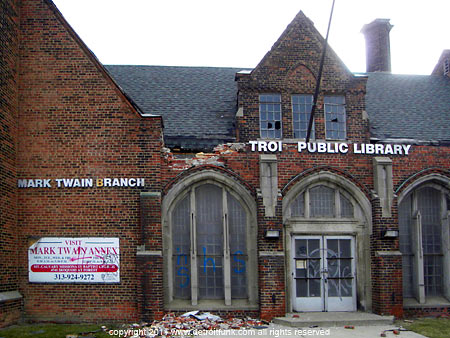
There are libraries that are named (or branded, as they now say) for Twain and one of them was founded by him. It is located in Redding, CT. Another was closer by in Detroit, but as you can see from the pictures below, it is no longer open.

Sources: To be quickly up to snuff on things Twainian just go to these two websites.
Start by visiting the site of Dr. Alan Gribben, Scholar and Editor. Go then to Elmira College which houses the Center for Mark Twain Studies. To buy a rare copy of a Twain book, consult Kevin Mac Donnell at Mac Donnell Rare Books in Austin, TX.
Post Script: Those of you who are surprised by this degree of scholastic devotion should know that there are often entire journals/periodicals/magazines/newsletters devoted to single individuals. In this case, see the Mark Twain Journal which has been around since 1936. Dr. Gribben is the current editor.

Tuesday, 19 February 2019

The Trans Canada Trail


Back in the last century at a large family Christmas party where I was somewhat of a genetic and social outlier, I nonetheless received a nice gift from the person who was unlucky enough to have drawn my name. For my present the person had donated enough money to help construct one metre of the Trans Canada Trail which is now 24,000 kilometres long. I received a trail certificate, a crest, a brochure, a newsletter and a promise that my name "would be permanently inscribed on a trail marker along the route of the longest trail in the world."

The gift was given in December 1997 when the Trans Canada Trail was only about five years old. In 2017, as the nation celebrated its 150th anniversary The Great Trail turned 25 (the name change occurred in 2016). It now stretches from coast to coast and is found in all 13 Provinces and Territories. You can learn all about it at the fine The Great Trail website.


The Great Trail Pavilion - St. Thomas Ontario


The promise of an inscription was fulfilled in the summer of 2001 when the trail passed by as close as it is going to get if you live in London, Ontario. The claim that "four out of five Canadians live within 30 minutes of the Trail" is true in my case and is more generally true since the trail does pass through all the major cities and along the corridors where most Canadian live. My name is on the pavilion in a small green space on Jonas Street in St. Thomas, but you will need to hike a few kilometres out of town to feel like you are on a Great Trail.

One can no longer make a donation to a local pavilion to have a name inscribed. The program was costly to maintain and was discontinued in 2012. For $1000 you can get your name put on a pavilion in Ottawa and the Trans Canada Trail Foundation would gladly accept a smaller amount.


Sources:

The Great Trail website is quite good and if you click on the map provided, you can find the closest the trail comes to your location. The Great Trail often joins lesser ones and for those of you in the London area see: for St. Thomas and here; for Elgin County.
"St. Thomas Picked For New Trans Canada Trail Pavilion," Laura Bradley, St. Thomas Times-Journal, July 13, 2017. "St. Thomas Welcomes Trans Canada Trail," Stephanie Cesca, London Fre Press, Aug. 5, 2001.
Post Script:
There are some very generous donors. BMO gave $750,000 to help complete the southwestern Ontario portion. Jack Cockwell donated $3 million to honour his mother, Daphne.
  One fellow just completed walking the entire trail. If you wish to do so there is a new book out that will help you if you start in the Maritimes. It is from Goose Lane Editions.

Monday, 18 February 2019

USELESS KNOWLEDGE


Fellowships


    I have been going through several issues of The Times Literary Supplement and have been pleased to see that there are still advertisements offering enticements to scholars, even if they are labouring in fields that are not relevant, popular or useful. If you are interested in the 18th century, for example, the Lewis Walpole Library at Yale will provide you with accommodation in an appropriate eighteenth-century house, a stipend, a per diem living allowance and you will be reimbursed “the cost of a rental car or local travel expenses.” If you are not an 18th century fellow, but would still like to go to Yale, contact the Beinecke Library there which offers “fellowships to support research in a wide range of fields, from literary and cultural studies to the history of science, music, theater, and art; the history of the book, of photography, graphic design, and architecture; as well as social, intellectual, and political history.” You might qualify for a living allowance of $4,000 per month, which isn’t bad since those are U.S. dollars. If you would rather labour abroad, try the Herzog August Bibliothek Wolfenbuttel in Germany if you are interested in medieval or early modern history or go for a Katharine F. Pantzer Jr Award if you are doing bibliographic research and want to reside in London where there are still lots of books.

   I am pleased because it is refreshing to see that libraries full of books and manuscripts are luring people to use the collections and paying them to do so. The university libraries in which I worked are now largely emptied of books, which makes them more appealing to students seeking only safe spaces with electrical sockets. While it is surprising to learn that there is still some income to be derived from the arts and humanities and that there are a few survivors outside the STEM fields, it is also satisfying to see that some people are being paid to pursue interests and subjects which most people see as useless.

The Cultivation of Curiosity

   During a time when universities are expected to be more concerned with useful, practical, vocational matters it is worth reconsidering “The Usefulness of Useless Knowledge.” That is the title of an essay that appeared in Harper’s magazine in 1939 and it is the subject again of an article in a recent New York Times: ”Useless Knowledge Begets New Horizons,” Bret Stephens, Jan. 3, 2019. Although Stephens used the example of space exploration and the need for funding for  “pure” science, perhaps the softer, even more useless, subjects should be considered as well. Two samples from the article:

“And yet, in being the kind of society that does this kind of thing — that is, the kind that sends probes to the edge of the solar system; underwrites the scientific establishment that knows how to design and deploy these probes; believes in the value of knowledge for its own sake; cultivates habits of truthfulness, openness, collaboration and risk-taking; enlists the public in the experience, and shares the findings with the rest of the world — we also discover the highest use for useless knowledge: Not that it may someday have some life-saving application on earth, though it might, but that it has a soul-saving application in the here and now, reminding us that the human race is not a slave to questions of utility alone.

There are plenty of reasons to worry about the state of the American mind today, as well as the state of the university. Speech is not as free; gadflies are not as welcome; inquiry is dictated as much by the availability of funding as it is by the instincts of curiosity, and funding itself is often short. But let’s start 2019 on a happier note.”

Sources: 

   There are many examples for fellowships, some of which entail more obligations than others. See: The John Carter Brown Library and The Folger Shakespeare Library and The Harry Ransom Center at the University of Texas.
   For more about “Useless Knowledge” and Flexner see the Institute for Advanced Studies where his essay and other related ones are found.
Post Script:
   Perhaps the best example of noblesse oblige without strings, obligations or expectations is the MacArthur Fellowship offered by the MacArthur Foundation. One is given $625,000 for a five year period for such things as: "Pushing the boundaries of literary fiction in works that combine the surreal and fantastical with the concerns and emotional realism of contemporary life" or "Expanding the potential of vocal and orchestral music to convey emotional, dramatic, and literary meaning."
See the very interesting MacArthur Foundation website.


Friday, 8 February 2019

The Plight of the Pangolins


Pity the Pangolin
I recently wrote about endangered species and have posted about the "insect apocalypse" and the passing of the passenger pigeons. Now I will move on to consider pangolins which I did not know existed and soon won't. After that I will
offer a few words about totoabas.
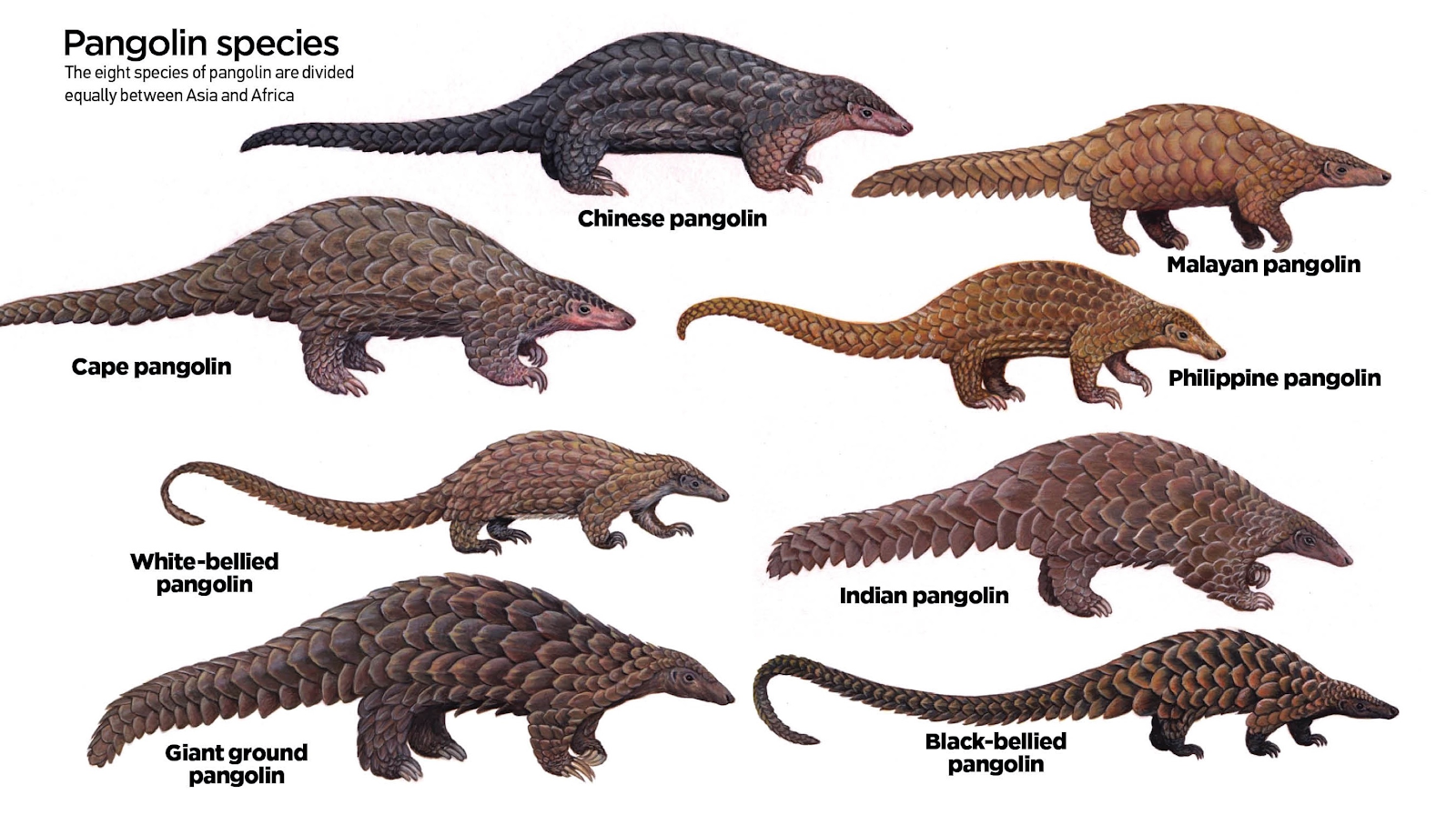
Pangolins are anteater-like mammals that are (soon to be were) found in Asia and Africa and I don’t think I had ever seen the word until I read that 9 TONS of their scales have just been seized from one ship in Hong Kong. Apparently the 9 tons represents around 14,000 of the little critters.I guess I missed the article from 2013 about a ship carrying 22,000 pounds of pangolin which hit a reef in the Philippines.
   I should mention that, perhaps acting as ballast, there were also 1,000 elephant tusks in the same shipment.


Totoabas


Totoabas are fish that are found in increasingly decreasing numbers and only in the Gulf of California. Recently, “Chinese customs officials have confiscated 444 kilograms (980 pounds) of totoaba swim bladders, estimated to be worth about $26 million.” Note, that weight is just bladder weight; I am not sure how many totoabas were involved.
In both cases the main reasons for the slaughter are ‘medicinal’ ones and the Chinese are involved. Apparently the Chinese apothecary profession is not as advanced as the one producing the 5G communication networks.
It is unfortunate indeed that, while we are losing so many species simply as collateral damage, others are being deliberately destroyed for medicinal reasons without merit.
Sources:

The Wikipedia entries for both species are very good.
I learned about the poaching of the pangolins from: "9 Tons of Pangolin Scales Are Seized in Hong Kong, Tiffany Mat, New York Times, Feb. 1, 2019. For earlier articles see: "A Struggle to Save the Scaly Pangolin," Erica Good, New York Times, Mar. 30, 2015 and "No Species is Safe From Burgeoning Wildlife Trade," Bettina Wassener, Mar. 12, 2013.

For the totoaba see the website of the Intercultural Center for the Study of Deserts and Oceans (CEDO) and the entry for "Totoaba". For a recent smuggling case see: "China Seizes Totoaba Swim Bladders Worth $26 Million, Arrests 16," Mongabay.com, Dec. 29, 2018.