Wednesday, 20 September 2023

LINE 5 AGAIN


STILL UNDER THE WATER AND UNDER THE RADAR


   Just over a couple of years ago I wrote about Line 5 and in the post you will see a picture of the the Sarnia-Lambton MP, Marilyn Gladu pointing toward a sign indicating that many in the area would lose jobs if Line 5 was shutdown. Background was provided along with some sources and you can read it here

  If you are like many others, you probably don't recognize Line 5 which is not as well known as Keystone or even the long ago Maginot. It carries fossil fuels from Alberta all the way to Sarnia and beyond. It helps keep things running and people warm. A couple of years ago, Governor Gretchen in Michigan ordered it shut down, which is why I wrote about it. Now a judge in Wisconsin again has ordered it shut off. Canada has objected again and the oil continues to flow. 

  I find it curious that the issue is not much discussed. The more recent Line 5 ruling involves Indigenous rights because the pipeline passes through land occupied by the Lake Superior Chippewa in Wisconsin. I can understand why many don't care about that and I realize that it is likely that you are about to stop reading.

  But, the earlier shut down ordered by Governor Whitmer was requested because of environmental concerns. The pipeline, you see, runs under the Straits of Mackinac and it is argued that a rupture of it would be devastating for not just one Great Lake. Line 5 turned 70 this year and perhaps, in 'pipeline years', it is older than both President Biden or aspirant Trump and age is a factor that should be considered. As well, pipelines can be treated just as roughly as presidential candidates.  Plus, there have been other spills involving Enbridge pipelines including one fairly close by in the Kalamazoo River.

  Even more curious is the fact that it is the Canadian government that opposes the shutdown. It would be less curious, perhaps, if the government was a Tory one. It is not surprising, however, that even Trudeau wants to keep things as is, since state, provincial, federal, international, Indigenous, labour and environmental actors are involved and most Canadians seem not to be worried about a pipe that may not burst.

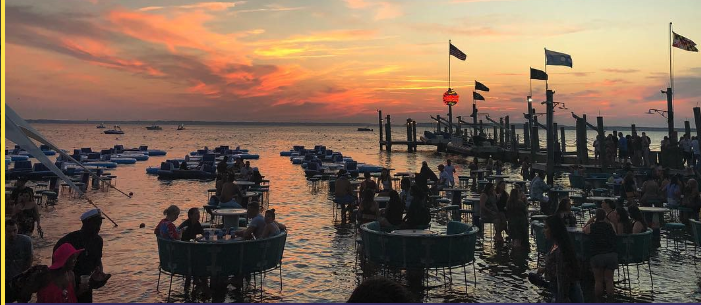
Sunset on the Mackinac Straits


  Sources:
   This recent piece explains the situation well. It is found in a publication with a fine subtitle: "Michigan Pipeline Standoff Could Affect Indigenous Rights Across the US," Mike Shriberg, The Conversation: Academic Rigour, Journalistic Flair, August 16, 2023. It was republished in The Detroit Free Press on Sept.10, under this title: "Proxy Fight in Straits Could Decide Who Gets to Draw a Line in Sand." The text is presented here and parts of it are bolded by me for emphasis. It is followed by the more recent shutdown ruling.
As the author of the article says at the end, "Your Turn."

The article:

"Should states and Indigenous nations be able to influence energy projects they view as harmful or contrary to their laws and values? This question lies at the center of a heated debate over Enbridge Energy's Line 5 pipeline, which carries oil and natural gas across Michigan and Wisconsin.

Courts, regulatory agencies and political leaders are deciding whether Enbridge should be allowed to keep its pipeline in place, with upgrades, for another 99 years. The State of Michigan and the Bad River Tribe in Wisconsin want to close the pipeline down immediately.

My expertise is in Great Lakes water and energy policy, environmental protection and sustainability leadership. I have analyzed and taught these issues as a sustainability scholar, and I have worked on them as the National Wildlife Federation's Great Lakes regional executive director from 2015 until early 2023.

In my view, the future of Line 5 has become a defining issue for the future of the Great Lakes region. It also could set an important precedent for reconciling energy choices with state regulatory authority, and Native American rights.

A Canadian pipeline through the US Midwest

Line 5, built in 1953, runs 643 miles from Superior, Wis., to Sarnia, Ontario. It carries up to 23 million gallons of oil and natural gas liquids daily, produced mainly from Canadian tar sands in Alberta.

Most of this oil and gas goes to refineries in Ontario and Quebec. Some remains in the U.S. for propane production or processing at refineries in Michigan and Ohio.

Controversy over Line 5 centers mainly on two locations: the Straits of Mackinac, and the Bad River Band Reservation in Wisconsin, where the pipeline crosses tribal land.

Line 5 crosses through the open water of the Straits of Mackinac in twin pipelines that rest on the lake bottom in some stretches, and are suspended above it in others. The route lies within an easement granted by the State of Michigan in 1953.

The Straits of Mackinac are one of the most iconic settings in the Great Lakes. They include hundreds of islands and miles of shorelines rimmed with forests and wetlands. Scenic Mackinac Island in Lake Huron, a popular resort area since the mid-1800s, is Michigan's top tourist destination.

The straits also have long been spiritually important for Great Lakes tribes. Michigan acknowledges that the Chippewa and Ottawa peoples hold treaty-protected fishing rights that center on the Mackinac region.

The Line 6b spill

In 2010, another Enbridge pipeline, Line 6b, ruptured near the Kalamazoo River in southern Michigan, spilling over 1 million gallons of heavy crude. Line 6b is part of a parallel route to Line 5, and the cleanup continues more than a decade later.

The spill, and Enbridge's slow, bungled response and lack of transparency, led to scrutiny of other Enbridge pipelines, including Line 5.

In a 2014 analysis, University of Michigan oceanographer David J. Schwab concluded that the Straits of Mackinac were the "worst possible place" for a Great Lakes oil spill because of high-speed currents that were unpredictable, and reversed frequently. Within 20 days of a spill, Schwab estimated, oil could be carried up to 50 miles from the site into Lakes Michigan and Huron, fouling drinking water intakes, beaches and other critical areas.

This, and other research, intensified a burgeoning advocacy campaign by pipeline opponents, including regional and national environmental organizations, Indigenous leaders and advocates and a newly formed network of local and regional businesses.

Pipeline supporters include the American Petroleum Institute and others in the fossil fuel industry, many conservative lawmakers, several key labor unions and the government of Canada. They argue that the current pipeline is safe, violates no federal laws and is a key piece of infrastructure that helps keep energy costs low.

Michigan revokes its easement

After years of scrutiny, including the formation of the Michigan Pipeline Safety Advisory Board and two expert reports commissioned by the state, analyses showed that Enbridge was violating provisions of its easement. Most notably, the section of Line 5 that ran under the straits lacked proper anchors and coating, increasing the threat of a rupture. The state concluded that the easement violated the public trust doctrine — the idea that government should protect certain natural resources, including waterways, for public use.

State reports concluded that the highest risk for rupture was from anchor strikes. Environmental nongovernment organizations found that Line 5 had already leaked more than 1 million gallons of oil and natural gas liquids. On April 1, 2018, a boat anchor struck the pipeline and nearly ruptured it, temporarily shutting Line 5 it down.

In 2019, Gov. Rick Snyder was succeeded by Gretchen Whitmer, who pledged in her campaign to close Line 5. Seeking to avert a shutdown, Enbridge proposed building a tunnel beneath the lake bed to protect the pipeline.

But after more analysis — and another anchor strike that temporarily shut down the pipeline again — Whitmer issued an order in November of 2020 revoking Enbridge's easement and giving the company six months to close Line 5. The state sought a court order to support its decision.

Instead of accepting state orders, Enbridge resisted. The company argued that Michigan lacked authority to tell it how to manage the pipeline, that the project had not required an easement in 1953, and that building the tunnel would mitigate any risks.

Enbridge sued Michigan in federal court, arguing that pipeline safety regulation was a federal issue, and that the state had no authority to intervene in what was essentially international commerce.

Challenging state and tribal authority

Enbridge also faced pressure from the Bad River Tribe in Wisconsin, where some 12 miles of the pipeline runs through the Bad River Band reservation and across the Bad River. Enbridge's easement on parts of the reservation expired in 2013, and in 2017 the tribal council voted to evict Enbridge from their land, calling the pipeline a threat to the river and their culture.

When Enbridge continued operating Line 5, the tribe sued the company in federal court in 2019, charging it with trespass, unjust enrichment and other offenses, and sought to get the pipeline closed.

Today, Michigan's case against Enbridge is bogged down in jurisdictional battles. But on June 16, 2023, the federal judge overseeing the Bad River case ruled largely in favor of the tribe and ordered Enbridge to stop operating the pipeline on tribal land within three years. Enbridge vowed to appeal the ruling, but is also seeking permits for a 41-mile reroute of Line 5 around the reservation.

A national precedent

Line 5 is more than a Michigan issue. It has become a focus for national activism and is a major diplomatic issue between Canada and President Joe Biden, who has worked to balance his ties with organized labor and his support for a clean energy transition, and has avoided taking a side to date.

To continue operating Line 5, Enbridge will have to convince the courts that its interests and legal arguments outweigh those of an Indigenous nation and the State of Michigan. But if the courts rule against Enbridge, it would be the first time an active fossil fuel pipeline has been closed due to potential environmental and cultural damage.

The outcome could set a precedent for other pipeline and fossil fuel infrastructure battles, from the mid-Atlantic to the Pacific Coast. Ultimately, in my view, Line 5 is an under-the-radar but critical proxy battle for how, when and under what authority the phasing out of fossil fuels will proceed.

Mike Shriberg is a professor in the School for Environment & Sustainability at the University of Michigan, a former Great Lakes Regional Executive Director for the National Wildlife Federation, and a former gubernatorial appointee under Gov. Rick Snyder to the Michigan Pipeline Safety Advisory Board. This article is republished from The Conversation under a Creative Commons license. Submit a letter to the editor at freep.com/letters.
Your Turn
Mike Shriberg

The New Shutdown Order

"Undo Line 5 Shutdown Order, Federal Government's Filing Urges U.S. appeals Court, The Canadian Press, Sept. 18, 2023

WASHINGTON — "Ottawa is urging a U.S. appeals court to reverse a Wisconsin judge's order that threatens to shut down the Line 5 cross-border pipeline by June 2026.
Forcing a shutdown would violate Canada's treaty rights, government lawyers argue in an amicus brief filed today with the U.S. Seventh Circuit Court of Appeals.
A Wisconsin court ruling in June gave Calgary-based Enbridge Inc. an ultimatum: reroute the pipeline around an Indigenous reserve within three years or shut it down.
Enbridge plans a 66-kilometre detour to replace the 19-kilometre stretch that runs through the sovereign territory of the Bad River Band of the Lake Superior Chippewa.
Both sides are appealing the decision — Enbridge wants more time to finish the reroute, while lawyers for the band want the taps turned off for good.
The band and its environmental allies fear a spill inside an ecologically sensitive and flood-prone Lake Superior watershed on the Bad River reserve."

Tuesday, 19 September 2023

Fishing For Money


The White Marlin Open

   This is not a fish story. "The White Marlin Open" which has been open and ongoing for 50 years, really is the "World's Largest & Richest Billfish Tournament." The port from which the contestants venture forth is Ocean City, Maryland. When we visited back in early April, there were many signs promoting the tournament which has now been completed. I thought I would take a look and see what happened. While I am looking and you are waiting, you can read or re-read my earlier account about visiting Ocean City in "Blogging While Travelling." 


  In that post, I did not focus on the rowdier aspects of the resort since we deliberately went before Memorial Day to enjoy the unoccupied ocean beach. From then until Labour Day, the place is a festive one and I suppose the reporting during that period would be more exciting, but I can assure you that this account about the fishing tournament is likely to be more rewarding than you might think. If you would like a sample of the more raucous side, simply visit the website of SEACRETS. It is a mini-Jamaica on the bay side where there are 15+bars and a distillery. Palm trees are trucked in every spring, but if you don't want to drink under them or in one of the many bars, you can drink right in the Isle of Wright Bay. 

   Rather than focus on the summer-long, "Spring Break" atmosphere and those people who spend a great deal of money drinking, I will now report on the fisherpeople who win large sums of money fishing (and likely drink some while doing so.) Here are some of the results which were taken from the WMO site or other sources. The prize amounts will seem confusing since someone in fourth may have won more than someone in second. That has to do with things like the type of contestant and the fish. The WMO rule book is 12 pp. of small type and that does not include the IFGA rules. As well, there is an additional information sheet where you can find out if it is legal to use a "FLIPPY FLOPPY" or a "STINKY TINKY." And, if you win a large amount, you may be asked to take a polygraph test. 


Blue Marlin
John Ols of Laytonsville, Md., was this year's big money winner, reeling in a 640.5-pound blue marlin aboard the Floor Reel out of Ocean City to take home $6,200,000.

Tuna
First place: Brian Stewart of Shady Side, Md., reeled in a 265-pound tuna aboard the Reel Tight out of Ocean City to take home $1M.
Second place: Chris Mentlik of Street, Md., reeled in a 221.5-pound tuna aboard the Fishlik out of Chincoteage to take home $360,000.
Third place: John Zimmerman of Boynton Beach, Fla., reeled in a 221.5-pound tuna aboard the Game Over out of Ocean City to take home $160,000.
Fourth place: Rusty Shriver of Leonardtown, Md., reeled in a 215-pound tuna aboard the Ro Sham Bo out of Ocean City to take home $1,700,000.


Wahoo
First place: John Harris of Boyertown, Pa., reeled in a 57-pound wahoo aboard the "Shooting Star" out of Indian River to take home $2,000.
Second place: Chad Jackson of Fory Myers, Fla., reeled in a 55-pound wahoo aboard the Captain Deadley out of Ocean City to take home $28,000.
Third place: Matthew Gessler, 15, of Chadds Ford, Pa., reeled in a 46-pound wahoo aboard the Boy's Toy out of Indian River to take home $26,000.


Dolphin
First place: Andrew Spangenberger of New Freedom, Pa., reeled in a 50.5-pound dolphin aboard the Roncito out of Ocean City to take home $25,000.
Second place: Timothy Goodman of Palm Beach, Fla., reeled in a 32-pound dolphin aboard the Aquila out of Beach Haven, N.J., to take home $78,000.
Third place: Will Mcateer of Kent Island, Md., reeled in a 31-pound dolphin aboard the Maverick out of Ocean City to take home $27,000.


White Marlin
  Ironically enough, there were no White Marlin caught at this year's White Marlin Tournament. But, the total payout was around $10.5 MILLION. 

The Bonus:


   Michael Jordan often competes in this tournament and did so again this year. Just about all you need to know is found in this title: "Michael Jordan Took His $8 Million Fishing Boat, Catch 23, to the White Marlin Open Competition: The 84-Foot-Long Vessel, Wrapped in Elephant Print, Costs a Whopping $1 Million Annually to Operate," Neha Tandon Sharma, Luxurylaunches.com, Aug. 14, 2023.
   I followed him farther north to the "Midatlantic Fishing Tournament" and learned this: "In total, the tournament paid out $5.79 million to 35 boat crews. Jordan's boat Catch 23, by the way, took home $462,318 for a 75-pound white marlin, good for third in that category."
The person who chose the name for Jordan's boat also deserves some credit.

Sources:
To prove that this is not just a fish story, here are some sources. 
   The website of "The White Marlin Open" contains all the rules and regulations and you will also find some archival issues of the White Marlin Open magazine. The recent issue has this article: "How OC Became the White Marlin Capital of the World." For another history of the event see: "The White Marlin Open: A History Lesson," Jan Fogt, Marlin Magazine, March 6, 2015.
  For coverage of this year's WMO see: "White Marlin Open 2023 Final Leaderboard: A $6.2M Blue Marlin is Big Winner," Keith Demko, Delmarva Now, August 12, 2023.
   The "Midatlantic Tournament" numbers were found in: "Sports Outdoors: Pipe Dreamer Wins $1.18M in MidAtlantic With Blue Marlin Catch," Dan Radel, Asbury Park Press, August 30, 2023.

  The more sensitive readers of MM may be disappointed that I did not mention the more serious subjects related to fishing, namely overfishing and endangered species. The issue of "conservation" is raised on both the website of the WMO and in the article about the history of the event. Many of the fish caught are released, although admittedly the process is not painless.  In short, industrial fishing is more problematic than sports fishing and those engaged in the sport are often ardent protectors of the things they wish to fish or hunt. Sushi eaters should be reluctant to throw stones, and appreciate the irony.

Some Perspective: 
   Perspective is somewhat difficult to apply when you compare fishing to putting or angling to golfing, but in the most recent PGA Fortinet Championship which was held on a golf course, Sahith Theegala won and received $1.512 million. If you weren't reading carefully the bit above, you may not have noticed that the winner of the WMO received $6,200,000 and another guy got $1,700,00 for catching a tuna.

Thursday, 7 September 2023

OLDE POSTS ADDENDA

   Fall is in the air, but the weather has not been bad enough to force me back inside. It is for that reason that my few readers have returned day-after-day only to  see those same baby chicks staring from the top page of Mulcahy's Miscellany. I will now attempt to put them at the bottom of this post. All 45,000 of them are, by the way, still missing as far as I know.

  I do, of course, come in in the evening, but by then it is usually "5 o'clock Somewhere" and I typically spend more time drinking than writing, or thinking about things about which to write. Perhaps tonight we should all have another Margarita while thinking about Jimmy Buffett. 

  With worse weather perhaps my productivity will increase. For now I will simply offer some updates to old posts. Although I generally leave the "Breaking News" to the many who claim to be offering only news that is breaking, even some of my obscure topics sometimes surface, although not on the first page or screen. Five are presented below and if you combine them with the originals you will have amassed a fair amount of information which you can use to impress those who read only the breaking news. While you are digesting what follows, I will try to work on some new subjects for the dreary days ahead.


BUTTER


  It was late in August of last year that I wrote about BUTTER and told you about the sculptures that were still being carved from it at the Minnesota State Fair. You had already learned about butter sculptures (and palaces made from corn) in an earlier piece about the mysteriously named, “The  Land of Cockaigne.” I am pleased to report that things are still rocking at the Fair in St.Paul and that the likeness of a new “Princess Kay of the Milky Way” has been produced from a 90-pound block of Grade AA Butter at this “agriculture Disneyland.” If you read the article below, you will also learn about “Sweet Martha’s Cookie Jar,” where you can get a bucket full of them without depleting her inventory since she can make 44,000 cookies in 12 minutes.
“At Agriculture Disneyland, Butter Princesses Reign Supreme: Where Can You Find Dairy Royalty, Pork Chops on a Stick and Sen. Amy Klobuchar? The Minnesota State Fair,” Natalie. B. Compton, Washington Post, Sept. 2, 2023.
   P.S. Some Canadian content is also provided. In addition to pork chops on a stick you can also get “Pizza-on-a Stick” which is made by Tino Lettieri who was raised in Canada and played for the Montreal Castors, the Vancouver Whitecaps and the Hamilton Steelers. “"Pizza-on-a-Stick" is one of my dearest friends — he was in my wedding,” Rick Born said of Tino’s Pizza-on-a-Stick founder Tino Lettieri. “He’s actually in the Canadian Soccer Hall of Fame, and his son plays for the Minnesota Wild.” (I continue to be amazed about what can be learned from MM.)


FINE PRINTING: MR. TOROSIAN AND LUMIERE PRESS


  The relatively unknown Michael Torosian and his Lumiere Press are again profiled in an article in The Globe and Mail: “Printer Savant Pays Homage to Bygone Era of Publishing, Photography,” by Kate Taylor (July 19, 2023.) You can learn more about an earlier profile in the G&M by reading this post from MM in 2018. Mr. Torosian’s archive has been acquired by the Thomas Fisher Rare Book Library at the U. of T. and he has published this book: Lumiere Press: Printer Savant & Other Stories and you can place an order for it here. 
     In the new article, Mr. Torosian is asked questions and here is one, along with the answer: “You trained as a photographer at what is now Toronto Metropolitan University but had no credentials in publishing. How did you start?”
   When I came up in the seventies there were very few galleries, few museums showing photography. It was almost like an underground network where the language was passed on and studied through books rather than through exhibitions. Books were the medium of photography.
It was a matter of finding a way to do it that worked for me. Because the industrial method of trying to compete with big publishers is lunacy. I saw photographer after photographer attempt it and they would end up with a basement full of books they didn’t know what to do with." Lead type and the letterpress disappeared from commercial publishing in the late 1970s, but you don’t fetishize the old technology. You also use digital means to reproduce some photos. Why the letterpress?
It’s indisputable that the most beautiful way of getting words on paper is with lead type on a letterpress. The technology has been around for 500 years and nobody really figured out a way of making it better.
When I discovered it, it wasn’t totally antiquated yet, but it really wasn’t commercially viable for the big companies. Big printing plants, newspapers and book publishers were dumping all their equipment. What had been exorbitantly expensive equipment was being sold for just a bit over scrap value. So, I hit the sweet spot, the moment where I could scoop up all this stuff and set up my own shop."

YOSEF WOSK


     Another person about whom more should be known is Dr. Wosk who lives in Vancouver. I mentioned him when I stumbled into a library named for him at the VanDusen Botanical Gardens, (see: Unexpected Libraries.) Recently Dr. Wosk won the “Freedom of the City Award”, which is the highest award given by Vancouver and “only in exceptional cases to individuals of the highest merit.” (see: Yosef Wosk.)
    Just a  few excerpts from this article will prove that Dr. Wosk (also a rabbi) is worth your attention. 

“Yosef Wosk has a dream. The academic, philanthropist and scion of a famous Vancouver family envisions a conservatory in the back of his Shaughnessy heritage home that will house his extensive collection of art and books….
“I think of the house as an emanation of the spirit,” he says of the home, one of several heritage projects he’s undertaken over the years. He helped restore the B.C. Permanent Building, a temple bank from 1907, filled with stained glass, as well as the first highrises in the West End, the iconic four-building Beach Towers complex he co-owned for 40 years, built in the 60s by midcentury architect Charles Van Norman. He’s a curator, patron of the arts, author and poet. He’s also a major donor to heritage conservation, galleries and museums, and various charities. But lately he’s become more circumspect about the projects he’ll take on, and how he spends his time, which is growing more valuable….
His father, who died in 2002, was also a celebrated philanthropist whose namesake is the Morris J. Wosk Centre for Dialogue, to which he contributed $3-million. The Wosks left Odessa, Ukraine, in 1928 with next to nothing, and settled in a Jewish community at the time on Parker Street, on the city’s east side, peddling refurbished pots and pans….
He is devoting his time to several volumes of writing and his immense, eclectic art collection. So far in his prolific career, he’s obtained two PhDs, a Masters in theology from Harvard, the Order of Canada, the Order of B.C., the Freedom of the City of Vancouver, several honorary doctorates and accolades too numerous to count. At one point, he received the key to the city of Medford, Mass., for his contributions to that city. He put his work and accomplishments into a curriculum vitae, which is 767 pages long and still not comprehensive…
These excerpts are from: “Yosef Wosk, Academic, Philanthropist and Art Collector, is Building a Gallery in His Own Backyard,” Kerry Gold, The Globe and Mail, Oct. 21, 2022. Ms Gold also wrote about Wosk more than a decade ago: "A Home With 'Character in Every Corner'," Kerry Gold, The Globe and Mail, April 22, 2010.

Crikey! WORMS AGAIN: But in Australia, Not Africa.


 Five years ago you were told about a gentleman who discovered a worm crossing his eyeball, and also that worms travelling in eye sockets had been spotted and written about by Mary Kingsley many years before in Travels in West Africa. See: "University of the Unusual (3); The Guinea Worm and Assorted Others.")

Here is a more recent headline about worms which have burrowed a little farther in: “She Was Depressed and Forgetful. It Was A Worm in Her Brain” Doctors in Australia Found a Three-inch Parasitic Worm in a Woman’s Brain During Surgery, After They Spent More Than a Year Trying to Find the Cause of Her Distress,” Amanda Holpuch, New York Times, Aug. 29, 2023. That’s the little fella, pictured above.
The explanation:  "An MRI showed that she had a brain lesion and, in June 2022, doctors performed a biopsy.
Inside the lesion, doctors found a “stringlike structure” and removed it. The structure was a red, live parasitic worm, about 3.15 inches long and .04 inches in diameter.
They determined that it was an Ophidascaris robertsi, a type of roundworm that is native to Australia and reproduces in a large snake, the carpet python, which takes its name from its intricate markings. The pythons shed the worm’s eggs in their feces. The eggs are then ingested by small mammals, and the worms can grow inside them….” 
The patient in this case resided near a lake area inhabited by carpet pythons. Despite no direct snake contact, she often collected native vegetation, warrigal greens (Tetragonia tetragonioides), from around the lake to use in cooking. We hypothesized that she inadvertently consumed O. robertsi eggs either directly from the vegetation or indirectly by contamination of her hands or kitchen equipment."

Jersey Girls STILL Don't Have to Pump Gas!

   Last year I pointed out that "Jersey Girls Don't Pump Gas!" and that is still the case. At that time, I also indicated that there was only one other state down in "The Land of the Free" where you were not free to fill up your own car. Oregon was that state, but now you are allowed to serve yourself, although many stations are still required to offer full service as well. So, this recent headline is now correct: "There's Only One State Left Where It's Illegal to Pump Your Own Gas," Nathaniel Meyersohn, CNN, August 9, 2023. That state is New Jersey. CNN also reported about the change in Oregon: "Oregon Drivers Are Now Allowed to Pump Their Own Fuel After the State Lifted a Ban Dating Back to 1951," Andy Rose, Aug. 6, 2023.
   If you are older you will remember that gas was always pumped for you and you were not allowed to do so yourself. If you are a youngster you will always have served yourself. This is one of the many benefits of progress. Those in New Jersey are not progressive in this respect since a poll recently revealed that most do not want stations to stop providing full service. I assume that if Canadians were polled on this issue, most would want to revert to the good old days and have an attendant serve them on the many cold and windy days, or the few truly hot ones.


I have run out of gas on this subject, but if you are now wondering why things changed, see my earlier post and these references:
NACS - "The History of Self-Fueling," Aug. 5, 2023
"First Gas Pump and Service Station," American Oil & Gas Historical Society.
"Gasoline Stations," Mulcahy's Miscellany," Nov. 19, 2017

The Bonus:
   There are a few full service stations in London. Here is Ron Kraft Auto Care, on Huron Street where you can go if you prefer to be served. What a concept.  You will also find:
-"Gas attendants who serve you at the pump – stay in your vehicle in rain, snow or heat
-Mobile payment machine brought to your car window
-Wheelchair accessibility to accommodate all of our customers
-Auto propane & BBQ tank refills."
"Why have the smell of gas on your hands when we can pump it for you?
At Ron Kraft Auto Care, if you don’t want to leave your vehicle, no matter the weather, our attendant is right there to pump your gas for you. Just pay with the mobile payment machine brought right to your car window."

Tuesday, 15 August 2023

The Great Huron County Chicken Heist(s)

 Have You Seen These Chicks, Or Any of the Other 44,996?


   Perhaps it is because I grew up on the Eastern Shore of Maryland, where Perdue is located and poultry and pullets were often discussed, that I noticed recently a report which indicated that 30,000 chicks were stolen from a farm here in southern Ontario. Soon after that, another 15,000 went missing from the same farm near Exeter in Huron County. Apparently this farmer was not guarding the henhouse.

   The raising of poultry is still very important on the Eastern Shore and Perdue is one of the largest agribusinesses in the U.S.. Ontario is Canada’s largest chicken producer and those involved contribute $5 billion to the province’s economy. Although the scale of the operations, both here and in Maryland is huge, one would think that the stealing of 45,000 chicks is worth noting and that the monetary loss is not just ‘chicken feed.’ The stealing of 45,000 of anything is worth noting.

   I am noting it here, for two reasons. The chickens are still missing and the thefts have not been solved. If you know anything about this heist, call the Huron County OPP. I also think that the great Ontario chicken thefts will be a major story on CBS’s 60 Minutes or NBC’s Dateline, either soon (since it is a big story), or when the thieves are caught (which surely will be an interesting one.) If you watch only the CBC, you will appreciate the background I am providing and will not be totally surprised when this news appears in the U.S. and eventually comes to your attention. That such a story will not be on the CBC is explained by the fact that it is lacking in diversity, in that all of the members of the flock were of the same colour and age. As well, no Indigenous people were involved, as far as we know. 

  The questions you now have are many, the first one likely to be, “Why such a rambling prologue?” The others will be related more directly to the crime(s) and I will quickly present some here, along with brief answers which can be verified by consulting the sources provided.

   How does one sneak up on a farmer or the chicks, in the middle of the night without causing a bit of a ruckus? Particularly since more than one person would have to be involved, along with some very large vehicles. How does one corral 30,000 chicks and then have enough nerve remaining to return and grab 15,000 more? Or, are there other groups of chicken stealers? Is this only a misdemeanour, or are the 45,000 chicks worth something? Each chick costs about $1.40 and that number is a small one compared to the number of eggs they would have produced, or the number of breasts for the BBQs. These issues and more are covered in the references below, but the major question, “Who stole the chicks?” remains unanswered at this time.

   Readers of Mulcahy's Miscellany who noticed my recent post about urban crime, (Signs of the Times - Shoplifting), may now have another question about the magnitude of criminal activities in the country. In short, other farm thefts have been recorded and you now have something else to worry about. For example:

- Not long ago, 44 pigs were stolen from a farm near Stratford and in 2019 
130 pigs disappeared in South West Oxford Township. The pigs were much heavier than the chicks;
- Eight beehives were taken from a bee-keeper near Peterborough;
- Using as many as a dozen trucks, 400 tonnes of corn were taken from a farm northeast of Montreal and that probably reminds you of "The Great Canadian Maple Syrup Heist", when 16,000 barrels of it were taken from a warehouse in Quebec.
-Even dead animals aren't safe. In Caledon, around $1.5 million worth of moose, elk and stag antlers were stolen from a taxidermist.

Sources:
"30,000 Chicks Stolen From Huron County Farm," CBC, April 21, 2023.
"Someone Stole 30,000 Chicks From Ontario Farm," National Post, April 24, 2023.
"Police Investigate 30,000 Chicks Stolen in Ontario," AGDAILY, April 24, 2023.
"How Does Someone Steal 30,000 Baby Chickens," Calvi Leon, London Free Press, May 16, 2023.
"Great Exeter Chicken Heist Still a Mystery," Calvi Leon, Clinton News-Record, May 24, 2023.
The Second Theft:
"Another 15,000 Chicks Reported Missing From Ontario Chicken Farm," Kevin Nielsen, Global News, June 19, 2023.
"More Chicks Stolen From Ontario Farm," Andrew Joseph, Farms.com. June 20, 2023.
"$1.5 Million Worth of Antlers Stolen From Ont. Taxidermy Shop," London Free Press, Aug. 14, 2016.

Nothing Is Sacred and Nothing Is Safe.

Sunday, 30 July 2023

A Short Commercial Break

Internet Archive

   You may not know about the Internet Archive, but you will have used it if you use the Internet and we should all support it. It is the library for all of those rotten links that no longer work for you and a massive graveyard where all of the Internet content produced is saved. And you can visit this cemetery for free. Here is what has been saved to date:

35 billion web pages
41 million books and texts
14.7 million audio recordings (including 240,000 live concerts)
8.4 million videos (including 2.4 million Television News programs)
4.4 million images
890,000 software programs


Classic TV Commercials

  I rarely watch current television commercials, but remember some from the past which serve as historical markers over the years. Chances are good that if you want to pull up a commercial from your childhood, you will be able to do so from the Internet Archive where over 17,000 are found dating back to 1949. They can be searched by year, by subject and media type and there are even some non-commercial public service examples. Click on the link above to learn more about the Internet Archive. Click on the links below for some enjoyment:


Cars - A Mustang Mid-60s Ad - The Car Even Had a Stereo-Sonic Tape Player.

Canadian - There are many. See this Zellers one from 1999 or this one from the Nova Scotia Department of Health in 1996.

Cigarettes- There is more Canadian content in this Viceroy ad from 1963 with William Shatner. 
   
   There are even commercials for products that no longer exist. If you have 1:36 to spare, see these Classic Commercials for Defunct Products where you will learn about hair products such as "Tip Toni Curl Permanent" or "Satin Set." 
   Listen to the songs from the decades when you were younger with, K-Tel's Let's Disco Album Commercial or Time-Life's CD set of Love Songs of the 60s

 And let's not forget Jim Varney, who you will remember as "Ernest.


The Bonus: 
  During the summer of 2023 you will have not been able to avoid "Barbie." Here she is over 60 years ago - See "Early Barbie Doll Commercials." 

A REAL COMMERCIAL - DONATE HERE
I can assure you that I get nothing if you do so. I just think such efforts need to be supported. Do so quickly since Muicahy's Miscellany may disappear soon and suddenly from whatever cloud it is in.

One Hundred Years Ago

 1923


   Since my last few posts have been about the present, I will now look back through the London Free Press to a time that was clearly different.  The day landed upon happened to be May 24 and "Empire Day" is no more and mostly forgotten. This curriculum also appears a bit outmoded.


      We no longer have a 'local' newspaper and one reason for that is there not enough advertising to support one. Advertising was important back in 1923.


Here is a larger version which indicates that advertising was the "Aladdin" of the day in 1923, but replaced later on by genies such as Kijiji and Craigslist.


Sources
  One often needs a genie to find digitized editions of older newspapers and not many free digitized pages of the LFP exist as far as I know. I found a few on Canadiana. The reasons for this vary, but often it is the case that there are commercial ones. Before you pay money, however, or spend time (lots of it) sitting in the library at a microform reader, do check around to make sure your community paper is not available via the Internet. Genealogists have been more helpful than librarians in assisting those interested in finding local newspapers. Here is the place to start and if you scroll down you will find Canadian newspapers listed by province: "Newspaper Links," The Ancestor Hunt.com. And, as usual, Wikipedia is very useful: "List of Online Newspaper Archives." 
  Given that this post is a slight one, here are some other suggestions and remember that more papers are added daily. 
For the U.S. start with "Chronicling America: Historic American Newspapers." Canada is generally behind other countries in undertaking a national digital approach, but you can find provincial ones: Alberta and British Columbia. For a local Ontario effort see: "INK-ODW Newspaper Collection." 
  Google started to digitize newspapers (and every thing else), but was forced to stop.
The Bonus: 
   One fellow who has not stopped is located close by in Fulton, New York where among the over 50 million digitized pages you will find many from Canadian newspapers. Tom Tryniski is his name and he has done from his house what many librarians have not been able to do from their libraries. Don't be fooled by the look of the website because if you are searching for something or someone, you are likely to find them here: "Old Fulton New York Post Cards.

Wednesday, 26 July 2023

Horrible Things Have Happened


   This post is prompted by a recent unfortunate incident in Toronto which is the likely cause of a suicide. The incident occurred at one of those “Complexion Seminars” that one is now generally forced to attend. During the ‘training’ it was stated that the society in which we live is systematically oppressive, our history toxic and our country worse than the one located south of here. One of the attendees apparently questioned some of those allegations. Unfortunately he was of the wrong complexion to do so and he is the one who committed suicide. Complexity apparently has no place in these “Complexion Seminars.” Perhaps such forced indoctrination training events should be referred to as I have, or relabelled as "DEE Training," for Diversity, Extremism and Exclusion.

   You will be aware of the situation in Toronto. My only purpose here, as the title implies, is to suggest that bad things have happened to people of all complexions and that the atrocity experienced by those of your complexion may not be greater than the one visited upon people of a different colour. It is also highly likely that Canada is not the worst place in the world in which to live and that our history may be less toxic than the past of at least a few other places in the world.

(If you are unaware of the events relating to the now deceased Richard Bilkszto, the KOJO Institute and Kike Ojo-Thompson, there are many articles in the Canadian and Toronto press in the summer of 2023. For one, see: "Ontario Launches Review of School Board's Handling of Allegations From Principal Who Later Died by Suicide," Caroline Alphonso, The Globe and Mail, July 25, 2023.)

   First, a warning. The examples below, especially the bolded parts, contain examples of horrible things and if you believe that language is violent you will be injured. Second, the episodes were picked quickly and there are more to be found. I didn’t mention, for example, the bad things that have happened to the Irish, or the episodes related to the Mongol Colonialists who caused the death of millions. The conclusion is that bad things have happened to lots of people all over the world and that it may be wise to reduce the volume of the whining in the songs being sung by those in the chorus of your own complexion.

                                               A Little History


A Japanese Example

   In a recent article there was a discussion of the hostility that existed between the Japanese and the Koreans. Here is a portion: 

   "The enmity has very deep roots. In the late 16th century, Japanese warlord Hideyoshi invaded the Korean peninsula and offered rewards for how many Koreans and Chinese could be killed. As proof, samurai hacked off the noses and ears of at least 330,000 Koreans, pickled them in brine and brought them back to Japan, where they were piled into mounds. (The largest one is in Kyoto and has become a pilgrimage site for Koreans.) In 1895, Japanese assassins butchered the consort, Empress Myeongseong – a.k.a. Queen Min – inside the grounds of the Gyeongbokgung Palace in Seoul. During 25 years of colonial rule, Japan banned the Korean alphabet, compelled the adoption of Japanese surnames and enforced worship at Shinto shrines. On the plus side, colonial rule modernized the Korean economy, improved education and produced an efficient bureaucracy."

    There is a link in the article to the pilgrimage site, the Mimizuka Mound. This text was taken from that website:

   "Not far from the Kyoto train station is an unassuming mound of earth located in a quiet residential neighborhood. Not found on most maps, the shrine—called the Mimizuka—is a rare physical reminder of Japan's 1592-98 war against Korea. It was dedicated on Sept 18, 1597, about a year before the war's end, to serve as the final burial site of tens of thousands of ears and noses sent from Korea in barrels filled with brine. These macabre shipments were delivered by Hideyoshi's generals in Korea, who were rewarded according to the number of enemy dead that they could prove their troops had slaughtered. The number of dead were so numerous that instead of sending back severed heads (a common measure of counting the dead), the generals preferred to return ears and noses, which were easier to transport and offered distinctive proof of casualties inflicted. It is not known how many ears and noses were ultimately returned from Korea. Most were likely discarded as soon as they had been counted. Only a fraction of the total (about 38,000) ended up at the Mimizuka—the tomb of noses and ears."

The source: "What Does the Return of Japanese Militarism Mean For Asia -- And the World"?, Peter McGill, Globe and Mail, July 8, 2023.
In the last sentence I quoted above from the article it is suggested that there was a "plus side" to colonial rule. One generally is not allowed to make such a suggestion these days. 


An Italian Example

   In a recent article about the bad things currently happening in Ethiopia, there was information about a bad historical episode which occurred when Ethiopia was part of the Italian Empire. 

   "When people there heard the artillery of the advancing Tigrayan forces, able-bodied men and women rushed to the front, while more vulnerable residents did what their ancestors had done countless times before during periods of war: they fled their villages for the shelter of one of the innumerable caves that pock the faces of the nearby mountains. But there was one cave in particular that they avoided, an expansive and seemingly impregnable cavern with a slit of an opening halfway down a towering cliff. Known as Ametsegna Washa, or the “Cave of the Rebel,” it has long been regarded by locals as a place of evil, haunted by malevolent spirits and by memories of a horrific act of mass violence that occurred here more than eighty years ago.
   In the spring of 1939, Italian military forces under Mussolini used mustard gas to flush out a band of Ethiopian resistance fighters, their families, and civilians from surrounding villages who had taken shelter in the cave. The details of what happened next remain contested to this day, but well over a thousand Ethiopians—including women and children—probably died, either from the effects of the gas or during the summary executions that followed their surrender. Forgotten and deliberately ignored for decades, it is an event that, like the rest of the five-year Italian occupation, has cast a long shadow over a divided and war-torn Ethiopia. It has also sparked fierce debate in Italy at a moment of far-right revival and continuing denialism about the country’s colonial past and its brutality. Today the darkened chambers of Ametsegna Washa are still strewn with the detritus of the siege and the bodily remains of the lives it extinguished—a grim memorial that unequivocally refutes the apologists’ polemics."

The Source: "In the Cave of the Rebel," Frederic Wehrey, New York Review of Books, June 21, 2023. The subtitle: “ One of the worst massacres perpetrated by Mussolini’s forces in Ethiopia has come to light only in the past two decades, bringing a belated reckoning with Italy’s colonial atrocities.”

A Spanish Example


   Since the ones above are rather long, here is a condensed version of the Spanish case which indicates that exhumations are an issue elsewhere, but in this case ideology rather than identity was involved.

   "An estimated 100,000 people were executed by Franco’s supporters during and after the Civil War, and buried in more than 2,000 mass graves scattered across the country."

The Source: "Spanish Vote Threatens Efforts to Recover Franco's Victims: Spain's Left-Wing Government Has Tried to Accelerate Exhumations of Mass Graves Left From the Dictatorship. If It Wins Sunday's Election, The Right May End That," Constant Méheut, New York Times, June 18, 2023. The photo at the top is from this article.

Post Script: 
   Ignored here are the Stolen Babies. Thousands of them were taken during the time of Franco, and even later. If you don't believe me, see:
"Spain's Stolen Babies and the Families Who Lived a Lie," Katya Adler, BBC News, Oct. 18, 2011. "“Spanish society has been shaken by allegations of the theft and trafficking of thousands of babies by nuns, priests and doctors, which started under Franco and continued up to the 1990s."
"Taken Under Fascism, Spain's 'Stolen Babies' Are Learning the Truth; Thousands of Spanish Children Were Taken From Hospitals and Sold to the Wealthy," Nicholas Casey, New York Times, June 15, 2023.
"Franco’s regime was not the only one to use the theft of children as a political weapon. In Argentina, as many as 30,000 people were “disappeared” by a military junta that ruled from 1976 to 1983 and gave their orphaned children to right-wing families, prompting decades of protests and demands that the government investigate."

I could go on.
  (For example, to provide some Canadian content, there are cases where children in Canada, who were not Indigenous, have been mistreated. See: " 'It's Like They Never Existed': Toronto Monument Will Honour Mistreated British Home Children," Mark Gollom, CBC News, Oct. 1, 2017. 
"Lori Oschefski, CEO of the Barrie, Ont.-based British Home Children Advocacy and Research Association, said few Canadians know about the plight of the 115,000 British Home Children who immigrated to Canada from the U.K. between the late 1860s and 1948.
She learned that 75 children are buried in two graves that were unmarked for years in Toronto's Park Lawn Cemetery."

The Bonus:
  To assist you in understanding why things are the way they are in our Hobbesian world, I provide a list I found on the website of the Linguistic Society of America. I have no idea why it is there or who did it and why. I have added to the top of it, a new entry.

                                 Shit Does Happen


Complexionists: Shit Has Happened Only to Us
Taoism: Shit happens.
Confucianism: Confucius say, "Shit happens."
Buddhism: If shit happens, it isn't really shit.
Zen Buddhism: Shit is, and is not.
Zen Buddhism #2: What is the sound of shit happening?
Hinduism: This shit has happened before.
Islam: If shit happens, it is the will of Allah.
Islam #2: If shit happens, kill the person responsible.
Islam #3: If shit happens, blame Israel.
Catholicism: If shit happens, you deserve it.
Protestantism: Let shit happen to someone else.
Presbyterian: This shit was bound to happen.
Episcopalian: It's not so bad if shit happens, as long as you serve the right wine with it.
Methodist: It's not so bad if shit happens, as long as you serve grape juice with it.
Congregationalist: Shit that happens to one person is just as good as shit that happens to another.
Unitarian: Shit that happens to one person is just as bad as shit that happens to another.
Lutheran: If shit happens, don't talk about it.
Fundamentalism: If shit happens, you will go to hell, unless you are born again. (Amen!)
Fundamentalism #2: If shit happens to a televangelist, it's okay.
Fundamentalism #3: Shit must be born again.
Judaism: Why does this shit always happen to us?
Calvinism: Shit happens because you don't work.

Source:
As a corrective, perhaps we all should read, The Better Angels of Our Nature; Why Violence Has Declined, Steven Pinker.