Wednesday, 17 October 2018

Some Good News For a Change

Amit Chakma Engineering Building

     I mention this because you may have missed it.  The Chancellor of Western University, Jack Corwin, surprised the president of that university by announcing that he is donating $5 million and asking that the new engineering building be named in honour of President Chakma. He remarked that: "Some of you may not know that Amit is also an engineer, and a faculty member here in Engineering,” Cowin told guests at the opening. “His passion for the profession and field makes this the perfect tribute to his time as Western’s President.”
     I also mention it because you may recall that I recently suggested in a post that when the names of people are attached to buildings, rooms, chairs, scholarships, etc., it would be good if we could quickly learn more about them. I would be surprised if my suggestion is considered and I would be even more surprised if anyone even read this blog. But, if anyone did want to know about more about the story behind the naming of the Amit Chakma Engineering Building, the source provided below would be the place to begin.

Sources: 
"Chancellor Donates $5M to Engineering, Honours, President," Cory Habermehl,  Western News, Oct, 12, 2018.
"New Engineering Building Renamed to Amit Chakma Engineering Building," Liam Afonso, The Gazette, Oct. 12, 2018.
"Officially opened today, the formerly named ThreeC+ Engineering Building will be renamed the Amit Chakma Engineering Building, announced Western University on Friday afternoon."

Post Script:
For my post about this subject see: Western University Names

This is not the first time a donor at Western has made a donation in honour of someone else. The Allyn & Betty Taylor Library is named for a former Chancellor and his wife and the donor was anonymous. That library does a good job of identifying those who have supported it. See "Supporters of the Allyn and Betty Taylor Library".

I have discovered a couple of other useful links in relation to names that appear on campus.
The International Centre for Olympic Studies identifies clearly the names related to the holdings in the ICOS archive. See the descriptions for the Brundage, Lenskyj and Worrall collections which is found here. 

For a list of Centres & Institutes on campus see here. At the bottom of the list one finds this sentence which is unclear to me: "* Please note some names reflect legacy naming conventions and do not conform to above-mentioned definitions."

MORE GOOD NEWS FOR WESTERN/IVEY

     As I was writing this it was announced that a $7 million gift had been received at Ivey and that there will be new 'Names' on campus that will need to be explained. See: $7-million Gift Creates John F. Wood Centre for Innovation in Business Learning," Western News, Oct. 16, 2018.

Aperçu #2

Historical Censoriousness

Image result for scold

    We continue to topple statues and erase names from buildings and I suggested in an earlier post that we should, in most cases, hold our judgement in reserve.  The author of Aperçu #2 agrees:

" Yet we need to be charitable about the moral failings of our ancestors - not as an act of charity to them but as an act of charity to ourselves.  Our own unconscious assumptions and cultural habits are doubtless just as impregnated with bias as theirs were. We should be kind to them, as we ask the future to be kind to us."

Source: "American Prophet: The Gifts of Frederick Douglas," Adam Gopnik, The New Yorker, Oct. 15, 2018, p. 82.

Post Script: My earlier suggestion is found in my own rather censorious post and year-end rant in which I quoted from The Whig Interpretation of  History.

“The dispensing of moral judgments upon people or upon actions in retrospect,” wrote Butterfield, is the “most useless and unproductive of all forms of reflection.”

Thursday, 11 October 2018

LANDMARK BOOKS


      A while back the author Bill Bryson was asked a question, the answer to which provides me with an opportunity to discuss another Book Series. The question posed: “Which childhood books and authors stick with you most?”  

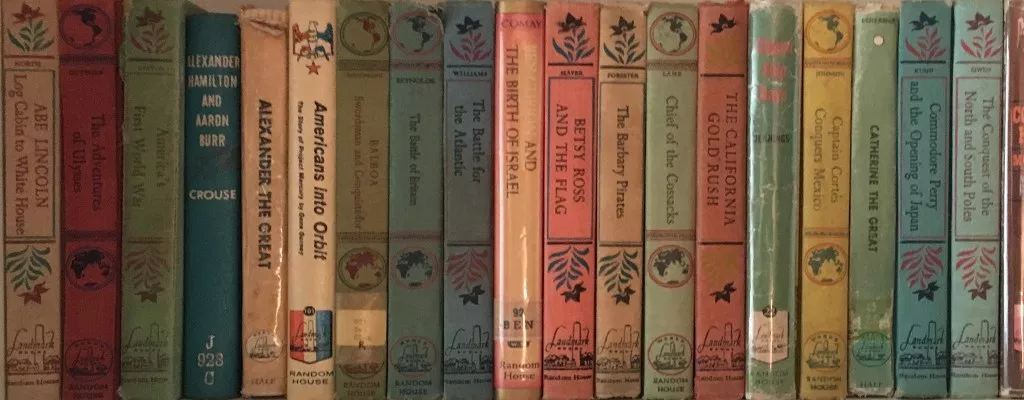
     Given that Mr. Bryson is so good at writing books one figures he will also be good at knowing which ones to read. Here is his answer: “I was completely devoted to an imprint called Landmark Books when I was growing up. I don’t know whether anyone remembers this series anymore, but they were nonfiction hardback books, on historical subjects, written for children or adapted from adult books. They made you feel that you were taking part in a grown-up activity but at a level that you could handle. A good deal of what I know about American history came from Landmark Books. I used to spend nearly all my pocket money on either Landmark Books or, if I was feeling rakish, Hardy Boys books. I am hugely indebted to both.”

     I did read some Hardy Boys books, but I was unaware of the Landmark ones and I know nothing about the current reading habits of children, assuming some still read. Still, given Bryson’s endorsement I thought it worth having a look at Landmark Books. (One has to remember, by the way, that he not only writes good books, he chooses good titles. A recent one, for example: The Road to Little Dribbling ( a path, by the way, down which a lot of gents my age seem to be heading)).

    Landmark Books were published in hardback by Random House during the 1950s and 1960s. They were works of non-fiction that were written for children by well-respected authors. Robert Penn Warren, for example, wrote one about the Alamo. I could go on and I was fully prepared to spend far too much time doing research about Landmark which would have resulted, at some far distant point in time, in a report that was far too long.

    It is the case, however, that one of the people who responded to Bryson’s answer is a professor of history at Furman University, who taught a course utilizing the Landmark Book series. He wrote an excellent account of Landmark which you can find here and which tells you all you need to know: See: “Generations Past: The Story of the Landmark Books,” David Spear, Perspectives on History, Oct. 17, 2016.

KIDDIE LIT


     Having been scooped by Professor Spear, I will turn our attention to ‘Kiddie Lit’, which is a slightly derisive term that was applied to those courses in a college curriculum which considered children’s literature. I recall that Western University has (or perhaps had) a solid collection of books related to children. They were, at one point, in the library of the Graduate School of Library Science, where it was realized that it would be a good thing for those aspiring to be librarians for children to know something about them. There is also a college of education which housed a good collection. As well, there is even material in the humanities library to support courses offered in the English Department. Now, much of this material is in a storage facility and clearly the collection(s) are strong. Among them, for example you will find these Landmark titles.
   

        A Baker’s Dozen of Landmark Books in the Western Libraries


Adams, Samuel Hopkins, General Brock and Niagara Falls. (1957)
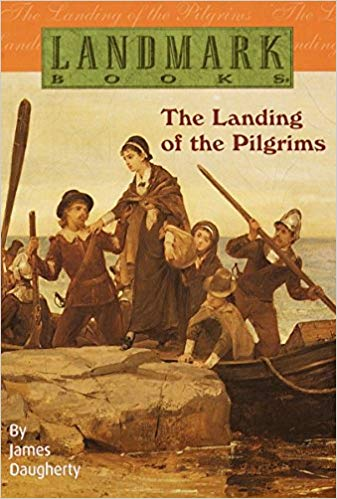
Daugherty, James, The Landing of the Pilgrims. (1950)
Fehrenbach, T. R. The United Nations in War and Peace. (1968)
Hill, Ralph Nading, The Doctors Who Conquered Yellow Fever. (1957)
Holbrook, Stewart H., The Golden Age of Railroads.(1960)
Hume, Ruth Fox, Great Men of Medicine. (1961)
Kjelgaard, Jim, The Explorations of Père Marquette. (1951)
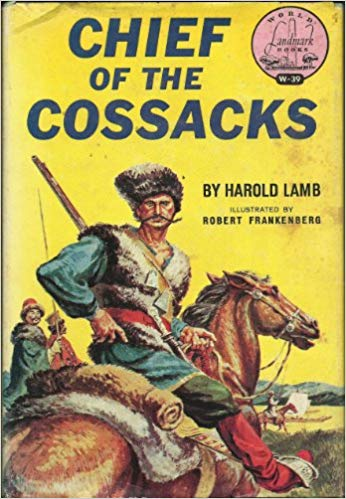
Lamb, Harold, Chief of the Cossacks. (1959)
Neuberger, Richard L., Royal Canadian Mounted Police.(1953)
Owen, Russell, The Conquest of the North and South Poles. (1952)
Reynolds, Quentin James, The F.B.I. (1954)
Walsh, Richard John, Adventures and Discoveries of Marco Polo. (1953)
White, Anne Terry. Prehistoric America (1951)


Sources:
Bryson's remarks are found in: "Bill Bryson: By the Book," New York Times, Jan. 14, 2016.  The letter from Professor Spear is found in the Jan. 29th issue.

Western does have sizeable collections of material relating to children. Apart from searching 'Childrens Literature' don't forget to look for the 'Ontario Textbook Collection". As well, see this specialized bibliography: An Evaluation and Comparison of the Children's Historical Collections at the London Public Library and in the Special Collections of the Graduate School of Library and Information Science (UWO), Deanna C. Wolf.

It is not uncommon for institutions of higher learning to lower their focus to the little ones. See, e.g.
The Children's Literature Collection at the UBC.
The Margo Sandor Children's Literature Collection, U of T.
The Northeast Children's Literature at the Univ. of Connecticut.
(For the story of how it got there, see the chapter on "Obsessed Amateurs" in Nicholas A. Basbanes, A Gentle Madness...)

Post Script
Parental guidance is advised. If you are thinking of getting some of these books for your children you should be aware that some of those who were the biographical subjects in the Landmark series may have recently had their statues removed. You might also want to scrutinize these titles:

Monday, 8 October 2018

EMPTY ROOMS

     I have noted, perhaps too frequently, that many university libraries seem to be following the trend in domestic architecture of creating 'open concept' structures which are simply large open spaces (known in the library world as 'makerspaces') devoid of both character and books. Now some high schools seem to think this is a desirable development. The rather sensational headline in the local paper recently announced: "Saunders Unveils $1.6 Million 'Library of the Future'. Perhaps it should have read: "Saunders Unveils $1.6 million 'Big Room'. Here it is:

[The image disappeared. I can assure you, it was a large room with a very small number of books.]


Cabinets of Curiosities        

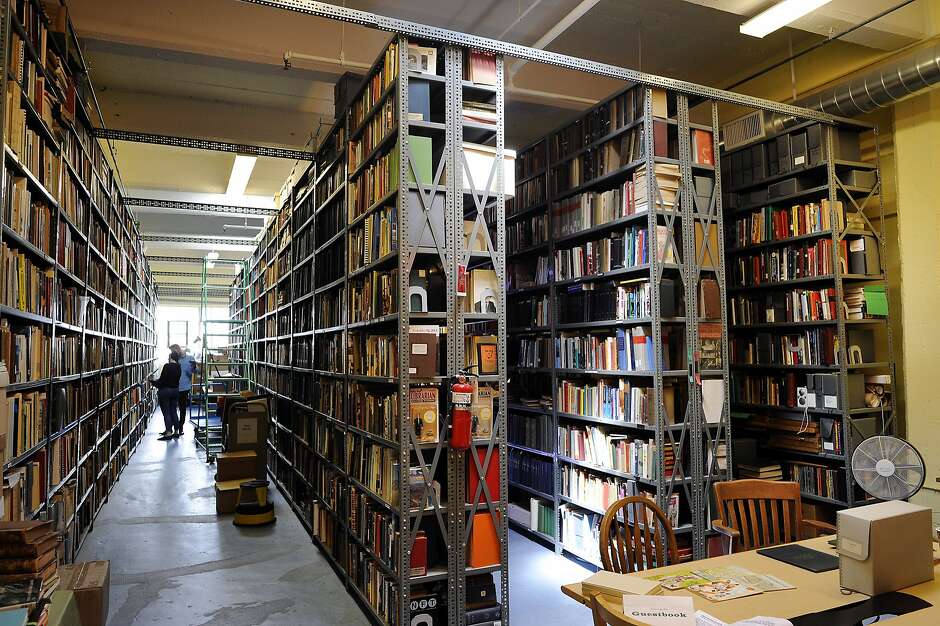
      I prefer a little clutter and think a good library should be full of books and, as well, be partially an archive and a museum containing lots of ephemera. Although what follows is not picturesque I find it preferable to the space above.


Prelinger Library
          That picture is from this article, "An Idiosyncratic Library Squirreled Away in SoMa," Ryan Kost, San Francisco Chronicle, Aug. 24, 2015 and the Prelinger Library is, indeed, idiosyncratic. It was started by two people interested in collecting material and the interest led to their marriage as well as the library. The collection is an eclectic one and, in part, it is provided by libraries that are essentially getting out of the library business. One of the founders notes that the Prelinger was started just as "libraries all around the U.S. were “under a lot of pressure in terms of how they used their space to serve their communities,” Megan says. This meant clearing out the very objects they’d been built to hold: books. Megan and Rick began to scan the lists of books being abandoned. The libraries would send them their way, so long as they were willing to cover the cost of shipping. Their collection grew, though selectively."

    It is an interesting story and you can read it at the Prelinger Library. 


A bookless and bland "library" of the future.

Wednesday, 26 September 2018

Free Speech & Ontario Universities

Erect More Platforms


From Buck-a-Beer to Buck-a-Thought

     Recently the Ontario Conservatives came up with a good idea that would have looked much, much better if it had come from those on the other side of the aisle. It also would have perhaps been more palatable if it had arrived as a request rather than a mandate - a mandate that imposes a deadline (Jan.1, 2019) and includes a threat (decreased funding). By that date, the Ministry of Training, Colleges and Universities will expect a free speech policy from every Ontario institution of higher education that receives funding from the government.

     I think speeches should be free on campus. I think it is a good thing that administrators and academics will now have to spend some time clarifying a policy about the concept of free speech, even if they have less time to work on documents about disabilities, diversity and indigneity. I hope they end up agreeing with President Chakma who said “It is not our responsibility to shield students from obnoxious views,”

     The deadline should not be a problem; there are many university policies from which to plagiarize. There also are many solutions to the two major problems 1) Campus Security(dealing with the 'Hecklers’ Veto') and 2) determining what constitutes 'Hate Speech’. The American solutions to campus disruptions are numerous and our laws and student conduct codes should suffice to cover many situations. 'Hate Speech' presents a particularly Canadian conundrum and one does not get much assistance from the Criminal Code or the Canadian Human Rights Act. It will be easier to figure out ways to accommodate controversial speakers than to determine if they are likely to say hateful things. (e.g, see a letter in the Gazette from a student: “Ann Coulter was an unacceptable figure to let onto our campus, not because of her political views, but because she has often publicly worked to incite hatred against minorities of colour, race, ethnic origin, religion and sexual orientation.”)

     I will include a few sources below for those interested in this issue. I will also provide an article I wrote in 2011 about a free speech kerfuffle on the campus of the University of Western Ontario back in 1953. It shows that Hecklers’ Vetos were exercised even back then and that the problem of freedom of speech has persisted for a very long time. It will be good to have a solution provided.

    More importantly it illustrates that the type of speaker determined to be eligible to speak freely changes over time. At Western in the early ‘50s conservative students didn’t want to listen to a radical talk about world peace and poverty. Some of the the radicals of yesteryear who were kept off campus are now the ones residing on it.  Ideas not permitted on the platform in one decade are perched upon it in another. Speakers, formerly welcomed and cheered, apparently can have a past-due date (Germaine Greer) and as someone once said (I think, but I can’t find it) it is useful to remember that “Today’s underground is tomorrow’s vaudeville”.

Sources:

     The remark from President Chakma is found in "Senate Faces a New PC Government in First Meeting," Martin Allen, The Gazette, Sept. 21, 2018.  See also Mr. Martin's earlier piece: "Western Administration is Grappling With Uncertainty Amid a Mandate to Create a New Campus Speech Policy," Aug. 30, 2018.  For the letters written about Coulter's appearance see the issues of The Gazette at the end of March, 2010. The specific quote is from a letter in the March 25th issue.

The diktat from the Ontario Government: "Ontario Protects Free Speech on Campus"

For an article critical of the new mandate see: "The Theatrics of the Ford Government Regarding Free Speech on Campus," Creso Sa, University Affairs, Sept. 6, 2018.

For a statement from the Council of Ontario Universities see: "Ontario Universities Share Goal of Protecting Free Speech on Campus, Will Work Closely With the Government," Aug. 30, 2018.

"FIRE’s mission is to defend and sustain the individual rights of students and faculty members at America’s colleges and universities." 

"First published in 2011, the annual Campus Freedom Index provides students, parents, politicians, university administrators, and the public with data about the state of free speech on 60 Canadian public universities."


The Red Dean


[This article appeared in Western News, Feb. 3, 2011 under “Nothing New in Quest for Free Speech,” p.5. It was in reaction to many of the free speech controversies at the time. A few bolded notes are inserted for clarification. I suggest you read at least the prescient comment by Hume Cronyn and the concluding paragraph.]


Dean of Canterbury Heckled Off London Stage by Western Students (1953)


     There have been a number of incidents recently where an individual has been invited to a campus or community to deliver a lecture and either has been unable to speak or found it difficult to do so because of the presence of protesters.  Just a few weeks ago a columnist for a major Canadian newspaper was not allowed to address an audience on a campus to which she had been invited to discuss her new book.*  One can debate whether such incidents are increasing and how much the concept of ‘free speech’ is now threatened, or even to what degree it is actually an alien idea in Canada. Less debatable would be the assertion that in the past polite Canadians or Western students would never have denied someone their right to speak, or disrupted a talk, forcing the lecturer to flee. In London over 50 years ago there was just such an episode and it resembles in some ways the more recent ones in Waterloo and elsewhere in Canada. *[The columnist was Ms Blatchford and the book is Helpless : Caledonia's Nightmare of Fear and Anarchy, and How the Law Failed all of Us.]

     In February, 1953  the Very Reverend, Dr. Hewlett Johnson, Dean of Canterbury was forced to leave hurriedly from London, just as did Christie Blatchford from Waterloo. One would have thought it likely that someone with such ecclesiastical credentials would not have been perceived as threatening as Blatchford. Nor might one have expected that the topic of the talk that was not delivered – ‘World Peace’-  would be as provocative  as, say the subject of ‘Islam’ as perceived  by the Very Controversial Mark  Steyn.*  Admittedly, by this time the dean was well-known as the ‘Red Dean’ and it was, after all,  during the Cold War. Apparently the climate for ideas was at least as chilly then as it is now. *Steyn was/is controversial and he spoke about Muslims at Centennial Hall after being refused a platform at the London Convention Centre. His appearance came after Ann Coulter spoke at Western and was critical of a Muslim student who questioned her.]

The speaker who was not allowed to speak, Dr. Johnson, was described later in his obituary in The Times as a “baffling, complex and controversial figure”, but he can be characterised more simply here, with little distortion, as a clergyman who was concerned about the plight of the poor, attracted to the idea of pacifism and, while not a member of the communist party, clearly a ‘fellow traveler’. He had encountered problems earlier when visiting Canada and had been barred for a time from entering the United States.  The London Soviet Friendship Committee was responsible for his visit and no one in attendance would have been surprised that his talk was going to be as much ideological as religious.

Over 600 people paid 50 cents to hear what Dr. Johnson had to say, but “Drowned out by clanging cowbells, exploding paper bags and shouts the dean left the speaker’s rostrum at the Masonic Hall after repeated attempts to make himself heard”. Those bells and bags feature prominently in news accounts (the Associated Press picked up the story) and are exhibited in an article from the New York Times which carries the wonderful headline: “ ‘Red Dean’ Flees Din: Canadian Students  Block Talk by Canterbury Cleric”.  In addition, it is noted that: “The students, from the University of Western Ontario, broke up a meeting of the London Society of Friendship Committee by keeping up a continual din” and that “When Dr. Johnson, on a tour of eastern Canada, dashed out the rear entrance, students surrounded his car. The police cleared a path for the automobile.”


     To be fair, in local accounts there is some disagreement about the composition of the audience and whether the protesters were simply students. In an article in the evening edition of the London Free Press (“Shouting Down of ‘Red Dean’ Stirs Controversy in London”) it is noted that “UWO students -jamming the first 15 rows and others scattered about the hall – refused to budge an inch”. Elsewhere it is reported that, while the President of the university “said he had been told by staff members who attended the meeting that UWO students were not among those who instigated the noise,” it was clear that “many of the spectators who made loud noises wore windbreakers and sweaters marked ‘Western’, and freely admitted they were students at the UWO.” Even if many were Western students, they were not all in opposed to the speech. One student was reported to have jumped on the stage in an attempt to get the audience to cooperate. Another in a letter to the Globe and Mail (“Placing the Blame in London”) indicated that “few if any of us had the intention of deliberately breaking up the meeting”. Still another, Paul D. Fleck, who was later to become Chairman of the UWO Department of English, wrote in Western’s Gazette “I have just come from the most disgusting exhibition of immaturity and downright discourtesy that I have ever seen”. It was also clear that some of the most strident boycotters were not students since the caption to one picture of the protest reads: “A member of the First Canadian Parachute Club, which branded the session as a communist meeting, has a heated argument with an unidentified attendant at Masonic Temple”.

The Free Press reported that “views were divergent today on the failure of Dr. Hewlett Johnson, ‘Red Dean’ of Canterbury to make his scheduled ‘mission of peace’ speech”. Among them, the one held by Dr. E.G. Hall, president of the university was singularly unhelpful. He said, “My only comment on the affair” is that “If citizens of the community don’t like what a speaker is saying, they have a right to heckle haven’t they?” The fatuousness of that remark was matched by the facetiousness of an editorial by students in the Gazette who wondered if the president meant that there should be a ‘Fifth Freedom’, the ‘Freedom of Noise’, to be included along with others such as ‘Freedom of Speech’, ‘Freedom of Religion’, etc. A weightier response was offered by the Rev. George W. Goth of the Metropolitan United Church who attended the event: “It wasn’t the dean who was humiliated last night; it was a thousand years of Anglo-Saxon tradition of freedom and fair play.” “Mr. Goth said he will preach on the matter Sunday night using the title ‘Should We Have Listened to the ‘Red Dean’.”The attitude of the Free Press is discernible from the editorial headline “Reds Only Ones Pleased by Dean’s Reception.” There was also a cartoon by Ting  (which obviously was not banned)* with an illustration of the ‘Red Dean” with a gigantic cork in his mouth. The caption: “A Smaller Cork Might Have Done Just as Well”. [This sarcastic aside was in reference to the fact that cartoons about some religious figures are acceptable; some are not. When the Yale University Press published a book about the Danish cartoons, they were afraid to actually include the cartoons - check for yourself - The Cartoons That Shook the World.]

With an irony that seems to have gone unnoticed and which was clearly not intentional one can also determine the attitude of another prominent Londoner on the subject. A report out of Toronto that was elsewhere in the Free Press on the same day bore the headline” “Loss of Freedom of  Speech in the U.S. Fear of Hume Cronyn”.  In an address to the Canadian Club he said “Today we are in danger of losing our prime freedom – freedom of speech.... It has got so that anyone who dares to have even mildly liberal views nowadays is the object of wild accusations, even those people who are miles away from being even parlor pinks. It is a frightening thing and I am disturbed to hear it is happening in Canada too”.


This episode demonstrates that the recent controversial cases are not new, although admittedly some things have changed. The protesting forces back then were from the ‘regressive right’ whereas now they are just as likely to be from the ‘progressive left’. The arguments over the concept of ‘free speech’ have grown more complex with the arrival of ‘offensive speech’ and ‘hate speech’. The threats may be perceived to be greater in that now those who object to what is said may target for reprisal the innocent as well as the guilty. Still, for the few of us who value free speech or for those of us who think, as a recent columnist in the London Free Press asserted, that Canadians are smart enough to hear divergent views, perhaps it is past time in our ‘free society’ to address the question of whether people really have the right to free expression.* Surely at a university which places a high value on the diversity of the student and faculty population there should be some tolerance for diversity in beliefs and some feeling that the academic freedom recently guaranteed to faculty be extended and expanded to visitors to campus. Provide security for those to those who come to hear a talk and do not simply capitulate to those who do not wish to listen. Offer counselling, if needed, for students and faculty whose feelings are hurt by what is said. Let the Coulters or clerics speak or clearly admit that you are unwilling to allow them to be invited. *[The columnist is Brian MacLeod. See: “Canadians Smart Enough to Hear Galloway, Coulter,”LFP, Nov. 25, 2010. Galloway is a former British Labour MP who is a critic of Israel and a Palestinian sympathizer. Although he had his problems with the Canada Border and Services Agency, he was welcomed on campuses.]

Post Script (the usual bonus bits for premium subscribers)

Book Discussions Can Be Dangerous
     For a recent example of the problems speakers and universities can face see this article: “Wilfrid Laurier Professor Withdraws From Free Speech Task Force in Protest:  Professor David Haskell Stepped Aside After Learning the University is Demanding $5,473 for Unspecified Security Costs  for a Lindsay Shepherd-organized Event,” Christie Blatchford, May 3, 2018 National Post
It shows how one university deals with the issue of security costs (Charge the organizers. Columbia University just chose to cover the costs). It also provides a test case that the university could use once its new policy is in place to see if it works. Try inviting Professor Frances Widdowson to discuss her book and to address the question “Does University Indigenization Threaten Open Inquiry?” Or if it is decided to put an American in danger first, invite Charles Murray.

Under the Radar
     If the University is lucky perhaps some potentially controversial events will go unnoticed. Apparently this one did. This is from a notice that is found in a spring 2011 issue of Western News:  9/11 TRUTHER BRINGS MESSAGE TO CAMPUS
“Niels Harrit, associate professor of chemistry at the University of Copenhagen, will offer a critique of the official account of the destruction of the World Trade Centres on Sept. 11, 2001, focusing on Building 7. Harrit published an article in 2009 about the discovery of nano-thermite, an incendiary and explosive, in the WTC dust. The free lecture takes place 7 p.m. today, March 3 in Social Science Centre, Room 2050. The lecture will be moderated by Dr. Paul McArthur, Western adjunct professor of family medicine.”

I was out of town at the time and only learned of the talk when I returned. As far as I can tell there was no mention at all of the event in the campus or local press. Perhaps believing that 9/11 was mainly fake news is not controversial. I tend to disagree, but am glad Mr. Harrit was allowed to give his talk. There is, by the way, a retired Western professor who also believes that 9/11 is a U.S. government conspiracy. See the book,Voodoo Histories: The Role of the Conspiracy Theory in Shaping Modern History for details and his identity. To learn more about Mr Harrit see Architects & Engineers for 9/11 Truth.

Friday, 21 September 2018

HAVE A NICE DAY


    A clichéd title is appropriate when the subject is a mundane one - the weather. I complain all the time about people who talk about and complain about the weather, which, I suppose makes me one of them. I should be excused for bringing up the topic in this instance, however, since I have now a clearer understanding of what ‘nice days’ are, weatherwise, and where we are most likely to find some of them.
     You might think that there is not much confusion about what constitutes a nice day. As the September solstice approaches, the birds clearly believe that the nicer weather is to be found to the south of Canada and they are soon to be followed by many Canadians who clearly agree. Apart from wanting to be warm we also generally agree that the heat should come without too much humidity, that a light breeze is better than a strong wind and that the sun should not be hidden by too many clouds. We want it to be basically like our living room, but perhaps with a view of some palm trees and water.

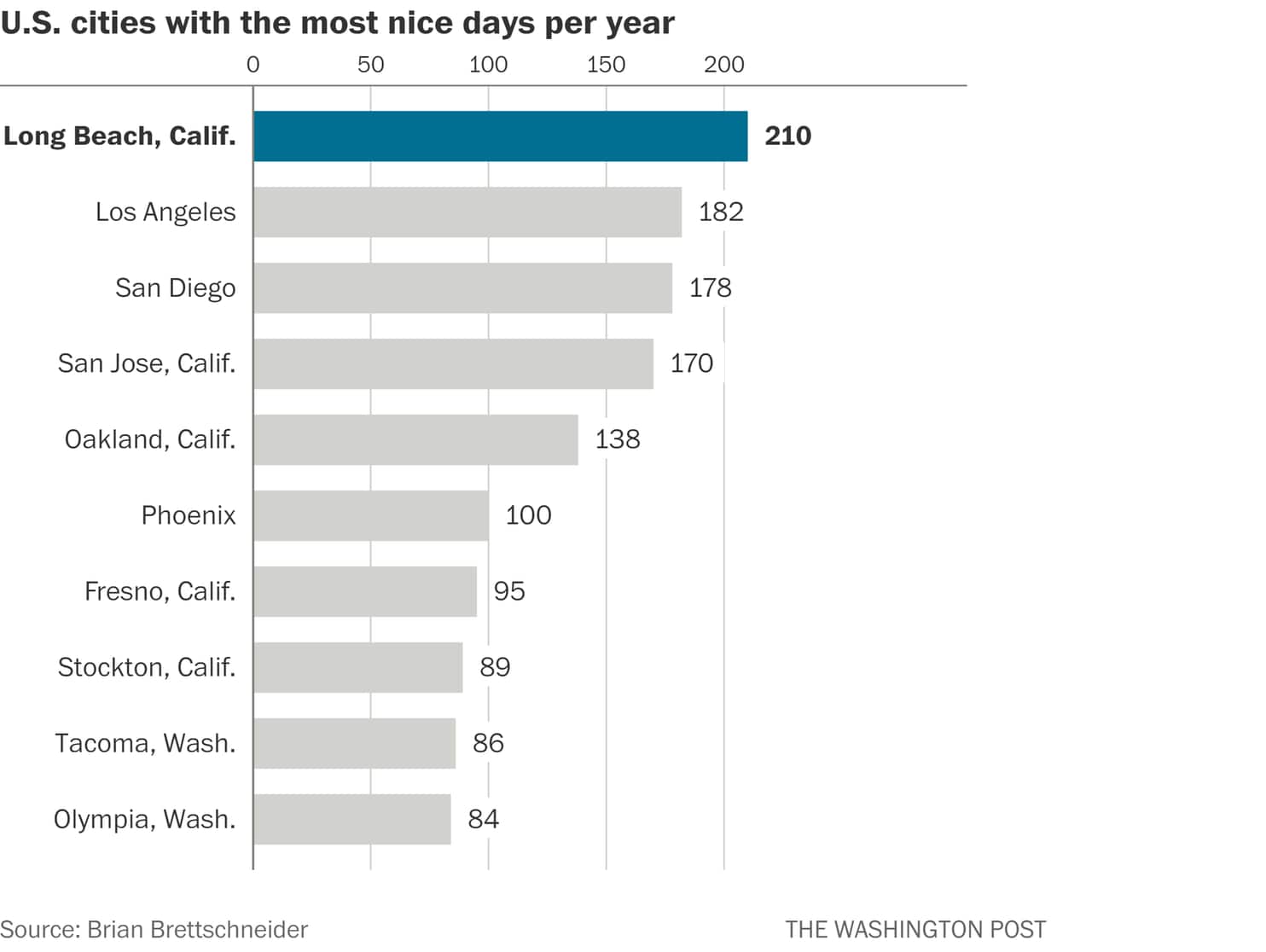
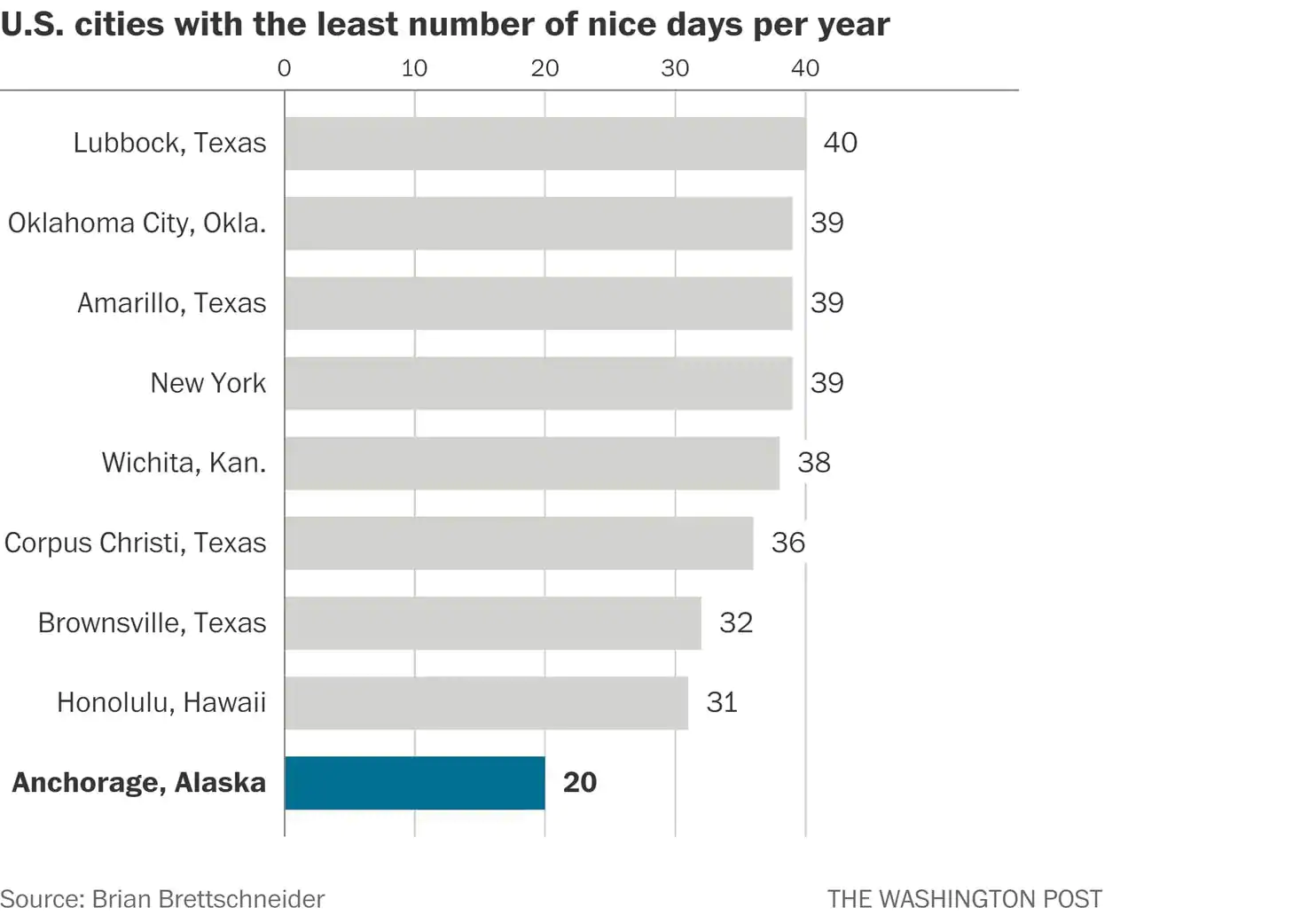
    Using such criteria, Brent Brettschneider, a climate scientist, analyzed the data provided from 373 stations around the country (the U.S. not Canada; our weather stations were probably frozen), on an hourly basis for all 365 days over the 20 year period from 1998 to 2018 to determine which places yielded the most nice days over an entire year.

    The results may surprise you. Hawaii doesn’t do so well (high winds and humidity) while Arizona does. If you look at a weather map right now it is likely to be around 85F (30C) in Phoenix or Tucson, but one has to remember that from October to March it is typically sunny, cool and dry. Seattle also does surprisingly well since the wet winter is offset by a fairly dry summer. Anchorage is apparently one of the worst places to be and that is where Mr. Brettschneider resides, proving that just as we can’t control the weather, we often can't choose where to live.

     The article, “What Cities Have the Most Nice Days in America?” by Brian Brettschneider, The Washington Post, August 7, 2018. Here are some of the interesting results:


Other high-scoring cities, which also include several in the Southeast United States, include:
Seattle: 78 nice days per year
Portland: 74 nice days
Charlotte: 74 nice days
San Francisco: 73 nice days
Atlanta: 73 nice days
Jacksonville, Fla.: 71 nice days
Las Vegas: 68 nice days


Other cities that score poorly, many in the Midwest and Northeast, include:
Colorado Springs: 41 nice days per year
Boston: 44 nice days
Omaha: 45 nice days
Washington: 46 nice days
Minneapolis: 46 nice days
Dallas: 46 nice days
Chicago: 47 nice days
Kansas City: 47 nice days
Philadelphia: 48 nice days
Austin: 48 nice days

Post Script
If you are interested in weather history see my post about the periodical, Weatherwise.

DAYS OF THE LONG KNIVES

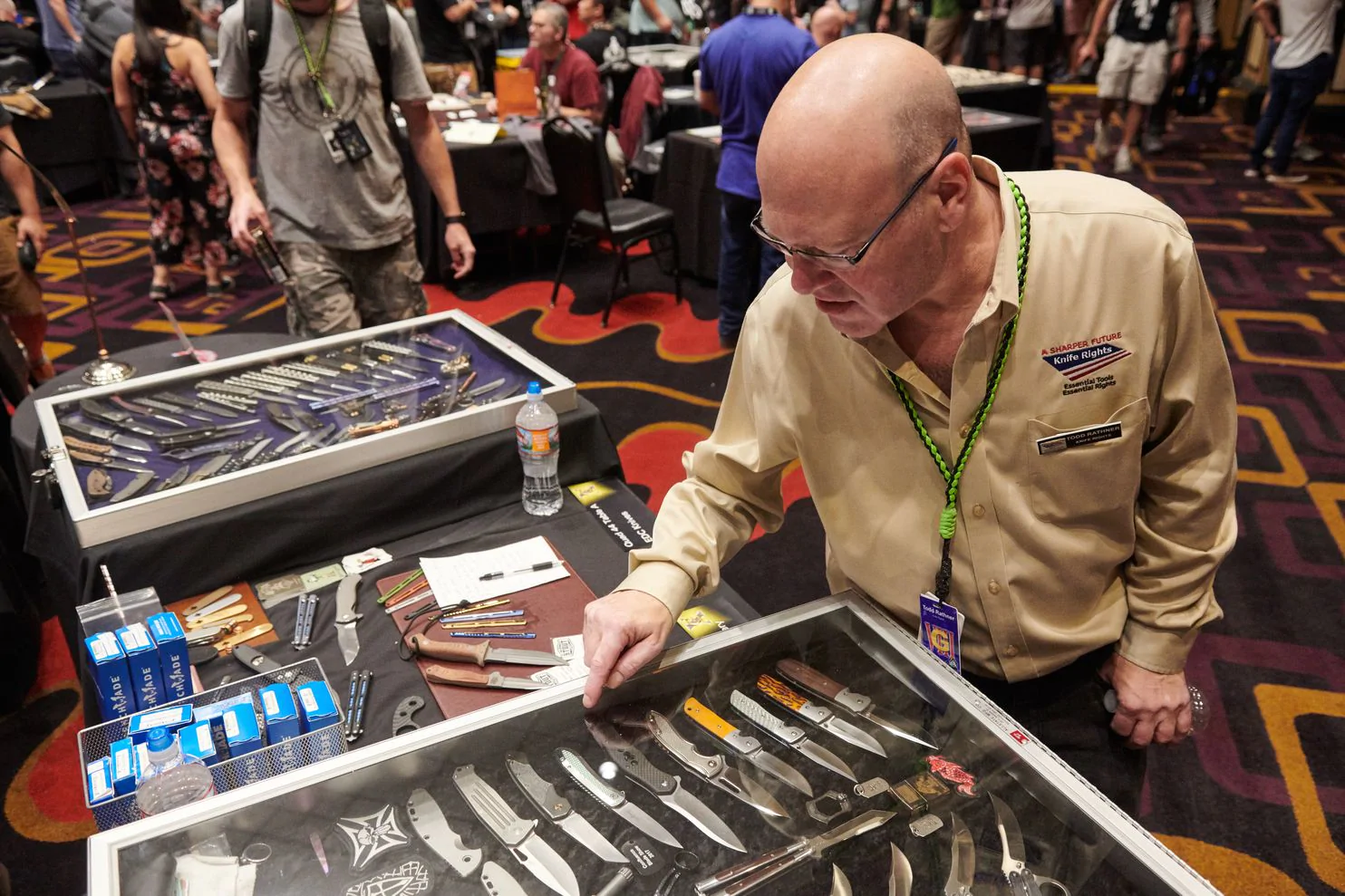
(Todd Rathner, director of legislative affairs for Knife Rights, browses knives during the Usual Suspect Gathering, where knife and other industry related vendors displayed and sold products last month in Las Vegas. (Bridget Bennett/For The Washington Post) [ If you missed the big knife show and the gathering of "The Usual Suspects", but you can learn about it here.https://www.usngathering.com/]

Something Else to Worry About

     While you have been fretting about guns you may have overlooked the knife problem. Simply put (so I can spoil your day more quickly) the calls for “Knife Rights” in the United States are growing louder. Apparently the Second Amendment indicates the right to carry a switchblade should not be infringed.

     Here is what you need to know from this recent article in the Washington Post. Perhaps it is fake news, but I doubt it:  “Borrowing Strategy From NRA, Activists Quietly Overturn Knife Restrictions Across U.S.” Todd C. Frankel, Sept. 15, 2018. It begins this way:

  He ordered the 20-ounce rib-eye, and so the waitress at the upscale restaurant dropped off a wood-handled serrated steak knife. Doug Ritter ignored it. Instead he pulled out a folding knife, its 3.4-inch blade illegal to carry concealed here in Clark County. He flicked it open with one hand. When the steak arrived, medium-rare, he started cutting.
     The steak dinner came as Ritter was savoring his many successful attempts at repealing the nation’s knife laws. Decades-old restrictions on switchblades, daggers and stilettos have fallen away in state after state in recent years. Much of this is because of Ritter and his little-known Arizona-based advocacy group Knife Rights, which has used tactics borrowed from the National Rifle Association to rack up legislative victories across the nation. And many of the changes have escaped widespread notice, obscured, in part, by the nation’s focus on guns….

     In addition, Ritter, 65, said that knives, like guns, should be considered arms protected by the Second Amendment. He doesn’t support any restriction on knives — not on switchblades or push daggers or even the ballistic knives that shoot like spears from a handle.

That’s become a winning argument. Twenty-one states have repealed or weakened their knife laws since 2010, many of them with bipartisan support, including Colorado, Michigan and Illinois. New York came close to doing the same last year. 

Now, Knife Rights is going after its biggest legislative target: overturning the 1958 Federal Switchblade Act, which bans the interstate shipment or importation of knives that open at the push of a button. It’s a long shot, but Ritter met earlier this month with lawmakers on Capitol Hill.
 “We’re trying to frame it as a freedom issue,” Ritter said in Washington, before disappearing into a congressman’s office.


Post Script


     For the Canadian situation see "Knives and Violent Crime in Canada, 2008," by Mia Dauvergne. More recently the CBC reported that knives appear to be a problem in the UK: "Surge in Knife Crime Pushes London's Murder Rate Beyond New York's," Thomson Reuters · Posted: Apr 06, 2018.
See also: "Why is Knife Crime Increasing in England and Wales? Shocking Statistics Show Incidents of Stabbing Have Risen by 22 Per Cent in a Year, With Children as Young as 13 Among the Victims," Lizzie Dearden, Independent, April 27, 2018.

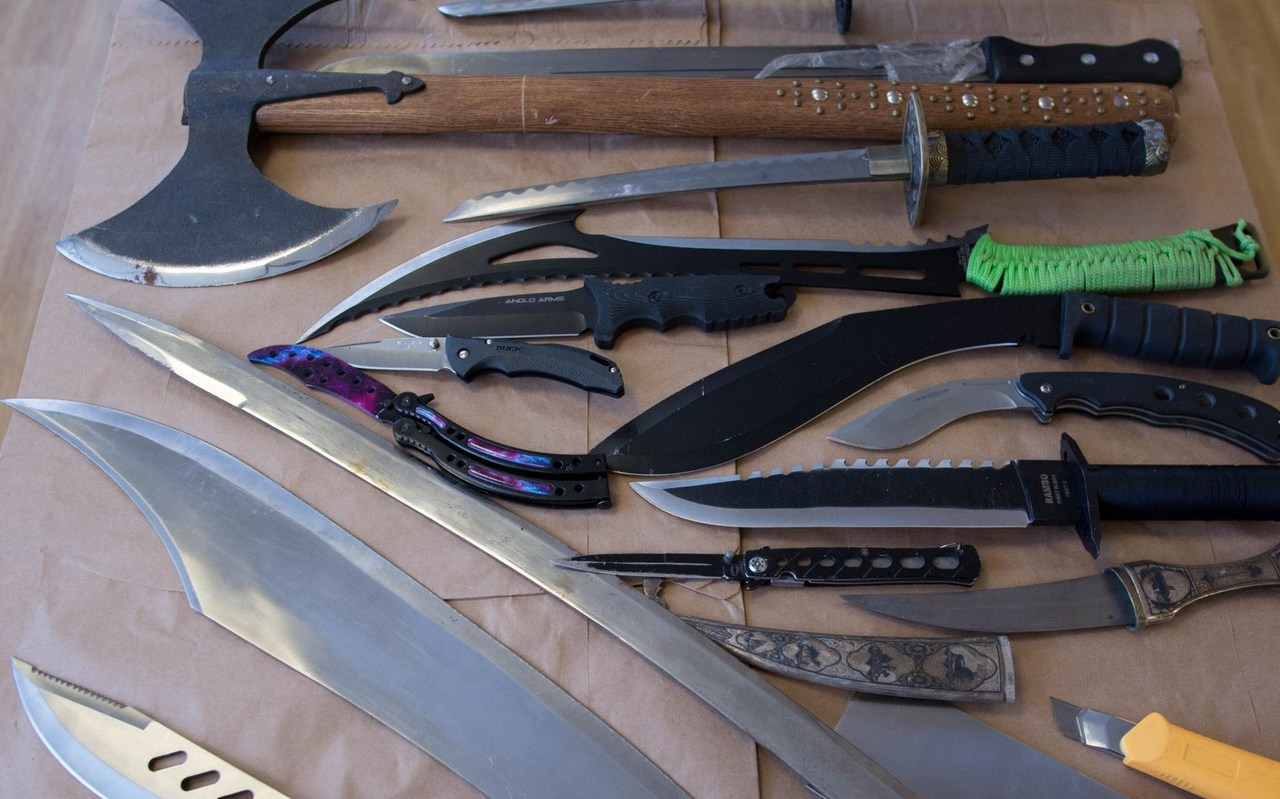
The picture above is from: "Ban on Knives Being Delivered to Shoppers' Doors Proposed by Government," Telegraph, July 18, 2017.

I suppose the Knife Rights people wish Charlton Heston was still around to utter "I Will Give Up My Knife When They Peel My Cold Dead Fingers From Around It."

I suggest that they could alter the other popular slogan to read: "If knives  are outlawed, only outlaws will have knives and we will all have to become vegetarians.