Showing posts with label Gentle Madness. Show all posts

Thursday, 11 October 2018

LANDMARK BOOKS


      A while back the author Bill Bryson was asked a question, the answer to which provides me with an opportunity to discuss another Book Series. The question posed: “Which childhood books and authors stick with you most?”  

     Given that Mr. Bryson is so good at writing books one figures he will also be good at knowing which ones to read. Here is his answer: “I was completely devoted to an imprint called Landmark Books when I was growing up. I don’t know whether anyone remembers this series anymore, but they were nonfiction hardback books, on historical subjects, written for children or adapted from adult books. They made you feel that you were taking part in a grown-up activity but at a level that you could handle. A good deal of what I know about American history came from Landmark Books. I used to spend nearly all my pocket money on either Landmark Books or, if I was feeling rakish, Hardy Boys books. I am hugely indebted to both.”

     I did read some Hardy Boys books, but I was unaware of the Landmark ones and I know nothing about the current reading habits of children, assuming some still read. Still, given Bryson’s endorsement I thought it worth having a look at Landmark Books. (One has to remember, by the way, that he not only writes good books, he chooses good titles. A recent one, for example: The Road to Little Dribbling ( a path, by the way, down which a lot of gents my age seem to be heading)).

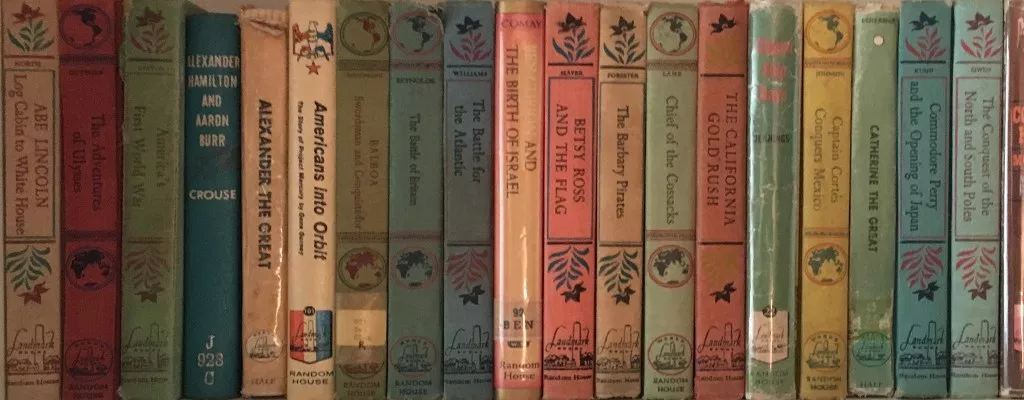
    Landmark Books were published in hardback by Random House during the 1950s and 1960s. They were works of non-fiction that were written for children by well-respected authors. Robert Penn Warren, for example, wrote one about the Alamo. I could go on and I was fully prepared to spend far too much time doing research about Landmark which would have resulted, at some far distant point in time, in a report that was far too long.

    It is the case, however, that one of the people who responded to Bryson’s answer is a professor of history at Furman University, who taught a course utilizing the Landmark Book series. He wrote an excellent account of Landmark which you can find here and which tells you all you need to know: See: “Generations Past: The Story of the Landmark Books,” David Spear, Perspectives on History, Oct. 17, 2016.

KIDDIE LIT


     Having been scooped by Professor Spear, I will turn our attention to ‘Kiddie Lit’, which is a slightly derisive term that was applied to those courses in a college curriculum which considered children’s literature. I recall that Western University has (or perhaps had) a solid collection of books related to children. They were, at one point, in the library of the Graduate School of Library Science, where it was realized that it would be a good thing for those aspiring to be librarians for children to know something about them. There is also a college of education which housed a good collection. As well, there is even material in the humanities library to support courses offered in the English Department. Now, much of this material is in a storage facility and clearly the collection(s) are strong. Among them, for example you will find these Landmark titles.
   

        A Baker’s Dozen of Landmark Books in the Western Libraries


Adams, Samuel Hopkins, General Brock and Niagara Falls. (1957)
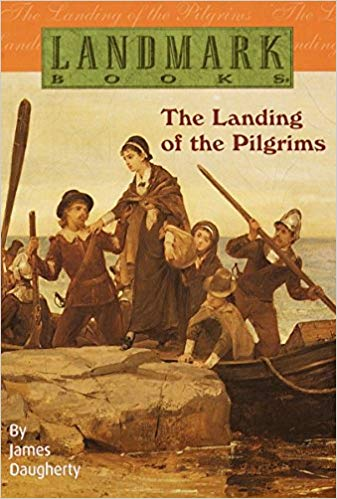
Daugherty, James, The Landing of the Pilgrims. (1950)
Fehrenbach, T. R. The United Nations in War and Peace. (1968)
Hill, Ralph Nading, The Doctors Who Conquered Yellow Fever. (1957)
Holbrook, Stewart H., The Golden Age of Railroads.(1960)
Hume, Ruth Fox, Great Men of Medicine. (1961)
Kjelgaard, Jim, The Explorations of Père Marquette. (1951)
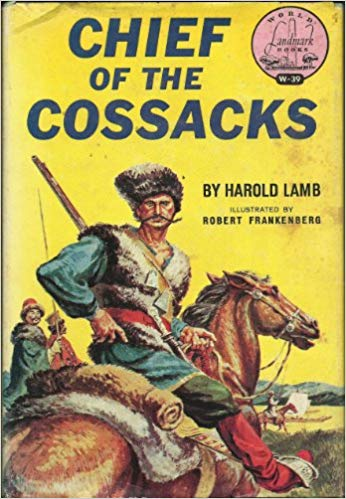
Lamb, Harold, Chief of the Cossacks. (1959)
Neuberger, Richard L., Royal Canadian Mounted Police.(1953)
Owen, Russell, The Conquest of the North and South Poles. (1952)
Reynolds, Quentin James, The F.B.I. (1954)
Walsh, Richard John, Adventures and Discoveries of Marco Polo. (1953)
White, Anne Terry. Prehistoric America (1951)


Sources:
Bryson's remarks are found in: "Bill Bryson: By the Book," New York Times, Jan. 14, 2016.  The letter from Professor Spear is found in the Jan. 29th issue.

Western does have sizeable collections of material relating to children. Apart from searching 'Childrens Literature' don't forget to look for the 'Ontario Textbook Collection". As well, see this specialized bibliography: An Evaluation and Comparison of the Children's Historical Collections at the London Public Library and in the Special Collections of the Graduate School of Library and Information Science (UWO), Deanna C. Wolf.

It is not uncommon for institutions of higher learning to lower their focus to the little ones. See, e.g.
The Children's Literature Collection at the UBC.
The Margo Sandor Children's Literature Collection, U of T.
The Northeast Children's Literature at the Univ. of Connecticut.
(For the story of how it got there, see the chapter on "Obsessed Amateurs" in Nicholas A. Basbanes, A Gentle Madness...)

Post Script
Parental guidance is advised. If you are thinking of getting some of these books for your children you should be aware that some of those who were the biographical subjects in the Landmark series may have recently had their statues removed. You might also want to scrutinize these titles:

Friday, 26 May 2017

The Great British Book Burglary


But First: The Harry Potter Caper
    Earlier this month it was reported that a short handwritten Harry Potter story by J.K. Rowling was stolen. It had been bought at a charity auction for £25,000 back in 2008. The incident reminded me of a much, much larger theft involving books that took place almost four months ago. I thought I would check to see if the culprits have been caught; they have not. Since I did the checking and since you are very likely to have been occupied by things Trumpian, I thought I would bring you up to date.

A BIG Heist at Heathrow
    The robbery took place at the end of January, 2017, but was not reported until around Feb.12 which is when the books were due to be on display at the 50th International Antiquarian Book Fair in Los Angeles. The books were being held in a warehouse in Feltham, West London near the Heathrow Airport.

   The robbers were quite daring and most accounts contain the words ‘Mission Impossible’ and ‘abseiling’. Athletes, surely, but not necessarily dilettantes. The crooks are clearly cosmopolitan and comfortable with languages other than English. Their reading tastes are also rather refined which means, you would think, that the coppers are looking for just a few David Niven-like characters. Still, no luck in finding them so far. It is doubtful the culprits were simply attempting to supplement their incomes to support opioid habits and it is unlikely they will be showing up at pawn shops in Hackney.

    Many other valuable items and books in the facility were ignored. The thieves focussed their efforts on a few crates from which they lifted over 160 rare books. The rarest and most expensive is the 1566 copy of Nicolaus Copernicus’s De Revolutionibus Orbium Coelestium valued at around £215,000. It belongs to an Italian book dealer from Padua who is reported to have lost over £680,000.

Not a Rare Event
         During the course of my investigation I uncovered an interesting database that I will identify in the sources below. It provides a complete list of all the books stolen from Heathrow. As well, it contains 173 pages that provide details of other thefts of rare books, posters, letters and maps over a number of years.

    I made a remark in a post a while back about accountants being the only ones these days who are interested in keeping books. It was meant sarcastically, but maybe I was right.

P.S.
    Of all the fascinating details provided above I am sure you were surprised by the fact that there is an Antiquarian Book Fair in Los Angeles, but that is true.
    You would be even more surprised if I had included this information about the owner of the Potter story that was stolen: at the time of the theft he was away on a business trip to Thailand with Steven Seagal!

Sources:
“Ancient Books Snatched in £2m ‘Mission Impossible’ Raid,” Fiona Hamilton, The Times, Feb. 12, 2017.
“Books Worth $2.5 Million Stolen in a Daring London Heist, Michael Schaub, Los Angeles Times, Feb. 14, 2017.
CBC Radio provided an interesting account on the program As It Happens: “ 'This was a Big job': Thieves Nab $3M Worth of Rare Books in Mission Impossible-style Heist,” Interview, CBC, Carol Off, Feb. 13, 2017. A transcript of the interview is available at this site and you can listen to the interview with the Italian book dealer (about 6 minutes).
“Thieves Steal Over 160 Rare Books in Major Heist,” Nate Pedersen, Fine Books & Collections, Feb. 14, 2017.

   The database I referred to is Stolen-Book.org which is found on a site provided by the International League of Antiquarian Booksellers. It includes details about the “Warehouse Theft, London, January 2017” and a complete list of the books.
  Also provided is an inventory of books stolen since 2010 which is very interesting. You will learn that no subject is safe. The list includes children’ books, gardening ones (Observations On The Theory And Practice Of Landscape Gardening, by Repton seems to be popular) and religious tomes. Other things are listed as well, including portraits, letters and globes. Among the posters pilfered is one advertising a performance by Buckinger (Buchinger) in London around 1730 (see my post about him back in September).
  Apart from providing details about the books burgled, there is generally a description of the places from which they were stolen. They include: private dealers; personal collections, booksellers, libraries and even castles. Here are two descriptions involving the latter two:
From a Library: (the lists of books are not included. For those see the website.
Hebrew Books Stolen from Lincoln College Library, Oxford
Please find below a list of 23 Hebrew books stolen from Lincoln College Library, Oxford (UK). The theft was investigated by the authorities in 1990, the list compiled by Rahel Fronda, Hebrew Antiquarian Cataloguer, in September 2014, has been circulated to Interpol and the Art Loss Register.
From a Castle:
List of Books Stolen from the Castle of Datschitz (Moravia, Czech Republic)
The following books were stolen from the Castle of Datschitz, Moravia (Czech Republic) in the year 2007. It might be possible that the books show up or have already shown up in the trade.

If you interested in book thieves, be sure to read the Wikipedia entry for Stephen Blumberg and then the story about him in A Gentle Madness: Bibliophiles, Bibliomanes, and the Eternal Passion for Books, by Nicholas Basbanes. Blumberg stole almost 25,000 of them.
For an interesting Swedish case see: US Returns to Sweden Millions in Antique Books Stolen by Suicidal Librarian, Sarah Cascone, June 17, 2015