Showing posts sorted by date for query mr. richard ivey. Sort by relevance Show all posts

Sunday, 16 August 2026

The Losing of Libraries

   In Mulcahy's Miscellany I often write about books and the collecting of them and a few recent posts have focussed on the private libraries amassed by individuals. Some people still value printed books and I stumbled upon several shelves of them last week on an island in Georgian Bay. They had come from far away and then the books had to be transported by boat and carried over rocks to the cottage.


Institutional Libraries
  The books prized by bibliophiles and kept by casual readers, who like Anthony Powell know that Books Do Furnish a Room, are more highly valued in many homes than they are in our public libraries and universities. I suppose the complaints about collections of books by partners or spouses are more easily parried than those coming from administrators at institutions, but the complaints are increasingly hard to counter when all of the content can be captured on a thumb drive.
  I thought of the article containing the photo above when I returned home and then saw the cover of the August issue of The Atlantic which contains only these few words in very large print:
"The Age of Reading Is Over." Then, I happened to see the image below which is found on the website of Western Libraries. It relates to a curious collection that was placed in the Weldon Library at the end of the last century. 


  Although the Pride Library is only closing for the summer and it is stated clearly that, "The Space Itself is Not Moving or Closing Permanently", my guess is that it will only be a sanctuary of sorts, and that there will be continuing pressure to use the space for something other than the storage of books and periodicals, even though the material is of some importance to those found in this initialism - LGBTQIA2S+.  My guess may be wrong and you can decide for yourself after reading: "The Pride Library: Frequently Asked Questions Regarding Temporary Closure."

  I used to work in some of the Western Libraries and there are now fewer of them. I have chronicled the loss of some and lamented the removal of books from the ones that remain (see, e.g. "Library Lamentations - Stackless Universities").
   I also wrote about another loss - one of the colleges/universities affiliated with Western University - Brescia University College (see, "Bad News From Brescia"). I did not note, however, that the Brescia Library also was closed. You can learn more about that lost library in the article below from Western News. The expansion was completed in 2006, but priorities do change. 

   The space is now a Pavilion which would probably satisfy the late philanthropist who passed away in 2008. She and her husband both contributed much to London and UWO (see, "Mr. Richard Ivey").


There were almost 50,000 items in the Brescia Library and they were absorbed by the other Western Libraries or placed in storage. (For the details see: "Brescia Library Integration FAQ")

  There are still two affiliated colleges attached to Western (Huron and King's) and they both have libraries which were curated over many years. I worry that their years are numbered.

The Bonus: 
 
A few years ago I published a post about "Edward Gorey's Library". When I  checked to see if the Western Libraries had many books relating to Gorey, I found that they did and that several were in the Pride Library and had been donated by "Empress II Madison Hart, Royal Imperial Sovereign Court of London and of Southwestern Ontario"!!
  For more information about the Pride Library, see Pride Library.

Friday, 3 January 2020


Mr. Richard Ivey


   Mr. Ivey was a well-known and respected philanthropist who passed away recently. The entire family was, and still is generous and Mrs. Beryl Ivey was also known for her charitable endeavours. The garden behind her in the picture below is near University College at Western University and is named after her as is the library at Brescia University.

   Mrs. Ivey passed away in 2007. At that time, the short notice below was published in a newsletter produced by the staff at the C.B. "Bud" Johnson Library in the Ivey Business School. It is no longer available, so I thought it should be provided here along with some other sources.


The Passing of Mrs. Beryl Ivey

A memorial service was held for Mrs. Ivey in London on January 11, 2008. While those of us who have been in London for a while certainly know about the Iveys, new students from elsewhere may not. If you would like to learn more about Mrs. Ivey, the Ivey family and their business and philanthropic activities we suggest you consult Frederick Armstrong’s ,The Iveys of London: An Entrepreneurial and Philanthropic Family.  As well, we present below for your convenience some of the related obituaries and tributes that appeared in the newspapers. Of course, both the Ivey and Western web sites contain additional information.

“Hers Was a Remarkable Life,” Ian Gillespie, London Free Press, Jan.12, 2007, p.A3.

“Beryl Ivey Remembered as 'a Great Canadian,”
Guelph Mercury, 27 December 2007.

“Philanthropist Supported Arts, Health, Education; Praise Pours in for 'Foremost Benefactor' of Western University,” The Toronto Star, 26 December 2007.

“Benefactor Beryl Ivey Dead at 82”
The Globe and Mail, 26 December 2007

“London Free Press”
The Canadian Press, 22:09, 25 December 2007, 682 words, (English)
This obituary is authored by Patrick Maloney and Claire Neary

“Governor General announces 71 appointments to Order of Canada,"
The Canadian Press, 15:13, 29 June 2007, 346 words, (English)
Mrs Ivey is among them.

Sources:
   The obituary for Mrs. Ivey was published in The Bottom Feeder in January, 2008. I was responsible for it and for the information below. Any errors are mine alone.

   An obituary for Mr. Richard Ivey is found in The London Free Press, Dec. 31, 2019.
See also: "London Business Leader and Philanthropist Richard Ivey Dies at 94," Dan Brown, The London Free Press, Dec. 30, 2019. 
"Wonderful Human Being': Londoners React to Death of Philanthropist Richard Ivey at 94: 'He was a true gentleman, and you took him at his word. With him it was not even a handshake, it was his word. There was great trust in the man'", The London Free Press, Jan.2, 2020.

Post Script:
   Apart from supporting universities and hospitals, the Ivey family also funded environmental projects. The folks at Nature London provided this note in their recent newsletter. 

"Richard Ivey, Friend of Nature
 Richard Ivey passed away recently at the age of 94.  In London, southwestern Ontario, Canada and beyond, the Ivey family and Richard have been a great influence for the protection and enjoyment of nature and a healthy environment.  Richard encouraged wise policies and supported groups like Ontario Nature, Nature London and the Thames Talbot Land Trust as they struggled to protect nature in our region.  In doing so Richard left us natural assets and organizations of great lasting value."


Thursday, 6 September 2018

Western University Names

Naming Names


    The slightly odd construction, ‘naming names’, is generally associated with bad behaviour and those so-named are usually implicated in something awful like, for example, a communist conspiracy. Here I will attempt to name some names related to Western University and to do so for a positive purpose. That purpose being: 1) to more clearly identify and define those whose names we see when we visit campus, either physically or electronically, and 2) to propose that a registry be constructed so that they can be easily found.

    Such a project is already underway and provides the impetus for this one. Just recently the folks at Research Western began to place plaques and link them to digital profiles of those who have contributed to the research endeavours of the University (for details see below). That seems like a very good idea to me. There are others who have contributed in other ways and some of their names are already on campus and there are many yet to be identified. Who are these people? Is the name on a building associated with someone who taught within it, or to a person who paid to have it built? Apart from acknowledging the person, a description surely would be useful for the highly transient student population, some of whom probably wonder who Paul Davenport was when they file into ‘his’ theatre.

    I know some of you are thinking that the construction of a biographical name registry is a bad idea and that it is ironic that the one suggesting it ranted, in a year-end post a couple of years ago, that we should abandon the practice of naming buildings and constructing statues for reasons that are now so obvious. As this is being written, the name ‘Trutch” is being removed from a building at UVic and today’s philanthropist could be tomorrow’s felon. As well, even the names of scholars can become suspect if, for example, they wrote something positive about a prime minister, or cranial size and criminality, or even used improper pronouns.

     A Western Biographical Register could get around these problems. As we become more enlightened and censorious we could continue to remove names from buildings and rooms and Chairs, but keep the registry. In it, an alteration could be made to a name that was rendered unsuitable to indicate exactly when we became ‘woke’ and, as well, ‘signal our virtue’.


     Research Western asked for suggestions and nominations related to the research mission of the university. The ones provided below are names that are already somehow associated with Western and some are related to research since they are encountered when using the Western Libraries. Others come from buildings and rooms; still others relate to scholars, donors, lectures and historical figures important to the University. All should be checked.

     In those cases where I easily found information, it is provided. Often information can be found when a naming occurred or a donation was made, but such information needs to be gathered in a central place to be easily located.

The List
[Update - 2021: I noticed that some embedded links no longer work. They are another reason for a more permanent home for them.]

 
3M Centre


(Okay, this is not a personal name, but still one might want to know why the Centre has such a label, other than the fact that  Minnes
ota Mining and Manufacturing Company probably wouldn't fit.)

Alexander Charles Spencer Engineering Building
(see also below - Thompson Engineering Building)

The Alexander Norman Collection of Comic Books
(A collection in the Western Libraries)

Alice Munro Chair in Creativity
("The Alice Munro Chair in Creativity will recognize and honour our Nobel laureate, inspire student writers and foster creative expression of all kinds. Alice Munro is counted among the University’s most extraordinary alumni."  For more see here. )

Allyn and Betty Taylor Library
(“The Allyn and Betty Taylor Library was officially opened on November 22, 1991, with the design and construction of the new library funded through the Renaissance Campaign (1989 –1994). At the time of the Library’s opening, Dr. Allyn Taylor (Western’s Chancellor from 1976 to 1980) was quoted as saying: “My long association with Western is very close to my heart. Betty and I are proud and thankful indeed to have our names linked with this fine, new library, and can only say how grateful we are to the anonymous benefactor responsible.” The $11.8 million three floor addition to the north side of the Natural Sciences Building had a total seating capacity of 1,000 in 1991.”)
see also the J. Allyn Taylor Building below.

Arthur & Sonia Labatt Health Sciences Building

The Arthur Labatt Family School of Nursing
(“Western opens innovative new home for Arthur Labatt Family School of Nursing, June 8, 2017”
“Arthur and Sonia Labatt, long-time donors to health education at Western University, opened the building Thursday with a ribbon-cutting and tour. They were awarded honorary doctorates from Western in 2012 and Arthur Labatt was Western University chancellor from 2004 to 2008.  Both are well-known philanthropists whose volunteer work includes arts, culture, health care and environmental causes.”)

Beatrice Hitchins Memorial Collection of Aviation History
(A collection in the Western Libraries)

C. B. “ Bud” Johnston Library
(At the time this Library was named, I had some association with it. Assuming that people would want to know who “Bud” was, I created a profile and bibliography. It is no longer available on the Western Libraries website.  I have a copy and it holds up well if you want to borrow it.)

Claudette Mackay-Lassonde Pavilion
“The Claudette MacKay-Lassonde Pavilion (CMLP) officially opened its doors on Saturday, October 3, 2009.  It is a 45,000 square-foot, $20-million facility, featuring advanced environmentally sustainable construction technologies and methodologies.  The CMLP houses research geared towards green technologies, processes and materials. This description also has a good link to the Lassonde Family Foundation”.)

Collip Building
(The assumption here is that it was named after Dr. J. Bertram Collip. A good profile of him is
here.)

Conron Hall
Most likely named for Dr. A.B. Conron.

DAN Department of Management & Organizational Studies

The D.B. Weldon Library

Dr. Don Rix Clinical Skills Learning Building
The Dr. Don Rix Protein Identification Facility
(“Named after Western medical school graduate Don Rix, who donated $2 million to assist in the construction of the laboratory, the Dr. Don Rix Protein Identification Facility has established Western as a leading proteomics research hub in Ontario.”) For a good account see: "What's in a Name: Dr. Don Rix Clinical Skills Building," Paul Mayne, Western News, Oct. 10, 2013.

Don Wright Faculty of Music
(“The name became the Don Wright Faculty of Music in October 2002 following a generous donation by alumnus, musician and philanthropist Dr. Donald J. Wright.”)

The Dr. Eddy Smet Collection of Comic Books
(A collection in the Western Libraries).

Elborn College

Fowler Kennedy Sport Medicine Sport Medicine Clinic

(One can find on their site a "History of the Fowler Fellowship".  Another profile and picture of Fowler is found on the site of the JP Metras Sports Museum.)

Fraunhofer Project Centre for Composites
(“The Fraunhofer Project Centre for Composites Research is a joint venture between Western University and the Fraunhofer Institute of Chemical Technology (ICT) in Pfinztal, Germany").

The G. William Stuart Jr. Collection of Milton and Miltoniana
(A collection in the Western Libraries).

Gibbons Lodge

The Gordon J. Mogenson Building

Gregory Clark Piscatorial Collection
(A collection in the Western Libraries).

The Hannah Collection on the History of Science and Medicine
(A collection in the Western Libraries).

Hellmuth Prize for Achievement in Research
One could start here.

The Hume Cronyn Memorial Observatory


(“The observatory was presented by Mrs. Frances Amelia Labatt Cronyn in memory of her husband (Hume Blake Cronyn) who had considerable interest in science even though he worked in the financial world as general manager of the Huron & Erie Savings and Loan Company (later to become the Canada Trust Company), and president of the Mutual Life Insurance Company.” See here. )


Ian O. Ihnatowycz Institute for Leadership
A description is here.

The J. Allyn Taylor Building

 (see the Allyn & Betty Taylor Library above.)

J. Gordon Thompson Recreation and Athletics Centre

The James Alexander and Ellen Rea Benson Special Collections
(“In 1999, Special Collections benefited from an endowment provided through the estate of Lillian Benson, a retired thirty-seven year employee and friend of Western Libraries. Ms. Benson had been Assistant Librarian, Administration, to Western Librarian, Dr. James J. Talman. In recognition of her gift, Special Collections was renamed The James Alexander and Ellen Rea Benson Special Collections in honour of Ms. Benson's parents.”)

The J. J. Talman Regional Collection

Joanne Goodman Lectures

John & Dotsa Bitove Family Law Library

John George Althouse Faculty of Education
(“1965 - The provincial Department of Education opens two new teacher training colleges in Ontario, one in Kingston and the other in London - Althouse College named after John George Althouse.” A good profile and picture are provided here.

John Labatt Visual Arts Centre

Josephine Spencer Niblett Law Building

The Joyce C. Garnett Innovation Fund
(Ms Garnett was  University Librarian from 1998-2013.
The information needed is provided in: “Gift Builds 'Bridge' to the Future,” by Crystal Lamb, Western News, September 14, 2016).

JP Metras Sports Museum
(“The athletic history at The University of Western Ontario covers a wide range of sports spanning well over 100 years. Between 1935-72, Western’s athletes prospered under the guidance of JP Metras as coach and athletic director. To preserve his legacy and Mustang history, the JP Metras Sports Museum opened in Alumni Hall").

J. W. Little Memorial Stadium
See here.

Kresge Building
“Pennsylvania-born businessman Sebastin Kresge met with Western President Ed Hall and Board of Governors member Jack White to discuss a possible donation for the nursing building. The meeting was successful, as Kresge donated $200,000 to the project. In recognition of his generosity, the new building was named the Kresge School of Nursing.”
From this very good link, complete with pictures:

Lawrence National Centre for Policy and Management
(“The Lawrence Centre was established in 2002 with a generous gift from Canadian businessman, Jack Lawrence, HBA '56, who was a strong proponent on behalf of business playing an active role in Canadian public policy.”)

The Laurene O. Paterson Building, Western Science Centre

Lawson Hall Residence
Lawson Research Institute

McIntosh Gallery
(Here is the information from: The Art of London, 1830-1980, Nancy Geddes Poole, 1984.
p. 103.
“While the Art Museum opened its doors in the autumn of 1940, the following June the cornerstone was laid for a second art gallery in the city, the McIntosh Memorial Gallery at the University of Western Ontario. Wilhelmina Morris McIntosh, when she died, left a bequest to the University in memory of her husband John Gordon McIntosh. The bequest not only included her personal art collection, but also provided funds to build the “English Renaissance-style” gallery at a cost not exceeding $50,000, as well as an endowment to provide for the upkeep of the building and for additional acquisitions for the collection.”)

McKellar Room

Paul Davenport Theatre
(“Renovations to Talbot Theatre were completed in August 2009 and the hall was renamed in honour of retiring university president Paul Davenport.”)

Pierre L. Morrissette Institute for Entrepreneurship
A profile of Morrissette is here.

Richard Ivey Building

Robarts Research Institute 


SCHOLARSHIPS
(Named scholarships could be problematic, in that there are probably a large number of them.. I did not quickly find a list of scholarships at the Office of the Registrar. They are often found at the department level; there are for example, at least three Professor Kenneth Hilborn ones listed by the History Department. Perhaps all of the scholarships could be subsumed under that heading and divided by faculty.)

Siebens Drake Research Institute
 (Might also wish to consider “The Haeryfar Lab  [which] is located in the Siebens-Drake Research Institute (SDRI) at Western University, under the Schulich School of Medicine & Dentistry and within the Department of Microbiology & Immunology.”)

Somerville House

Spencer Hall

Stevenson Hall

Stevenson-Lawson Building

The Stiller Centre

Sydenham Hall Residence

TD Waterhouse Stadium

Thompson Engineering Building
(see above Alexander Charles Spencer Engineering Building)

The Valberg Educational Resource Centre (VERC)
(for Dr. Leslie S. Valberg, Dean of the Faculty of Medicine)
See here.

Von Kuster Hall
(Named in honour of Clifford von Kuster, the first dean of the Faculty of Music, the recital hall is located in the Music Building with the entrance off the main lobby.)

William J. Cameron
(The name was attached to the William J. Cameron Reading Room in what used to be known as the Graduate School of Library and Information Science. Many of the books once located there show up in the Western Libraries catalogue, with his name attached.)

Sources: 
For information about the Research Western project see: "Plaques Celebrate Rich History of Research," by Paul Mayne, Western News, Nov. 9. 2017.
Information about the Heritage Plaques is found on the Research Western website.
A useful list of Western University buildings is found here. 

For a good example of how such a list could be done for the buildings see UCLA's BuildingName Origins. 

For a better one that honours philanthropists see this example of how the Canadian de Gaspe Beaubien family was featured when they made a large donation to the Baker Library. Click on the entries on the left to see other examples : A Campus Built on Philanthropy. 

Post Script
If Western ever encounters a situation where a donor wishes to have his/her name attached to a building already named they can again look to Harvard for solutions. When Mr. Bloomberg asked to have the name of his father on the Baker Library, he was accommodated. It is now know as the Baker Library/Bloomberg Center.

It seems to me that this would be a good project for those in the Western Libraries, working inter-departmentally with their colleagues over in Advancement Operations. The former have access to the university records and internal contacts with the scholars. The latter would know about the external donors and have access to the cash. Perhaps they could hire a hagiographer to write glowing bios and attract even more donors.

The Affiliates also have some names that could be named as does Fanshawe where one finds, The Lawrence Kinlin School of Business, the Donald J. Smith School of Building Technology and the Norton Wolf School of Aviation Technology.

In re-reading the above, I noticed that I used the word 'we'. I should make clear that, although I studied and worked at Western and retain some affection for the place,  I am now retired and the University is in no way responsible for these ramblings.

Sunday, 16 July 2017

An Architectural Mecca


Columbus, Indiana
    
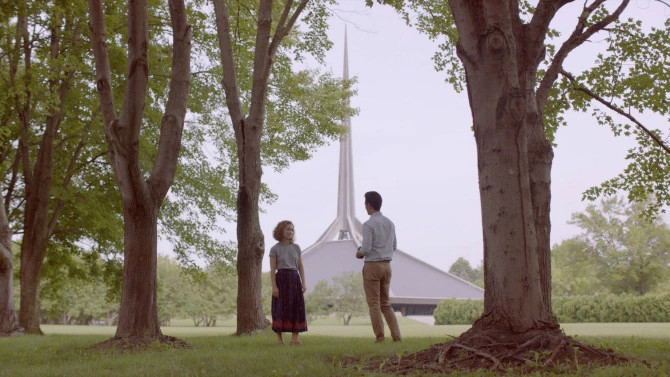
    There is a new film that has received positive reviews. It is called Columbus and was filmed in Columbus, Indiana. The director is kogonada and about him I know nothing. I also confess to knowing nothing about Columbus, Indiana until a few years ago when I ran across an account of the gentleman who has much to do with the fact that Columbus is full of fine buildings designed by famous architects.

J. Irwin Miller

    That gentleman is J. Irwin Miller and a profile of him is offered below. As you will see, it was suggested in 1968 that he would be a good candidate for President of the United States. You can decide for yourself if you think he is a better candidate than the current Vice President of the United States, who also was born in Columbus.

    Once again, I am shamelessly recycling some older material during the summer doldrums. If you wish to avoid more of my prose you can go directly to this site to learn about the architecture of Columbus. To learn more about Mr. Miller, see this essay which came out after the profile below was published:
“Eero and Irwin: Praiseworthy Competition With One’s Ancestors,” by Will Miller in Eero Saarinen: Shaping the Future, eds. Eeva-Liisa Pelkonen and Donald Albrecht.


[This originally appeared in a newsletter called The Bottom Feeder, which was produced by me at Western University. I alone am responsible for the content. In this instance, as you will see, the purpose was to offer evidence that some good business people do exist. “Ivey” is the name of the business school at that university.]

Profile No. 1.
"Ivey's mission is to develop business leaders who think globally, act strategically and contribute to the societies within which they operate".
J. Irwin Miller
(May 26, 1909 - August 16, 2004)
This is the first profile in what we anticipate will be a series dedicated to individuals in the business world who are exemplars of that portion of the Ivey mission statement that focuses on the social contributions made by business leaders.

It was completely by accident that some summer reading taken to a cottage in Muskoka happened to contain a biographical sketch of the American industrialist J. Irwin Miller whose family has long occupied an estate close by Windermere, Ontario. The admiring portrait is found in the American Scholar : "The Industrial-Strength Humanist: J. Irwin Miller Knew How to Get Things Built," by Robert Campbell (Vol.74, No.1, Winter, 2005,p.119). It quickly became clear that there is much about Miller to admire and the purpose here is to introduce to you a cultivated gentleman and patron of the arts who happened to run a large multinational while engaging in a variety of social causes. Before presenting information about Mr.Miller's contribution to society in general, we will provide some specific information about his business background and career.

Born in Columbus, Indiana into a family that was successful in banking and real estate, Miller is known in business circles for running for years the huge manufacturing company Cummins, Inc. which began as Cummins Engine Company. As a youngster Miller spent considerable time with the family chauffeur, Clessie Cummins, tinkering with diesel engines and the family invested heavily in Cummins for which Miller went to work in the early 1930s. He became President of Cummins in 1945 and Chairman in 1951 and remained actively involved with the company until 1977.
Although our concern here is with Miller's general contributions to society it is clear that his approach to the company and its employees was also an enlightened one. Cummins was successful in attracting talented and diverse workers and they continue to do well in that regard. It was reported recently in the Indianapolis Star that the company "has managed to buck the national average with a five-year hiring rate of 20 percent women" (which is high for a manufacturer). Cummins had worker-centered policies and Miller supported the foundation of a union in the 1930s. He wrote at one point that: "We understand the fact that we must give a machine the best care and the best treatment if we are to receive from it the best work. We have sometimes shied away from the similar fact that we must give a person the best care and the best treatment if we are to receive from him the best work". Upon his retirement from the Board, the Diesel Workers Union presented Miller with an honorary membership.
Miller attended Yale where he majored in Latin and Greek and he also did graduate work at Oxford. He was a generalist with strong interests in the arts and humanities and it was apparently at Yale that he became interested in architecture as a means for civic improvement. Those familiar with the Ivey School and the Ivey family will be aware of the positive impact a family can have on a city and such was the case with Miller and the Irwin family on Columbus, Indiana which is known as a "Mecca of Modern architecture" and the "Athens of the Prairie". Columbus, a small city south of Indianapolis, "boasts a collection of contemporary buildings unrivaled by that of any other American city except New York, Chicago and Los Angeles". There are over 70 significant buildings listed on the "Architectural Tour Map" that were designed by such famous architects such as: Eliel and Eero Saarinen, I.M.Pei, the firm Skidmore Owings and many more. " With its population of 39,000, Columbus likely has more buildings per capita designed by the winners of the profession's highest award - the Pritzker Architecture Prize - than any city on earth".
It has been noted that "Columbus, Indiana and J. Irwin Miller are almost holy words in architectural circles" and the reason is that Miller (the "Medici of the Midwest") established the Cummins Foundation in the 1950s which agreed to pay the architectural fees if famous and respected architects were chosen to build the schools, churches and buildings in the city. It was felt that it would be easier to attract workers to a more attractive city and that beautiful structures would make Columbus a more appealing place in which to live. All of this seems familiar given the recent emphasis on the "creative city" concept that has been widely discussed in the last couple of years.
After his recent death it was noted in one obituary that "When he died last August aged 95, thousands of Cummins workers downed tools to pay tribute to a man who not only built an empire, but also used his riches to promote human rights". Apart from his involvement with the architectural reconstruction of Columbus he was also active in the civil rights movement in the 1960s and helped organize the 1963 march on Washington. He was such a highly regarded and well respected business leader that you will find his picture occupying the entire cover of the October, 1968 issue of Esquire under the caption "This Man Ought to be the Next President of the United States". The author of the accompanying article, Steven Roberts, was given the assignment of finding a better choice for President during that tumultuous year and he found one in J. Irwin Miller. Miller had served on many government committees for both parties and believed firmly in government service and the need to address social ills. He wrote: "There are two ways in which you could avoid influenza. You could go all over the room with a microscope and a squirt gun and try to kill every influenza bug in the room, or you could make yourself sufficiently healthy that you could throw off the germ. The second way is more practical. That way is to make society so healthy that its operations are self convincing, that it really is the kind of place it pretends to be. You make this country resemble what we say it is on the Fourth of July speeches and I think many of our present problems would begin to diminish. We have to keep our promises". While he was interested in politics he had the intelligence to recognize that he would not be a good politician. Senator Lugar noted that Miller was " a reverent man whose extraordinary talents were clothed in remarkable humility" and that seems like a fitting epitaph. Another suitable one is provided by another senator (Birch Bayh): "His heart and soul was dedicated to making life generally better for a whole lot of folks".

Additional comments and suggested resources:
To learn more about J. Irwin Miller see the sources noted below. He died not long after returning from a brief trip to Canada. The Canadian connections of the Miller and Irwin families go back to 1908 when Miller's grandfather bought Llanllar Point in Muskoka. Miller's generosity and philanthropy extended to Canada and particularly to the little community of Windermere. It was noted upon his death that "Pretty much any endeavour that needed support received it from the Miller family..." (Jake Good, "Irwin Miller Left a Profound Mark on Windermere," The Muskokan, September 2, 2004). There is also an architectural legacy. See "Ontario's Saarinen: Never Published Before, This Summer Home by Architect Eero Saarinen is a Provocative Experiment in Style..." by Peter C Papademetriou, City and Country Home Vol.8, No.5, June, 1989.

Information about Cummins, the company, is easy to locate. Although Miller thought that local roots were important -- he remained in Columbus where he felt it most worthwhile to be in "praiseworthy competition with one's ancestors" - Cummins is now a global competitor with successful operations in India and China and elsewhere. In fact there is a recent Ivey case with the title "Taming the Dragon: Cummins in China".
There is also considerable information about the related family enterprise - Irwin Financial - and they have recently expanded operations into Canada.

Bibliography:
anon. "Cummins Mourns the Loss of Visionary Leader: Former Chairman, Chief Executive Officer J. Irwin Miller's Legacy Touched Thousands," Business Wire, August 17, 2004; anon. "J. Irwin Miller, 95 of Indiana, Patron of Prized Architecture," Los Angeles Times, August 22, 2004; anon. "Death of a Pioneer," Daily Telegraph, September 4, 2004; anon. "Ex-Cummins CEO Dead at 95," Fort Wayne Journal Gazette, August 18, 2004; anon. "Architectural Benefactor J. Irwin Miller Dies," The Washington Post, August 18, 2004; Campbell, Robert. "Columbus, Ind. -- Architectural Mecca," The Wall Street Journal, September 1, 2004; Bussel, Abby. "Architecture Patron J. Irwin Miller, 1909-2004: Transformed Indiana Town," Architecture, Vol. 93, No.10, Oct.1, 2004; Forgey Benjamin. "The Champion of Urbane Renewal," The Washington Post, August 21, 2004; Knight, Dana. "Engineering a Future," Knight Ridder Tribune Business News, Feb. 19, 2006, p.1; Pace, Eric. "J. Irwin Miller Industrialist and Patron of Modern Architecture," Pittsburgh Post-Gazette, August 23, 2004, (reprinted from The New York Times, August 19, 2004; Roberts, Steven V. "Is it Too Late for A Man of Honesty, High Purpose and Intelligence to be Elected President of the United States?" Esquire, Vol.LXVIII, No.4, October 1981 p.89;Schneider, Rob. "Columbus, Indiana Hails Benefactor Who Built Up Successful Engine Company," The Indianapolis Star, August 22, 2004; Tristam, Pierre, "Americans of a Higher Purpose: J.Irwin Miller, Gloria Emerson," Daytona Beach News Journal, September 21, 2004; Webber, Tammy. "Indiana Engine Magnate Dies at 95," The Indianapolis Star, August 17, 2004; Whiteley, Patrick. "Stroke of Genius That Created a Diesel Giant," Daily Telegraph, Oct.11, 2004.
Selected web sites:
For an interesting lecture by Mr. Miller see his address to the Indiana Humanities Council in 1997. The complete text of the talk is presented here.
Details about Cummins are found at this site:https://www.cummins.com/ In 2005 the magazine Business Ethics chose Cummins as its top U.S. corporate citizen.
To learn more about the Cummins Foundation see here. At this site you can also read their "Corporate Social Responsibility" report.
Information about Irwin Financial is here:
To learn more about the architecture of Columbus see here .
This profile was written in 2006. In 2008 we stumbled across a very useful essay about  Miller. Here are the details: "J.Irwin Miller", in Business People in the News, Vol.1, 1976, p.266-269.  It is a well-written account and it indicates clearly that Miller was a good choice for our first example of a business person who has admirable qualities.
[This essay appeared in 2006 and is no longer available on the library website.]

P.S.
For reviews of the film see:
"Film featuring Indiana city's architecture wins top prize,” Associated Press, June 28, 2017;

“Highlights from the 2017 Sundance Film Festival, Richard Brody, The New Yorker, Jan. 25, 2017

“Columbus’s merits are visual and dramatic: kogonada proves a highly skilled director of actors (stars John Cho and Haley Lu Richardson both deliver superlative performances, rich in nuance and feeling) and a stylist with an exceptional eye (his laser-precise compositions, framed around the modernist architecture for which Columbia, Indiana, is renowned, are positively stunning).” By Calum Marsh, June 14, 2017.

“Video essayist kogonada’s debut feature is a mesmerizing drama about, believe it or not, relationships and architecture. Bringing the eye he does to his essays, several of which you’ll find as Criterion Blu-ray extras, kogonada and cinematographer Elisha Christian (who, interestingly when it comes to composition, has a lot of credits from the world of video games) use the architecture of Columbus, Indiana as their canvas. They set up almost-always-static shots of some of the city’s most striking buildings and then allow the human drama to play out in front of it. It is a film with precise lines that captures very imprecise human emotions.” Brian Tallerico, Jan. 25, 2017 from rogerebert.com.