Showing posts with label trails. Show all posts

Monday, 6 January 2025

Walking Around the United Kingdom


   If one of your resolutions for the new year is to walk more, then book a flight to England, head for the closest coast and start walking. All the travel advice you need is found here - England's Coast.   For more background see this:

   "Britain is an island nation. And soon it will be possible to walk all the way round that island, because the King Charles III England Coast Path, as it is formally known, will open. (Wales already has a coastal path, and Scottish rules enshrine the freedom to roam, including along the coast.) The English path has been long awaited: the campaign for it began in 2004. It is also long. Its 2,700 miles will make it the longest continuous coastal path in the world. Neil Constable, national adviser at Natural England, which has created the path, hopes that by the end of 2025 it will be possible to arrive at the coast of England, and “turn right or left and follow the national trail as far as you want to go”...."
   "
YOU WILL walk past Pevensey, where William the Conqueror landed, and Margate, where the Spanish Armada did not. You will walk past Plymouth, from where the Mayflower famously set sail, and Southampton, from where the Titanic infamously did. You will walk past places made famous in poetry and song: past Lyme Regis, where Mary Anning sold seashells on the seashore, past Scarborough Fair, and past the blue birds over the white cliffs of Dover. You will walk along a “footpath through British history”, says David Abulafia, a professor of history at Cambridge University, and its “relationship with the sea”.
("You Will Be Able to Walk Around the Coast of England in 2025: You May Want to Bring Your Wellies," Catherine Nixey, The Economist, Nov. 20, 2024.

  If you are only interested in reading about walking, I will place here, some related posts found in MM. I wrote about this British path back in 2020, The Coastal Path.  If you want to walk across Canada, see: The Great Trail which was orginally called "The Trans Canada Trail" and is about 24,000 kilometres. You can get on it in St. Thomas. For a shorter walk see, Walking Around Prince Edward Island.  It you like to sing while you walk, listen to the songs found in Trail Tunes For Old-Timers. You will hear: Frankie Lane sing, "Along the Navajo Trail", and  "The Happy Wanderer," among others. 
  And if you are really interested in reading about trails and byways, have a look at:
American Trails Book Series, or this which will help with your exploration of England: Highways and Byways of England. 

The Bonus: 
 
On Jan. 1, CNN listed some of the best places to visit  in 2025 and this was one of the suggestions:

England’s footpaths
  "All manner of footpaths, bridleways and byways crisscross the English countryside, many of which have been trodden by humans since ancient times. Access to them is enshrined in law passed just over 75 years ago. That means no matter who owns the land, there’s usually a signposted trail, and some of the most idyllic scenery in the world remains open to all.
   England might not have the epic mountain trails found in some parts of the world, but just yards from almost every doorstep in the land, there’s a hedgerow path wending off into a green tunnel of overhanging trees or onto a romantically wuthering moorland.
   Popular long-distance routes such as the Pennine Way (60 years old in 2025), Coast-to-Coast or South Downs Way get attention, but quieter corners of the country have their own waymarked trails. Indeed, anyone armed with an Ordnance Survey map can create their own.
   Only visiting London? Check out the Capital Ring Walk — a sectioned trail that loops around the city’s suburbs and hidden wildernesses. Or head up the London Underground’s Metropolitan Line and sample the Chess Valley Walk from Chesham to Rickmansworth: 10 miles (16 kilometers) of mostly rural bliss with a Tube station at either end." — Barry Neild

Sunday, 31 March 2024

Literary Landscapes

   This post is for those intending to go to the United States and who would like some literary guides. It is also meant for anyone who has no intention to go to the States, but would like to read about some of the more exotic locales from the safety of the couch.
   The literature related to particular places can be very interesting and useful for the travellers passing through them. The descriptions in fiction of the local areas visited are generally better than we can provide and reading them helps revive the memories of trips taken long ago. Local histories supply the background needed if one bothers to explore beyond the interstate intersections which are now all the same. If you are thinking of a road trip, Blue Highways by William Least Heat-Moon will put you in the proper mood. If you are staying home, settle in and read about such places as this one, which is the title of a book by Wallace Stegner about the west: Where the Bluebird Sings to the Lemonade Springs.
   
More such books are found below. The first source will direct you to over a thousand novels. The other sources also include works of non-fiction. Many are related to the southeastern U.S., around where I grew up and will soon revisit. The northwest is not neglected, however, and we also hope to go in that direction when we can. 


Start From Here: "1,001 Novels: A Library of America," by Susan Straight. 
   No matter where you are, and whether you are leaving by car or staying on the couch, begin with this website. You can click on a map and quickly find the books and/or authors relating to a particular region. There are eleven of them which are nicely named and two are illustrated above. Some of the others: 
“Pointed Firs, Granite Coves and Revolution”, which relates to, Vermont, Maine, New Hampshire, Massachusetts, Connecticut, and Rhode Island, and “Golden Dreams & Sapphire Waves”, which is about California and Hawaii. Here is a description from: "Mapping USA Via Novels, Not Left and RIght Politics," Giuliana Mayo, KCRW, Los Angeles, June 29, 2023:
"Partnering with ArcGIS Story Maps, Straight began putting together novels that spoke to a broader America....The interactive map allows people to zoom in on locations where novels are set all over the country. “[Story Maps] made it so easy to navigate the map. You click on one of the dots, and you see the exact GPS location [where the book takes place], and then the book cover comes up,” she explains. She also wrote two-sentence thumbnail descriptions for all 1,001 books.


Heading South

 You have missed this year's New Orleans Book Festival, but you can take the SOUTHERN LITERARY TRAIL, to learn about the places lived in, related to or written about by authors from Alabama, Mississippi and Georgia. Among them you will find: Shelby Foote, Lilian Hellman, Harper Lee, Truman Capote, Tennessee Williams, Eudora Welty and Margaret Mitchell, about whom I have posted. 


There is also a Facebook page for the SLT, and for Alabama, more information is found in the Encyclopedia of Alabama. For Mississippi see the "Southern Literary Trail Gallery" at Mississippi State University Libraries. 


Heading Southeast
 Additional information about Georgia is found on the "Guide to Georgia's Literary Landmarks" which provides links to the Georgia Writer's Museum, Flannery O'Connor's Homes, Martha Mitchell's House and others. If you are really interested in O'Connor, see the book: A Literary Guide to Flannery O'Connor's Georgia. I wrote recently about Erskine Caldwell and you can learn more about him by visiting Moreland, Georgia. It is also the home of Lewis Grizzard and if you come by my house I will give you my copy of "Don't Bend Over in the Garden, Granny, You Know Them Taters Got Eyes, for reading this far. 
   For South Carolina, see Libby Wiersema's, "Six South Carolina Literary Landmarks" for information about: James Dickey, Pat Conroy and some other local authors.
   North Carolina's Literary Trails can be explored by ordering a three volume set which covers all the areas of the Tar Heel State, the east, the Piedmont area and the mountains.


   "The Mountains volume brings together more than 170 writers from the past and present, including Sequoyah, Elizabeth Spencer, Fred Chappell, Charles Frazier, Kathryn Stripling Byer, Robert Morgan, William Bartram, Gail Godwin, O. Henry, Thomas Wolfe, F. Scott Fitzgerald, Anne Tyler, Lillian Jackson Braun, Nina Simone, and Romulus Linney. Each tour provides information about the libraries, museums, colleges, bookstores, and other venues open to the public where writers regularly present their work or are represented in exhibits, events, performances, and festivals."


  "In the Piedmont volume featured authors include O. Henry, Doris Betts, Alex Haley, Langston Hughes, Zora Neale Hurston, John Hart, Betty Smith, Edward R. Murrow, Patricia Cornwell, Carson McCullers, Maya Angelou, Lee Smith, Reynolds Price, and David Sedaris."

"The third volume focuses on the eastern portion of the state. Georgann Eubanks has organized the manuscript into three “trails”: "The Southeastern Corridor" from Raleigh to Wilmington, "The Middle Corridor" from eastern Wake County to Carteret County, and "The Northeastern Corridor" from Wake Forest to the northern Outer Banks. Each trail is further broken down into several tours of half-day segments. Each tour features a map detailing how to get from site to site, brief biographies of the writers included in the trail, passages from the writers that refer to the places along the trail, reading lists, and web addresses linking to further information about sites and authors."

More Books About Regional Books

The Ideals Guide to Literary Places in the U.S Paperback – January 1, 1998
by Michelle Prater Burke (Author)
"Here is a travel book with a difference! For the armchair traveler, there are fascinating descriptions, sketches, and quotes from the authors. For the more adventurous, there are maps, directions, and information on how to ger there and the features of each place. And there are over 50 places included, each associated with one of America's greatest writers. Clearly and logically presented, this is a beautiful book that is fun to read as well as a practical guide to America."

Traveling Literary America: A Complete Guide to Literary Landmarks Paperback – January 1, 2005
by B. J. Welborn
"Readers and travelers are guided to more than 200 homes and historic sites of America’s greatest writers—from the Jack London Ranch in northern California to William Faulkner’s home in Oxford, Mississippi. Clear driving directions and visitor instructions are combined with unique tidbits about each site and author, such as the story of Jack London’s custom-made furniture and the roll top desk and Dictaphone on display in his study. Literary enthusiasts are guided to the site of Thoreau’s bean field, where they can poke around an exact replica of his cabin. They can drop in on Margaret Mitchell’s recently restored Atlanta apartment or visit John Steinbeck’s haunts in the cozy California seaside town of Pacific Grove. This family-oriented, user-friendly guide teaches literary folk about writers' work, their philosophies, and the forces that compelled them to write. All 50 states are represented, and the literary sites are divided by geographic regions."

A Literary Tour Guide to the United States: Northeast, Paperback – May 1, 1978
by Emilie C. Harting (Author)
"A comprehensive guide to visiting the homes and haunts of American writers and the settings of their works in the U.S. Northeast."


Northwest Passages: A Literary Anthology of the Pacific Northwest from Coyote Tales to Roadside Attractions, Bruce Barcott.
"Northwest Passages, an anthology of approximately 90 short pieces and excerpts from longer works published over the last two centuries, is by far the more exhaustive treatment of the region. Its selections, from the legends of native tribes to the stories and poems of the freshest transplants, provide a remarkably complete history of the Northwest. As for what the area is like, the answers to be gleaned from works by Rudyard Kipling, Chief Joseph, lack Kerouac, Theodore Roethke, and Raymond Carver, to name just a few, are as varied as a landscape that includes deserts, mountains, fertile valleys and plains, forests, beaches, and water in unparalleled abundance. The only unanimity is inspired by the weather. The explorer William Clark reported "rain falling in torrents," and, on the evidence of these pieces, the sky has scarcely cleared since. As Seattle poet Denise Levertov notes, "Gray is the price/of neighboring with eagles, of knowing / a mountain's vast presence, seen, or unseen."

Local London Readers
  As I mentioned above somewhere, I am willing to part with my copy of Grizzard's book about Granny. Almost by accident, I suppose, I have acquired other books of regional interest, which I am quite willing to lend if you want to come by and pick them up. Without looking around much, I can think of:
About ten books by Reynolds Price (North Carolina.) 
About the same number by RIchard Russo (New York State.)
A few by Pat Conroy and Padgett Powell (South Carolina)
A few about the Northwest - e.g. Notes From the Century Before, Passage to Juneau and Far Corner.
If you wish to leave the continent, there are more books, such as this one about some remote islands in the Indian Ocean - Kings of the Cocos. 
Just remember, I used to work in libraries and there will be fines. 

Monday, 31 October 2022

Lovely Names for Lost Landscapes


   I just did another post about the elimination of old geographic names and I will not bore you again with that subject. Instead, I will suggest that we should also be concerned about the creation of new toponymic terms. Particularly as they are applied to recently constructed housing developments.

   You may have noticed when travelling around the perimeter of London, that the natural landscape is rapidly being altered and replaced by rows of very large homes on very small lots. While they may not look attractive, they are attractively described and if you are lured by the name, you are likely to be disappointed. 

   There appear to be no truth in advertising regulations about names which are deceptive, so I will offer a few suggestions here. If the name sounds old and has the word "Mews" in it, it is brand new. Often the description is about things which don't exist on the sites, or conveys notions about what the place is not. "Rolling Meadows" is likely to be flat and not green. If trees are mentioned there will be none and do be especially wary of those that offer groves of chestnuts. Avoid descriptive phrasing that uses "At", as in "The Sanctuary at Sydenham Canyons" or "The Preserves at Port Stanley." An "Andover Trails" will have few and none that are not concrete and if the brochure uses the word "Trace" for "Trails", surely there will be no place to hike. 

Fancy Names for Bland Developments is Not a New Development

   In the early part of the last century one finds examples of entrepreneurial developers who were guilty of real estate hyperbole and in this quote you will learn that I am not the first to make fun of it.

"I had not been long in the Northwest before I discovered it to have elegancies. It first astonished and then mildly amused me to run across, among the stumps still standing on logged-off land, a hunt club, complete with red coats, masters of the hounds, and considerable view halloo.
The Northwest was spotted here and there with elegancies other than hunt clubs. I suppose all new countries go through like labors. Kensington Manors were appearing suddenly where one might yet hear the melancholy cadences of the owl. Out of the newly drained swamps, as one watched, sprang Mayfairs, Windermeres, Highland Moors. A small convivial party of newspaper reporters once devoted an entire evening to conjuring up the most preposterous names possible for one of these raw new subdivisions. We finally settled on Buckinghamshire Mews."

The Source: 
   
Far Corner: A Personal View of the Pacific Northwest Including Certain Places No Longer Found, Stewart Holbook.

The Bonus:
 
What the hell is a "view halloo"? ---"
a shout given by a hunter on seeing a fox break cover."

Tuesday, 5 October 2021

Walking Around Prince Edward Island


   Just over a year ago, I did a post about the England Coast National Trail which is about 4500 km long. If you are not up for that, you can stay in Canada and hike The Island Walk  around all of PEI. It is only about 700 km. 
   The Island Walk website is a good place to start. It provides the map above and an explanation for the markers. I learned about it from the G&M article cited below, from which this description was taken:
The Island Walk is broken up into 32 sections and can be started at any point. Lodging should be booked ahead of time, and partner hotels along or close to the route that offer transfers are listed on the Island Walk website. The signposted trails are user-friendly and not terribly challenging, save for a few rolling hills here and there. The route mostly follows the coastline, and goes through the island’s cities and towns while also venturing onto parts of the existing Confederation Trail that runs across PEI and has long been popular with cyclists….

  It is likely a circumnavigation most of us could complete. 

Sources:
"PEI’s New Island Walk, Inspired by the Camino de Santiago, Lets Visitors Travel the Province Entirely on Foot," Lola Augustine Brown, The Globe and Mail, Sept. 17, 2021.
   Bryson Guptill is one of the people responsible for the idea of creating the path around the island after having walked the Camino de Santiago.  He has written a book about his experience which is available for download here (there is a charge): The Island Walk
This is the first-ever book about our inaugural 700 km walk around the perimeter of Prince Edward Island, Canada. The walk took 32 days and we averaged 20 - 25km/ day. The book describes our route, where we stopped each day, our accommodations, and where we ate. It also suggests interesting things to see and do along the way. 
   
One of the places you can stay along the way is the Siren's Beach Hotel which offers a package for Island Walkers. 
   For information about The Confederation Trail :
The Confederation Trail runs tip-to-tip across Prince Edward Island and is best explored on foot or bicycle. Built on the decommissioned railway line, the main trail is 273 kilometres from west to east - Tignish to Elmira. Branch trails run through small towns and communities including the heart of Charlottetown. The gradients along this rolled stone dust trail never exceed two per cent making it suitable for all fitness levels.

The Bonus:
   If you want to begin training closer to home,  Ontario Trails is a good place to start.  You can browse by area and if you look at London you will find Kains Woods, the Kirk-Cousins Trail and many others.
   If you want to sing along the way, some good songs and lyrics are found in my Trail Tunes for Old Timers


Sunday, 26 April 2020

Trail Tunes For Old-Timers


A while back I did a post about Canada's Great Trail and I plan to do a series relating to the subjects of trails, roads and pathways. Right now, writing about trails is less difficult than walking them. The weather is still rather bleak and wet and we are supposed to stay inside to avoid the Great Virus. I am offering here some Trail Music for you to listen to in the comfort of your cozy home.

    I will begin with a song which I heard recently on the car radio. Bing Crosby was the singer and you can easily find a version done by him and the Andrews Sisters on YouTube.  The one I have chosen is a little rougher and is found on "Hell Bent For Leather", an album by Frankie Lane.

  Click on each title to listen to the tune. 

Along the Navajo Trail
Every day, along about evening
When the sunlight's beginning to pale
I ride through the slumbering shadows
Along the Navajo Trail
When it's night and crickets are callin'
And coyotes are makin' a wail
I dream by a smoldering fire
Along the Navajo Trail
I love to lie and listen to the music
When the wind is strummin' a sagebrush guitar
When over yonder hill the moon is climbin'
It always finds me wishin' on a star
Well what a ya know, it's mornin' already
There's the dawnin', so silver and pale
It's time to climb into my saddle
And ride the Navajo Trail

    The next one will be familiar to the elderly as the theme song sung by the "King of the Cowboys" along with "The Queen of the West."

Happy Trails
Some trails are happy ones,
Others are blue.
It's the way you ride the trail that counts,
Here's a happy one for you.
Happy trails to you,
Until we meet again.
Happy trails to you,
Keep smiling until then.
Who cares about the clouds when we're together?
Just sing a song, and bring the sunny weather.
Happy trails to you,
Until we meet again.

   During the 1950s when Roy and Dale were singing Happy Trails, this tune from Germany wandered onto the Pop Charts and probably drove you crazy since it was hummed, whistled and sung far too often. I have provided a particularly annoying version.

The Happy Wanderer
I love to go a-wandering
Along the mountain track
And as I go, I love to sing
My knapsack on my back
Val-deri, val-dera
Val-deri, val-dera
Ha, ha, ha, ha, ha, ha
Ha
Val-dera
My knapsack on my back
I love to wander by the stream
That dances in the sun
So joyously it calls to me
Come join my happy song
Val-eri, val-dera
Val-deri, val-dera
Ha, ha, ha, ha, ha, ha
Ha
Val-era
Come join my happy song
I wave my hat to all I meet
And They wave back to me
And blackbirds call so loud and sweet
From ev'ry green wood tree
Val-eri, val-dera
Val-deri, val-dera
Val-deri, val-dera
Oh, may I go a-wandering
Until the day I die
Oh, may I always laugh and sing
Beneath God's clear blue sky
Val-eri, val-dera
Val-eri, val-dera
Ha, ha, ha, ha, ha, ha
Ha
val-dera
Beneath the clear blue sky

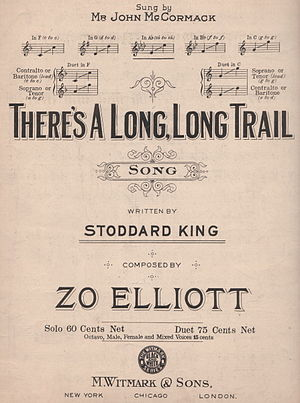
   This song is from an earlier time and is generally associated with World War I.  I ran across a recent reference while reading The Old Ways: A Journey on Foot, by Robert Macfarlane where it is discussed in the chapter about the poet Edward Thomas. There are many recordings of it. The one chosen offers you a medley by Frank and Bing; it is the third song at about 3:15.


There's A Long Trail A-Winding
Nights are growing very lonely,
Days are very long;
I'm a-growing weary only
List'ning for your song.
Old remembrances are thronging
Thro' my memory
Till it seems the world is full of dreams
Just to call you back to me.
Chorus:
There's a long, long trail a-winding
Into the land of my dreams,
Where the nightingales are singing
And the white moon beams.
There's a long, long night of waiting
Until my dreams all come true;
Till the day when I'll be going down
That long, long trail with you.

All night long I hear you calling,

Calling sweet and low;
Seem to hear your footsteps falling,
Ev'ry where I go.
Tho' the road between us stretches
Many a weary mile,
I forget that you're not with me yet
When I think I see you smile.

   And, I suppose, this one by the Sons of the Pioneers cannot be left out.

Tumbling Tumble Weeds
See them tumbling down
Pledging their love to the ground!
Lonely, but free, I'll be found
Drifting along with the tumbling tumbleweeds
Cares of the past are behind
Nowhere to go, but I'll find
Just where the trail will wind
Drifting along with the tumblin' tumbleweeds
I know when night has gone
That a new world's born at dawn!
I'll keep rolling along
Deep in my heart is a song
Here on the range I belong
Drifting along with the tumbling tumbleweeds
I know when night has gone
That a new world's born at dawn!
I'll keep rolling along
Deep in my heart is a song
Here on the range I belong

Drifting along with the tumbling tumbleweeds

The Bonus Material (provided by me)

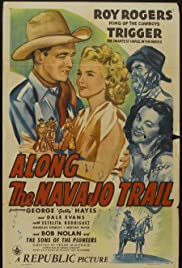
Along the Navajo Trail is also a movie that is now relevant and perhaps should be re-run.
 U.S. Deputy Marshal Roy investigates the disappearance of a government agent who has come to Dale's father's ‘Ladder A Ranch’. The bad guys want the land the ranch sits on because they know an oil pipeline is planned through this location. IMDb

   Apparently the German song, The Happy Wanderer became the unofficial anthem of the Montreal Expos. (See the Wiki entry for The Happy Wanderer. )

   
One learns from the Wiki entry for Happy Trails that: "On October 1, 1970, Janis Joplin left a taped recording of the song as a birthday greeting for John Lennon, three days before her death. Lennon, whose birthday was October 9, later told Dick Cavett that her taped greeting arrived at his home after her death."

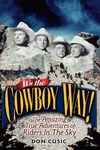
   If you enjoy western music and Sons of the Pioneers and singing cowboys like Gene Autry, you might be interested in It's the Cowboy Way! The Amazing True Adventures of Riders In The Sky by Don Cusic. (University Press of Kentucky).

It's the Cowboy Way! The Amazing True Adventures of Riders In The Sky

Post Script: 
During this time of COVID-19, there are real concerns about lost jobs and how people can be employed. There were similar concerns in the 1930s and this book discusses one solution that involved music and musicians.
Cover for GOUGH: Sounds of the New Deal: The Federal Music Project in the West. Click for larger image   At its peak the Federal Music Project (FMP) employed nearly 16,000 people who reached millions of Americans through performances, composing, teaching, and folksong collection and transcription. In Sounds of the New Deal, Peter Gough explores how the FMP's activities in the West shaped a new national appreciation for the diversity of American musical expression.

Happy Rambling..

Saturday, 28 March 2020

Archer Butler Hulbert


   It is a rainy day during which we are currently quarantined. If you have run out of interesting books to read, here are some suggestions. The books mentioned below are available for free over the Internet.
   The Wikipedia entry for Hulbert mentions that an early bibliography of his works has over 100 entries. What led me to him is the series he authored which is discussed below.

Historic Highways of America

This is essentially a bibliographic note which will be of use to those who are interested in the history of roads, trails and the paths that have been used to traverse the continent. I used to work in the libraries at Western University and took a look for some of the titles in this series, which are provided more clearly in the list below. When they were not found, I was somewhat surprised since the Western Libraries have (or at least, had) strong collections in the humanities. It turns out that the entire collection of Historic Highways of America is in storage at Western Libraries. The individual titles are not catalogued, but the volumes can be found by searching for the title of the series. Here are the titles which cannot be read clearly on the spines above. Apart from the Historic Highways of America, the Western Libraries have more of Hulbert's books and they are listed after the individual titles of the series.
v. 1. Paths of the mound-building Indians and great game animals. 1902 --
v. 2. Indian thoroughfares. 1902 --

v. 3. Washington's road (Nemacolin's path). The first chapter of the old French war. 1903 --

v. 4. Braddock's road and three relative papers. 1903 --

v. 5. The Old Glade (Forbe's) road (Pennsylvania state road) 1903 --
v. 6. Boone's wilderness road. 1903 --
v. 7. Portage paths, the keys of the continent. 1903. --
v. 8. Military roads of the Mississippi basin. 1904 --
v. 9. Waterways of westward expansion. 1903 --
v. 10. The Cumberland road. 1904 --
v. 11-12. Pioneer roads and experience of travelers. 1904 --
v. 13-14. The great American canals (v. 1. The Chesapeake and Ohio canal and the Pennsylvania canal. v. 2. The Erie canal) 1904 --
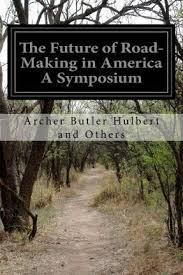
v. 15. The future of road-making in America: a symposium by A.B. Hulbert and others. 1905 --
v. 16. Index
Additional Books by Archer Butler Hulbert in the Western Libraries
   
1830-1930, the Oregon Trail centennial : the documentary background of the days of the first wagon train on the road to Oregon.
David Zeisberger's history of northern American Indians, ed. by Hulbert and Schwarze.
Forty-niners : the chronicle of the California trail.
Frontiers, the genius of American nationality, by Archer Butler Hulbert.
Historic highways of America.
History of the Niagara River / by Archer Butler Hulbert.
Ohio in the time of the Confederation : ed., with introduction and notes, by Archer Butler Hulbert.
Pioneer roads and experiences of travelers, By Archer Butler Hulbert.
Soil; its influence on the history of the United States, with special reference to migration and the scientific study of local history, by Archer Butler Hulbert.
Southwest on the turquoise trail; the first diaries on the road to Santa Fe, edited, with bibliographical resumé, 1810-1825 / by Archer Butler Hubert; with maps...
The Crown collection of photographs of American maps, selected and edited. Series II.
The making of the American republic, by Archer Butler Hulbert.
The old national road: a chapter of American expansions, by Archer Butler Hulbert.
The paths of inland commerce : a chronicle of trail, road, and waterway / by Archer B. Hulbert.
The records of the original proceedings of the Ohio Company. Edited, with introd. and notes, by Archer Butler Hulbert.
Zebulon Pike's Arkansaw journal ....

Sources:
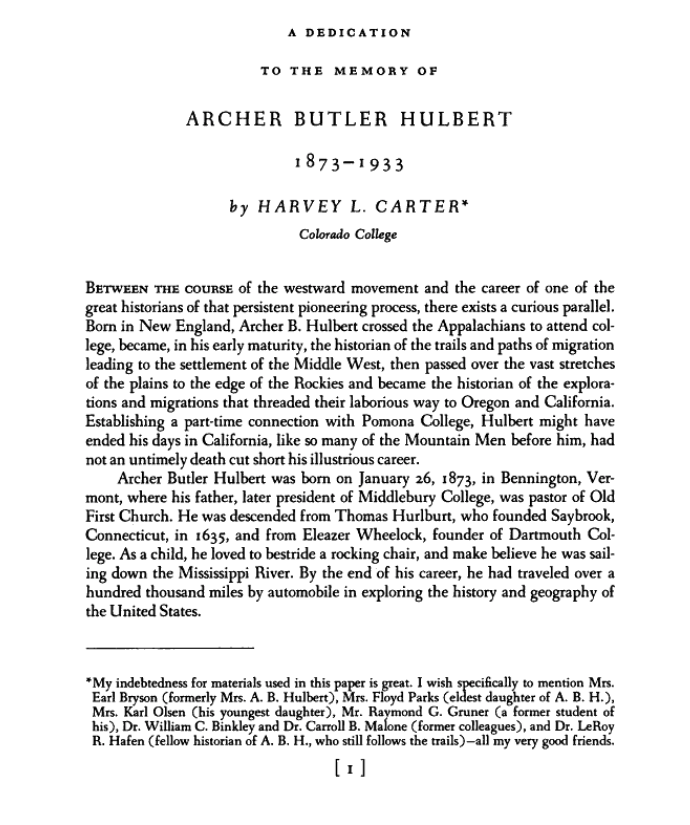
The following two sample pages are taken from: "A Dedication to the Memory of Archer Butler Hulbert, 1873-1933," Harvey L. Carter, Arizona and the West, Vol.8, No.1, 1966


For a review of The Niagara River:
“This is a splendidly printed and illustrated popular account of the Niagara River and vicinity, including its scenery, geological history and human associations. One chapter is entitled, “A Century of Niagara Cranks.” from Bulletin of the American Geographical Society
Vol. 41, No. 8 (1909), pp. 513-514, by R.E.D. 

The entire book is available in the Internet Archive

Post Script:
The complete set is now available electronically in the Hathi Trust Digital Library. Given that digital versions are freely accessible there likely will be pressure to remove the print copies, since the Western Libraries have decided to devote more space to students and less to books. Although the books are digitally available, the entire set of Historic Highways of America would be of interest to booksellers.I  did not attempt to retrieve any of the volumes and do not know if they are in good condition.
   As I indicated, I no longer work in the Western Libraries and no one there would be responsible for any errors in this post.

           This is one in a series relating to books about roads and trails.