Showing posts with label private library. Show all posts

Wednesday, 8 July 2026

Private Library Photos

  About these two personal libraries, I know little. It is simply the case that the pictures of the books show up in essays about the individuals, both of whom produced books you may have among your own.

ErIc Hobsbawm


  This photograph is from “The Century of Eric Hobsbawm”, by Enzo Traverso, The Ideas Letter, June 25, 2026. In it, it is mentioned that a new biography of Hobsbawm will soon be published by Belknap Press (Harvard University Press). The title: The Age of Hobsbawm; The Life of a Revolutionary Historian, by Emile Chabal.
  I often have rambled on about periodicals and Hobsbawm co-founded one in 1952 - Past & Present, which is still being published by Oxford.

A Bonus: (This is from the essay mentioned.)
 “Hobsbawm loved jazz—a passion he wrote about under the nickname of Francis Newton, becoming a reputed jazz critic for The New Statesman. But in this realm, too, his tastes favored the classics: In his eyes, Miles Davis and John Coltrane simply could not compete with Duke Ellington.”

William T. Vollmann


   I am sure I have read some of Vollmann's magazine pieces, but have none of his books. If you are unfamiliar with him, you should see the interesting Wikipedia entry and read Mr. Sorondo's essay.
   The pictures are from this substack: "We Always Leave Things Unfinished", by Alexander Sorondo, in Big Reader Bad Grades, June 30, 2026. Have a look.


   Mr. Vollmann lives in Sacramento and apparently these books are found in a former Mexican restaurant that Vollmann "bought in 2000 and converted into a studio. The building is closed-in with a tight perimeter of chainlink fence."
   Mr. Vollmann is not well.
If you think you might want to purchase some of his work for your library, leave ample room. In 2003 he produced a massive "seven-volume treatise on violence and his new novel is coming out in August. A Table for Fortune has over 3,000 pages.


Thursday, 22 January 2026

Anaïs Nin's Library

    I will do this quickly in order to push the unpleasant post below, farther down the page. This one will be the third in a row about a private library assembled by a woman; the last two belong to Geraldine Brooks and Louise Penny. Here is what Nin's library looks like.


  Given Nin's interests, one can say that this is a library for adults only. If now you are interested, then simply go to the Wikpedia entry for Anaïs Nin, where you will likely spend the rest of the day. There is little need for me to say much more since you will surely go deep into the erotic rabbit holes hinted at in the article provided. She had, for example, two husbands (at the same time), one in the east and another in the west, which she referred to as her "bicoastal trapeze."


This is the outside of the house in Los Angeles. It was designed by Eric Lloyd Wright, whose grandfather was Frank and the Wikipedia entries for both will provide you with more interesting content than I am offering. 


    Her full name is, by the way, Angela Anaïs Juana Antolina Rosa Edelmira Nin y Culmell and she was a flamenco dancer, who also practiced psychoanalysis and slept with her psychoanalyst, Otto Rank. 
    To provide a bit more content, which will push the unpleasant subject below out of sight, I will mention an earlier post about people with Very Long Names
    
I have also written often about Single-Author Journals and Nin has two devoted to her: Anaïs: An International Journal and A Café in Space: The Anaïs Nin Literary Journal.
    If you are new to the subject of erotica, see my: "Erotica: A Beginner's Guide."
    I have also done several posts about collections of books by men. See, for example, "Boys With Books."
Source: 
 "Anaïs Nin’s Los Angeles Hideaway Still Keeps Her Secrets: Shrouded by the pines of Silver Lake, the erotic writer’s minimalist, midcentury residence is a lasting monument to her life and legacy," Kurt Soller, The New York Times Style Magazine, March 21, 2022. 

Sunday, 28 September 2025

Cormac McCarthy's Library


   I often write about libraries, and about a dozen posts relate to the libraries of individuals, not the institutional kind.  The last one, about Darwin's Library, contains links to some of the others. Scholars like to browse through them, looking for influences, while many of us are just curious about the books to be found on the shelves in private homes. 
   Little was known about Cormac McCarthy's library since he led a rather solitary life in a house near Santa Fe, New Mexico. Apart from writing he would hang out at the Santa Fe Institute which is a scientific research center. Perhaps that explains why his collection of over 20,000 books (with more in storage) covers many subjects. The group of scholars attempting to organize and catalog the collection has already discovered that,

 "discernible in his work but confirmed beyond doubt in his library, was that McCarthy was a genius-level intellectual polymath with an insatiable curiosity. His interests ranged from quantum physics, which he taught himself by reading 190 books on the notoriously challenging subject, to whale biology, violins, obscure corners of French history in the early Middle Ages, the highest levels of advanced mathematics and almost any other subject you can name."

   In my small collection, I do not have any books by McCarthy, although I did read The Road and saw the movie, No Country For Old Men. His library, however, contains books by a wide assortment of authors as this description indicates:

   "Giemza marveled at the heavy-duty philosophy books they were finding. “Seventy-five titles by or about Wittgenstein so far,” he said, referring to the Austrian philosopher of mathematics, logic, language and the mind. “And most of them are annotated, meaning Cormac read them closely. A lot of Hegel. That was his light evening reading, apparently.” 
   In the living room was a pool table piled with books and a leather couch facing two tall windows and three sets of nine-foot-tall wooden bookshelves designed by McCarthy that held approximately 1,000 books. Moving closer, I saw they were nearly all nonfiction hardbacks with no obvious system of organization.
   One shelf held volumes about Mesoamerican history and archaeology, along with Charles Darwin’s collected notebooks, Victor Klemperer’s three-volume diary of the Nazi years, books about organic chemistry and sports cars, and an obscure volume titled The Biology of the Naked Mole-Rat (Monographs in Behavior and Ecology). Another shelf held books about Grand Prix and Formula 1 racing, a great passion of McCarthy’s, and the collected writings of Charles S. Peirce, the American scientist, philosopher and logician, in six fat volumes of dense, difficult prose."


McCarthy wins a MacArthur
   McCarthy grew up in Knoxville in a relatively wealthy family, 'but Mr. McCarthy wrote for many years in relative obscurity and privation." In the early '80s, however, he did win a "Genius Grant" from the MacArthur Foundation, a fellowship that comes with a considerable amount of money. He was, of course, very successful in his later career, and at the end of it he sold his archives to Texas State University for $2 million. One reason he had so many books is that he did not use the Internet or a computer. His Olivetti sold for $254,500 at auction. 

The Bonus: 
   Apart from books, he also left behind a few automobiles. Here is a description from the article by Richard Grant, cited below:

   "I parked behind the house between a silver 1966 Buick Riviera rusting on deflated tires and a weathered red Lincoln Mark VIII. These were among the last survivors of McCarthy’s little-known vehicle collection. Dennis had sold 13 other cars, including two Allard racing cars from the early 1950s, a 1992 Lotus and a Ford GT40 racing car. McCarthy, who labored in obscurity and chronic poverty until he was 60, became a multi-millionaire later in life and freely indulged his desires and obsessions, with classic sports cars high on the list. Most of the money came from Hollywood, which turned three of his novels—All the Pretty Horses, No Country for Old Men and The Road—into star-studded movies."

Sources:
    The quote above and the picture of the typewriter are from this obituary: Cormac McCarthy, Novelist of a Darker America, Is Dead at 89: 
“All the Pretty Horses,” “The Road” and “No Country for Old Men” were among his acclaimed books that explore a bleak world of violence and outsiders," Dwight Garner, New York Times, June 13, 2023. For another obit: "Cormac McCarthy, Spare and Haunting Novelist, Dies at 89," Harrison Smith, Washington Post, June 13, 2023.
   The description of his library is from this very good article and the title indicates that examining private libraries can be revealing: "Two Years After Cormac McCarthy’s Death, Rare Access to His Personal Library Reveals the Man Behind the Myth," Richard Grant, Smithsonian Magazine, Sept./Oct. 2025. 
   For more about his library see: The Cormac McCarthy Library Project. There is a Cormac McCarthy Society and they produce one of those single-author journals which I have often discussed, The Cormac McCarthy Journal. See, for example,
"Periodical Ramblings (8)". 

Wednesday, 18 September 2024

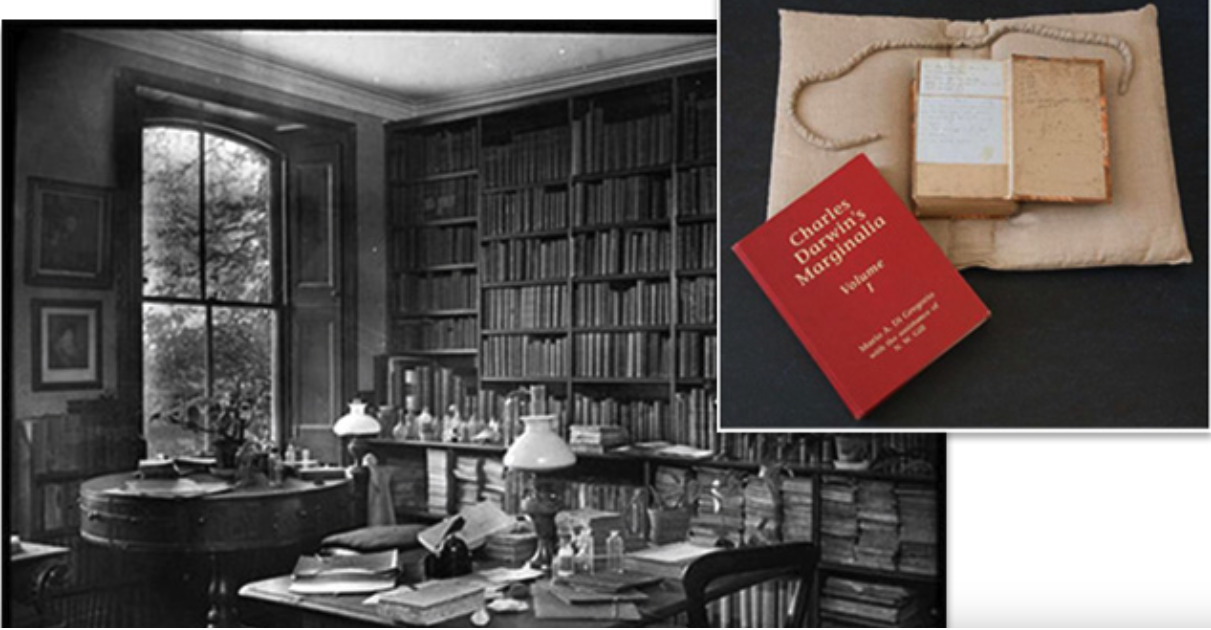
Darwin's Library


READ WHAT DARWIN READ
     I have presented other "private libraries", but this one is different, in that you can actually read the works in it, from the comfort of you own. Simply visit, Darwin Online. 
   The two libraries associated with Darwin, the one at Down House, his home in Downe, and the other at Cambridge, hold only a very small percentage of the books he read over his lifetime. In 1875, Darwin composed a "Catalogue of the Library of Charles Darwin", but many of the items listed on the 426 pages had been lost. Over 18 years, scholars have tracked down everything he read. "Darwin Online" now provides access to thousands of volumes and there are virtual links to over 9,000 of them. The leader of the project notes that:
“This unprecedentedly detailed view of Darwin’s complete library allows one to appreciate more than ever that he was not an isolated figure working alone but an expert of his time building on the sophisticated science and studies and other knowledge of thousands of people. Indeed, the size and range of works in the library makes manifest the extraordinary extent of Darwin’s research into the work of others.”
   This 'new' Darwin library contains novels and philosophical works as well as books in languages other than English. It even contains the works he had with him on the Beagle. See, "
Charles Darwin's Beagle Library."
   As an example of the exotica to be found, here is one from Audubon taken from the Edinburgh New Philosophical Journal. It relates to buzzards, but it is so interesting, I have included the link. 
Audubon, John James. 1826. "Account of the habits of the Turkey Buzzard (Vultura aura), particularly with the view of exploding the opinion generally entertained of its extraordinary power of smelling." Edinburgh New Philosophical Journal 2 (October-December): 172-184.

Sources: 
   Darwin Online is all that most of you will need and here is a press release about it from the National University of Singapore. 
   See also: "Researchers Reveal Lost Library of Charles Darwin For the First Time,"Ashley Strickland, CNN, Feb. 11, 2024 or "Contents of Charles Darwin's Entire Personal Library Revealed For First Time" by Mark Brown, The Guardian, Feb. 11, 2024.
   You can visit Darwin's home in Downe, Kent where there is soon to be a Halloween Celebration. 

Post Script: Private Libraries
  Since Mulcahy's Miscellany has no index, here are some of the other posts related to personal/private libraries, as opposed to, say libraries with people's names on them.
   You could start with "The Old Card Catalogue" which provides the catalogues of several private libraries.
Jefferson's Library
Mark Twain and Libraries
Oscar's Library
Library Furniture
(the library at Althorp in Northamptonshire.)

Tuesday, 28 May 2024

Fine Books in Bismarck, North Dakota


   Mr. William A. Strutz passed away early this year. He was an attorney and a collector of fine books. A few of the items from his collection of 15,000 are pictured above. His rationale for buying so many, was simple: "I'm a reader."
  This important collection is being auctioned and bibliophiles will be interested. I will provide the details here since it is not too late to get out your wallet. [Note in the small print above that the opening bid for these items are all in six figures.]

   "One of the Finest Private Libraries in America, Assembled By William A. Strutz, To Be Offered at Heritage Beginning June 27
Auction includes only privately owned copy of Mary Shelley’s Frankenstein in original pink boards, as well as spectacular inscribed copies of The Great Gatsby and The Hobbit, among other important books and manuscripts." 

William Strutz’s library consists of over some 15,000 books — the result of a “lifelong labor,” the attorney’s hometown newspaper, The Bismarck Tribune, once noted. He began collecting books in college in the late 1950s, on subjects ranging from astronomy to psychology, religion to law, philosophy to history. Soon after he began to focus on books of great literary significance, in superb original condition, and with important provenance. This accounts for the profusion of presentation and association copies found in his library, many of which are of great rarity.
   But Strutz wanted more than just a copy of the book itself. He sought out copies held by — touched by, gifted by, loved by — their authors. He wanted books presented from one notable to another. As result, Strutz assembled “one of the most important collections of English and American literature that has come on the market in decades,” says Francis Wahlgren, Heritage Auctions’ International Director of Rare Books & Manuscripts.
   The attorney’s lifelong labor makes its auction debut on June 27 as Important English and American Literature: The William A. Strutz Library, Part I, Rare Books Signature® Auction. More than 225 books, letters and manuscripts from Strutz’s collection are offered in this inaugural event, which is now open for bidding. This auction event includes some of the greatest works of English and American literature from the 16th to 20th centuries. Heritage will then offer selections from Strutz’s coveted collection over a series of auctions throughout this year and next.

“The collection is probably one of the few remaining great private libraries in America, formed over six decades,” says Wahlgren. “Sixty years of collecting is not frequently seen anymore, especially with his focus on depth and quality. Some of these books are so rare they’re likely never to be obtainable — or seen outside an institution — again. He was extraordinarily well-read — Strutz famously cited quotes from his vast collection during trials — and his books reflect that.”

For additional details see the auction website and: "One of the Finest Private Libraries in America" to Auction," Fine Books and Collections, May 23, 2024.
The Bonus:
For an earlier Western auction of books related to natural history in MM, see Sotheby's.