Showing posts with label Insects. Show all posts

Wednesday, 8 February 2023

Crickets and Conspiracies


About the Conspiracy  

 I just uncovered a note to myself from back in the summer. In it, I had noticed a CBC article about a conspiracy involving the crickets now being raised in a factory here in good old London, Ontario. Apparently these little livestock are part of a "sinister totalitarian plot" promoted by a "cabal of shadowy elites" who "are trying to force us to eat insects. Seriously. 

   It is likely that you may have missed the article, so I will resurrect it here and present it as proof that conspiratorial thinking also occurs north of the border. As well, I will provide additional cricket information. The rationale for doing so is not obvious, so I will make it so. I have already written about our new cricket factory and about the consumption of them and other insects (see, Entomophagy.) If you combine the information already offered with what is about to be presented, you will have amassed a considerable amount of information about crickets. That will likely surprise you, but not nearly as much as I was surprised to learn that I am again writing about crickets. 

   What follows will not be so convoluted and will be presented like PowerPoint points, rather than in long, quirky sentences. Sources are provided, as usual, so you can go directly to more reliable and better written material. The short points follow this long introduction about the CBC piece.

The CBC Exposure

   The CBC title is a good one and should serve as a piquer (that is not a French word, but an invented one of mine. It should pique your interest.) "HOW A LONDON, ONT., CRICKET PLANT FOUND ITSELF AT THE HEART OF AN INTERNATIONAL CONSPIRACY THEORY, 7 DAYS AFTER THE FACTORY WAS BUILT, IT WAS FALSELY IMPLICATED IN A GLOBAL CONSPIRACY." by Colin Butler, CBC, Aug. 29, 2022. 

   It is quite long and well done. A timeline relating to the spread of the theory is offered as well as some comments by a professor here in London who teaches about conspiracies. A link is provided above, but here are some bits that may pique your interest. It's a conspiracy theory, so needless to say, the WEF, Jews and deniers of all sorts are involved. If they have their way, you will no longer be eating beef tenderloin.

   "The conspiracy theory has been circulating for months, amplified and published by hawkers of online misinformation in Canada and elsewhere in English and Chinese, often with the falsehood growing more sweeping or outrageous with each iteration. 

Those spreading the myth aren't just online bloggers and anonymous social media accounts. The falsehoods are also spread and tweaked by a number of political operators to suit their agenda, including the Alberta separatist movement and politicians like a sitting MP and a Conservative Party of Canada leadership hopeful. 
CBC News charted the history of how this conspiracy theory grew, from a single tweet by an Ontario construction company to being used as rhetoric in the Conservative Party of Canada leadership campaign. 

The timeline of the theory's growth
The entire thread begins simply enough with a tweet on June 10 from the Toronto-based construction company Ellis Don, announcing it had just completed work on the world's largest cricket production facility. 
The information was picked up a week later by Awakening Canada, a Facebook group that posts misinformation about the pandemic and conspiracy theories about the World Economic Forum.

The June 17 post was published shortly after midnight, asking: "Are you guys ready to eat some crickets welcome to communist Canada." It got 10 shares among the page's 4,600 followers. 

Eight hours later, the false information was repeated by Mike McMullen, a London, Ont., political candidate who ran for the People's Party of Canada in the last federal election, and a candidate for city councillor in this October's municipal elections...."

False info persists
Back on June 17, information about cricket consumption for humans continued to be shared on Facebook in Chinese on this page. According to Facebook's translation algorithm, followers are told the cricket factory is part of the "'Great Reset' agenda to stop the people from owning everything and implement the major food chain." 
On June 18, a similar post appears on Black Sheep Truth Media, a Facebook group that features numerous conspiracy theories with the caption: "The planned food shortages now offers a solution. Not to worry now, there will be plenty to eat folks."

The information has been reaching more people, with at least 292 shares and 164 comments among the page's 30,000 followers. It is also flagged as false information by Facebook after being singled out by independent fact checkers. 

Next, on June 22, the conspiracy is repeated by Tanner Hnidey, the vice-president of economics with the Alberta Prosperity Project (APP), a provincial separatist group. 

Hnidey posts a video to his personal Facebook titled "We're going to keep eating Alberta Beef!" 
"I do not intend to eat crickets or bugs for breakfast," Hnidey says in the video, falsely claiming the federal government is trying to replace beef with insect protein...."

On July 9, federal Conservative leadership hopeful Leslyn Lewis wrote a blog post with the heading, "Is animal meat being phased out?" that hints the cricket plant is part of a larger plan by the federal government to phase out meat.....

[The comment by the professor about all of this:]

"CBC News shared the timeline of the conspiracy theory's growth with Alison Meek, an associate professor of history at King's College at Western University in London, Ont., who studies conspiracy theories. 
She said the false information taps into a growing anti-government sentiment, playing on the fear and isolation many felt during the darkest days of the COVID-19 pandemic when authorities were imposing sweeping lockdowns and health restrictions that upended many people's daily routines. 
Meek said it's clear from the timeline that the false information was twisted and manipulated by each person who spread it, adding or taking away details in order to create propaganda to suit their own agenda."

--------------

   The timeline related to the cricket conspiracy has continued into this new year.  Here is the first paragraph from an article in the publication, American Thinker:

"Give up cheeseburgers, and eat bugs instead.  That's what the Davos elite want you to do, while they dine on $50 burritos and slabs of steak.  They would even have you feel good about being a meat- and diary-free insectivore.  To this end, they have carefully manufactured the cult of environmental alarmism, whose virtue-signaling adherents have been duped into thinking an ecological disaster is at hand." From, "Let Them Eat Bugs," Janet Levy, American Thinker, Jan. 23, 2023.


More Cricket Material

The Construction of the Cricket Factory
   EllisDon did construct the factory and the announcement is found here:

About Aspire - The Cricket Company
   The company website is useful and it announces that, A growing population and increasing demand for food and raw materials requires sustainable, scalable solutions that keep our world healthy.

Canadian Government Support For Aspire
   It is the case that the company received government funding in the summer of 2022. "Investment in State-of-the-art Facility For Aspire to Support Sustainable Food Production," Agriculture and Agri-Food Canada, June 27, 2022.
"The Canadian agriculture sector continues to develop innovative ways to meet the demand for more sustainably grown food. Today, Francis Drouin, Parliamentary Secretary to the Minister of Agriculture and Agri-Food, announced on behalf of the Honourable Marie-Claude Bibeau, an investment of up to $8.5 million for Aspire to support the building of a commercial facility to produce cricket protein.
Alternative sources of protein such as insects provide an opportunity for Canada's agriculture and agri-food sector to more sustainably meet global demand for food. Aspire's goal to tackle global food scarcity led to its focus on edible insect production, which can provide high volumes of nutritious food with a low environmental footprint.
With funding under the AgriInnovate Program, Aspire will use the latest smart technology to create the ideal growing conditions for crickets at its facility in London, Ontario. This investment will allow the company to monitor and grow billions of crickets at a time, producing a nutrient-rich protein for premium health food and pet markets. The technology will also significantly cut Aspire's cost of production, making its products more attractive for sale in domestic and international markets."

WEF Support For Insect Eating
   Early in 2022 the WEF did publish this report: "5 Reasons Why Eating Insects Could Reduce Climate Change," Feb. 9, 2022. The link is provided. It is noted that the report has been under attack: 
Help us prevent the spread of disinformation
This article has been intentionally misrepresented on sites that spread false information. Please read the piece for yourself before sharing or commenting.

The World Economic Forum is committed to publishing a wide array of opinions. Misrepresenting content diminishes open conversations.
Our consumption of animal protein is the source of greenhouses gas and climate change.
Insects are an overlooked source of protein and a way to battle climate change.
The consumption of insects can offset climate change in many ways.

Thinking About Entomophagy?
   See this video offered by the New York Times: "The Joy of Cooking (Insects)," Tala Schlossberg, et al, (no date) 
Mealworm soup. Chile-lime cricket tacos. Charred avocado tartare with ant larvae.
"In the West, edible insects have long been the domain of food adventurers, with few other takers — even as billions of people elsewhere on the planet count insects as a part of their traditional diets.
But as we explore in the Opinion Video above, a growing tribe of environmentalists, academics and entrepreneurs are arguing that edible insects must enjoy a wider acceptance to help create a more sustainable global food system and save the planet."

"Salted Ants. Ground Crickets. Why You Should Try Edible Insects," Carolyn Beans, Washington Post, Nov. 27, 2022. 
"Sanchez encourages people to eat insects, in part, to lighten environmental footprints. Farmed insects produce far less greenhouse gas and require much less land and water than conventional livestock. Insects also generate more biomass with less input. Crickets, for example, are 12 times more efficient than cows at converting feed into edible weight.
Already, 2 billion people eat insects, according to one estimate — primarily in parts of Africa, Latin America and Asia. The practice dates back millennia. “I always thought, even back in the ’90s, someday, maybe, [Americans] will do this,” Sanchez says."

Thinking About Getting Into the Cricket Business?
   Here is an abstract of a market research report indicating billions can be made. 
"Edible Insects Market by Product (Whole Insect, Insect Powder, Insect Meal, Insect Oil), Insect Type (Crickets, Black Soldier Fly, Mealworms), Application (Animal Feed, Protein Bars, Bakery, Confectionery, Beverages), and Geography—Forecast to 2030’, provides an in-depth analysis of the edible insects market in five major geographies and emphasizes on the current market trends, market sizes, market shares, recent developments, and forecasts for 2030. In terms of value, the Edible Insects Market is expected to reach $9.60 billion by 2030, at a CAGR of 28.3% during the forecast period 2022–2030. In terms of volume, the Edible Insects Market is expected to reach 3,139,035.10 tonnes by 2030, at a CAGR of 31.1% during the forecast period 2022–2030.
The 237 page report will cost you $4,175 (US).

The Bonus (finally)
  For another example of conspiratorial thinking in London, see my post about 9/11.
  You probably failed to notice that the name of a food writer above is "Carolyn Beans", an example of an aptronym.

CRICKET
  For those of you who thought all of this might be about the sport, see my "Sports News From Elsewhere." You will learn that real money can be made in cricket. 
  If, on the other hand, you don't know a "googly" from a "lolly" see: "15 Corker Cricket Terms, Deciphered", Angela Tung, mentalfloss.com, May 5, 2016.

Tuesday, 7 June 2022

Lepidoptera in London


    It is a rainy day so I will attempt to catch up on my blogging. If the weather continues to be dreary you might consider a trip up to the campus at Western where you will find at the McIntosh Gallery the exhibit "Insect as Idea." It is on until June 18th and the Gallery is open from 10 til 5 from Monday to Friday and from 12 to 4 on Saturday. 
   It was on a Saturday that I visited and I was the only visitor at the time. The campus is especially pleasant at this time of year and you will also find it so, as long as you avoid the convocation ceremonies.
   That is a picture taken by me at the top and the text below is part of a description found on the wall.

Insect as Idea: Carl Beam, Christi Belcourt, Catherine Chalmers, Andrea Cooper, Aganetha and Richard Dyck, Jude Griebel, The Institute of Queer Ecology, Jennifer Murphy and Amy Youngs:Featuring insect specimens from the Zoological Collections, Department of Biology, Western University

  You may have noticed in the CBC piece that "insects are under threat." That is true and a serious problem. For more see these three posts: "Insect Elegy;" "Insect Apocalypse" and the bottom portion of "Birds and Bugs."

The Bonus:
   The McIntosh Gallery used to have in its collection, "Backwoods of America" by Jasper Cropsey, the sale of which was rather controversial. See: Jasper Cropsey

    If you are an older alumni you will see some changes on campus and not just those related to the buildings. You may have noticed above, for example, The Institute of Queer Ecology.  I happened also to find this mysterious (to me) lengthy initialism mentioned on the Western website and will explain it for those who are as ancient as I. Apparently Mental Health Support is available to all, including those who are: LGBTTIQQ2SA+. I assume the + means there are more to come. 
    To translate: LESBIAN, GAY, BISEXUAL, TRANSGENDER, TRANSSEXUAL, INTERSEX, QUEER, QUESTIONING, 2-SPRITED, ASEXUAL. And to translate further - "2 Spirit"  "a term used within some Indigenous communities, encompassing cultural, spiritual, sexual and gender identity. The term reflects complex Indigenous understandings of gender roles, spirituality, and the long history of sexual and gender diversity in Indigenous cultures."
  I am not sure what this means in terms of bathroom facilities. There used to be rooms for "Males" and "Females" and I do know there was some controversy about bathrooms specifically for "Faculty." I think they have all now disappeared.  I didn't have to go, so I can't help you. In the old days, this could have been an example:
Now here are some suggestions you might find on the bathroom doors:


Or: 

Sunday, 29 October 2017

INSECT ELEGY


    I indicated yesterday (see the post below) that I would attempt to get back to this blogging business. So, in case you missed it, here is some information about a news item that was widely circulated in late October. It has to do with the dramatic decline in the number of insects.


Something Else to Worry About


    Even those not concerned with environmental issues could hardly avoid the many articles written over the last few years about bees, Colony Collapse Disorder and neonicotinoids. A new scientific study indicates that bees may not be the only insects in danger of elimination. In short, it may not be a good idea to encourage your kids to major in entomology since there may soon be a shortage of specimens to study.


    The recent news stories are based on this article which is found in a respected journal that is freely available to you: “More Than 75 Percent Decline Over 27 Years in Total Flying Insect Biomass in Protected Areas,” Caspar A. Hallmann, et al. PLOS ONE, Oct. 18, 2017.
I will provide at the bottom of this post some samples of the reactions to this report.


The Windshield Phenomenon


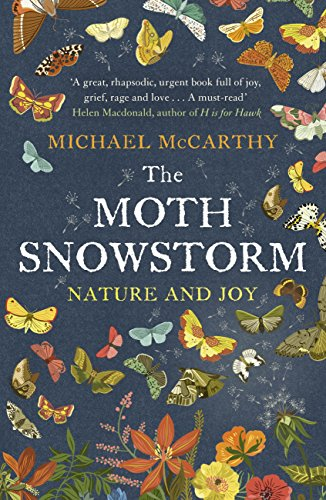
   If you are not inclined to slog through a scientific study then you should have a look at this book which tells the same story in a very effective and readable way. I happened upon it a few years ago, probably because I had read the author’s Say Goodbye to the Cuckoo. (see my earlier post back in late May on the subject of cuckoos.) It has been widely circulated among my friends who have all enjoyed it and, of course, my friends are all sophisticated and discerning readers.


    Still, you are likely not convinced that a book about moths would be very interesting and I agree that it would probably be more popular if the title was Butterfly Ballet, The Majesty of Monarchs or especially The Birds and the Bees. Even the author notes that “Moths have long been unloved.” (p.100.) Trust me and my friends and have a look at it. Here is a sample that explains the title and which also basically indicates that the subject of the book has to do with the disappearance of insects.


“This means, of course, that in the dark there are far, far more moths out and about than ever there are butterflies during the daytime; it’s just that we don’t see them. Or, at least, we didn’t, until the invention of the automobile. The headlight beams of a speeding car on a muggy summer’s night in the countryside, turning the moth’s into snowflakes and crowding them together the faster you went, in the manner of a telephoto lens, meant that the true startling scale of their numbers was suddenly apparent, not least as they plastered the headlights and the windscreen until driving became impossible, and you had to stop the car to wipe the glass surfaces clean. (I know there are many other insects active at night as well, but let the moths stand proxy for the rest.) Of all the myriad displays of abundance in the natural world in Britain, the moth snowstorm was the most extraordinary, as it only became perceptible in the age of the internal combustion engine. Yet now, after but a short century or existence, it is gone.” p.102


Sources:
“Warning of 'Ecological Armageddon' After Dramatic Plunge in Insect Numbers: Three-quarters of Flying Insects in Nature Reserves Across Germany Have Vanished in 25 Years, With Serious Implications for all life on Earth, Scientists say,”  Damian Carrington, The Guardian, Oct. 18, 2017
“The abundance of flying insects has plunged by three-quarters over the past 25 years, according to a new study that has shocked scientists.”
“Insects are an integral part of life on Earth as both pollinators and prey for other wildlife and it was known that some species such as butterflies were declining. But the newly revealed scale of the losses to all insects has prompted warnings that the world is “on course for ecological Armageddon”, with profound impacts on human society.”
“The research, published in the journal Plos One, is based on the work of dozens of amateur entomologists across Germany who began using strictly standardised ways of collecting insects in 1989. Special tents called malaise traps were used to capture more than 1,500 samples of all flying insects at 63 different nature reserves.”
“The fact that the samples were taken in protected areas makes the findings even more worrying, said Caspar Hallmann at Radboud University, also part of the research team: “All these areas are protected and most of them are well-managed nature reserves. Yet, this dramatic decline has occurred.”

"Flying Insects Are Disappearing From German Skies: The Country Has Lost Three-quarters of its Aerial Insects  Since 1989’” Nature, Oct. 18, 2017


‘This is Very Alarming!’: Flying Insects Vanish From Nature Preserves," Ben Guarino, Oct. 18, The Washington Post, Oct. 18, 2017
“Biologists call this the windshield phenomenon. It's a symptom, they say, of a vanishing population.”
“If you like to eat nutritious fruits and vegetables, you should thank an insect. If you like salmon, you can thank a tiny fly that the salmon eat when they're young,” Black said. “The whole fabric of our planet is built on plants and insects and the relationship between the two.”


“Insects Are In Serious Trouble: In Western Germany, Populations of Flying Insects Have Fallen by Around 80 Percent in the Last Three Decades”, Ed Young, Atlantic, Oct. 19, 2017


Here is a Canadian sample:
“Inside the Mysterious Decline of Earth's Insects: Insects are by far the Most Populous Species on the Planet, But They Seem to be Disappearing. Why Aren't More People Concerned?”,  Leslie Anthony, Canadian Geographic, Oct. 21, 2017.


This is an article by the author of The Moth Snowstorm:
“A Giant Insect Ecosystem is Collapsing Due to Humans. It's a Catastrophe
Insects Have Triumphed for Hundreds of Millions of Years in Every Habitat but the Ocean. Their Success is Unparalleled, Which Makes Their Disappearance all the more Alarming,"
Michael McCarthy, The Guardian,  Oct. 21, 2017.


“Furthermore, insects form the base of thousands upon thousands of food chains, and their disappearance is a principal reason why Britain’s farmland birds have more than halved in number since 1970. Some declines have been catastrophic: the grey partridge, whose chicks fed on the insects once abundant in cornfields, and the charming spotted flycatcher, a specialist predator of aerial insects, have both declined by more than 95%, while the red-backed shrike, which feeds on big beetles, became extinct in Britain in the 1990s.”


“It has taken us a lot of time to understand this for two reasons: one cultural, one scientific. Firstly, we generally do not care for insects (bees and butterflies excepted). Even wildlife lovers are fixed on vertebrates, on creatures of fur and feather and especially the “charismatic megafauna”, and in the population as a whole there is even less sympathy for the fate of the chitin-skeletoned little things that creep and crawl; our default reaction is a shudder. Fewer bugs in the world? Many would cheer.”


Secondly, for the overwhelming majority of insect species, there is no monitoring or measurement of numbers taking place. It is a practical impossibility: in the UK alone there are about 24,500 insect species – about 1,800 species of bugs, 4,000 species of beetles, 7,000 species of flies and another 7,000 species of bees, wasps and ants – and most are unknown to all but a few specialists. So their vast and catastrophic decline, at last perceptible, has crept up on us; and when first we began to perceive it, it was not through statistics, but through anecdote.”


“The earliest anecdotal impression of decline was through what is sometimes termed the windscreen phenomenon (or windshield if you live in the US): time was, especially in the summer, when any long automobile journey would result in a car windscreen that was insect-spattered. But then, not so much. Two years ago I wrote a book focusing on this curious happening, but I gave it a different name: I called it the moth snowstorm, referring to the moths which on summer nights in my childhood might cluster in such numbers that they would pack a speeding car’s headlight beams like snowflakes in a blizzard.”


“But the point about the moth snowstorm was this: it had gone. I personally realised it had disappeared, and began writing about it as a journalist, in the year 2000; but it became obvious from talking to people who had also observed it that its disappearance dated further back, probably to about the 1970s and 1980s. And the fact that an entire large-scale phenomenon such as this had simply ceased to exist pointed inescapably to one grim conclusion: though unnoticed by the world at large, a whole giant ecosystem was collapsing. The insect world was falling apart.”