Showing posts with label Environment. Show all posts

Monday, 23 March 2026

Nature Dies In Darkness

    Events are being cancelled, some news is censored and other sensitive subjects are not broached. There is more silence than there was. People disappear and some things disappear, never having been seen. One of those things is The National Nature Assessment. 
   
The assessment was announced on Earth Day in 2022. President Biden issued and executive order to undertake a thorough examination of the state of nature. The evaluation of the environment was to be done by a large number of experts and scientists, who were mostly volunteers. Research was undertaken and hundreds of pages written. A draft of the report was about to be submitted, but, The National Nature Assessment was cancelled by the Trump administration.

   The National Nature Assessment disappeared, but The Nature Record exists. The authors of the Assessment thought their work needed to be evaluated and made public. They did not want the data to disappear. 
   The 800+ pages of the draft is available for public comments and scientific review. "For a chapter-by-chapter journey through the state of nature in America," here is The Nature Record.  It can be read online or downloaded. If you fear that nature is not in good shape and don't want to read about it, skip to Chapter 4: "Bright Spots in Nature."


Samizdat:
   I usually write "Sources", but perhaps that word is now appropriate. For more background see:
   Catrin Einhorn produced two good reports for the New York Times:
1) "
Trump Killed a Major Report on Nature. They’re Trying to Publish It Anyway: The first full draft of the assessment, on the state of America’s land, water and wildlife, was weeks from completion. The project leader called the study “too important to die.” NYT, Feb. 10, 2026.
  "The draft was almost ready for submission, due in less than a month. More than 150 scientists and other experts had collectively spent thousands of hours working on the report, a first-of-its-kind assessment of nature across the United States.
   But President Trump ended the effort, started under the Biden administration, by executive order. So, on Jan. 30, the project’s director, an environmental scientist named Phil Levin, sent an email telling members of his team that their work had been discontinued.
   But it wasn’t the only email he sent that day.
   “This work is too important to die,” Dr. Levin wrote in a separate email to the report’s authors, this one from his personal account. “The country needs what we are producing.”

2)
"Nature Report, Killed by Trump, Is Released Independently: A draft assessment of the health of nature in the United States is grim but shot through with bright spots and possibility."
Catrin Einhorn, NYT - March 5, 2026
   "The report’s name has changed from the National Nature Assessment to the Nature Record, to reflect that it is a new, independent effort, but it builds off work that was already underway and most of the authors remain the same. Its scientific review will be conducted by the National Academies of Sciences, Engineering, and Medicine, the same organization that would have reviewed the report had it remained under the auspices of the federal government.    
   The first two chapters that will summarize the sprawling endeavor are not yet written, because the authors are waiting until after this round of feedback. But 13 other chapters are in place.
   The report explores not only actions that harm nature, but also how people are affected by nature and its loss, with chapters on human health, the economy and national security. And throughout, the report highlights solutions and nature’s ability to recover when given the chance."
  For an example of reports on various substacks see:
"Why the Trump Administration Couldn’t Kill the Nature Record: Science has a way of refusing to stay buried", Jeff Nesbit, The Contrarian, March 16, 2026.  

Sunday, 9 November 2025

SALT & WATER


Rust Never Sleeps
  The skies are growing darker, as are the forecasts, and soon snow will be falling. Salt flakes will also fill the air, and later the water. Not just our vehicles are affected. 
   Concern about salt pollution was raised in two articles that came out around the same time last spring and I happened to notice them; one was about Muskoka to the north of us and the other New York state to the south. Consider this another public service announcement (PSA).

   
"Muskoka First in Ontario to Call for Provincial Action on Road Salt Pollution: 
Rescue Lake Simcoe Coalition Also Raising Issue with Conservation Authority, City of Barrie, Town of Georgina" Staff, Orillia Matters - news release, Mar. 19, 2025. Here are some of the important bits:

   "As the dust settles from the provincial election, Muskoka is wasting no time when it comes to tackling road salt impacts.  On Monday, Muskoka became the first Ontario jurisdiction to pass a resolution declaring the need for provincial action on salt pollution from road salt. The District of Muskoka council passed a resolution which asks the province to both advance limited liability for the snow and ice management sector and to create a stakeholder advisory committee to advise the province on managing salt pollution in Ontario’s lakes and rivers.he resolution was initiated and moved by Muskoka District chair Jeff Lehman, who issued the following statement: “The district is pleased to work with local cottage associations, the landscaping industry, and environmental groups to help mitigate the impacts of salt and ensure the right amount is used in the right way in the right places. Building on previous district work and commitments, we look forward to continuing to improve lake health and provide leadership in reducing the environmental impact of road salt in Muskoka.”...  
   Ontario is Canada’s No. 1 user of winter salt, applying approximately two million to three million tonnes of salt each winter. Road salt is a known toxic substance designated under the Canadian Environmental Protection Act because of tangible threats including serious, irreversible environmental and public health damages. Other impacts to drinking water sources, critical public infrastructure (roads, bridges, buildings), and private property are also important concerns.  Currently, there are no provincial policies or regulations for road salts, including no salt use standards, required training, enforcement mechanisms, or protections against salt pollution.... 
   Municipalities, conservation authorities, non-governmental organizations, and businesses alike have been warning about the growing impact of salt pollution and oversalting for decades, to no avail. Now, they’re banding together to ensure this issue gets the attention and action it needs.
   The reaction to this move was positive and more details are provided in: "
Very positive response’: Residents’ Group Applauds Muskoka Council’s Decision on Road Salt Issue: Resolution Aims to Reduce Usage While Ensuring Road and Sidewalk Safety Concerns About ncreasing Chloride Levels in Lakes rompted Action," Brent Cooper, Muskokaregion.com., March 22, 2025:
   "A representative from a Muskoka group concerned with the region’s environment is applauding a District of Muskoka move to tackle the ongoing issue of road salt in area lakes.
Here’s what you need to know
Jim Davis, who is a director with the Gull and Silver Lakes Residents’ Association, is praising the district council’s passing of a resolution on March 17, which commits its ongoing efforts toward the reduction of road salt as much as possible, while maintaining safety on roads and sidewalks.“Protecting the water quality of our lakes is the No. 1 concern for our association,” he said after the March meeting. “The continued use of road salt, resulting in every-increasing chloride levels, poses a serious threat to the lake health of Gull and Silver Lakes, and lakes throughout Muskoka. The resolution passed by district council is a very positive response to an environmental problem that is entirely man-made.”

The New York State Salt Situation
    Here is the other article, which indicates that the problem is widespread in snowy northern regions:
   "
Salty Suburban Roads Are Clouding the Future of N.Y.C. Drinking Water: A new environmental report finds that rising salt levels in New York City’s water supply could make some of it undrinkable by the turn of the century," Hilary Howard, New York Times, March 25, 2025.
   "Road salt is leaching into the reservoirs that hold New York City’s tap water and could make some of it unhealthy to drink by the turn of the century, according to a new study commissioned by city environmental officials….“We just need people who operate roads to start realizing that this is a chemical that we are adding to our environment, and we have to take that seriously,” Mr. Aggarwala said.
Road salt is cheap and plentiful, but it is also dangerous for the environment and corrosive for infrastructure. New York City’s pristine tap water is a source of pride among residents and local leaders. Most of it, about 90 percent, comes from rural areas in the Catskill Mountains, a range that extends more than 125 miles north of New York City. It represents the largest unfiltered water supply in the United States."
   The study mentioned is this one and it has a literature review: 
“Salinity Management Assessment”, Bureau of Water Supply, NYC Dept. of Environmental Protection, March 21, 2025,  35 page pdf.

  The solutions to the salt situation are not obvious and the prohibition of it would likely make some people in the Goderich area unhappy. 
Some Salt Sources:
   ONTARIO SALT POLLUTION COALITION
   WATER WATCHERS

                                                       WATER


   More recently, the problem is not salty water, but the shortage of drinking water. Just two examples from the east and the west:

  "What Happens When the Well Runs Dry? After Months of Drought, Nova Scotians are Finding Out," Barry Rueger, Special to The Globe and Mail, Oct.1, 2025
and:
  "As Water Dries up in Northeast B.C., Some Want Industry Paying More to Pump the Precious Resource," Matt Preprost,CBC, Nov. 2, 2025.
   Of course, out in B.C. the salmon are also affected by the salt:
"B.C. Researchers Find Road Salt Most Toxic to Salmon During 24 hours After Egg Fertilization; The updated research reveals how road salt is also having a negative effect on developing chum salmon," Tiffany Crawford, Vancouver Sun, Nov. 2, 2025.

The Bonus:
  I generally make fun of the notion of "breaking news", but these stories just broke as this was being written, the point being that, the lack of water is even a local problem.
 " 
$400M Water Upgrade Needed as St. Thomas Industrial Boom Spikes Demand: If the provincial government does not help, water users, including homeowners and businesses, will pay more," London Free Press, Nov.6, 2025.
  
‘We Were Not Expecting it for Another 30 Years’: $400 million water plant expansion for PowerCo could sink municipal finances," Byan Bicknell, CTV News, Nov.6, 2025

Sunday, 29 October 2017

INSECT ELEGY


    I indicated yesterday (see the post below) that I would attempt to get back to this blogging business. So, in case you missed it, here is some information about a news item that was widely circulated in late October. It has to do with the dramatic decline in the number of insects.


Something Else to Worry About


    Even those not concerned with environmental issues could hardly avoid the many articles written over the last few years about bees, Colony Collapse Disorder and neonicotinoids. A new scientific study indicates that bees may not be the only insects in danger of elimination. In short, it may not be a good idea to encourage your kids to major in entomology since there may soon be a shortage of specimens to study.


    The recent news stories are based on this article which is found in a respected journal that is freely available to you: “More Than 75 Percent Decline Over 27 Years in Total Flying Insect Biomass in Protected Areas,” Caspar A. Hallmann, et al. PLOS ONE, Oct. 18, 2017.
I will provide at the bottom of this post some samples of the reactions to this report.


The Windshield Phenomenon


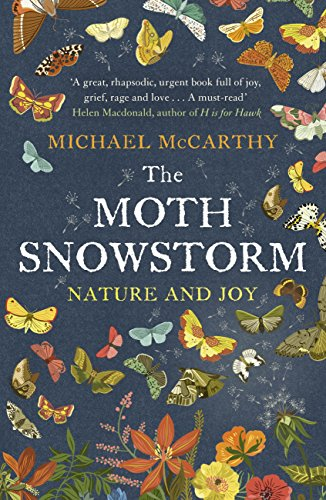
   If you are not inclined to slog through a scientific study then you should have a look at this book which tells the same story in a very effective and readable way. I happened upon it a few years ago, probably because I had read the author’s Say Goodbye to the Cuckoo. (see my earlier post back in late May on the subject of cuckoos.) It has been widely circulated among my friends who have all enjoyed it and, of course, my friends are all sophisticated and discerning readers.


    Still, you are likely not convinced that a book about moths would be very interesting and I agree that it would probably be more popular if the title was Butterfly Ballet, The Majesty of Monarchs or especially The Birds and the Bees. Even the author notes that “Moths have long been unloved.” (p.100.) Trust me and my friends and have a look at it. Here is a sample that explains the title and which also basically indicates that the subject of the book has to do with the disappearance of insects.


“This means, of course, that in the dark there are far, far more moths out and about than ever there are butterflies during the daytime; it’s just that we don’t see them. Or, at least, we didn’t, until the invention of the automobile. The headlight beams of a speeding car on a muggy summer’s night in the countryside, turning the moth’s into snowflakes and crowding them together the faster you went, in the manner of a telephoto lens, meant that the true startling scale of their numbers was suddenly apparent, not least as they plastered the headlights and the windscreen until driving became impossible, and you had to stop the car to wipe the glass surfaces clean. (I know there are many other insects active at night as well, but let the moths stand proxy for the rest.) Of all the myriad displays of abundance in the natural world in Britain, the moth snowstorm was the most extraordinary, as it only became perceptible in the age of the internal combustion engine. Yet now, after but a short century or existence, it is gone.” p.102


Sources:
“Warning of 'Ecological Armageddon' After Dramatic Plunge in Insect Numbers: Three-quarters of Flying Insects in Nature Reserves Across Germany Have Vanished in 25 Years, With Serious Implications for all life on Earth, Scientists say,”  Damian Carrington, The Guardian, Oct. 18, 2017
“The abundance of flying insects has plunged by three-quarters over the past 25 years, according to a new study that has shocked scientists.”
“Insects are an integral part of life on Earth as both pollinators and prey for other wildlife and it was known that some species such as butterflies were declining. But the newly revealed scale of the losses to all insects has prompted warnings that the world is “on course for ecological Armageddon”, with profound impacts on human society.”
“The research, published in the journal Plos One, is based on the work of dozens of amateur entomologists across Germany who began using strictly standardised ways of collecting insects in 1989. Special tents called malaise traps were used to capture more than 1,500 samples of all flying insects at 63 different nature reserves.”
“The fact that the samples were taken in protected areas makes the findings even more worrying, said Caspar Hallmann at Radboud University, also part of the research team: “All these areas are protected and most of them are well-managed nature reserves. Yet, this dramatic decline has occurred.”

"Flying Insects Are Disappearing From German Skies: The Country Has Lost Three-quarters of its Aerial Insects  Since 1989’” Nature, Oct. 18, 2017


‘This is Very Alarming!’: Flying Insects Vanish From Nature Preserves," Ben Guarino, Oct. 18, The Washington Post, Oct. 18, 2017
“Biologists call this the windshield phenomenon. It's a symptom, they say, of a vanishing population.”
“If you like to eat nutritious fruits and vegetables, you should thank an insect. If you like salmon, you can thank a tiny fly that the salmon eat when they're young,” Black said. “The whole fabric of our planet is built on plants and insects and the relationship between the two.”


“Insects Are In Serious Trouble: In Western Germany, Populations of Flying Insects Have Fallen by Around 80 Percent in the Last Three Decades”, Ed Young, Atlantic, Oct. 19, 2017


Here is a Canadian sample:
“Inside the Mysterious Decline of Earth's Insects: Insects are by far the Most Populous Species on the Planet, But They Seem to be Disappearing. Why Aren't More People Concerned?”,  Leslie Anthony, Canadian Geographic, Oct. 21, 2017.


This is an article by the author of The Moth Snowstorm:
“A Giant Insect Ecosystem is Collapsing Due to Humans. It's a Catastrophe
Insects Have Triumphed for Hundreds of Millions of Years in Every Habitat but the Ocean. Their Success is Unparalleled, Which Makes Their Disappearance all the more Alarming,"
Michael McCarthy, The Guardian,  Oct. 21, 2017.


“Furthermore, insects form the base of thousands upon thousands of food chains, and their disappearance is a principal reason why Britain’s farmland birds have more than halved in number since 1970. Some declines have been catastrophic: the grey partridge, whose chicks fed on the insects once abundant in cornfields, and the charming spotted flycatcher, a specialist predator of aerial insects, have both declined by more than 95%, while the red-backed shrike, which feeds on big beetles, became extinct in Britain in the 1990s.”


“It has taken us a lot of time to understand this for two reasons: one cultural, one scientific. Firstly, we generally do not care for insects (bees and butterflies excepted). Even wildlife lovers are fixed on vertebrates, on creatures of fur and feather and especially the “charismatic megafauna”, and in the population as a whole there is even less sympathy for the fate of the chitin-skeletoned little things that creep and crawl; our default reaction is a shudder. Fewer bugs in the world? Many would cheer.”


Secondly, for the overwhelming majority of insect species, there is no monitoring or measurement of numbers taking place. It is a practical impossibility: in the UK alone there are about 24,500 insect species – about 1,800 species of bugs, 4,000 species of beetles, 7,000 species of flies and another 7,000 species of bees, wasps and ants – and most are unknown to all but a few specialists. So their vast and catastrophic decline, at last perceptible, has crept up on us; and when first we began to perceive it, it was not through statistics, but through anecdote.”


“The earliest anecdotal impression of decline was through what is sometimes termed the windscreen phenomenon (or windshield if you live in the US): time was, especially in the summer, when any long automobile journey would result in a car windscreen that was insect-spattered. But then, not so much. Two years ago I wrote a book focusing on this curious happening, but I gave it a different name: I called it the moth snowstorm, referring to the moths which on summer nights in my childhood might cluster in such numbers that they would pack a speeding car’s headlight beams like snowflakes in a blizzard.”


“But the point about the moth snowstorm was this: it had gone. I personally realised it had disappeared, and began writing about it as a journalist, in the year 2000; but it became obvious from talking to people who had also observed it that its disappearance dated further back, probably to about the 1970s and 1980s. And the fact that an entire large-scale phenomenon such as this had simply ceased to exist pointed inescapably to one grim conclusion: though unnoticed by the world at large, a whole giant ecosystem was collapsing. The insect world was falling apart.”