Monday, 16 December 2024

The 100 Most Livable Cities in Canada - 2024

London Isn't One of Them (Again)


   Last year the G&M published a ranking of the "Most Livable Cities" in Canada, to help you determine in which city you would choose to live. Given that London did not appear among the "Top 100," I figured I would call that fact to your attention. It is typically the case that if one fairs poorly in a ranking, it is best to move on to a subject that is better rated. Since you probably did not read about London's poor ranking in what is left of the local news sources, have a look at this: "The 100 Most Livable Cities in Canada" in MM. You will learn from it that the closest Livable City appears to be Middlesex Centre. If you would prefer to rely on the original analysis (a good idea) see: "Canada's Most Livable Cities: Explore Our Data-Driven Ranking of the Most Desirable Places to Live in the Country," Mahima Singh and Chen Wang, Globe and Mail, Nov. 25, 2023. 

The News Is Not Good (for London)
   The data have been crunched again by the same authors and the 2024 edition of "Canada's Most Livable Cities" will be found in the G&M, Dec.12. If you are headed to a convenience store for some beer, you still may be able to grab a copy if city officials didn't abscond with all of them. I will provide here, the top 10 nice big places to live in Canada.


    Last year, I did not bother to say much about London since it was not among the 100 Most Livable Cities. This year, I dug a little deeper and found London buried among the 448 communities for which a number of variables were analyzed. Unfortunately London's rankings are not good and have gotten worse. Like I said earlier, you should look at the original article, where the methodology is explained. The article, by the way, was nominated for a Digital Publishing Award, (see, G&M, April 25, 2024.)
   

   There are sub-rankings as well and the Top 20 are listed. Unfortunately London doesn't appear, but at least it does creep into the Top 100 in one category - as a place for Entrepreneurs. The bad news is that London did worse in all categories this year.
                                                      Sub-rankings
            
                                               2024    2023
Full Ranking                         168      139
For Young Professionals.   166        99
For Raising Kids.                 129      116
For Midlife Transitions         254      196
For Retirement                      306      152
For Newcomers                     213      163
For Entrepreneurs                 76        74

You should look at the original article and especially the comments. There are, for example, many who think their city deserves a higher spot than Winnipeg. 
  MM is London-based and I have lived here for many years. Although I don't think London is as "Livable" a place as it was fifty years ago, I would think that most people in most cities (even in the top 100) would say the same thing. And I still think it is likely better than say, Winnipeg.  
(Readers of MM know how I rate Toronto and you will be able to tell from these titles:
Toronto the Carbuncle and Toronto the Carbuncle (Update).)

Friday, 13 December 2024

The Word of the Year


                                                BRAIN ROT
   In my last post I mentioned the word of the year for 2024 which is shown right above. As usual, I don't agree and think there are better choices. First of all, if it is going to be the word of the year, then it should be just one word.
   "Brain rot" is the choice of a few Oxford lexicographers, aided by some public input. I like better the pick of the picky people at the Economist. As the newly elected president in the United States began selecting the new government officials, a better word of the year came to the surface -
KAKISTOCRACY: the rule of the worse. This is from the Economist: 


   So the word everyone was Googling was kakistocracy: the rule of the worst. The first root, kakos, is found in few others in English. “Kakistocracy” is not found in ancient sources; it seems to have been coined in English as an intentional antonym to aristocracy, originally “rule by the best”. Having spiked on Google Trends the day after Mr Trump’s election, kakistocracy jumped a second time in the wake of these nominations. Searches surged a third time on November 21st, when Mr Gaetz announced that he would withdraw from consideration for attorney-general, suggesting that he was seen as the worst of the worst. The term was particularly popular in Democratic strongholds such as Oregon, Massachusetts and Minnesota....

   Kakistocracy has the crisp, hard sounds of glass breaking. Whether that is a good or bad thing depends on whether you think the glass had it coming. But kakistocracy’s snappy encapsulation of the fears of half of America and much of the world makes it our word of the year.
   
    A close second for me, is a word from down under -
Enshittification - defined by Australia's Macquarie Dictionary as, “the gradual deterioration of a service or product brought about by a reduction in the quality of service provided, especially of an online platform, and as a consequence of profit-seeking.”
  (By the way, if you missed the word of the year discussions, perhaps it is because you have brain rot. Here is the common definition:
"Brain rot" is a term that describes the supposed decline of a person's mental or intellectual state, particularly as a result of consuming too much online content that is considered trivial or unchallenging. It can also refer to something that is likely to lead to such deterioration.)


The Bonus:
I often offer one, but this is a good one if you just want to stay online and not go Christmas shopping.
   "Enshittification" was my second choice because I noticed that it had already been proposed before the Aussies chose it this year. If you are interested in such things as these then go to the American Dialect Society where you will find all of their word choices going back to 1990. 
For example, way back in 2014, here are a couple of words which indicate we have made no progress at all:
columbusing: "cultural appropriation, especially the act of a white person claiming to discover things already known to minority cultures."
manspreading: "of a man, to sit with one’s legs wide on public transit in a way that blocks other seats."
There are also other words offered for various categories. To wit: Most Creative; Most Useful; Most Outrageous. There are even Hashtags and Emojis. 
    One of my favorites is in the Euphemism category and it is: 
structurally restrictive housing: solitary confinement (rebranded by the New York City Department of Correction.)
   Enjoy your day surfing rather than shopping, both of which contribute to brain rot. You might as well stay warm.
Go to the American Dialect Society and then click on "Words of the Year.

More Books For Christmas

    Every few years I have suggested some books for your consideration as Christmas gifts. In 2017 I offered choices for those interested in history (see: "Christmas Shopping for Historians.") The list was more diverse in 2022 (see: "Christmas Book Shopping".) Last year ("Books for Christmas") contained some popular choices. There are other book lists from which to choose on MM and you may want to visit them since the older books might be in paperback and cheaper. 
  More recently, in two posts, I told you about books you could read because they were short. Here are a couple to read because you should. I should as well since the two listed I have not read, but will recommend anyway.
   If you are an admirer of Reagan who said, "I've always felt the nine most terrifying words in the English language are: I'm from the Government, and I'm here to help," then you should skip the first book. Reagan
 also thought that, "government is not the solution to our problems. Government is the problem," and the results of the last election indicate that many agree with him. So many, in fact, that perhaps the word "ungovern" should have been the word of the year, rather than "brain rot" which was. 


   The following information is from the Princeton University Press website, which should serve as a warning if you are one of those also suspicious of elites as well as the government. 

Ungoverning: The Attack on the Administrative State and the Politics of Chaos: How a concentrated attack on political institutions threatens to disable the essential workings of government, Nancy L. Rosenblum and Russell Muirhead.

   "In this unsettling book, Russell Muirhead and Nancy Rosenblum trace how ungoverning—the deliberate effort to dismantle the capacity of government to do its work—has become a malignant part of politics. Democracy depends on a government that can govern, and that requires what’s called administration. The administrative state is made up of the vast array of departments and agencies that conduct the essential business of government, from national defense and disaster response to implementing and enforcing public policies of every kind. Ungoverning chronicles the reactionary movement that demands dismantling the administrative state. The demand is not for goals that can be met with policies or programs. When this demand is frustrated, as it must be, the result is an invitation to violence.
   Muirhead and Rosenblum unpack the idea of ungoverning through many examples of the politics of destruction. They show how ungoverning disables capacities that took generations to build—including the administration of free and fair elections. They detail the challenges faced by officials who are entrusted with running the government and who now face threats and intimidation from those who would rather bring it crashing down—and replace the regular processes of governing with chaotic personal rule."

Some of the Blurbs
“Ungoverning is an essential book for our moment, starting with a title that deserves to become a touchstone in our political conversation. Brilliantly drawing together philosophical reflections on democracy’s obligations to its citizens with a lively practical sense of how government works, Muirhead and Rosenblum offer a passionate defense of the now contested work of making our society fairer, safer, and more responsive.”—E. J. Dionne Jr., author of Our Divided Political Heart: The Battle for the American Idea in an Age of Discontent.

"An illuminating — and alarming — book. . . . Muirhead and Rosenblum finished ‘Ungoverning’ before the 2024 election, but Trump’s ludicrous nominations — one already crashed in flames — serve as a sort of publicity campaign for the book’s thesis."—Ron Charles, Washington Post

“Ungoverning provides an unflinching and much-needed look at the threat posed by a new form of politics that actively seeks to undermine the core functions of government. Muirhead and Rosenblum deftly show how this alarming and uniquely nihilistic political philosophy helps define Trumpism and threatens democracy.”—Corey Brettschneider, author of The Presidents and the People: Five Leaders Who Threatened Democracy and the Citizens Who Fought to Defend It.


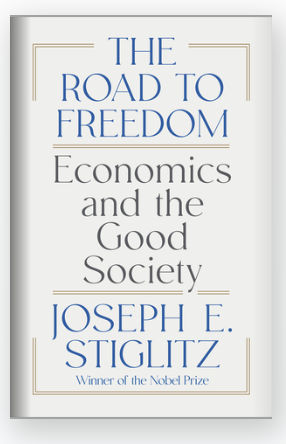
    Once again, if you are a libertarian-leaning, Reagan-lover, you will not like this choice either. The Road to Freedom will also not be liked by those who like,The Road to Serfdom.
   What follows is from the publisher:
   "We are a nation born from the conviction that people must be free. But since the middle of the last century, that idea has been co-opted. Forces on the political Right have justified exploitation by cloaking it in the rhetoric of freedom, leading to pharmaceutical companies freely overcharging for medication, a Big Tech free from oversight, politicians free to incite rebellion, corporations free to pollute, and more. How did we get here? Whose freedom are we—and should we—be thinking about?
   In The Road to Freedom, Nobel prize winner Joseph E. Stiglitz dissects America’s current economic system and the political ideology that created it, laying bare their twinned failure. “Free” and unfettered markets have only succeeded in delivering a series of crises: the financial crisis, the opioid crisis, and the crisis of inequality. While a small portion of the population has amassed considerable wealth, wages for most people have stagnated. Free and unfettered markets have exploited consumers, workers, and the environment alike. Such failures have fed populist movements that believe being free means abandoning any obligations citizens have to one another. As they grow in strength, these movements now pose a real threat to true economic and political freedom."

Blurb-like Comments
"Stiglitz is a rare combination of virtuoso economist, witty polemicist and public intellectual."
New Statesman
"Along with Krugman and Thomas Piketty, Stiglitz forms a triumvirate of leading economic critics of global capitalism, 21st-century-style."
Andrew Anthony, Guardian
"An insanely great economist."
Paul Krugman, The New York Times
"A towering genius of economics."
Independent
"A seer of almost Keynesian proportions"
Newsweek
The Road to Freedom ... seeks to reclaim the concept of freedom for liberals and progressives [and] calls for the creation of a “progressive capitalism'' that would look nothing like the neoliberal variant
John Cassidy, The New Yorker

Post Script:
   
If you think you might be inclined to be a "Stiglitzian" read the review of three of his books in, "Why the Rich Are So Much Richer,"by James Surowiecki, in the New York Review of Books, Sept. 24, 2015
   The Great Divide: Unequal Societies and What We Can Do About Them, by Joseph E. Stiglitz
Norton, 428 pp., $28.95
Rewriting the Rules of the American Economy: An Agenda for Growth and Shared Prosperity by Joseph E. Stiglitz
Creating a Learning Society: A New Approach to Growth, Development, and Social Progress by Joseph E. Stiglitz and Bruce C. Greenwald
Columbia University Press, 660 pp., $34.95; $24.95 (paper)
   "In the years since the financial crisis, Stiglitz has been among the loudest and most influential public intellectuals decrying the costs of inequality, and making the case for how we can use government policy to deal with it. In his 2012 book, The Price of Inequality, and in a series of articles and Op-Eds for Project Syndicate, Vanity Fair, and The New York Times, which have now been collected in The Great Divide, Stiglitz has made the case that the rise in inequality in the US, far from being the natural outcome of market forces, has been profoundly shaped by “our policies and our politics,” with disastrous effects on society and the economy as a whole. In a recent report for the Roosevelt Institute called Rewriting the Rules, Stiglitz has laid out a detailed list of reforms that he argues will make it possible to create “an economy that works for everyone.”....
   After all, the policies that Stiglitz is calling for are, in their essence, not much different from the policies that shaped the US in the postwar era: high marginal tax rates on the rich and meaningful investment in public infrastructure, education, and technology. Yet there’s a reason people have never stopped pushing for those policies: they worked. And as Stiglitz writes, “Just because you’ve heard it before doesn’t mean we shouldn’t try it again.”

Tuesday, 10 December 2024

TAXING TIMES


  I am not sure where I saw this, but I will pass it along as a public service. Although soon-to-be-again President Trump has promised to cut taxes (at least for the very wealthy), that may not include you and you might have other reasons for wishing to emigrate from the U.S. If so, you might want to attend this tax seminar offered by Moodys on Dec. 14. They will answer the following question.

TRUMPUGEES
 
When Trump was elected last time, there was reportedly a surge in Google searches relating to moving to Canada. The immigration law firm, LARLEE ROSENBERG, noticed this and they will assist you with the migration process if you visit, trumpugees.ca. You might want to attend the Moody's webinar first if your motivation relates more to a concern about taxes than Trump. The folks at LAREE ROSENBERG have indicated that there has indeed been a spike in immigration queries:

"How are the inquiries you’re getting today different from Trump’s first win?"
"The volume of requests is much higher. For the first couple of weeks after the election, it was three or four an hour round the clock. Trump has moved much farther right on the political spectrum since 2016, which has broadened the playing field in terms of people looking to escape his second term. We have received inquiries from people on the far left, as well as from Republicans who are still left of Trump. There are U.S.-based companies interested in shoring up their Canadian operations to give their employees an opportunity to work here. That’s mostly in tech—video games and software development companies. And then we’re also hearing from Americans who are already living in Canada and are now worried about what a Trump presidency might mean for their permanent residency applications. We’re calling those people sur place Trumpugees."

   Although I came from the United States to Canada and stayed, I am skeptical about any surge in trumpugees at this time. The Moody's tax seminar will deter some and the weather, others. On the other hand, if mass deportations are ordered in the U.S., there may be a dramatic increase in trumpugees of a different kind.
   It is also the case that are many instances reported in Canada where people are trying illegally to get into the United States, a destination for those who think that it is still preferable to living here. 
   Most Canadians I know have very strong feelings about Trump, (negative ones), but I predict that it will take a much weaker loonie to deter their visits when the "March Break" days appear on the calendar.  For more about this see: "The Trump Slump" which was written when school trips to the U.S. were cancelled and there were calls to boycott U.S. vacations. And, "Trump and Travel" which I did back in 2019. 

Source: The question above was asked by a Maclean's reporter. See, "Can Trumpugees Move to Canada," Courtney Shea, Nov. 28, 2024.

Thursday, 5 December 2024

Eddie Mulcahy

 My Father
   I don't post much of a personal nature in MM so you readers looking for the stuff I usually provide will have to wait until tomorrow. (The stuff I usually offer is difficult to characterize and that is why I had to resort to calling it "stuff.") This post is simply about the death of my dad. 
  I thought about him because he died fifty years ago, while on vacation. I have had many more vacations than he, and have already lived many more years. That is rather unfair; he was a much better father than I was a son. 
  In 1974 the small town in which he lived still had a local newspaper and since Eddie had been the proprietor of "Eddie's Restaurant", his passing was noted on the front page. I see that the "Wilson Funeral Home" held the service. I remember when the owner used to come into "Eddie's", one of the guys sitting and lying in a back booth would usually say, "Here comes the 'Buzzard'." There were nicknames for everyone and it could have been "Hacksaw" Payne who referred to the mortician. 
  I was unable to go to the funeral, so I probably last saw my father around fifty-two years ago. My children will have no recollection of him, nor the grandchildren who never met him. Below, they will at least see a trace of his existence. The front page is provided along with the article. 


  Here is one of the ads that appeared in the Marylander and Herald. It was continued by the Somerset Herald, which ceased publication in the mid-1980s.  At least digitized copies still exist. My father, and my mother, are both buried near the Legion home mentioned. 

   Princess Anne is located on the Eastern Shore of Maryland. In the early 1950s, a trip to the Western Shore and the mainland was made easier when a bridge across the Chesapeake Bay was constructed. (See, "The Eastern Shore.") 

Have a Merry Christmas.   

More Short Histories

   I just provided a list of "short histories", but excluded some additional options since the post would have been too long for you to read. Here are some more for those of you who want abridged versions of the past. 

Bloomsbury 
   
They offer "A compact history series that’s both authoritative and original, Bloomsbury's Short Histories provides the essential facts for a range of subjects and combines them with informed discussions and extensive bibliographies, making them perfect for students, teachers, and general history enthusiasts." Here are a few examples: 


Bloomsbury Publishing is British. It is likely the books are good ones since Bloomsbury has an "Annual Modern Slavery and Human Trafficking Statement". They are against both slavery and trafficking. 

Thames & Hudson
   
Also British and you can learn more about them here. 


Penguin Random House 
   
Penguin used to be British and you can learn about the colours of Penguins and Pelicans in MM's, Penguin Books.  They have a few titles in their "DK Short History Series. To wit:
  If you are Christmas shopping, these short books should be less expensive than the tomes.

Wednesday, 4 December 2024

Short Histories


   This post will be useful for those university students who have not read a book and now need to do so. Apparently even those at "The Ivies" show up having not read a book (see: "The Elite College Students Who Can't Read Books: To Read a Book In College, It Helps to Have Read a Book in High School," Rose Horowitch, The Atlantic, Nov. 2024.) It will also be of use to oldsters, like myself, who are running out of time and want to read up on subjects about which they have forgotten - sex, for example. 
   I have done this before. At the beginning of 2019 I suggested that you could fulfill your intellectual resolutions for the new year by consulting Oxford University Press's Very Short Introductions.. and the 30 Second Books produced by Ivy Press, (see Intellectual Resolutions - 2019.) I see that I also showed you which titles were held by the London Public Libraries.
  Here is the list of Short Histories provided by "The Experiment" publishing company and additional information is found on their website. I will begin with the subject about which I have forgotten.
The Shortest History of Sex

Two Billion Years of Procreation and Recreation

by David Baker, Simon Whistler (Foreword)

Paperback | $16.95 US / $21.95 CAN

From the first microbial exchanges of DNA to Tinder and sexbots, how did sex begin, and how did it evolve to be so varied and complex in humans? What influence do our genetic ancestors have on our current love lives?

Among the short titles, I also found one that is brief:

A Brief History of the World in 47 Borders Surprising Stories Behind the Lines on Our Maps by Jonn Elledge Paper Over Boards | $24.95 US / $32.95 CAN Many lines on the map are worth far more than a thousand words, going well beyond merely marking divisions between nations. In this eye-opening investigation into the most remarkable points on the map, a single boundary might, upon closer inspection, …

The Shortest History of China

From the Ancient Dynasties to a Modern Superpower—A Retelling for Our Times

by Linda Jaivin

Paperback | $16.95 US / $21.95 CAN

As we enter the “Asian century,” China demands our attention for being an economic powerhouse, a beacon of rapid modernization, and an assertive geopolitical player. To understand the nation behind the headlines, we must take in its vibrant, tumultuous past—a …

The Shortest History of Democracy

4,000 Years of Self-Government—A Retelling for Our Times

by John Keane

Paperback | $15.95 US / $21.00 CAN

This compact history unspools the tumultuous global story that began with democracy’s radical core idea: We can collaborate, as equals, to determine our own futures. Acclaimed political thinker John Keane traces how this concept emerged and evolved, from the earliest …


The Shortest History of Dinosaurs

The 230-Million-Year Story of Their Reign and Their World

by Riley Black

Paperback | $16.95 US / $21.95 CAN

Despite their cultural influence, the grand narrative of the dinosaur story is rarely told. Most of us have heard of Stegosaurus and Tyrannosaurus, for example, but these two dinosaurs lived more than eighty million years apart—a greater span of time....


The Shortest History of England

Empire and Division from the Anglo-Saxons to Brexit—A Retelling for Our Times

by James Hawes

Paperback | $16.95 US / $21.95 CAN

England—begetter of parliaments and globe-spanning empires, star of beloved period dramas, and home of the House of Windsor—is not quite the stalwart island fortress that many of us imagine. Riven by an ancient fault line that predates even the Romans...


The Shortest History of Eugenics

From “Science” to Atrocity—How a Dangerous Movement Shaped the World, and Why It Persists

by Erik L. Peterson

Paperback | $16.95 US / $21.95 CAN

Eugenics emerged in the nineteenth century as a potent and seemingly benevolent—even prudent—idea: The simplest way to rid society of social ills and bring about a healthier, more “desirable” humankind was through the “science” of better breeding. Seizing on advancements...


The Shortest History of Europe

How Conquest, Culture, and Religion Forged a Continent—A Retelling for Our Times

by John Hirst

Paperback | $16.95 US / $21.95 CAN

Propelled by a thesis of startling simplicity, celebrated historian John Hirst’s fast-paced account of the making of modern Europe—from Ancient Greece to today—illuminates the continent as never before. Just three elements—German warrior culture, Greek and Roman learning, and Christianity.....


The Shortest History of France

From Roman Gaul to Revolution and Cultural Radiance—A Global Story for Our Times

by Colin Jones

Paperback | $16.95 US / $21.95 CAN

France is the most popular tourist destination in the world, thanks to its unsurpassed cultural and historical riches. Gothic architecture, Louis XIV opulence, revolutionary spirit, cafĂ© society, haute cuisine and couture . . . what could be more quintessentially French? …


The Shortest History of Germany

From Roman Frontier to the Heart of Europe—A Retelling for Our Times

by James Hawes

Paperback | $16.95 US / $21.95 CAN

A country both admired and feared, Germany has been the epicenter of world events time and again: the Reformation, both World Wars, the fall of the Berlin Wall. It did not emerge as a modern nation until 1871—yet today, Germany …

The Shortest History of Greece

The Odyssey of a Nation from Myth to Modernity

by James Heneage

Paperback | $16.95 US / $21.95 CAN

Philosophy, art, democracy, language, even computers—the glories of Greek civilization have shaped our world even more profoundly than we realize. Pericles and the Parthenon may be familiar, but what of Epaminondas, the Theban general who saved the Greek world from …


The Shortest History of India

From the World’s Oldest Civilization to Its Largest Democracy—A Retelling for Our Times

by John Zubrzycki

Paperback | $16.95 US / $21.95 CAN

India—a cradle of civilization with five millennia of history, a country of immense consequence and contradiction—often defies ready understanding. What holds its people together—across its many cultures, races, languages, and creeds—and how has India evolved into the liberal democracy it …


The Shortest History of Israel and Palestine

From Zionism to Intifadas and the Struggle for Peace

by Michael Scott-Baumann

Paperback | $16.95 US / $21.95 CAN

The ongoing struggle between Israel and Palestine is one of the most bitter conflicts in history, with profound global consequences. In this book, Middle East expert Michael Scott-Baumann succinctly describes its origins and charts its evolution from civil war to ...


The Shortest History of Italy

3,000 Years from the Romans to the Renaissance to a Modern Republic—A Retelling for Our Times

by Ross King

Paperback | $16.95 US / $21.95 CAN

The calendar. The Senate. The university. The piano, the heliocentric model, and the pizzeria. It’s hard to imagine a world without Italian influence—and easy to assume that inventions like these could only come from a strong, stable peninsula, sure of … The Shortest History of Japan: From Mythical Origins to Pop Culture Powerhouse - The Global Drama of an Ancient Island Nation

by Leslie Downer
Price: $16.95 US / $21.95 CAN
Discover the aesthetic traditions, political resilience, and modern economic might of this singular island nation. The Shortest History books deliver thousands of years of history in one riveting, fast-paced read.

The Shortest History of Migration

When, Why, and How Humans Move—From the Prehistoric Peopling of the Planet to Today and Tomorrow’s Migrants

by Ian Goldin

Paperback | $16.95 US / $21.95 CAN

For hundreds of thousands of years, the ability of Homo sapiens to travel across vast distances and adapt to new environments has been key to our survival as a species. And yet this deep migratory impulse is being tested as …


The Shortest History of Music

From Bone Flutes to Synthesizers, Hildegard von Bingen to BeyoncĂ©—5,000 Years of Instrument and Song

by Andrew Ford

Paperback | $16.95 US / $21.95 CAN

No art form is as widely discussed—or as readily available—as music. With the click of just a few buttons, modern humans can decide what they think of the brand-new BeyoncĂ© just as quickly as they can form opinions on Brahms …


The Shortest History of Our Universe

The Unlikely Journey from the Big Bang to Us

by David Baker, John Green (Foreword)

Paperback | $16.95 US / $21.95 CAN

In this thrilling history, David Baker captures the longest-possible time span—from the Big Bang to the present day—in an astonishingly concise retelling. His impressive timeline includes the “rise of complexity” in the cosmos and the creation of the first atoms; …

The Shortest History of War

From Hunter-Gatherers to Nuclear Superpowers—A Retelling for Our Times

by Gwynne Dyer

Paperback | $15.95 US

War has changed, but we have not. From our hunter-gatherer ancestors to the rival nuclear powers of today, whenever resources have been contested, we’ve gone to battle. Acclaimed historian Gwynne Dyer illuminates our many martial clashes in this brisk account, tracing …

—------- CANCON:

Canada also has "IVIES", but they are called "MAPLES".