Sunday, 20 December 2020

George R. Stewart (1895 - 1980)

Pandemic Reading Project

   It is highly likely that you are bored and have run out of reading material. My purpose here is to introduce you to one author who will provide all the books you need, whether you are a fan of fiction or non-fiction. As well, a large number of subjects are covered.
   You will be surprised to learn that the producer of all these books, on different topics and in different genres, was a professor of English. Don't let that discourage you. He was an interesting fellow and the English Department at Berkeley was clearly different back in his day. You can easily learn more about him in the sources I will offer.  For now, here are some of the subjects he wrote about and there will surely be one-or-two that will interest you. We will begin with the fiction.

The Pandemic

   Although you may be trying to avoid reading about the current Covid crisis, you can't. Nor can your friends and relatives and we are all reading and talking about the same things, which at this moment are vaccines. Introduce some variety into the conversation, by speculating about what would happen if the virus resulted in the loss of most of mankind (or theykind or whatever.) In the novel Earth Abides, a young man returns from the wilderness only to find that most of the population has disappeared - because of a virus. It is a well-crafted tale. The earth abides, the animals do well, but the humans do not.

The Weather

   Always a very popular subject and now we are experiencing it in extreme forms. The National Weather Service ran out of the usual names for storms this year and had to take some from the Greek alphabet. Although the Atlantic tropical storms have only been given names since 1953, Stewart named storms in his novel, Storm which was a Book of the Month Club selection back in 1941. 
   The weather was also partially responsible for the destruction of almost 10 million U.S. acres by fires. Stewart's novel Fire, "is the blazing story of Spitcat, a forest fire, and of the eleven days during which it was born, almost died, and raged across a green and gracious Sierra forest to leave only black desolation and a terrible silence. It is the story of a flaming disaster that took only a few days to happen, but would need a hundred years to mend. It is also the intensely human story of the men and women who risked their lives and pitted their strength and strategy against this red terror of the forest."

Now For Some Non-Fiction

   Not all of Stewart's work is going to be covered, but if you are growing impatient and want to read a book about possible cannibalism among pioneers in the Sierra Nevada mountains, read Ordeal by Hunger (or just read the almost book length account about the Donner Party in Wikipedia.)

Travel

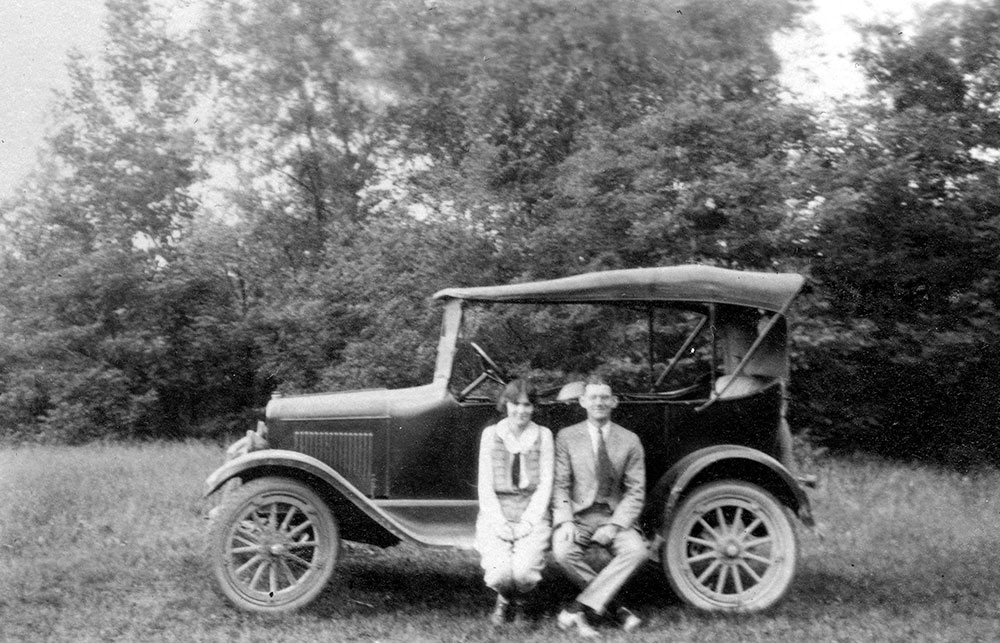
   You are not supposed to be travelling, but you can read about doing so. I covered books about trails and wandering around and included Stewart's The California Trail, He also wrote about Route 40 and the roads heading north to Alaska and south to Costa Rica. He travelled a lot to gather research about the names of places. That is Stewart pictured above with his wife.

Names

   The problems we are having now with many names was covered in my post - Names on the Land, which is also the title of one of Stewart's books. There are others by him about other names. The New York Review of Books re-publishes 'classics' and Names on the Land is one of them. It is fascinating and I have a copy if you want to borrow it. 

University Politics

   You probably aren't eager to tackle this topic which has been much in the news. Stewart did write about the subject and Year of the Oath has some relevance. When university professors were forced to sign an oath indicating they were not members of the Communist Party, Stewart objected and noted that "Men and Women of Spirit object to having a knife put at their throats." It takes a spirited individual these days to stand up to those now wielding the knives.
   

Sources: 

   This is now far too long.  To quickly see if Stewart is likely to interest you read the Wikipedia entry for him. This source is not being updated, but it is very good: George R. Stewart. This one is continually updated and very good. Earth Abides (there is also a Wikipedia entry for this book.)
   
   There is a copy of Earth Abides in the London Public Library System and at Western. Other books by Stewart available in the Western Libraries are listed below.

Books by George R. Stewart

   The books in red are available in the libraries of Western University for those who live in the London area and have access to the collections (Search done in December 2020).

Novels:
      
East of the Giants, Holt, 1938.
Doctor's Oral, Random House, 1939.
Storm (Book of the Month Club selection), Random House, 1941.
Fire, Random House, 1948.
Earth Abides, Random House, 1949, 3rd edition, Hermes, 1974.
Sheep Rock, Random House, 1951.
The Years of the City, Houghton, 1955.

Nonfiction:
Bret Harte,
Houghton, 1931, reprinted, AMS Press, 1977.
Ordeal by Hunger, Holt, 1936, reprinted, Houghton, 1960, with a supplement and three accounts by survivors, 1992.
Names on the Land, Random House, 1944.
Man: An Autobiography, Random House, 1945.
The Year of the Oath, Doubleday, 1950 , reprinted, Da Capo Press, 1971.
U.S. 40 , Houghton, 1953, reprinted, Greenwood Press, 1973.
American Ways of Life, Doubleday, 1954, reprinted, Russell, 1971.
N.A. 1 , Houghton, 1957.
Pickett's Charge, Houghton, 1960.
The California Trail, McGraw, 1963.
Committee of Vigilance: Revolution in San Francisco, Houghton, 1964.
Good Lives, Houghton, 1967.
Not So Rich as You Think, Houghton, 1968.
American Place-Names, Oxford University Press, 1970.
Names on the Globe, Oxford University Press, 1975.
American Given Names: Their Origin and History in the Context of the English Language, Oxford University Press, 1979.
Also author of Technique of English Verse, 1930, Bibliography of the Writings of Bret Harte, 1933, and John Phoenix Esquire, 1937. Juveniles: To California by Covered Wagon, Random House, 1954.


The picture at the top is from the Berkeley Historical Plaque Project.  For a recent article about Earth Abides see this article in the Berkeley alumni magazine: "A Killer-Type Virus Ends the World! Revisiting Earth Abides, the Novel That Inspired Stephen King and Jimi Hendrix," by Pat Joseph, Summer 2020. 

Post Script: Western University has also started a digital plaque project. See: Western University Names. 

Tuesday, 15 December 2020

Christopher Hitchens

  Christopher Hitchens passed away on December 15, 2011. This year marks the ninth anniversary of his death and since there will be many remembrances next year, I thought I would present mine now. Had he lived, he would be almost 72 and I am sure would have remained as pugnacious as he appears in the picture above.

Some of the reasons why I admire him are better expressed by Larry McMurtry who wrote this about him in Walter Benjamin at the Dairy Queen:

“The descendants of the great readers I have mentioned are too often merely fluent know-it-alls, of whom Christopher Hitchens might be considered the exemplar. There he is, every week or month, in the Nation, Vanity Fair, the London Review of Books, writing about history, politics, books, public figures, virtually anything that comes down the freeways of our global culture. I personally have seen Christopher Hitchens in public debate while so weary or drunk or both that he can hardly have known whether he was even facing his audience, or whether there was an audience --and yet not a detail of his argument was dropped and not any of his long and well-turned sentences were slurred. His speech, like his writing, is precise, often brilliant, sometimes spellbinding, rarely inelegant; and yet one feels--as with many of his high-journalistic peers--that all this knowledge (or at least all this information) is not really reading-derived, but has been acquired more or less by osmosis, by rubbing elbows with his journalistic peers in Washington, London, New York, Paris, Delhi, Tehran, or wherever. I might note that this fluency is something few Americans seem to possess; perhaps it stems from admirable European secondary education. I might note too that it is mainly those high journalists who seem to command the steadily released energies of their Victorian counterparts, Bagehot, Macaulay, Saintsbury.” (p.123)

To be able to argue well while drunk may not be a skill you admire, but as one who does not do such a good job, even when sober, it is one that appeals to me. I am, by the way, rather good at drinking and much prefer it over arguing.

The abilities he displayed while arguing typically where employed in support of notions I also support. He was not a fan of religion as you will gather from the hint provided in this title: God Is Not Great. If you need a bigger hint, it is found in the not so subtle sub-title: How Religion Poisons Everything.

After receiving the cancerous death notice, he was asked near the end if it was likely that he would seek solace in religion. Here is his answer: "Mr. Hitchens discussed the possibility of a deathbed conversion, insisting that the odds were slim that he would admit the existence of God."“The entity making such a remark might be a raving, terrified person whose cancer has spread to the brain,” he told The Atlantic in August 2010. “I can’t guarantee that such an entity wouldn’t make such a ridiculous remark, but no one recognizable as myself would ever make such a remark.”

  He was also a critic of what is termed "Islamofascism" and would have undoubtedly written (as I did) about the recent beheading of a French teacher and the murder of three churchgoers by Islamist terrorists. He defended Salman Rushdie who, you may remember, had to go into hiding and whose Japanese translator was murdered and his Norwegian publisher shot. This is what Hitchens wrote when asked about that fatwa:

When The Washington Post telephoned me at home on Valentine's Day 1989 to ask my opinion about the Ayatollah Khomeini's fatwa, I felt at once that here was something that completely committed me. It was, if I can phrase it like this, a matter of everything I hated versus everything I loved. In the hate column: dictatorship, religion, stupidity, demagogy, censorship, bullying and intimidation. In the love column: literature, irony, humor, the individual, and the defense of free expression. Plus, of course, friendship -- though I like to think my reaction would have been the same if I hadn't known Salman at all. To re-state the premise of the argument again: the theocratic head of a foreign despotism offers money in his own name in order to suborn the murder of a civilian citizen of another country, for the offence of writing a work of fiction. No more root-and-branch challenge to the values of the Enlightenment (on the bicentennial of the fall of the Bastille) or to the First Amendment to the Constitution, could be imagined. (p.268.)

Post Script:

In the "About This Blog" section of this blog I state the one of its purposes is to serve as a memory aid for me. By reading up on subjects and then writing down thoughts, I assumed, for example, that a year-or-two from now I might have a vague recollection of who Christopher Hitchens was. It is not working.

A few paragraphs into this post I had the thought that I might have written about Hitchens before. I have. Not only that, I quoted the same bit from Larry McMurtry! Well, it is a good bit and if I have any readers, they may have forgotten it as well. The post was about Mother Teresa, about whom Hitchens wrote a book: The Missionary Position: Mother Teresa in Theory and Practice.

The Bonus:

Since I provided the McMurtry quote twice, here is a new one. It is from Michael Kinsley and it is found in a review of God Is Not Great, in the New York Times, May 13, 2007:

His enemies would like to believe he [Hitchens] is a fraud. But he isn’t, as the very existence of his many enemies tends to prove. He is self-styled, to be sure, but no more so than many others in Washington — or even in New York or London — who are not nearly as good at it. He is a principled dissolute, with the courage of his dissolution: he enjoys smoking and drinking, and not just the reputation for smoking and drinking — although he enjoys that too. And through it all he is productive to an extent that seems like cheating: 23 books, pamphlets, collections and collaborations so far; a long and often heavily researched column every month in Vanity Fair; frequent fusillades in Slate and elsewhere; and speeches, debates and other public spectacles whenever offered.


The quotation about Hitchens unlikely deathbed conversion is also from the New York Times:

"Christopher Hitchens, Polemicist Who Slashed All, Freely, Dies at 62," by William Grimes, Dec. 16, 2011.


You can see and hear Hitch in action in many YouTube videos; e.g. interviews with Jon Stewart and Sean Hannity and an almost seven hour compilation.


Sunday, 13 December 2020

Bird Art

 John Gould


   I happened to notice the image above, which is from a Gould work found in the Collection of Barbara and Ira Lipman which is being auctioned by Sotheby's. It is only one of the 269 items being offered and the starting bid for the Gould folio is $80,000. It is not the most expensive work in the lot. A 'Babe' Ruth baseball card is expected to fetch between $300,000 to $500,000 U.S.  You will have to hurry since the auction begins closing on Dec.16. Details about all of the books and manuscripts and odds and ends are easily found on the website of Sotheby's. 

   If you go to the Sotheby's site you will find enough to keep you busy for a long while. If you are interested in our subject for today - Bird Art - and the bird artist John Gould, then you need to visit The John Gould Ornithological Collection at the University of Kansas. Those of you who are tired of my prose, can go directly to the site to view thousands of beautiful bird illustrations.

   John Gould was born in Dorset in 1804 and over the years produced, along with his wife and Edward Lear, over 50 large illustrated volumes with alluring titles such as A Century of Birds From the Himalaya Mountains. He is an interesting character and it will be easy for you to learn more about him. 
   The story relating to how the Gould works came to reside in Kansas is also interesting.  It involves a compulsive collector of all things avian - Ralph Nicholson Ellis, Jr. He was so obsessed and so eager to spend his inheritance on bird books that his mother had him institutionalized and his wife filed for divorce. During all of these problems he had  his 65,000-item collection shipped in two boxcars which ended up on a siding in Kansas where the head of the Museum of Natural History in Lawrence, agreed to store them. The rest is history, as they say, and more details are provided in "The Story of the Gould Collection" by Karen Cook which is found on the University of Kansas website provided above.  For more about Ellis and his "galloping bibliomania" see Basbane's,  A Gentle Madness, p.21.

   With the financial assistance of the NEH, more than 6,000 drawings, lithographs and watercolours were digitized and  are viewable online. Here is the formal description of the collection:
This collection of the large-format bird books published by John Gould (1804-1881) also includes several thousand pieces of pre-publication artwork produced by Gould and his artists. It is part of the Ralph Nicholson Ellis, Jr. natural-history collection in Special Collections, Kenneth Spencer Research Library, University of Kansas.

The Bonus Material:

   If you are a 'birder' and interested in bird books, have a look at the Soffer Ornithology Collection at Amherst. Although the books have not been digitized it is interesting see the notes about the books which were provided by the collector. There are several Gould books listed.

   Perhaps you are wondering whether the university closer by has any Gould books. Here is the answer:
Books by John Gould in the Western University Libraries
(This list was gathered by me. For a thorough account you should check with a Western Librarian.)

Gould, John, 1804-1881. Birds of Asia. Illus. from the lithographs of John Gould. Text by A. Rutgers.   London : Methuen, 1969, c1968.
QL674.G668.(storage)
Gould, John, 1804-1881.  Birds of Australia. Ill. by John Gould. Text by Abram Rutgers. London, Methuen [1967]
QL693.G58.(storage)
Gould, John, 1804-1881. Birds of Europe. Illus. by John Gould. Text by A. Rutgers. London, Methuen [1966]
 QL690.A1G64.(storage)
 Gould, John, 1804-1881. Birds of New Guinea. Illus. from the lithographs of John Gould. Text by A. Rutgers. New York, St. Martin's Press [1971, c1970
 QL694.N4G68 1971.(storage)
Gould, John, 1804-1881. Birds of South America. Illus. from the lithographs of John Gould.  Text by A. Rutgers. London, Eyre Methuen [1972] 
QL689.A1G68 1972.(storage)
Lambourne, Maureen. Birds of the world : over 400 of John Gould's classic bird  illustrations / Maureen Lambourne.
London : Studio, 1992. QL674.L35 1992. (DBWOVR)
Gould, John, 1804-1881. John Gould's Birds of Great Britain / introduction by Maureen Lambourne. London : Eyre Methuen, 1980.
QL690.G7G76 1980.(storage)
Gould, John, 1804-1881. The Mammals of Australia / John Gould ; with modern notes by Joan M. Dixon. South Melbourne : Macmillan 1983.
QL733.G7 1983.(storage)
For biographical details see:
John Gould: The Birdman: A Chronology and Bibliography, by Gordon C. Sauer, 
QL31. G67S28 1982 (storage)
John Gould’s Contribution to British Art: A Note on Its Authenticity, Allan McEvery
QL31.G67M3 1973 (storage)
The Ruling Passion of John Gould: A Biography of the Bird Man, Isabella Tree, 1991
QL31.G67T74 1991 DBWSTK
See also Basbane’s A Gentle Madness… TX907.C67 2001, DBWSTK

Bird Eggs: If you are interested in beautiful pictures of eggs see: Oology and Ralph's Talking Eggs: Bird Conservation Comes Out Of Its Shell, Carrol Henderson. ( a copy is available at the Taylor Library at Western.)
"In Oology and Ralph's Talking Eggs, Carrol L. Henderson uses the vast egg collection of Ralph Handsaker, an Iowa farmer, as the starting point for a fascinating account of oology and its role in the origins of modern birdwatching, scientific ornithology, and bird conservation in North America. Henderson describes Handsaker's and other oologists' collecting activities, which included not only gathering bird eggs in the wild but also trading and purchasing eggs from collectors around the world. Henderson then spotlights sixty of the nearly five hundred bird species represented in the Handsaker collection, using them to tell the story of how birds such as the Snowy Egret, Greater Prairie Chicken, Atlantic Puffin, and Wood Duck have fared over the past hundred years or so since their eggs were gathered. Photos of the eggs and historical drawings and photos of the birds illustrate each species account, Henderson also links these bird histories to major milestones in bird conservation and bird protection laws in North America from 1875 to the present. While wild bird conservation has come a long way in the last hundred years, this book is a call to action for conservationists because some modern-day threats to bird life are far more insidious than threats posed to birds a century ago by market hunting and the plume trade."--BOOK JACKET.

For additional research about birds at Western, visit AFAR, which I described here: For the Birds. 

Saturday, 12 December 2020

Bob Dylan

 $300 Million Blowing in the Wind


   I paid passing notice to the fact that Bob Dylan recently sold his music catalogue to the Universal Music Publishing Group for an estimated $300 million. Maybe he needed the money, although I thought he had finally met with the Nobel Prize people and picked up that small cheque for about another million. The music business and the associated rights are too complicated for me, but I do suppose that we will now hear his melodies and lyrics in advertisements for such things as insurance and drugs. Perhaps President Trump will be able to use Dylan's tunes at his campaign rallies in 2024. To learn more, look for news stories in early December. For example: "Bob Dylan Sells His Songwriting Catalog in Blockbuster Deal: Universal Music Purchased His Entire Songwriting Catalog of More Than 600 Songs in What May Be the Biggest Acquisition Ever of a Single Act’s Publishing Rights," Ben Sisario, New York Times, Dec.7, 2020 or, "What Bob Dylan Selling His Music Catalog Does and Doesn't Mean," Simon Vozick-Levinson, Rolling Stone, n.d.

The Bob Dylan Archives

   I paid more attention about three years ago when around 6,000 personal Dylan items, including his old wallet from 1965 and Otis Redding's business card, were purchased and deposited in the archive at ----Are You Ready?--- the University of Tulsa. It is not in Minnesota where Robert Allen Zimmerman was born.  The city of Tulsa is home to George Kaiser and the Foundation bearing his name and he ponied up the reported $20 million for the purchase. He had already provided another $3 million to acquire for the University, the archives of Woody Guthrie. Apparently Mr. Kaiser is only marginally interested in either gentlemen. He is more interested in other things and gave $200 million for a park along the Arkansas River. If the border re-opens you will find the Bob Dylan Archive housed in The Helmerich Center for American Research at the Gilcrease Museum. It is predicted that, "So many people will be going to Tulsa," says the historian Brinkley. "Eventually, this will be one of the most important 20th-century literary and musical archives anywhere."


The Bonus:


  The University of Tulsa also has material from "One of the most influential man of letters in the twentieth century..." Edmund Wilson.  This collection even includes glass window panes inscribed by such individuals as Stephen Spender and Dorothy Parker.
His son is a Professor Emeritus in the Department of Modern Languages & Literature at Western University and lives here in London, Ontario.

Sources:
   For more about George B. Kaiser see: "A Billionaire's Quirky Quest to Create a Mecca for Dylan Fans," Karen Heller,  Washington Post, Oc. 12, 2017.

Factlet (6)


Extraordinary Times....         Desperate Times.....

That's Billions With a 'B'

   For review, a Factlet is true, whereas a Factoid is only widely believed to be true. I have not provided a Factlet for a while, so here are a bunch of them in one post. My last one was about the Opioid Epidemic and was negative, and this one is about the Covid Pandemic, but is positive. The pandemic has been profitable for some and not just the manufacturers of Purell or the makers of plexiglass. To wit:


   To put the chart in context, consider this:


A Wealth Tax??

   Jeff Bezos has already decided to give $10 billion to causes relating to climate change. He started by donating $791 million to various organizations, including $100 million each to: The Environmental Defense Fund, The National Resources Defense Council. The Nature Conservancy, The World Resources Institute and The World Wildlife Fund.  This will certainly help, since in 2019 only 2% of the $730 billion given globally was for the fight against climate change.
   Elon Musk has decided to move from California to Texas. The decision may be related to the fact that the Lone Star State has less regulations and lower taxes.

   Short of pleading for these individuals to be more philanthropic, what could be done? Instituting a wealth tax is one option and it is being considered in the UK. It is suggested that the tax could be a one-time one and there appears to be a fair amount of public support for it. That would likely be true here, but perhaps not in the Lone Star State during the time of Trump.

Sources:
   The chart is from a report produced for Americans For Tax Fairness and The Institute for Policy Studies. The title: "Net Worth of U.S. Billionaires Has Soared by $1 Trillion - To Total of $4 Trillion - Since Pandemic Began." A sub-heading indicates that the "Wealth Increase in 9 Months Exceeds Likely $908 Billion Cost of Covid Relief Package GOP Has Stalled as Too Costly."

   The charitable actions of Bezos are reported in the Washington Post - see: "Bezos Makes First Donations From $10 Billion Earth Fund For Fighting Climate Change," Steven Mufson, Nov. 16, 2020.
Bezos owns the Washington Post.

   The title of the Wealth Tax Report is: "A Wealth Tax For the UK", Wealth Tax Commission Final Report, by Arun Advani et al. The full 126 pp final report is available. 

The defining feature of a one-off wealth tax is that it would be a one-off exceptional response to a particular crisis. Individuals would only be taxed once based on the wealth they owned valued at a particular date. They would still be allowed to pay the tax in instalments over a number of subsequent years, to reduce the cost in any single year, but the amount of tax would be based on their wealth on the initial assessment date.

For two articles about the report: "Economic Cost of Covid Crisis Prompts Call For One-Off UK Wealth Tax," Richard Partington, The Guardian, Dec. 9, 2020 and "U.K. Urged To Levy $350 Billion Wealth Tax to Fund Pandemic," Andrew Atkinson, Dec. 9, 2020.

The Bonus: 
   You will have noticed the names of three Waltons in the chart. To see what Alice did with a bit of her money a few years ago, read this earlier post or, when the pandemic is over, travel to the Crystal Bridges Museum of American Art.


Sunday, 6 December 2020

Local Currencies

    In an attempt to support local businesses, I did just venture out for a bit and went to the abandoned Kellogg factory which now is a destination of sorts - do have a look and visit soon, 100 Kellogg Lane.  The line-up was too long and I am now again back blogging to avoid shopping. 

   I gather that a number of local vendors were available and, as an incentive, early arrivers were to be given "Merry Money" to spend. It was the mention of funny currency that drew my attention and provides me with the excuse to blog. I am sure you have seen examples of local currencies before and you certainly have held Canadian Tire money in your hands. If you wish to go downtown shopping you should get some Downtown Dollars.  As we become more concerned with buying locally and buying Canadian, we are likely to see more examples of local money which will probably look as legitimate as those colourful ones printed at the mint.


LETS - Local Exchange Trading System

   LETS is the technical term and here is the place to learn all about Local Currency Programs. It was not such an easy subject to find information about a decade ago. I recall students asking about it for a project and was able to find some information. It was written up for a little newsletter we produced: The Bottom Feeder, July 2006. Here is what was provided:

LETS

This acronym was new to us and discovered while assisting in an undergraduate research project that was tougher than we expected. Researching the subject is much easier if you look at some of the sources we provide here. LETS typically stands for "Local Exchange Trading System" and less frequently for "Local Employment and Trading System". A good definition is found in a book about the subject: Bridges into Work? An Evaluation of Local Exchange Trading Systems, by Colin Williams, et. al. "Local Exchange Trading Systems (LETS) are non-profit making associations that use local currencies to encourage members to trade services and goods with each other" (p.vi). Two other books in our collections relate directly to the subject: Community and Money: Men and Women Making Change, by Mary-Beth Raddon and Currency Movements as a Challenge to Globalisation? A Case Study of Manchester's Local Currency Networks, by Peter North. While the former book does give some Canadian examples, we will provide here some links to Canadian sites where "community currencies" or "alternative money" is being used in 2006. For information about "Toronto Dollars" see the site of Toronto Dollar Community Projects Inc.

"Calgary Dollars" are described here: http://www.calgarydollars.ca . The Victoria LETS is found at http://www.lets.victoria.bc.ca To find additional examples and to learn more about the use of community currencies see the very interesting journal we discovered along the way. Links to the International Journal of Community Currency Research are provided by searching that title in our catalogue. If you happen to be heading to the West Coast, you can buy some Salt Spring Dollars at http://www.saltspringdollars.com.

  Although the URLS provided are unlikely to work, you can find many local currencies. Here, for example, is information about Salt Spring Dollars and here is an article about how they were attempting to use them in Comox: "Why Comox Valley Is Launching Its Own Currency." 

  Now I think I have stalled long enough and won't have to go out shopping again today.

Be Careful What You're Woke For


   When you think of Baltimore,  you are probably more likely to associate it with "The Wire" than you are with works of art. It does have some fine museums, however,  including the Walters Art Museum and the Baltimore Museum of Art, which is still the home of the painting above. I wrote 'still' because recently the museum put Warhol's "The Last Supper" and a couple of other paintings up for sale.

   The purpose of the sale was an admirable one, one would think. It was a reaction to the "Black Lives Matter" movement and the money was to be used to support diversity and equity and to raise the salaries of the lower paid employees who were likely not the same colour as the higher paid ones. What could go wrong?

   The selling of a painting by a white Warhol and other white artists to raise $65 million in a city that is largely Black, surely should be a sure thing.  An earlier sale to raise money to purchase more works by women and Black artists had been successful, but this effort was not. The sale has been cancelled, some board members have resigned and one potential $50 million gift was withdrawn (it gets even messier - the name of one of the anonymous donors was revealed.)

   Deaccessioning is the problem and in this case it Trumped the ones related to race relations. There are rules governing the sale of art works housed in non-profit museums. For example, if you donated a painting to the local gallery, you would be pleased if there was a rule to prevent the selling of it to support a grand office party, or even to repair the plumbing. The Association of Art Museum Directors enforces restrictions related to such matters and they have recently relaxed them since many museums are experiencing budgetary problems, some of which are related to the pandemic. One has to be careful in such circumstances as this statement indicates: “If you start monetizing the value of the art on the walls, it raises a whole host of problems and leads to a slippery slope,” Laurence Eisenstein, a leading critic, said. “Next time the state or city are thinking about giving money to the museum, it leads to people asking questions like ‘why don’t you sell some works?’”

   This post is in response to an article I read this morning and because blogging is easier than Christmas shopping. A couple of years ago I did write about this issue when a Canadian deaccessioning controversy occurred. The attempted sale of a Chagall by the National Gallery, caused all kinds of problems. Years before that there was a dispute here in London when the University of Western Ontario sold a Cropsey. You can read more about it in this post: Jasper Cropsey ,which I will feature today.

Sources: 

"A Baltimore Museum Tried to Raise More Money by Selling Three Pricey Artworks: It Backfired Stupendously," Sebastian Smee and Peggy McGlone, Washington Post, Dec. 6, 2020.
See also: "Baltimore Museum Halts Sales of Three Painting, Including Warhol's "Last Supper," Just Hours Before Auction," Peggy McGlone, Washington Post, Oct. 28, 2020.

The Bonus:

  I gather that the University close by is also addressing the Black Lives Matter movement and attempting to do something about the systemic racism that exists there, apparently in clear violation of the HR rules and provincial regulations relating to such things as promotion and hiring. Princeton is doing the same thing as you will learn from the first few paragraphs found in this nicely titled article:
"Keywords: Hoist, Petard: On How Princeton's Crusade Against Systemic Racism Has Backfired," Roger Kimball, New Criterion, Nov. 2020.

Perhaps we ought to have included “chickens” and “roost” among the keywords as well. For many years now, woke administrators, professors, and other activists at all the toniest colleges have been like the parade of flagellants in The Seventh Seal: skirling in public about their sins, above all their institutional or (as we have lately been taught to say) their “systemic” racism. Their cries are accompanied by the demand for alms—$50 million at Yale to support “diversity,” $100 million at Brown for kindred exercises in political penance, and so on.

On September 2, Christopher L. Eisgruber, the president of Princeton University, made a major contribution to this emetic genre. In an open letter to the university “community,” he beat his breast about America’s overdue “profound national reckoning with racism.” He didn’t exclude his own university. Indeed, he beat himself harder as he bemoaned Princeton’s long history of “intentionally and systematically exclud[ing] people of color, women, Jews, and other minorities.” Nor, according to him, has that history ended. “Racist assumptions from the past,” President Eisgruber sobbed, “remain embedded in structures of the University itself.”

His confession did not go unnoticed. On September 16, the Department of Education sent President Eisgruber a letter. The letter minutes an interesting discrepancy. Since Christopher Eisgruber became president of Princeton in 2013, the university has received more than $75 million in taxpayer funds. It has also “repeatedly represented and warranted to the U.S. Department of Education . . . Princeton’s compliance with Title VI of the Civil Rights Act of 1964.” What’s Title VI? Among other things, it’s the law that stipulates that no institution receiving federal funds may discriminate against anyone because of “race, color, or national origin.”