Showing posts with label Earth Abides. Show all posts

Sunday, 27 November 2022

Old Beatrice & Uncle Tom


   It has been two weeks since I last posted and it is raining so I will attempt one now. It will be based, I think, on stories I just read in the Sunday papers. You will be relived to know that they are not "news" stories, since most such stories are rather bad these days.

  I will begin with the benign one about Beatrice. The picture above is from the North Sea off the coast of Scotland where the oil rigs, like the one on the right, are being replaced by the wind turbines on the left. There will be over 80 of them and the 50 square miles will be known as "The Beatrice Offshore Wind Farm." Her name was also on the old oil rigs. 

  You will not be surprised that I noticed the name "Beatrice", since I have written often about such names, mostly because they are being replaced. You will also know that I am not generally in favour of such replacements since the history behind them is often more interesting and illustrative than the monikers manufactured by the new toponymic totalitarians among us. 

  Although HRH Prince Charles of Wales reigned over the official opening of the "farm" in the Moray Firth, Scotland, old Beatrice is not British.  She was the wife of old T. Boone Pickens, who has his name all over the campus at Oklahoma State University. Old T. Boone was very rich and his story is more interesting than this post (see below for sources.)


  At this time I don't think anyone is suggesting that Beatrice be removed, but remember that the hummingbird "Anna" is being attacked for being named after the wife of a French naturalist. "Uncle Tom", as in "Uncle Tom's Cabin,"  is causing problems, even in Germany where "Onkel Toms Hütte" is the name of a subway station in Berlin. Blacks would be very much offended by being referred to as an "Uncle Tom" and the one pictured above objects to the station name as do many others. She is not alone and the naming authorities will probably have to re-name a Bauhaus housing development and the street, Onkel-Tom-Strasse. Just as I did not say much about T. Boone, I will say little more about the Uncle Tom controversy in Germany, since it is the type of  "news" story, of which there are already too many. If you can't figure it out, sources are provided, along with some other interesting bits.

Sources:
   
For information about Beatrice see: "Giant Wind Farms Arise Off Scotland, Easing the Pain of Oil’s Decline," Stanley Reed, New York Times, Nov. 27, 2022.
   For Boone Pickens see the very interesting Wikipedia entry. The money he has given to OSU could save Laurentian U. and revitalize the entire industry of higher education in all of Canada. If you are a golf fan you will finally understand why so many of the foreign (and domestic) top PGA tour professionals ended up in Stillwater rather than, say in San Diego. 

  Information about the "Onkel Toms Hütte" controversy is found in this article, from which the illustration above was poached: "A Berlin Subway Stop is Called ‘Uncle Tom’s Cabin.’ Some Black Germans Want Change," Meena Venkataramanan, The Washington Post, Nov. 27, 2022.

The Bonus:
   
There is no doubt that you are still looking for something better to read on this dreary Sunday. Here is a suggestion, which allows me to plug some of my old posts. When discussing the various naming controversies, I have usually mentioned George R. Stewart. His name and book were mentioned in this article which also contains many other good book suggestions: "BY THE BOOK: Douglas Brinkley Would Like to Invite Thoreau to Dinner," New York Times, Nov. 27, 2022. Here is his answer to this question:
"What's the last great book you read?"
"During the pandemic I was transfixed by George R. Stewart’s “Earth Abides,” perhaps the most frightening doomsday thriller of all time. Most of American civilization collapses because of a strange disease, but a Berkeley ecologist is one of the rare survivors of the epidemic. Stewart wrote the book about 75 years ago, but his description of empty cities and the power of nature unleashed seem very contemporary in a world of Covid and climate change. It holds up well, and Kim Stanley Robinson wrote a fine introduction for the 2020 edition."
For more about Stewart and some of his other books see: 
George R. Stewart (1895 - 1980)
 My last post about geographic name changing is:  "British Columbia or Sasquatchia?" There are many more which surprises me. 


Sunday, 20 December 2020

George R. Stewart (1895 - 1980)

Pandemic Reading Project


   It is highly likely that you are bored and have run out of reading material. My purpose here is to introduce you to one author who will provide all the books you need, whether you are a fan of fiction or non-fiction. As well, a large number of subjects are covered.
   You will be surprised to learn that the producer of all these books, on different topics and in different genres, was a professor of English. Don't let that discourage you. He was an interesting fellow and the English Department at Berkeley was clearly different back in his day. You can easily learn more about him in the sources I will offer.  For now, here are some of the subjects he wrote about and there will surely be one-or-two that will interest you. We will begin with the fiction.

The Pandemic

   Although you may be trying to avoid reading about the current Covid crisis, you can't. Nor can your friends and relatives and we are all reading and talking about the same things, which at this moment are vaccines. Introduce some variety into the conversation, by speculating about what would happen if the virus resulted in the loss of most of mankind (or theykind or whatever.) In the novel Earth Abides, a young man returns from the wilderness only to find that most of the population has disappeared - because of a virus. It is a well-crafted tale. The earth abides, the animals do well, but the humans do not.

The Weather

   Always a very popular subject and now we are experiencing it in extreme forms. The National Weather Service ran out of the usual names for storms this year and had to take some from the Greek alphabet. Although the Atlantic tropical storms have only been given names since 1953, Stewart named storms in his novel, Storm which was a Book of the Month Club selection back in 1941. 
   The weather was also partially responsible for the destruction of almost 10 million U.S. acres by fires. Stewart's novel Fire, "is the blazing story of Spitcat, a forest fire, and of the eleven days during which it was born, almost died, and raged across a green and gracious Sierra forest to leave only black desolation and a terrible silence. It is the story of a flaming disaster that took only a few days to happen, but would need a hundred years to mend. It is also the intensely human story of the men and women who risked their lives and pitted their strength and strategy against this red terror of the forest."

Now For Some Non-Fiction

   Not all of Stewart's work is going to be covered, but if you are growing impatient and want to read a book about possible cannibalism among pioneers in the Sierra Nevada mountains, read Ordeal by Hunger (or just read the almost book length account about the Donner Party in Wikipedia.)

Travel

   You are not supposed to be travelling, but you can read about doing so. I covered books about trails and wandering around and included Stewart's The California Trail, He also wrote about Route 40 and the roads heading north to Alaska and south to Costa Rica. He travelled a lot to gather research about the names of places. That is Stewart pictured above with his wife.

Names

   The problems we are having now with many names was covered in my post - Names on the Land, which is also the title of one of Stewart's books. There are others by him about other names. The New York Review of Books re-publishes 'classics' and Names on the Land is one of them. It is fascinating and I have a copy if you want to borrow it. 

University Politics

   You probably aren't eager to tackle this topic which has been much in the news. Stewart did write about the subject and Year of the Oath has some relevance. When university professors were forced to sign an oath indicating they were not members of the Communist Party, Stewart objected and noted that "Men and Women of Spirit object to having a knife put at their throats." It takes a spirited individual these days to stand up to those now wielding the knives.
   

Sources: 

   This is now far too long.  To quickly see if Stewart is likely to interest you read the Wikipedia entry for him. This source is not being updated, but it is very good: George R. Stewart. This one is continually updated and very good. Earth Abides (there is also a Wikipedia entry for this book.)
   
   There is a copy of Earth Abides in the London Public Library System and at Western. Other books by Stewart available in the Western Libraries are listed below.

Books by George R. Stewart

   The books in red are available in the libraries of Western University for those who live in the London area and have access to the collections (Search done in December 2020).

Novels:
      
East of the Giants, Holt, 1938.
Doctor's Oral, Random House, 1939.
Storm (Book of the Month Club selection), Random House, 1941.
Fire, Random House, 1948.
Earth Abides, Random House, 1949, 3rd edition, Hermes, 1974.
Sheep Rock, Random House, 1951.
The Years of the City, Houghton, 1955.

Nonfiction:

Bret Harte,
Houghton, 1931, reprinted, AMS Press, 1977.
Ordeal by Hunger, Holt, 1936, reprinted, Houghton, 1960, with a supplement and three accounts by survivors, 1992.
Names on the Land, Random House, 1944.
Man: An Autobiography, Random House, 1945.
The Year of the Oath, Doubleday, 1950 , reprinted, Da Capo Press, 1971.
U.S. 40 , Houghton, 1953, reprinted, Greenwood Press, 1973.
American Ways of Life, Doubleday, 1954, reprinted, Russell, 1971.
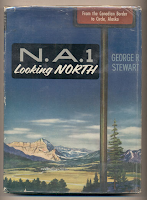
N.A. 1 , Houghton, 1957.
Pickett's Charge, Houghton, 1960.
The California Trail, McGraw, 1963.
Committee of Vigilance: Revolution in San Francisco, Houghton, 1964.
Good Lives, Houghton, 1967.
Not So Rich as You Think, Houghton, 1968.
American Place-Names, Oxford University Press, 1970.
Names on the Globe, Oxford University Press, 1975.
American Given Names: Their Origin and History in the Context of the English Language, Oxford University Press, 1979.
Also author of Technique of English Verse, 1930, Bibliography of the Writings of Bret Harte, 1933, and John Phoenix Esquire, 1937. Juveniles: To California by Covered Wagon, Random House, 1954.


The picture at the top is from the Berkeley Historical Plaque Project.  For a recent article about Earth Abides see this article in the Berkeley alumni magazine: "A Killer-Type Virus Ends the World! Revisiting Earth Abides, the Novel That Inspired Stephen King and Jimi Hendrix," by Pat Joseph, Summer 2020. 

Post Script: Western University has also started a digital plaque project. See: Western University Names.