Friday, 21 April 2017

The University of the Unusual (1)


(Forthcoming posts under the title above will all involve strange and sensational subjects. Given my blogging performance past it is safe to say the series will consist of at least one entry).


The Ingestion of Foreign Objects
    Children often swallow small objects and adults sometimes accidentally ingest things that were not meant to sink into the stomach, if indeed they can get that far. As well, there are people who deliberately swallow items - many, many items.


    I happened to stumble across a short article in The TImes (London) from the early 1980s that offered examples of patients who had, on purpose, put into their mouths many things not remotely related to any of the major food groups. That article prompted a reader to send in a clipping from The Times which provided another example that occurred almost 50 years earlier. In that piece there was another reference to an even earlier article that was supposedly found in the New York Times and it had to do with a woman who was found to have half a hardware store in her stomach.


    If you are at all interested in investigative reporting involving gastric issues read on since I was able to track down all the sources. Although some of the accounts are astonishing, keep in mind that the sources are a medical journal and the two TIMES, and that his all happened before the era of fake news.


A Knife and Fork For Dinner


    The original report that started all of this is found in the “Times Diary” for March 1, 1982 under the heading “Hard to Swallow”. The author is summarizing an article from a medical journal. I went looking for the original source and here it is: “Recognition and Management of Patients who Repeatedly Swallow Foreign Bodies”, Journal of the Royal Society of Medicine,  Volume 75, February 1982. The article notes  that “During 1978, over 3000 operations for the removal of foreign bodies from-the gastrointestinal tract were performed on adults in England and Wales”.
Here are the five cases presented in that article (if you wish, you can skip these medical accounts and go directly to the two sensational journalistic ones that follow):
Case reports
Case 1:
An 18-year-old warehouseman in Cardiff docks, with a history of repeated drug overdosage, was first treated in the Midlands in 1965 by gastrotomy for the removal of an ingested darning needle. Eleven years after this he swallowed some razor blades which he had wrapped in tissue paper. These were removed at laparotomy which was complicated by a faecal fistula. A few weeks later, following a quarrel with his prostitute girlfriend, he swallowed some more razor blades which, again, he had covered with tissue paper 'so as not to cut my throat'. A plain anteroposterior abdominal X-ray (Figure 1) showed a razor blade which, although it overlay the gastric shadow, was not seen in the stomach at gastroscopy because it was probably situated in the transverse colon. The blades passed naturally and without complication.[WOW]


Case 2:
A male cook first presented at a hospital on the south coast, aged 23, after he had swallowed some pins. Following an unsuccessful attempt at endoscopic removal, the pins were removed by gastrotomy which was complicated by a subphrenic abscess. Two years later he swallowed several darning needles which on plain abdominal X-ray appeared to lie outside the bowel (Figure 2). There were no physical signs to suggest bowel perforation and he was therefore managed conservatively, without complication. Two weeks later he swallowed a propelling pencil and a kitchen knife which both passed naturally. Six months after this he swallowed a penknife and an open safety pin. The penknife was removed at gastrotomy but the safety pin could not be found, and was subsequently passed naturally. When the patient was told that he was fit for discharge, he threatened to 'swallow the hospital bit by bit'; as an hors d'oeuvre he promptly swallowed a bolt from the bed-elevating mechanism. A month after discharge he attended the accident and emergency department of another London hospital claiming falsely to have swallowed paraquat. Two weeks after this he was readmitted to Charing Cross Hospital following an overdose of chlorpromazine, amitriptyline and salbutamol. While an inpatient he swallowed an open safety pin which passed naturally, and a few days before discharge, using a syringe which he had acquired on the ward, he injected his anterior abdominal wall with lavatory cleaner.


Case 3.
A divorced woman, aged 28, was seen at a hospital in Surrey having swallowed three spoons. There was a previous history of depressive illness in adolescence, which had been treated by electroconvulsive therapy, and she had cut her wrists at the age of 23. The patient said that she had swallowed the spoons because she heard a voice telling her to do so. During the next fifteen years, in response to this voice, she swallowed safety pins, needles, hair grips, a tooth brush, both metal and plastic teaspoons, over a dozen dessert spoons and the bell end of a stethoscope. She has undergone at least 17 laparotomies, in a variety of hospitals, for the
removal of these objects. At one laparotomy performed in Charing Cross Hospital, five spoons marked 'Guy's Hospital' were removed. The indications for each of the laparotomies varied but at no time had bowel perforation occurred. Although there are at least five spoons at present in her bowel (Figure 3), for the past three years a policy of conservative management has been adhered to. She has remained well  during this period, although she has been admitted to Charing Cross Hospital on four occasions with mild intestinal obstruction which has rapidly settled with a period of intravenous fluids and nasogastric decompression. It is not clear whether this obstruction is the result of previous surgical adhesions or is due to the spoons.


Case 4.
A 17-year-old subnormal boy, in long-term hospital care, presented with
haematemesis. Plain abdominal X-ray demonstrated foreign bodies in the stomach, including nails, razor blades, glass and coins. Endoscopic removal was attempted but was unsuccessful and the objects were removed by gastrotomy. Following this operation the patient developed mediastinal abscesses which were the result of an oesophageal tear at the level of the azygos arch and which required a thoracotomy for drainage.


Case 5.
A 17-year-old reform school boy swallowed several nuts and bolts because he 'felt like a change of scenery'. He was admitted to St Woolos' Hospital, Newport, where he was managed conservatively and returned to his school's sick-bay. Eventually he was able to confirm, from regular stool examination, that all the objects seen on the plain abdominal Xray had been passed.


“Heimlich Maneuver Sprays Shrapnel”


Had these next two accounts appeared in the tabloids, they might have had a title like the one above.


    The clipping sent in by The Times’s reader must have been this article:
“Italian Labourer’s Appetite: A Diet of Mixed Hardware,” The Times, Sept. 19, 1936.
This report is from their correspondent in Trieste.
“An X-ray examination in a local hospital revealed in the stomach of a 47-year-old labourer 11 pencils, three fountain pens, a fork, a screw, several coins and five keys. Two more pencils had been painfully ejected by the patient as he was entering the hospital, but his statement that he was unable to go home because he had swallowed the key of the front door was disbelieved until its probability was scientifically proved.
A glimpse of other undefined articles, equally hard of digestion, lying in his stomach was obtained, but a complete inventory of them was obtained only on Wednesday after an intricate operation, the fruits of which are said to have amazed the surgeon who performed it. One by one were taken from the man’s body 13 ordinary keys, a large door key, a screw, a sardine-tin opener, three cigarette holders, a spoon, 15 pencils, five fountain pens, four penknives, a safety razor holder, two needles, a piece of glass, four 2-lire coins, one 50-centesimi coin, and a key chain. The operation is said to have been perfectly successful, and the man’s first words after its conclusion were to inquire whether the 8,50 lire he had swallowed had been found.


In the reporting about the 1936 account provided above there was a reference to a sensational case two years earlier and this would be it. Given that we are all now more sensitive about medical privacy I almost redacted Miss Wolf’s name, but I am pretty sure she is not around to be offended. This report is from The New York Times, March 20, 1934.


“1,2O3 METAL ITEMS EATEN BY WOMAN: Hardware Found in Stomach Includes Bolts, Screws, Tacks, Pins, Wire and Glass -SWALLOWED FIVE YEARS AGO”.
A total of 1,203 items of hardware was taken from the stomach of a woman patient at Kings County Hospital after an operation last week, Dr. Adam Eberle, superintendent of the institution, revealed yesterday.
The patient, Miss Mabel Wolf, 40 years old, of 476 Eastern Parkway, Brooklyn, is recovering and apparently will be none the worse for the experience. Dr. Eberle said her immediate need was a prolonged rest and a more orthodox diet.
The operation, for which the original diagnosis was gall bladder trouble, was performed last Tuesday by Dr. Anthony Pirundini under the direction of Dr. Edwin H. Fiske, head of the hospital’s surgical staff.
The list of items removed follows:
584 fine upholstery tacks,
144 carpet tacks,
2 chair tacks,
46 small screws,
6 mediums screws,
80 large screws,
1 hook-shaped screw (coat hanger)
30 small bolts,
47 larger bolts,
3 picture-frame hooks,
3 nuts,
2 large bent safety pins,
1 small safety pin,
1 head of nail,
3 brass nails,
83 pins,
9 pins without heads,
1 matted mass of hair containing screws and pins.
59 assorted beads,
4 pieces of wire,
89 pieces of glass (all sizes),
1 piece of teacup handle.
According to the story she told physicians, Miss Wolf swallowed the objects in the course of a single week five years ago when she was employed in the hardware section of a Manhattan department store. She said she felt depressed one day and for reasons which she cannot account, swallowed a quantity of tacks, nails, screws and pins.
This she continued for the next five days. There were no immediate effects, she said, but a few weeks later she began to have recurrent pains. These she treated successfully with patent medicines until a few weeks ago, when they became so acute she called a physician.
She was taken to the hospital, where an X-ray examination revealed a mass of foreign substance in the stomach. The physicians were frankly puzzled, but even more so after the operation was performed. They are at a loss to explain how she was able to retain the metal objects for so long a period of time.
Dr. Eberle said the case had attracted a great deal of attention at the hospital and that the hardware had been placed on exhibition for the benefit of internes and others interested.

Miss Wolf is understood to live alone and have no relatives.

You will have to admit that this subject is more interesting than "Clean Eating" and are probably relieved that the entire article was gluten-free.


Monday, 3 April 2017

On Smoking


They’d Walk a Mile For One

    Most of you probably know that it used to be the case that many people smoked - everywhere and all the time. Cigarettes were lit in libraries, and in movie theatres smoke curled around the light beams streaming from the projector. The command of permission heard in military settings - “The Smoking Lamp is Lit” - was not required by civilians who flicked their lighters immediately upon awakening and inhaled smoke along with their orange juice. I remember one friend who smoked through every meal. He would take puffs between bites and light a new cigarette from the one still burning. Bars were smokey, ash trays were full, stogies stunk and mostly we hardly noticed.
    Now it is the case that many people are intolerant of smoking and it is largely outlawed indoors. That is why we see groups of puffers huddled outside large buildings and even hospitals. Many are often ostracized from their own abodes and forced to sneak a few puffs on cold Canadian mornings outside on the porch. Why they continue to smoke, even in such unappealing conditions, is a question best answered in this description. It is of a man with bad lungs caused by too much time in a tannery and too much smoking.

    “He sat until he felt he had denied himself the final pleasure long enough. Then he took out the Camel, lit it and inhaled deeply. It seemed odd to Mather Grouse that nothing went all the way down any more except cigarette smoke, which somehow knifed through the phlegm and arrived at the very center of his body. At times he thought it would be the most exquisite pleasure in the world to smoke an entire pack of Camels, one right after the other, for it was only when he smoked that he had the sensation of truly breathing. Intellectually he knew it was a cruel deception - that each Camel reduced the number of breaths allotted to him - but there was no denying the experience. Even the pure oxygen he received at the hospital didn’t penetrate the way Camels did, and he often smiled at the notion that what he needed was not to be hooked up to an oxygen tank but to an endless Camel.”

    The wonderful writing above is by Richard Russo and it is found in the novel Mohawk, (Vintage Books), pp.76-77. If you enjoy good stories about the complicated simplicity of small town life be sure to read his books. He also authored a very funny book about life in an English department (Straight Man). And, if you think your mother is a burden, have a look at Elsewhere: A Memoir, which is largely about his.

Saturday, 1 April 2017

Campus Comedy

Essay Time

    I was up at the university nearby a few days ago and the students seemed down and dour. It was quiet even in the library.  I would imagine things are rather gloomy because essays are due and exams are forthcoming. It is highly likely that the professors (or more likely, adjuncts or graduate assistants) who have to read the results are depressed as well, but none were spotted. On this frivolous first day of the month I thought I would attempt to cheer them up by reminding them of the potential humour at hand.

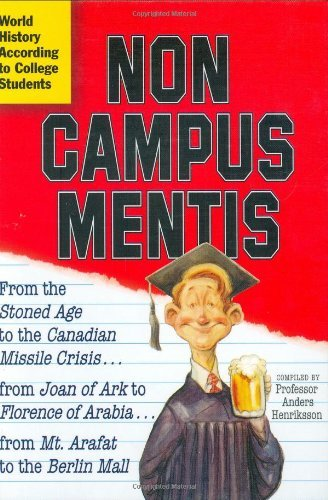
     Early in this century an enterprising professor mined the student papers and exam booklets for funny bits and found enough to publish this book:
Non Campus Mentis: World History According to College Students, by Anders Henriksson. This is the 2001 edition.


    A few years later he published another version and from these works some samples are provided:
Ignorance is Blitz: Mangled Moments of History From Actual College Students, by Anders Henriksson. This is the 2008 paperback edition.


“John F. Kennedy worked closely with the Russians to solve the Canadian Missile Crisis.”


“Stalin, Roosevelt, Churchill and Truman were known as “The Big Three.”


“Athena the Hun rampaged the Balkans as Far as France.”


"Prehistoricle people spent all day banging rocks together so they could find food. This was the Stoned Age."


"Civilization woozed out of the Nile about 300,000 years ago. The Nile was a river that had some water in it. Every year it would flood and irritate the land."


"Magellan circumcised the globe."


"John Calvin Klein translated the Bible into American so that the people of Geneva could read it."


"Cat berets were a favorite form of German entertainment at this time."


"History grundled onward. International relations moved to the broodle stage."


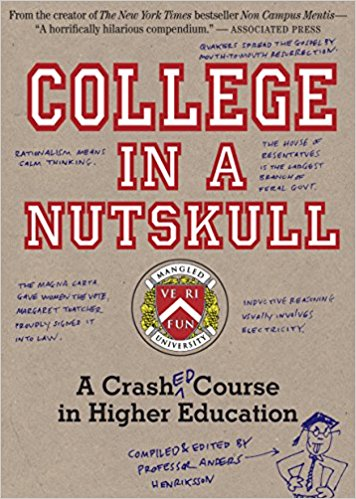
    Perhaps proving that the Whig interpretation of history is the correct one, evidence of continuing progress is found  in Professor Henriksson’s latest work:


This work “is a parody of a course-by-course study guide right down to its spiral notebook complete with doodles. Featuring bloopers, blunders, and desperate attempts to bluff the right answer, it is a hilarious report on the state of American higher education.”  Some of those bloopers:
"The Eight Amendment bans cool and unusual punishment."
"Most liberals are circular humanists."
"The propositional phrase is often an attempt to answer the questions 'where' and when'?"
    I assume that among my millions of followers many are Canadians and I would warn them that it would be wrong for them to assume that books such as these provide additional evidence that standards are a little lower in the establishments offering higher education south of our border. (As an aside, better evidence will be available tonight in the interviews that will be held after the “Final Four”). I offer this warning because some of the student ‘gems’ offered by Professor Henriksson were written by Canadian students!
    Professor Henriksson taught at both McMaster University and the University of Alberta (he has a Ph.D in history from the University of Toronto). Way back in the last century he produced an essay presenting such student wisdom and much of it was likely based on Canadian examples. The article was originally published in the Wilson Quarterly in the spring of 1983. Luckily for you, it was one of their most popular essays and it was re-published in their collection “Four Decades of Classic Essays” and you can read it here (WQ, Vol.38, No.1, Winter, 2014).
   In an interview he was asked:  "You're making these up, right? College students aren't this stupid”. His answer: “ I'm not making them up. I don't think you could. Anyone who's taught at any level, whether it's college or third grade, will have a whole raft of funny things like this that students write. ... I got into the habit of sitting with a legal pad next to the stack of essays I grade, and I write down the funny things I run across. And I've built a network of other like-minded souls across the English-speaking academic world who very kindly contribute to me their own harvest of glee.”

   With some glee I am able to report that Professor Henriksson is still teaching history at Shepherd University in Shepherdstown, West Virginia. Perhaps he will offer us more samples. (As another aside, I will note that they will have to be really good given the humorous examples of mangled prose and jumbled thoughts being offered daily by a competitor - the POTUS who is located just a few miles down the Potomac).

Sunday, 26 March 2017

The Trump Slump

Going to the U.S.?


    You may not have read the recent article found under the headline announcing that the Canadian Girl Guides were no longer traveling to the U.S. and you may not realize there are 70,000 of them along with about 20,000 guiders. There have been other recent articles about the cancellation of school trips which involve even larger numbers. Students from Toronto and Windsor will not be viewing cherry blossoms this year and the decline in visits to the United States is now being called the “Trump Slump” - an unintended, but predictable consequence of the various restrictions on travel imposed by the Trump administration.


   Many in Canada are probably not visiting because of the Canadian loonie not the American ones. School trips are being cancelled out of fear that an entire busload may be turned around because a few swarthy students are aboard. Others are opting out because of the stories of visitors now being more rigorously questioned and delayed or detained at airports.  Let’s face it: the border agent inhaling your exhaust at a bleak border crossing, seeing your sunny smile and hearing that you are going to golf on Hilton Head is hardly likely to be more welcoming these days.


  Perhaps you deprived yourself of time in the sun during March Break because you are a principled person who does not wish to support, in any way, the current regime. An article in the Toronto Star suggests that you should boycott, take a stance and not go. But, if you are still undecided about heading south you should read a recent article in Maclean’s which makes a good case that such boycotting doesn’t work.


Sources:


“Girl Guides of Canada Suspend Trips to U.S. Citing Border Concerns,” Hina Alam, Toronto Star,  March 13, 2017


“Time to Boycott Vacations to the U.S.” Mark Bulgutch, Toronto Star, Jan. 30,2017
“There’s no need to start a campaign. Just make a personal decision to avoid the United States whenever you can as long as the cruelty persists.”


“They’re Not Worth Doing, They’re Not Worth Opposing, and They Won’t Change Much,” Nick Taylor-Vaisey Maclean’s, March 10, 2017.


“Toronto Schools to Cease Field Trips to U.S.” Craig S. Smith, The New York Times, March 24, 2017.


‘Like 9/11 All Over Again’: Canadians Grow Fearful of Crossing the Border,” Catherine Porter, The New York Times, Feb. 13, 2017.


“The Trump Slump? Tourists say They're Scared to visit the United States, Barbara Demick, Los Angeles Times, Mar. 12, 2017,
“An economic consulting firm that has crunched the numbers from various airline and travel booking websites projects that the U.S. will lose 6.3 million visits by the end of next year, which translates into $10.8 billion in spending. What the firm, Tourism Economics of Wayne, Pa., is calling “Trump-induced losses” could affect an estimated 90,000 Americans whose jobs are directly or indirectly dependent on tourism.”
“It doesn’t take very much uncertainty or antipathy to influence decisions away from a given travel destination,” said Adam Sacks, the firm’s president. “Ultimately, destinations and companies are in the business of building a brand and a message that is welcoming .… All the ‘America first’ rhetoric in various policy areas like trade, diplomacy and immigration is conveying the exact opposite.’’

“Among the cities that stand to lose the most are New York, Miami, Los Angeles and San Francisco. New York expects to lose 300,000 foreign tourists this year, a big worry because it is foreigners who drop the big money, spending about four times as much as domestic tourists, according to officials.” [these quotations are all from the Demick article cited above].

Much Ado About NOTHING

Blank Books

   We have yet another occasion to think, “Why didn’t I think of that?” That is, we have been scooped, yet again, by someone who, yet again, has come up with the idea of publishing a book that consists of blank pages. Apparently books of this sort are both easier and cheaper to produce than the other kind.
    Those of you on the right side of the political spectrum will quickly understand why the book below is appealing, devoid of content and selling well these days.

    Apparently quick-witted, left-wing ‘writers’ have responded with such titles as Reasons To Vote For Republicans: A Captivating Interpretation and, the perhaps more complex, Reasons to Vote for Republicans: An Incomprehensible Guide. In an age of instant publishing such titles are likely to quickly multiply. Self publishers can also be creative and one has already contributed to the genre with Everything Obama Knows About the Economy.

    Evidence of such erudition is, of course, to be found also in England, where this “exhaustively researched” book was produced a few months ago. Not surprisingly, given the subject, it has no content.

   Remarks and reviews have been mostly favorable and here are a few samples:
“A well-researched, well-written and 100% accurate catalog of Mr. Trump's greatest strengths,” a customer named Michael Coles wrote. “People have read it, and let me tell you, they love it. It's the best book. It's going to be yuuuuuge. Bigly.”

“Very, very, yugely poor translation from original Russian,” Nancy Gormezano added. “And that's Putin it mildly. Maybe kindle version be better?”
    The Brits, once again, of course, have a long tradition of producing learned tomes of this sort. A few years ago an enterprising chap published What Every Man Thinks About Apart from Sex which obviously contained nothing. It holds the Guinness Book of Records record in the category for the published book with the most blank pages. He even sold the translation rights and then came up with the idea of producing a book with nothing but grey pages of various shades which bore the clever title Fifty Shades of Grey.  Although the title was slightly different, the publishers of Fifty Shades of Gray were not amused.

Searching For Nothing

    Now, in addition to wondering why you didn’t think of publishing books like these, rather than attempting to find the words to actually write one, you are probably wondering how I know all of this. How does one find books about nothing? That was my question when I ran across the new blank book since I distinctly remember one from the past. Unfortunately that was all I remembered, so I guess I should have said ‘vaguely remember’ rather than ‘distinctly’. What would one search for and how could even a good googler avoid long lists consisting of books such as Being and Nothingness, which contains nothing but really big words some of which are from a different language, or books by nihilists which are also often about nothing?

    Unfortunately for you, I am not going to reveal the complex search strategy that was used to find the book which you will certainly recognize, but which you would not have been able to find without my assistance. On the other hand, perhaps you would have simply remembered the title.

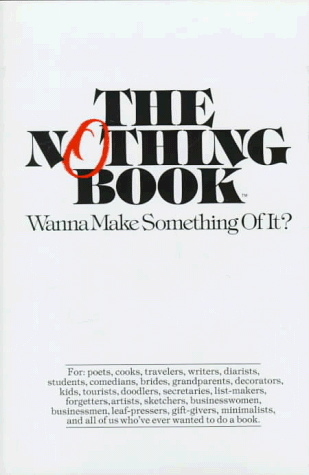
The Nothing Book


     There were also offspring: The Nothing Album; The Nothing Notebook; The Next to Nothing Book; The Nothing’s Happening Book, and supposedly a Son of Nothing was in the works. Thousands of copies of the book were sold and reviewers were happy because having to read nothing made their jobs easier. Here are some sample reviews:

“A Book You Can Put Down,” by Angela Taylor, New York Times, June 27, 1974.
The first sentence: “What can you say about a book that is virtually unreadable?”
It concludes: This reviewer can safely say that it is the lightest reading of this or any other summer.” It was published by Harmony Books, had 192 blank pages and cost $3.
“Nothing Ventured, Something Gained:The World of Writers,” Herb Kenny, Boston Globe, July 7, 1974. In this review some spinoff subjects are suggested:
The Compassion of Pawnbrokers
The Ethics of Slum Landlords
The Humility of Norman Mailer
The Shyness of Don RIckles
The Generosity of Banks

“And Nothing's Plenty for Me: The Nothing Book : Wanna Make Something of It?”, Richard Freedman, The Washington Post, Aug. 25, 1974.
The Nothing Book is a heartening response to the print explosion. It is a first-rate piece of minimal art, going far beyond the plays of Beckett, the sculptures of Giacometti or the music of John Cage. At a time of dismaying slovenliness of production by most publishers, it has not one typographical error.”

Plagiarism and Nothingness

    You are likely thinking that perhaps you might try a Canadian version of such a book and wonder if nothing can be plagiarized. The question “Can Nothing Be Plagiarized?” was asked back in 1974 by a Belgium publisher who had published a blank book a few years before -The Memoirs of an Amnesiac - and thought The Nothing Book was just a ripoff of their idea.

    Nothing appears to have come of the case so go ahead and type up a title.

Friday, 24 March 2017

Joy in Mudville

Golfing in London
    It was announced in the London Free Press today that the municipal golf courses will be opening on April 4. That is good news since the assumption is that spring is near, although most of us will likely watch more golf than play it until well after the magnolias have bloomed at the Masters. It is good news, as well, that the courses still exist since about a half-dozen years ago the city considered selling them. One of them, Thames Valley, is particularly pretty and as advertised, is actually in a valley along a river. Even the game of golf does not spoil a walk around it.


Thames Valley in the 1930s
    I mention all of this because I ran across an article from almost 80 years ago which indicates that the City Fathers (and they probably all were), were no wiser back then, although the need for cash for the city was probably greater given that this was the during the ‘Dirty Thirties’. Here is what a columnist had to say about the proposed sale:


Let’s hope that golfers in London, Ontario, will rally round to keep the civic fathers from doing any more than just considering the closing of that city’s famous municipal course at Thames Valley and selling the land. The 27 hole Thames layout is probably the finest municipal links in Canada, and no less an authority than Gene Sarazen a few years ago described it as one of the finest public courses in North America.
  Thames Valley’s case is the old story of a low-fee public club being the developing ground and feeder for private clubs. Business at Thames Valley has been slumping ever since the new Sunningdale course was opened, and, although the municipal course has never cost the ratepayers a cent in taxes, storm signals have been sent up by the Public Utilities Commission, which operates the links. Thousands of golfers throughout Ontario who have enjoyed the Thames test of golf, as well as its scenic beauty, will doubtless join the writer in hoping that this fine course can be saved.
(“Diggin' Divots At the 19th,” Roche, Bill. The Globe and Mail, Sept. 30, 1937, p.19.)


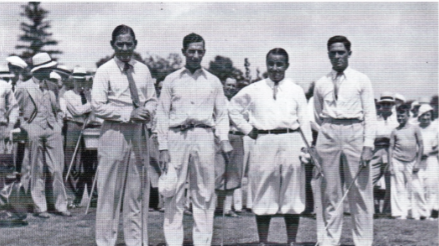
   I found the Sarazen description interesting and wondered why and when he might have visited Thames Valley. I learned that he was here in 1933 as the photograph below indicates and it was probably because he played in the Canadian Open that year, which was won by the Aussie in the photo - Joe Kirkwood. Apparently Sarazen won the match at Thames.
From left to right, Joe Kirkwood, Sandy Sommerville, Gene Sarazen and Jack Nash pose for a photo on the first tee Of Thames Valley prior to their opening day match. July 29, 1933.


    All of this information is provided by John Cowie and can be found in his book: From Rough to Fairway: The First 85 Years of the City of London Golf Courses. An excerpt of the book (along with the photo above) is found on this website: History of London and Area Golf Courses, with which Mr. Cowie is associated. [c 2024 - this link still works, but may be compromised. The information is still viewable, but use with caution since there appears to be an attempt to redirect to India.]


    Anyone interested in golf in this area should have a look at History of London and Area Golf Courses. [ see above.] It answered for me this question which I have often asked: “Wasn’t there a golf course on Gainsborough Road, on the north side before you get to Hyde Park?” The answer is “Yes”.


Additional sources:
    Information about the proposed sale of some or all of the courses back in 2011:
“City May Sell off One Golf Course ; London Assets: Revenues are Declining and a Report Says the Market is Overbuilt”, Patrick Maloney, The London Free Press, Sat. Jan. 15, 2011.Page: A3.
“Give Links Away, City Told ; Public Golf Courses: A Realtor Says Unloading Courses Would Be More Profitable For the City, But Others Say That’s Not the Answer to a Saturated Market,” Jennifer O’Brien, The London Free Press, Jan. 17, 2011, p.A1.
A response to the above: Letters to the Editor Column, The London Free Press
Sat Jan 22 2011 Page: E3. This good letter by Mr. Phil Gingrich offers strong reasons for keeping the municipal courses.


    The 1933 article by Mr. Roche was found in The Globe and Mail, as indicated. I am not sure what was written at that time in the London newspaper about the proposed sale since it is only available on microform.
    Mr. Roche, by the way, was born in Forest and worked for a time at the London Advertiser. He later joined the staff of The Globe and Mail and worked there until his retirement in 1958. He covered hockey as well as golf and wrote: The Hockey Book: The Great Hockey Stories of all Time, Told by the Men Who Knew the Game the Best. For an obituary see: “W.V. (Bill) Roche: Book Told Anecdotes About NHL Players, The Globe and Mail, June 26, 1962, p.30


    He is buried just up the river from Thames Valley in the Mt. Pleasant Cemetery.