Weatherwise
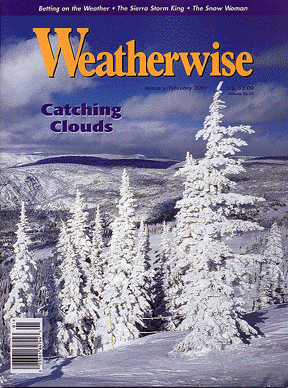
I discovered this interesting magazine in the old periodical room in Weldon Library at Western University and was reminded of it because of two recent articles issuing from that university. Weatherwise covers the climate, weather and meteorology from a variety of different perspectives and the two pieces from Western News indicate that some scholars at Western are now studying those subjects. They are likely to find the periodical useful as will the many others who are increasingly interested in the climate and the way it has changed.
Professor MacEachern of the History Department was somehow able to get Environment Canada to send him a considerable amount of data AND somehow able to convince the folks in the Archives and Research Collections Centre to house the material which consists of two parts:
“The first part comprises all existing meteorological observations generated at thousands of weather stations across Canada, from the predecessor agencies of Environment Canada, from 1840-1960….”The second part of the collection consists of 250 volumes of journals, observations, letter books, and correspondence related to Canadian meteorological and climatological history, and spanning the 1820s to the 1960s.”
Professor Melitta Adamson a “ Modern Languages and Literatures professor and food historian is among the first scholars in her field to document how climate change, with its critical impact on food production, shaped the Middle Ages (or Medieval Period) through famine, disease and war.”
Those interested in their work should see: 1) “Canada Researcher Unboxing Canada’s Climate History,” Adela Talbot, Western News, June 12, 2018 and 2) “Professor Tracks Medieval Winds of (Climate) Change, Aniruddho Chokroborty-Hoque, Western News, June 12, 2018.

The two covers above will indicate why, in the old days, Weatherwise was often seen on the re-shelving shelves and frequently used, even if only by the odd faculty member who had wandered in to avoid grading. Here is how the magazine describes itself:
“Weatherwise features fascinating articles and spectacular color photographs that showcase the power, beauty, and excitement of weather. Weatherwise articles present the latest discoveries and hottest issues in meteorology and climatology and focus on the relation of weather to technology, history, culture, art, and society. In each issue, our expert columnists answer reader questions about the weather; discuss current events and people in the news; review new weather-related books and videos; test reader forecast skills with analysis of weather maps; and summarize recent weather events in the United States and Canada.”
As they mention, Canadian weather information is often provided and here is a partial sample: “Hail and High Water,”, Malcolm Geast, Oct/.Nov.1996:
“One of the worst flooding disasters in Canadian history devastated parts of Quebec in July, as eight inches of rain in less than 48 hours triggered flash flooding in the Seguenay (sic) River valley, killing ten people. The flood, coupled with several ferocious hailstorms in Winnipeg and Calgary, resulted in over half a billion dollars in damages and made for a memorable summer north of the border.”
And, way back in 1956 you will find “A Short History of the Meteorological Service of Canada,” Vol.9, 1956, No.2
Historians interested in the weather only as it affected an historical event will find examples such as these:
On the Halifax explosion -” Retrospect: December 6, 1907: Halifax Explosion,” Sean Potter, Vol. 70, 2017, No.6
“U.S. Weather Synoptic Weather Map for 1300 GMT (9:00 a.m. AST) December 6, 1917. An area of high pressure helped create cool, clear conditions for Halifax, Nova Scotia, on the morning of an explosion that would prove to be the deadliest disaster in Canadian history. Meanwhile, a developing coastal low to the southwest would move up the Atlantic coast over the following 24 hours, bringing heavy snow and blizzard conditions to the area, hampering relief efforts.”
The military historians will enjoy: “The Weather of Independence: Burgoyne's Northern Campaign”, David M. Ludlum, Vol. 29, , 1976 No.5, and “Friend and Foe: Weather and the War of 1812,” Stephen Vermette, Vol. 65, 2012, No.1
I know you are interested in the weather and are now curious about this serial, but before you run up to the lovely campus you should know that the print Weatherwise was cancelled and most of the volumes are in storage. Over the years, hundreds of periodical subscriptions had to be cancelled at Western and that is the case at other universities as well.
That bad news has to be followed quickly with the good news that the Western Libraries has been able to continue subscribing to the electronic version. It is available via three different vendors so, if you are associated with Western, you can read the periodical from afar and not have to visit the old periodical room.
But, I need to quickly also add that you will not be able to access all the issues of Weatherwise electronically, including most of the articles mentioned above. The magazine began in 1948 and the Western Libraries have a healthy print run going back to 1950. But the oldest issues one can access electronically via the Western Libraries catalogue are from 1990.
One can search the archives of Weatherwise from their site and get articles from before the 1990s either by subscribing to the publication or paying per article. One can also search the back issues from one of the vendors provided by Western (Taylor & Francis), but they also ask you to pay per article for the older ones. It is highly likely that the library could not afford to buy access to the complete electronic file - and keep in mind that the journal had already been purchased once.
(Tip: Search Weatherwise from their site or via Taylor & Francis in the Western Library catalogue and then ask for the journal to be retrieved from storage. Another tip is to ask a bona fide librarian.)
Sources:
The series "Periodical Ramblings" so far has considered: The Sewanee Review, Fortune, The Village Voice, Flair and the Wilson Quarterly. For its rationale see: Periodical Ramblings (The Series)
Professor Adamson, mentioned above is also the author of Food in the Middle Ages : A Book of Essays. If you are interested in the history of food, see my recent post about sources for that subject: Food History. If you are really, really interested in that subject see my brief essay on "Clean Eating" (which, you should be warned, has a section on "placenta eating"). If you are more of a locavore see Local Food.
Finding books about the history of weather and its cultural impact can be tricky. Here are two that will illustrate how scholars are now looking at things with weather in mind.
For a look at the weather as experienced by Lewis and Clark see: Lewis & Clark: Weather and Climate Data
from the Expedition Journals, edited by Vernon Preston. It is available as an ebook from the Western Libraries:
"The Lewis and Clark Expedition of 1803-1806 systematically recorded weather and climate data during their 4,162-mile journey across largely uncharted territory. This data, organized by date and complemented by route descriptions and 50 color photos and historical maps, creates a fascinating look at the weather-related challenges that, at times, nearly derailed the Corps of Discovery from completing its mission and returning safely. Lewis and Clark is both a compelling read for weather and history buffs and a key resource for scientists researching climate history."
For a literary example see: Weatherland: Writers and Artists under English Skies by Alexandra Harris.
"Writers and artists across the centuries, looking up at the same skies and walking in the same brisk air, have felt very different things and woven them into their novels, poems and paintings... 'Weatherland' is both a sweeping panorama of cultural climates on the move and a richly illustrated, intimate account - for although weather, like culture, is vast, it is experienced physically, emotionally and spiritually; as Harris cleverly reveals, it is at the very core of what it means to be English."
(also available at Western)