Showing posts with label Lynching. Show all posts

Sunday, 10 October 2021

A Black Sculpture


   The Black sculpture pictured above was created by the Black sculptor, Hank Willis Thomas. It has travelled across the continent and been displayed in various museums and galleries. Here is another image from a different exhibition from a different perspective. 


The sculpture was purchased recently and now rests privately in the back garden of a home in Vancouver, British Columbia.

   Mr. Thomas is a very interesting multimedia artist who often deals with Black conceptual subjects. That makes sense since he spent a fair amount of time in the Schomburg Center for Research in Black Culture, where his mother, Deborah Willis,  was employed as an art and photo historian. She is also interesting and a winner of a MacArthur Grant. She has her own Wikipedia entry, as does Mr. Thomas. They are both so interesting, I will leave for you at the bottom, some resources where their talents and interests are better described by others. 

   What I find interesting is the fact the source for the inspiration for the sculpture, now on the West Coast, is found on the East Coast. In fact, in a town very near the one in which I was raised on the Eastern Shore of Maryland. 

   That town is Cambridge and the events that are now memorialized in that Black sculpture occurred in May of 1964. At that time, the Eastern Shore was still a segregated region and race relations were strained.  Alabama Gov. George Wallace was a presidential candidate and when he attempted to address a whites-only audience, things did not go well, as this headline indicates: "Racial Hotbed: Cambridge, MD: Wallace Visit Unleashes Race Riots in Cambridge:" Here is a partial account of what transpired. "Eleven integrationists were under arrest and two others hospitalized in the aftermath of a wild brick-throwing Negro street demonstration quelled by National Guard tear gas..." Guardsmen under the command of Col. Maurice Tawes, a distant cousin of Maryland Gov. J. Millard Tawes, at first tried to break up the demonstration by pulling some of the leaders from the group. But, that started a free-for-all among the Negroes and the soldiers. As a last measure, Tawes ordered tear gas bombs fired." 

   That report is from the Chicago Daily Defender, May 13, 1964. There had been other protests and riots and 'militia law' (a form of limited martial law) had been in place since the summer before. Two weeks later, this article appeared in the New York Times:"New Riot Erupts in Cambridge, MD: Four Guardsmen Hurt, One by Gunfire, as Negroes Are Dispensed With Gas," (May 26, 1964.)

   Above, I highlighted "pulled some leaders from the group." One of them was Clifford Vaughs, a black activist. 


Sources:
   
There are many, starting with the Wikipedia entries for Mr. Thomas and Ms. Willis. His own website, has photos, illustrations and a lengthy CV and bibliography. His mother's is found here: Deb Willis. 
   Many articles about his exhibitions are easily found. See, for example, the one at Art Basel in Miami, and at the Crystal Bridges Museum of American Art.  He was even exhibited at the AGO -"Art in the Spotlight: Hank Willis Thomas," and the Globe and Mail published an article about him when he won the $50,000 Aimia/AGO Photography Prize for 2017. (by Brad Wheeler, Dec. 4, 2017.)
   For his early career see: "Artist Hank Willis Thomas and Gallerist Jack Shainman Share Their Story: The two friends look back on 15 years of collaborating," Hilarie M. Sheets, Galerie, April 6, 2020. 

   For another post about race and the Eastern Shore, see my account of the Last Lynching in Maryland. 

The Bonus: 
   A few years ago, we visited Crystal Bridges, deep in the Arkansas woods and you should go if you get a chance. I discussed the visit in Amazing Accomplishments and I also wrote about the fine library at Crystal Bridges in this post about Unexpected Libraries


Sunday, 19 April 2020

The Gibbet

   A while back I wrote about a lynching. It was the last lynching that occurred in the state of Maryland and it happened in 1933. It is an example of what is now described as a "racial terror lynching" and I will say no more about it. All the information you need for this subject is found at The National Memorial for Peace and Justice. 

   Around the time I wrote about "The Last Lynching", I happened to run across a description of one in a book I was reading. It was written by a white man, but he was a Welshman not a white southerner. His reaction to what he saw is curious, to say the least. The event happened around 1900 in Tennessee. Here it is:


Some days after leaving Memphis, I arrived at a small town, where I was surprised to see an unusual amount of bustle, the surrounding country for miles having sent in all its able bodied men. Every man was armed with a gun, and they stood in small groups talking outside the various stores. It seemed as though there had been rumours of an invasion, and that these men were organising to defend their homes and country, but I had not the least idea of what had really happened. The small groups now began to join together into larger ones, and the larger groups joined until they became one large body of men. This one body then shouldered guns and moved quickly along the main street, the men's faces being drawn and pale. I followed on, perhaps the one unarmed man among them, curious to know the meaning of it all. They came at last to a halt, and, to see the reason for this, I stepped across the way, and saw that they had halted before a large building, which, by its barred windows, I had no difficulty in recognising as the jail. One man had curled around his shoulders a long rope, and this man with two others knocked loudly with the butt ends of their guns on the prison door. Almost in an instant the door was flung wide open, and the sheriff stood in the open way to know their wants. The men must have demanded the prison keys, for I saw the sheriff at once produce them, which he handed to these men without the least show of resistance. This man with the rope and several others then entered the jail, and the silent crowd without cast their eyes in that direction. Up to the present time I had not heard a distinct voice, nothing but the buzz of low whispering. But suddenly from the jail's interior there came a loud shriek and a voice crying for mercy. Men now appeared in the open doorway, dragging after them a negro at the end of a rope. This unfortunate wretch was possessed of a terror that is seldom seen in a human being. He fell on his knees to pray, but was jerked to his feet ere he could murmur the first words, O Lord. He staggered to and fro and sideways, at the same time howling and jabbering, foaming at the mouth, and showing the horrible white of his eyes. I can well understand a man screaming, trembling and crying for mercy, when actually enduring bodily pain, but that one should show such a terror at the thought of it, filled me more with disgust than pity. That this prisoner should have been so brutal and unfeeling in inflicting pain on another, and should now show so much cowardice in anticipation of receiving punishment inadequate to his offence, dried in me the milk of human kindness, and banished my first thoughts, which had been to escape this horrible scene without witnessing its end. For it was now I remembered reading of this man's offence, and it was of the most brutal kind, being much like the work of a wild beast. They now marched him from the jail, their strong arms supporting his terror stricken limbs, but no man reviled him with his tongue, and I saw no cowardly hand strike him. Soon they came to a group of trees on the outskirts of the town, and, choosing the largest of these, they threw the rope's end over its strongest branch, the prisoner at the same time crying for mercy, and trying to throw his body full on the ground. When this was done a dozen hands caught the rope's end, made one quick jerk, and the prisoner's body was struggling in the air. Then all these men shouldered their guns, fired one volley, and in a second the body was hanging lifeless with a hundred shots. In five minutes after this, nothing but the corpse remained to tell of what had occurred, the men having quietly scattered towards their homes.

I will also say nothing more about this episode.

   I gather that Steven Pinker argues in The Better Angels of Our Nature, that the world is gradually becoming a better place and we are growing less violent. Maybe so. I ran across another execution in Maryland, but this one was earlier and happened in 1781.  The sentence of the men found guilty:
That they be carried to the Jail, of Frederick County, that they be drawn from thence, to the Gallows of Frederick Town, and be hanged thereon, that they be cut down on the Earth alive, that their Entrails be taken out, and burnt, while they are yet alive, that their heads be cut off, that their bodies be divided into four Parts, and that their Quarters be placed where his Excellency the Governor shall direct and appoint.

Sources:
    The lynching account is from: The Autobiography of a Super-Tramp, by W.H. Davies. I also wrote about the book in my post about "Jails as Hostels."
    The image chosen for this post is a fairly benign one, I think you will agree. If you would like something more graphic you can find lots of photos of black men hanging above a crowd of people, containing some children and many who are smiling see: Without Sanctuary: Lynching Photography in America, by James Allen.
    My abruptness above is in reaction to the current issue of 'cultural appropriation'. Apparently it is easy to be seen as insensitive if one writes about such things and is white. 
    See for example:
"Emmett Till’s Coffin, a Hangman’s Scaffold and a Debate Over Cultural Appropriation,” Hillary M. Sheets, NYT May 31, 2017
"Protests over Sam Durant’s sculpture “Scaffold,” installed in the Minneapolis Sculpture Garden of the Walker Art Center, have drawn immediate parallels to the controversy this year over Dana Schutz’s painting “Open Casket” in the Whitney Biennial.
Both works, made by artists who are white, recall historical acts of racial violence and have been viewed by many as painful and insensitive to communities that have suffered directly from those injustices.
Central to both cases are issues of cultural appropriation and artistic freedom. Should white artists, no matter how well intentioned, represent harrowing stories that are not their own to tell? Conversely, should any subject matter be off-limits to artists because of their race, ethnicity, gender, sexual orientation or other life experiences?"
  And:
"Thank God for Cultural Appropriation," Richard Cohen, Washington Post, June 5, 2017.
"The great jazz singer Billie Holiday recorded “Strange Fruit” on April 20, 1939. It is a song about lynchings, inspired by the 1930 murder of Thomas Shipp and Abram Smith, who were photographed, like in the words of the song, “hanging from the poplar trees.” Holiday sang the song so often and it meant so much to her that she apparently came to believe she co-wrote it. She didn’t. Abel Meeropol wrote it. He was a Bronx high school teacher — white, Jewish and, not uncommon at the time, a communist. Now, maybe, he would be called a “cultural appropriator.”

Bonus Material
   There is a huge and hugely interesting book by John Sutherland which contains short essays on 287 novelists. 287 of them! If you are interested in the subject of  hangings in literature, Sutherland is your man. For example, he discusses Thackeray's On Going to See a Man Hanged, and the many hangings that are found in the works of Dickens and Hardy. The book is: Lives of the Novelists: A History of Fiction in 287 Lives. 
   For hanging histories in our very own London see: "Hanging Days" by the late Christopher Doty. 


Friday, 21 February 2020

The Last Lynching


   I grew up on the Eastern Shore of the state of Maryland, on a peninsula that is separated from the mainland by the Chesapeake Bay. The distance to the more civilized counties, and the cities of Baltimore and Washington, is farther than it looks and the attitudes held by those who lived on the Shore were typically more ‘southern’ than the latitude suggests.

   Apart from reminiscing about a fine and warm mid-Atlantic childhood spent along the rivers and between the Chesapeake and the Atlantic, I have often told stories about the society on the Shore which was a segregated one. I went to an all-white school and our parents had a restaurant that did not serve blacks.  Even though my small town had a small all-black college and a sizeable black population, they existed in a situation that was separate and definitely not equal. We generally co-existed peacefully, but a black person had been lynched not long before I was born and it was an event not discussed. I remembered that a good friend and classmate wanted to write an essay about the subject, but was told not to do so. I didn’t think he did.

   My memory was incorrect. Although I am sure many people tried to discourage him, he did in fact choose the lynching as a topic for the“Old Home Essay”, which those of us in our senior year were expected to write in 1961. The title of his essay is: “Princess Anne Ties A Noose.” Given my faulty memory, I will tell the rest of the story using the facts I have found and choose to use. Keep in mind that the ‘facts’ surrounding such an event are many and some are likely to be fictitious.

The Crime

It is a fact that George Armwood was lynched in Princess Anne, Maryland on October 18,1933. One is less certain about the crime he allegedly committed. A local newspaper close by described it this way:

The attack which was a very brutal one, occurred early Monday morning as Mrs. Mary Denston was walking back to her home near Manokin after a visit at the home of her daughter, Mrs. Albert Wagner. As she passed a wooded spot the Negro seized her, dragged her into the woods, stripped her clothing from her body and brutally attacked her. In her desperate struggles against him, Mrs. Denston was badly bruised and lacerated and her condition is regarded as serious.

There seems to be little doubt that Armwood attacked the woman, but the nature of the attack and the reasons for it remain unclear. It has been suggested that his white employer was somehow involved, but most accounts report (as most such accounts do) that he raped her.

The Lynching

   While one does not know what George Armwood did, it is known what was done to him. Three reports follow and the first one was authored by an employee of the Associated Press.

“Boy Slashes Negro’s Ear” New York Times, Oct. 19, 1933.
   “The march to the scene of the lynching of Armwood was wild in the extreme. The mob members seemed crazed, continually leaping on the Negro, even after he fell to the ground and was unable to rise. One boy, apparently about 18 years old, slashed the Negro’s ear almost off with a knife. Under the oak tree, despite the presence of women and children, all the victim’s clothes were torn from his body and he hung there for some minutes nude.”

   
A more detailed account appeared in the newspaper published in the small town of Crisfield just south of Princess Anne. 

“Mob Storms County Jail Wednesday Night: Lynches Negro Accused of Attacking White Woman Monday: Crowd of Several Thousand People Drag Body of George Armwood Through the Streets After Battling With Guards: Captain of State Police and Eight Other Officers Were Injured in the Attack," Crisfield Times, Friday Oct. 20, 1933.
Judge Robert F. Duer drove to the scene and in a speech to the crowd entreated them to go to their homes and let the law take its course. The Judge stood on the running board of his car and urged the people to allow the Negro to remain in the jail. He promised that the grand jury would meet Monday and that Armwood would have a speedy trial. He was met with derisive shouts.
   Following Judge Duer's speech the mob again attempted to storm the jail, but were met by a hail of tear gas bombs which momentarily checked them. Bricks, stones, and other missiles were hurled at the officers and many of them were injured. Several poles were secured by the attackers
which were used as battering rams with which to beat in the door of the prison.
   After securing entrance they dragged the Negro forth with a noose around his neck. He was dragged for a considerable distance through the streets of the town while the ring leaders debated the question on where to hang him. It is doubtful if the Negro was still alive when the question was finally settled.
   Several members of the mob wished to hang the man from a tree on Judge Duer's lawn, but they were outvoted. A tree was finally decided on in the lawn of Mrs. Thomas H. Bock on the Main Street. A rope was thrown Over a limb and the Negro hoisted several times and allowed to fall.
Tiring of its sport after a time, the mob then dragged the body to a spot near the Court House where a quantity of gasoline was poured over it and set afire. It was reported that the local undertakers refused to remove the body, but after several hours a truck arrived and the body carted away by State officers.”

   The lynching of Armwood was not reported at the time in the Princess Anne newspaper, The Marylander and Herald. To my surprise the lynching is vividly described in that paper by my friend and classmate in his "Old Home Essay" in 1961. 

 He [Armwood] was dragged from his cell, down the stairs of the jail, and thrown to the mob outside.  During all this, Armwood made no statement and offered little resistance. He was severely beaten while still in the jail, and one ear was razored off. When he was thrown to the crowd, he was beaten and kicked and stabbed several times around the head and shoulders. Then a rope about thirty feet long was brought up, and a noose tied around his neck. Then, with as many hands as could find a spot on the rope, he was dragged to death up Broad Street. Dead by the time his body reached Main Street, he was dragged about a half mile up Main to the home of Judge Duer, where he was hung from a tree on the lawn of Mrs. Thomas Bock, next to the judge’s lawn. By this time, the mob had grown to a size estimated at three thousand. Their frenzy had reached a zenith, and after hanging for a few moments, the body was cut down and dragged back up to the center of town past the crowds which lined the sidewalks. The corpse was reviled and cursed as it passed, and when the ringleaders reached the traffic light in the center of town, the body was strung up over the light cable, and a fire built beneath it. The body burned for a short time before the kerosene fire ate through the rope and the body fell into the flames. A plan to cut up the body and distribute it throughout the Negro section of town apparently in an effort to emulate the Williams mob in Salisbury, never developed. The body of the dead man lay in the street as the mob broke up as quickly as it had formed. There it lay until midnight when the town garbage truck came and hauled it to a nearby lot. Attempts to receive the help of a Negro undertaker in order to bury the body proved fruitless. M&H, June 9, 1961, p.3.

More reports can be found and sometimes details differ, but there is no doubt or disagreement about the fact that George Armwood was lynched.


The Prize Essay - "Princess Anne Ties the Noose"

   I misremembered the fact that my friend had actually written about the lynching in 1961. A further indictment of my memory can be levelled since I also did not remember that the essay was deemed the “Prize Essay” and was published in The Marylander and Herald and contained an actual lurid account of the event. Although it was written twenty-eight years after the lynching, many of those involved were still around, the society was still segregated and racial problems were simmering.  If there was much of a reaction, I don’t remember. But, I can tell you about what he wrote.

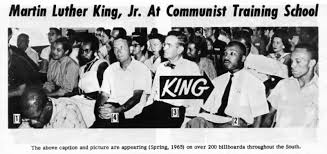
   It may seem odd to have begun this section with a picture of Martin Luther King; a picture which I do recall having been shown around town in the early 1960s. Perhaps it will seem even odder that “Princess Anne Ties The Noose” begins with this quotation from Karl Marx:

“Communism must be taken to, and if necessary, forced upon the world. Our plan is not one of negotiation, but action; not dependence on time but on violence and chaos.”

   It ends with the suggestion that the lynching “vividly demonstrates the means by which the Communist party achieve their avowed ends. Their constant goal is to tear down orderly government processes in any way possible. They also desire to stir up people, and cause them to commit acts of unlawfulness; racial hatreds are eagerly seized upon by the Communists as weaknesses of a nation and are exploited to their fullest."

    Lest you think my classmate held rather extreme views, I can offer in his defense the facts that it was believed both, at the time of the lynching and at the time of the writing of the essay, that communist influence was involved, and there is some truth behind the assertion. In a couple of other racially charged crimes on the Shore, the International Labor Defense League and Bernard Ades had worked hard to defend the Negros involved. The ‘communist front’ International Labor Defense League represented the Scottsboro boys and Ades was a white communist lawyer from Baltimore. A letter writer to The Marylander and Herald right after the event "Lays Blame For Lynching on Shoulders of Bernard Ades and The Communists” and there were many headlines suggesting socialist influence, such as this one from the Los Angeles Times: “Lynching Stirs Socialists’ Ire: Maryland Party Demands Ritchie’s [the Maryland Governor] Impeachment; Communists Asks Arrest of County Authorities, Governor Says Safekeeping of Negro Promised.”  It should also be noted that my classmate does not offer this reason as an excuse and says clearly that the lynching was abhorrent, a “display of human brutality and inhumanity.”

   An economic rationale for the lynching is also offered and the times were not good for most blacks or whites during those depression years. My friend notes that “this story evidences to the sociological fact that when economic conditions in an area are particularly bad, the incidence of crime, and especially crimes of mob violence goes up considerably." He also reports that “It was also the opinion of most Princess Anne citizens that the mob was led by outsiders from Virginia…”, but I am sure he doubted that was true.

   The real villains, it was contended, were other outsiders, those in the more civilized areas on the Mainland. In two episodes just prior to the Armwood lynching, the Negros involved had been taken, for safety reasons, to Baltimore where they were defended by the communists, and considerable money was wasted during hard times to prove the obvious. Armwood had also been taken to Baltimore, but was returned because of pressure from those on the Shore and because Judge Duer promised he would be safe. The Baltimore press was hostile and Mencken in particular berated the morons in “Trans-Choptankia” and ridiculed “Eastern Shore Kultur”.  An editorial in The Marylander and Herald asked the question: “Who Took Armwood to Baltimore?” “In the answer to that question, will be found in our minds, the cause of the lynching."

  The hostilities between the Shoremen and the Mainlanders were real and significant and the condescending attitudes toward the Shore morons led to attacks as this headline from The Marylander and Herald indicates: “Sunpapers [published in Baltimore] Are Unpopular Here: Incensed Citizens Confiscate and Burn Bundles as Rapidly as They Arrive.” Taunted, poor and angry, some Shoremen felt they could better take care of their own business and lynch more cheaply those who would be hanged by the State in any case. (One of the blacks who had been tried and re-tried on the Mainland was ultimately hanged.)The essay acknowledges the emotions which were at high tide on the Eastern Shore:

"And finally, this story makes it clear to us on the Eastern Shore that while heritage and self-reliance are valuable and to be cherished, we, or any group under like conditions of environment, must not let these admirable aspects of our lives degenerate  into a clannishness which disregards those laws made for the common good. An incident like that of the Princess Anne lynching must never again enter into the annals of Eastern Shore history."

The Aftermath:

   The Armwood lynching was the last in Maryland. There were some investigations, but those responsible were never held accountable:

“The grand jury issued its report to Judge Duer, and the Armwood lynching case was over. The Armwood lynching may be the only one in the history of the United States in which nearly a dozen lynchers were identified based on the sworn affidavits of police officers, and in which four lynchers were arrested by the National Guard, and yet still no indictments were issued. And so the nine men identified by state police officers as leaders of the lynch mob lived out their lives, several in Princess Anne, for years thereafter, suspected by blacks and whites of being the men who lynched George Armwood and known, more importantly, as a symbol of the legal system’s shameful alliance with white supremacy.”

   In the 1960s the arrival of integration led to violent racial encounters and race riots. In 1964, some students from that small black college attempted to eat in the local white restaurants and were refused service. Police using K-9 dogs and volunteer firemen using hoses clashed with the students. An editorial in the Saturday Evening Post had the title "Nazi Tactics in the 'Free State." An editorial in The Marylander and Herald responded to the comparison of the Maryland State Police to Nazis this way: 

"In an editorial entitled "Nazi Tactics In the 'Free State' the Post gives, as the gospel truth, its own interpretation of what happened in Princess Anne. If the Post had happened to be right its editorial conclusions would have been right. But it was dead wrong, just as dead as a number of persons would have been in Princess Anne if police dogs and fire hoses had not been used. The only alternative to that degree of force would have been guns in self defense. The State Police, with  their K-9 dogs, and the Princess Anne firemen, and their use of water by restraint, to quell but not maim by the use of their hoses, are to be commended and not condemned.”

   By then both the author and I had left the Eastern Shore. I do not know how the racial  relationships are now, or to what degree integration has been achieved.

Digging Up Dirt on the Eastern Shore


It is Black History Month, but I re-visited this event and those times because of the recent publicity generated by the efforts of the Equal Justice Initiative and the establishment in Montgomery, Alabama of what is informally known as "The National Lynching Memorial." One initiative is to collect soil from the places where lynches occurred, so as to increase awareness of what transpired.
The soil has been collected from such sites in Somerset County. In the adjacent county, where there was a lynching in Salisbury just before the one in Princess Anne, they have established "The Wicomico Truth and Reconciliation Initiative." For more details see:"Eastern Shore Lynching Victims Remembered in New Memorial," Jeremy Cox, Delmarva Today, April 30, 2018.
See also the Maryland Lynching Memorial Project. For more about the National Memorial for Peace and Justice which is also known as the National Lynching Memorial see: https://museumandmemorial.eji.org/.

Sources:
The local newspapers have been digitized and made available and the quotations from The Marylander and Herald  can be easily found. 
The "Old Home Prize Essay" by David Pusey is in the issue for Friday, June 9, 1961.
The account of the lynching from The Crisfield Times will be found on Oct. 20, 1933.
The quotation about the lack of consequences for the lynchers is found in: On The Courthouse Lawn: Confronting the Legacy of Lynching in the Twenty-first Century, Sherrilyn A. Ifill.
The Saturday Evening Post editorial about the incident in 1964, is in the issue of  March 28, 1964.
There is a Wikipedia entry for "The Lynching of George Armwood" and one for Bernard Ades.

There had been other lynchings in Princess Anne. Canadians would have read about this one:
                    "A Lynching in Maryland," The Globe and Mail, June 10, 1897.
"Princess Anne, Maryland, June 9.
Wm. Andrews, the young negro accused of felonous[sic] assault upon Mrs. Benjamin T. Kelly, was taken from the Sheriff here today and beaten into insensibility and then hanged to a tree by an infuriated mob immediately after having been arraigned in court and sentenced to death for his crime."

Post Script:
You may wonder why I don't just clarify all of this by asking my old friend David Pusey, the author of the essay. During the Viet Nam war, David served in the U.S. Navy where he was injured on a ship in the Pacific. He was in a coma for years and passed away a few years ago. He was a fine fellow.

The Bonus Material
Recently, John Stormer, the author of None Dare Call It Treason, also passed away. The following is from the obituary which appeared in the Washington Post on July 16, 2018:
"The collapse of the Soviet Union in 1991 did not blunt Mr. Stormer’s concern about spreading communism. He said front groups in America and elsewhere continued to promote a subversive, pro-communist agenda.
In an interview on America’s Survival TV in December 2014, he cited claims by police of communist-instigated protests in the wake of the police shooting in Ferguson, Mo., of Michael Brown on Aug. 9, 2014. “There were hundreds of people from all over the country put in hotels and organized those protests,” he said. They were, he added, “looking ultimately to bring about revolution.”