Friday, 30 October 2020

The Referendum

       
   Half of my readers have been complaining about the lack of content. The other two are disappointed in the content. To placate the former I will provide a quick post which consists largely of content provided by others, which should satisfy the latter since my thoughts and writing are kept to a minimum.

   If you are like most Canadians I know, you are consumed by the U.S. election which will take place next week. About it, I can think of nothing which has not been written. So, the focus here is on the 25th anniversary of a vote that took place in Quebec.

   It was a very important event and I was reminded of it by an email I received this morning from Maclean's. It is a very good magazine, by the way, and you should subscribe to it and pay more attention to Canadian affairs which, admittedly are not quite as, shall we say,  baroque as those south of our border. A portion of the email is appended:

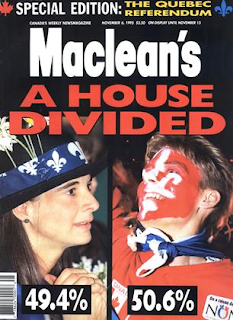
ANNIVERSARY OF THE DAY: Twenty-five years ago today, Quebecers nearly voted to leave Canada. A stunning 93 per cent of eligible voters cast a ballot for either "Oui" or "Non," and the nays won the day with a margin of a little over 1 per cent. "So near and so far for sovereigntists, and so uncertain and unsatisfying a result for both sides," wrote Anthony Wilson-Smith in Maclean's.

   The email included a link to the article in Maclean's written at the time: "A House Divided: After A Narrow NO Win, Federalists Fear That the Real War is Only Starting," Anthony-Wilson Smith, November 6, 1995. Snippets from the article are provided below. Let us hope that the headlines from the election next week are not similar to the one noted above and the results more satisfying and certain.

It took 128 years to make Canada into the country that it is today—and 10 hours of voting and a margin of only 53,498 votes to almost break with that past and reshape both the map and the country’s future. No, 50.6 per cent, total votes: 2,361,526. Yes, 49.4 per cent, 2,308,028 votes. In however much time remains to Canada as a united country, those figures are likely to stay burned on the consciousness of federalists and Quebec sovereigntists alike. By that narrowest of margins, the dream of preserving one existing nation almost died on Monday night, and the dream of building a newer, smaller one within Quebec was thwarted—for now. “The people have spoken, and it is time to accept that verdict,” said a clearly relieved Prime Minister Jean Chrétien early Tuesday morning, when it finally became clear that the No side had won. But, said Quebec Premier Jacques Parizeau, in a defiant speech that was in sharp contrast to Chrétien’s attempt to make peace, “the battle for a country is not over. And it will not be until we have one.”


So near and so far for sovereigntists, and so uncertain and unsatisfying a result for both sides. The vote result means that Canada survives—by the barest of margins, and, perhaps, for the briefest of periods in its present form. The final result, which took close to four hours to record, showed the two sides divided by fewer than 54,000 votes out of a total of 4,669,554 cast, and the province riven by cleavages along linguistic, ethnic and regional lines. Montreal, the metropolis and economic motor of the province, voted massively No: the rest of Quebec, with the exception of the Ottawa Valley region, went strongly to the Yes side. Montrealers and ethnic and anglophone voters joined together to defeat Yes voters who were overwhelmingly francophone native-born Quebecers from other regions.

The Bonus:

   Paul Wells writes often and very well for Maclean's and you can read his posts without a subscription, but I won't provide the link since you should subscribe. He went to Western and I will have to ask some of my old friends in the Political Science Department if they have any good stories about him.

   I kept my subscription to Maclean's even after the humour column by Scott Feschuk was dropped. Fortunately you can read some of Feschuk's posts here. For those of you who insist on following the antics of President Trump, read what Feschuk had to say in this post back in 2017: "Scott Feschuk Unpacks Donald Trump's Totally Awesome Just-Trust-Me Tax Plan."

   Feschuk also went to Western and you can read more about him in this article by Brent Holmes, "Faces of the Gazette: Scott Feschuk,". One of his books, by the way, looks like required reading: The Future and Why We Should Avoid It.

  I wrote earlier about another Maclean's columnist, Allan Fotheringham and you can read it here: The Death of Dr. Foth.

Tuesday, 20 October 2020

So Long Summer

    Now that the weather has turned I will move inside and try to do some blogging. I will start with something about summer which just disappeared. I am a fan of summer and hated to see it go. I dread the cold and dreary days to come. Most people around here do not agree with me and are eagerly awaiting the first snow. Perhaps I can use this post to attempt to understand why the winter lovers are now so happy and convince myself that summer is the bad season.

The Humidex

   I will not devote much time to this relatively new meteorological measure; I discussed it in my post about The Human Suffering Index. The haters of summer, it seems to me, tend to agree with the TV weather people when they say that we should stay inside because the temperature is 22, BUT it feels like 40. "It's not the heat, it's the humidity." I tend to prefer a high humidity to a high wind chill, but next summer I will wear sweatshirts and flannel Bermies in order to better empathize with those who are suffering through the summer season.

The Sun

   I am old so I tend to look forward to sunny skies, but I understand that now the sun is a bad thing. I am not sure about the status of Vitamin D.  I was misled in my youth by ads such as these, but being old I will not attempt to launch a class action law suit against the advertisers.

Next summer I will stay inside and stare at this cartoon so I am reminded of the dangers outdoors.


Mosquitos

I grew up along the mosquito-infested mid-Atlantic coast, where we boasted that they were as big as Piper Cubs. Having mosquito bites was like having sand in your shorts - small prices to pay for having cold beers on hot beaches. And we had fairly effective ways of dealing with the bugs and even had some fun doing so. On our bikes we would chase after the trucks spraying insecticides. When such solutions were delivered by aircraft in the Florida Keys, we could feel the spray when it landed on our heavily tanned skin. I will not launch a class action suit against the chemical companies because I am old enough to feel like I bear some responsibility for my actions. As well, it would set a precedent that my sons might follow and sue me for letting them cruise around shirtless in the Florida sunshine without life preservers. While there have been no melanomas as far as I know, they may at some point feel the pangs of PTSD because of the potential for melanomas and because of the swimming and boating experiences they endured - as well as the high Humidex.


Back then, only malaria was a concern and insecticides were not. Now we know that mosquitoes also are responsible for Zika, West Nile and Lyme Disease and that we probably should not have welcomed the showers of mosquito spray. I am still dreading the coming of winter, but I will spend part of it reading this new book by Canadian historian Timothy Winegard: The Mosquito: A Human History of Our Deadliest Predator. Apparently, "The general consensus of demographers is that about 108 billion human beings have ever lived, and that mosquito-borne diseases have killed close to half—52 billion people, the majority of them young children. While only 830,000 people were killed last year by mosquito bites, it is likely that they were bitten during the warm weather.

I will try to enjoy winter more, but will likely not enjoy summer less. There is just about as much of a likelihood of me avoiding the bright sunshine as there is of me achieving total sobriety.

Source:
 
For a review of the Winegard book and the figure of 830,000 see: "The Mosquito Has Killed Millions and Changed Our DNA," Brian Bethune, Maclean's July 10, 2019.

The Sunblock cartoon is by Christopher Weyant and it is found in The New Yorker on July 5, 2020. I have a subscription and hope he won't mind.

Monday, 19 October 2020

More Contrarian News for Old Codgers (OATS3)

 The News Continues to Be Bad

(The Death of Elaine)

   Loyal subscribers will know that OATS is an acronym for Old Age ThemeS and the themes are typically negative in tone. It is produced to offset the propaganda to which you are otherwise subjected. If, like most of my friends, you are determined to avoid decrepitude and are going to live healthily and happily until you die while exercising at the age of 110, give or take a few years, you should stop reading now.

MAID

   MAID is a Canadian acronym for Medical Assistance in Dying.  Those of us codgers who have a more realistic view of our future generally welcomed the news back in 2016 when it was decided that we had a constitutional right to determine when we might choose to leave. There were those, however, who disagreed and were determined to erect speed bumps so we could not exercise too quickly the right we were granted. The number of obstacles that were to be encountered if you were attempting to pull the plug, were so numerous that you were more likely to die of old age than you were from having a last shot of Single Malt and an injection from your doctor. Even as I type, Bill C-7 is being re-considered in an attempt to make dying easier. But not too easy. 

No Way To Go

   I am actually feeling well and had not been thinking about MAID until I remembered an article from a few months ago. It was about an 83 year old gentleman from Nova Scotia who was suffering from COPD and had had enough. He did all the hard work that is required to overcome the obstacles constructed by those who did not want him to have an easy passage. His MAID request was finally approved, however, and he was good to go. Although it is difficult for Canadians to choose to die, what made this story newsworthy was the fact that another hurdle was erected right before the finish line and placed there by his wife and her lawyers.

Husband Wins - He Dies

   The article from a few months ago which caught my attention was about the efforts of the wife of the gentlemen above, who initiated court proceedings to prevent his passing. About this, he was not happy and they stopped speaking after nearly 50 years of marriage. It was one of those 'He said', 'She said' situations. He said he was suffering and suffocating, she said he was anxious and mentally incapable of making such a decision. More important, one suspects, were her moral objections to MAID. He moved out. I wondered what happened.

  In this case, the husband did have the last word. After a few months of legal proceedings, the wife's request was denied. He pulled the plug. It is a sad story. The ones included in OATS usually are.

Sources:

  "Husband, 83, Dies With Medical Assistance After Wife's Court Bid To Stop Him Fails: Jack Sorenson of Bridgewater, N.S., Died on Saturday Following Legal Battle With Wife Over MAID," Taryn Grant, CBC News, Oct. 6, 2020.

  For Bill C-7 see this recent G&M editorial: "Reasonably Forseeable Litigation," Oct.16, 2020. 

   Given that the Bill attempts to make dying a little easier, there are many who are opposed. See, for example, this statement from the Canadian Conference of Catholic Bishops:
"Today, more than 50 religious leaders from across Canada released an open letter to all Canadians in opposition to Bill C-7 An Act to amend the Criminal Code (medical assistance in dying). This ecumenical and interfaith message is a response by religious leaders to the legislation introduced by the federal government on 5 October 2020 which seeks to expand the eligibility criteria for euthanasia and assisted suicide (euphemistically called “medical assistance in dying”) by removing the “reasonable foreseeability of natural death” criterion currently in the Criminal Code, and by loosening some of the existing “safeguards” allowing patients whose death is “reasonably foreseeable” to waive final consent to receiving euthanasia by making an advance directive."

   If you think MAID is a good idea, support for making the process easier is found here:
Dying With Dignity: It's Your Life. It's Your Choice. 

For the official government web site see MAID. 

For more postings in the OATS Series see here and here. 

The Bonus:
  Usually the OATS postings are accompanied by this image:

  The new one at the top is a painting by Homer Watson, The Death of Elaine. Now you know who the boulevard in Kitchener is named after. The image is from Homer Watson: Life & Work, by Brian Foss. Both the image and the biography are found on the website of the Art Canada Institute.

Tuesday, 6 October 2020

On Worms


  A few weeks ago an old friend on the West Coast sent me an email about worms. He is generally concerned with more exalted matters and is not, like your friends, one who routinely sends out YouTube links about very cute pets. Apparently he had remembered a long-ago lecture at what was then Waterloo Lutheran University. It was for a geography class and the subject was about what is now referred to as “Worm Grunting” (Wikipedia prefers “Worm Charming”. Such lectures are easier to recall (or attend) than those about Kant.

  He probably also recalls the Kant lectures, but knowing that I am better able to deal with more earthly subjects, he was kind enough to send it along with the suggestion that it might be a subject this blog can handle. I am not above accepting such challenges and will attempt to interest you in worms, which is far easier than attempting to learn about Kant.

   The first reason you should carry on is that you will enjoy the video, especially if you are interested in what the citizens of Sopchoppy, Florida do when they are out there in the Apalachicola National Forest. If you are academically inclined and need more convincing, I will just say that the video is provided and the process explained in this article in The Smithsonian Magazine: “How To Charm Worms Out of the Ground: The Art of Worm Grunting,” Colin Schultz, Smithsonianmag.com, Aug, 15, 21014 (additional sources and links are provided below.)

  The other two reasons are Canadian related and will help me keep up my CanCon quota. You will be astonished to know that currently dew worms or nightcrawlers are a significant cash crop and that recently Toronto was referred to as ‘the worm capital of the world.’ Ontario worms also have historical significance, in that they attracted American attention and were the subjects of a widely syndicated article. As far as I can tell, the worm incident of almost thirty years ago was one of only two occasions in the last one hundred years when Canada was the subject of a news story in the United States.

The Current Worm Situation

    Luckily for me, the worm industry in Ontario is the subject of a recent study which will provide you with all the data you need. The harvesting of worms is a significant agricultural endeavour worth around $230 million. Here are some of the major conclusions from the study done  by Mr. Joshua Steckley and more information about it is provided below:

Highlights
*The global supply of 700 million dew worms for bait comes from Southwestern Ontario.
*Low tillage hay fields and manure application ensure perpetually high dew worm populations.
*Dairy farmers rent their land to worm pickers for between $800 and $1200/acre.
*Some dairy farmers view worms as a cash crop and work them into their multiyear rotations.
 *Current worm pickers tend to be Southeast Asian immigrants, primarily Vietnamese.

The Historical Worm Wars

I vaguely recall stories about 'worm hunters' and flickering lights in fields along Highway 401. In 1993 there were accidents along that highway involving worm pickers and that was the Canadian subject that caught the attention of Americans. The syndicated story was widely circulated in both countries under headlines like these: "We've Got One Really Slimy Problem Here"; "Worms on the Highway"; "Worms On the Road: Recipe For Disaster" and "CANADIAN IMPORT OPENS A WHOLE CAN OF WORMS." The article is by Dave Barry, the Pulitzer Prize winning humorist and it is easily found back in July, 1993. A portion of it is provided here and it is funny, particularly the last paragraph where he makes fun of Canadians and Rush Limbaugh.

In May, the Canadian Press Service sent out a report that began: "GEORGETOWN, Ontario - More than 50 worm pickers beat each other with steel pipes and pieces of wood in a battle over territory." The story states that two rival worm-picking groups "arrived at the same spot at the same time" and started fighting over who would pick worms there. A number of people were hospitalized . . . and a van was set on fire.
You may have the same questions I did:
 
1. These people were fighting over WORMS?
 
2. Is there some kind of new drug going around Canada?

In an effort to answer these questions, I spoke with detective Sgt. Michael Kingston of the Halton Regional Police. He told me that worm-picking is a big deal in Ontario, which produces a long, fat style of worm that is prized by fisherpersons as well as the fish. "There's a huge market," Kingston said. "On a good evening, an industrious worker can make about $185 picking these worms." He said there's intense competition for prime picking locations such as golf courses, where the worms come to the surface at night to breed and and soak up dew. Kingston said the pickers, many of whom are Vietnamese immigrants, wear miners' hats with headlamps and drop the worms into cans strapped to their ankles. Doesn't that sound romantic, in a Wild West kind of way? I like to think that, at the end of the night, the pickers stride into the Worm Pickers Saloon, where they pay for whiskey by slapping nightcrawlers on the bar. But this is not what happens. What happens is that the pickers load vast quantities of worms into their vehicles and proceed to drive on Canadian highways. This has led to a scary new development: worm spills. I am not making this up. Here's a quotation from a May 25 story written by Timothy Appleby for the Toronto Globe and Mail: "TORONTO - A van carrying a group of worm pickers overturned west of Toronto yesterday morning, leaving eight people injured . . . The accident occurred a few hundred meters from where another van full of worm pickers crashed and rolled 10 days ago, sending 18 people to the hospital." The story quotes a constable as saying "I've never seen so many worms in my life." As any safety professional will tell you if he has been drinking, worms on the highway are a recipe for disaster. Suppose a tour bus is tooling along a Canadian highway at a speed of 130 hectares per centigram, the unsuspecting passengers chatting away happily in Canadian ("Eh?" "Eh?" "Eh?") when suddenly their laughter turns to screams as the bus encounters a worm slick and spins, out of control, off the road, and the passengers are hurled out of doors and windows, landing in the Canadian woods, injured and moaning, unable to protect themselves from wild mooses pooping on them or sadistic beavers repeatedly tail-slapping their faces. Your natural reaction, as a humanitarian, is: "So?" But perhaps you will not be so blase when I inform you that, according to a Canadian bait expert (I am still not making this up), most of the Canadian worm crop is shipped to the United States. Yes. This means you could find yourself in a car behind a truck containing 137.4 bazillion Canadian earthworms. And if, God forbid, something went wrong and the truck's cargo suddenly got dumped onto the road, you could find yourself plowing into a writhing slime-intensive worm mass nearly TWICE the size of Rush Limbaugh.

That should be enough about worms for now. Alert readers, however, are not wondering about worms, but rather about the other episode I alluded to - the one other Canadian incident that was reported south of the border. I can provide only anecdotal evidence for this, but I recall a remark made by a friend early in the 1970s. He was a professor, however, so his observation is credible. He said that during the entire year he spent on sabbatical in the United States, the only mention of Canada he could recall was in the story about Prime Minister Trudeau dating Barbra Streisand. After an exhaustive search I found no other mentions of Canada during the last hundred years. I was able to determine, however, that Trudeau did date Streisand, although the author of the source is now persona non grata: "Pierre Trudeau and His (Many) Women," Margaret Wente, The Globe and Mail, Oct. 28, 2009.

Finally - The Video: WORM GRUNTING


The Bonus:
   Since most of you will not go any further, I will provide the bonus here. The fellows in the forest reminded me of Elwood P. Suggins. Fans of Jonathan Winters will remember him.  Enjoy this video. 

Sources:

  Presented first is the source for the Steckley study and some articles about it. The older material follows:

"Cash Cropping Worms: How the Lumbricus Terrestris Bait Worm Market Operates In Ontario, Canada." Joshua Steckley, Geoderma, 2020;363: (The Global Journal of Soil Science).

Abstract:Anecic earthworms such as Lumbricus terrestris are ecosystem engineers whose impacts on soil fertility and remediation have been extensively researched. The majority of L. terrestris used for such research and practical remediation applications are procured through the largely unknown bait worm market that serves freshwater recreational fishermen across North America and Europe. Some earthworm researchers have questioned the use of these bait worms for research and soil inoculations because of their untraceable origins, unknown environmental exposures and growing conditions, as well as the sustainability of harvesting practices. However, there has been no recent study of this unique industry and how it hand-picks hundreds of millions of L. terrestris worms annually from a single region in southwestern Ontario. This paper provides a detailed description of how land and labour are currently organized to supply the world market for the valuable L. terrestris, commonly known as the “Canadian Nightcrawler” bait worm. Based on 59 semi-structured depth interviews, the findings show there are an estimated 500 to 700 million worms picked annually from farmer fields that stretch between Toronto and Windsor, Ontario. Dairy farms in particular have emerged as de facto L. terrestris production sites because of their perennial alfalfa crops, heavy manure application, and reduced tillage practices. This has made L. terrestris the most lucrative crop in the region with many farmers leasing land to worm-picking operations for over $1000 CND per year ($750 USD/ €685) — approximately four times the regional rental rates. Worm-pickers have historically been recent immigrants to Ontario with the majority of current pickers coming from Vietnam. Worm pickers make $20CND ($15 USD, €13.50) per thousand worms, and can pick over 20,000 worms per night in optimal field conditions (moisture, temperature, wind, moonlight). The piece-rate wages tend to reward speed and efficacy with some pickers capable of making over $600 in a single night. This peculiar arrangement between dairy farmers, soils, and worm pickers opens avenues for socio-economical, agronomical and ecological studies of commercial L. terrestris harvesting.

"Agriculture - Dairy Farms; Data on Dairy Farms Reported by Researchers at University of Toronto (Cash Cropping Worms: How the Lumbricus Terrestris Bait Worm Market Operates In Ontario, Canada)" Agriculture Week, April 9, 2020.

"Getting a Grip on the Wild World of Worm Picking: The Bait Worm Industry is Worth an Estimated $230 million, According to a Study From the University of Toronto,"
By: Maxine Betteridge-Moes ,Guelph Today, Aug. 24, 2020.

"Dekker Family Follows Environmental Farm Rules," The Wellington Advertiser, n.d.
An interesting article by the owner of "Country Bait". For example, you will find out that the industry has changed: When Dekker began worms were picked at golf courses; today he will not even accept worms from them. First, the chemicals used on the grass made those worms smaller, and many of them are now black. He said a desirable worm is one that is pale or translucent. Two or three black worms in a flat of 500 might be okay, but more than 30 and the entire flat could die.
_________________________

"Niagara Worm Wars Getting Rough," Tom Spears, Toronto Star, July 9, 1986.
Worm pickers who sneak on to farms without permission in the middle of the night are at the heart of the growing confrontation.
And farmers who were once content to call police to deal with trespassers are changing: One worm picker who came too close to a farmer's garage had a pair of shotgun blasts fired over his head in an impromptu arrest, and sources say one picker was "tied up and beaten severely."
The lucrative bait business has turned rough, and may get rougher.

"Second Spill Reveals Rough Trade Business in Worm Capital of the World Sparks Turf Wars," Timothy Appleby, The Globe and Mail, May 25, 1993.
A van carrying a group of Vietnamese worm pickers overturned west of Toronto yesterday morning, leaving eight people injured - one seriously - and six or seven unaccounted for after they fled.
By coincidence, the single-vehicle accident on Highway 401 near Milton occurred a few hundred metres from where another van full of Vietnamese worm pickers crashed and rolled 10 days ago, sending 18 people to hospital.
"They should be installing a worm-crossing zone or something," said Milton Ontario Provincial Police dispatcher Jane Fleet. "It's a bit of deja vu."

------
The Wikipedia entry is found under: "Worm Charming."
Toronto as "Worm Capital" is found in this article: "Worm Picking a Slippery Industry in Toronto," Dan Taekema, Toronto Star, Oct.26, 2015.

Apparently they used to have a "Worm Festival" in Shelburne, ON and they still have one in Sopchoppy. 
Wednesday, 30 September 2020

Rod Spittle

   Mackenzie Hughes is a Canadian golfer who, last week, finished in third place in a golf tournament in the Dominican Republic. Apart from getting a tan, he received $276,000. At the richer Travelers Championship, back at the end of June, he tied for third and won $436,000. On the first of March he finished second at the Honda Classic and the number on the check was $763,000. Playing golf as a professional was not always so financially rewarding.

  Rod Spittle was born in St. Catherines in 1955 and, like Hughes, headed south to Ohio to play golf and get a college education. He went to Ohio State, while Hughes attended Kent State. The economic prospects for professional golfers were not so bright back then and Spittle decided to go into the insurance business which was likely to be more lucrative and, some would say, more exciting.  In an interview back in 1977 he indicated he was spending time in the pro shop and supplementing his income by making wooden drivers like the one illustrated above (a link to the video is provided below.)

Apart from a fine collegiate career, Spittle won the Canadian Amateur Championship in 1977 and 1978. If you recognize him, however, it is likely because you have seen him on the Champions Tour, which is the professional tour for older players. It was only after a long career in insurance that he attempted to become a professional golfer. In 2010 he won the AT&T Championship in San Antonio and has made over $4 million. He retired from golf in 2018. Apparently he is a fine fellow and you can learn more about him below.

Television Archives

I stumbled upon Mr. Spittle when I discovered that some television news footage from a neighbouring state is now available over the Internet. Those who would rather watch events from the past than read about them, will be pleased to know that more archived video material is now being made available. In this case, the Buffalo Broadcasters Association is providing content as part of the New York Heritage Digital Collections.

The Channel F Sports Director interviewed Spittle back in 1977 when he was the Canadian Amateur Champion. You can see the entire interview by clicking on the link provided. There is a short opening glitch, but stick with it and listen to the southern-sounding Spittle talk about his career and the club he has made. It looks better than the one pictured above. (the video is only 2 minutes) WIVB-TV Featured Segment - Rod Spittle-1977.

The Bonus - Local News Coverage


   Those who would like to view local television news coverage will be pleased to know that the archives of the London TV Station CFPL are available at Archives Ontario. Footage is provided for the years from 1953 to 1968. Here is the link to the Ontario Archives. 
   I used the CFPL footage in a post I did about Western students winning a bed-pushing contest in the early 1960s -see, The Important Subject of Bed-Pushing.  Lately, however, I have had problems opening the videos. I hope you have better luck. A few of the CFPL broadcasts are available on YouTube. 

Sources:
   There is a Wikipedia entry for Rod Spittle and a profile on the PGA Tour Champions website. He is also in the Canadian and Ontario Halls of Fame. 
For a good profile see:
"Rod Spittle Returns to Hamilton For Historic Career Milestone," Brent Long, Golf Canada. 

My only other post about golf is about golfing in London in the 1930s - see Joy in Mudville. 

Monday, 28 September 2020

Fall Blues

    When I started the series of posts titled "Periodical Ramblings",  I noted that I shared a fondness for magazines with a sister who had tons of them piled around her house.  It has been pointed out to me that I also have several pounds of them as well, many of which I can access electronically. As fall approaches I have been throwing them out. Reluctantly. While doing so, I paused over the covers of the New Yorker. Here are two from almost a decade ago and they seem still to have some relevance. Unfortunately. 


The Bonus:

   Loyal readers will know that this often is where the good stuff is found. In this instance, it is not so much a clever remark or insightful insight, but an actual gift. The first reader to respond, and who has a pickup truck, can have a huge stack of Spy magazines. Here is the cover of one from 1993, which is also relevant since it will apply to a sizeable segment of the U.S. electorate in early Nov. 


Tuesday, 22 September 2020

Names on the Land


   There are more examples this week of linguistic puritans roaming the countryside looking for names to be erased and eliminated from the geographic vocabulary. I don't think they should be. Rather than treat established place names as bits of graffiti that should be painted over, perhaps they should be looked at as we do pictographs and petroglyphs and regarded as something from which we can learn.

 Let Them Be

   The current problem is named 'Squaw's Tit' which is pictured above and located near Canmore, Alberta. Even though the word 'squaw' is an indigenous one, it is now regarded as a racist term and when situated next to 'tit' it is doubly offensive because it is clearly misogynistic as well. It will surely be changed. The half as offensive 'Squaw Valley' in California is going soon and clearly we are more 'woke' than the Americans.  Shame on you if you ever skied there.

   I am not a racist or misogynist, but I am also not a toponymist so I am unlikely to be able to convince you that we should not so quickly erase what has been labelled over a long period of time and for many different reasons. Before you join the protests of the puritans, or sign the petition to have the name of your street changed, pause and read these two books.

   The first one is Names on the Land, by George R. Stewart, who also wrote, Names on the Globe and American Place-Names, as well as other books and novels. From him you will learn to appreciate names, no matter how crude or offensive. Consider this:

   The land has been named, and the names are rooted deep. Lake Mead may fill with silt, and Lake Michigan again spill south to the Gulf -- but the names may still remain. Let the conqueror come, or the revolution rage; many of our names have survived both already, and may again. Though the books should be burned and the people themselves be cut off, still from the names -- as from arrowheads and potsherds -- the patient scholar may piece together some record of what we were. 

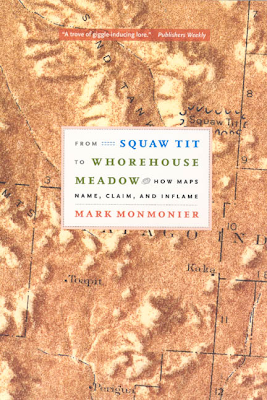
   The second book is, From Squaw Tit To Whorehouse Meadow: How Maps Name, Claim, and Inflame by Mark Monmonier. So far, this book has not been burned, nor has the author been forced to erase the title (he almost called it, Fighting Words). Although this book is about applied toponymy and is by an academic, it is written in prose the rest of us can understand.  Here is what the publisher's blurb indicates. The publisher is the University of Chicago Press:

“Brassiere Hills, Alaska. Mollys Nipple, Utah. Outhouse Draw, Nevada. In the early twentieth century, it was common for towns and geographical features to have salacious, bawdy, and even derogatory names. In the age before political correctness, mapmakers readily accepted any local preference for place names, prizing accurate representation over standards of decorum. Thus, summits such as Squaw Tit—which towered above valleys in Arizona, New Mexico, Nevada, and California—found their way into the cartographic annals. Later, when sanctions prohibited local use of racially, ethnically, and scatalogically offensive toponyms, town names like Jap Valley, California, were erased from the national and cultural map forever. 

From Squaw Tit to Whorehouse Meadow probes this little-known chapter in American cartographic history by considering the intersecting efforts to computerize mapmaking, standardize geographic names, and respond to public concern over ethnically offensive appellations. Interweaving cartographic history with tales of politics and power, celebrated geographer Mark Monmonier locates his story within the past and present struggles of mapmakers to create an orderly process for naming that avoids confusion, preserves history, and serves different political aims. Anchored by a diverse selection of naming controversies—in the United States, Canada, Cyprus, Israel, Palestine, and Antarctica; on the ocean floor and the surface of the moon; and in other parts of our solar system—From Squaw Tit to Whorehouse Meadow richly reveals the map’s role as a mediated portrait of the cultural landscape.”

  See especially Chapters 3, "Purging Pejoratives," and 4, "Body Parts and Risqué Toponyms." It is an enjoyable book.

Bonus Material: (from the book):
   Some officials chose the toponym "Naughty Girl Meadow", for an area in Oregon, but the locals protested and it was changed back to "Whorehouse Meadow", "officially recognizing the historical and cultural significance of the established local name for the area."
   Even original, indigenous names are not safe: "Another Indian name to bite the dust is Paska Township (in Ontario)—although paska means “shallow” in Cree, the province changed the name after a local Finnish family objected that a word with a similar sound means “shit” in Finnish."
   When the word "gay" began to mean something other than "happy", the locals in Gayside, Newfoundland decided they were more comfortable with Baytona. 

Post Script: 
    For now, Dildo is still in Newfoundland and Swastika is still here in Ontario. 

Sources:
   "Lawyers Hope to Erase Racist and Misogynistic Nickname of Mountain Landmark: Momentum is Building to Properly Name the Landmark, Which Can be Seen From Canmore, Colette Derworiz · The Canadian Press · Posted: Sep 06, 2020.
   For the Squaw Valley name change see this FAQ:
After extensive research into the etymology and history of the term “squaw,” both generally and specifically with respect to Squaw Valley, outreach to Native American groups, including the local Washoe Tribe, and outreach to the local and extended community, company leadership has decided it is time to drop the derogatory and offensive term “squaw” from the destination’s name.
Work to determine a new name will begin immediately and will culminate with an announcement of a new name in early 2021. Implementation of the name change will occur after the winter season concludes in 2021.

To learn more about Professor Monmonier, who is worth learning about see:
His website:
The official faculty link at Syracuse.
To order your copy of From Squaw Tit... and for more of his books, including, Bushmanders and Bullwinkles, see the University of Chicago Press website.