Friday, 3 January 2020


Mr. Richard Ivey


   Mr. Ivey was a well-known and respected philanthropist who passed away recently. The entire family was, and still is generous and Mrs. Beryl Ivey was also known for her charitable endeavours. The garden behind her in the picture below is near University College at Western University and is named after her as is the library at Brescia University.

   Mrs. Ivey passed away in 2007. At that time, the short notice below was published in a newsletter produced by the staff at the C.B. "Bud" Johnson Library in the Ivey Business School. It is no longer available, so I thought it should be provided here along with some other sources.


The Passing of Mrs. Beryl Ivey

A memorial service was held for Mrs. Ivey in London on January 11, 2008. While those of us who have been in London for a while certainly know about the Iveys, new students from elsewhere may not. If you would like to learn more about Mrs. Ivey, the Ivey family and their business and philanthropic activities we suggest you consult Frederick Armstrong’s ,The Iveys of London: An Entrepreneurial and Philanthropic Family.  As well, we present below for your convenience some of the related obituaries and tributes that appeared in the newspapers. Of course, both the Ivey and Western web sites contain additional information.

“Hers Was a Remarkable Life,” Ian Gillespie, London Free Press, Jan.12, 2007, p.A3.

“Beryl Ivey Remembered as 'a Great Canadian,”
Guelph Mercury, 27 December 2007.

Philanthropist Supported Arts, Health, Education; Praise Pours in for 'Foremost Benefactor' of Western University,” The Toronto Star, 26 December 2007.

“Benefactor Beryl Ivey Dead at 82”
The Globe and Mail, 26 December 2007

“London Free Press”
The Canadian Press, 22:09, 25 December 2007, 682 words, (English)
This obituary is authored by Patrick Maloney and Claire Neary

“Governor General announces 71 appointments to Order of Canada,"
The Canadian Press, 15:13, 29 June 2007, 346 words, (English)
Mrs Ivey is among them.

Sources:
   The obituary for Mrs. Ivey was published in The Bottom Feeder in January, 2008. I was responsible for it and for the information below. Any errors are mine alone.

   An obituary for Mr. Richard Ivey is found in The London Free Press, Dec. 31, 2019.
See also: "London Business Leader and Philanthropist Richard Ivey Dies at 94," Dan Brown, The London Free Press, Dec. 30, 2019. 
"Wonderful Human Being': Londoners React to Death of Philanthropist Richard Ivey at 94: 'He was a true gentleman, and you took him at his word. With him it was not even a handshake, it was his word. There was great trust in the man'", The London Free Press, Jan.2, 2020.

Post Script:
   Apart from supporting universities and hospitals, the Ivey family also funded environmental projects. The folks at Nature London provided this note in their recent newsletter. 

"Richard Ivey, Friend of Nature
 Richard Ivey passed away recently at the age of 94.  In London, southwestern Ontario, Canada and beyond, the Ivey family and Richard have been a great influence for the protection and enjoyment of nature and a healthy environment.  Richard encouraged wise policies and supported groups like Ontario Nature, Nature London and the Thames Talbot Land Trust as they struggled to protect nature in our region.  In doing so Richard left us natural assets and organizations of great lasting value."


Wednesday, 1 January 2020

Racing Across America


   On-Demand Films (in theatres)

   Before I get to the interesting part about racing across America (more specifically the portion occupied by the United States), here is a brief introductory aside which is also interesting.
   In the city of London we have a fair number of cinemas and a much larger number of screens, most of which are showing the same movie for kids. Right now we are fortunate that the few remaining ones are playing Cats or Frozen II.
   One theatre that is not like the others is The Hyland which is located about a block from our house. It shows foreign films (I guess most films in Canada are ‘foreign’) and even movies for adults (but, not Adult Movies, let me be clear). They on occasion also have films that  appeal to hardly anyone, but which have been requested by small audiences which, in the aggregate, become large ones.
    The concept is a new one and it needs a better descriptor then 'On-Demand'. It has been described as “like an ‘Airbnb for cinemas", but that doesn’t help much either.  'Event Cinema’ is another term that is sometimes used (I will provide sources below). Basically if you and your small group of philatelist buddies find a good documentary about stamp collectors you can request to have it shown. A  company (an Australian one) will take care of the rest; the theatre will host it and if enough people show an interest, all you have to do is buy some popcorn and enjoy the movie. Right now, for example, How To Bee (about a beekeeper) is being offered and you can request Scotch: A Golden Dream. You can also request the documentary, The Rise of Jordan Peterson, but I suggest you don’t since there are many who think his ideas should not be displayed  and there have been boycotts. I have seen two such films. One was Dawn Wall (about climbing) and the other was Four by 3000: A Journey Through the Toughest Bike Race in the World which is about racing across America on bikes.


Racing Across American On Bicycles

   The film Four by 3000 is what led to this post. It is a documentary about a relay team of four men who cycled non-stop from a pier in Oceanside, California to a dock in Annapolis, Maryland. They were participating in the Race Across America (RAAM) which has been held since 1982. There are solo participants as well as relay teams of 2, 4 or 8 people. Unlike the Tour de France, RAAM is a one stage race. That is, the button on a timer is pushed at the start on the shore of the Pacific and again only when one reaches the shore of the Chesapeake. Although cycling long uphill or flat stretches can be tedious for both the cyclist and the spectator, Four by 3000 is quite good. You can learn more about the film and see a trailer for it by consulting some of the sources provided. 
   How long does it take to cycle across the country? 
   The record times vary depending upon such things as the weather encountered and the route taken. A single man has completed the race in seven days and an eight man team did so in just over five. Here are some statistics:
Solo Man - 7:15: 56 - Average Speed 16.42 (mph) (26.43 km/h) for 3020 miles (4860.2 km/h)
Solo Woman 9:04: 02 - Average Speed 13.23 covering 2912 miles.
2-Person 6:10:08
4-Person 5:08:17
8-Person 5:03:43
RAAM begins again on June 16.

Racing Across America By Car


HOW QUICKLY CAN ONE DRIVE ACROSS THE COUNTRY? 
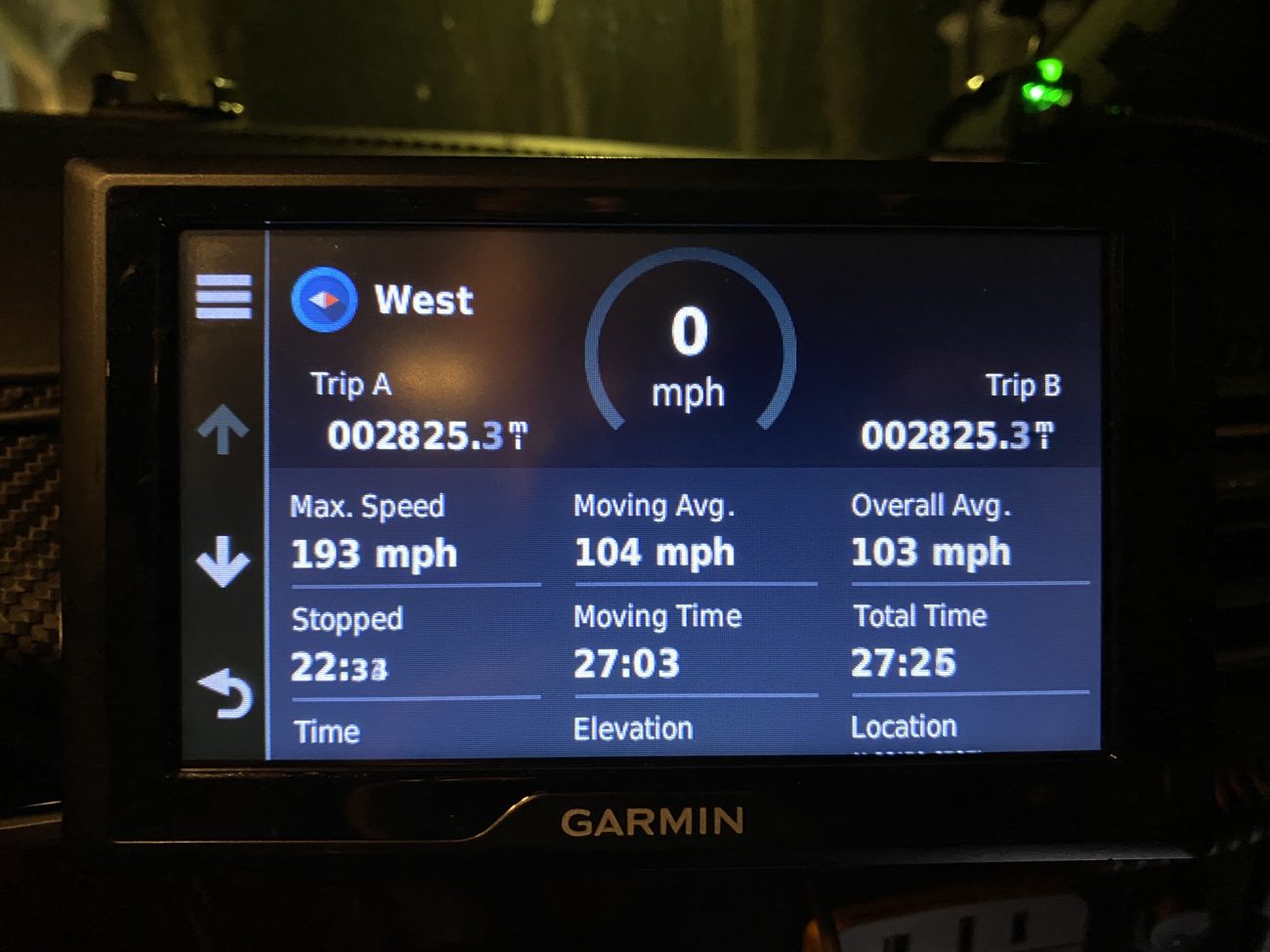
   The answer is provided above from the screen of the Garmin device which recorded the event. The car left a garage in Manhattan and arrived at a hotel in Redondo Beach 27 hours and 25 minutes later. 2825 miles were travelled (4546k) at an average speed of 103(mph) (165kph) and the top speed reached was 193mph or about 310 kph. During that time the car was stopped for only 22 minutes.

  Such an event was done illegally, of course, and clandestinely as it alway is. The car is typically modified to look like a very plain one. For this event:
"The car was further modified inside and out, including cutting out part of the back seat to make room for a cooler and supplies. An added fuel cell helped load the car with more than 60 total gallons of gasoline.
The team also deployed a laser defuser, which alerts the driver when police use laser guns to register speed. The device scrambles the laser for a couple seconds, which is long enough to slow down, Toman said. A brake light kill switch also helped the team avoid signalling police that they were braking.
Other devices included a radar detector, police scanner, CB radio, several GPS devices and an old-fashioned kitchen timer. That helped cut down on the math of time-zone changes, Toman noted. A hunting scope mounted on the roof helped detect roadside deer and parse heat signatures of police in speed traps.
Their secret weapon, though, were spotters along for the journey in other cars and in the back seat. Chadwick, a college student armed with gyro-stabilized binoculars, was tapped to look for police cars ahead or going the other way."

   I do not wish to be seen as promoting such an activity and now will simply direct you to sources where you can learn more. 

Sources:
  For On-Demand films see:
The Canadian website is here
For the Canadian introduction see: "Demand Film Launches in Canada," Jordan Pinto, Playback, Aug. 28, 2017.
“The company’s goal is to set up one-night cinema screenings for feature films (typically documentaries) on evenings when theatre attendance is low (usually Monday, Tuesday or Wednesday). Since it was founded four years ago, the company has expanded to the U.S, U.K., Ireland, Singapore and Germany and has now launched in all the provinces across Canada. 
Demand.Film’s model is designed to give filmmakers and producers a way of getting projects that appeal to niche audiences into cinemas. In order for a screening to take place, a person must first request a film (from Demand.Film’s catalogue of titles) to be screened in their own market. Once tickets go on sale, the number of tickets sold must reach a certain threshold for a screening to go ahead. In Canada, 50 tickets is the threshold in order to make a one-off screening profitable. If less than 50 tickets are sold for a particular theatre, the screening does not go ahead and ticket-buyers aren’t charged. If a screening is locked in, Demand.Film typically confirms four or five weeks in advance."
  For the Australian background: "Perth Cinema On-Demand Startup Demand.Film Thinks Global With Launch Into North America", Angele Castles, SmartCompany, June 19, 2017. The name of the company originally was Leap Frog Films and was changed to Demand.Films.
For information about Four by 3000 the kickstarter website where they sought funding. 

For the Race Across America see the Wikipedia entry and the RAAM website
There is even a tougher cycling race for those who compete alone and without support. See the Wikipedia entry for The Trans Am Bike Race  or the official website. 

For the illegal 'Cannonball' Event see these two recent articles and the very good and long account on Arne's Antics. With good photos. 
"These Guys Finished a Record Cannonball Run From New York to L.A. Averaging 103 MPH: Here's How," Alex Horton, Washington Post, Dec. 6, 2019.
"These Guys Just Drove an E63 AMG Across America in a Record 27 Hours and 25 Minutes: The Cannonball Record Has Been Broken Again," Benjamin Preston, Road & Track, Dec.3, 2019
"My Journey to the Fastest Drive in History,"by Arne's Antics, Dec. 3, 2019.

Tuesday, 31 December 2019

Caskets for Colleges


Image result for university of alabama casket   It is highly likely that your email today is full of requests for donations and some of them will be from your alma mater. I will offer here a suggestion for Western University. Although it is not my idea, or a new one, it does not appear that any Canadian colleges or universities have used it. It involves the selling of caskets to alumni. Western might be well-placed to enter this market since it was announced in the Western Alumni News that one of its graduates recently built a casket for King Richard III.

  The models above are from the University of Alabama, but Collegiate Memorials - The Memorial Licensing Company - builds them for institutions that range from the Air Force Academy to West Virginia University. Given the talents of Western's casket building alumnus, Western could follow the lead of Notre Dame which partners with Trappist Caskets to construct well-branded ones that sell for over $3000 (US).

Urns for Universities


    Image result for memorial urns universities  Image result for memorial urns universities
   For those concerned about the environment, urns are an option. For examples in Solid Cherry, Walnut Inlaid Mahogany or Rose Marble, visit Collegiate Memorials. Really loyal graduates often choose to go out wearing collegiate gear and clutching the college mascot.

Sources:
The website for Collegiate Memorials where shoppers can find more options.
Those of you who graduated from Notre Dame should go directly to Trappist Caskets.
For information about the talented Western casket maker see:"Alumnus Builds Casket for Richard III".

Monday, 30 December 2019

Lunch With Churchill


Image result for irving berlin   Image result for isaiah berlin
     In 1944 either Irving Berlin or Isaiah Berlin had lunch with Winston Churchill. Apparently there was some confusion and Sir Winston assumed that the Berlin he was dining with was the other Berlin. An amusing anecdote about the incident has been circulating for years and you may be aware of it. You may not know, however, that another version surfaced in a letter to The New York Times a few days ago. Here it is:

Irving or Isaiah?
To the Editor:
In his review of James Kaplan’s “Irving Berlin: New York Genius” (Dec. 8), Eric Grode mentions a luncheon that supposedly occurred between Irving Berlin and Winston Churchill at which Churchill thought he was actually dining with the philosopher Isaiah Berlin. According to Grode, the book’s author was skeptical about the validity of this tale.

In fact, an event like this really did happen, but Kaplan (and Grode) got the story backward. Many years ago, Isaiah Berlin told me and my father, Arthur Schlesinger Jr., that he once received an invitation for lunch with Churchill. When he met with the prime minister, Churchill began asking him about his shows. Berlin realized, to his chagrin and embarrassment, that Churchill thought he was talking with Irving Berlin.

Stephen Schlesinger
New York

  So, according to Mr. Schlesinger, Churchill met with Isaiah and asked the philosopher perplexing questions about show tunes. Perhaps because it was a slow news day (excluding the tweetings and shootings), I did some poking around. All of the other versions of the story have Churchill asking Irving questions that were puzzling and related more to politics than music. One summary of the discussion is found on a website devoted to Isaiah and it indicates that Churchill thought he was talking to Isaiah.  Here is a typical summary of those in the 'Irving School' and it is offered by our very own Robert Fulford:

A bizarre social event in 1944 involved him [Isaiah Berlin] in some harmless gossip and became one of the great anecdotes of the era, told and re-told in many versions. He wasn’t there when it occurred but his editors say it brought him more fame than anything else in his life. Lord Halifax, his boss at the British embassy in Washington, loved to tell it and often insisted that Berlin describe it in detail.

According to a summary Berlin made from what he was told, it began when Clementine Churchill said to her husband, Winston Churchill: “Irving Berlin is in town.” Winston thought she was talking about Isaiah Berlin, whose reports on US politics he had often read. “I want him to come to lunch,” Winston said. So the great songwriter was summoned, along with a few other guests. Irving Berlin did not know why he was there, and Winston, sitting next to him, did not know who he was.

When it all ended Winston’s assistant private secretary explained the confusion. Winston was so amused that he told the cabinet about it at their meeting later the same day — and they began spreading it. Lifted on the wings of celebrity, the anecdote went viral. Soon it appeared in at least four books (on Churchill and Irving Berlin) and countless newspaper pieces.

After the war Winston asked Isaiah to lunch and said, “You will doubtless have heard of a very grave solecism which I was so unfortunate as to have perpetrated.” Heard of it? Sometimes it must have seemed that he heard of little else.

   There are other accounts, some of which contain the questions Irving found difficult to answer. I did not find any which indicated Isaiah was involved. I did not find any which suggested that Churchill was really confused and asked one of the Berlins to hum a few bars from The Hedgehog and the Fox.

Sources: 
The Schlesinger letter appears in the Book Review section of The New York Times, Dec. 27, 2019.
The Fulford article is found in the National Post. See, "How Isaiah Berlin Committed The Sin of Success," Jan. 5, 2016.

Post Script:
If you remain as confused as I am you can undertake you own search. Do so with some diligence since searching for "Churchill and Berlin" will take you a while.

The Bonus: In the Fulford article I did find this variation of Sayre's Law which is offered by Isaiah, not Irving - “Certainly no politics are more real than academic politics, no love deeper, no hatreds more burning, no principles more sacred.”


Sunday, 29 December 2019

Swearing & Slurring

Image result for swearing
   The night light which turns on automatically when the darkness arrives, just came on at mid-day. The day is also damp as well as dreary so I might as well jot down a few words. Since I have no profound year-end thoughts to offer, I will return to a consideration of profanity which began in my recent eulogy for Reinhold Aman who was a scholar of it. I am not, although I swear a fair bit. What follows are a few thoughts and sources about ‘bad language’ which were left out of the quickly written paean for the late Professor Aman.

   On the one hand, we speak cautiously these days, on the other, the middle finger is often raised. Even the cursing stand-up comedian is expected to display some comity when discussing a particular ethnic group or gender. If you are considering a career as a politician, you might want to take another career path if you told a Polish joke at the company picnic back in the last century when some of us thought them funny. Ethnophaulisms have been eliminated and pejorative terms purged from our conversations and essays, but we can curse like a m***f***g sailor as long as the speech is not deemed to be ‘hateful’.


Take The F-Word For Example


   Unlike the N-word, the F-one is okay. It was used over 500 times in the Wolf of Wall Street and now appears in the title of some films. It also appears in the titles of many books. Here are a few:  F*ck Feelings: One Shrink’s Practical Advice for Managing All Life’s Impossible Problems, is written by the same father-daughter team that produced F*ck Love: One Shrink’s Sensible Advice for Finding A Lasting Relationship. The author of F*ck Love also wrote F*ck Marriage. Perhaps you can get a bulk discount from Amazon if you also order these three: The Life-Changing Magic of Not Giving a F*ck: How to Stop Spending Time You Don't Have with People You Don't Like Doing Things You Don't Want to Do (A No F*cks Given Guide), by Sarah Knight. The Subtle Art of Not Giving a F*ck: A Counterintuitive Approach to Living a Good Life, Mark Manson. What the F: What Swearing Reveals About Our Language, Our Brains, and Ourselves, by Benjamin K. Bergen.
   I confess to having read one F-book and it is the one you should read if you are interested in all things f***able. It was written by a lexicographer and published by the Oxford University Press: The F-Word, Jesse Sheidlower. He is the same person who wrote the nice piece about the passing of Reinhold Aman.
  You will learn from the book that it is not true that the F-word is an acronym derived from such phrases as "Found Under Carnal Knowledge" or "Fornication Under Consent of the King". You will learn when the word first appeared in films, print, etc. and where it is concealed in songs such as “If You See Kaye”. The entries in the book are arranged like those in the OED (where Sheidlower did some editing) and show how the f-word is used as a noun, verb, adjective, adverb, interjection or infix. The first entry provides an example of an infix - ‘absof***inglutely. The last one is ‘zipless f***k. If you don’t believe me, “F***k you and the horse you rode in on” (p.100).
   For a very good and funny account about how the use of crude language has crept into articles in newspapers and magazines read Between You & Me: Confessions of a Comma Queen by Mary Norris. In the chapter with the title "F**k This Sh***t " she asks the question, “Has the casual use of profanity in English reached high tide? Her answer: F***k yeah!.

What Would Aman Do?

    In respectable publications (and blogs such as this one) how should one display  a ‘bad’ word, or should one display any at all? But, what if a Prime Minister or Vice President Cheney, says “F***k Off”. Does the reporter use “Fuddle-Duddle” or a bunch of asterisks? Aman, of course, argued that such words are used and should be written as used. He offers the various methods used to censor profanities and they are provided here in order from best to worst:

1. Spell it out . Aman says newspapers have become bolder with words such as fart, piss and ass.
2. Drop vowels (F-ck, sh*t). "If you use f-ck, we all know what it means, so why should spelling it out make anyone more upset?"
3. Drop all letters except the first (F – -, s***).
4. Insert [vulgarity deleted] or [blasphemy deleted]. "At least then the reader has some idea of the genre. 'Expletive deleted' means nothing."
5. Falsify the word (change hell to heck, fuck to fudge). "That method annoys the hell out of me.
6. Employ euphemisms , such as [opposite of father-hater] or [vulgar term for excrement].
7. Substitute all letters except the first with an underline (c____), such as Time magazine does. But Aman protests, "There's a big difference between cocksucker and cunt."
8. Insert ellipses or dingbats ($%@#!). In a column about a college student expelled for yelling racial epithets, Ellen Goodman reported he had shouted "...Jews!" "That's blatantly withholding information from the reader," Aman charges. "When someone is kicked out of school for a hate crime, I want to know what he said."
9. Delete the word altogether . To Aman, a cardinal sin.

Sources: 
   The editorial advice by Aman is found in: "Maledicta Favors the Whole F***ing Truth,"Chip Rowe, The American Journalism Review, Jan./Feb. 1992.

For some general books:
Dictionary of Euphemisms and Other Doubletalk
How Not To Say What You Mean: A Dictionary of Euphemisms, R.W. Holder
Euphemania: Our Love Affair with Euphemisms , Ralph Keyes
Holy Sh*t: A Brief History of Swearing, Melissa Mohr.
In Praise of Profanity, by Michael Adams.
Swearing is Good For You: The Amazing Science of Bad Language, Emma Byrne

Post Script:
Jonathon Green’s Green’s Dictionary of Slang, in three volumes (2010), lists 1,740 words for sexual intercourse, 1,351 for penis, 1,180 for vagina, 634 for anus or buttocks, and 540 for defecation and urination.
If you want to reminisce about those old ethnic jokes see: A Dictionary of International Slurs (Ethnophaulisms: With a Supplementary Essay on Apects of Ethnic Prejudice), by A.A. Roback.

Tuesday, 24 December 2019

RIP - Reinhold Aman (1936 - 2019)


  You are likely to be familiar with his name. It is found in just about any magazine or newspaper article over the last three decades that has ‘dirty words’ as the subjects. Dr. Aman was a Dr. of the Dirty Stuff, a Professor of Profanity, a Lexicographer of the Lewd, or as he put it, a “Verbal Proctologist”. The go-to guy with information about invective, insults and sick jokes is gone.

   The large number of journalists who relied on his scholarly input for information about slurs and nasty slang words have not shown up in large numbers to note his passing. There were a few obituaries in German back in the spring, but otherwise information about his death is found mainly on social media and in blogs. There surely will be homages by academics in scholarly journals relating to language, philology and semantics, which are slow to publish.

    He was educated as a chemist, but after emigrating to the United States, focussed on language and earned a doctorate in medieval German literature. His specialty became ‘bad words’ and he started a journal that was devoted to them - Maledicta: The International Journal of Verbal Aggression. He was a linguist of the lingo used by the lascivious and ribald and he was devoted to the investigation of offensive language and cruel slurs. Columnists who wrote about cursing relied upon Dr. Aman as they did upon Dr. Spock if writing about children.

   Long before strong speech became violence and harsh words became sticks and stones, Aman got into trouble for the very “Verbal Aggression” he studied. He was not only a scholar of bad words, he used them frequently. During a bad divorce he sent his wife headlines cut from newspapers - headlines such as “Man Kills Ex -Wife” and “Estranged Wife Is Found Slain in Her Home”. It gets worse. He called the judge “Old Bitch Becker” and the attorney “Filthy Phillips” and suggested the "slimebags" should be slain. Since he sent some of the threats by the U.S. postal service, FBI agents soon showed up and Dr. Aman went to the ‘slammer’ or ‘hoosegow’ where he was able to continue educating himself about slang and profanity. His arguments that he was verbally aggressive, not physically so and that he only shot off his mouth not a gun did not work. He said he was only doing “what all powerless people do - draining off anger at adversaries through name-calling.” I am sure that he was not happy when name-calling became a potential hate crime.

Maledicta -The Journal


I have been discussing journals and magazines in a series called “Periodical Ramblings” and I probably would have gotten to Maledicta at some point. Here I will just provide you with some samples from it. You are likely to be very interested in what follows and if you have access to the library close by at Western University you will find Vols. 1-9, ranging from about 1977 to 1987. They are in storage, however, and you will probably be too embarrassed to ask to have them retrieved. If so, you can find a compilation - The Best of Maledicta - in the stacks.

   Before I list some article titles, here is a sample submission by Aman himself. It relates to the N-word, a subject about which I recently posted. He objected to the new term that was suggested as a replacement for the other word which is now also, I suppose, an N-word -"Negro".

Say What?
In Maledicta Monitor, [a related newsletter] I published various examples of silly "politically correct" language castration, such as replacing the good word "Negro" with the inaccurate, polysyllabic, patronizing and stupid term "African American." -- But the absolutely most idiotic p.c. term ever was recently created by the school board of Oakland, Calif., to get Federal funds: "Black English," a social dialect earlier upgraded to "Ebonics" (from ebony + phonics) now is called -- thanks to mouse-brained educators and bureaucrats -- "Pan-African Communication Behaviors." (San Francisco Chronicle 26 Dec 1996: A-11). -- Mother: "Do my son speak Black English?" Oakland School Board: "No, Ma'am, he do engage in Pan-African Communication Behaviors."

   Jokes were to be made about the new subject of Ebonics and here is a sample which is typical of the kind of racial humour that is often found in Maledicta:

"Hooked on Ebonics"
Leroy is a 20-year-old ninth-grader. This is his homework assignment. He must use each vocabulary word in a sentence.
Foreclose: If I pay alimony dis month, I ain't got no money foreclose.
Rectum: I had two Cadillacs, but my ole lady rectum both.
Hotel: I gave my girfriend da crabs, and da hotel ever'body.
Disappointment: My parole officer tole me if I miss disappointment, he gonna send me back to da big house.

   Here are some article titles from Maledicta:

American Condom Names
Bad Words in Tonga
Blasphemy Trial in Québec
Canadian Gay Jokes
Canadian Sexual Terms
Canadian Slurs
Celebrity Sick Jokes
Colorful Insults in Arabic, Armenian, Georgian, Swahili
Czech Ethnonyms
Do You Like Aural? British Phone Sex Ads
Domino's Pizza Jargon (e.g. bitch pie - pizza with PMS - Pepperoni, Mushroom and Sausage)
Door Whore and Other New Mexico Restaurant Slang
Doctors’ Slurs of Patients
Dutch Soldiers' Latrinalia
Dutch Terms of Abuse
Genital Pet Names
Glossary of Fart Euphemisms 
Lexical Categories of Homosexual Behaviour in Modern Burmese
The Lord’s Prayer in Ebonics
Mozart's Bizarre Verbal Behavior: A Case of Tourette Syndrome?
Offensive Rock Band Names
Pessimistic Prison Slang
Russian Women's Bawdy Verse

   And from an article about the phrase, "Shit Happens" here are some examples in a religious context:

Anglicanism
It's true, shit does happen -- but only to Lutherans.

Atheism
1. Shit doesn't happen.
2. I don't believe this shit!
3. No shit!

Fundamentalism
Shit happens because the Bible says so.

Catholicism
1. If shit happens, you deserve it.
2. You were born shit, you are shit, and you will die shit.
3. Shit happens to you because you are BAD.

Southern Baptist
Shit will happen. Praise the Lord!

I suppose the ultimate "Shit Happens" happened to Aman this year. Let us remember Reinhold this way.

Sources:
Jesse Sheidlower published a fine obituary in his blog " "Strong Language: A Sweary Blog About Swearing."

Another was recently published on the Linguist List, Dec. 17, 2019, by Tristan Miller. 

Aman's run-in with the law occurred in 1993 and there were many articles about his difficulties. I used: "The Damned One: Swearing Was Reinhold's Life. Now It's His Curse," David Streitfeld, Washington Post, Oct. 22, 1993.

Post Script:

According to one account, Aman was a fan of feral cats. Loyal readers will know I am not.
See: The Great Cat Cull.

Wednesday, 18 December 2019

Mussels and Other Molluscs

[One in a River Series which discusses rivers as they were, not as they now are.]

   One of the advantages of personal blogging is that one doesn't have to spend any time creating a captivating title to satisfy the people in the marketing department. The subject of mussels (and pearls if you are already bored) concerns us today because I just read this article: "Freshwater Mussels are Dying at an Alarming Rate, and Scientists Want to Know Why," Travis Loller, USA Today, Dec. 17, 2019. The report focuses on the Clinch River in Tennessee, but the problem is a global one. “Over the past century, mussel populations everywhere have declined steeply due to pollution, habitat loss and climate change, yet the current decline looks to be something different. Richard and a team of scientists suspect an infectious disease.”

   A few years ago I looked into this subject because of something else I read and I compiled some information about it. Of course, I never did anything with the material which gathered dust while nestled in a cloud somewhere. It was still there so I will provide some of it here because I will never get around to writing about it. The basic points I would have made are that our rivers used to be clean and full of fish and molluscs. Towns along them thrived by harvesting mussels and making buttons and there were even pearl divers.
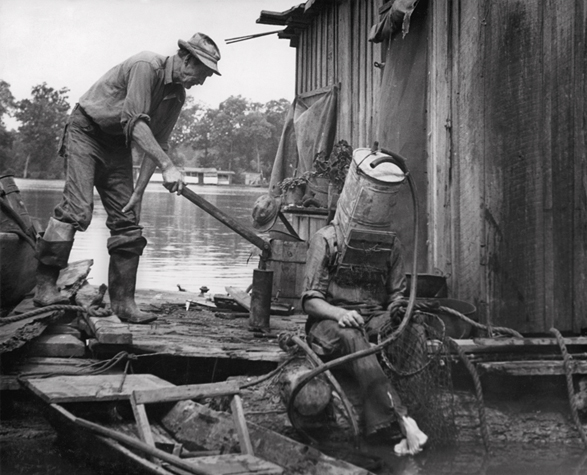

Caption:PEARL STRIVERS
A car's old gas tank and some garden hose compose a homemade helmet for this Mississippi River pearl diver. Notes with the photo claim the apparatus enabled the man to "go down 70 feet, and remain down one and a half hours." He would have needed that much time to find anything. When this photo was taken in 1938, the Mississippi's population of pearly mussels had already been largely depleted for use by button factories. For them, the mussels' shells proved more valuable than the gem sometimes inside. One bivalve could yield 24 buttons punched from its halves—and some six billion buttons were produced in the U.S. in 1916 alone. Though most pearl-button factories did not survive the 1940s rage for plastic buttons (not to mention zippers), the end of the harvests did not bring the Mississippi's mussels numbers back. Dozens of its species are now classified as endangered or threatened. Some might say they're as rare as pearls. Margaret G. Zackowitz

   We are now far more likely to associate rivers with sewage than with sustenance. That was not the case in 1911 when this book was written: Highways and Byways of the Great Lakes, by Clifton Johnson. It was the book that led me to do a little research from which you will now benefit. The passage the follows relates to the Rock River around Dixon, Illinois. It is the river, by the way, that provided employment for Ronald Reagan as a lifeguard back when one could actually swim in them. Here is Johnson's description of clamming and 'pearlin'.

“But far more important commercially than the fish are the clams that inhabit the river. The clamming season, which lasts from April 1st to October 1st, had recently closed and every little while I observed a great heap of shells on the bank. I learned something of the industry at the hotel in the town where I stopped that night. "If a man wants to go clamming," said the landlord, "he fixes up a lot of four-pronged wire hooks, fastens 'em with short strings to sticks about a dozen feet long — perhaps as many as two hundred hooks to each stick. He goes out in a little flat-bottomed boat, drags down stream, and pulls up his stick and puts it on a rack at the side of the boat. Then he takes off the clams that have clinched onto the hooks and throws 'em into the boat. On the shore he has a tank under which he builds a fire and heats water to put the clams into and make 'em open. As he takes the clams out he feels for pearls, throws the shells in a heap, and saves the clams to give to farmers to feed their hogs. I tell the farmers who use that sort of feed to fat their hogs that I don't want to buy no pork off 'em, but probably it's all right. They feed the hogs corn before they market 'em. 

"The clam-opening job is rather odorous, and pearlin' don't attract very high grade labor. The pearl gatherers are mostly kind of shiftless — too lazy to do anything else, and they only work when they feel like it; but pearl hunting is profitable. A man can get shells enough in a day to net him four dollars, and there's the chance to make a big thing in pearls besides. One fellow in this town got a pearl that sold for eighteen hundred dollars. I've seen 'em clear as glass, and so round that when you put 'em down you could hardly keep 'em from rollin'. One was found, in another part of the state, this year, that was pink in tint and weighed fifty grains and sold for five thousand dollars. I wouldn't give five dollars for all there are in this river for my own use." When I was a boy I used to go pearlin' in a New England river near my home, and I had a whole teacup full of pearls at one time. I took 'em to a jeweler's store, and he said they wasn't any good. I couldn't get a nickel for 'em." 

(pp.288-289).

   Among the many sources (some of which will be provided below) here are some Canadian examples:
“The lumbermen, while sailing down the Canadian rivers on their rafts, collect Unios [a genus of freshwater mussels] for food, by fastening bushes to the rear of the raft, so that when they pass through the mussel shoals, where the rivers are shallow, the bushes touch, the Unios close on the leaves and thin branches, holding to them securely and at intervals the bushes are taken out and the Unios removed. Many brooks and rivers, among them the Olentangy, at Delaware, Ohio, and a number of streams near Columbus, have been completely raked and scraped, often in a reckless manner, and consequently with little result. The general method of collecting shells was for a number of boys and men to wade into the mill-race or into the river to their necks, feeling for the sharp ends of the Unio, which always project. When one was discovered in this manner, the finder would either dive after it or lift it with his feet. It was the custom at that time to open the shells in the water, and once during the process a pearl the size of a pigeon's egg is said to have been dropped into the water and never recovered.”p. 230.

   This happened along the Humber around Toronto as my annotation to this article will show:
"Attention to Toothsome Clam may Become National Sport." The Globe, Sep 20, 1923, 
This one is Canadian and relates to the Old Mill on the Humber. A caterer from Rochester introduced Canadians to the ‘clam-bake’. “It was claimed that this affair was the first “official” clam-bake ever held in Canada, and those concerned, without exception, did the repast justice worthy of the occasion.” It was obviously quite the affair, held in the late afternoon with dancing and a live orchestra.  Clams were served along with with salmon, chicken, lobster and corn on the cob. There is no mention of whether the clams came from the Humber or were brought from NY.  “It was unanimously agreed when the remains were cleared away that, if the custom has only been introduced into Canada, it deserves immediate adoption, eternal preservation, and inclusion in the category of national sports.”

Sources:

   I should be Christmas shopping so I will stop here and provide you with the sources. Towns along major rivers often offer resources- see especially Muscatine ("The Pearl of the Mississippi"), Dubuque and Prairie du Chien. Although I don't usually provide links, I will do so here since they seem to have existed for a while and I will also provide additional information to help you find them. Some article references are also included. 
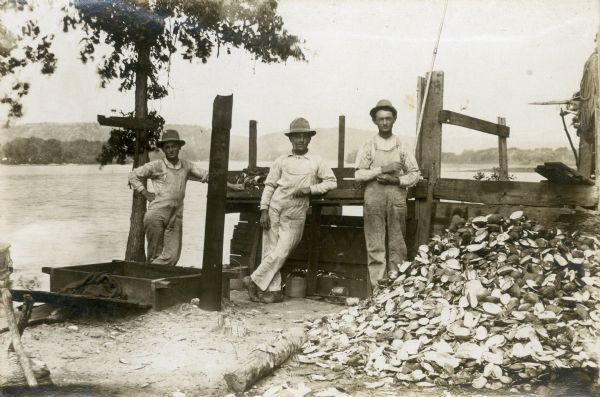
 

Harvesting the River (Illinois)
Under harvesting, follow the link to the "History of the Pearl Button Business in Meredosia, IL.
Great River - (The Mississippi River)
See especially, "The Clam Lady of America's Rivers: Marian Havlik," which should be here:
http://www.greatriver.com/clam.htm
"Back in the late 1960s Mrs Havlik was attempting to help her daughter with a science project and soon discovered how little (or difficult to find) was information about fresh water mussels. She goes on to become an authority on the subject and works to conserve what remains. The “Clam Lady” can be classified as a Malacalogist. She founded Malacological Consultants, in 1977 and a company with that name is found in La Crosse, WI"- I did not check to see if she is still associated with the company.
This should work for information about Muscatine:http://www.greatriver.com/pearls.htm
"Pearl Clamming and Pearl Button Clamming on the upper Mississippi River", Kari Pearls
For Dubuque: Encyclopedia of Dubuque.
Wisconsin: A Brief History of the Clamming and Pearling Industry in Prairie Du Chien, Eric F. Temte
And even in South Dakota - a very good article: "Clams Once Thrived in the Clean, Steady Waters of the James River," John Andrews, South Dakota Magazine, May/June, 2009.

Selected Newspaper Articles About Clamming - c1900-1980.
(from oldest to latest with some annotations)

"Big Pearl in a Clam Shell," Chicago Daily Tribune. Sep 18, 1900,
This is an example of how lucrative clamming could be . This report is from Winona, Minn and it is reported that a large pearl of “exceptional lustre” was estimated to be worth between $1500 and $2000. The pearl was supposedly the largest seen “in this part of the river”

"American Pearl Fishing." Los Angeles Times, Oct 15, 1900,
A basic description of the pearl fishery on the Mississippi.

"Our Finest Pearl." Los Angeles Times, Jun 28, 1901,
Good piece about a $50,000 pearl. The subtitle is: “Jewel Discovered in a Mississippi River Clam by a Poor Clam Digger Valued at $50,000”. The clam was caught in May 21 in Prairie du Chien and sold to a dealer for $17,500. It was re-sold and is now being offered for the amount above. A description is offered in the final paragraph: “Connoisseurs who have examined the pearl since it was brought to Chicago pronounce it the  most wonderful ever found in America. They also say it is equaled by few in the world. Its weight is 103 grains,while the average pearl weighs from 2 to 5 grains. It is almost a perfect pear shape, measuring over three-quarters of an inch in length and five-eighths of an inch. It is of a pink hue and exceedingly lustrous.”
[Like the other LAT stories this is a reprint - in this case from The Chicago Tribune.]

"Gems in River Clams." The Washington Post, Sep 25, 1904,
This is a very long piece with three pictures  - from the Mississippi in Iowa - 1) Clamtown, Prairie du Chien 2) Clamming Village at York’s Landing and 3) Clamming Scene near McGregor. The article concludes with a discussion of pearl-diving in the Far East and the development of ‘artificial’ pearls by the Chinese. The opening provides a good description of the process and how pearls develop.
"Woman and Boy Drowned Hunting for Pearls in River." Chicago Daily Tribune, Aug 11, 1910,
This event occurred on the Fox River near Wedron, Ill. A woman and her 6 year old grandson stepped in an 18 foot hole.
“Wading around in the river, the woman and boy were picking up clams and putting them into a bag which Mrs. Carter carried. Twice they had filled the bag and the same number of times had gone to the bank and opened them in search of pearls. Each time they were unsuccessful and the last time they walked down stream stepping into an eighteen foot hole”

"How Clams are Planted." Los Angeles Times, Jul 18, 1913,
This is a lengthy piece which provides background for the article immediately above. Because the beds were being over-clammed the federal government undertook artificial propagation by injecting baby clams into fish. This article describes the process thoroughly and is pretty good.

"Farming Clams in Kansas." Los Angeles Times, Nov 6, 1913.
This is taken from  The New York Telegram and the subtitle is “Tons of the Bivalves Gathered in the Rivers for the Pearl in Their Shells to be used as Buttons” Pearl hunting and clam gathering has become a “regular business”. “On a single farm, that of C.M Gregory, which is traversed by the Cottonwood River, no less than 100 tons of clams, it is estimated, have been taken from the riverbed during the last few weeks.” They are shipped in freight cars and each carload will bring $300 to $500 depending upon the quality.
“This is the first time in years that the Cottonwood River had been low enough to enable shell hunters to successfully explore its largest clam beds, which at some points are said to lie so thickly as to cover the river- bed.”

"Pearls in River Clams." The Atlanta Constitution, Nov 9, 1913,
This is reprinted from Leslie’s and discusses briefly the thriving clam industry around Peoria, Ill.

"Fortunes in Clam Shells." Boston Daily Globe, Jul 26, 1914.
The rest of the title is “Mississippi Yields Them by Thousands of Tons for the Maker of Buttons and Ornaments”.
“An industry which now assumes large proportions, and around which clings a peculiar flavor of romance, has developed on the Mississippi River, where hundreds of men are employed in gathering mussel shells in commercial quantities.” That is the opening paragraph and the concluding one: “The supply for a constantly increasing market is almost inexhaustible, the work is easy.

"Rise in Clam Shells." The Washington Post, Nov 12, 1916.
"Mississippi River Clam Diggers." Los Angeles Times , Aug 13, 1922,
This is a short piece indicating that clam digging was resuming after a 5 year moratorium. It mentions that there were factories in La Grange and Canton and that excessive clamming had depleted the beds. Apparently it takes 5 years for clams to mature.

"Scarcity of River Pearls, Clam Beds Worked Out." Boston Daily Globe, May 26, 1925,
This article is about the depletion of clams along the Upper Mississippi and in the Sugar and Rock Rivers and the inland streams of Wisconsin.

"Chasing the Elusive Clam New Way to Pay Way through College." Boston Daily Globe, Aug 15, 1926.
This is an account of three young women in Mass who are clamming on the North River. It does not say exactly what the clams are for but, “The clams meet a ready market and the three girls often total seven bushells in a day’s work.”

"Makes River Clams Grow Fine Pearls." Daily Boston Globe, May 20, 1928.
"Clam Digger Swims to Evade Policemen." Daily Boston Globe, Apr 23, 1930,
Apparently digging was not allowed because of pollution in the Saugus River in
Massachusetts.

Berlin .H.W. "Specimens of Hiawassee River Warty Clams Desired." The Atlanta Constitution, Sep 14, 1930.
Mass."Parker River Clam Diggers to Receive $4 a Barrel." Daily Boston Globe, Aug 2, 1940.
"U. S. Gives Up some Sanctuary Areas, Holds Clam Flats." Daily Boston Globe, Sep 17, 1946, 1946.
Special to The Christian Science Monitor. "Pennsylvania Spurs River Conservation." The Christian Science Monitor, Nov 10, 1948,
This is about the Schuylkill  [sic] which was heavily polluted by coal mining.

“Fall River Recalls Clambake 'Boom'." The Christian Science Monitor , Aug 18, 1956,
“...not only is there  profit in gathering the shells, but occasionally pearls ranging in value from $5 to $20 are found in the mussels. In the last three seasons more than 10,000 tons of shelves have been taken”
"Man, Dig those 16 $100 Clams in that Crazy Niantic River." The Hartford Courant, Jul 29, 1956.
"Ruling Held Up on River Clamming." The Washington Post, Times Herald , Sep 19, 1964.
"Clamming Permits on Sale for River." The Hartford Courant, May 1, 1969.
“Niantic River Clamming Rules Set by Shell Fish Commission." The Hartford Courant, May 2, 1970.
"Harmful Chinese Clam Discovered in River." The Hartford Courant, Apr 4, 1973,
This is another reason why clams declined - in this case the invasive Chinese clam.

"Tiny Clam A Threat to River." New York Times, Mar 1, 1973,
David Bird, Special to The New York Times. "Return of Clams and Even Oysters is also Envisioned." New York Times, Apr 28, 1973,
This is about the Hudson and more about shad which have also largely disappeared.

"River Closed to Clammers." The Hartford Courant , Jul 18, 1976.
"Clamming Closed in Niantic River." The Hartford Courant , Apr 22, 1979.

Post Script:
Apparently one fellow is still in the business:
"How to Dive for Pearls," By Malia Wollan July 23, 2019. NYT
“Run your hands back and forth through the sediment at the bottom of the river,” says Chuck Work, who has spent much of the last 25 years underwater, crawling the muddy bed of the Tennessee River, feeling for mussels with his hands.
When he started diving in the mid-1990s, the booming cultured-pearl industry in Japan meant thousands of boats jockeyed for territory on the river (about 80 percent of the mussel shells exported from the United States come from Tennessee). Back then, you needed a companion onboard to ward off shell thieves. Today only about 20 divers remain. A few years back, he found a pearl almost the size of a quarter, but he had a hard time selling it and now wears it around his neck. “I sure wish people would start wearing more pearls again,” he says."

The clams are now gone, the pearls are cultured, the buttons plastic and the rivers polluted.